Concept Sketches · 9 scenes
V-berth and boat cushions, from the bow to the cockpit
A boat is a trapezoid factory with a locker under every seat. One real sailboat refit, and the lid, bench and weather lessons that go aboard with it.

 Save
The quick answer
V-berth cushions are usually two mirror-image trapezoids that meet on the centerline, so each half lifts for the locker below. Draw each half with its long edge, short bow edge, centerline length and depth, write the unit beside every number, and label every piece. Outdoor fabric is water-repellent, not waterproof, so dry the cushions and store them ashore for winter.
Nothing on a boat is square
Nothing on a boat is square. The hull curves, the berth narrows toward the bow, and nearly every seat is a lid with a locker under it.
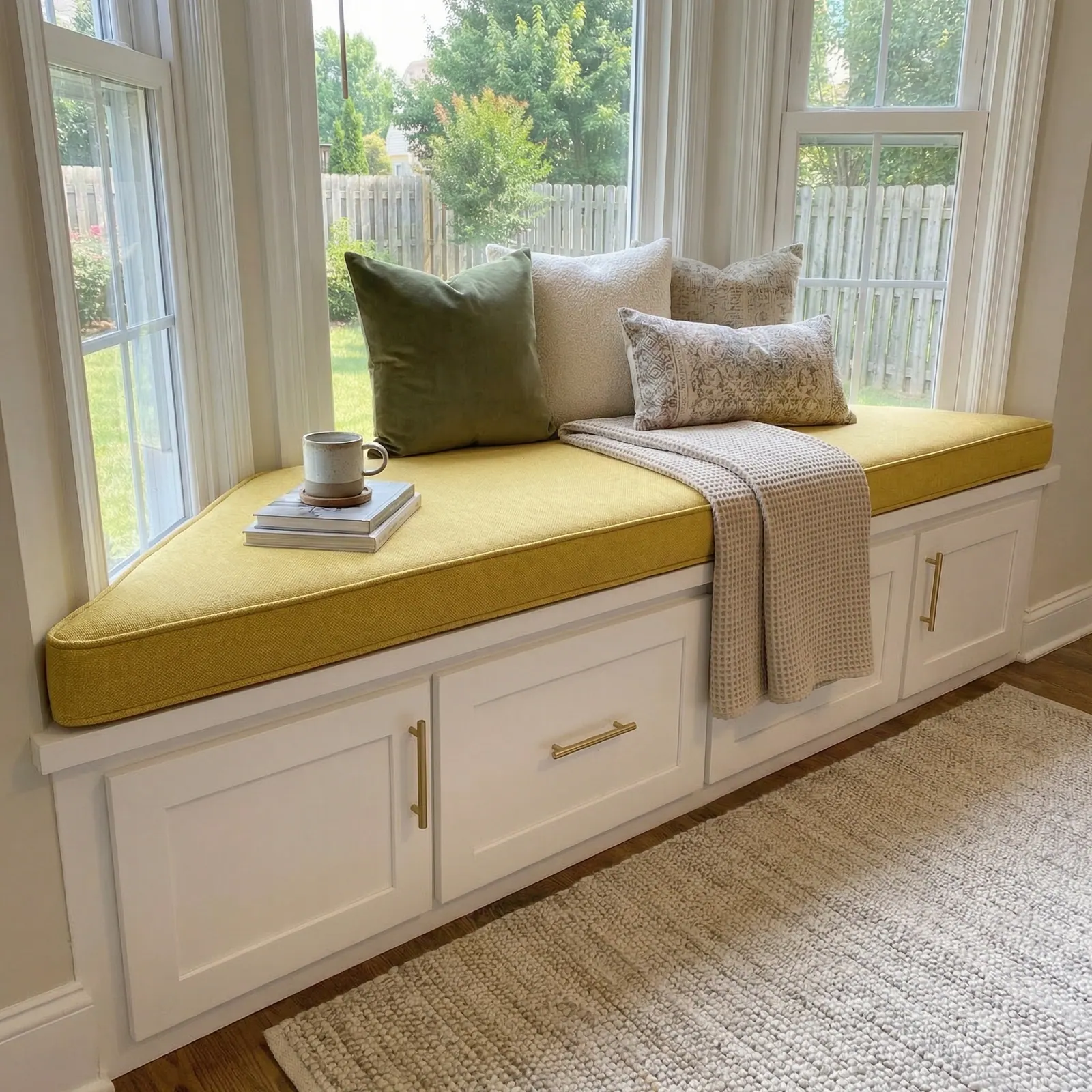
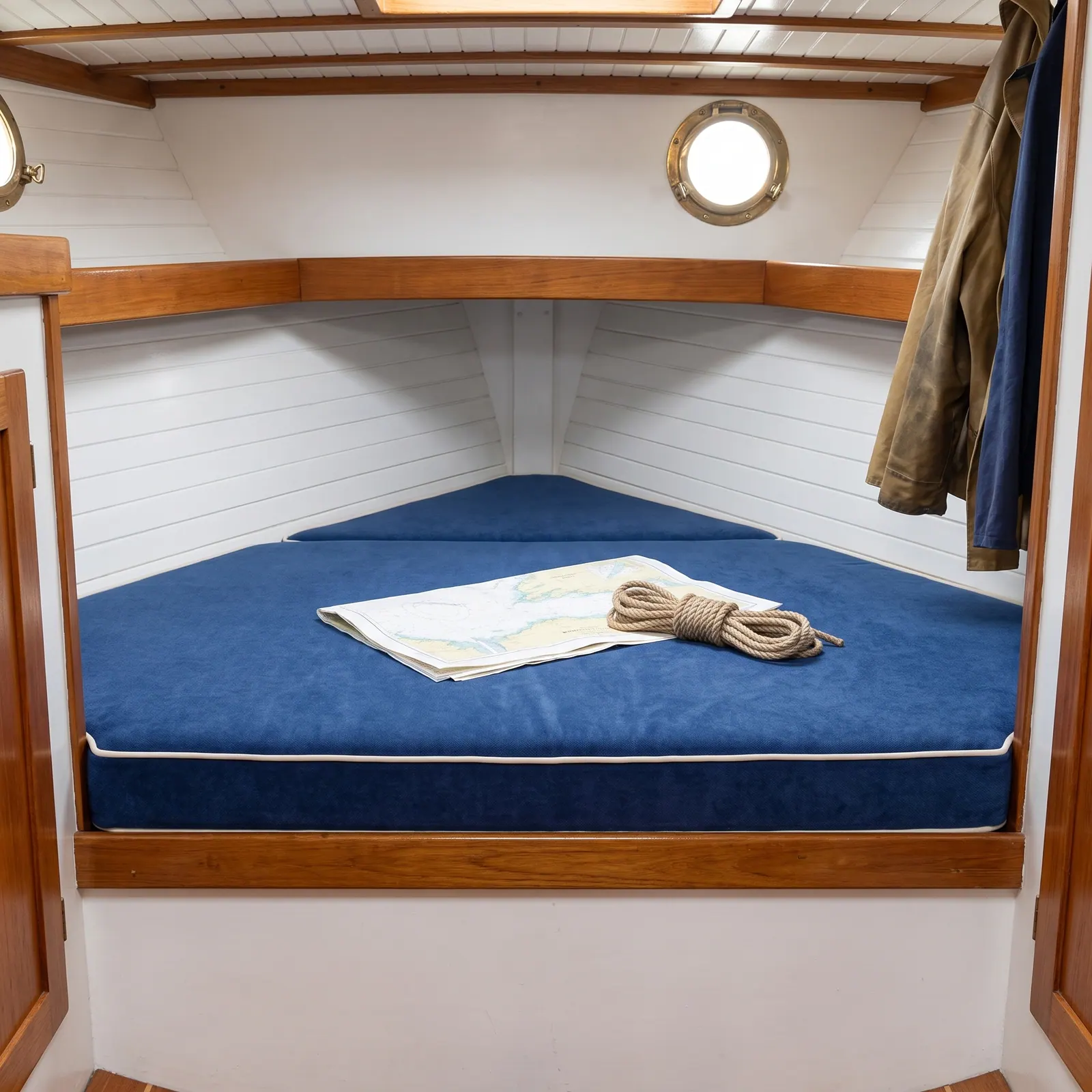
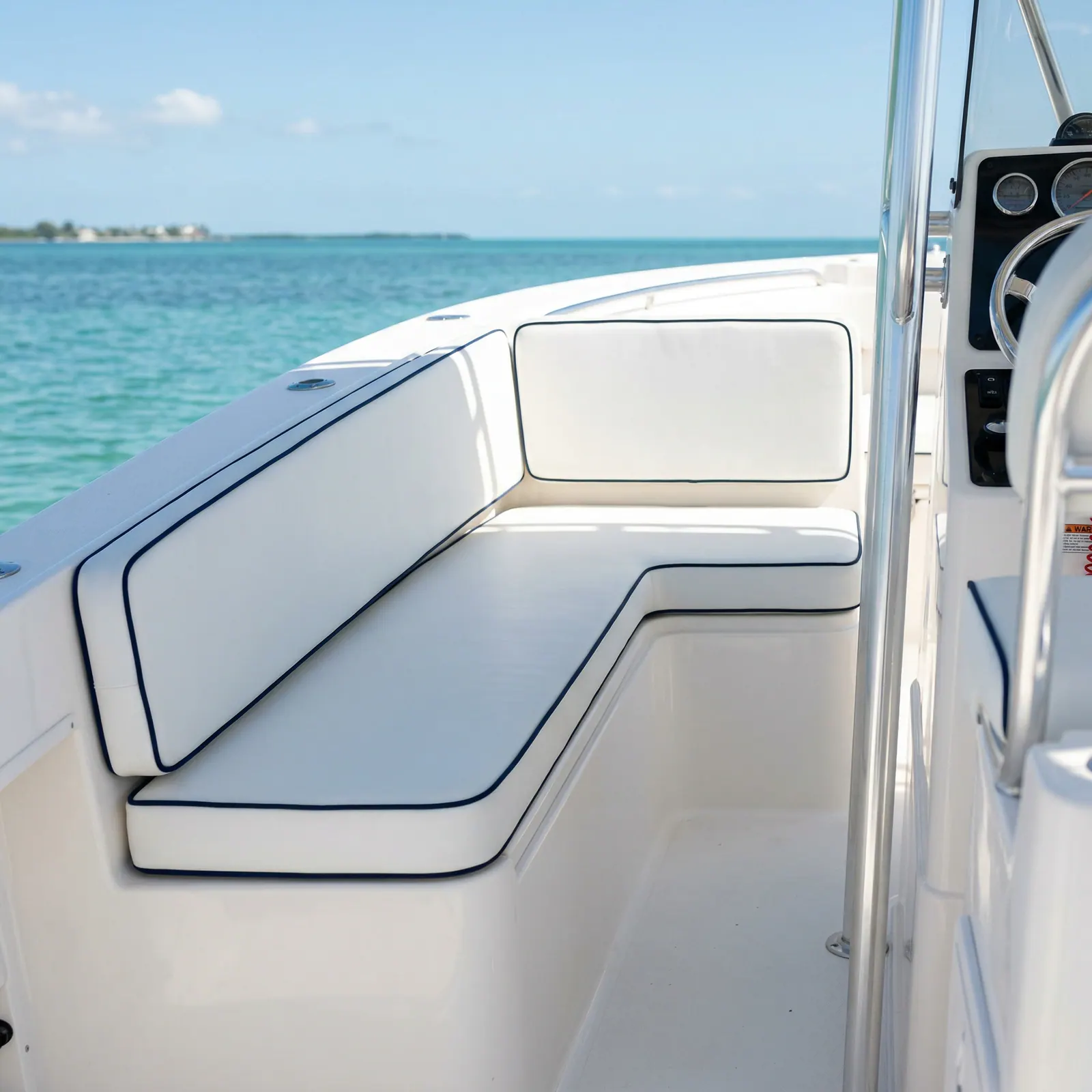
So a boat is a trapezoid factory. V-berth cushions are two trapezoids meeting on the centerline, usually split down the middle so each half lifts for the locker below. Saloon backs change height as they follow the hull. Cockpit cushions take the weather full in the face.
One full sailboat refit is retold below with its real numbers. The rest borrow lid, bench and weather lessons from the boat and RV cushion and outdoor cushion files; each one applies aboard. The V-berth template Pattern walks the measuring.
So tell me, friend: how many cushions does your boat carry, and does each one have a name yet?
9 boat cushion lessons from the bow, the saloon and the dock
01A past project
A sailboat refit in dark green velvet
A boat owner wrote to the workshop needing dark green velvet covers for the saloon, the nav station, a corner seat and the cabin berths. Some pieces were shaped: four-sided bases, and backs about 5 in (13 cm) at the ends rising to 8.3 in (21 cm) in the middle. Sizes ran from about 23 1/4 x 13 3/4 x 4 3/4 in (59 x 35 x 12 cm) to 27 1/2 x 23 1/4 x 4 3/4 in (70 x 59 x 12 cm). The workshop asked for length, width and thickness on every piece, plus photos.
The takeaway: Name every cushion before you measure it. 'Saloon port back' is a label; 'the long one' is a guess.
02A past project
Loop velcro to meet the hook already aboard
On the same refit, the existing foam already carried hook velcro along the back. So the new covers needed matching loop velcro sewn on the bottom, plus zippers. The workshop asked for a sketch showing where each strip sits, so new loop lands on old hook.
The takeaway: Sketch each cushion from above and mark every velcro strip, measured from a named end.
03A past project
The V-berth, drawn as two halves
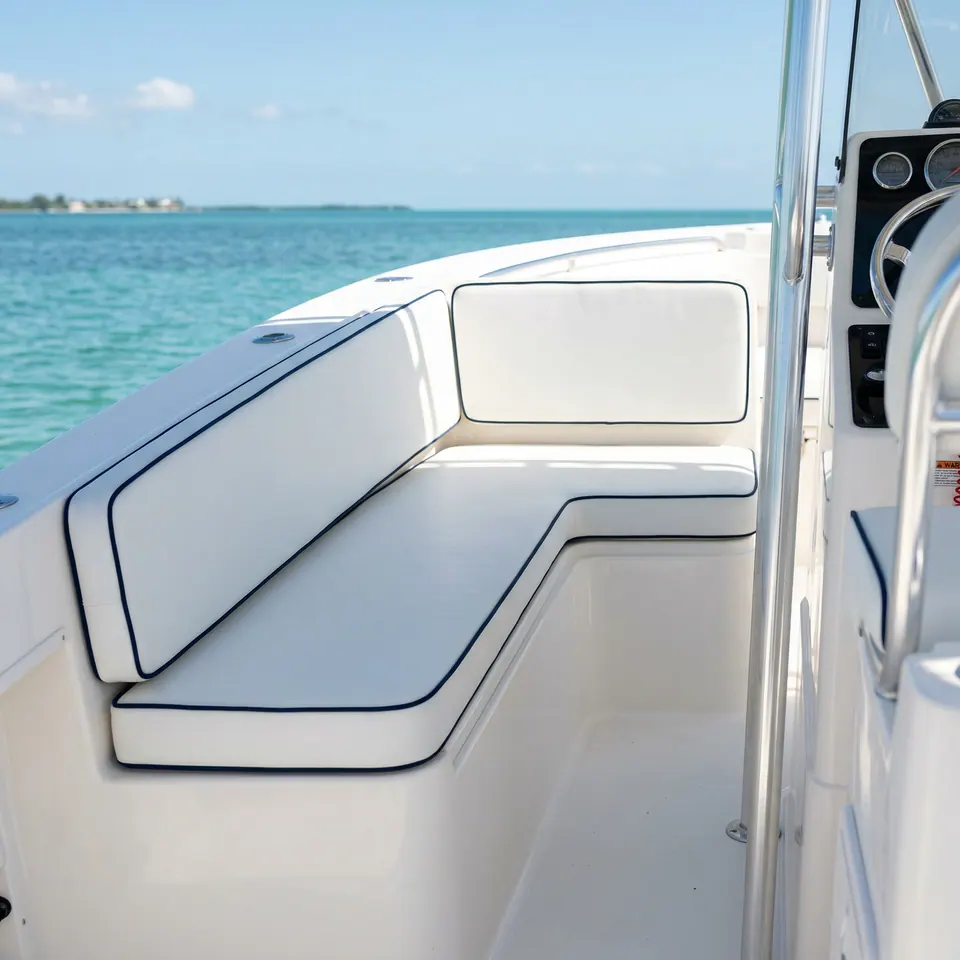
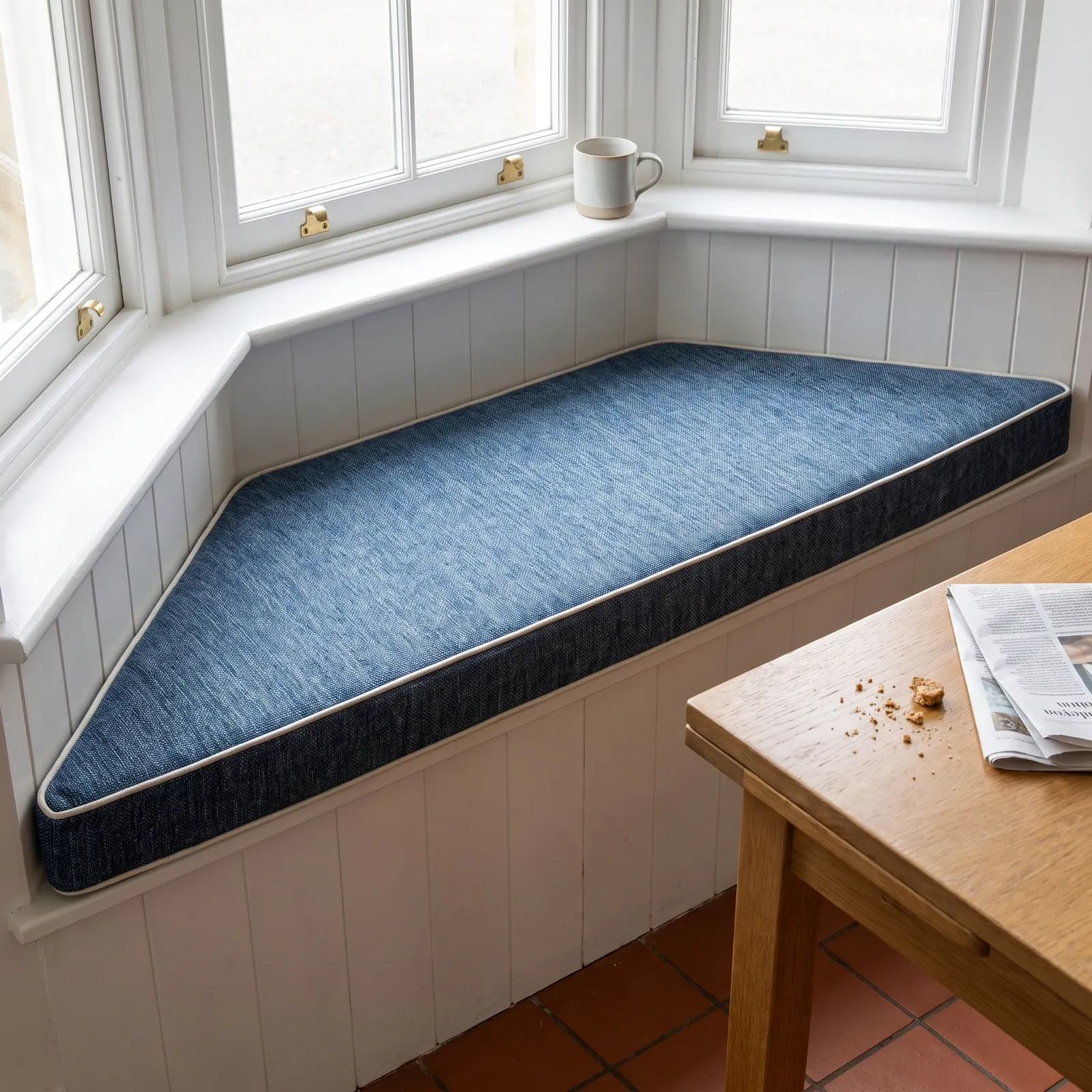
V-berth cushions are two mirror-image trapezoids meeting on the centerline. For each half the workshop asks for four numbers: the long edge, the short edge at the bow, the centerline length and the depth. Draw both halves, write the numbers on the drawing, and upload it with the order.
The takeaway: Draw port and starboard separately, even when they look like twins.
04A past project
Inches or centimeters, written on every line
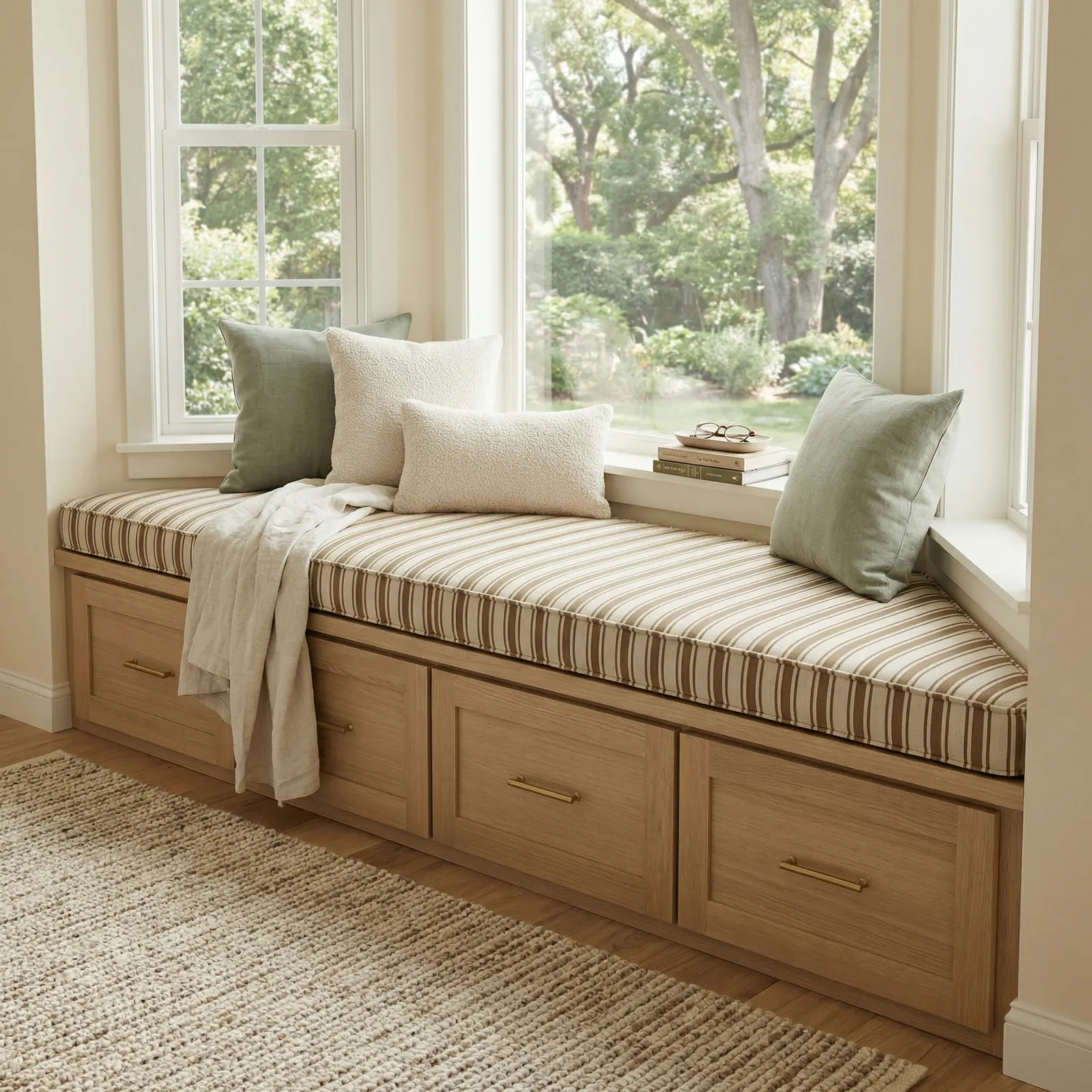
A buyer in the US sent drawings for three trapezoid window seats, measured in inches. The first quote came back far too low because the numbers had been read as centimeters. It was caught and put right, the cushions went to 3 in (7.5 cm) thick instead of 2.5 in, and the buyer later loved them.
The takeaway: Put the unit beside every number, not once in a corner.
05A past project
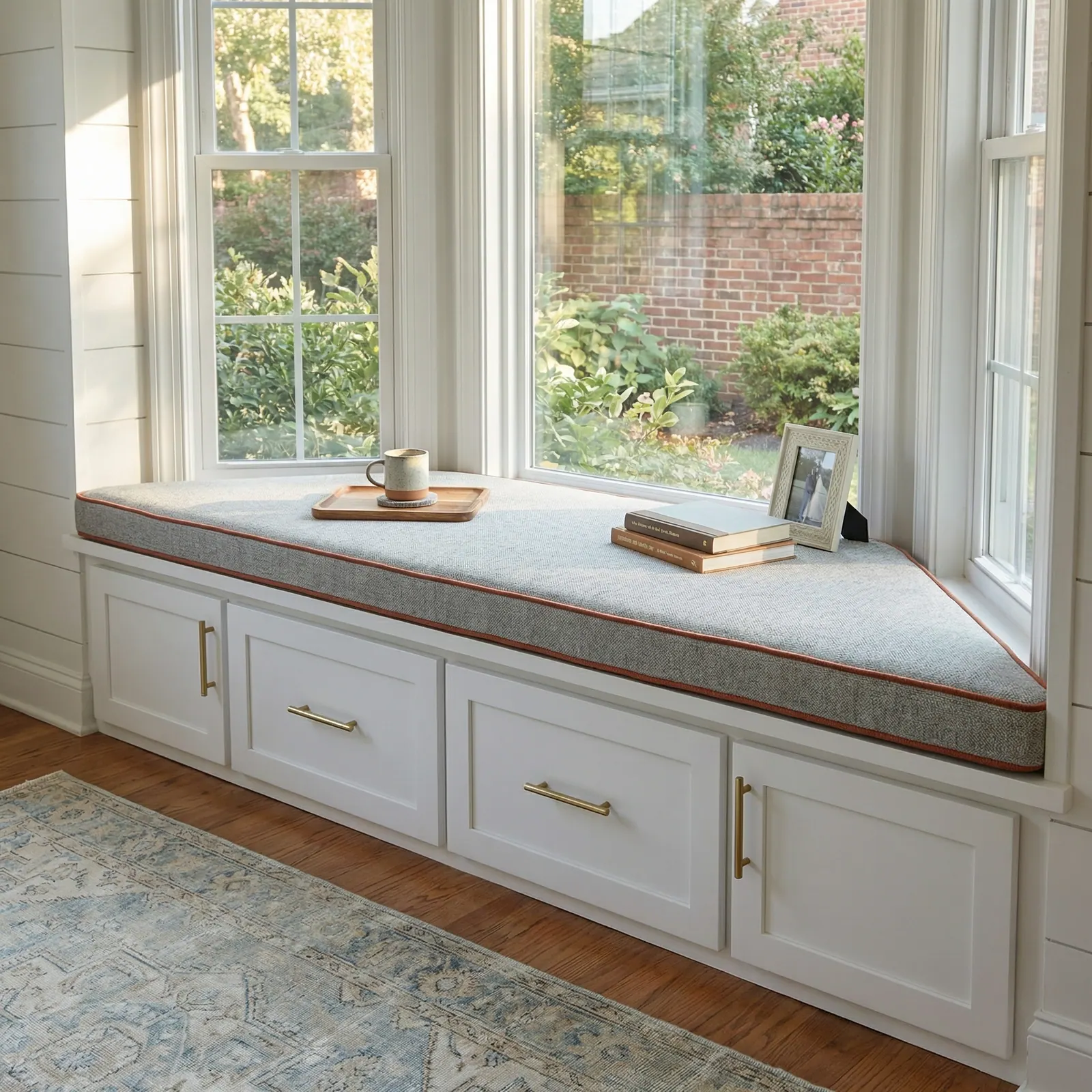
A lid under every seat
A buyer in the US sent drawings of outdoor storage benches whose lids lift, and asked for the cushions to be split at the lid lines. One run was slightly asymmetric, about 1.5 in (3.8 cm) off in depth, so the workshop asked for a separate full drawing of every piece. The seats were 3 in (7.5 cm) thick, two of them 45.5 in (116 cm) long.
The takeaway: Split where the lid splits; draw each piece alone.
06A past project
Wind, wedges and what holds them down
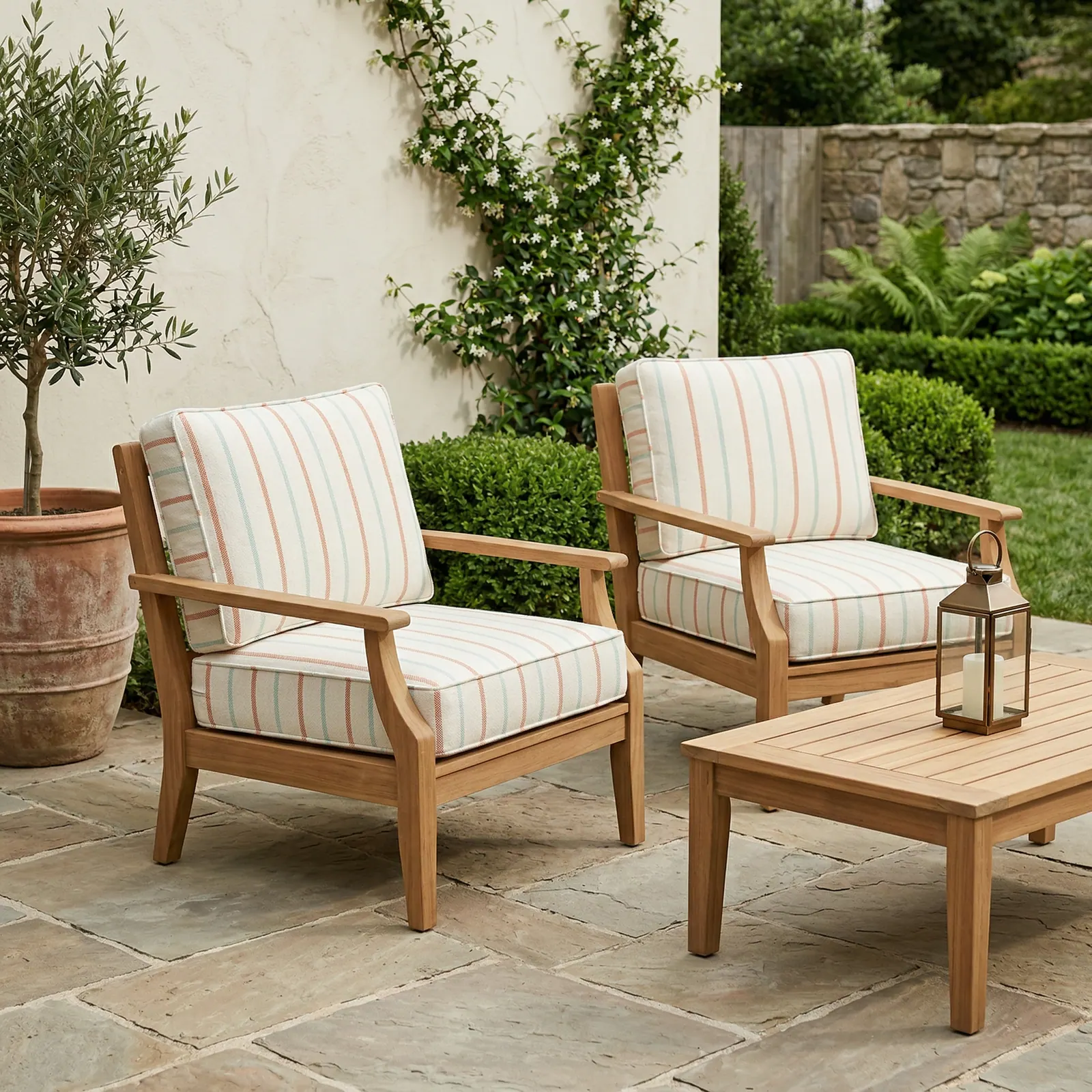
A buyer in the US with a windy patio wanted two 33 x 30 x 4 in (84 x 76 x 10 cm) seats and two 32 x 13 in (81 x 33 cm) backs, thicker at the bottom like a wedge, with ties or velcro straps. Ties or a non-slip bottom are the usual fix; two-sided velcro strips have been sewn on request, one side under the cushion and one for the bench.
The takeaway: Put the hold-down in writing and wait for confirmation.
07A past project
Airtight, or dry enough?
A buyer with good foam wrote to the workshop wanting eleven replacement covers in a fully waterproof fabric with sealed seams and mesh vents. The workshop said plainly that sealed seams and mesh vents aren't offered, and sent its water-repellent outdoor neutrals instead. The buyer settled happily on water-repellent outdoor canvas with normal zippers, because the cushions spend the winter indoors anyway.
The takeaway: Cushions that winter indoors don't need a sealed build.
08A past project
Zippers, thread and the edge that takes the knocks
A buyer asked what zippers and stitching go into outdoor work. The answer: concealed heavy-duty zippers, UV-resistant thread and double-stitched seams. A buyer in the US re-covering a 64.75 x 31 x 4 in (164 x 79 x 10 cm) outdoor seat was also told that self-piping reinforces the edges.
The takeaway: Ask for self-piping on the edges that take knees, elbows and wet towels.
09A past project
Winter lay-up for a five-seat bench
A buyer messaged the workshop about a thick cushion for a 118 x 19 3/4 in (300 x 50 cm) pool bench that seats five, torn between one long piece, two, or five. The workshop explained that one long piece can be folded or rolled for storage without creasing or damage, because the foam is flexible. It was quoted at 5 in (13 cm) thick.
The takeaway: Bring cushions in dry. Store them flat or loosely rolled, never damp in a sealed bag.
Water-repellent, waterproof, airtight: three words for boat fabric
Buyers write 'marine waterproof' and mean three different things. The honest version is short.
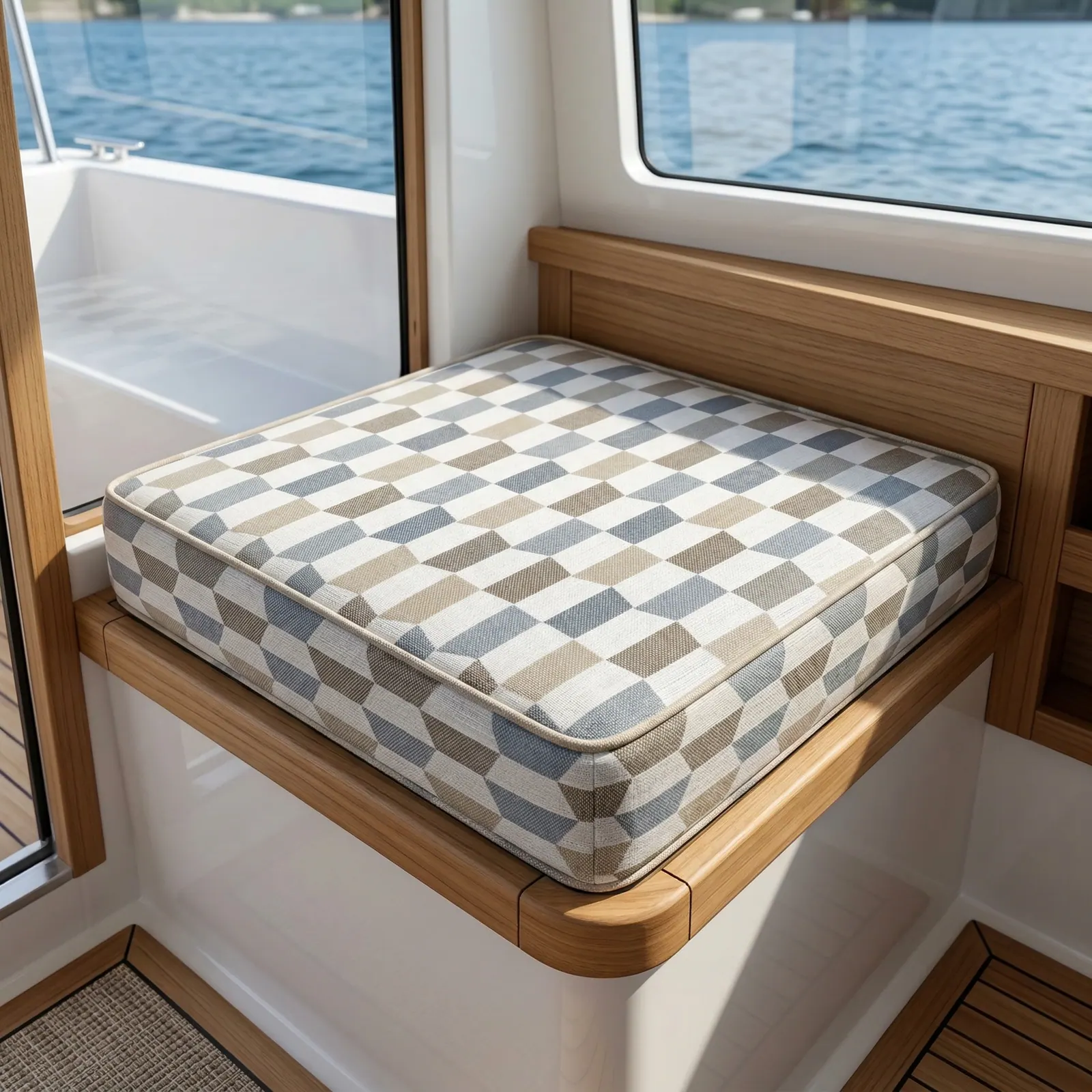
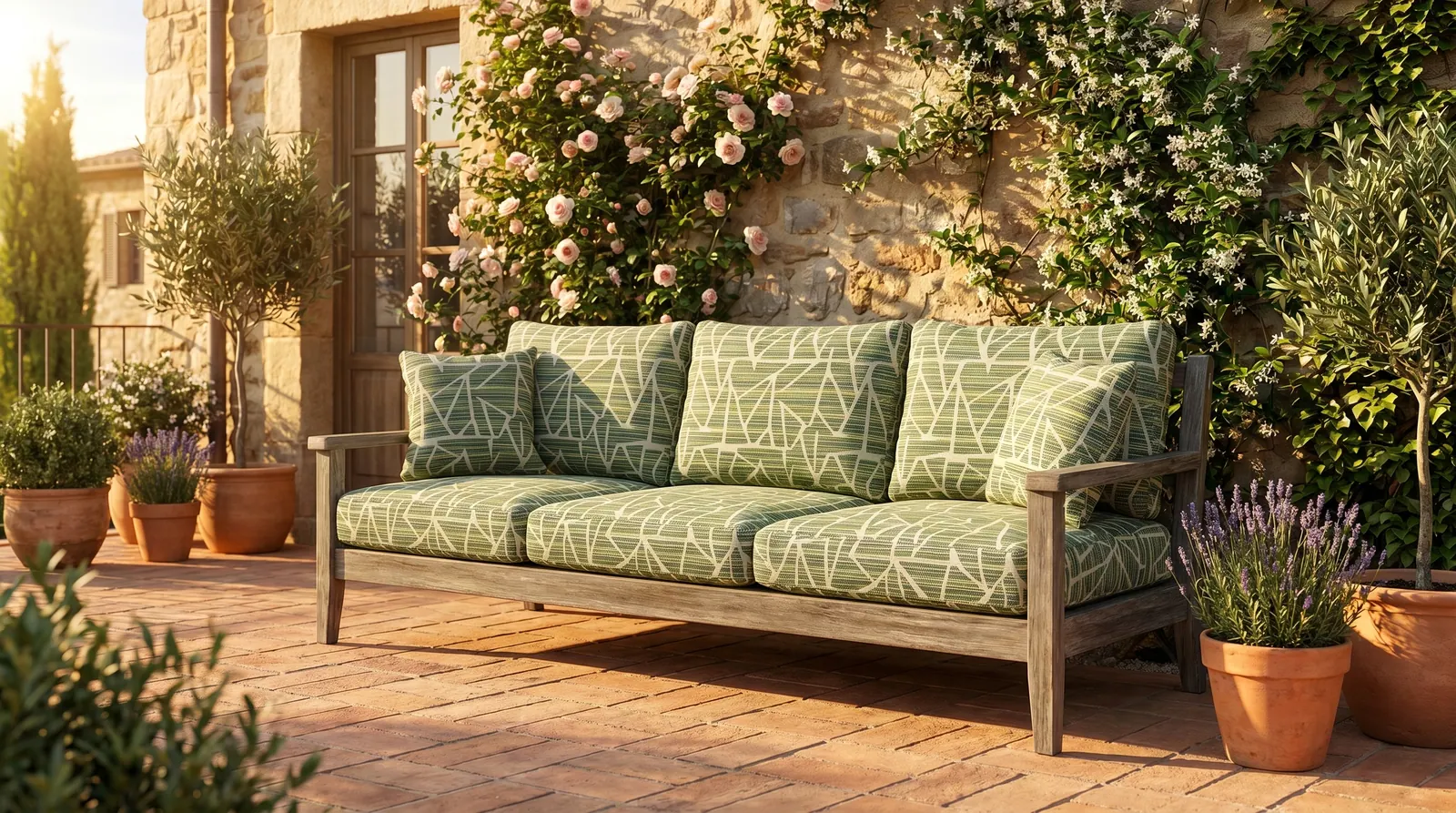
Water-repellent fabric sheds a rain shower and a spilled drink. That is the workshop's outdoor line: a UV-resistant, water-repellent polyester with its own color chart. Waterproof means water never gets through, and a sewn cushion with a zipper is not that. Airtight means sealed seams, which aren't offered. Water-repellent is a promise; waterproof is a contract.
Buyers ask for Sunbrella by name. The workshop doesn't stock it, and there is no quick-dry foam or mesh bottom on the list. So the foam still needs time to dry after a soaking. The water-repellent vs waterproof Pattern and the water-repellent fabric family go deeper.
One more, and it matters most. A decorative boat cushion is never a flotation device, whatever it is made of. Keep the approved throwable where a hand can find it.
Where each cushion lives aboard, and what it needs
Run the shapes through the trapezoid cushion calculator and the seat feel through the foam firmness finder. More tapered shapes live in the trapezoid cushion hub, and fabrics in the outdoor fabric families.
| Spot aboard | Shape | Fabric | What holds it |
|---|---|---|---|
| V-berth | Two mirror-image trapezoids, split on the centerline | Velvet below deck in the refit; outdoor fabric wherever spray or damp reaches | Its own weight; velcro strips on request |
| Saloon and nav station | Shaped backs, about 5 in at the ends and 8.3 in in the middle | Matched to the seats | Loop velcro sewn to meet existing hook strips |
| Seats over lockers | Split at every lid line | Same as the rest of the run | Ties on the hinge side only |
| Cockpit and deck | Seats plus wedge backs | Water-repellent, UV-resistant outdoor fabric | Ties or a non-slip base |
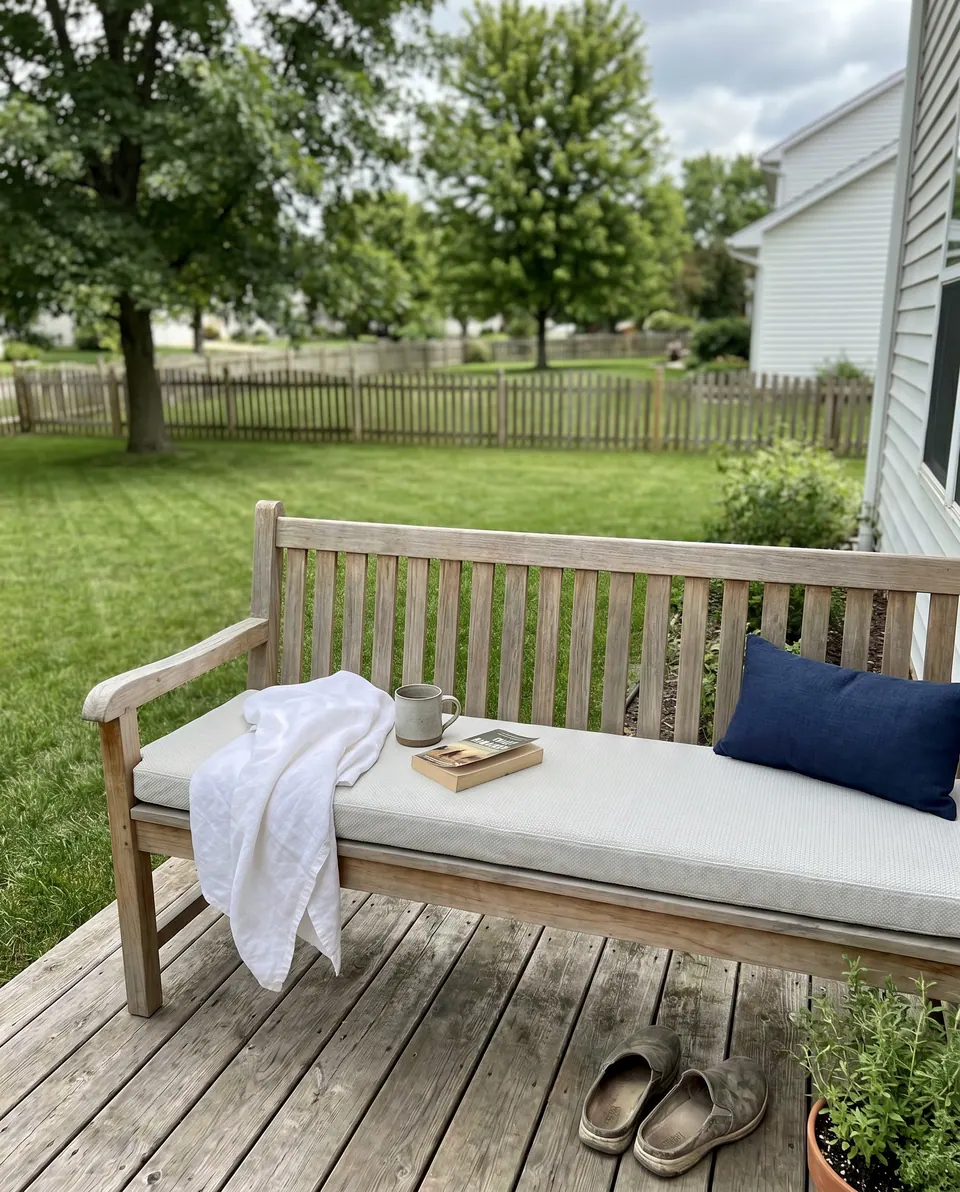
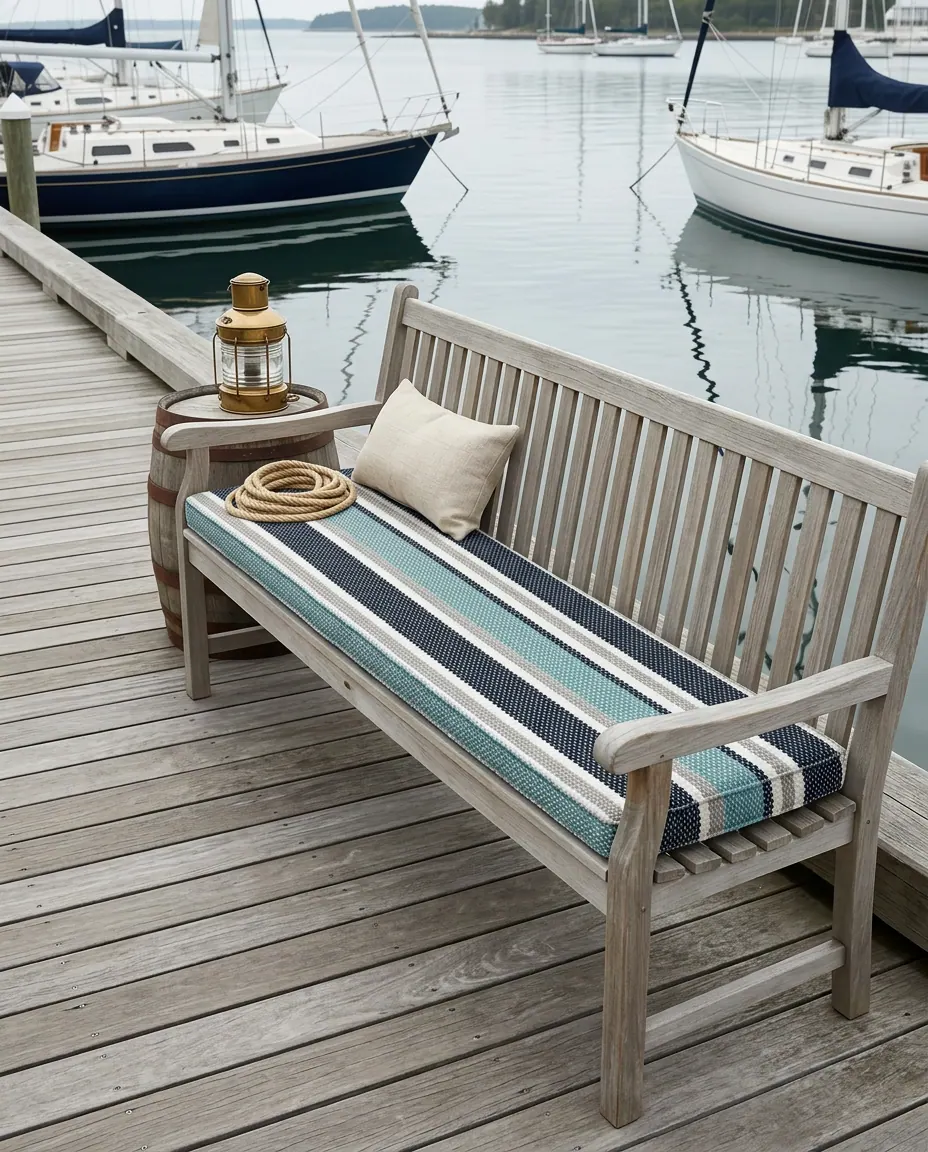
| Dock or pool bench | One long piece, or sections chosen by storage | Outdoor fabric, not tufted, since tufting lets water in | Non-slip base |
A V-berth cushion is two mirror-image trapezoids split on the centerline, and every piece aboard needs a label, three numbers and a unit.
Callum
Boat, lid and weather questions
- A common question
Can the cushions have velcro instead of ties to keep them in place?
The workshop's answerTies or a non-slip bottom are the workshop's usual ways to stop a cushion moving, and it tends to suggest one of those first. Velcro tabs and snap fasteners aren't made. Two-sided velcro strips have been added on request: one side sewn under the cushion, the matching side sent to you to fix to the bench. Strips cost extra, so some buyers fit their own. Write the request in the personalization box with your fabric and piping codes, and wait for confirmation.
- A common question
My bench seat lifts up for storage. How do I keep the cushion on the lid?
The workshop's answerAsk for ties on the hinge side only, so the cushion stays attached when the lid opens. Write your exact size and 'ties on the hinge side' in personalization, and give each hinge's position from a stated end, its width and a photo so the ties line up. If ties won't work with your hinges, the cushion can sit inside the lid's bevel, for example 42 x 18 in (107 x 46 cm), on a non-slip base. On an RV bench lid a non-slip bottom is often preferred, but without ties a lifted lid can still shed the cushion.
- A common question
Are the outdoor cushions actually waterproof, or only water-resistant?
The workshop's answerWater-resistant. They're made from a separate water-repellent outdoor range with its own color chart, sent on request, and it isn't a sealed, coated material. It handles rain showers and spills well, and outdoor seats and backs get outdoor-suitable inserts. For a bigger project you can order one cushion first to check the fit; one test cushion took about 5 days to make and 3 to 4 days to arrive. Store outdoor cushions indoors through long off-seasons.
- A common question
Can linen, velvet or chenille cushions go outside?
The workshop's answerNo. Fabrics on the indoor listings, including linen, velvet and chenille, are indoor-only and not made for open-air use; chenille especially isn't recommended for permanent outdoor exposure in humid climates. Outdoor-performance fabrics resist moisture, mildew and mold far better. Order through the outdoor listing, where more than 100 colors are outdoor-rated, water-repellent and UV-resistant, with any piping combination.

Have it made
Have an idea like this made — ask Callum’s workshop
Short list: size, sun hours, how fast it has to dry. The workshop goes through it with you. — Callum
Leave your details and the workshop will call you to confirm measurements, fabric, foam and piping. No prices, dates or payment on this page: it is a request, not an order.
Questions buyers ask next
Should V-berth cushions be one piece or split?
Usually split down the centerline into two mirror-image halves, so each lifts on its own for the locker below and is easier to handle. Draw both halves with the long edge, bow edge, centerline and depth, and label them port and starboard. A paper template helps where the hull edge curves.
Can a boat's existing foam be re-covered instead of replaced?
Yes, if the foam is still good; the sailboat refit above did exactly that. Measure the bare foam's length, width and thickness for each piece, note any velcro already on it, and send photos. Covers are cut to the numbers you send; see covers for existing foam.
Are tufted cushions a good idea on deck?
Not where they will get wet. Tufted shapes can be made in outdoor fabric, but the tufting lets water inside even then. For spray, rain or a pool deck, choose a non-tufted, foam-filled cushion in outdoor fabric; zippered outdoor versions are made without tufting.
What's the right way to store boat cushions over the winter?
Bring them ashore or below completely dry. Store them flat or loosely rolled in a dry place, never damp in a sealed bag. Long pieces in flexible foam can be rolled without creasing. The winter storage Pattern has the rest of the routine.