A Reading by NateL-Shaped Corner Bench Cushions
An oatmeal L-shaped bench cushion on masonry, and the props that make it work
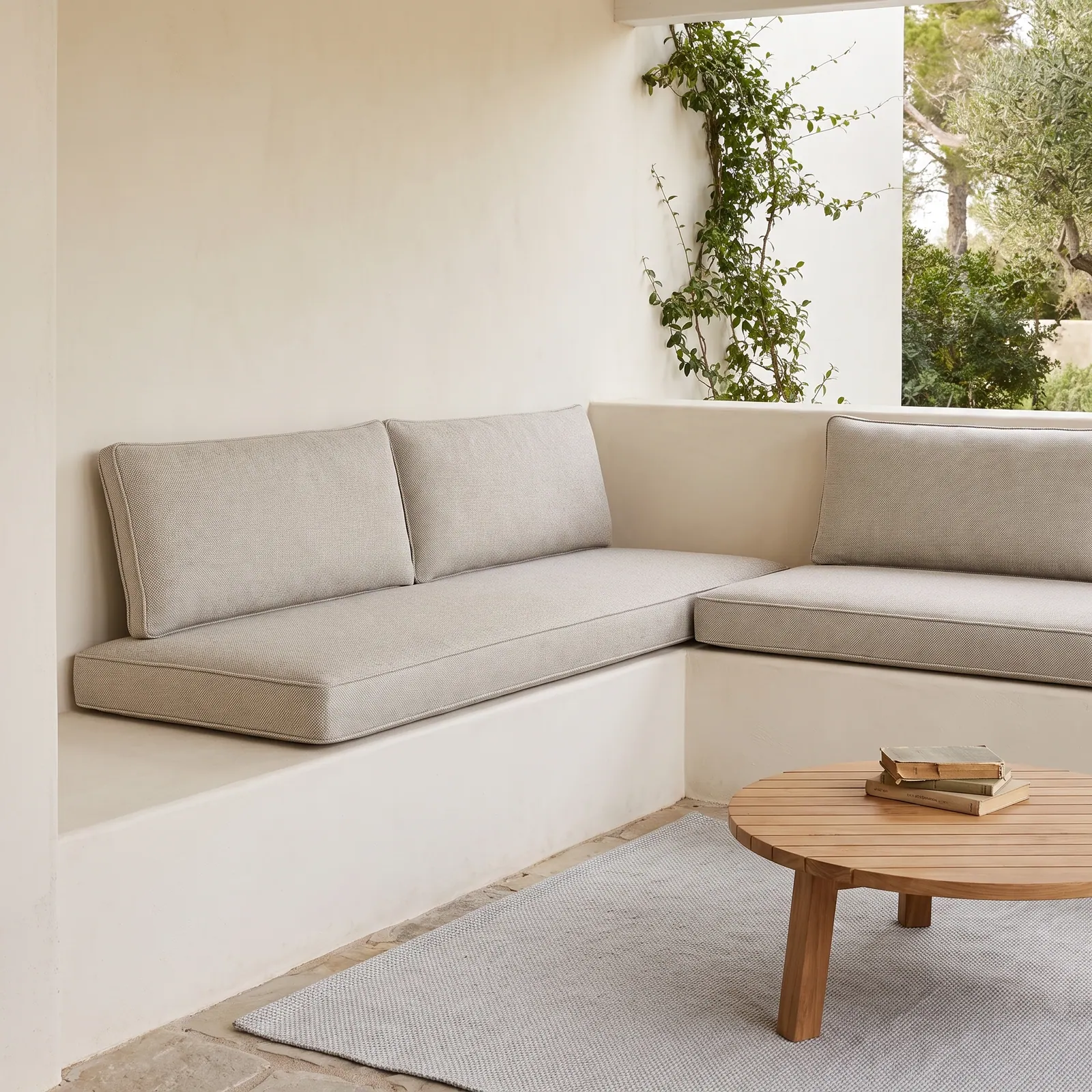
A whitewashed corner seat, oatmeal cushions the color of the render, and four props doing four jobs. Nate takes the terrace apart like an assembly drawing.

 Save
The quick answer
An L-shaped bench cushion for a built-in masonry seat is best made as two rectangles, with one piece running the full length through the corner and the other butting against it. Oatmeal fabric close to the wall color makes the seat look carved from the render, and the props (a round teak table, gray flatweave rug, books and climbing greenery) add warmth and color around it.
The cushion, cut open
Cover fabric. A removable, zippered cover. Machine wash at 86°F (30°C) on a gentle cycle and air dry.
Piping. A fabric-covered cord sewn into the seams. It sits on the seam line, so it does not change the size.
Fiber wrap. Polyester fiber (Dacron) batting around the foam: it fills the cover out and softens the edges.
Foam core. About 2.0 lb/ft³ (32 kg/m³) high-resilience foam, firm to medium-firm, cut to the ordered size.
Zipper. Along the back band, as hidden as possible. The zipper side faces down or toward the wall.
Base panel. The underside of the cover. A non-slip fabric backing can cover the whole of it instead.
Exploded view: cushion, render, props
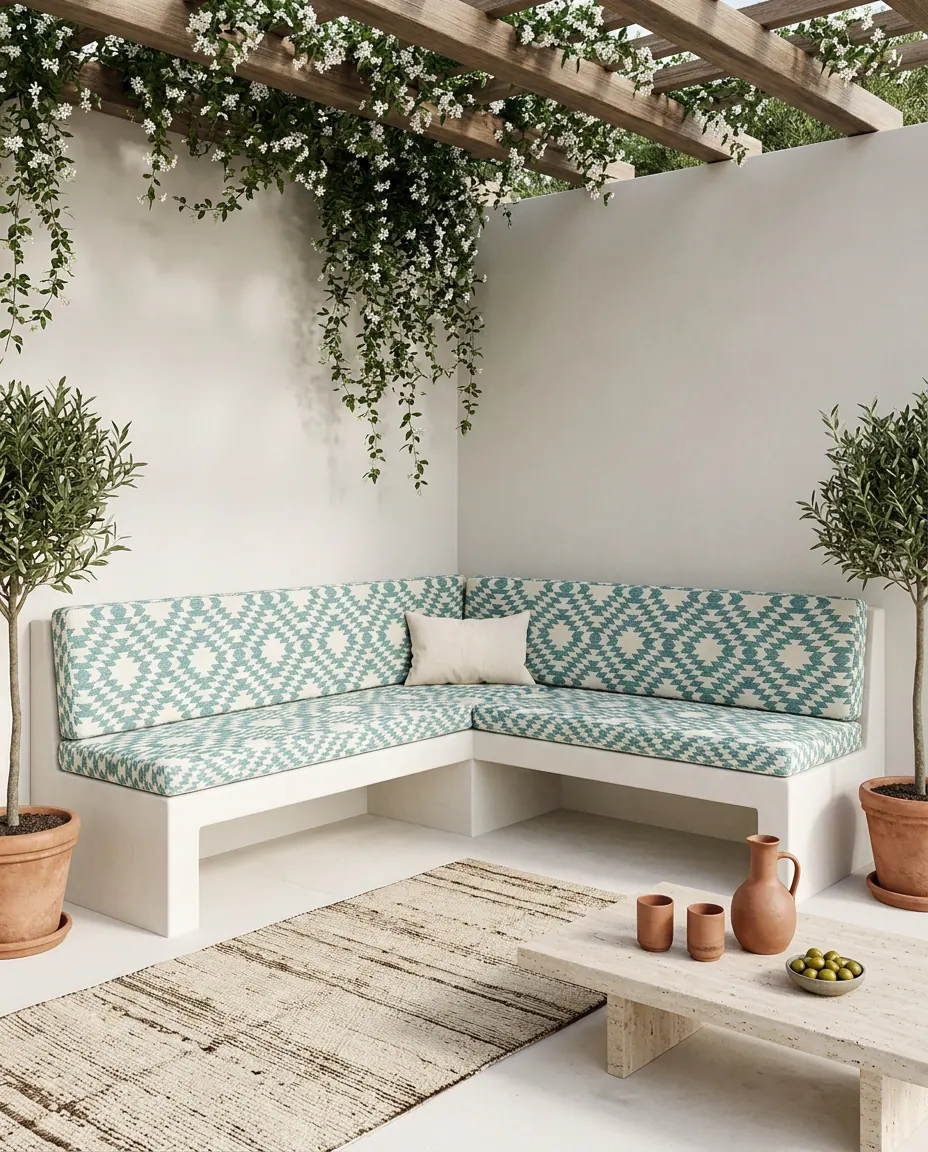
Four props, two cushion runs, one corner. That is the whole bill of materials on this terrace, and every line item has a job.
Start with the parts list, bottom up. A rendered masonry plinth. On it, oatmeal box seat cushions with self piping along the front edge. Behind them, loose back cushions leaning on the wall, which works because the wall itself is the frame. No rail, no hardware.
The fabric is a water-repellent outdoor cloth in oatmeal melange, within a shade of the render. That is why the seat looks carved out of the wall instead of set on it.
Masonry is never a catalog size. Built-ins rarely come out square, and outdoor render may slope so rain runs off. So the seat is cut to the plinth. Before you order an L-shaped bench cushion for a built-in, make a paper template of the corner and write the slope, if any, at each end.
Now the props, one at a time.
The round teak table. Round, because an L already has one hard 90° corner, and a square table would add four more at shin height. Teak, because a pale scheme needs one warm wood.
The small stack of old books. Scale. A low stack tells the eye the table is for sitting beside, not for dining at.
The gray flatweave rug. It marks the seating zone on open paving and lies flat, so a chair leg or a bare heel never catches an edge.
The climbing plant and the olive tree beyond. They supply all of the color, which is exactly why the cushions are allowed to stay the color of the wall.
The method transfers to any patio or porch: cushions within a shade of the wall or siding, one warm wood, one living green.
Copy the terrace in five moves
- Template the corner in paper and write the slope, if any, at each end.
- Split the L into two rectangles; the longer run owns the corner.
- Pick cushion fabric within one shade of the wall, then add color only through plants.
- Use a round table, so the L gains no new corners.
- Anchor the zone with a flatweave rug that lies flat on paving.
Pinned by Nate: seat, back, corner, table, vine
Five pins trace the build: seat on the plinth, back cushion on the wall, the corner joint, the teak table with its books and the climbing plant.
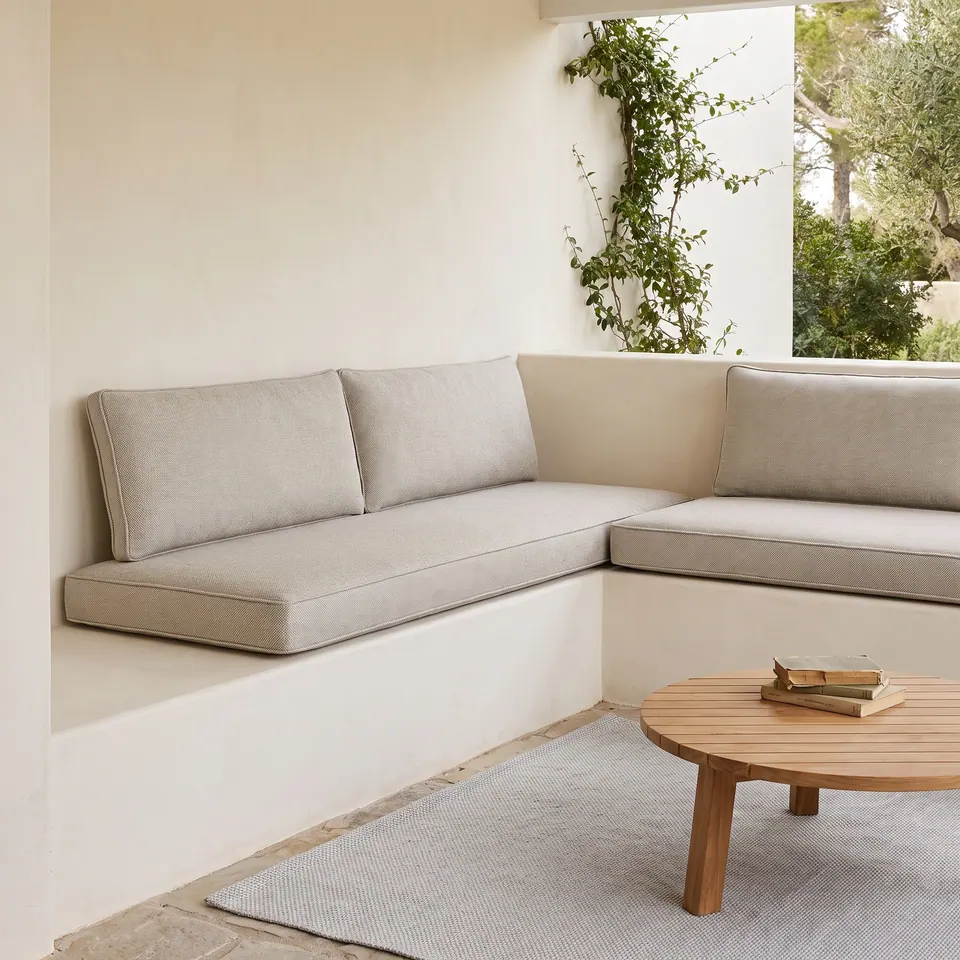
- Seat on masonry bench
Seat cushions are cut to the built-in plinth, with self piping along the front edge.
- Back cushion on wall
Loose back cushions lean on the rendered wall, so no frame is needed.
- L-shaped corner
The two runs meet at the corner and follow the L of the masonry exactly.
- Teak table with books
A round teak table and a few old books add warmth to the pale scheme.
- Climbing plant
The greenery supplies the color while the cushions stay close to the render.
- Seat on masonry benchSeat cushions are cut to the built-in plinth, with self piping along the front edge.
- Back cushion on wallLoose back cushions lean on the rendered wall, so no frame is needed.
- L-shaped cornerThe two runs meet at the corner and follow the L of the masonry exactly.
- Teak table with booksA round teak table and a few old books add warmth to the pale scheme.
- Climbing plantThe greenery supplies the color while the cushions stay close to the render.
One cushion or two? The drawing decides
A buyer wrote to the workshop with the question we hear on almost every corner seat: should an L-shaped bench get one cushion or two?
Before answering, the workshop asked for a paper drawing. Angles are just lengths in disguise, and a sketch with numbers on it settles what a photo cannot. The drawing came back, and the answer was two: 17 3/4 x 59 in (45 x 150 cm) and 17 3/4 x 35 1/2 in (45 x 90 cm), made exactly to the drawn sizes.
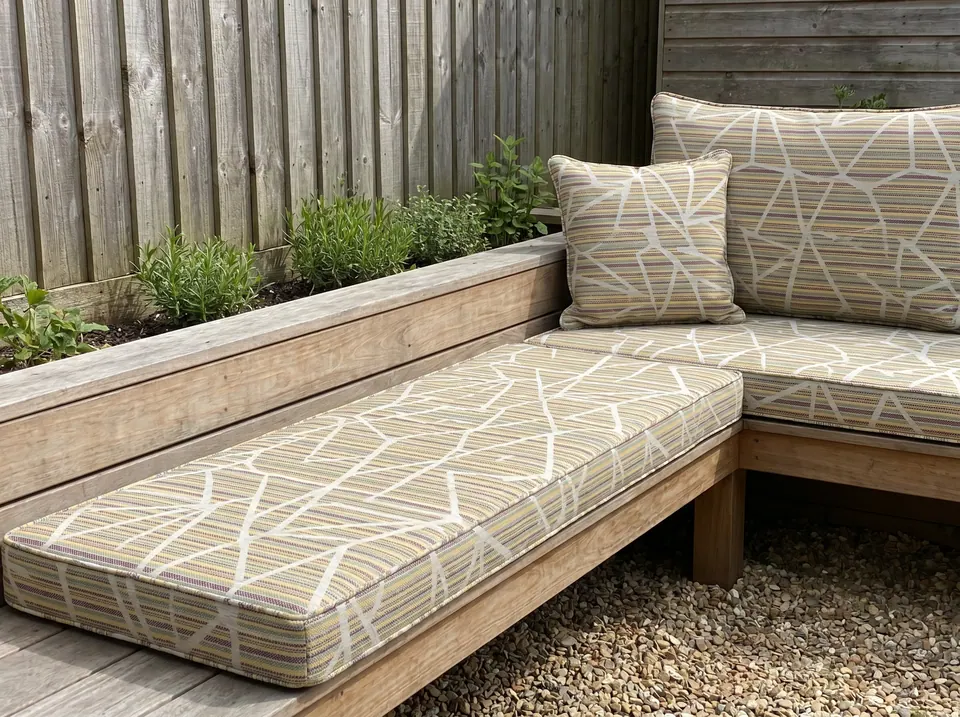
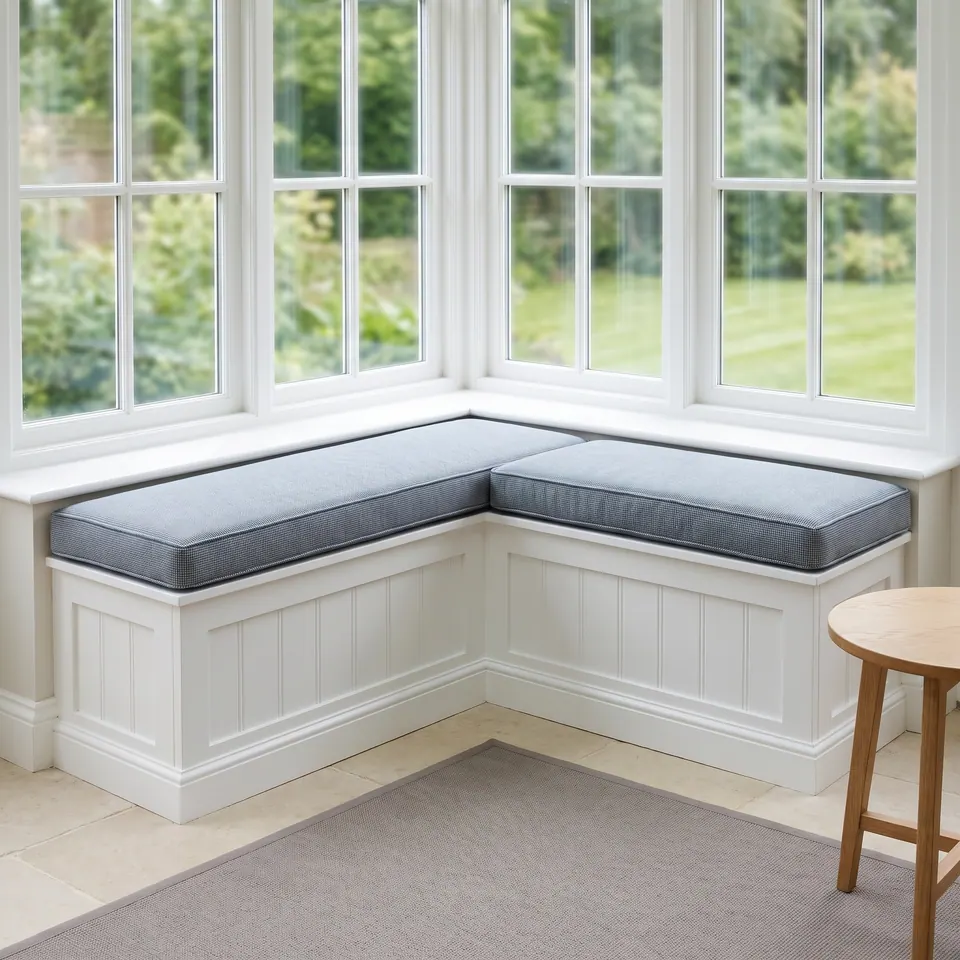
Here is the geometry, partner. Run the 59 in (150 cm) piece the full length through the corner, then butt the 35 1/2 in (90 cm) piece against its side. Two rectangles, one clean joint, no mitered seam trying to hold a 90° turn. The Pattern on which piece owns the corner has the diagrams.
On the cutting table: the terrace corner
| Layout | L-shaped, two rectangular seat cushions |
|---|---|
| Buyer's sizes | 17 3/4 x 59 in (45 x 150 cm) + 17 3/4 x 35 1/2 in (45 x 90 cm) |
| Corner | The longer piece runs through; the shorter butts against it |
| Backs | Loose box cushions leaning on the render along both walls |
| Fabric | Water-repellent outdoor fabric in oatmeal melange |
| Edge | Box, with self piping on the front edge |
| Before ordering | Paper template of the corner, slope noted |
| Best for | Built-in masonry seats on covered terraces and patios |

Have it made
Have this made — ask Nate’s workshop
Every edge and both diagonals, to the nearest 1/4 in. If the numbers do not close, the workshop will say so on the call. — Nate
Leave your details and the workshop will call you to confirm measurements, fabric, foam and piping. No prices, dates or payment on this page: it is a request, not an order.
Buyer questions: raspberry stripes, a small window seat, two backs
- A common question
Which of your striped fabrics comes closest to raspberry?
The workshop's answerN17 is the closest: a vivid pinkish-red with a berry feel. N18 is a muted, dustier take on a similar tone, and N15 reads as a classic true red rather than raspberry.
- A common question
What would a 13 x 35 1/2 in (33 x 90 cm) window seat cushion cost as a custom size?
The workshop's answerThe workshop quoted the custom size. The buyer then re-measured the seat and found that a standard listed size fit after all, so no custom work was needed. Re-check your numbers before you pay for a custom cut.
- A common question
For a back bench, is one long back cushion plus two small pillows better than two back cushions?
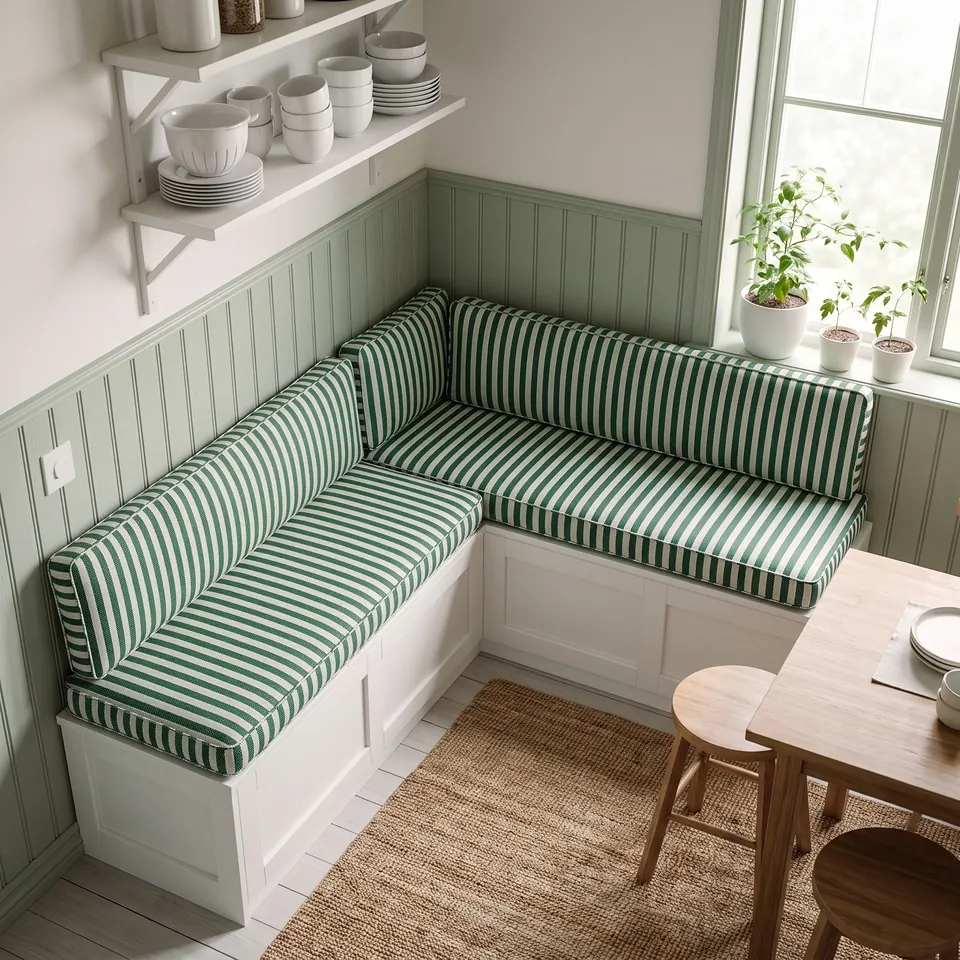
The workshop's answerTwo back cushions on the one seat cushion. It is the cleaner arrangement and easier to keep in place than a single 50 in (127 cm) back cushion with two small pillows.
An L-shaped bench cushion works best as two rectangles: the longer piece runs through the corner and the shorter one butts against it.
Nate
Questions buyers ask next
How do I measure a built-in masonry bench for cushions?
Measure each run along both the front and the back edge, since built-ins are rarely square, and check the corner angle. A paper template of the corner is the most reliable record. Note any slope in the render so the maker can plan for it.
Do back cushions need a frame on a built-in bench?
Not when a wall stands behind the seat. Loose box back cushions can lean on render or siding, one per section, and stay upright without hardware. On an open bench with no wall, you would need ties, a rail or a heavier cushion.
What cushion color suits a whitewashed outdoor wall?
A color within one shade of the wall, such as oatmeal or stone, makes a built-in seat look carved from the masonry. Let plants, a wood table or a rug bring the stronger colors, so the cushions can be replaced without redoing the scheme.
± 1/4 in — Nate