Cushions for Midwest homes, from porch to basement
The Midwest runs every cushion through a full test cycle each year: humid July, frozen January, a spring storm in between. I design for the cycle, not for the one nice day in the catalog photo.
MidwestUnited States12 states · tap one to open its guide
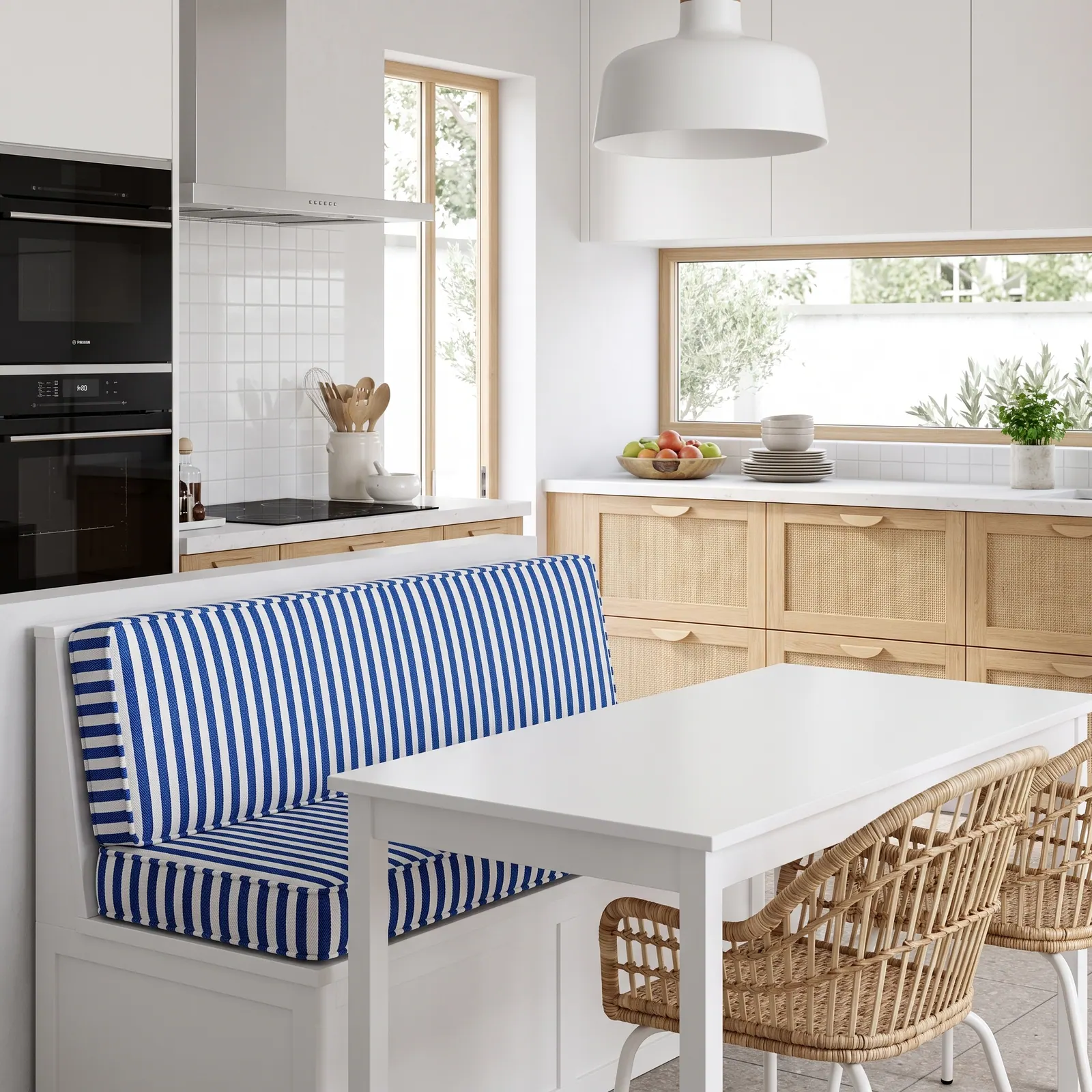
SaveOne bold cobalt stripe on the banquette is the only strong color in a white and oak kitchen.
The quick answer
Midwest outdoor cushions do best on a covered or three-season porch and indoors from the first freeze to spring, because the workshop's foam isn't quick-dry and has no mesh drain bottom. Indoors, family banquettes and storage benches want about 2.0 lb/ft³ (32 kg/m³) medium-firm foam, a wipe-clean weave, and a separate cushion for every lift-up lid.
Field notes
Weather and light in the Midwest
Sun & UVStrong (level 3 of 4)Strong summer sun
HumidityHumid (level 3 of 4)Muggy summers, dry heated winters
Rain & stormsFrequent (level 3 of 4)Spring and summer storms
Snow & freezeRegular (level 3 of 4)Cold, snowy winters, longest up north
Watch for
Freeze and thaw
Three-season porches
Mud and snow at the back door
Plain-language levels from general climate patterns, not measurements. Your own porch, shade and window exposure matter more.
Fifteen hot days, 153 freezing ones: the Midwest test cycle
A Minneapolis porch cushion sees 15 days a year at 90°F (32°C) or hotter and 153 days when the low hits 32°F (0°C) or below. That's the load case for Midwest outdoor cushions, and it's a demanding one.
The rest of the region reads the same way. Des Moines: 134 freezing days and 36.5 in (93 cm) of snow. Indianapolis: 113 freezing days. St. Louis: 94 freezing days and 46 days at 90°F or above. Minneapolis adds 51.2 in (130 cm) of snow.
Summer is humid; indoor air turns dry once the furnace runs. Foam and fabric that stay stable through both last longest, so for anything a family sits on daily I specify firm foam and a tight performance weave.
Then spring storms. For hail loss claims from 2017 to 2019, Nebraska ranked third in the nation, Minnesota fourth and Illinois fifth. A cushion left on an open deck in May can be a cushion you're replacing in June. The winter storage guide covers the other half of the year.
Foursquares, farmhouses and split-levels: where the family sits
Midwest houses are built for traffic. Farmhouses with long porches. American Foursquares and brick bungalows. 1950s ranches and split-levels with finished basements. Many early-1900s Minnesota homes got a sleeping porch, part of that era's fresh-air movement. In a lot of houses the mudroom, not the front door, is the everyday entrance.
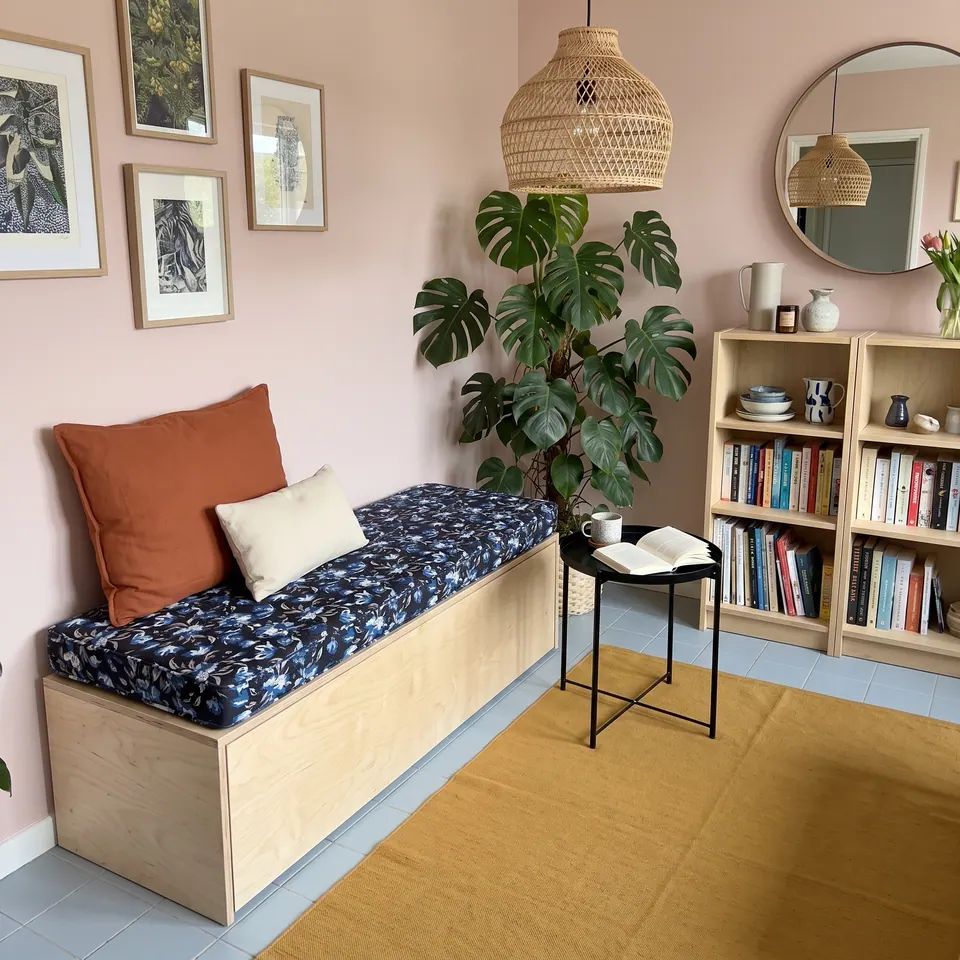
Three benches from buyers in the US show the pattern. An L-shaped kitchen bench, 84 x 22 in (213 x 56 cm) on one run and 62.5 x 21.5 in (159 x 55 cm) on the other, in sage corduroy 207 at 4 in (10 cm), with a backrest on the long side only; the foam back was cut as a wedge so it stays against the wall without Velcro. An L-shaped dinette in a white-shiplap farmhouse room, used daily by kids aged 9 to 14, made in the soft easy-clean fabric in 'smoke', a beige-gray, to the real 17 x 45 in and 17 x 54 in. And two flip-up storage benches with a 2 in (5 cm) gap at the corner: three separate pieces, 15.5 in (39 cm) wide and 2.5 in (6.4 cm) thick, with ties at the bottom back corners. Those ties were missed in production, and the workshop sent matching fabric and thread to sew them on. Confirm small extras in writing, partner.
What's the gap between your bench top and the underside of your table? Measure it before you pick a thickness; the seat height calculator does the arithmetic.
Fabric, foam and fastening, seat by seat
Seat
Fabric
Foam and thickness
Fastening and fit
Kitchen banquette or L-bench
Soft performance fabric in a mid-tone; velvet also wipes clean
4 in (10 cm) standard; 2-3 in (5-7.5 cm) if knees meet the table
Storage benches, a 1.5 in surprise, and an honest no
A buyer in the US, in a climate with hot summers and snowy winters, sent drawings of outdoor storage benches with lids that open and backrests behind them. She wanted the cushions split at the lid lines, the right call, as the hinged-lid guide explains.
One run turned out to be about 1.5 in (4 cm) deeper at one end than the other. Small, but a cushion cut to the wrong assumption would gap on one side and bulge on the other. The workshop asked for a separate full drawing of every piece, each with its own measurements. Tolerance is kindness to your future self.
She asked for Sunbrella, a fast-drying mesh bottom and quick-dry foam. The answer was plain: none of the three. The outdoor fabric is UV-resistant and water-repellent, and it suits a covered porch or cushions stored over winter. It is not built to sit uncovered through rain and snow.
She went ahead on those terms. She asked for close-ups of eight codes from the HM range, chose HM-21, and ordered seat cushions 3 in (7.5 cm) thick, including two at 45.5 in (116 cm), plus full back pillows and long round lumbar pillows. Sketch yours in the bench cushion builder first.
A storage bench cushion should be cut at every lid line, one piece per lid. If a cushion spans the break, the lid won't open fully.
Open any photograph large; each one has its own link and a Save button.
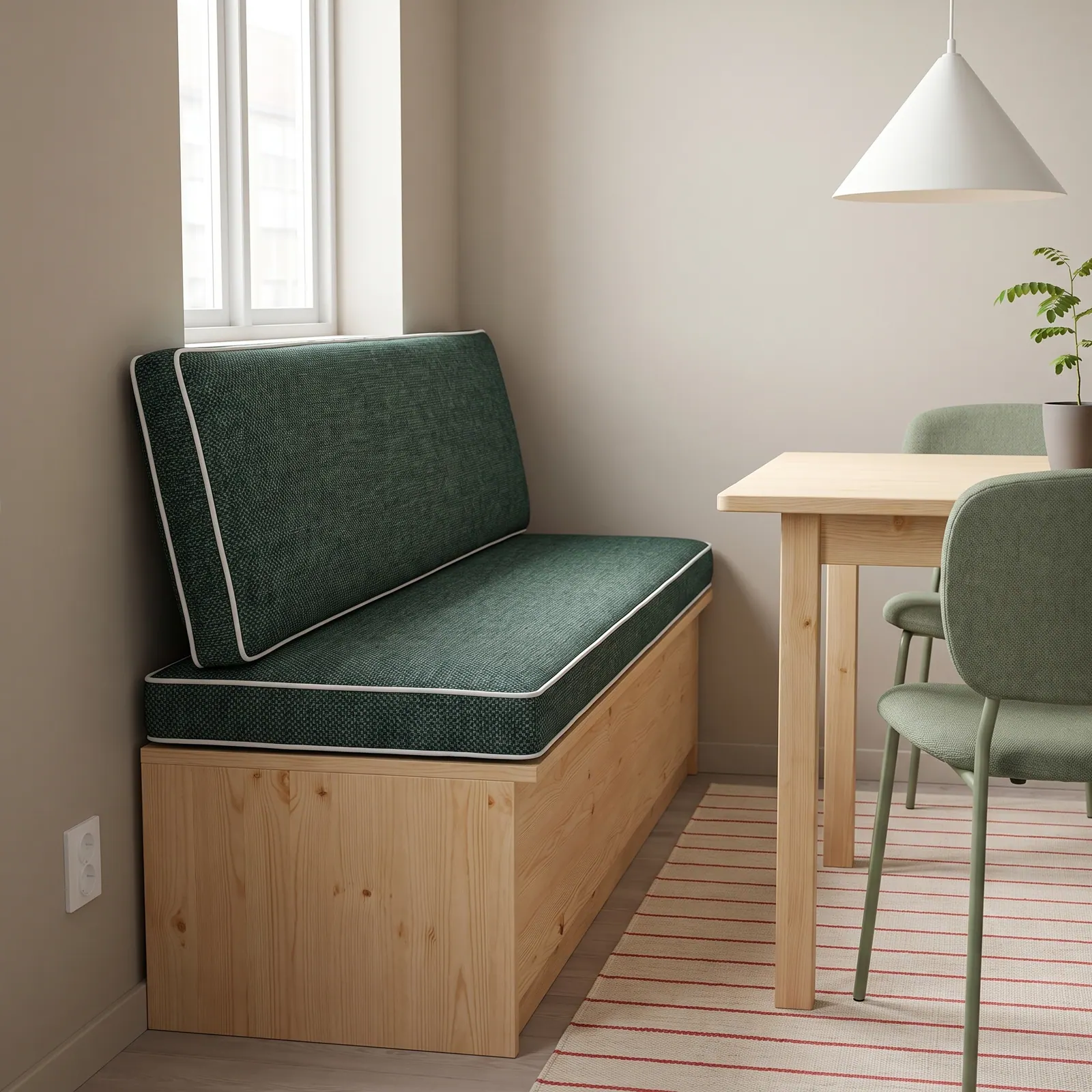
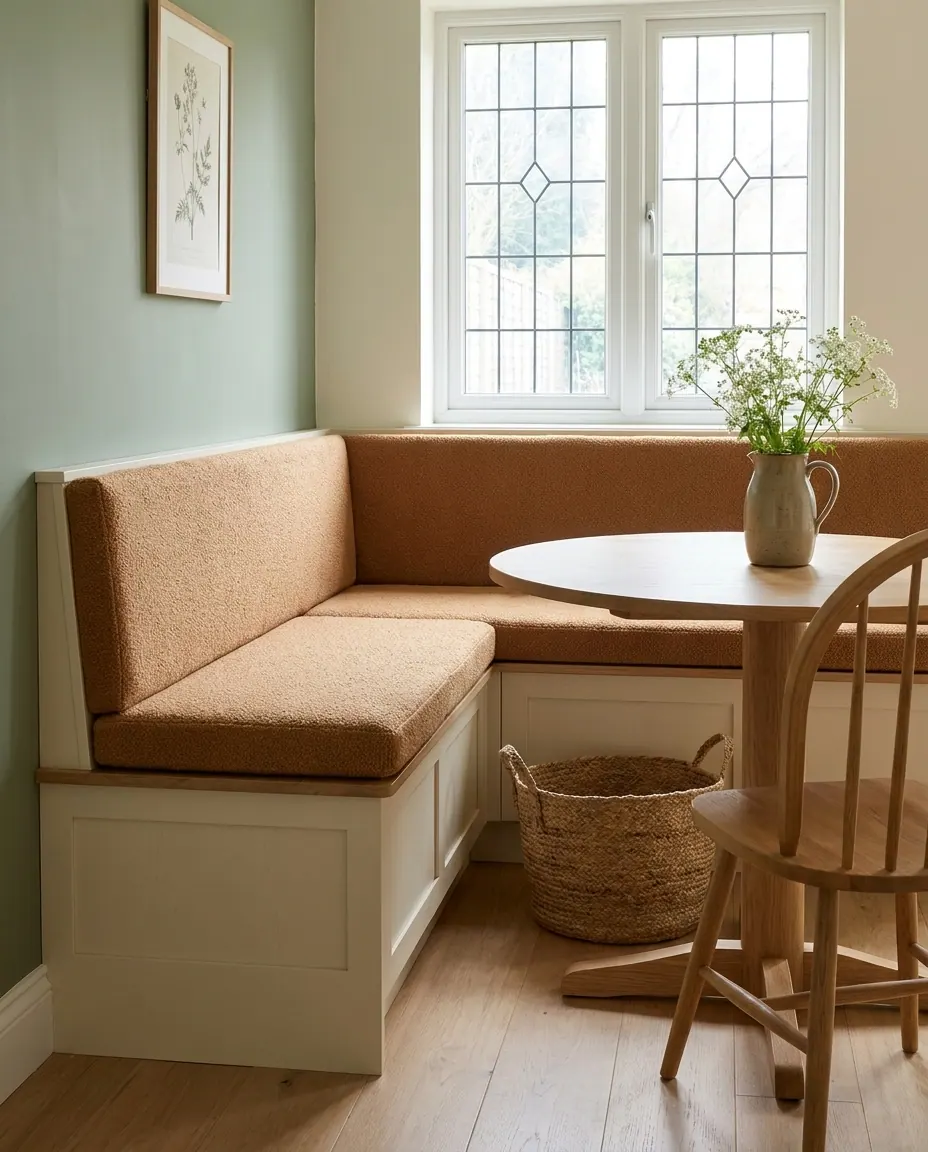
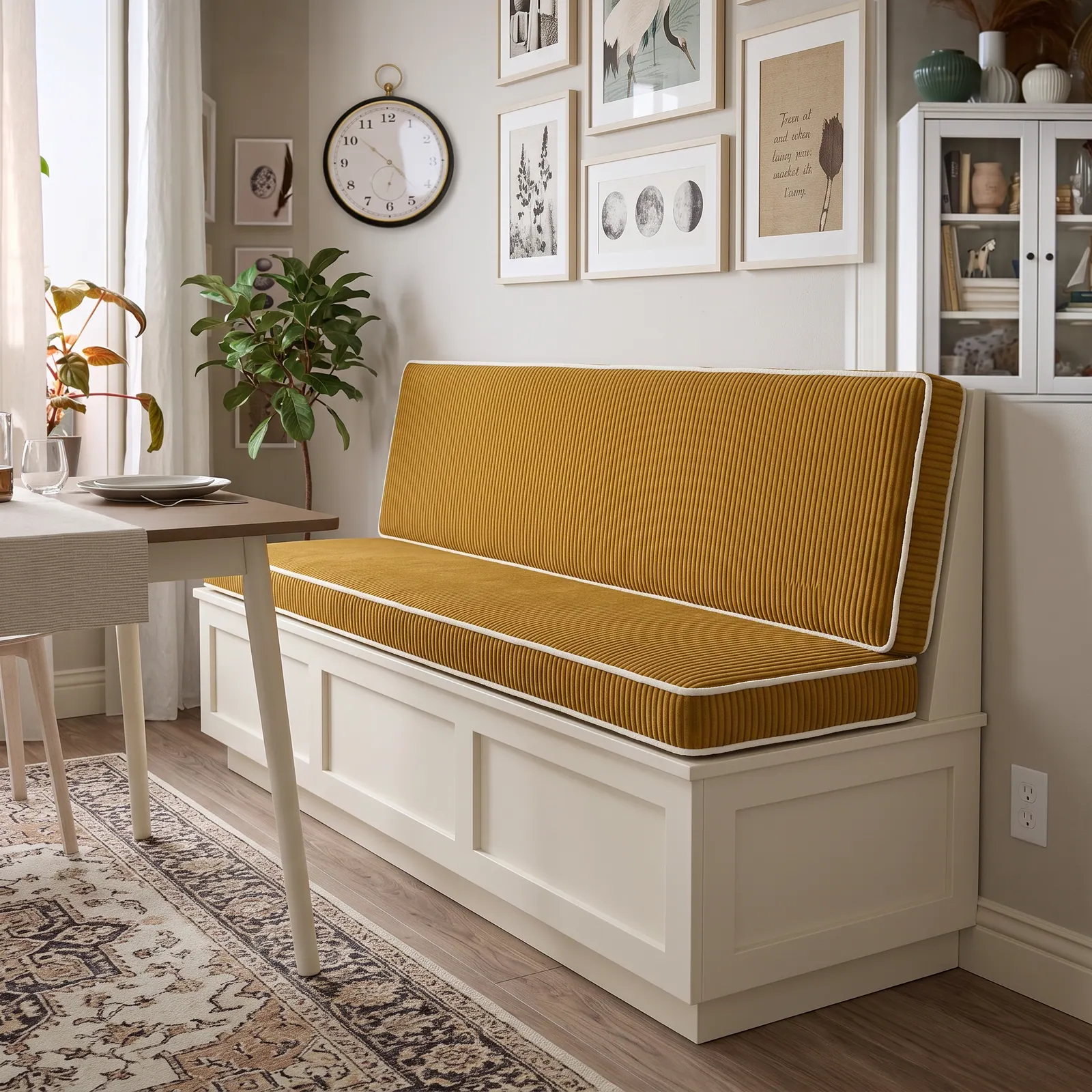
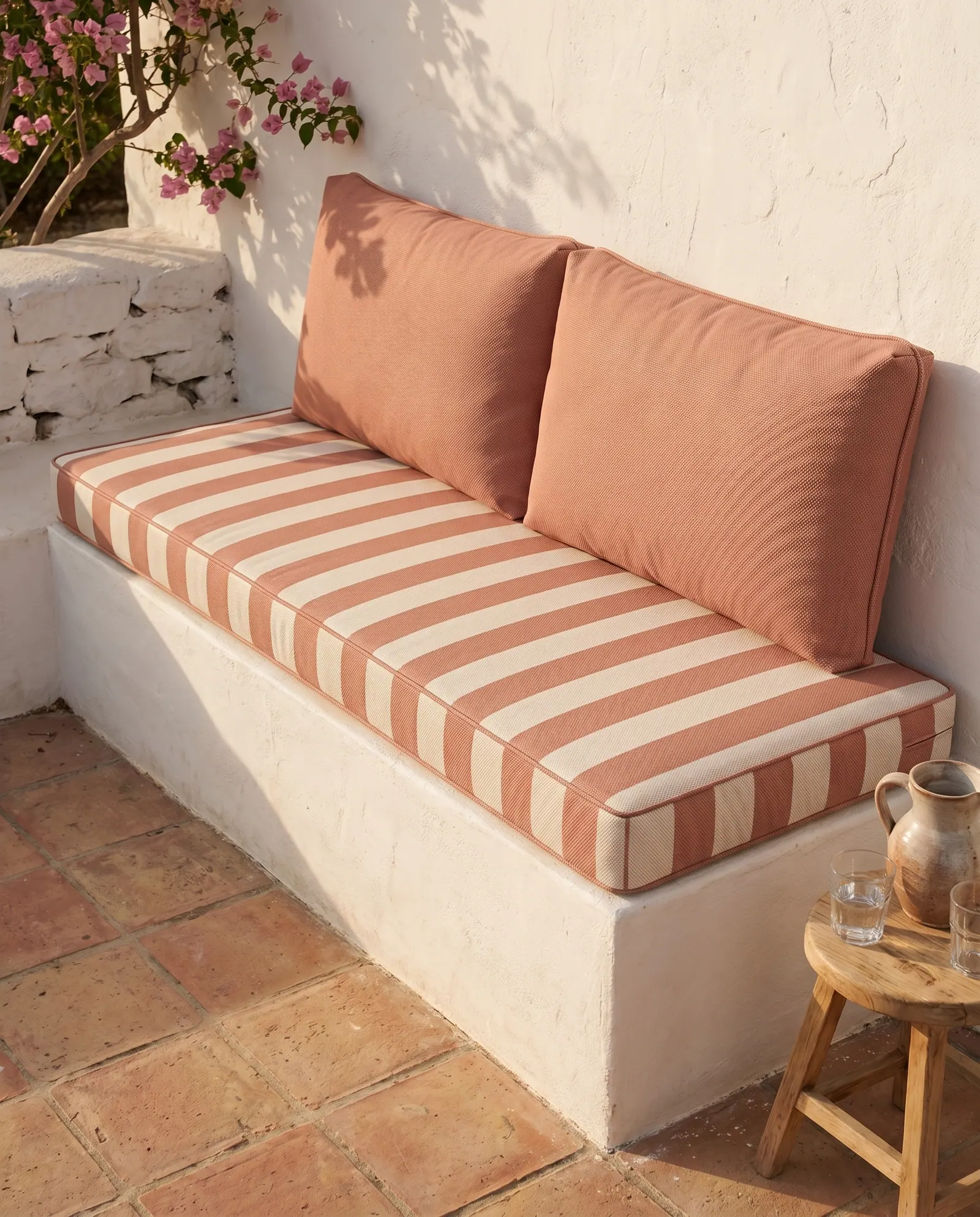
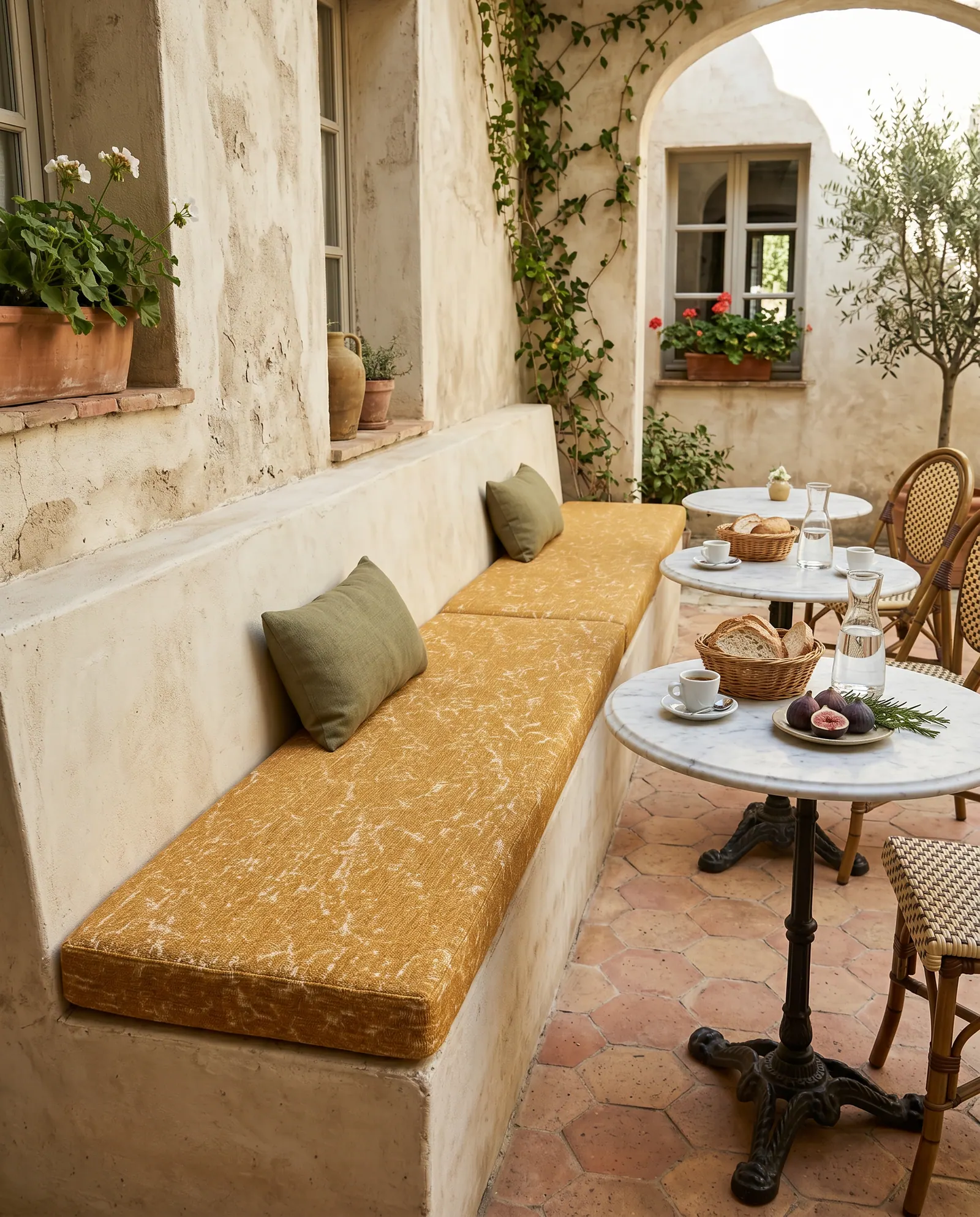
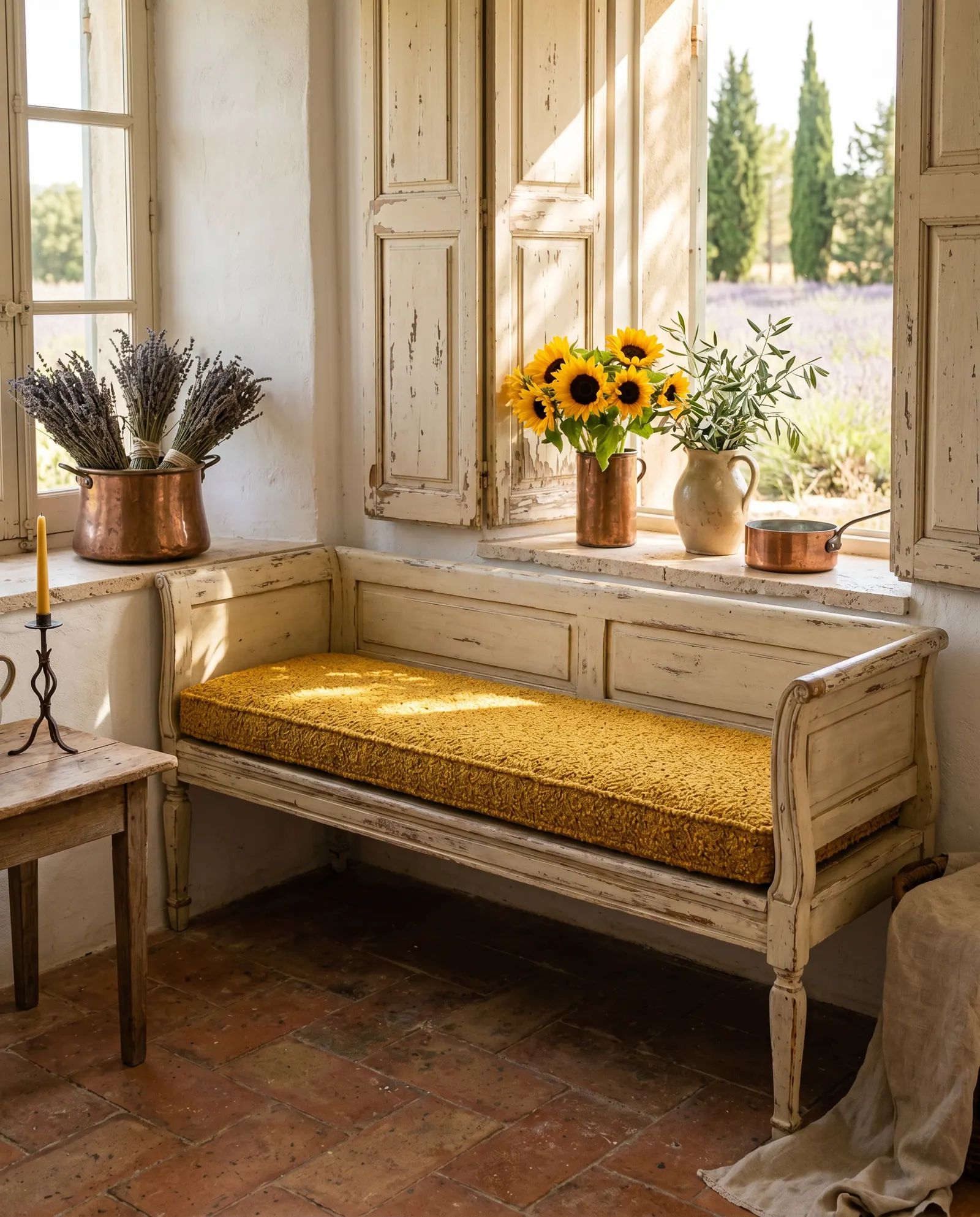
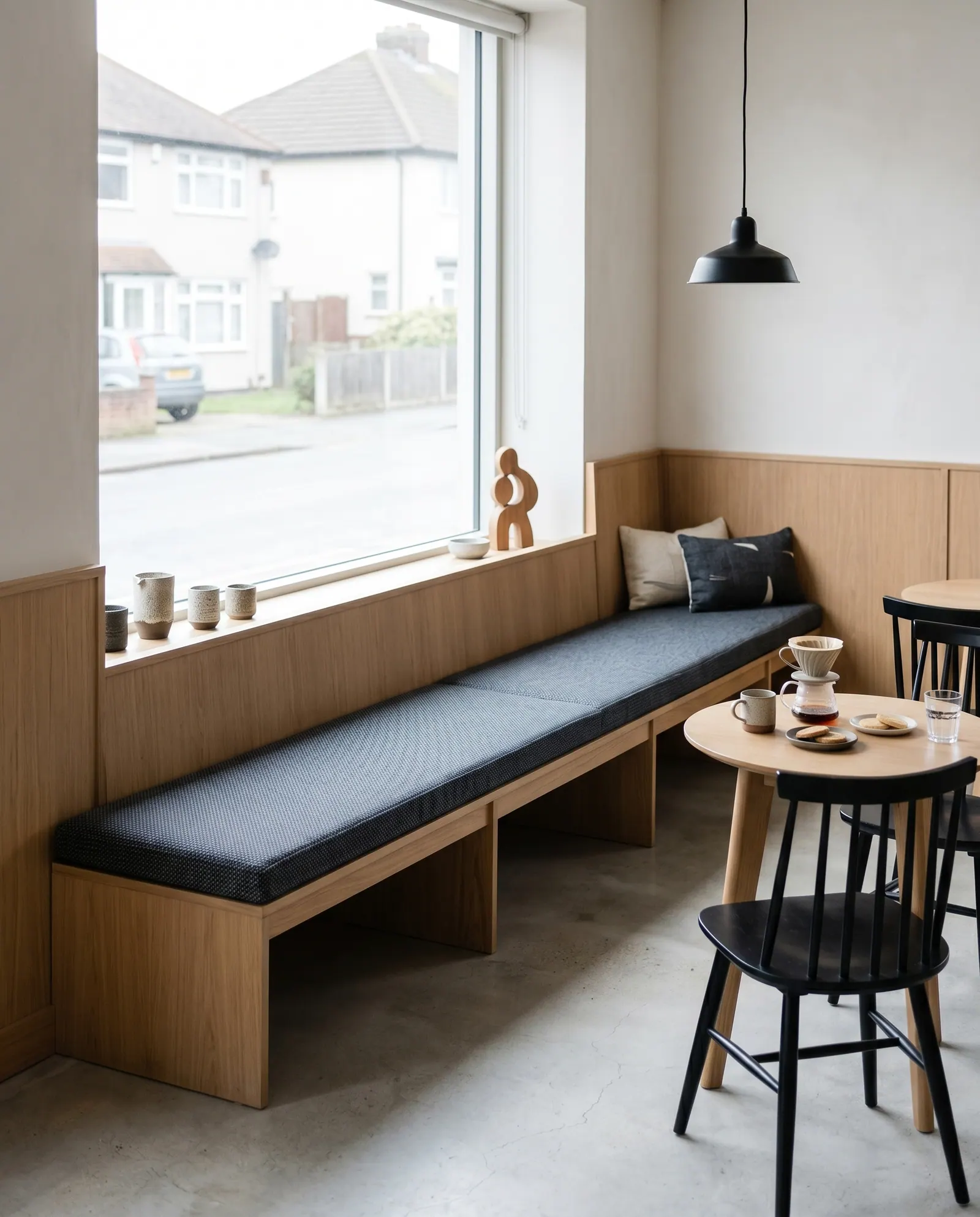
SaveA hard-wearing bottle green weave dresses a pine storage bench for everyday dining.SaveSeat and backrest cushions in caramel bouclé turn a painted corner bench into a proper banquette.SaveMustard corduroy brings warmth and texture to a white dining banquette under a layered gallery wall.SaveA striped seat and solid backs in matching coral dress a built-in plaster bench on a tiled terrace.SaveTwo saffron cushion lengths line a built-in plaster banquette in a sun-washed courtyard set for lunch.SaveMustard bouclé in a chipped cream settle, lit by low sun and matched by a jug of sunflowers.SaveTwo charcoal cushion lengths line an oak window banquette in a quiet café, with round tables pulled close.
The Midwest cushion calendar
March–April: check stored cushions for damp spots before they go back out. Anything damp gets dried within 24 to 48 hours.
May–June: storm season. Carry porch cushions in when severe weather or hail is forecast.
July: the humid weeks. Zip off porch and banquette covers, wash at 86°F (30°C), and let them dry fully before zipping them back on.
October: before the first freeze, clean, dry and store outdoor cushions off concrete in something breathable. Water left in foam freezes, thaws and never really dries.
December–February: wipe snowmelt and road salt off the mudroom bench with a damp cloth and a little mild soap.
Any month: blot a banquette spill first, then wipe. Don't soak the foam.
Buyer questions: foam, fasteners and snowy winters
A common question
Our summers are very hot and our winters snowy. Do you offer Sunbrella, a fast-drying mesh bottom or quick-dry foam for outdoor storage bench cushions?
The workshop's answer
No to all three. The outdoor fabric is UV-resistant and water-repellent, but it isn't Sunbrella, there's no fast-drying mesh bottom, and the foam isn't a quick-dry outdoor foam. These cushions work very well on a covered porch or stored over winter; the workshop says plainly they aren't the right product to leave uncovered in rain and snow.
A common question
What density foam goes into a bench cushion?
The workshop's answer
32 kg/m³, about 2.0 lb/ft³: a high-density, high-resilience polyurethane with a medium-firm feel. It's firmer and longer-lasting than the 28 kg/m³ foam often specified, and on a 3 in (7.5 cm) cushion it stays comfortable and holds its shape for years without going lumpy. Every custom cushion gets it as standard; a softer grade can be requested.
A common question
Could you put velcro on the bottom instead of ties so the banquette cushion stays put?
The workshop's answer
The standard answers are ties or a non-slip bottom, and the workshop usually suggests one of those. Velcro tabs and snap fasteners aren't made. A two-sided velcro strip has been added on request at extra cost, one side sewn under the cushion and the other sent to fix to the bench; ask in the personalization box and wait for confirmation. For banquettes it may ask for a photo of the bench first.
A common question
We have a toddler who spills everything. Is there a waterproof or wipe-clean fabric for the kitchen bench?
The workshop's answer
The standard indoor fabric isn't waterproof, but it's durable, easy to clean, and zippered covers machine wash at 86°F (30°C) or lower. For real liquid protection, B19 is the water-repellent option. The workshop also sends water-resistant premium charts that wipe clean easily, and a faux leather chart for bench cushions. Close-up photos and videos of swatches come on request.
A common question
Is a non-slip bottom included, or is that extra?
The workshop's answer
It's an optional add-on, not standard, and it works on any shape: bench, entryway, window seat, daybed, trapezoid, even outdoor seat cushions. The cost scales with cushion size. Write 'non-slip base' and your exact size in personalization, and the workshop includes it in your quote or sends a link for the difference. You can choose it for some cushions in a set and not others.
Have it made
Have it made for your home — ask Nate’s workshop
Every edge and both diagonals, to the nearest 1/4 in. If the numbers do not close, the workshop will say so on the call. — Nate
Leave your details and the workshop will call you to confirm measurements, fabric, foam and piping. No prices, dates or payment on this page: it is a request, not an order.
Midwest questions, measured
Can porch cushions stay out on a Midwest porch all winter?
Not these. Minneapolis averages 153 days a year at or below 32°F (0°C), and water trapped in foam freezes and thaws without drying. The workshop's foam isn't quick-dry, so store outdoor cushions dry, off concrete, in a breathable cover from the first freeze to spring.
What fabric suits a three-season or screened porch?
If rain or humid air can reach the seat, outdoor fabric: water-repellent, UV-resistant and better against mildew. A porch with a solid roof where neither rain nor direct sun reaches can take the regular indoor fabrics, though they aren't waterproof.
Should an L-shaped kitchen bench cushion be one piece or two?
A small L can be one piece. A buyer in the US had 18 x 70 in and 18 x 42 in runs made as a single cushion 2 in (5 cm) thick from a clearly measured sketch. Lift-up seats are different: one piece per lid, so each lid opens.
Does hail matter for Midwest patio cushions?
Yes, in the Plains especially. Nebraska, Minnesota and Illinois ranked third, fourth and fifth in the US for hail loss claims from 2017 to 2019. Bring cushions under cover when storms are forecast, and size each piece so one person can carry it.

 Save
 Save
 Save
 Save
 Save
 Save
 Save
 Save