Across the Map · Great Lakes · United States
Custom cushions for Wisconsin cottages, cabins and Milwaukee flats
Wisconsin gives a cushion two load cases: a storage bench in a Milwaukee flat that gets opened every day, and a dock bench in the Northwoods that spends the winter in storage. Here are the measurements for the first and the procedure for the second.
- Sun & UVModerate
- HumidityModerate
- WinterLong and hard
- CoastSalt air nearby
- Typical seatsWindow seat, storage bench with lift-up lids, mudroom bench

 Save
The quick answer
Custom cushions in Wisconsin split into two jobs: window seats and storage benches indoors, and dock and porch cushions outdoors. Indoor pieces in Milwaukee duplexes and lake cottages are measured wood to wood, cut at every lid line and usually made 3 in thick. Door County and Northwoods cushions need water-repellent outdoor fabric and ties for lake wind, then dry storage before Milwaukee's 133 freezing nights.
The load case: snow, freeze and a short, damp summer
Every cushion has a load case. In Wisconsin it reads like this, from NOAA station averages:
- Milwaukee: 48.7 in (124 cm) of snow, 133 days at or below 32°F (0°C), mornings at 79% humidity, 10 days at 90°F (32°C) or hotter.
- Green Bay: 55.6 in (141 cm) of snow, 155 freezing days, August and September mornings at 90% humidity.
- Madison: 51.8 in (132 cm) of snow, 154 freezing days.
Sun is the small variable. Milwaukee gets 69% of its possible sunshine in July and 35% in December. Cold and damp are the big ones. So the outdoor season is short and sharp: Wisconsin's outdoor cushion searches show one of the steepest single May peaks in the country.
Indoors, the season is long. Wisconsin scores 30 for window seat cushions, level with Vermont and New Hampshire. That is a lot of reading by the window between November and April.
Two-flats, Polish flats and the paneled basement
Milwaukee's signature house is the duplex. The most common form is the up-and-down two-flat on the bungalow plan: a long rectangle set perpendicular to the street, a wide porch in front, an enclosed stair at the back. By 1911 a UK Board of Trade study already called it the city's most common house type.
Then the Polish flat. A family built a small cottage, later raised it on jacks, dug a half-sunken apartment underneath, and set the house back down on new masonry walls. Two homes stacked: ownership and rent income under one roof.
Narrow plans mean seats in tight quarters. Measure wood to wood, inside the frame, with nothing subtracted; a handmade cushion lands within about 1/2 to 1 in (1.3 to 2.5 cm) of your size. If a window ledge sits over a radiator, split it. A buyer in the US had a 106 x 15 in (269 x 38 cm) ledge over a radiator, and the workshop made two 53 x 15 in cushions so heat can rise and each half lifts out.
Downstairs, plenty of Milwaukee houses keep a wood-paneled basement rec room or bar, many of them built after World War II. The bench along that wall is a bench cushion job. Keep it off bare concrete.
Door County, the Northwoods, and a dock that faces the wind
Door County, the peninsula between Green Bay and Lake Michigan, has 298 miles (480 km) of shoreline and six state parks. Vilas County, up in the Northwoods, has 1,318 lakes. That is a lot of docks, and a dock bench always faces the wind.
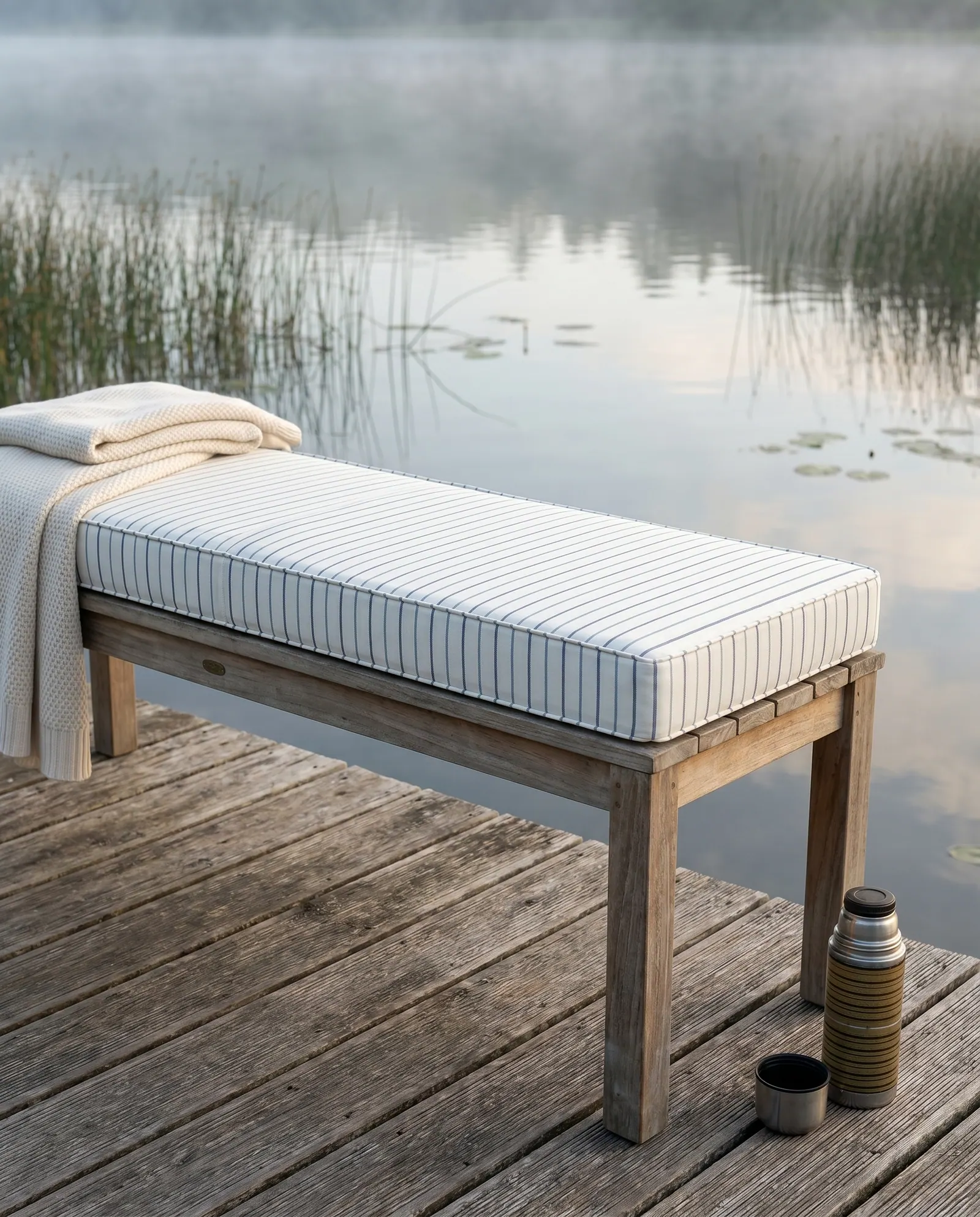
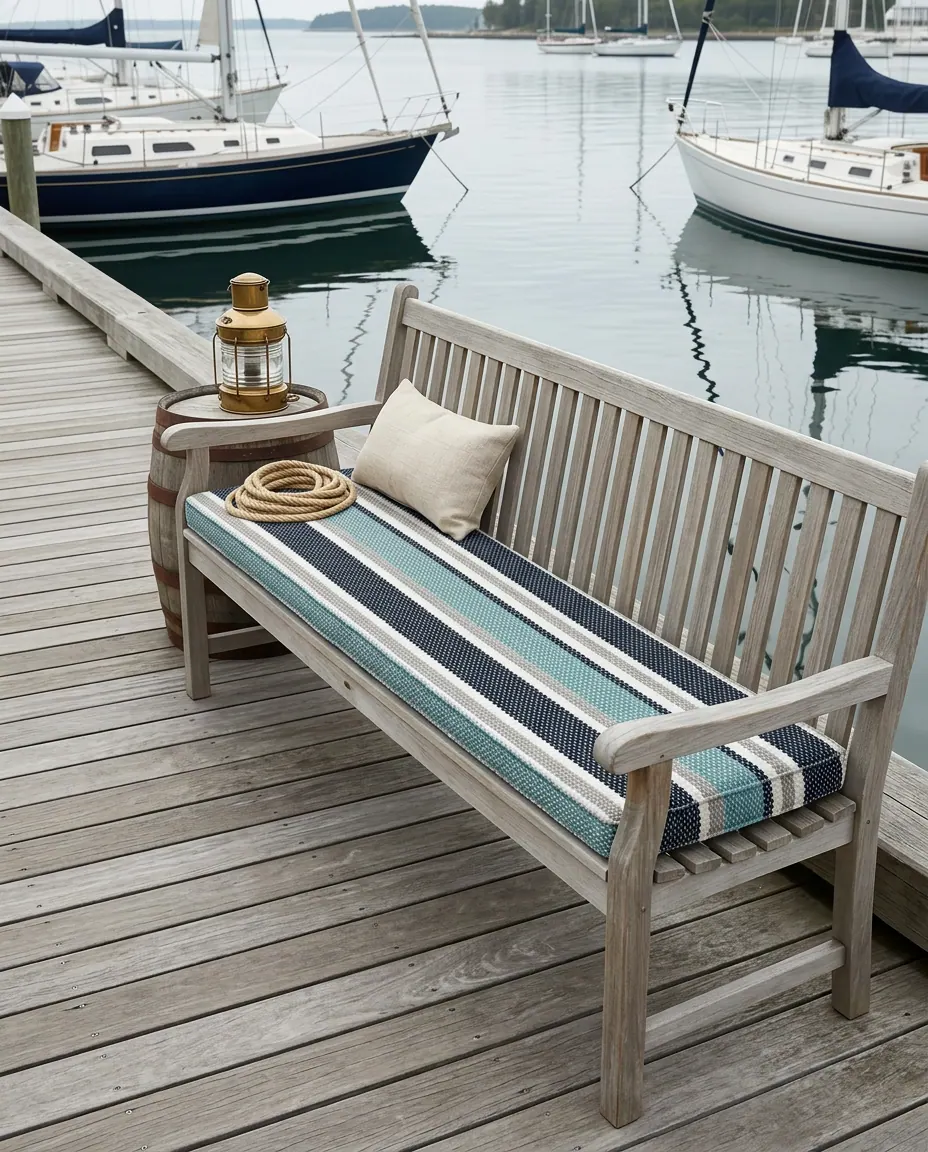
Dock and porch cushions get water-repellent outdoor fabric, 3 to 4 in (7.5 to 10 cm) thick, and ties. Specify three things in writing: the count, each position from a named end, and what it wraps. Four at the corners for a slatted dock bench, knotted underneath; two on the back edge for a rail. The tie placement pattern has the diagrams. The foam is not quick-dry, so cushions come in before a storm.
Inside the cabin, storage benches and quilt boxes do the heavy lifting. Split the cushion at every lid line and put ties on the hinge side only; the hinged-lid pattern shows how. Angles are just lengths in disguise: a cabin bay seat is a trapezoid you can check in the bay window calculator. Write every edge down, partner. The lake-house routine lives on our Great Lakes cottage page, and Michigan has the other shore.
Cut list: window seat, storage bench, mudroom, dock
| Seat | Measure | Build | Notes |
|---|---|---|---|
| Duplex or Polish flat window seat | Front wall to wall, back along the glass, depth at both ends | 3 in (7.5 cm) for a neat line; linen-look, velvet or corduroy | Split over a radiator; notch around casings |
| Storage bench or quilt box with lids | Inside, wood to wood; every lid line; each hinge from a named end | One piece per lid, 2.5 to 3 in (6.4 to 7.5 cm) | Ties on the hinge side; a non-slip base helps sitting, not a lifted lid |
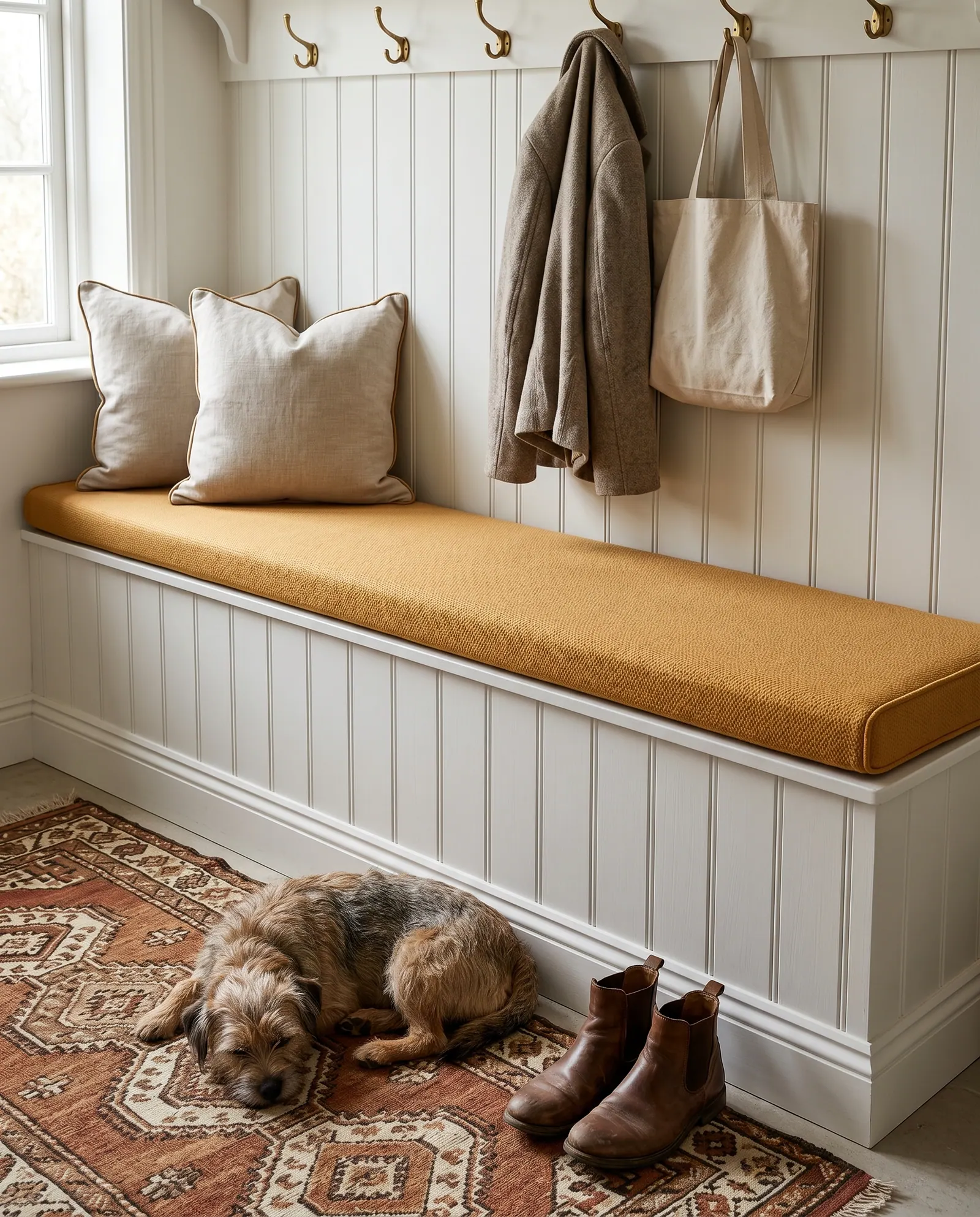
| Mudroom bench niche | Niche width, depth and height | Thickness = target seat height minus bench height | Wipeable performance fabric for snowmelt |
| Door County or Northwoods dock bench | Bench top, plus where the frame can take ties | 3 to 4 in (7.5 to 10 cm) in water-repellent outdoor fabric | Four corner ties for lake wind; carry it in before storms |
Standard seat foam is high-density, about 2.0 lb/ft³ (32 kg/m³), medium-firm to firm, and not quick-dry. Covers wash at 86°F (30°C) on a gentle cycle.
Two lids, a 2-inch gap and three pieces
A buyer in the US had a dining nook built from two flip-up storage benches that don't meet at the corner: a 2 in (5 cm) gap, plus a small corner piece. They sent a diagram of the bench tops with their proposed cushion sizes, 15.5 in (39 cm) deep.
The workshop's advice, as a spec: - close fit, no overhang; - 2.5 in (6.4 cm) thick, foam-filled, not tufted; - three separate pieces, so each lid opens on its own; - ties at the bottom back corners, so the pads stay put when a lid goes up.
They chose a lavender soft fabric, since the corduroy didn't come in lilac. One miss: the ties were left off, and the workshop sent matching fabric and thread so they could be added. Check the pre-shipment photo against every line of your order.
- Measured
- Long pieces 15.5 in (39 cm) deep, 2.5 in (6.4 cm) thick; 3 pieces; 2 in (5 cm) gap at the corner
- What it taught
- On lift-up storage benches, cut the cushion at every lid break and add ties at the back corners so pads don't slide when a lid opens.
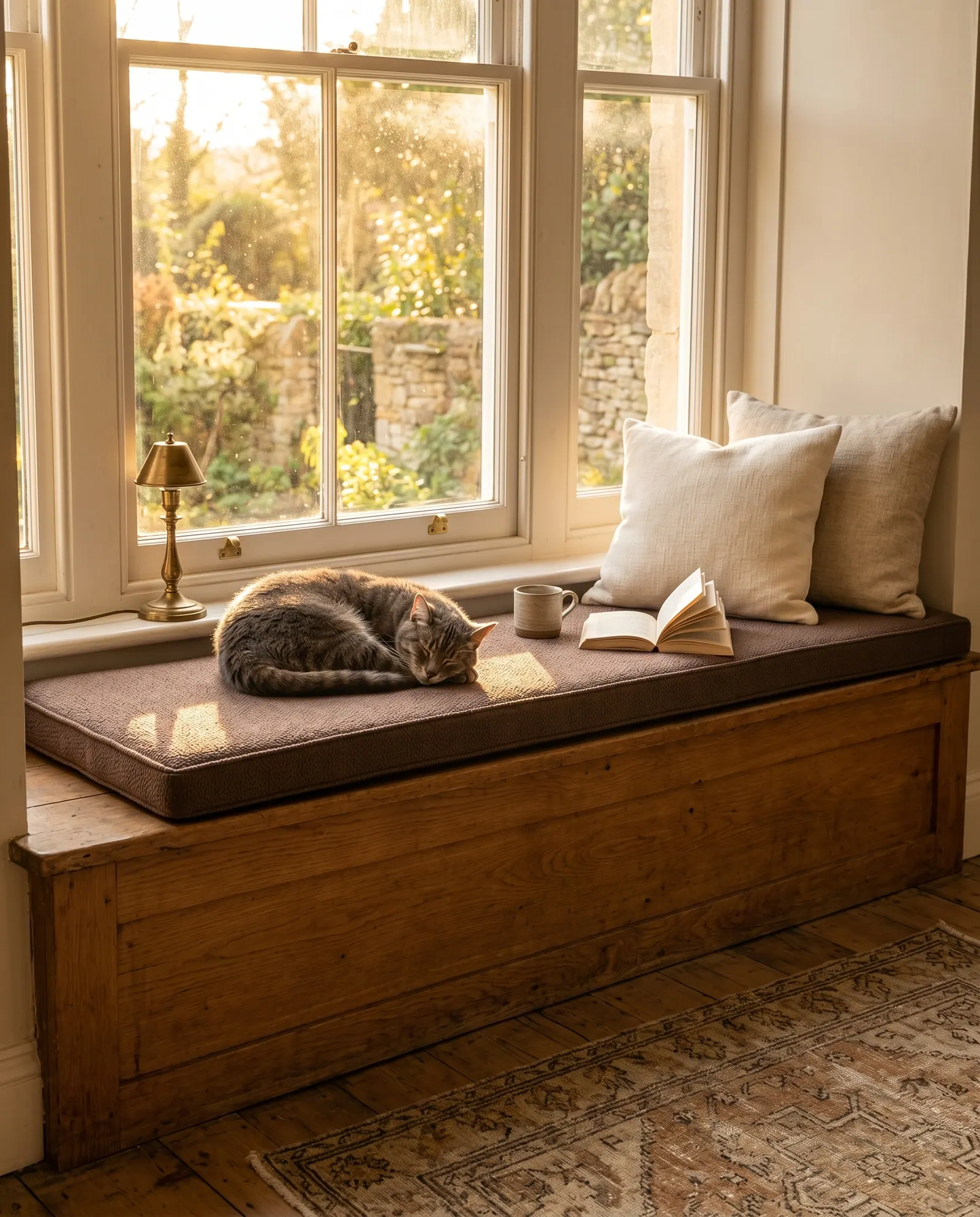
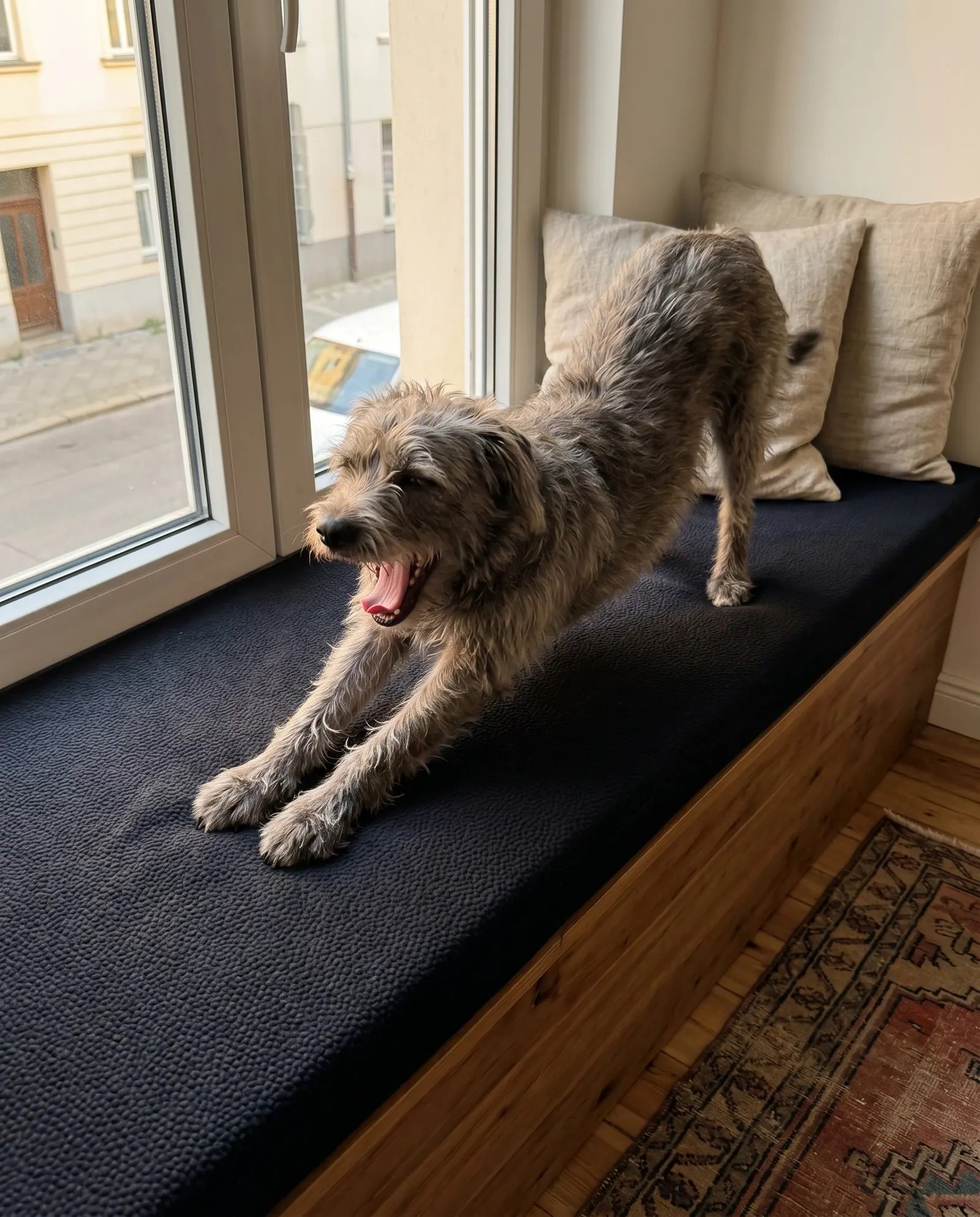
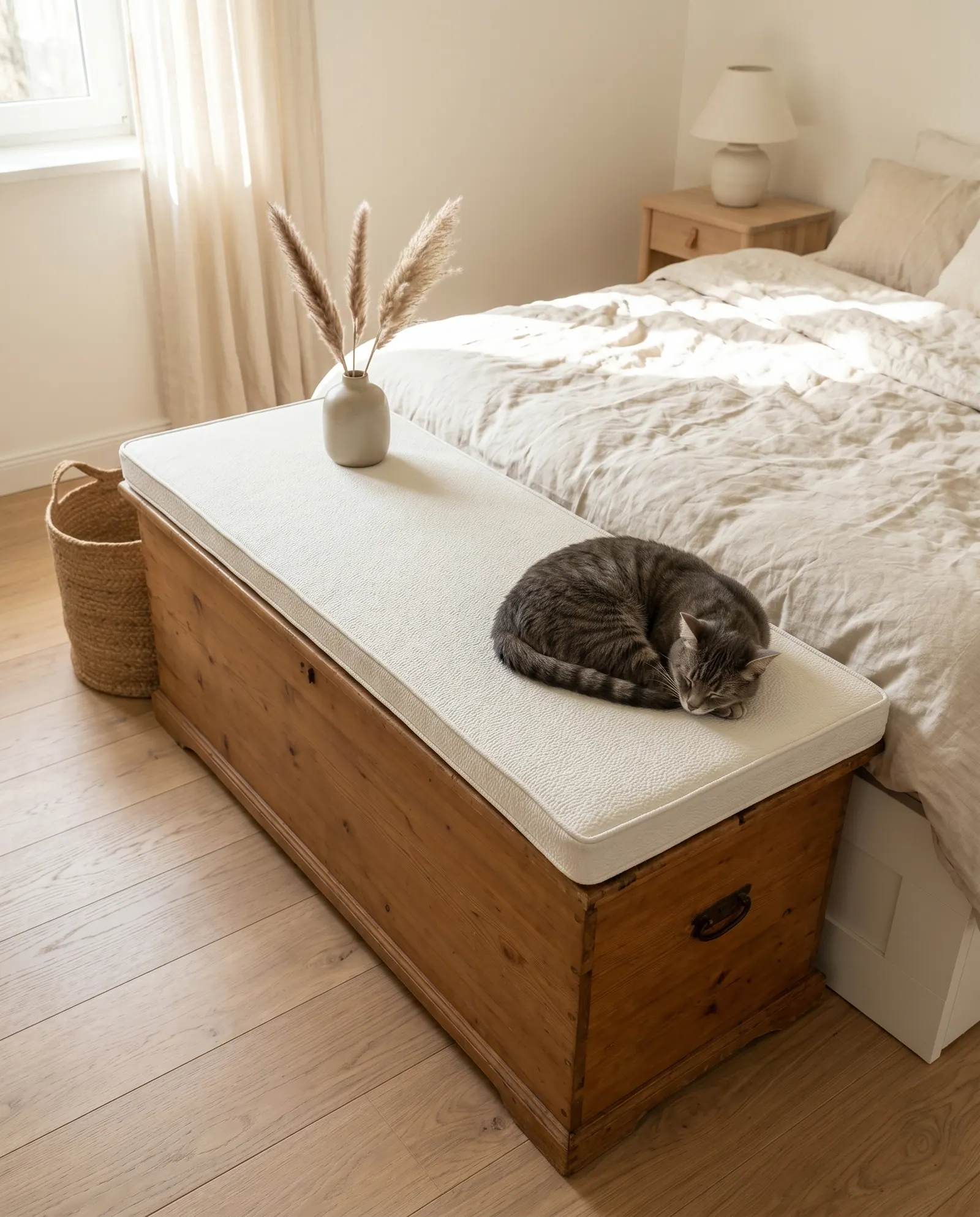
Photographs for homes like these
Open any photograph large; each one has its own link and a Save button.
 Save
 Save
 Save
 Save
 Save
Closing the cabin: the cushion procedure
- Pick the day: before the first hard freeze. Green Bay averages 155 nights a year at or below 32°F (0°C).
- Unzip every cover and wash it at 86°F (30°C) on a gentle cycle. Air dry; no dryer.
- Dry the foam to the core. Stand it on edge where air moves for 24 to 48 hours, longer after rain.
- Store off the floor and off concrete, in breathable covers. Never sealed damp in plastic.
- Keep stored cushions and throws at least 3 ft (0.9 m) from the woodstove or furnace.
- Opening weekend: check every tie and zipper before the May rush.
Measure the lid lines before the length. On a storage bench, every lid is its own cushion.
Nate
Buyer questions: lids, niches and bay geometry
- A common question
Ties won't work with the hinges on my chest. How else can the cushion stay put?
The workshop's answerThe cushion can be made to fit inside the lid's bevel, for example 42 x 18 in (107 x 46 cm), and a non-slip base helps it stay put in normal use. Honestly, when the lid is lifted the cushion can still slide off and may stop the lid opening fully. That is the nature of a lifting lid.
- A common question
What size cushion should I order for a mudroom bench niche?
The workshop's answerFor a niche 17 x 35.75 in (43 x 91 cm) and 15 in (38 cm) high, a 3 in (7.5 cm) cushion gives the 18 in (46 cm) seat height the buyer wanted. Pick the nearest size options and write the exact 17 x 35.75 x 3 in in the note.
- A common question
Are your cushions only 4 in thick, or can I get them thinner?
The workshop's answerFour thicknesses are standard: 2, 3, 4 and 5 in (5 to 12.5 cm). The listing photos show 4 in (10 cm), and most buyers choose 3 or 4 in. Pick it in the thickness option or write it in the personalization box.
- A common question
Can I choose where the zipper goes?
The workshop's answerYes. Name the edge: along the long back edge, down the long side so the cushion can be flipped, at the back of a trapezoid chair seat, or at the narrow end of a tapered cover so it slides onto the wider end.
- A common question
My bay window seat has two extra edges, more of a pentagon or hexagon than a trapezoid. Can you make it?
The workshop's answerYes. Send the exact length of every side or a simple sketch, and the workshop turns it into a template for you to check. Choose the length and width ranges that fit, such as 78 in and 22 in, and write the full shape in the personalization: front, back, angled sides, end sides and depth.

Have it made
Have it made for your home — ask Nate’s workshop
Precision starts on the phone. Give the workshop your measurements and they will read them back to you, edge by edge. — Nate
Leave your details and the workshop will call you to confirm measurements, fabric, foam and piping. No prices, dates or payment on this page: it is a request, not an order.
Wisconsin cushion questions
How thick should a Wisconsin window seat cushion be?
Three inches (7.5 cm) gives a neat, low line under the sash; 4 in (10 cm) gives more cushioning for long reading. The foam is high-density, about 2.0 lb/ft³ (32 kg/m³), so a front overhang of up to about 2 in (5 cm) holds its edge with an inner support wrap.
Can dock cushions stay out on a Northwoods lake all summer?
In water-repellent outdoor fabric with ties, they handle normal summer use. The foam is not quick-dry, though, so carry cushions in before storms, stand wet ones on edge to dry within 24 to 48 hours, and store everything dry before the first hard freeze.
When should Wisconsin porch and dock cushions be ordered?
Before May. Wisconsin's outdoor cushion searches have one of the sharpest single May peaks in the country, and the season is short: Milwaukee averages only 10 days a year at 90°F (32°C) or above. Measure in March, order in April.
What goes on the bench in a Milwaukee basement rec room?
Measure the bench wood to wood and choose a zip-off cover in a wipeable fabric such as soft performance fabric or velvet. Keep the cushion off bare concrete, where damp collects, and add a non-slip base if the bench top is smooth.
± 1/4 in — Nate
The atelier
Keep going
Across the Map
Nearby places
Close by on the map