Across the Map · Midwest · United States
Custom cushions for Minnesota cabins, porches and window seats
On December 21 the Minneapolis sun sets at about 4:36 p.m. The window seat does a lot of work in winter. So does the cabin, when you close it.
- Sun & UVModerate
- HumidityModerate
- WinterLong and hard
- SettingInland
- Typical seatsWindow seat, cabin bunk, sleeping porch daybed

 Save
The quick answer
Custom cushions in Minnesota serve three places: the window seat through short winter days, the cabin up north, and the screened or three-season porch. Choose 3 in (7.5 cm) for a calm window seat, size bunk and daybed covers to the mattress's length, width and thickness, use outdoor fabric behind screens, and store porch cushions clean and dry before the first freeze.
Field notes
Weather and light in Minnesota
- Sun & UVModerate (level 2 of 4)Long June days, short December ones
- HumidityModerate (level 2 of 4)Humid summers, very dry heated winters
- Rain & stormsModerate (level 2 of 4)Summer storms and spring hail
- Snow & freezeLong winters (level 4 of 4)Long, snowy winters, longest up north
Watch for
- Dry furnace air
- Hail on open porches
- Cabins closed for winter
Plain-language levels from general climate patterns, not measurements. Your own porch, shade and window exposure matter more.
Eight hours and fifty minutes of light
On December 21, Minneapolis gets about 8 hours and 50 minutes of daylight. In June it gets about 15 hours and 40.
Winter is long. Minneapolis-St. Paul averages 51.2 in (130 cm) of snow and 153 days at or below 32°F (0°C). Duluth has 182 such days. International Falls has 198.
The air changes with the season. Outdoor afternoon humidity averages about 68% in January and 54% in July, yet a heated house turns dry. The EPA suggests keeping indoor humidity between 30 and 50 percent. Firm foam and a stable weave hold their shape through the swing.
Sun is gentle. The noon UV Index averages about 7.9 in July and 0.9 in December. Fading is a summer question here.
Lakes, cabins and a porch for sleeping
Minnesota counts 11,842 lakes of ten acres or more. Many have a cabin. That is where the bunks are, and the dock, and the bench by the door.
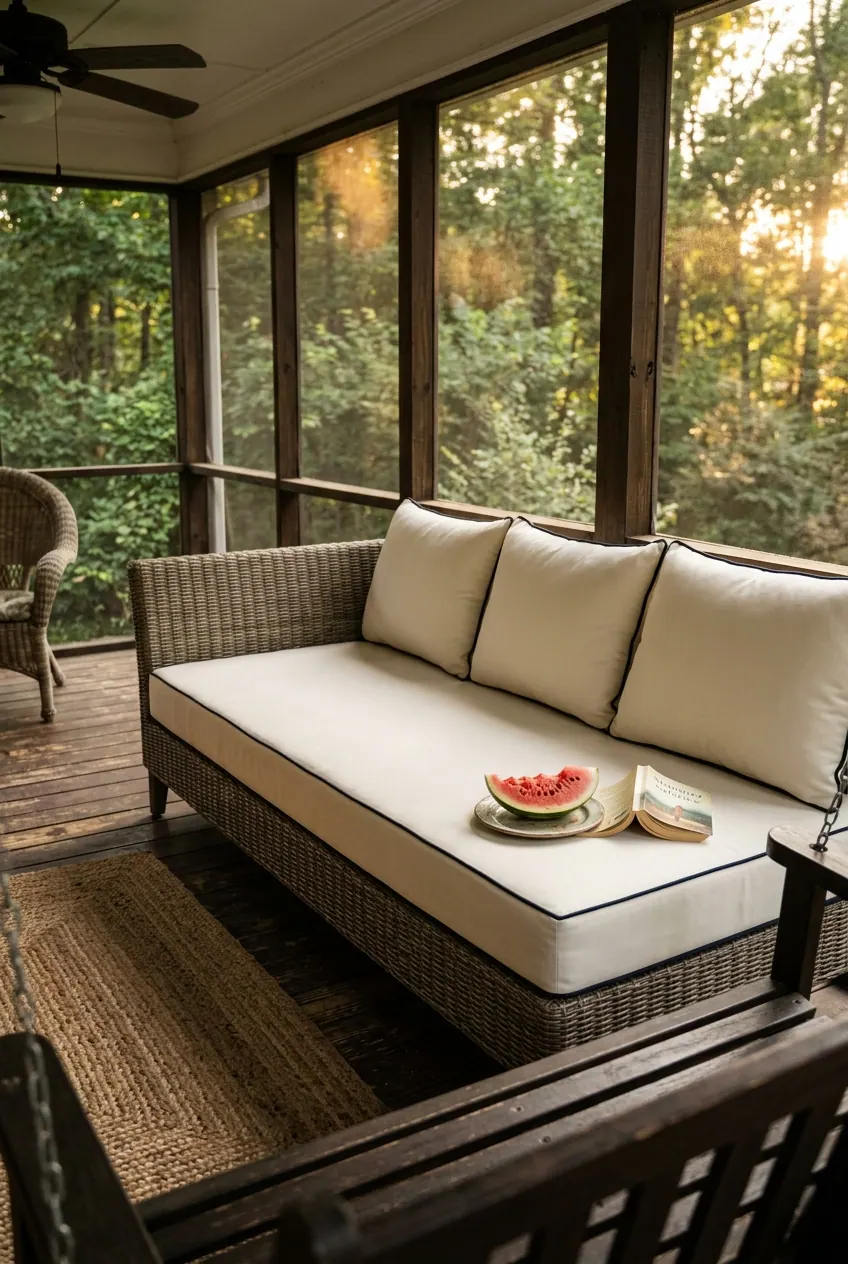
Sleeping porches were built into many Minnesota houses in the early 1900s, during the fresh-air movement. If yours is still screened, a daybed there wants outdoor fabric: screens let in pollen and damp air. Indoor fabric belongs under a closed roof, behind glass. The Pattern on covered porches draws the line.
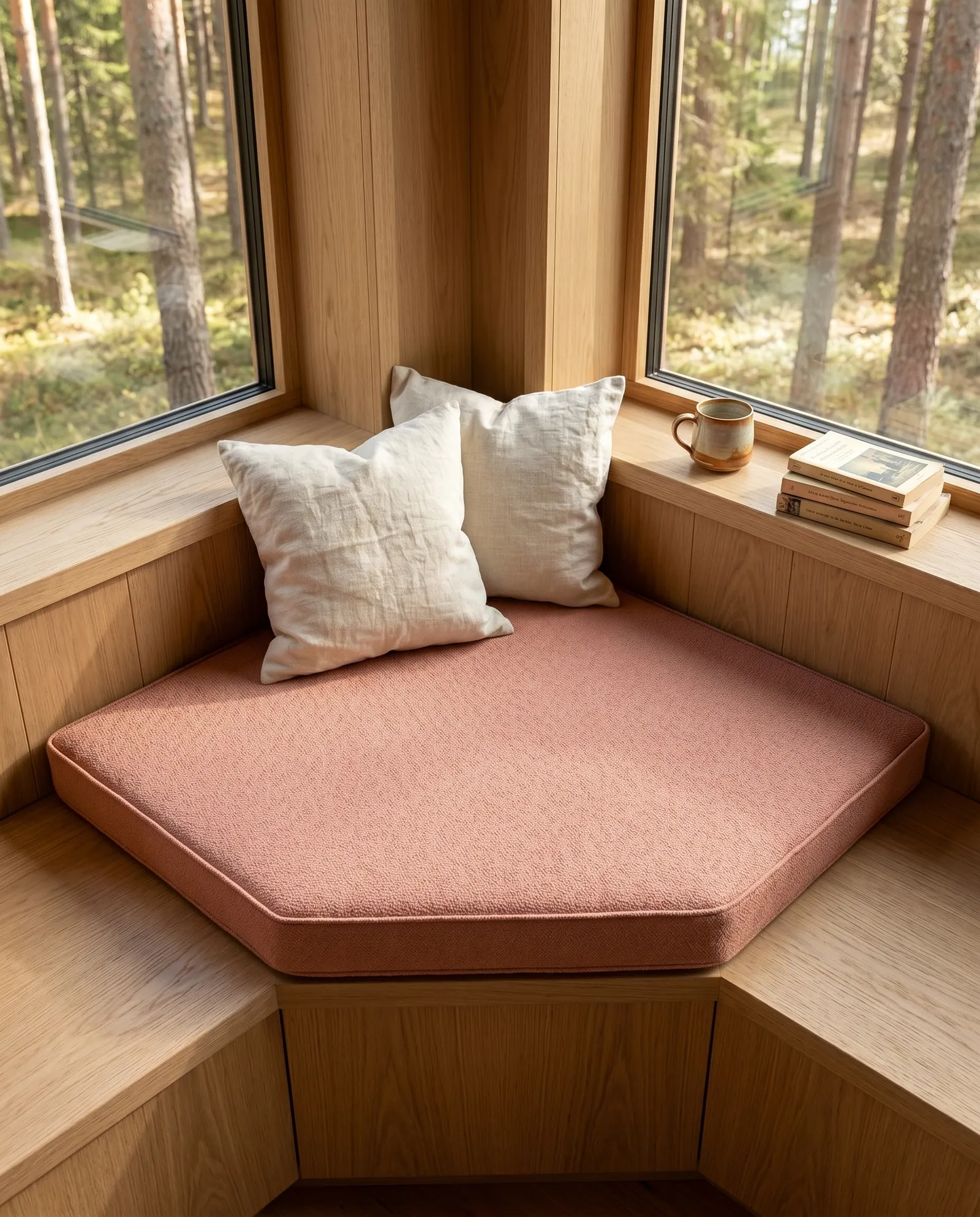
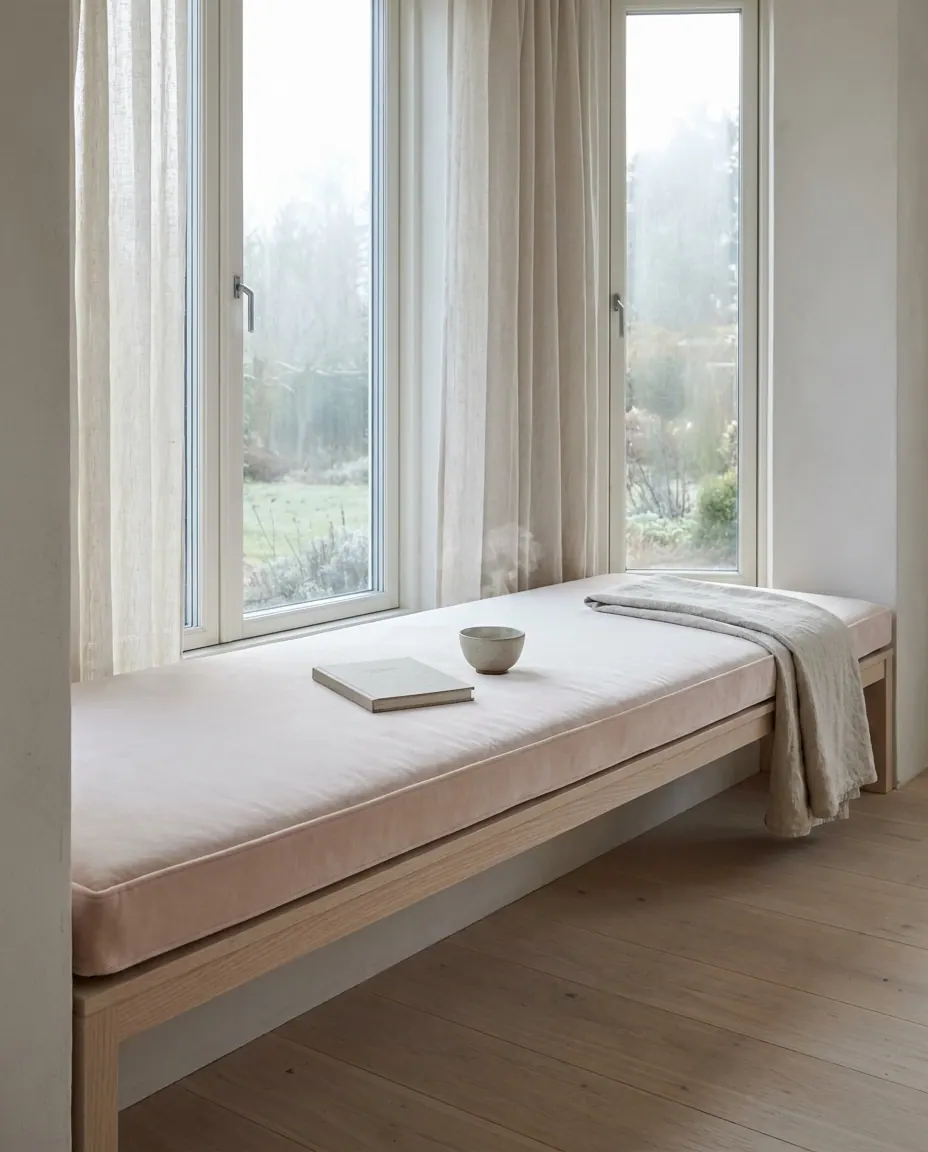
Inside, rooms tend to be plain. Minnesota has the highest share of Scandinavian ancestry of any state, and it shows in pale wood, white walls and a few good things. Height is a feeling. On a window seat, 3 in (7.5 cm) keeps the line low. 4 in (10 cm) is for the seat you nap on.
The wider region is on the Midwest page. Lake cabins share a lot with Great Lakes cottages.
Snow outside. Light on the seat. Nothing else needed.
Window seat, bunk, porch: what to choose
| Seat | Fabric | Thickness | Notes |
|---|---|---|---|
| Window seat in winter light | Linen or soft performance fabric, light neutral | 3 in (7.5 cm) | Self piping keeps the line quiet |
| Cabin bunk or daybed | Soft performance fabric or linen | Cover cut to the mattress | State length, width and thickness |
| Screened sleeping porch | Outdoor fabric, UV-resistant and water-repellent | 3 to 4 in (7.5 to 10 cm) | Indoors from the first freeze to spring |
| Glassed three-season porch | Linen, velvet or soft fabric | 3 to 4 in (7.5 to 10 cm) | Fine under a closed roof; keep wet boots off |
| Two bunk cushions for sleepovers | Any indoor fabric | Same thickness for both | Ties on the edges hold them flat together |
| Dock bench at the cabin | Outdoor fabric, not tufted | 2 to 3 in (5 to 7.5 cm) | Ties at the back corners; in before storms |
Seat foam is 32 kg/m³, about 2.0 lb/ft³, firm enough for daily use at any thickness. One contrast piping line is plenty in a calm room.
Picked for Minnesota
Seats to start from
Fabric families
Try it in the Studio
Two daybeds under two windows
A parent in the US wanted two twin XL daybeds under windows, one in each child's room. Not beds against a wall. Sofas for reading.
The mattresses measured 38 x 80 x 10 in (97 x 203 x 25 cm). She asked for extra-tall back pillows, about 26 in (66 cm) high, running the full length. That height fills the space between mattress and window, so the daybed reads as a sofa by day.
She liked linens 2, 3 and 6 and asked for larger photos before choosing. Good. Pale linens shift a lot between a screen and a gray January window.
The same method fits a sleeping-porch daybed or a cabin bunk. Give the mattress's length, width and thickness, and the height up to the sill. What is the height from your mattress to the sill?
- Measured
- Two twin XL mattresses 38 x 80 x 10 in; back pillows about 26 in high
- What it taught
- Give the mattress size and the sill height, so the back pillows fill the gap.
Closing the cabin, opening the porch
- Late September: Duluth averages 2 freezing nights in September, International Falls 4. Bring porch cushions in before them.
- Wash covers at 86°F (30°C) on a gentle cycle and air dry. No tumble dryer, especially for non-slip pads.
- Dry the foam completely, standing on edge where air moves.
- Store off the floor, in a breathable bag or a dry closet. Never sealed damp.
- Storm season: carry porch cushions in when hail is forecast.
- May: Minnesota's outdoor-cushion searches peak sharply. Check stored cushions for damp spots before they go out.
- Winter: wipe the sill dry under a window seat by cold glass.
A note on repellent finishes and the PFAS law
Since January 1, 2025, Minnesota has prohibited intentionally added PFAS in 11 product categories, including textile furnishings and upholstered furniture. PFAS have been used in some water- and stain-repellent finishes, which is why the rule matters for outdoor fabric.
The workshop describes its outdoor fabric as UV-resistant and water-repellent. It does not call it PFAS-free, and neither will I without the mill's paperwork. If the finish matters to you, ask for the fabric's documentation before ordering. This is a summary, not legal advice; the Minnesota Pollution Control Agency lists the categories.
Photographs for homes like these
Open any photograph large; each one has its own link and a Save button.
 Save
 Save
 Save
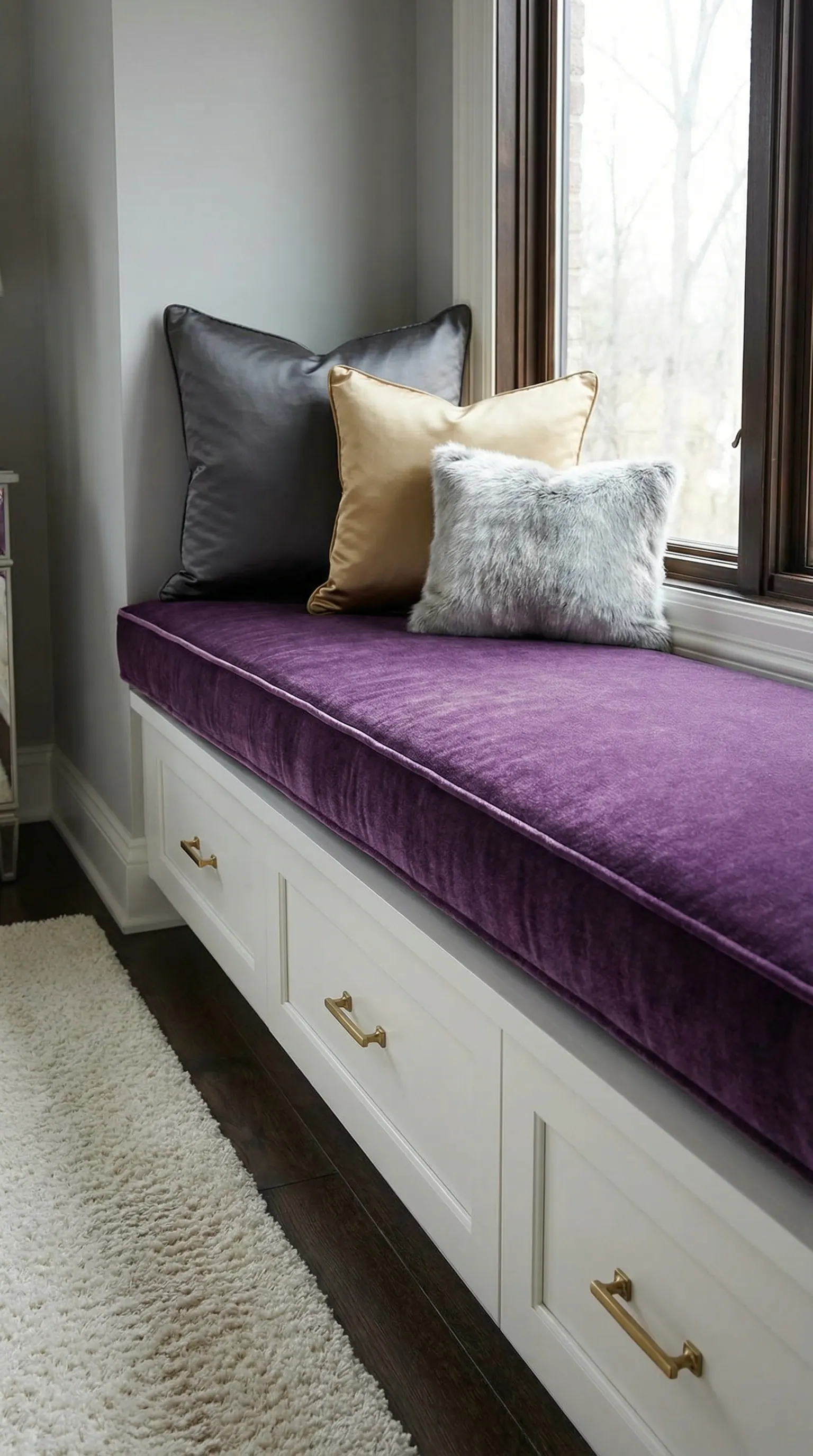 Save
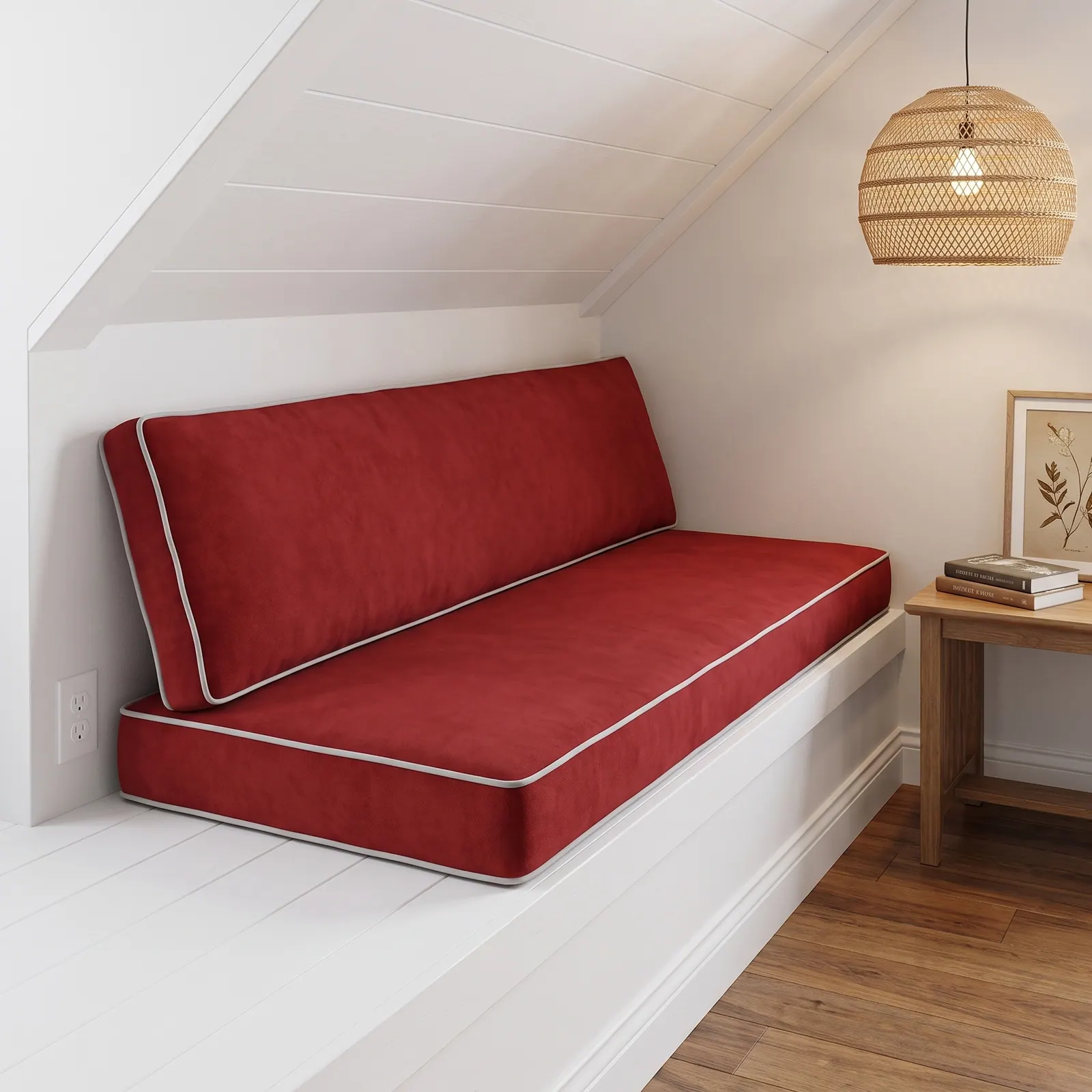 Save
A palette for short days
- Birch white#EEEBE3Returns what light December gives.
- Oat linen#D8CDB9Warm without turning yellow in cool light.
- Lake slate#5E6B73Hides lint on a cabin bench.
- Pine green#3E5344For one pillow, not the whole seat.
- Lingonberry#9E2B35One line of piping in a white room.
In a Minnesota winter, the window seat is where the day's light goes. Keep the cushion low and the color pale.
Hana
Buyer questions: bunks, daybeds and dry storage
- A common question
What do you need to make a cover for my daybed mattress?
The workshop's answerThe mattress's length, width and thickness, for example a twin at 39 x 75 x 12.5 in. If no thickness is given, the workshop may assume a double-layer mattress and make the cover twice as thick, so always state it.
- A common question
Can two cushions tie together so they lie flat as a bed for sleepovers?
The workshop's answerYes. Ties can go on the edges or corners, so a seat and back, or two floor cushions, tie into one bigger sleeping surface. Specify the ties for every cushion in the order.
- A common question
Will your linen cushions be all right on a covered porch?
The workshop's answerYes, under a roof. For a daybed on a covered patio, the workshop checked the area was under a roof before recommending the regular fabric.
- A common question
Can I take the cover off and put it in the washing machine?
The workshop's answerYes. Covers zip off completely. Machine wash at 86°F (30°C) on a gentle cycle, air dry without a tumble dryer and iron on low if needed. Non-slip pads in particular don't tolerate the dryer.
- A common question
What's the real difference between 2, 3 and 4 in cushions?
The workshop's answer2 in is a slim, low-profile pad; 3 in adds cushioning and a fuller look while still sitting neatly; 4 in is noticeably plumper. All use firm 32-density foam, and 3 in is a solid middle ground for benches and window seats.

Have it made
Have it made for your home — ask Hana’s workshop
A good size is a quiet thing. You notice it only when it is wrong. Let the workshop check yours first. — Hana
Leave your details and the workshop will call you to confirm measurements, fabric, foam and piping. No prices, dates or payment on this page: it is a request, not an order.
Questions buyers ask next
When do cabin porch cushions come in up north in Minnesota?
Before the first freeze. Duluth averages 2 freezing nights in September and 12 in October; International Falls 4 and 16. Wash and dry covers and foam in September, while the air is still warm.
Can a cabin bunk cushion be made thick, like a mattress?
Yes. A pair of cushions for a camper top bunk was quoted at 12 in thick. Measure the headroom first, from the bunk deck to the ceiling or the bunk above, and leave room to sit up.
Does Minnesota's PFAS law cover cushions?
The prohibition in force since 2025 covers intentionally added PFAS in textile furnishings and upholstered furniture, among 11 categories. This is a summary, not legal advice. Ask for the fabric's documentation if a repellent finish matters to you.
Should hail change where I keep Minnesota porch cushions?
Yes, in storm season. Minnesota ranked fourth in the nation for hail loss claims from 2017 to 2019, with 150,673. Carry porch and dock cushions in when hail or severe storms are forecast.
— Hana
Concept Sketches
Sketches for homes like these
Real projects, drawn up as ideas you can borrow.
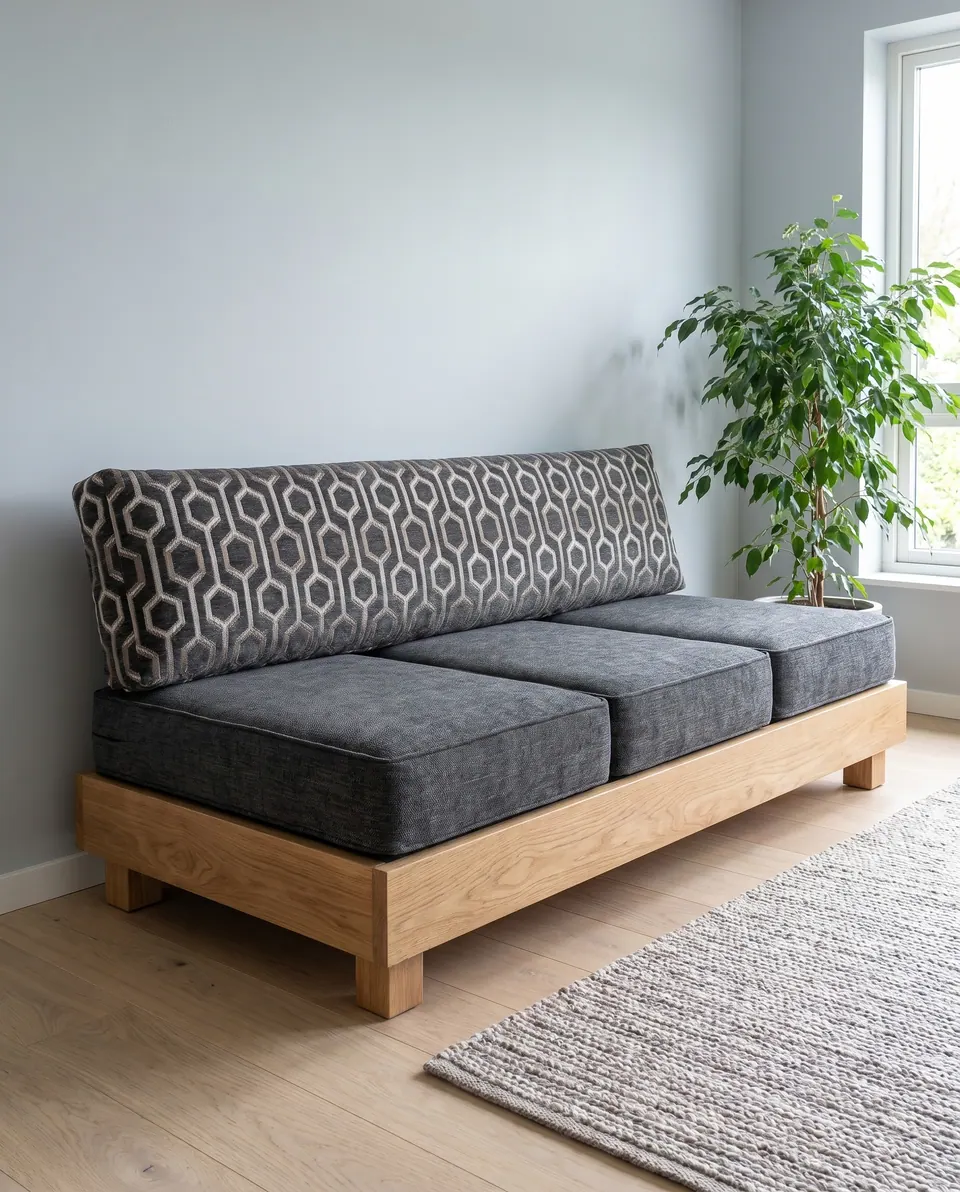
The atelier
Keep going
Across the Map
Nearby places
Close by on the map