Across the Map · Midwest · United States
Custom cushions for Illinois homes beyond Chicago
Chicago has its own page. This one covers the rest of the state: long Prairie School benches under bands of windows, Victorian bays in Springfield and Peoria, lidded farmhouse boxes downstate, and suburban decks that meet May hail. Every one of them is a list of honest measurements.
- Sun & UVModerate
- HumidityHumid
- WinterCold
- SettingInland
- Typical seatsPrairie built-in bench, storage bench with lift-up lids, victorian bay window seat

 Save
The quick answer
Custom cushions for Illinois homes outside Chicago start with the seat's own geometry: measure long Prairie built-ins as one run, split storage benches at every lid line, and order firm, about 2.0 lb/ft³ (32 kg/m³) foam for daily sitting. Deck cushions need outdoor fabric, a dry indoor spot from the first freeze to spring, and a fast carry-in plan for May hail.
Springfield to Rockford: 111 to 141 freezing nights
An Illinois cushion lives two lives a year: a humid one in August and a dry, furnace-warmed one in January. Build for both and the seat stays square.
The numbers come from NOAA's airport stations. Springfield gets 38.04 in (97 cm) of precipitation and 21.8 in (55 cm) of snow a year, Peoria 37.55 in and 26.2 in, Rockford 37.24 in and 37.1 in. Nights at or below 32°F (0°C) run about 111 a year in Springfield, 124 in Peoria and 141 in Rockford. Summer mornings are damp: Peoria's August mornings average 89% relative humidity. Springfield sees about 33 days a year at 90°F (32°C) or hotter.
Sun is moderate, not absent. Springfield averages 57% of possible sunshine, and a south-facing band of windows still bakes a bench seat on a July afternoon.
Then comes May. Illinois ranked fifth in the nation for hail loss claims from 2017 to 2019, with 150,416 of them, and the state's searches for outdoor cushions run in one sharp May peak with almost nothing in winter. So deck cushions here are a stack-and-store system, not furniture that lives outside. The winter storage Pattern covers the off-season half.
Long, low and built in: Prairie benches, Victorian bays, farmhouse boxes
Oak Park holds the world's single greatest concentration of houses by the Prairie School architects; Frank Lloyd Wright moved there in 1889. The style runs horizontal: low roofs, broad eaves, windows grouped in long bands. In Springfield, the Dana-Thomas House (1902 to 1904) still holds more than 100 pieces of furniture designed for it. Build a bench under one of those bands and the cushion becomes a straight run that can pass 100 in (254 cm), with casings that stick out a little.
Peoria's West Bluff mixes Italianate, Second Empire, Queen Anne and Prairie houses, most built between 1875 and 1924, with bays to match; see bay window cushions and the Chicago bay notes. Downstate, the farmhouse is often an I-house, a name coined in the 1930s because the type was so common on farms in Indiana, Illinois and Iowa. Its benches are plain boxes, many with lids. The suburbs add mudroom benches and decks.
Three rules for these seats, partner: 1. Measure the run, not the old cushion. Front edge wall to wall at seat height; depth at both ends and the middle. 2. Split at every lid line. One cushion per lid, or the lid won't open fully. The hinged-lid Pattern has the tie details. 3. Decide one piece or two before you order. The long bench Pattern lays out the trade-off.
Built-in, lid box, bay, deck: fabric, foam and piping by seat
Indoors you choose for hand and color. Anywhere rain or hail can reach, choose outdoor fabric and a way to carry it in.
| Seat | Fabric | Foam and thickness | Piping | Build note |
|---|---|---|---|---|
| Prairie built-in under a band of windows | Linen-look, velvet or corduroy | 3 in (7.5 cm) for a low, flat line; 4 in (10 cm) for daily sitting | Self-piping, so the edge reads as one horizontal line | One continuous piece is possible; notch around casings from a drawing |
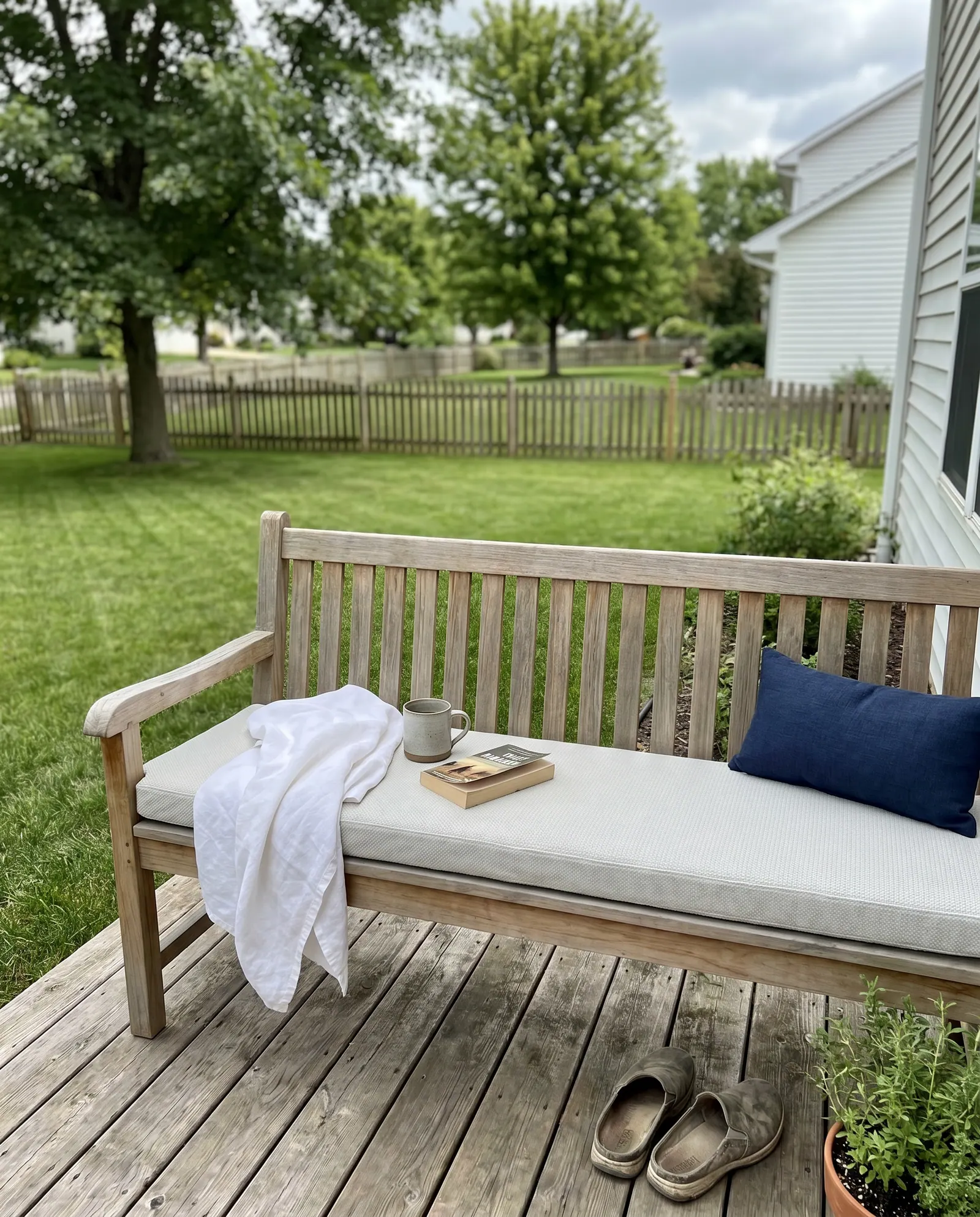
| Storage bench or window box with lift-up lids | Linen-look or a performance weave | 2.5 to 3 in (6.4 to 7.5 cm) | Self-piping | One cushion per lid; ties on the hinge side only |
| Victorian bay seat in Springfield or Peoria | Velvet or corduroy for winter; linen-look where the sun is strong | 3 to 4 in (7.5 to 10 cm) | Contrast welt to trace the angles | Custom-shape listing with every edge drawn |
| Reading bench adults use every day | Performance weave or velvet | Firm 32 kg/m³ foam; 6 in (15 cm) on request | Self or contrast | Density decides lifespan; firmness decides feel |
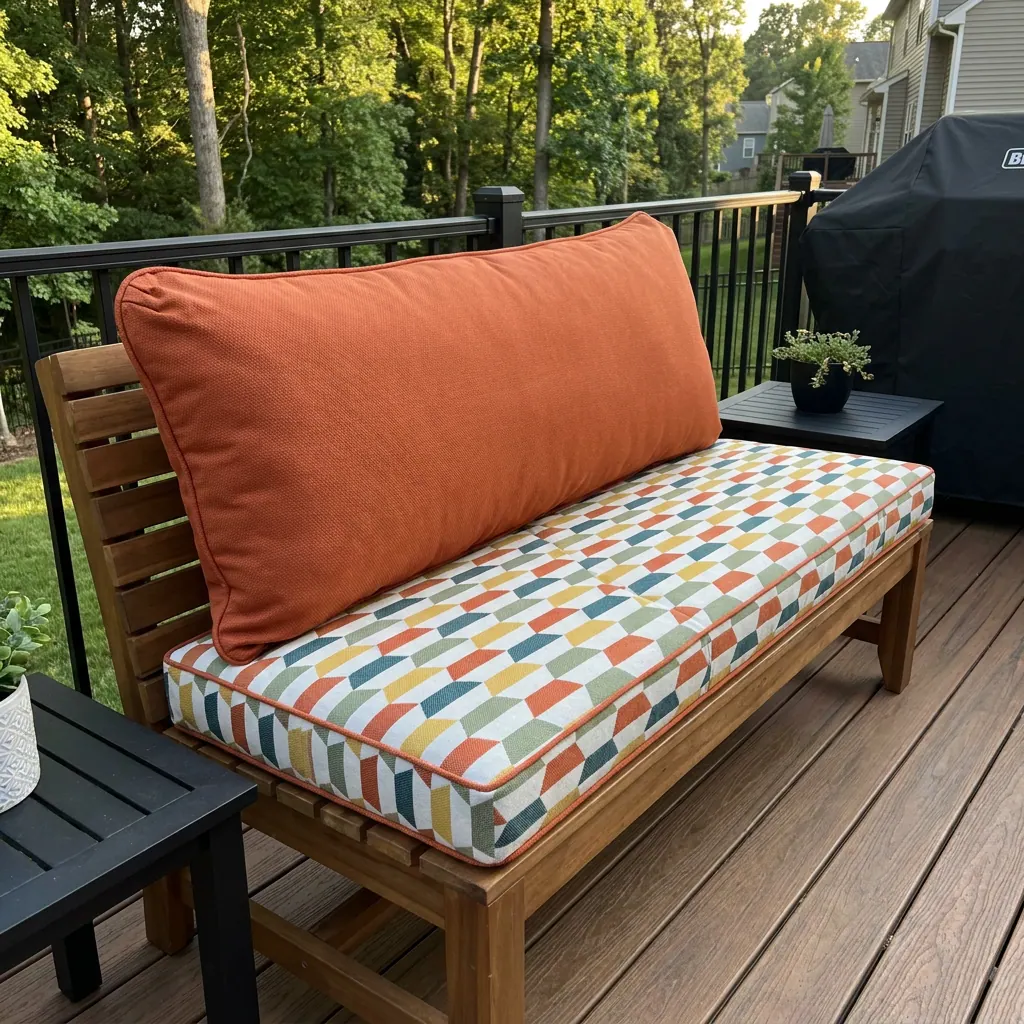
| Suburban deck sectional | Outdoor fabric, water-repellent and UV-resistant | 4 in (10 cm) seats | Self-piping reinforces outdoor edges | Ties or a non-slip base; stacked indoors before hail and before the first freeze |
The 111¼-inch ledge and the half inch that crept
A buyer in the US ordered a bench cushion 29.5 x 111.25 in for a long built-in ledge. The workshop cut it at about 29.5 x 111.5 in (75 x 283 cm), the nearest whole-centimeter conversion. The length was perfect. The width came out at 30 in (76 cm) and crept slightly over the edge of the ledge.
Here is the arithmetic. The cut width works out to 29.53 in (75 cm), so the conversion added almost nothing. The rest is handmade tolerance: about ±3/8 in (1 cm) on any cushion, and more likely to show over a long span. A front edge also relaxes with use.
So on any built-in where the cushion must sit inside a lip or between two walls, order a hair under the maximum. On a Prairie bench with an oak lip, I would take 1/4 in (6 mm) off the depth and let the fabric fill it. Measure twice; the fabric remembers. The size tolerance Pattern explains where those millimeters come from.
An Illinois year for built-ins and deck cushions
- March: order deck cushions now. Illinois searches for outdoor cushions peak in May, and so does the rush.
- April: bring stored cushions into a warm room for a day and check for damp spots before they go out.
- May to June: hail season. Size every deck piece so one person can carry it, and stack them inside when storms are forecast.
- After a soaking: stand cushions on edge under cover and get them dry within 24 to 48 hours.
- August: the humid weeks. Unzip covers, wash at 86°F (30°C) on a gentle cycle and air dry.
- Before the first freeze: dry deck cushions completely and store them off the concrete, never sealed damp in plastic.
- January: lift window-seat cushions once in a while to air the side that faces cold glass.
Photographs for homes like these
Open any photograph large; each one has its own link and a Save button.
 Save
 Save
 Save
 Save
 Save
Oak, art glass and autumn colors in a Prairie room
Prairie rooms are wood and glass: long oak built-ins, art-glass windows, natural materials. A cushion there should read as part of the woodwork, not a pillow dropped on it.
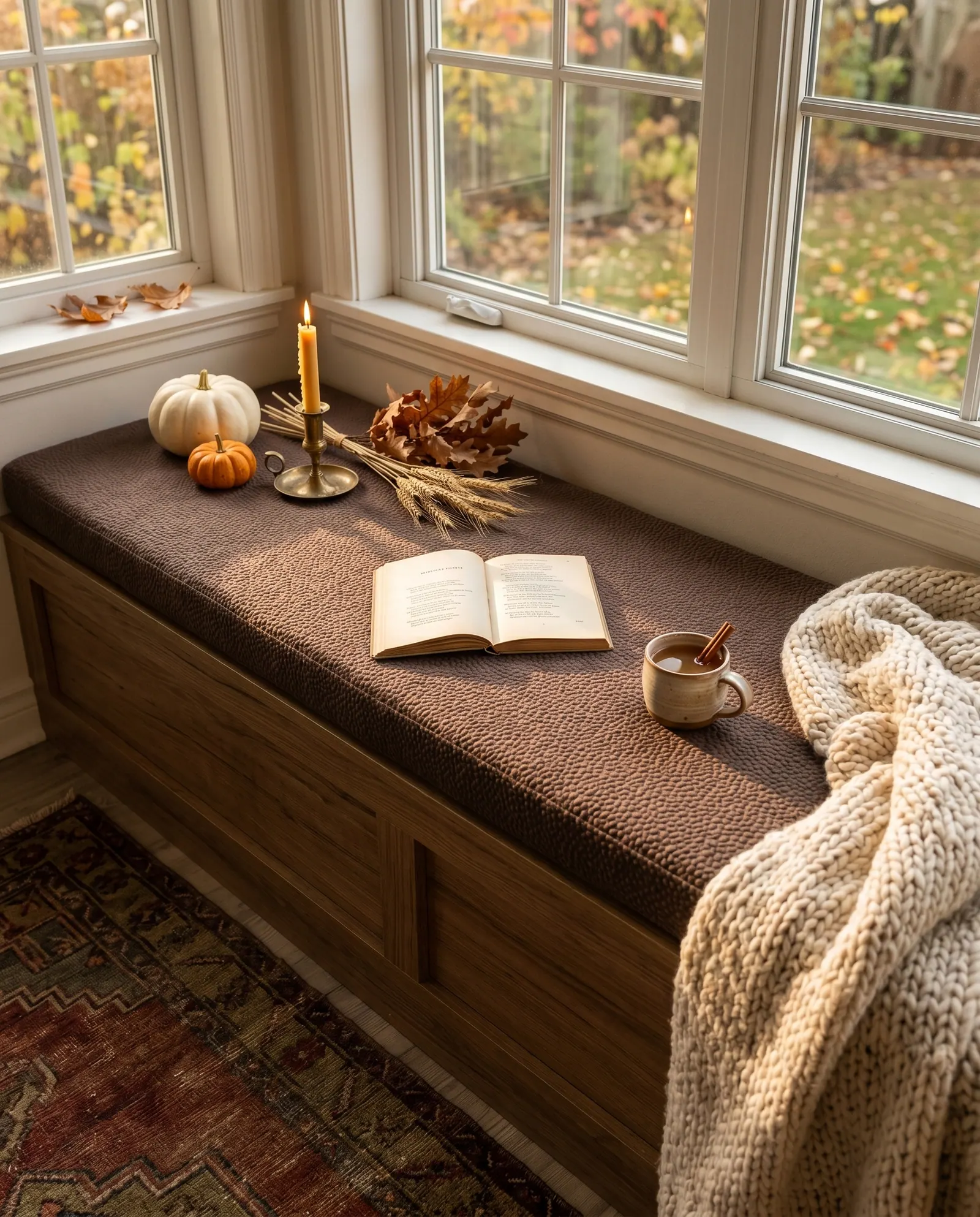
I'm an engineer, not a colorist, so I use a rule: match the cushion to the wood's undertone and let the glass supply the color. Chocolate, mocha, olive, ochre and rust sit well on oak, and a self-piped edge keeps the line flat. The photo up top shows it: a chocolate cushion on an oak storage seat under a run of white casements, dressed for fall.
Victorian parlors can take more: deep velvet with a contrast welt tracing the bay. Farmhouse boxes suit stripes and ticking; on a long run, check the stripe direction Pattern, because the roll width decides which way stripes can run without a seam.
What does your longest bench measure, end to end? Put it in the bench cushion builder and see the cutting ticket before you order.
On a long built-in, order a hair under the maximum. Handmade cushions carry about ±3/8 in (1 cm), and over 100 inches you will see it.
Nate
Buyer questions: long runs, lids and firm foam
- A common question
Can a 138-inch window seat cushion be made as one continuous piece instead of two?
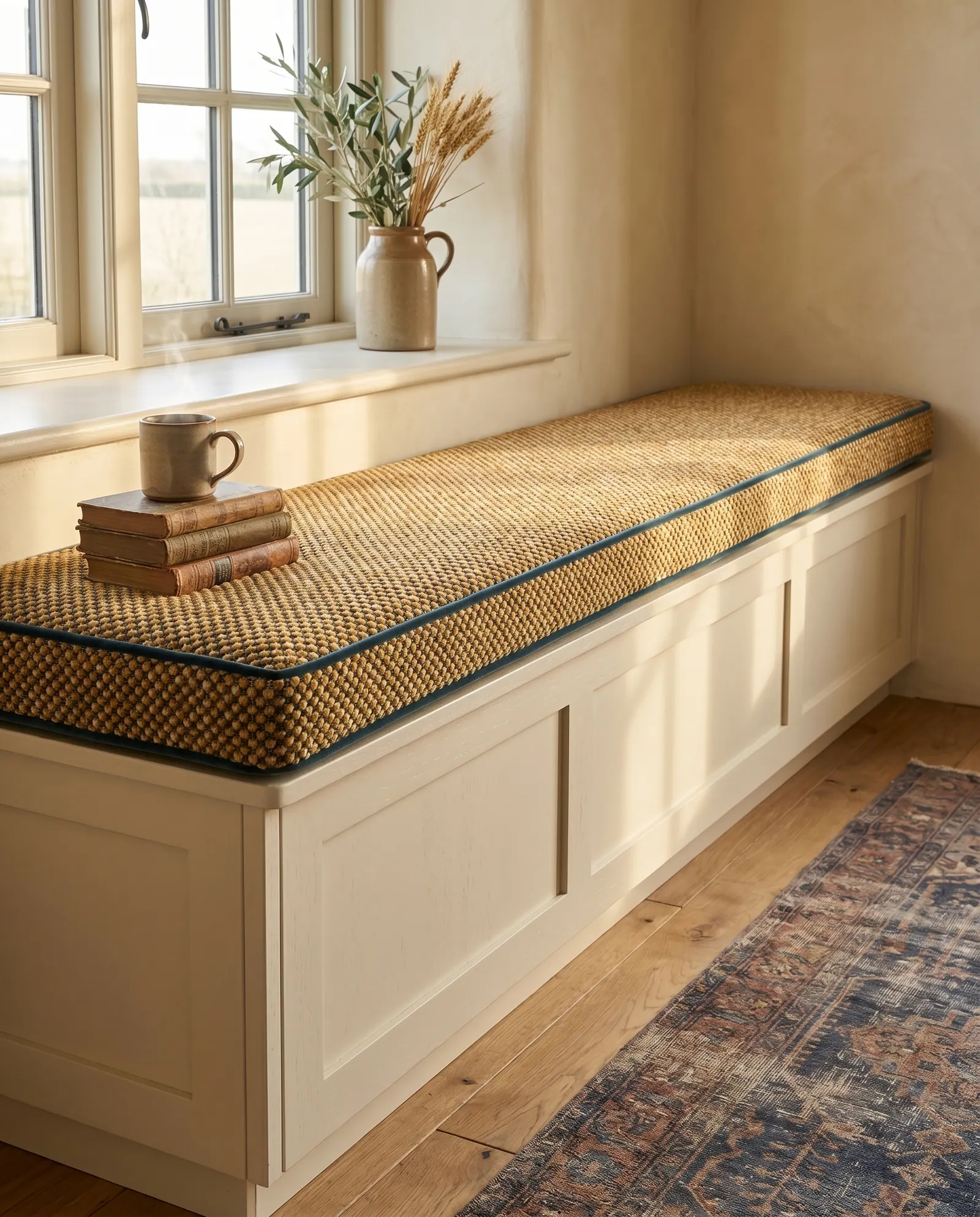
The workshop's answerYes. A 40 x 138 in (102 x 351 cm) cushion, 3 in (7.5 cm) thick, in linen with contrasting velvet piping, was made as one continuous piece, and the workshop added that exact size to the listing for checkout.
- A common question
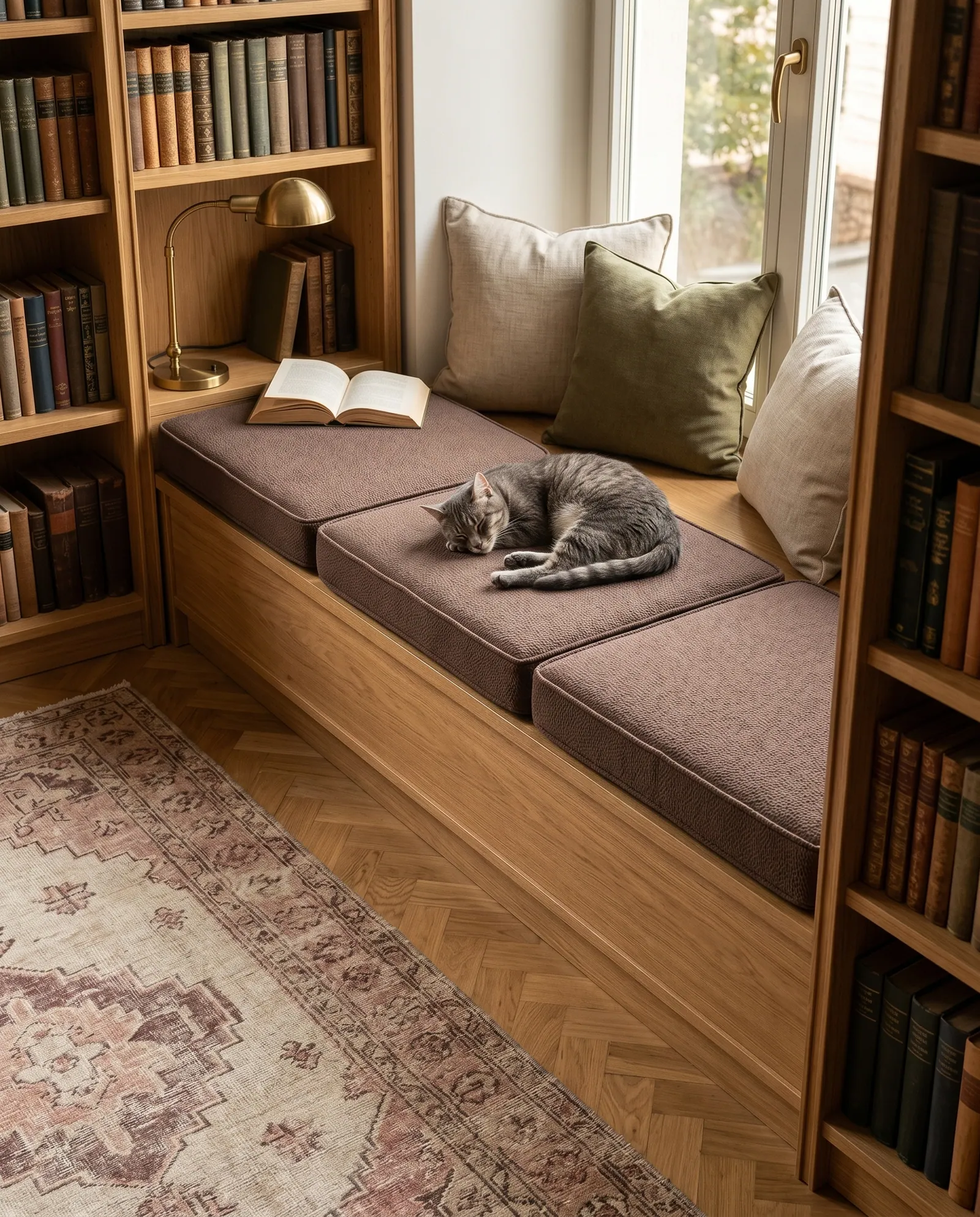
Our window seat has three flip-up lids. How should the cushions be made?
The workshop's answerAs three separate cushions, one for each lid section, so every lid opens on its own. Send clear photos and the measurements of each section.
- A common question
I need high-density foam, 1.8 lb or more and ILD 44 or firmer, 6 inches thick, so adults won't sink through. Can you do that?
The workshop's answerYes. The foam is 32 kg/m³, about 2.0 lb/ft³, so it clears a 1.8 lb requirement, and it sits in the firm category. There's no official ILD rating to quote. A 6 in (15 cm) thickness can be made; a 25 x 78 x 6 in (64 x 198 x 15 cm) bench cushion was quoted that way.
- A common question
Is foam density the same as firmness? I'd like high-density foam that's only medium firm.
The workshop's answerThey're different. Density is the foam's weight and quality, and it drives how long the cushion lasts; firmness is how it feels when you sit. High-density foam can be supplied in a medium firmness.
- A common question
Will my cushion be made to my exact size, and can you notch it around a window frame that sticks out?
The workshop's answerYes to both. Sizes are produced as written, not rounded: 22 x 99.5 in and 22 x 98.5 in cushions were made exactly so. For a frame that sticks out about 3/4 in (2 cm), send a photo and a drawing, and a notch or angled edge is cut to it.

Have it made
Have it made for your home — ask Nate’s workshop
Precision starts on the phone. Give the workshop your measurements and they will read them back to you, edge by edge. — Nate
Leave your details and the workshop will call you to confirm measurements, fabric, foam and piping. No prices, dates or payment on this page: it is a request, not an order.
Illinois questions, measured
Can Illinois deck cushions stay outside over winter?
No. Springfield averages about 111 nights a year at or below 32°F (0°C) and Rockford about 141. Water in foam freezes and thaws without drying, and the foam isn't quick-dry, so store deck cushions clean, dry and off concrete from the first freeze to spring.
How do I protect patio cushions from hail in Illinois?
Carry them in. Illinois ranked fifth in the US for hail loss claims from 2017 to 2019. Keep each piece light enough for one person, give the set a spot in the garage or mudroom, and bring it in whenever severe storms are forecast.
What thickness suits a Prairie-style built-in bench?
Three inches (7.5 cm) keeps the low, horizontal line these rooms were designed around; 4 in (10 cm) is softer for daily sitting. The foam is a firm 32 kg/m³ either way, so the thinner cushion still supports. Check the finished seat height with the calculator first.
Should a Victorian bay seat in Springfield or Peoria be one cushion?
Usually one, cut on the custom-shape listing from a drawing with every edge measured. If the long front runs past about 79 in (2 m), two pieces split at a corner are easier to make, to lift out of the bay and to unzip for washing.
± 1/4 in — Nate
The atelier
Keep going
Across the Map
Nearby places
Close by on the map