Cushions for Chicago bungalow bays, two-flats and porches
Chicago built its bungalows by the tens of thousands, most with the same angled front bay. That bay is a geometry problem with a view. Here is how I solve it, plus what porches and rooftops need in lake wind.
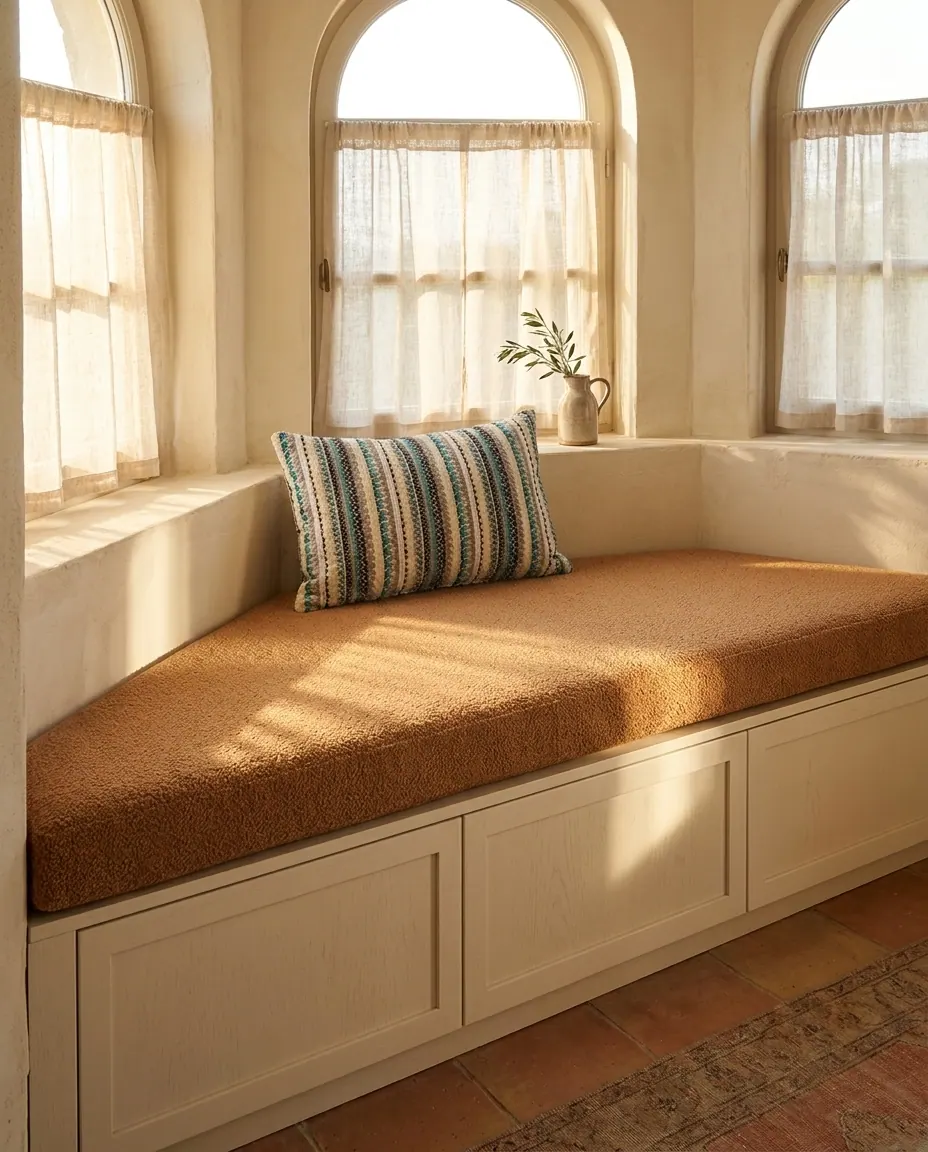
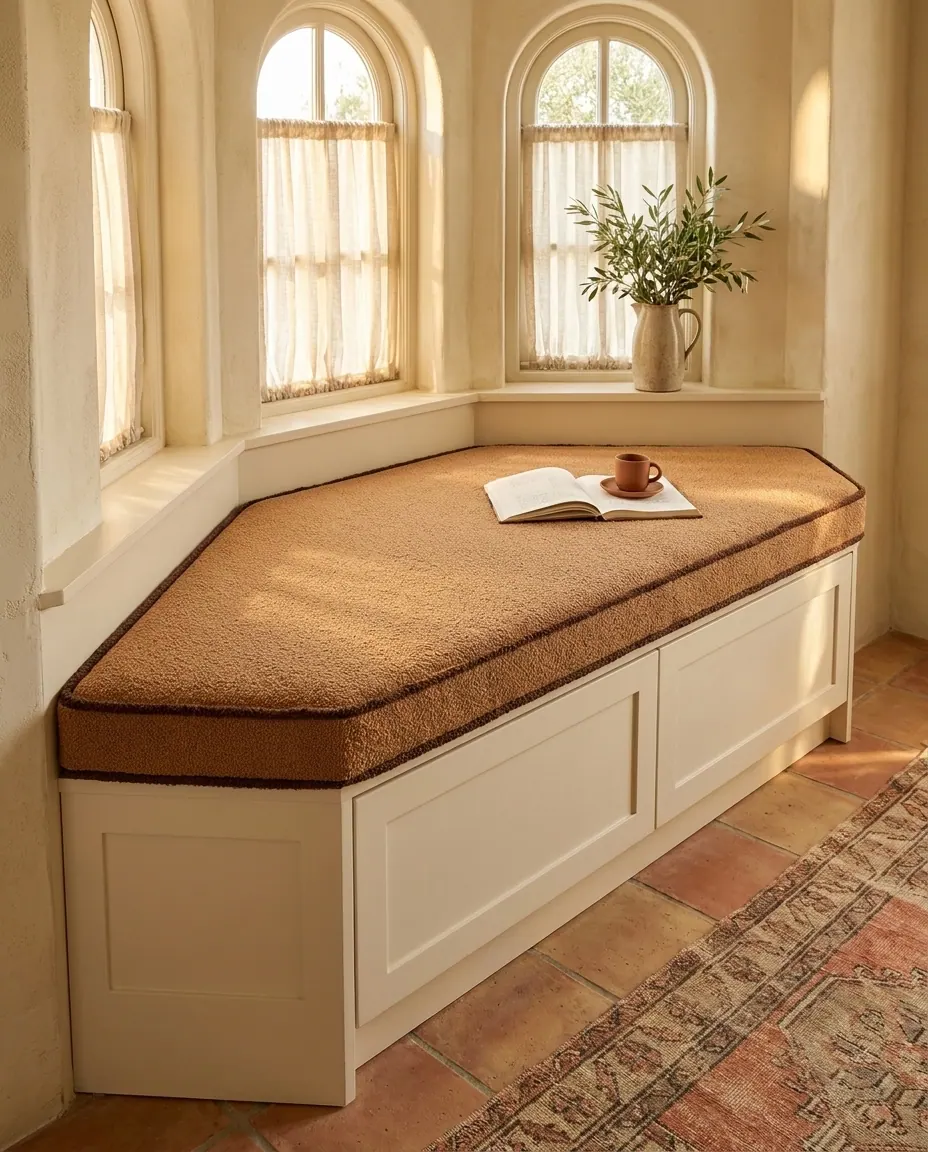
SaveGolden-hour sun rakes across a caramel bouclé bay cushion, with one teal striped pillow for contrast.
The quick answer
A Chicago bungalow window seat cushion is a clipped trapezoid: a long straight front, a center window panel, two slanted sides and usually short straight returns at each end. Measure every edge, each slant separately and the depth square to the front, then order on the custom-shape listing with a labeled drawing. Standard thickness is 4 in (10 cm); 3 in (7.5 cm) sits neater.
Field notes
Weather and light in Chicago
Sun & UVModerate (level 2 of 4)Bright summers, gray winters
HumidityHumid (level 3 of 4)Humid summers, dry heated winters
Rain & stormsFrequent (level 3 of 4)Storms in spring and summer
Snow & freezeRegular (level 3 of 4)Cold, snowy winters
Watch for
Wind off the lake
Radiator heat
Back porches and rooftop decks
Plain-language levels from general climate patterns, not measurements. Your own porch, shade and window exposure matter more.
Gray lake skies, 126 freezes and a radiator under the sill
The bay seat is the best seat in a Chicago house from November to March, and the one most likely to be cut wrong.
Chicago runs cool and wet. The airport station logs about 126 days a year at or below 32°F (0°C), 38.4 in (98 cm) of snow and 126 days with measurable rain or snow. Mornings average 80% relative humidity, and only about 17 days a year reach 90°F (32°C).
Sun is modest but real. The noon UV Index averages 8.4 in July and 1.1 in December. A south-facing bay still takes full summer sun through the glass, so a dark velvet there deserves a second thought.
Wind is the other variable. The lakefront and every rooftop deck get gusts, and Illinois ranked fifth in the country for hail loss claims from 2017 to 2019. Outdoor cushions here get tied down, and they come inside for winter.
Bungalow belt, two-flats and greystones: where Chicago sits
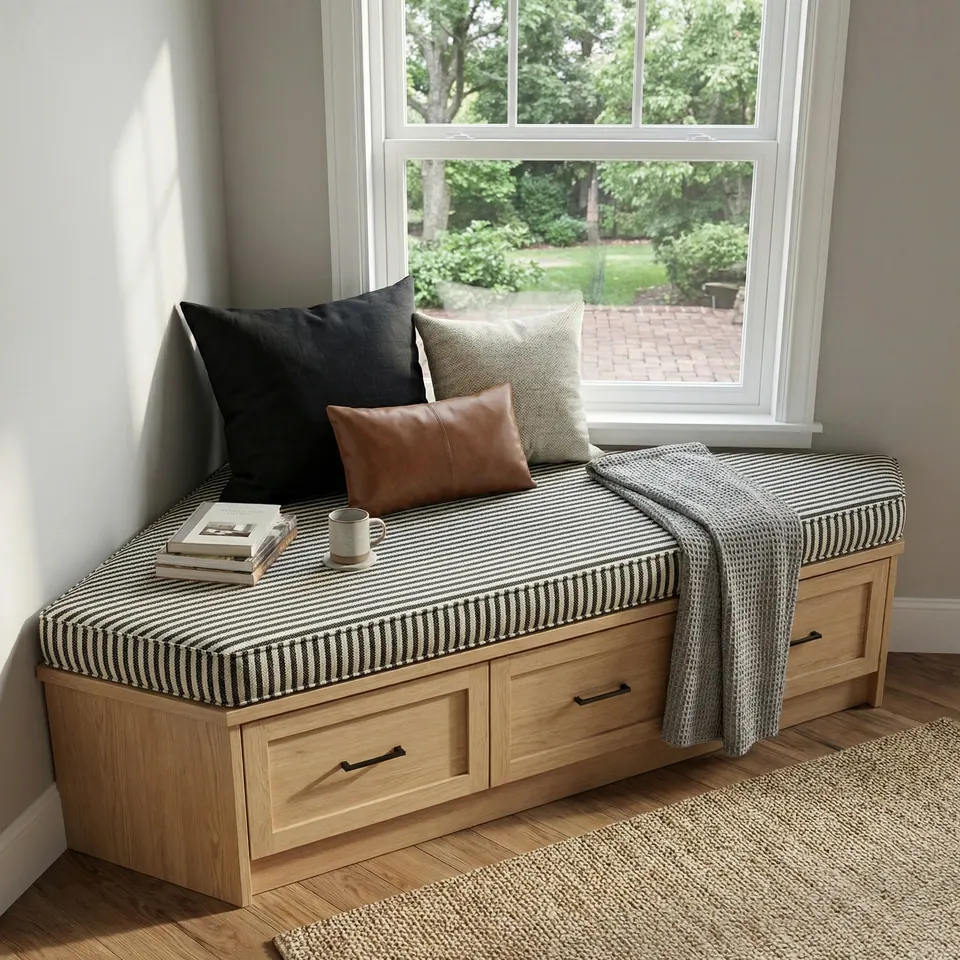
Chicago has about 80,000 bungalows, nearly a third of the city's single-family homes. Most went up between 1910 and 1940 in the C-shaped bungalow belt: brick with limestone trim, low-pitched roofs, generous windows. The front of most of them is an angled bay, and a seat built into it is a clipped trapezoid with short straight returns against the side walls. See the Craftsman bungalow window seat sketches.
Two-flats and greystones add long window ledges, often over a radiator. When a ledge like that runs long, the workshop has advised two cushions instead of one, so heat can rise between them and each piece lifts out. Courtyard buildings bring kitchen nooks and deep sills. Prairie School houses in Oak Park and the western suburbs favor long, low built-ins.
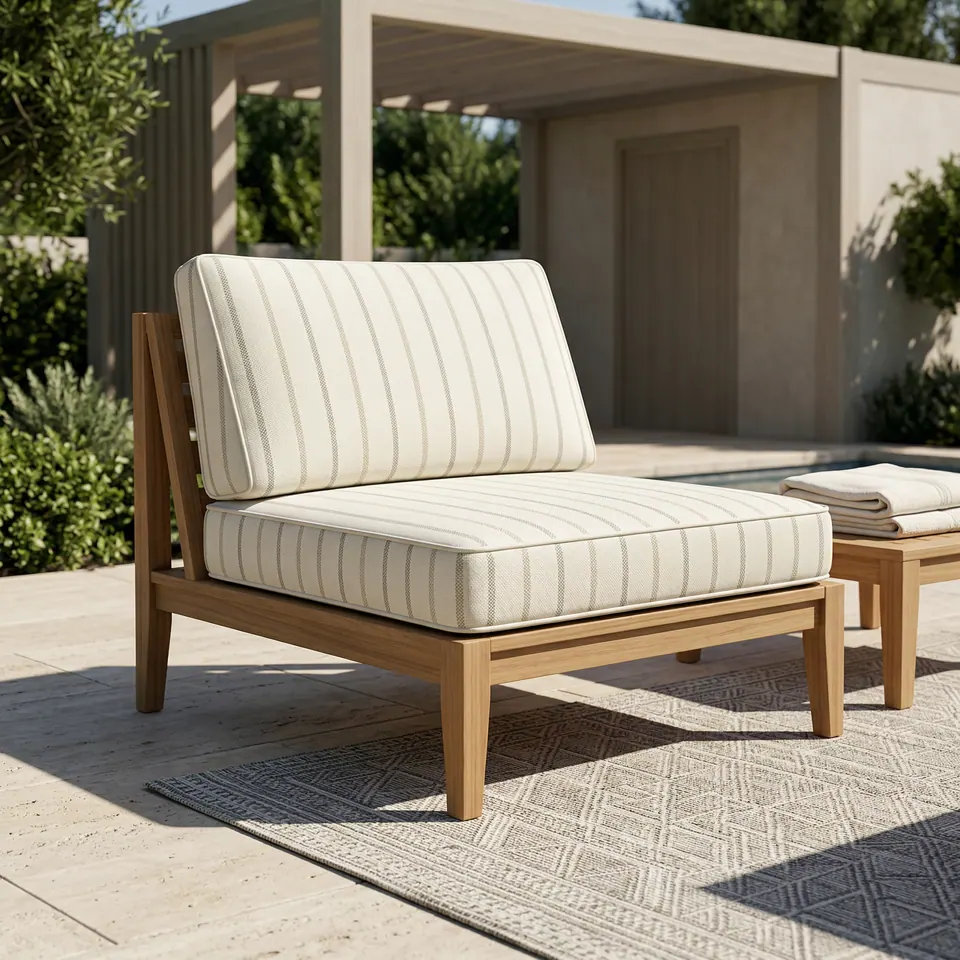
Out back there are wooden back porches, and up top, rooftop decks with sectionals. Those belong with patio and porch cushions. Which of these seats is in your house, partner?
Measuring a bungalow bay: six edges, one depth, one check
Letter every edge on a sketch
Draw the seat from above and letter the front, both returns, both slants and the center panel. A 2 in (5 cm) return still gets a letter.
Measure the front, wall to wall
Take the long straight edge at seat height, where the cushion will actually sit, not along the floor.
Measure the center panel
This is the back edge against the middle window. Measure it at seat height, trim to trim.
Measure each slant on its own
Corner to corner, left and right as two numbers. Real bays are rarely symmetrical; sides 1/2 to 3/4 in (1.3 to 1.9 cm) apart show up in real orders.
Measure the depth square
From the front edge straight back to the center panel, at 90 degrees. An angled side is always longer than the depth. If your slant comes out shorter, one number is wrong.
Make the numbers close
Run them through the bay window calculator or the trapezoid cushion calculator. If measured and calculated slants differ by more than about 1 in (2.5 cm), re-measure. In older houses, add both diagonals.
Order on the custom-shape listing
Pick the size range by the longest length and deepest depth; it only sets the price. Upload the drawing, put thickness and fabric code in personalization, and approve the maker's scale drawing before cutting. The 3-sided bay window Pattern goes panel by panel.
Bay seat, radiator ledge, porch, roof: fabric and foam by seat
Indoors you choose for hand and color. Anywhere rain or snow can reach, choose outdoor fabric and a way to hold the cushion down.
A buyer in the US opened a bay window cushion that was too long, too narrow, and pointed at both ends where the seat had square ones. We went back to the sketch.
It read: bottom 90 in (229 cm), top 52 in (132 cm), depth 27 in (69 cm), 6 in (15 cm) straight ends, 4 in (10 cm) thick. The slants were noted as 24 in (61 cm). Here is the trouble. Once the front, the top, the depth and the returns are fixed, the slants are no longer a choice. Those numbers force each slant to about 28 in (71 cm). Angles are just lengths in disguise.
While re-checking, the buyer found two extra cuts in the window frame and sent a new diagram. The workshop turned it into a drawing for approval and remade the cushion free, as goodwill. The second one fit perfectly.
Another US drawing read bottom 86.5 in, top 39.5 in, depth 24.5 in, 2 in returns and 31 in slants. The check said about 32.5 in. Re-measured, the top came back just under 40 in, and the slants really were 32.5 in. That cushion went ahead at 4 in thick, cut once.
Photographs for homes like these
Open any photograph large; each one has its own link and a Save button.
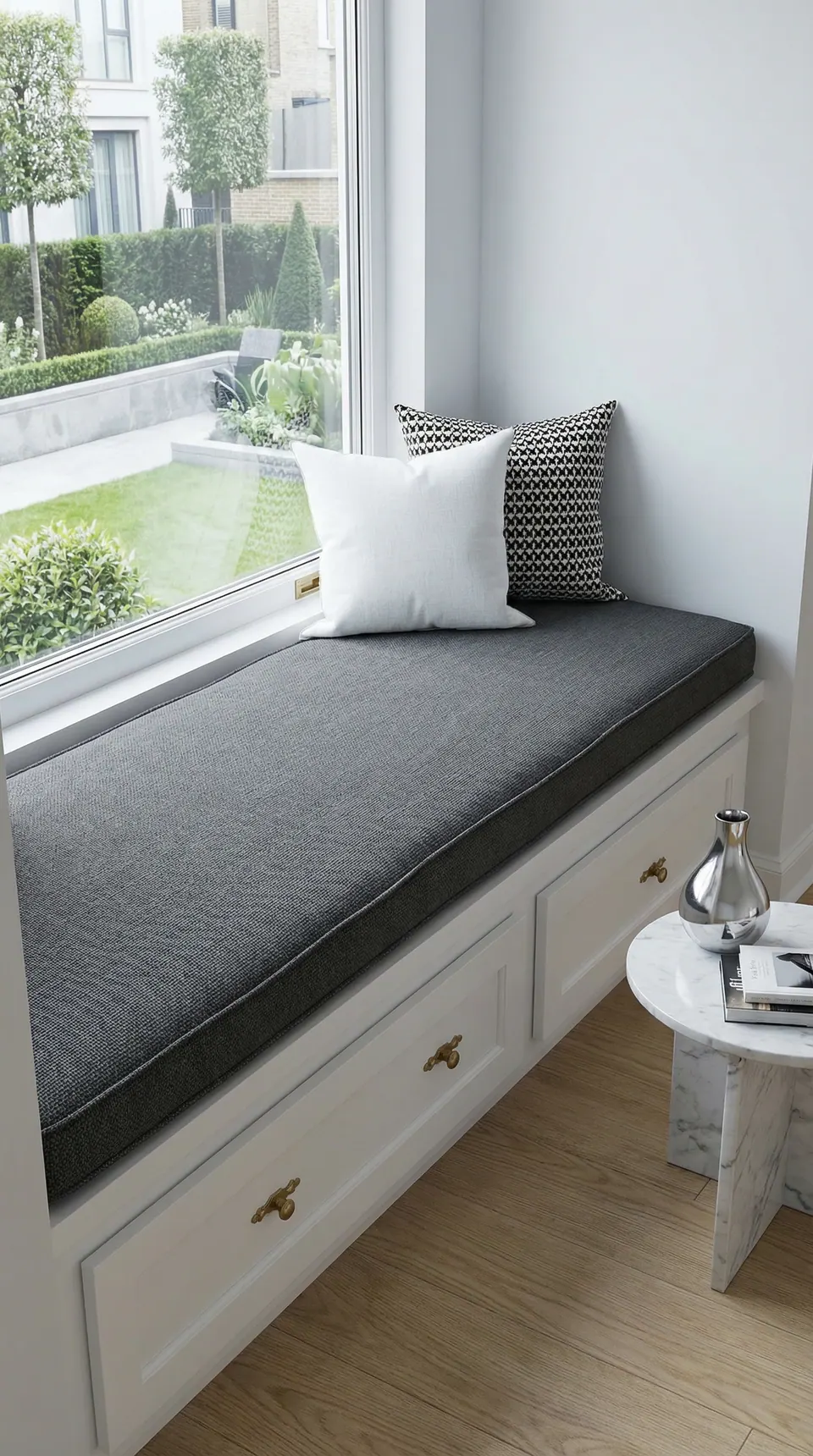
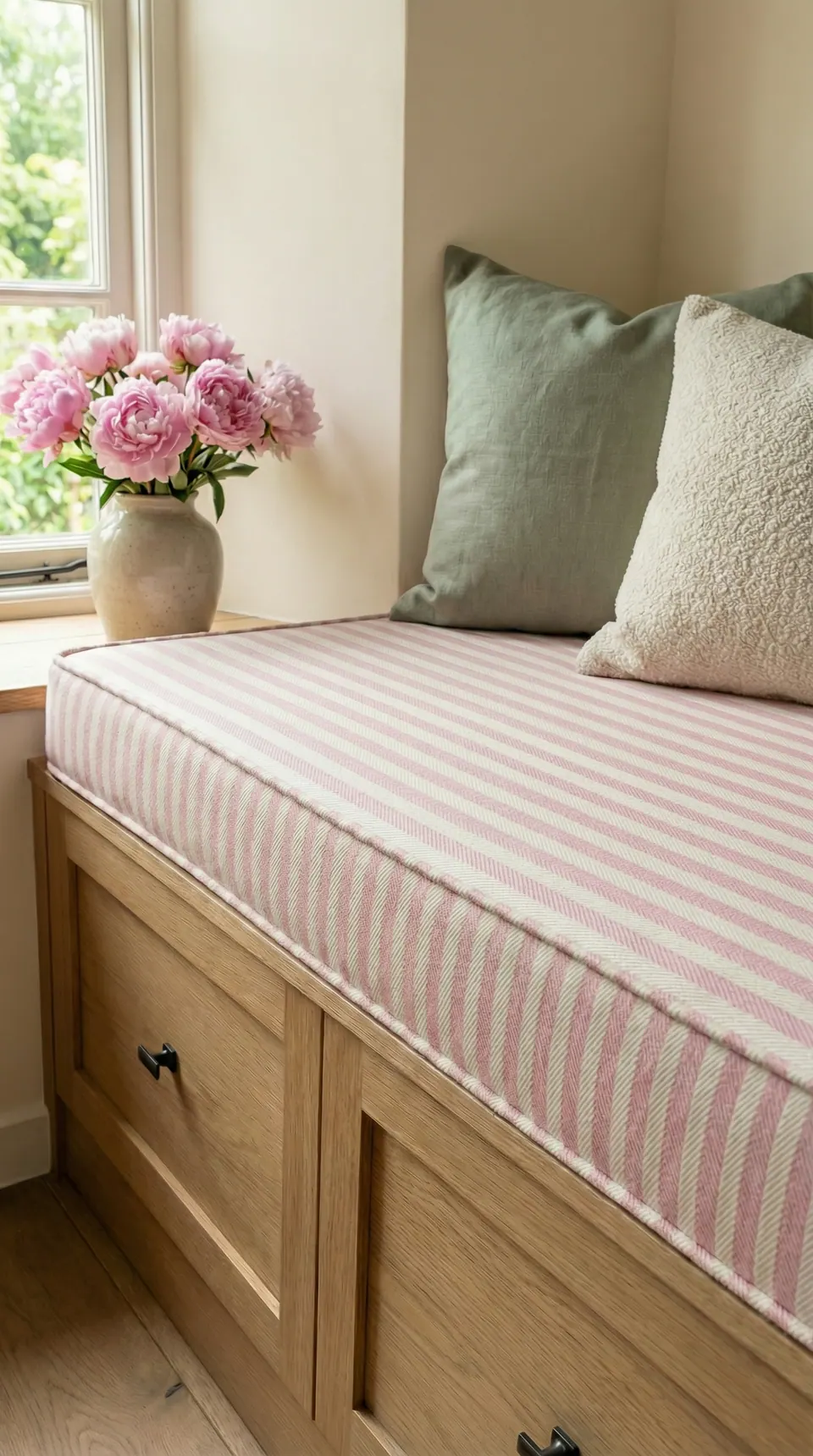
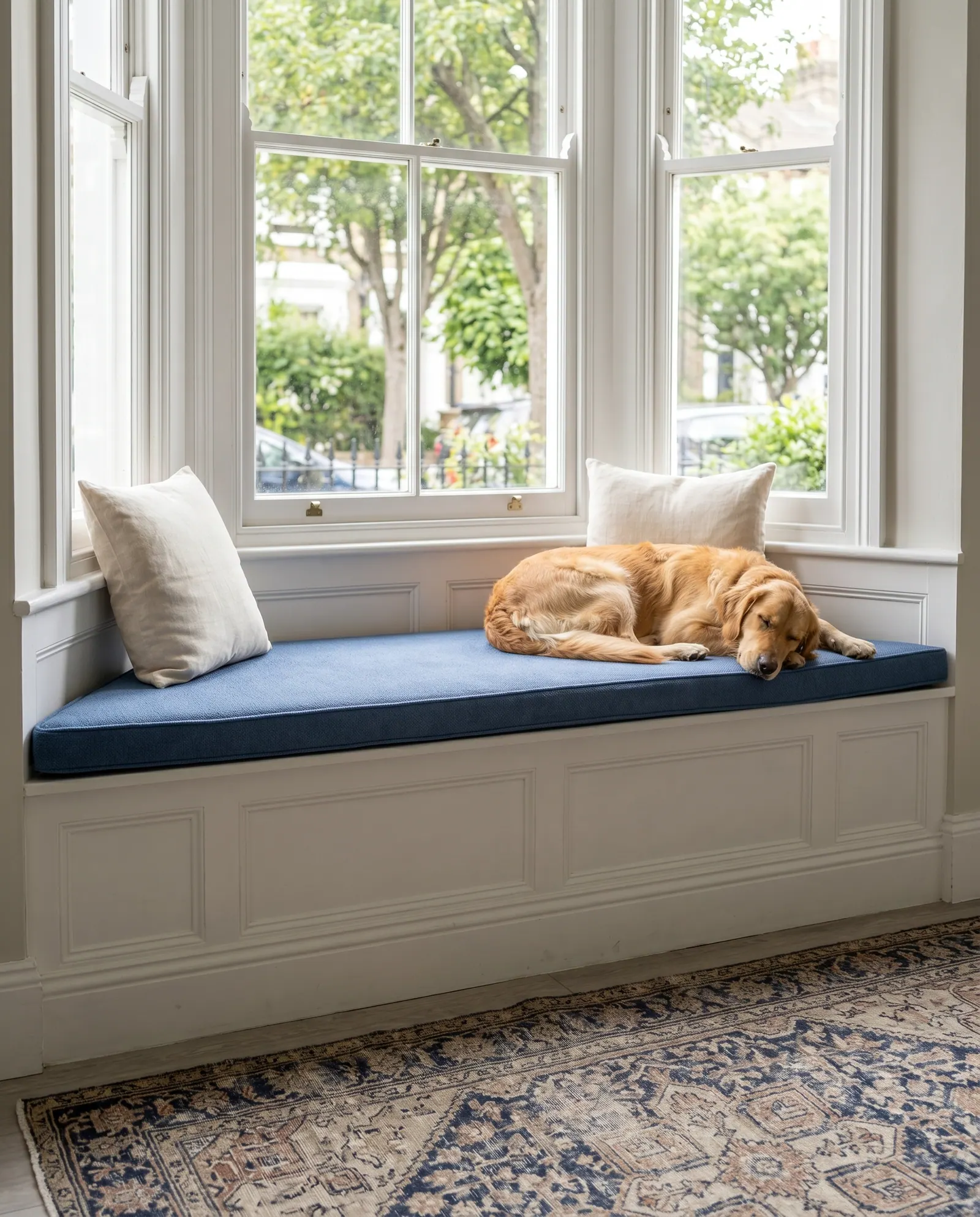
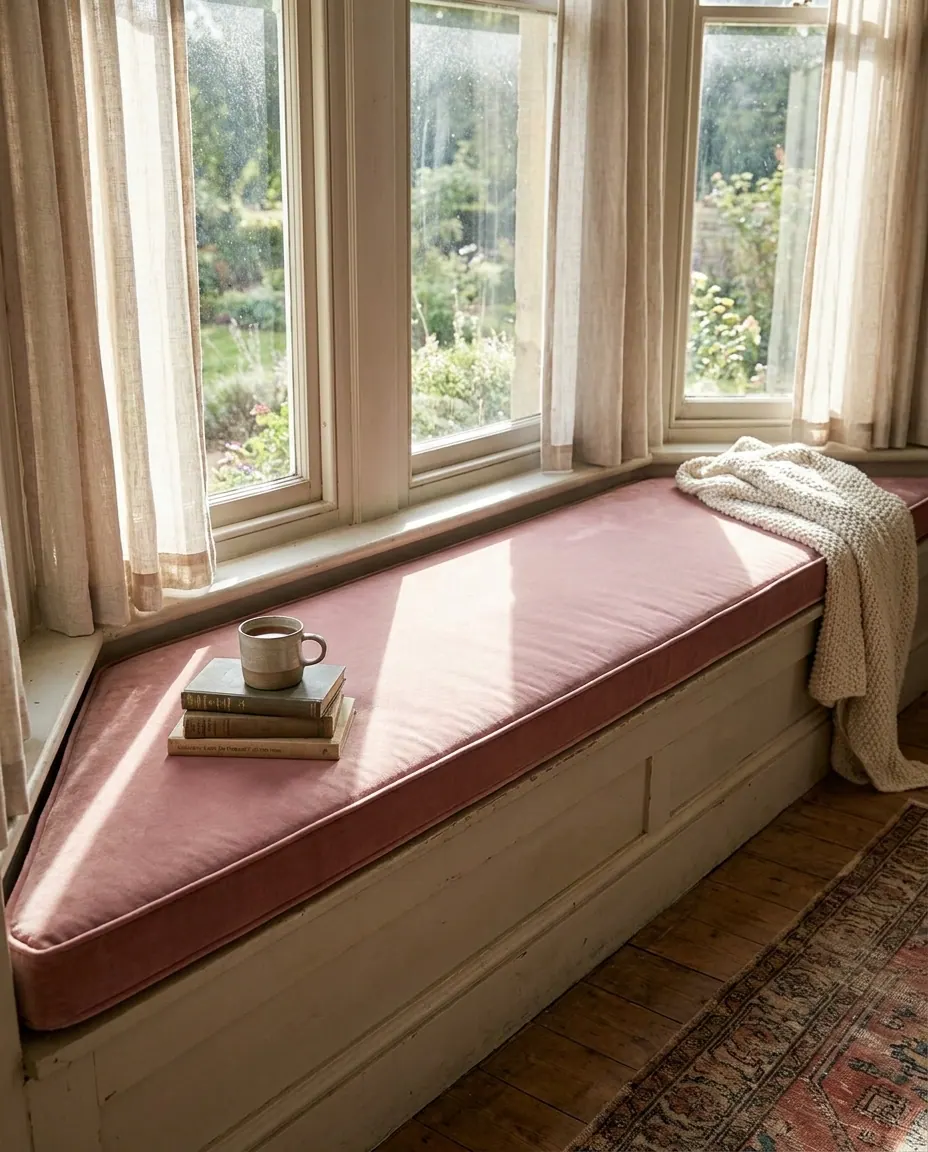
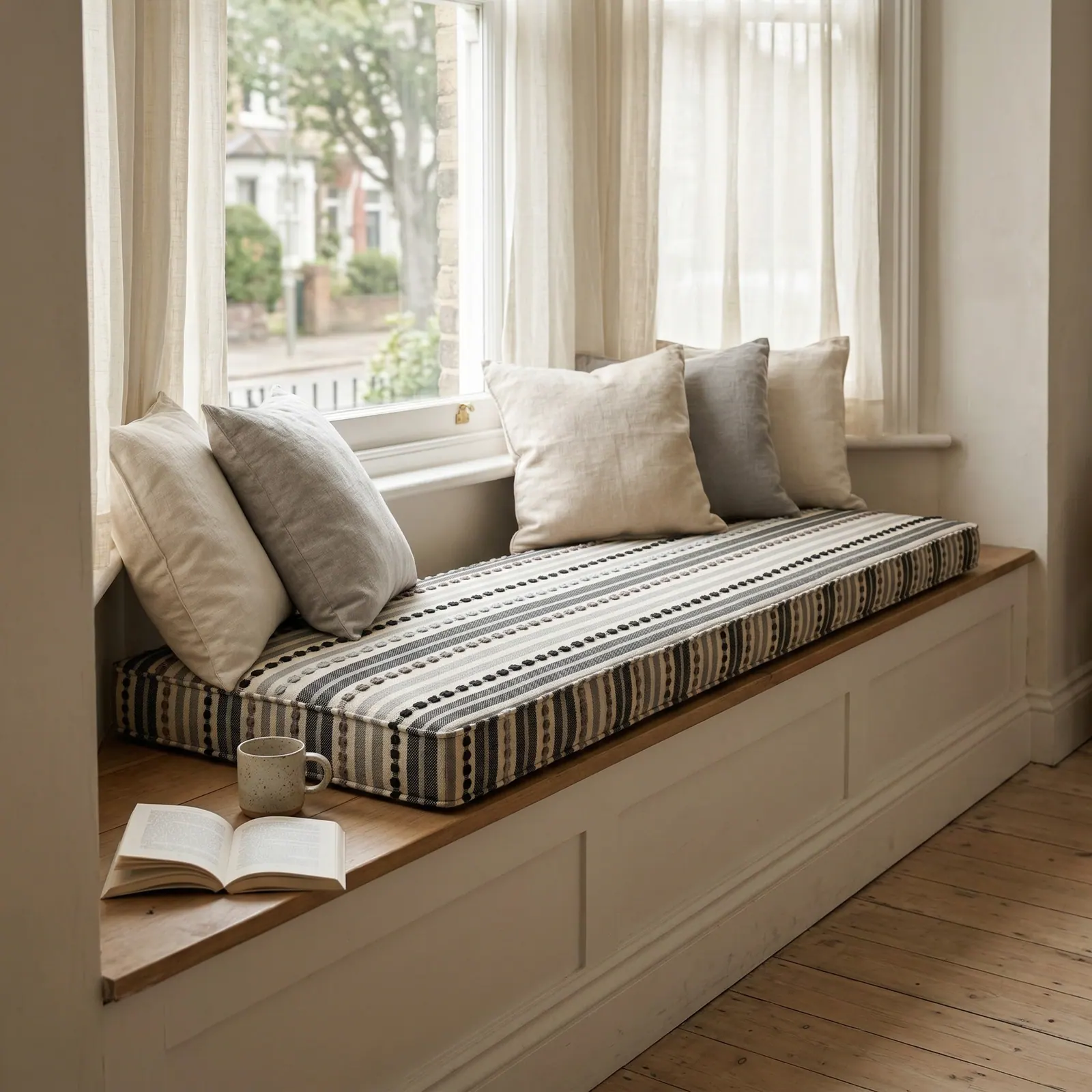
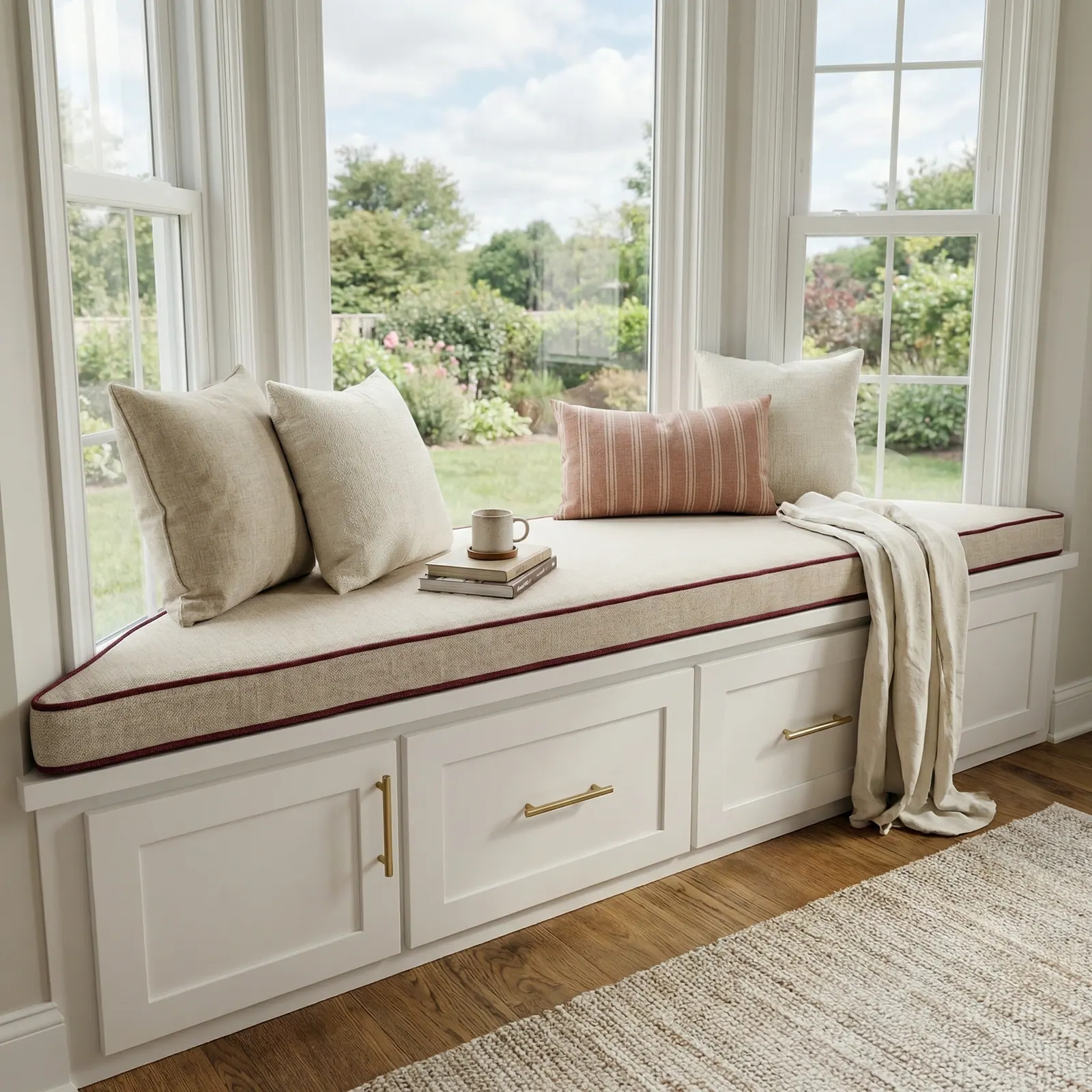
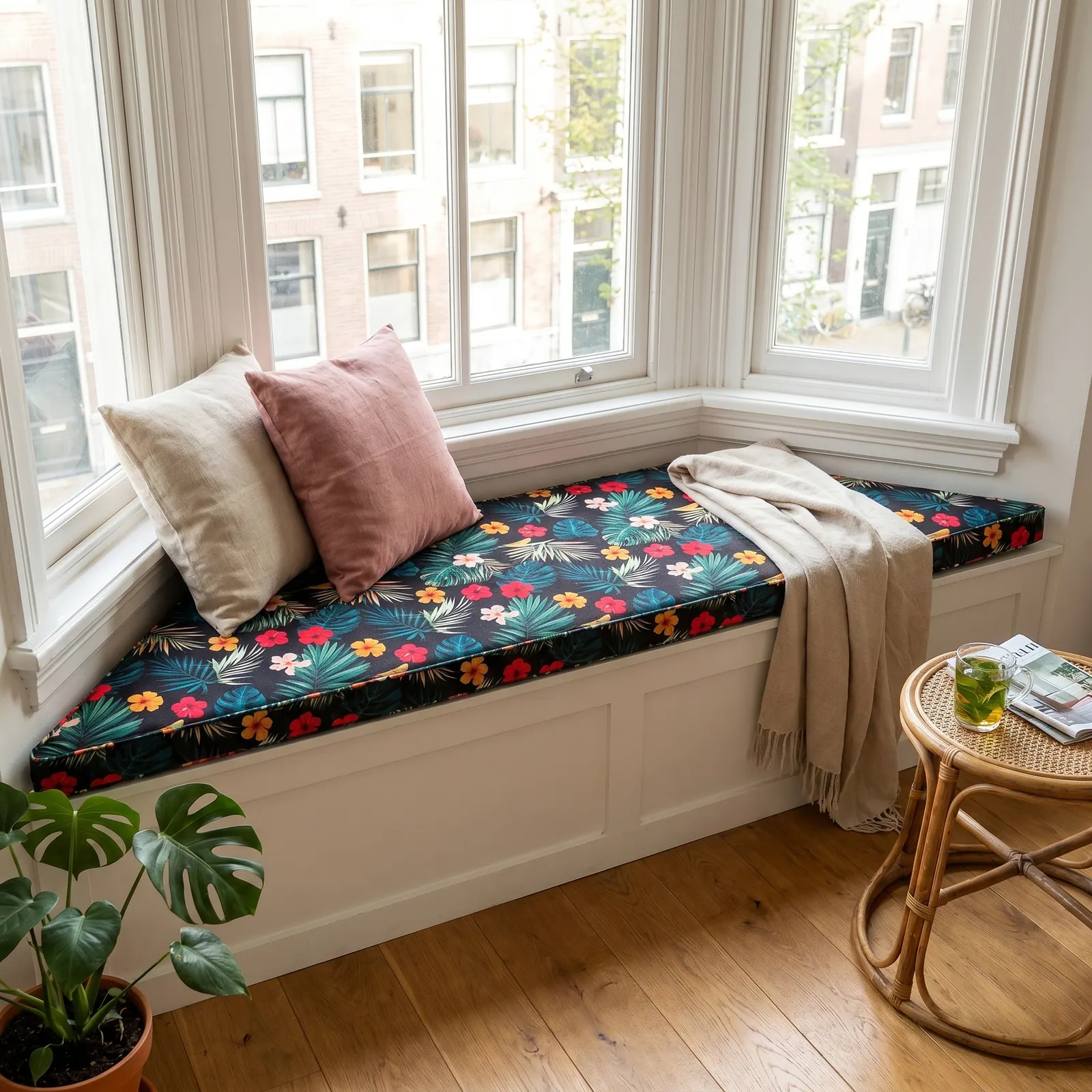
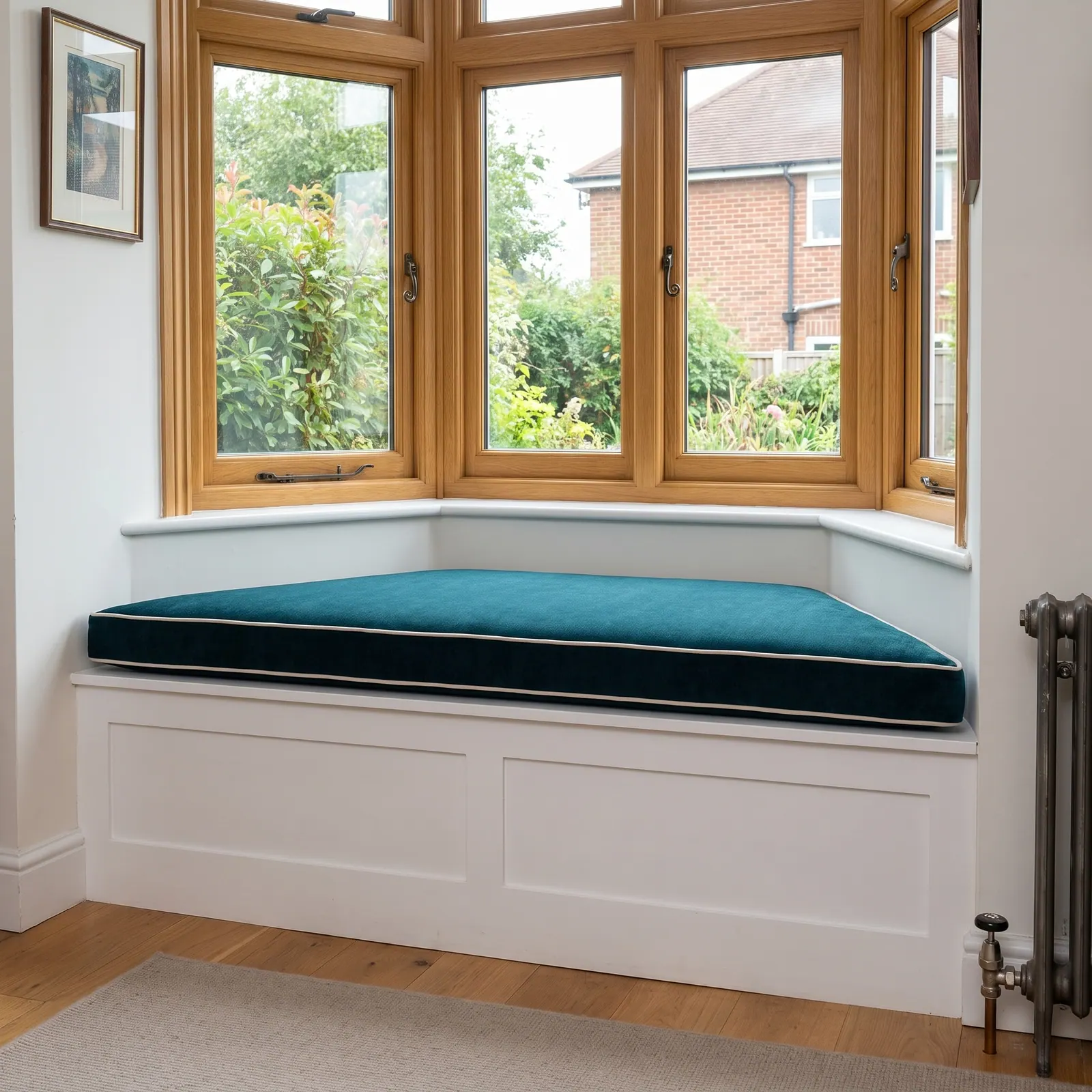
SaveA trapezoid-cut denim blue cushion fills a white bay seat, long enough for a golden retriever to stretch out.SaveA dusty rose velvet cushion cut with an angled end to fit a bay window seat exactly.SaveCut a little shallower than the oak seat board, the cushion leaves a ledge at the front for a mug and a book.SaveFour pillows, a draped throw and a thin wine welt turn a plain storage bench into the softest seat in the room.SaveA caramel pad cut to an angled bay, with cocoa piping that traces every edge of the shape.SaveAgainst a gray brick street, a trapezoid cushion in a dark tropical print brings the color the view lacks.SaveHoney oak window frames and a deep teal seat make a classic warm-and-cool pairing in a living room bay.
A Chicago year for bay seats, porches and roof decks
March: wash bay seat covers at 86°F (30°C) on delicate and dry them fully before refitting.
May, once the freezes are done: bring porch and rooftop cushions out and check every tie before the first windy weekend.
Summer: draw a sheer or blind across a south-facing bay on the brightest afternoons; the July noon UV Index here averages 8.4.
Storm forecast: carry rooftop cushions in. The foam is not quick-dry, and there is no mesh bottom.
After a soaking: stand cushions on edge under cover and get them dry within 24 to 48 hours.
October, before the first freeze: wash covers, dry the foam completely, and store everything off the concrete, never sealed damp in plastic.
Heating season: keep radiator-ledge cushions in two pieces so warm air can rise between them.
If a bay window cushion's measured slant and calculated slant differ by more than about 1 in, re-measure before anything is cut.
Our bay seat has two angled sections of 25.5 in and a long edge of 54.5 in. How do I enter depth and length on the custom-shape listing?
The workshop's answer
Depth runs from the angled sections straight to the long edge, and length runs across the outer corners. Those two totals only choose the size range, which sets the price; the cushion is cut from your drawing with every edge marked. That couple had a second person re-check the numbers before ordering, which is a habit worth copying.
A common question
I measured both angled sides of my trapezoid bay at 43.25 in, the same as the front. Is that right?
The workshop's answer
Not for that shape, so the workshop asked for each side separately. Measured again, they came out at 21.25 in on the right and 20.75 in on the left, with the front at 43.25 in. In a bay the angled sides are rarely identical, so always give each one its own number.
A common question
It's windy where we live. Can seat cushions and wedge-shaped back cushions be held down with ties or velcro straps?
The workshop's answer
Yes. That set was two 33 x 30 x 4 in seats and two 32 x 13 in backs, thicker at the bottom like a wedge. Ties can be sewn into the seams at the corners or along the back; two-sided velcro strips have been added on request at extra cost, and a non-slip base is another option. The workshop doesn't stock Sunbrella and uses its own UV-resistant, water-repellent outdoor fabric.
A common question
My sketch of an angled-top bay is hard to read. What's the clearest way to send the sizes?
The workshop's answer
Letter every side and type the numbers as well as drawing them. One buyer sent A 4.3, B 4.3, C 78.5, D 48, E 24, F 24 and G 23 in, and the cushion was made in deep navy velvet 131, which machine-washes at 86°F (30°C).
A common question
My window seat is 18.5 x 51.25 in and that size isn't in the dropdown. Can I still order it?
The workshop's answer
Yes. Choose the dropdown range that covers your widest and deepest measurements, since it only sets the price, then type the exact size, thickness and fabric code in the personalization box. Half and quarter inches are fine, and so are centimeters. For an angled seat, upload a drawing with every edge marked.
Have it made
Have it made for your home — ask Nate’s workshop
Send the numbers in inches: length × depth × thickness, plus any angle. The workshop checks them with you, because foam has no undo button. — Nate
Leave your details and the workshop will call you to confirm measurements, fabric, foam and piping. No prices, dates or payment on this page: it is a request, not an order.
Questions buyers ask next
Is the front bay of a Chicago bungalow a standard trapezoid?
Usually it is a clipped trapezoid: a long straight front, a center panel, two slants and short straight returns at the side walls. The returns change the slant length, so measure and draw them. Order on the custom-shape listing; an angled shape placed on the rectangle listing is canceled and refunded for reordering.
Should a long bungalow bay cushion be made in one piece or two?
Very long trapezoids, around 79 in (2 m) or more on the long side, may be suggested in two pieces. Split at a corner or at the midpoint and draw each piece separately. Two sections are easier to make, to lift out of the bay and to unzip for washing.
When should Chicago back porch and rooftop cushions come inside?
Before the first freeze. Chicago averages about 126 days a year at or below 32°F, and the foam is not quick-dry. Store cushions clean, completely dry and off the concrete, never sealed damp in plastic, and bring them back out after the last hard frost.
Can velvet or corduroy go in a sunny south-facing bungalow bay?
Yes, indoors, but plan for sun through the glass: Chicago's July noon UV Index averages 8.4. A bay that bakes for hours can be made in a sun-resistant outdoor fabric instead. Corduroy suits a reading seat better than a kitchen bench, where its ribs can split under hard use.

 Save
 Save
 Save
 Save
 Save
 Save
 Save
 Save