A Reading by NateBay Window Cushions
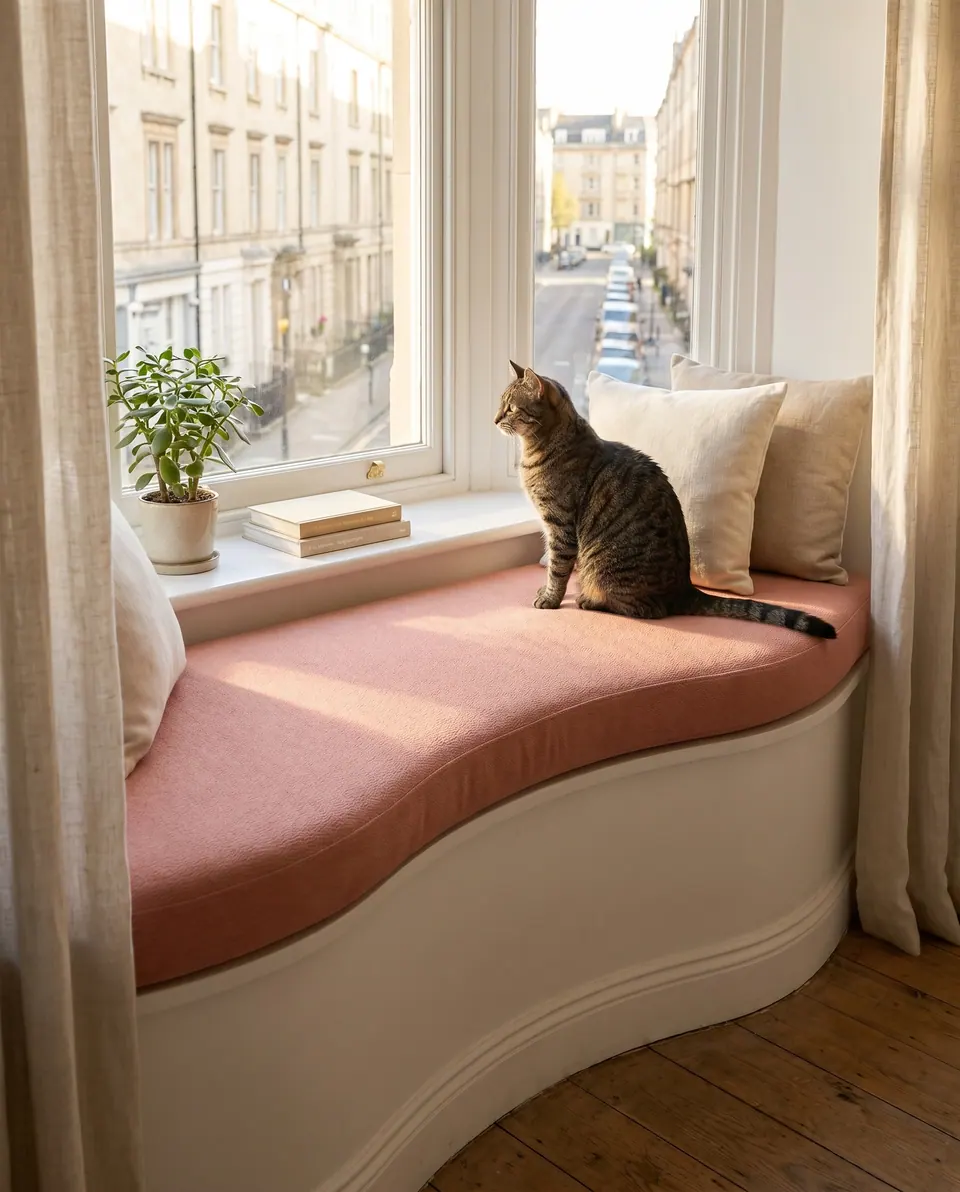
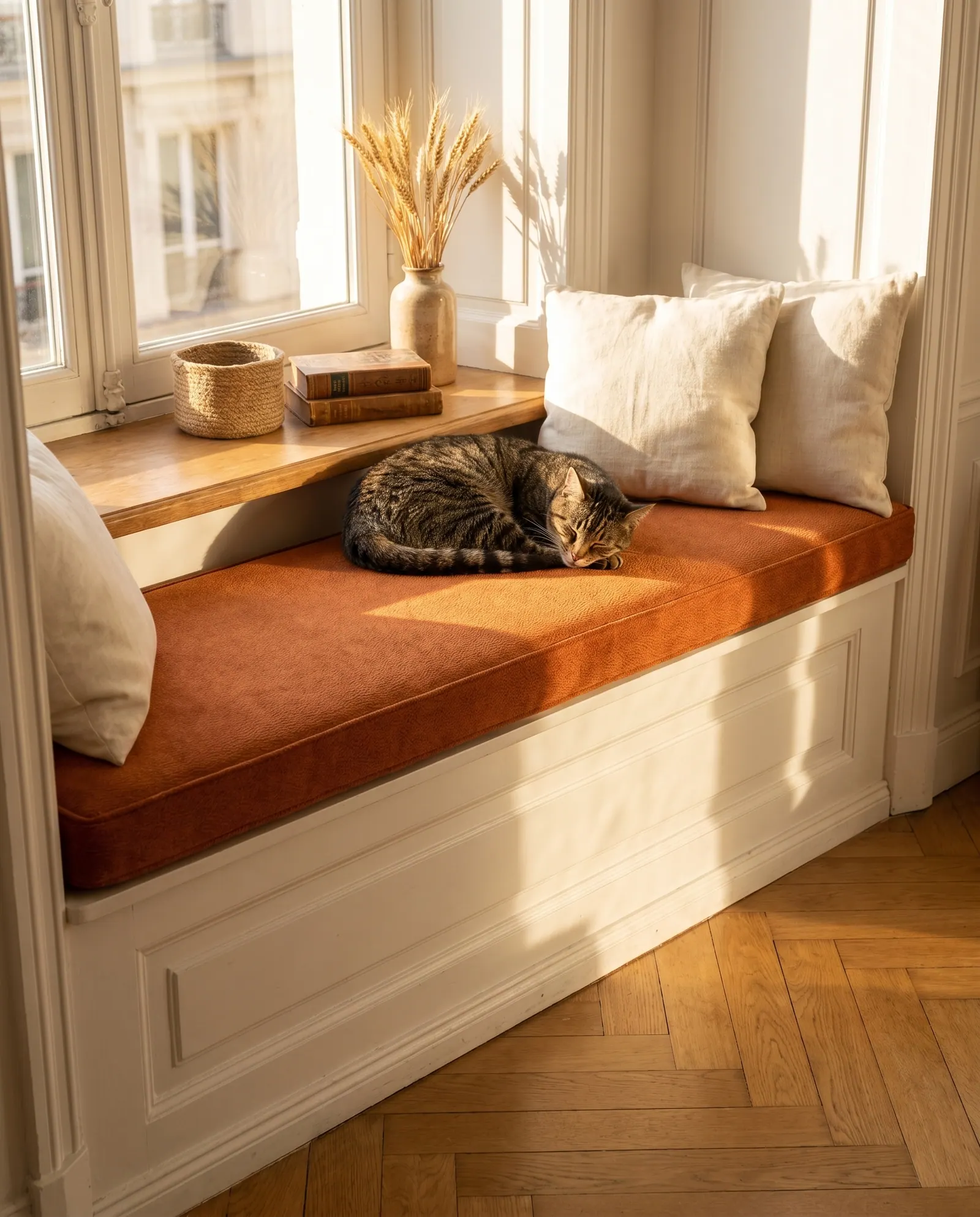
Self, contrast or none: the piping on a terracotta bay window seat cushion with a sleeping tabby
Nate traces the welt around a trapezoid bay seat, adds up every edge it has to follow, and explains why the tailor chose piping that disappears.

 Save
The quick answer
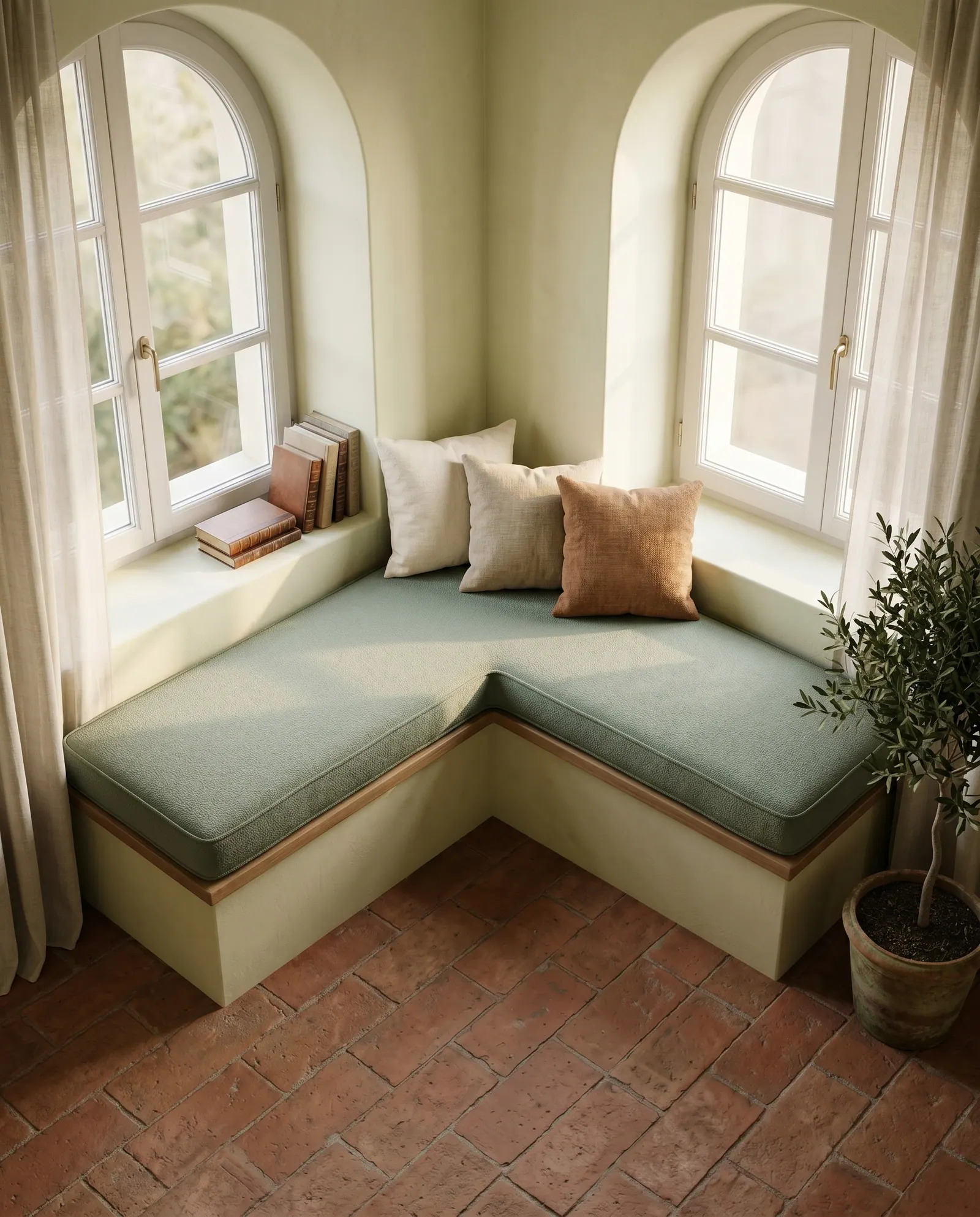
On a bay window cushion, self piping keeps the eye on the whole shape, while contrast piping outlines every angle and cut-in. This terracotta trapezoid uses self piping so the seat and the oak ledge read as one surface. Choose contrast only if you want the geometry drawn in ink, and no piping for the softest edge.
The cushion, cut open
Cover fabric. A removable, zippered cover. Machine wash at 86°F (30°C) on a gentle cycle and air dry.
Piping. A fabric-covered cord sewn into the seams. It sits on the seam line, so it does not change the size.
Fiber wrap. Polyester fiber (Dacron) batting around the foam: it fills the cover out and softens the edges.
Foam core. About 2.0 lb/ft³ (32 kg/m³) high-resilience foam, firm to medium-firm, cut to the ordered size.
Zipper. Along the back band, as hidden as possible. The zipper side faces down or toward the wall.
Base panel. The underside of the cover. A non-slip fabric backing can cover the whole of it instead.
Field measurement: how much line a bay seat draws
A trapezoid bay cushion has more edge than anyone budgets for, partner.
Take a bay a buyer sent the workshop: 105 1/2 in on the long side, 51 in on the short side, two 30 in angled sides and two 6 in cut-ins. Add them up and one face has about 228 1/2 in (580 cm) of perimeter. Every inch of it turns an angle or runs to a corner, and the welt follows all of it.
That's the piping decision in one number. Contrast piping would draw the whole thing in ink, every angle and cut-in outlined for the room to count, and a 1/4 in wander would show. Self piping, the choice in this photograph, keeps the edge firm and defined but lets the terracotta read as one warm surface.
The cushion needs that, because its job is to disappear into the architecture. It's deep enough to sit nearly flush with the oak ledge, so seat and sill read as one plane from across the room. A cream welt would have drawn a line exactly where the tailor worked to hide one.
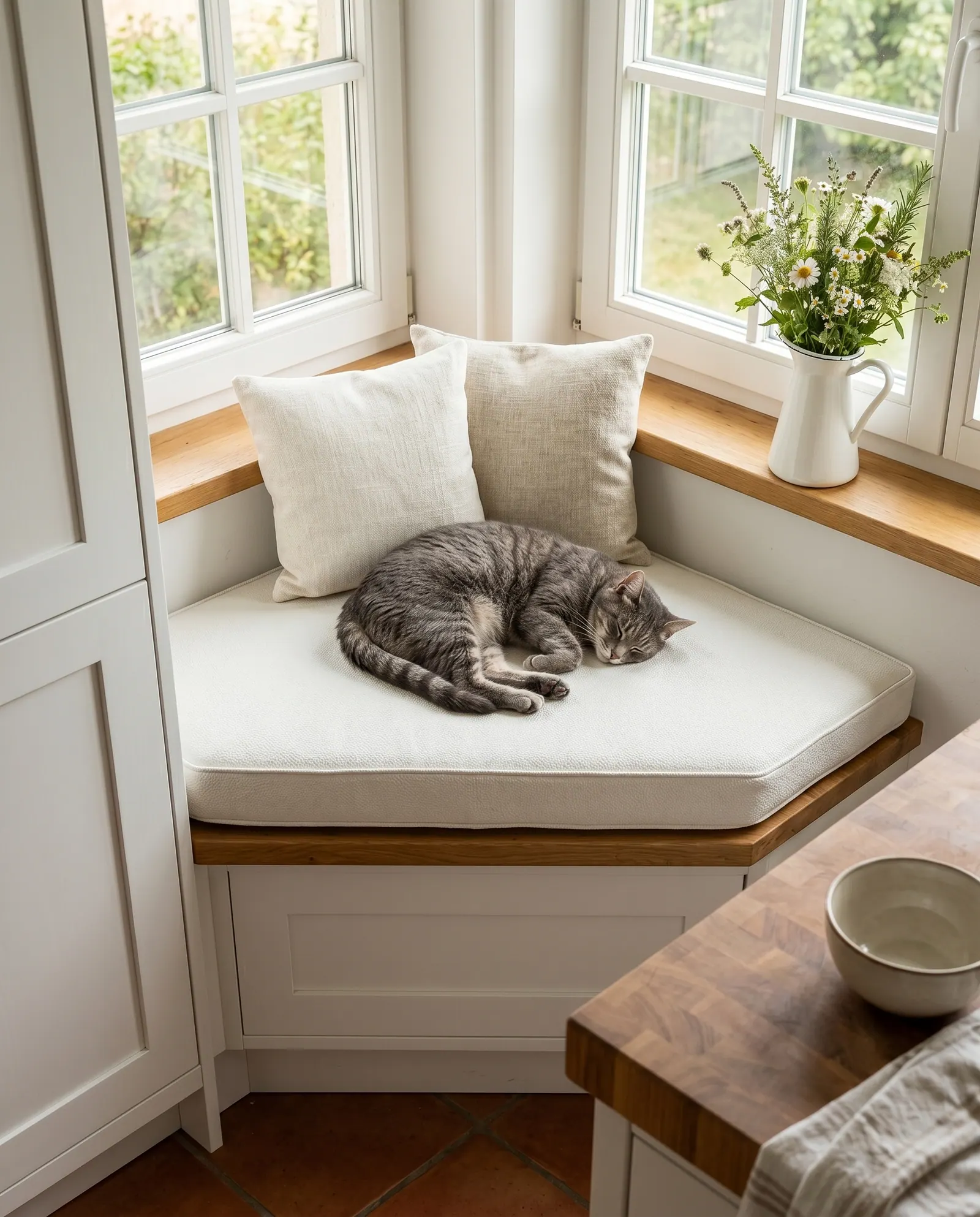
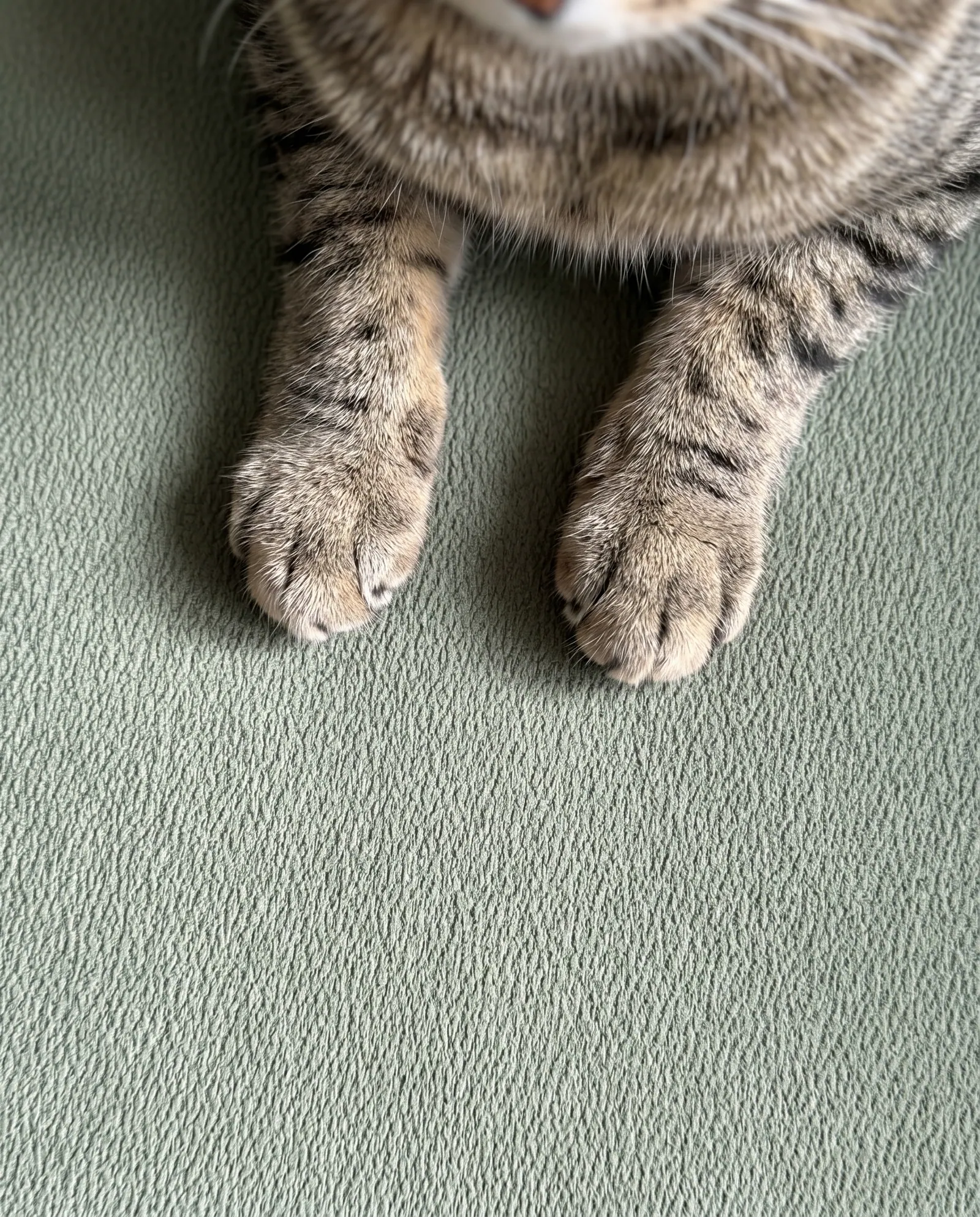
Color does the bridging. Terracotta sits between the white paneling and the honey herringbone floor, and the sleeping tabby lives in the same brown-orange family, so shed hair blends in. The props stay dry and earthy: dried wheat in a cream ceramic vase, a woven seagrass basket, two leather-bound books. Off-white linen pillows pad the corner where seat meets wall. Nothing competes with the line.
The full comparison is in matching, contrast or no piping, more angled seats are in bay window cushions, and the cloth is on the performance and pet-friendly shelf.
Pinned by Nate
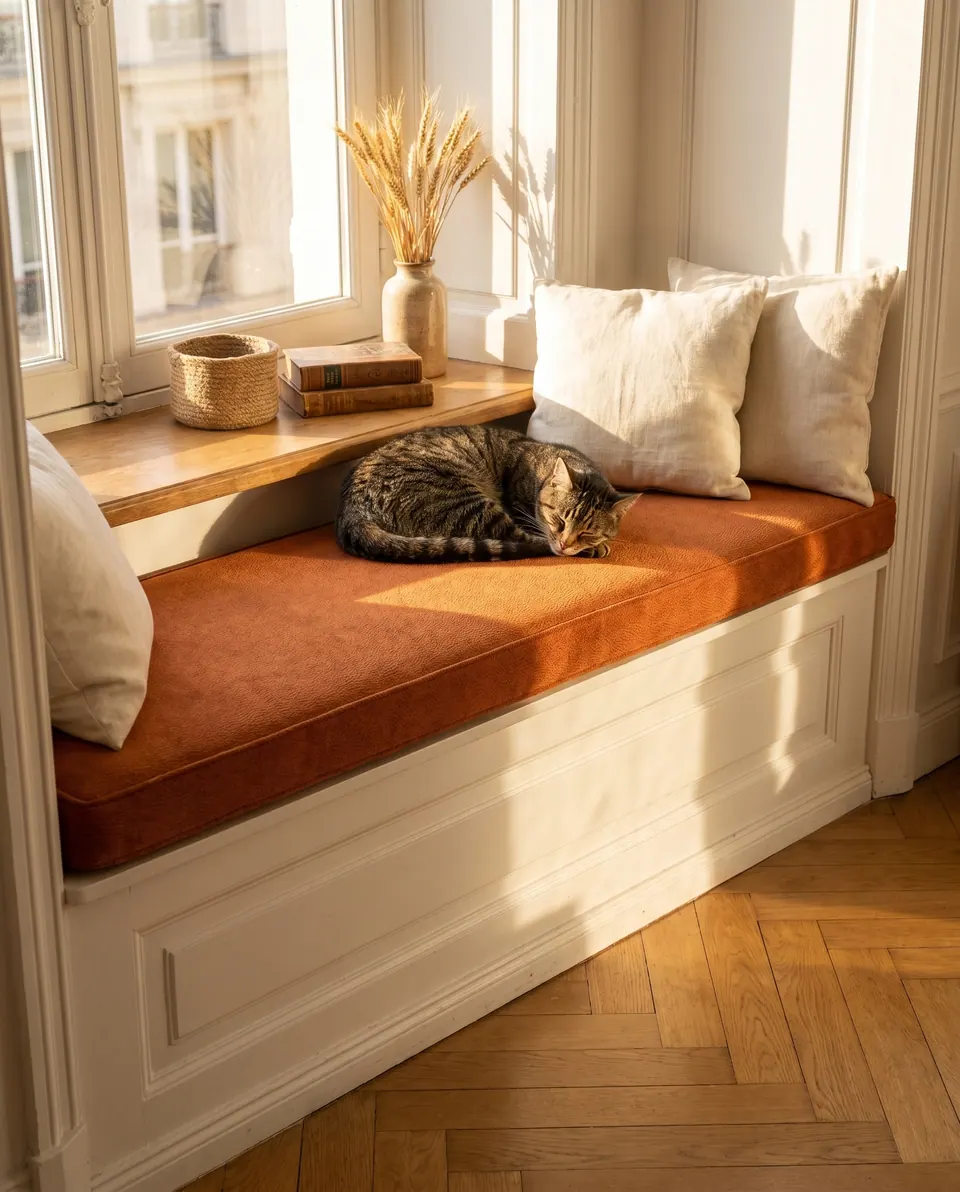
Five pins, from the tabby on the terracotta to the herringbone floor that bridges it to the white paneling.
- Sleeping tabby
Tabby stripes sit in the same brown-orange family, so shed hair blends into the seat.
- Terracotta box edge
A firm box edge lines up with the ledge, making seat and sill read as one surface.
- Wheat in ceramic vase
Dry wheat stalks echo the warm fabric and the low sun.
- Linen pillows in corner
Two off-white linen pillows pad the corner where the seat meets the wall.
- Herringbone oak floor
Honey parquet is the color bridge between white paneling and terracotta.
- Sleeping tabbyTabby stripes sit in the same brown-orange family, so shed hair blends into the seat.
- Terracotta box edgeA firm box edge lines up with the ledge, making seat and sill read as one surface.
- Wheat in ceramic vaseDry wheat stalks echo the warm fabric and the low sun.
- Linen pillows in cornerTwo off-white linen pillows pad the corner where the seat meets the wall.
- Herringbone oak floorHoney parquet is the color bridge between white paneling and terracotta.
Self, contrast or none on an angled seat
| Piping | What the line does | On a trapezoid bay seat |
|---|---|---|
| Self (this photo) | Firms the edge in the body color; the shape reads as one mass | Quiets the angles; seat and sill read as one surface |
| Contrast | Draws the outline in a second color | Outlines every angle and cut-in; a 1/4 in wander shows |
| None (plain seam) | Softest edge, no cord | Relaxed look; corners hold a little less crisply |
105 1/2 in, 51 in, and a drawing on paper
A buyer in the US sent the workshop the numbers for a trapezoid bay seat: 105 1/2 in (268 cm) on the longest side, 51 in (130 cm) on the shortest, 30 in (76 cm) angled sides, 6 in (15 cm) cut-ins, and 21 in (53 cm) deep.
Good numbers. But a list of numbers doesn't show which edge sits where, or which way a cut-in turns. The workshop asked for a drawing on paper, passed it to the tailor, and then sent a custom order link. The tailor cuts from the sketch.
For a bay window, give every edge and every cut-in, and draw it. The bay window calculator helps you check the angles before you send it.
- Sizes
- 105 1/2 in long side, 51 in short side, 30 in angled sides, 6 in cut-ins, 21 in deep (268, 130, 76, 15 and 53 cm)
The lesson: For a bay window, give every edge and cut-in plus a drawing; the tailor cuts from the sketch.
Buyer questions: ties, fabric close-ups, and which way the lines run
- A common question
Can you put corner ties on my window seat cushion?
The workshop's answerYes. Ties are an add-on priced per cushion, paid through a separate extra-payment link.
- A common question
Before I decide, can you send photos of a few specific fabric codes?
The workshop's answerYes. The workshop sends photos and close-ups of any code you name, such as P-50, P-51 and P-54, L-18, or the S-09, S-29 and S-30 outdoor fabrics, so you can check texture and tone. Light can shift a color a little in photos, but the physical fabric matches the catalog swatch.
- A common question
Can I pick the direction of the stripes, or of the corduroy ribs?
The workshop's answerYes. Stripes and corduroy wales can run horizontally or vertically, on the top and on the side edges, to match a reference photo; say so in the order. The production team checks for technical limits and picks the best-looking option if a direction isn't possible. A replacement sofa backrest cover was made with vertical fabric so it matched the rest.
On the cutting table: the terracotta bay seat
| Cushion | Trapezoid bay window seat cushion |
|---|---|
| Fabric | Terracotta performance weave, pet-friendly |
| Piping | Self piping in the body color |
| Edge | Firm box edge, nearly flush with the oak ledge |
| Perimeter check | Add up every edge and cut-in before choosing contrast piping |
| Pet note | A tabby coat in the same color family hides shed hair |
| Order with | A paper drawing of every edge and cut-in |
| Best for | Bay windows with angled ends and a ledge to match |

Have it made
Have this made — ask Nate’s workshop
Send the numbers in inches: length × depth × thickness, plus any angle. The workshop checks them with you, because foam has no undo button. — Nate
Leave your details and the workshop will call you to confirm measurements, fabric, foam and piping. No prices, dates or payment on this page: it is a request, not an order.
Contrast piping on a bay window cushion outlines every angle and cut-in; self piping lets the whole trapezoid read as one surface.
Nate
Questions buyers ask next
Does piping color matter more on an angled cushion?
Yes, because an angled cushion has more corners and edges for the piping to trace. A contrast welt outlines each one, so the geometry becomes the feature. Self piping keeps the edge firm without pointing at the angles.
Should a bay window cushion sit level with the window ledge?
It looks most built-in when it sits nearly flush, so seat and sill read as one surface. Measure from the seat base up to the ledge, then choose the thickness that closes that gap.
Which fabric color hides cat hair on a window seat?
A color in the same family as the coat. A tabby's brown-orange stripes blend into terracotta and rust, and a gray cat fades into dove gray. Pair the color with a pet-friendly performance weave.
± 1/4 in — Nate
More photographs to read
 Save
 Save
 Save
 Save
 Save
 Save