A Reading by NateBay Window Cushions
A peach bay window seat cushion cut to a serpentine curve, and why its piping matches
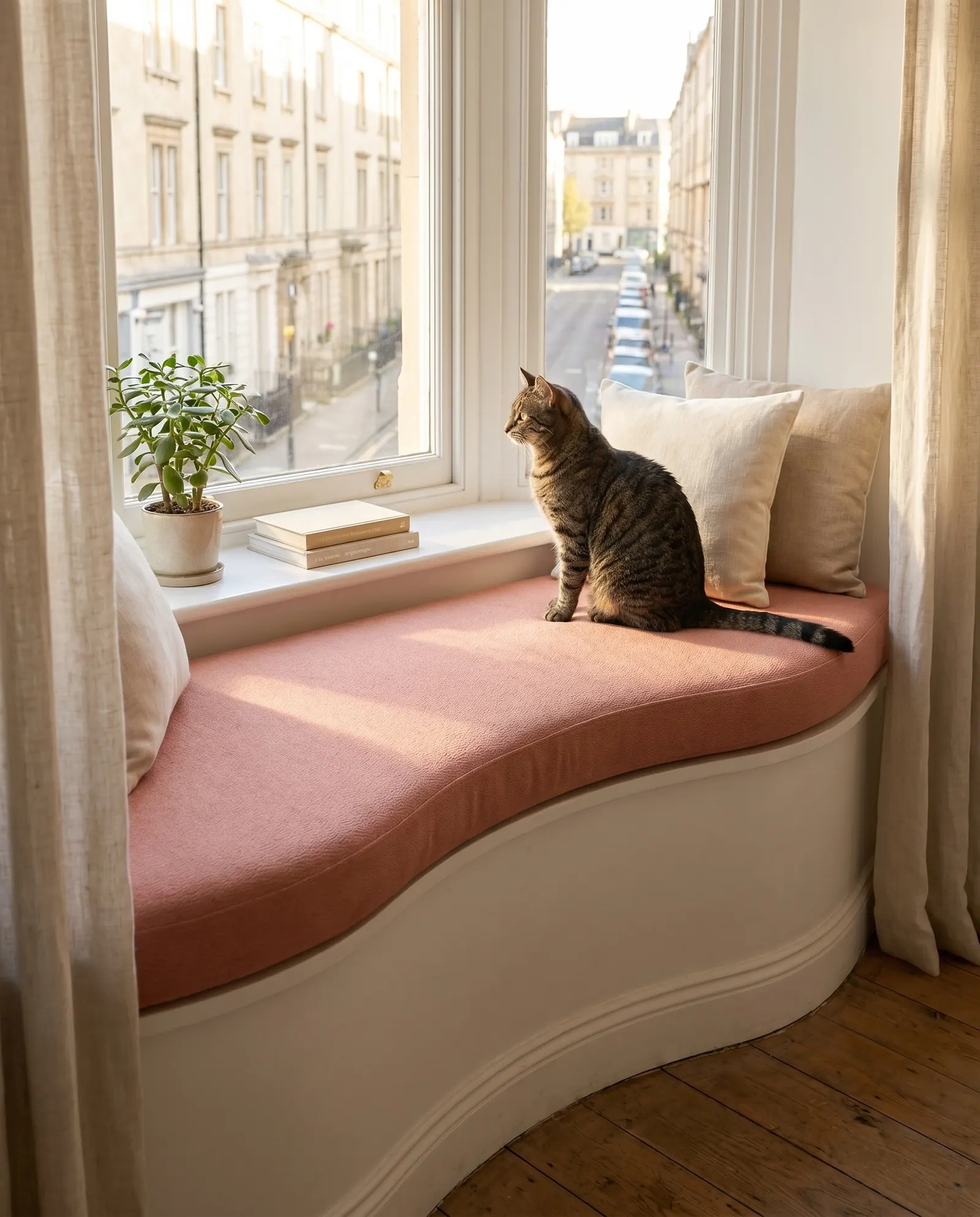
A curved base, a peach performance weave and a tabby cat who got there first. Here is the cushion taken apart layer by layer, with the piping decision in the middle.

 Save
The quick answer
On a curved bay window cushion, self piping is the safest choice: it holds the edge firm without drawing a colored line that exaggerates every small wobble in the curve. Contrast piping suits long straight runs, and no piping suits soft, casual seats. Send a full-size paper template or a drawing with every measurement, and the curve is cut to match.
The cushion, cut open
Cover fabric. A removable, zippered cover. Machine wash at 86°F (30°C) on a gentle cycle and air dry.
Piping. A fabric-covered cord sewn into the seams. It sits on the seam line, so it does not change the size.
Fiber wrap. Polyester fiber (Dacron) batting around the foam: it fills the cover out and softens the edges.
Foam core. About 2.0 lb/ft³ (32 kg/m³) high-resilience foam, firm to medium-firm, cut to the ordered size.
Zipper. Along the back band, as hidden as possible. The zipper side faces down or toward the wall.
Base panel. The underside of the cover. A non-slip fabric backing can cover the whole of it instead.
Anatomy of a serpentine seat, from the template up
Start at the floor and work up, partner.
Layer 1, the base. A white window seat with a wavy front. The cushion follows that wave with no gaps, which happens one way only: a paper template traced on the real seat. A tape measure can't describe a serpentine curve. A template can. See the paper template method and chord and rise for curves.
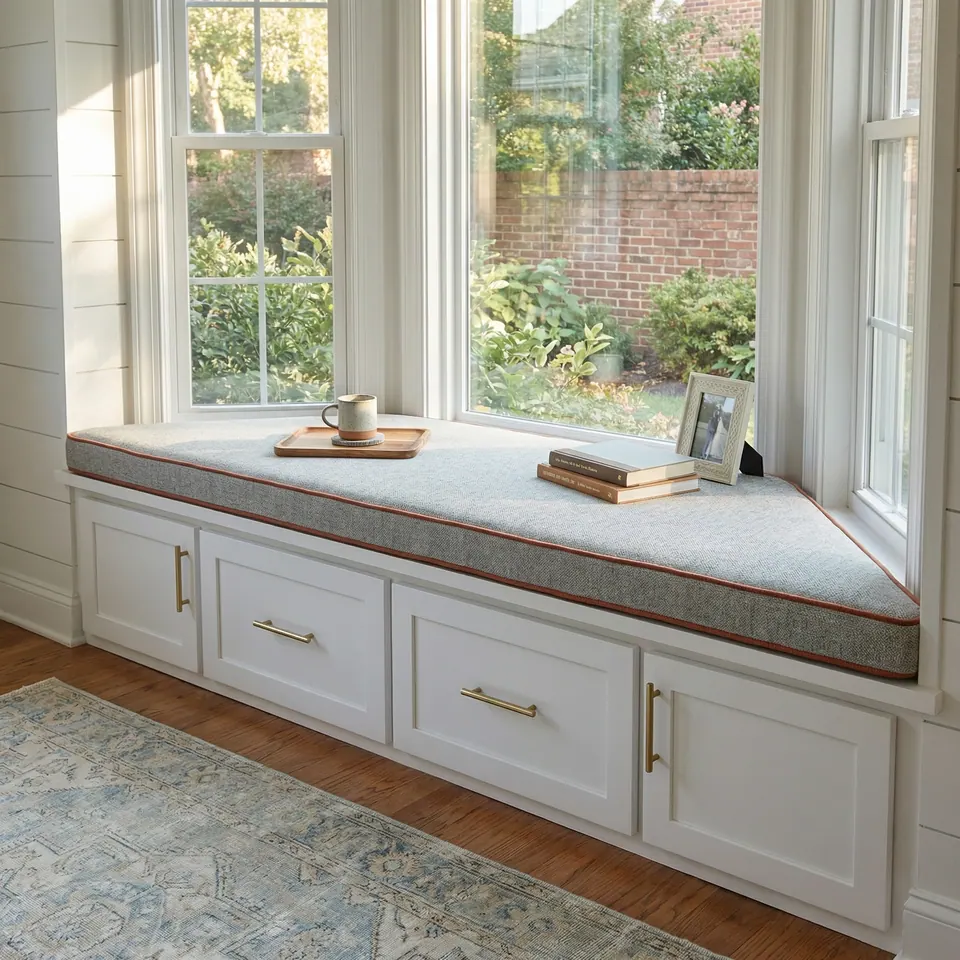
Layer 2, the cushion. A box edge in a tight peach performance weave. Top panel, side band, bottom panel. At both seams sits a welt cut from the same peach. That is self piping.
Layer 3, the color. Peach on white keeps the curve readable from across the room, and low golden sun flatters it.
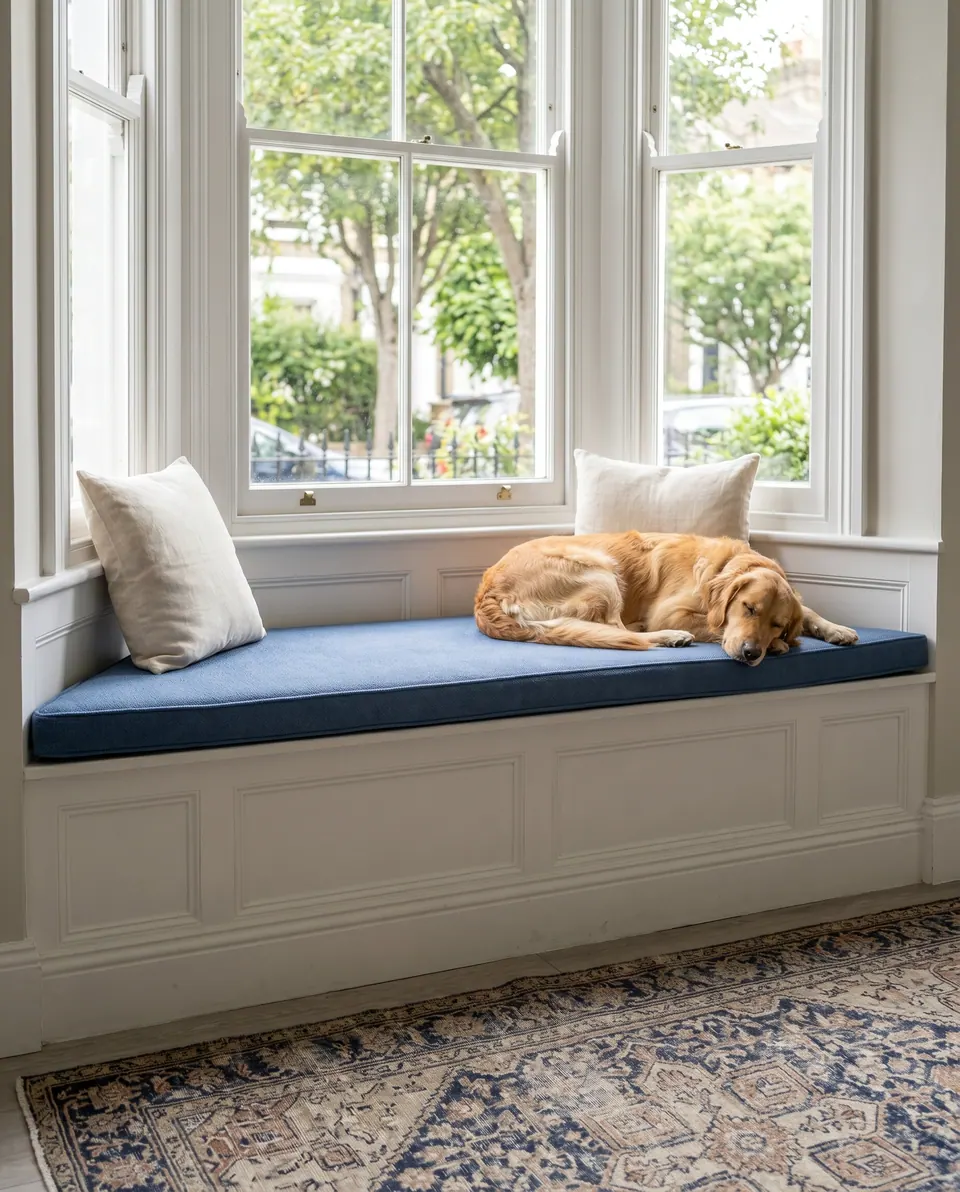
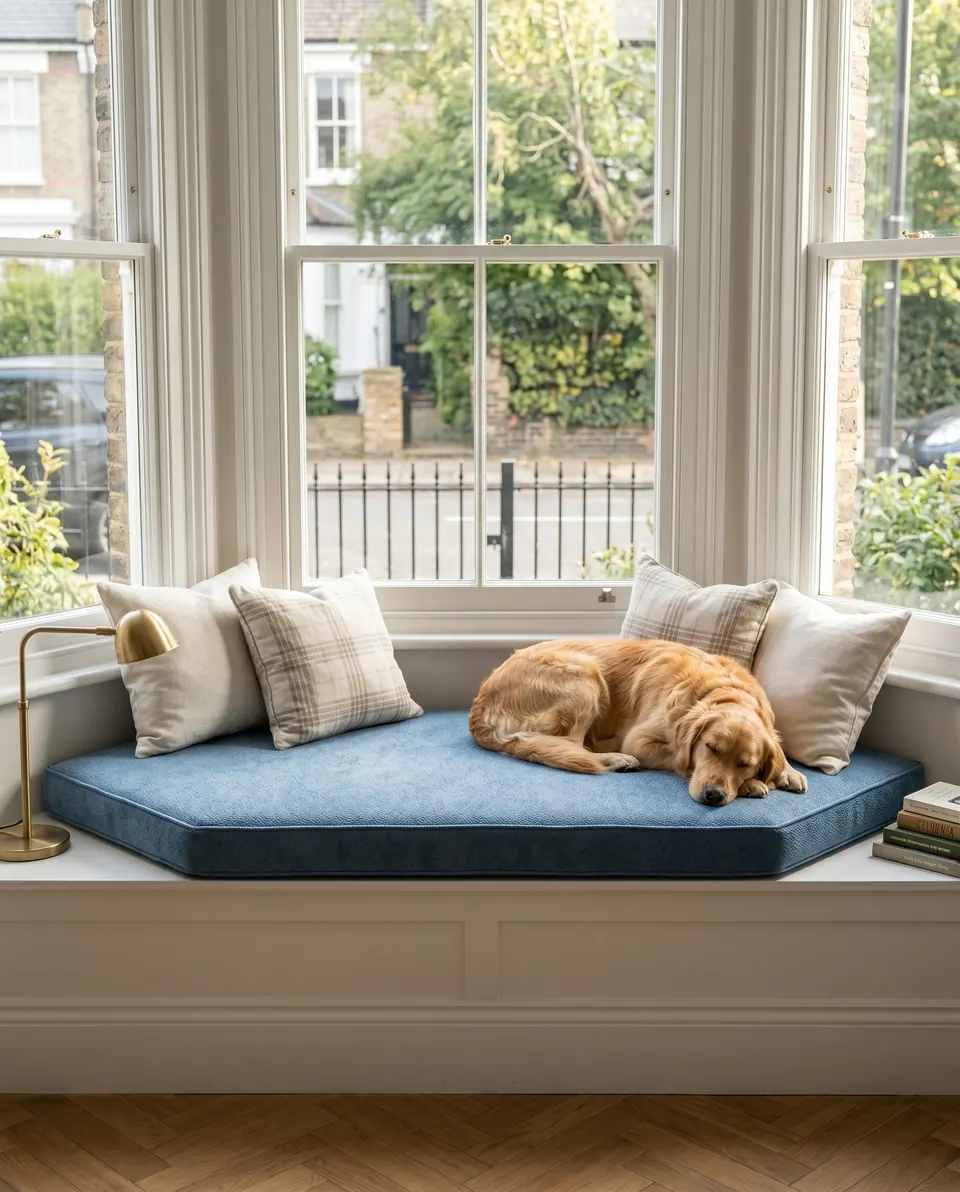
Layer 4, the load. Three cream linen pillows gathered at the wall end, the sunny middle left open, and a tabby cat who has clearly claimed it. A jade plant stays on the sill, off the seat.
Self, contrast or none: what each does to a curved line
| Piping | What the eye sees | On this curve |
|---|---|---|
| Self (matching) | A firm ridge in the same color; the curve reads as one soft shape | Chosen. Holds the edge, forgives small wobbles |
| Contrast | A drawn line that traces every inch of the outline | Handsome on straight runs, unforgiving on a wave |
| None | A softer seam that can ripple over a long curve | Fine on casual seats, less crisp here |
Pinned by Nate: five measurements hiding in plain sight
Five pins, from the curved front edge that needed a template to the cat who tested the weave.
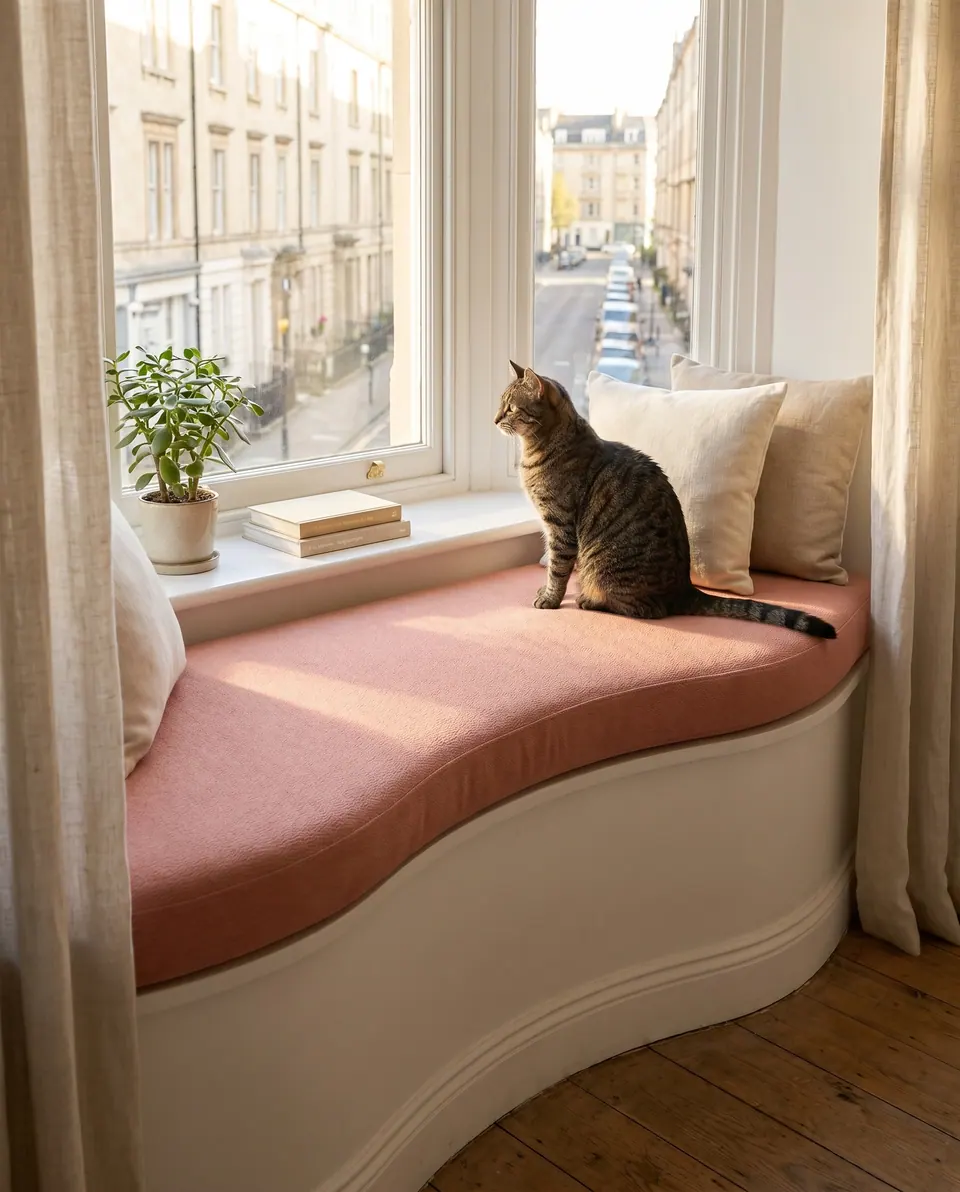
- Curved front edge
The cushion follows the serpentine base, which needs a full-size template to cut.
- Tabby cat
A tight pet-friendly weave suits a seat the cat has clearly claimed.
- Linen pillows
Cream pillows gathered at the wall end leave the sunny middle free.
- Jade plant
The plant sits on the sill, not the cushion, so the whole seat stays usable.
- Curved plinth
Peach on white keeps the curve readable from across the room.
- Curved front edgeThe cushion follows the serpentine base, which needs a full-size template to cut.
- Tabby catA tight pet-friendly weave suits a seat the cat has clearly claimed.
- Linen pillowsCream pillows gathered at the wall end leave the sunny middle free.
- Jade plantThe plant sits on the sill, not the cushion, so the whole seat stays usable.
- Curved plinthPeach on white keeps the curve readable from across the room.
The trapezoid that turned out to have six sides
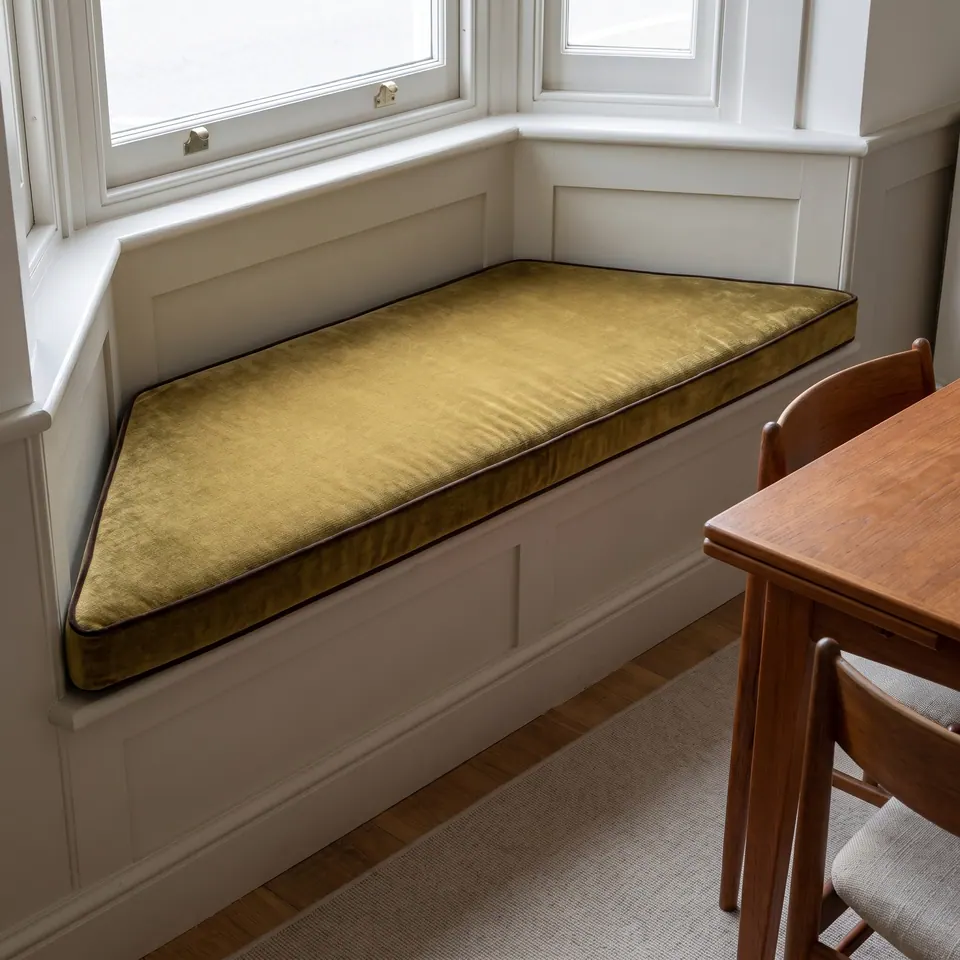
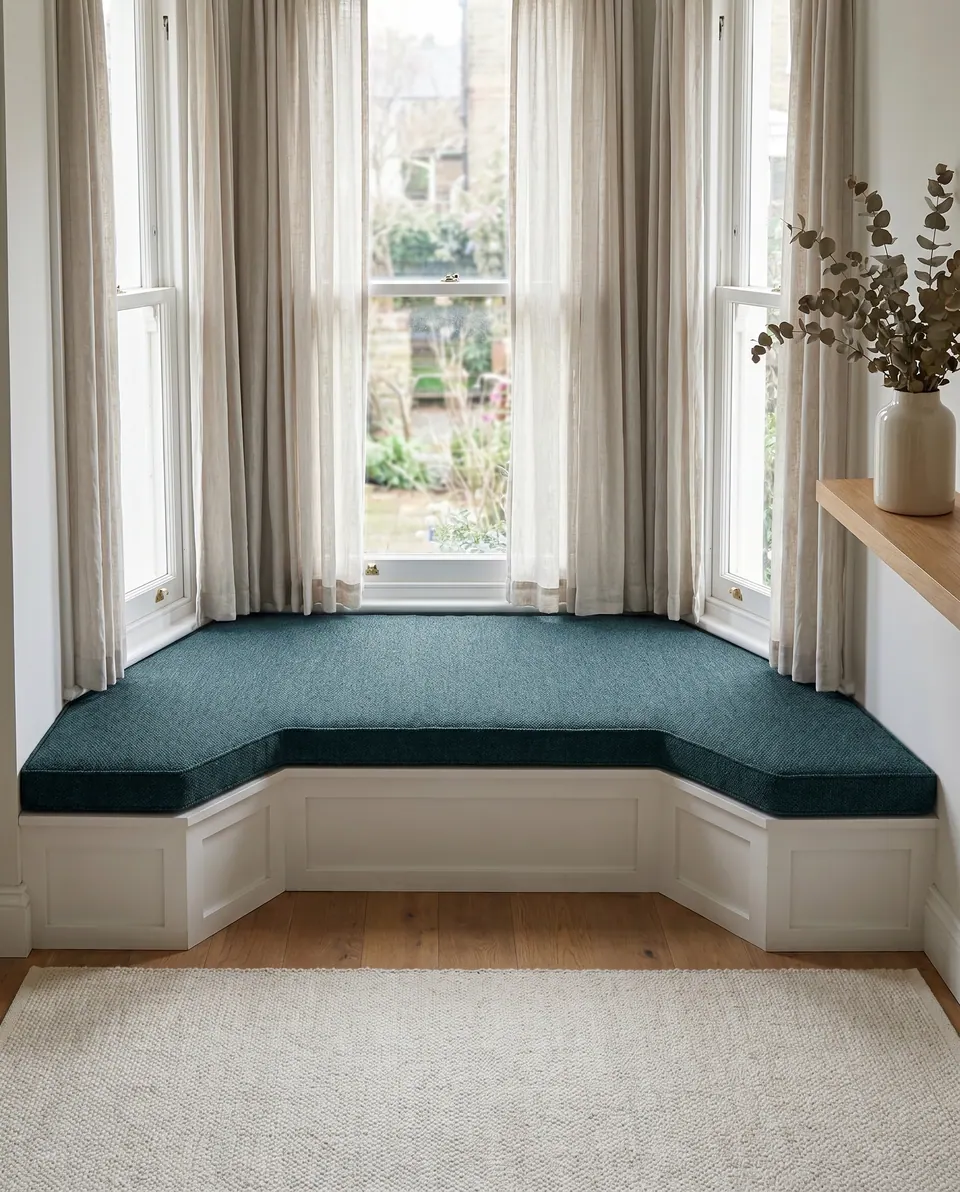
A buyer in the US asked whether corduroy would work on a trapezoid bay seat. Then they looked again and found two short extra edges at the ends. That made it a hexagon.
The workshop turned the sketch into a template: - Front 78 in (198 cm) - Back 46.5 in (118 cm) - Angled sides 23 in (58 cm) - End returns 5 in (13 cm) - Depth about 22 in (56 cm)
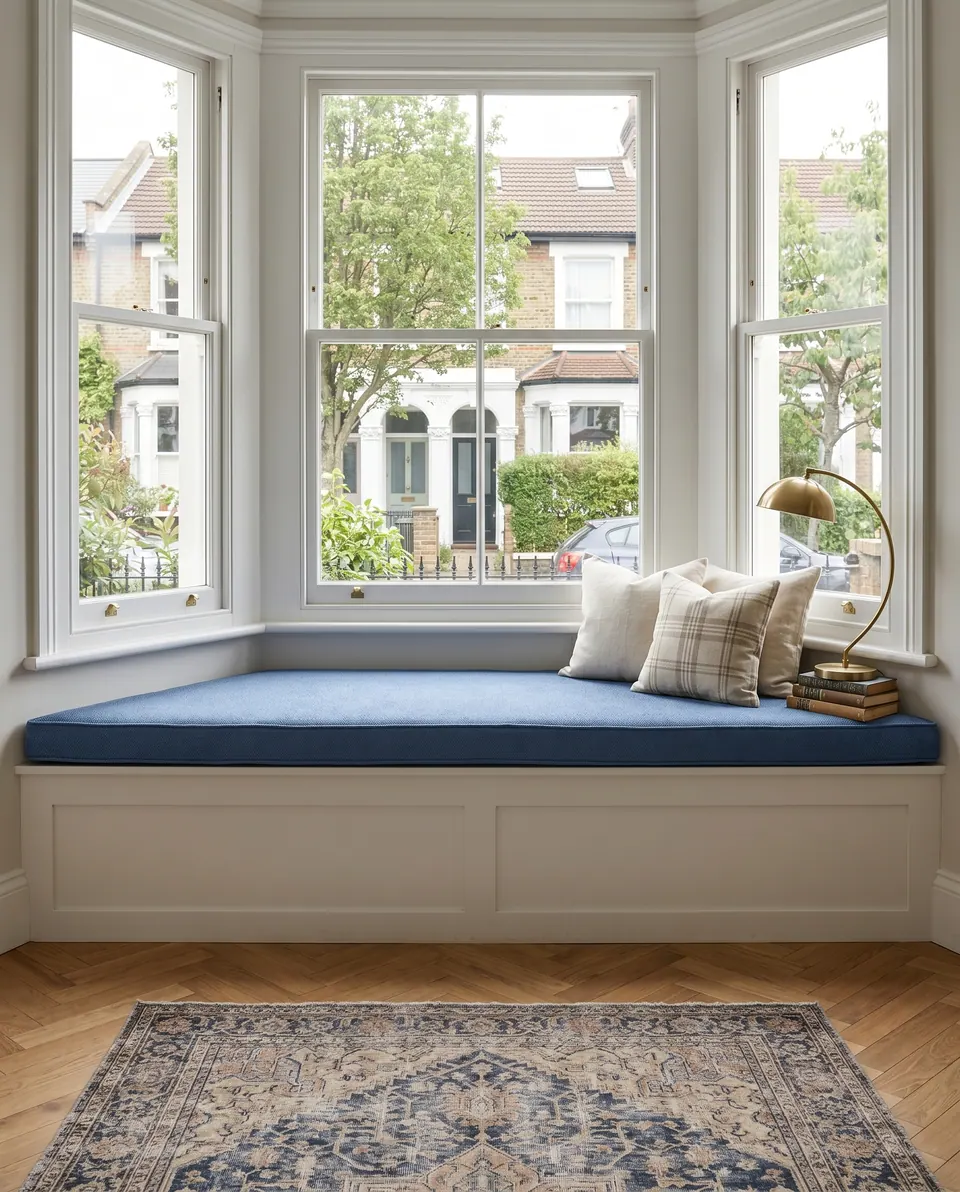
The workshop told them to select the size ranges covering 78 in and 22 in, then write the full shape into the personalization note. Fabric: navy corduroy. Angles are just lengths in disguise, so measure every edge, including the short ones. The bay window calculator takes all of them.
On the cutting table: the curved peach seat
| Product | Bay window seat cushion, serpentine front |
|---|---|
| Fabric | Performance weave, peach |
| Edge | Box edge |
| Piping | Self piping at top and bottom seams |
| Standard thickness | 4 in (10 cm) |
| Shape source | Full-size paper template, or a drawing with every measurement |
| Checkout size | Nearest range; 3 to 5 in (8 to 13 cm) off is absorbed |
| Styled with | Three cream linen pillows at the wall end |
| Best for | Sunny bays, curved seats, homes with a cat |

Have it made
Have this made — ask Nate’s workshop
Precision starts on the phone. Give the workshop your measurements and they will read them back to you, edge by edge. — Nate
Leave your details and the workshop will call you to confirm measurements, fabric, foam and piping. No prices, dates or payment on this page: it is a request, not an order.
Buyer questions: thickness, size ranges and rounded fronts
- A common question
I'd like a velvet window seat cushion with bolsters to match. Can it be at least 4 inches thick?
The workshop's answerIt can: standard thickness is 4 in (10 cm), and every size can be customized. Pick a color number from the velvet swatch card; one buyer chose dusty rose, no. 11, for a 25 x 63 in (64 x 160 cm) seat. Then order the set with seat, backrest and bolsters, and write the thickness in the note.
- A common question
The size I picked at checkout is quite different from my real bench. What happens now?
The workshop's answerA gap of 3 to 5 in (8 to 13 cm) is no problem. A large one, such as 91 in (231 cm) selected against 109 in (277 cm) needed, nearly 20 in (51 cm) more, takes extra material and labor, so in that case the workshop asked for a top-up before cutting.
- A common question
Can you make a cushion with a rounded front, shaped to fit my bay window nook?
The workshop's answerYes. Send a photo of the area or a drawing of the shape with every measurement marked, and curved cushions are cut from that. One bay-nook floor cushion spanning three 46 in (117 cm) window sections was quoted from exactly that kind of drawing, priced for its large size and custom shape.
On a curved bay window cushion, contrast piping traces every wobble; self piping holds the edge and lets the curve read as one shape.
Nate
Questions buyers ask next
Does self piping make a window seat cushion look plain?
No. Self piping still gives the edge a firm, tailored ridge; it only skips the colored line. On curves and busy prints it reads as crisp rather than plain, and on a solid color like peach it lets the shape itself carry the design.
When is contrast piping the better choice on a window seat?
On straight, rectangular seats where the line runs true, and when you want to repeat a color from the room. A contrast welt draws the outline in ink, which is handsome along a straight bench and harsh on a curve that wanders even slightly.
Is a tight performance weave sensible on a seat the cat has claimed?
It is a sensible pick. A close weave gives claws less to catch than loose, textured cloth, and it cleans more easily. No fabric shrugs off claws forever; a tight weave simply holds up better than a loose one.
± 1/4 in — Nate