Across the Map · Midwest · United States
Custom cushions for Ohio porches, bay windows and Lake Erie winters
Cleveland logs 156 wet days a year, and a Victorian bay has at least five edges. Both are measurement problems, which is good news, because measurement problems have answers.
- Sun & UVModerate
- HumidityModerate
- WinterCold
- SettingInland
- Typical seatsBay window seat, radiator window seat, porch swing

 Save
The quick answer
Custom cushions in Ohio split two ways: bay window seats indoors, measured edge by edge including both slants and any short returns, and porch or patio cushions outdoors in water-repellent fabric with ties. Over a radiator, use two pieces. Outdoor foam is not quick-dry, so store cushions clean, fully dry and off the floor from the first freeze to spring.
156 wet days, 63.8 inches of snow
Ohio weather is a damp-management problem before it is a sun problem. Cleveland averages 156 days a year with measurable precipitation, 202 cloudy days and 63.8 in (162 cm) of snow. Sunshine runs 47% of possible over the year and 22% in December.
The snowbelt east of the city is its own category. In the winter of 2024 to 2025, the National Weather Service in Cleveland reported more than 120 in (305 cm) locally around Chardon, Thompson and Hambden. Youngstown's normal is 67.8 in (172 cm).
Central and southern Ohio get less snow and more heat. Columbus averages 28.2 in (72 cm) of snow and 138 wet days; Cincinnati gets 23.3 in (59 cm) of snow, 45.26 in (115 cm) of total precipitation and 23 days at 90°F (32°C) or more. Freezing nights run 118 in Cleveland, 112 in Columbus and 103 in Cincinnati.
For a cushion that means water gets into foam, stays there, and then freezes. The variables that matter are drying time, storage and fit, which is why patio cushions in Ohio need a storage plan more than a sunscreen, and outdoor cushions in Cleveland spend the winter indoors. Demand follows the porches: Google Trends ranks Ohio fourth in the country for patio-cushion searches and tenth for porch swing cushions.
Western Reserve windows, Italianate bays, two-story porches
Northeast Ohio was Connecticut's Western Reserve, and Hudson, founded in 1802 by settlers from Goshen, Connecticut, still has the Greek Revival houses to show for it. Old New England-style window seats are rarely square. Expect a casing or a trim board that calls for a notch.
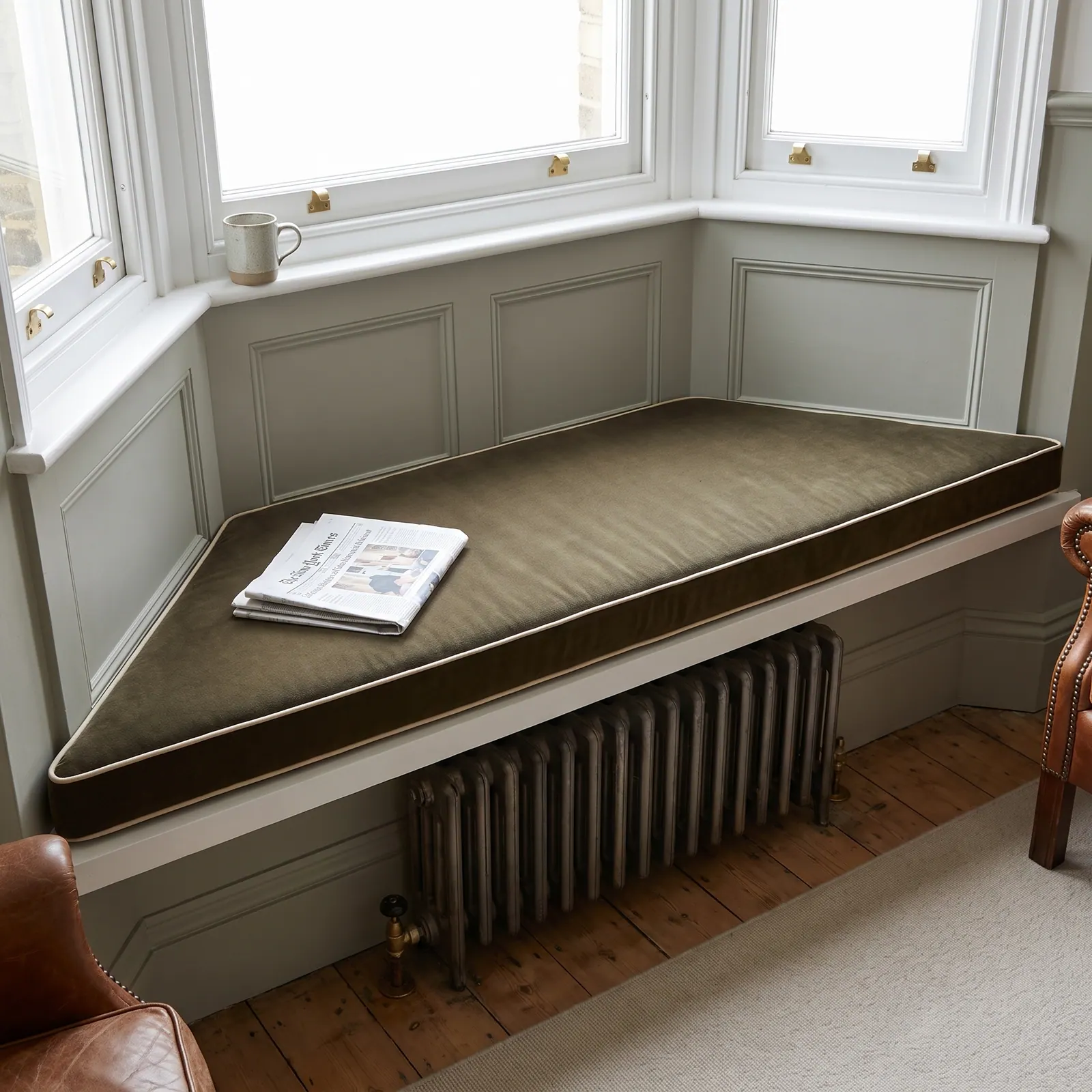
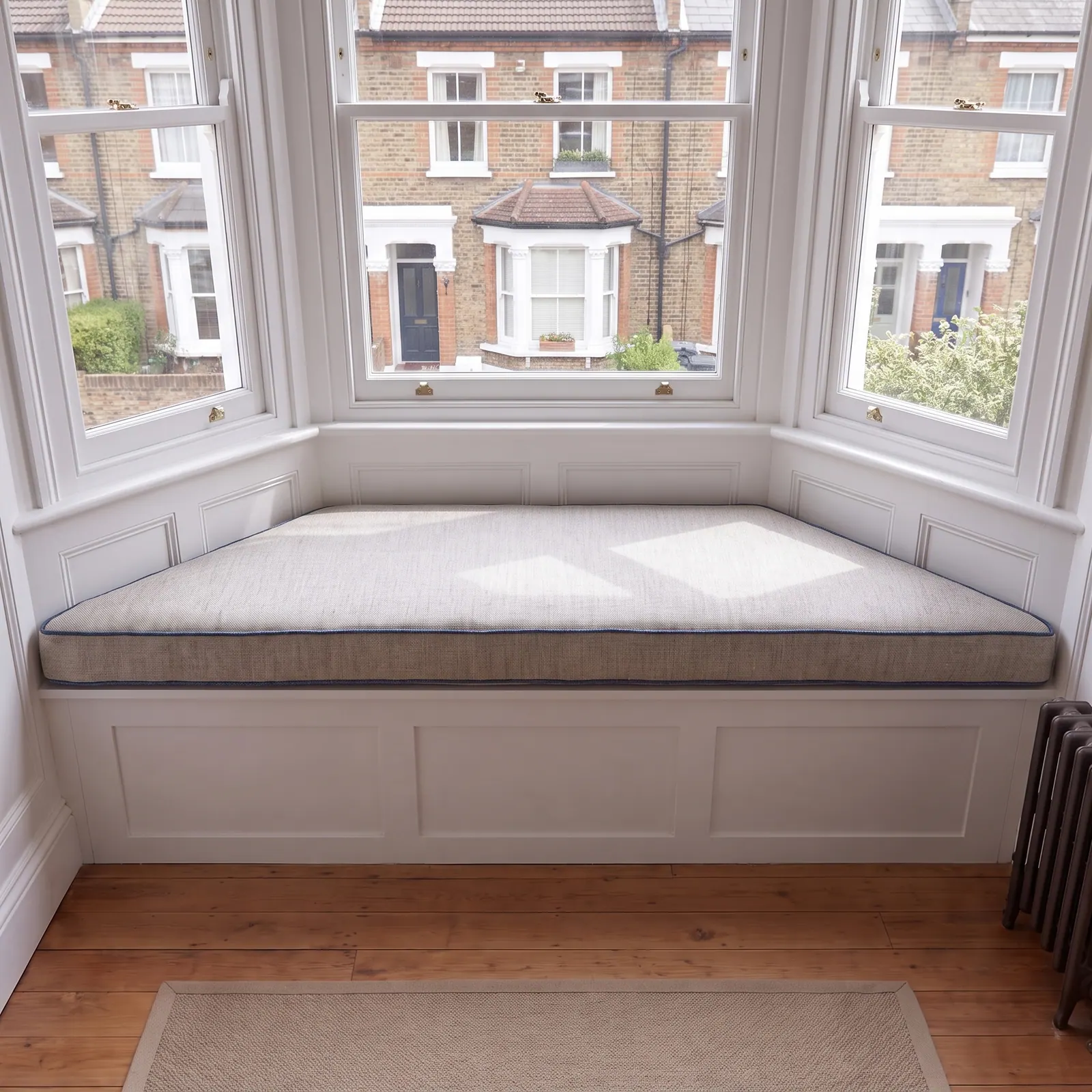
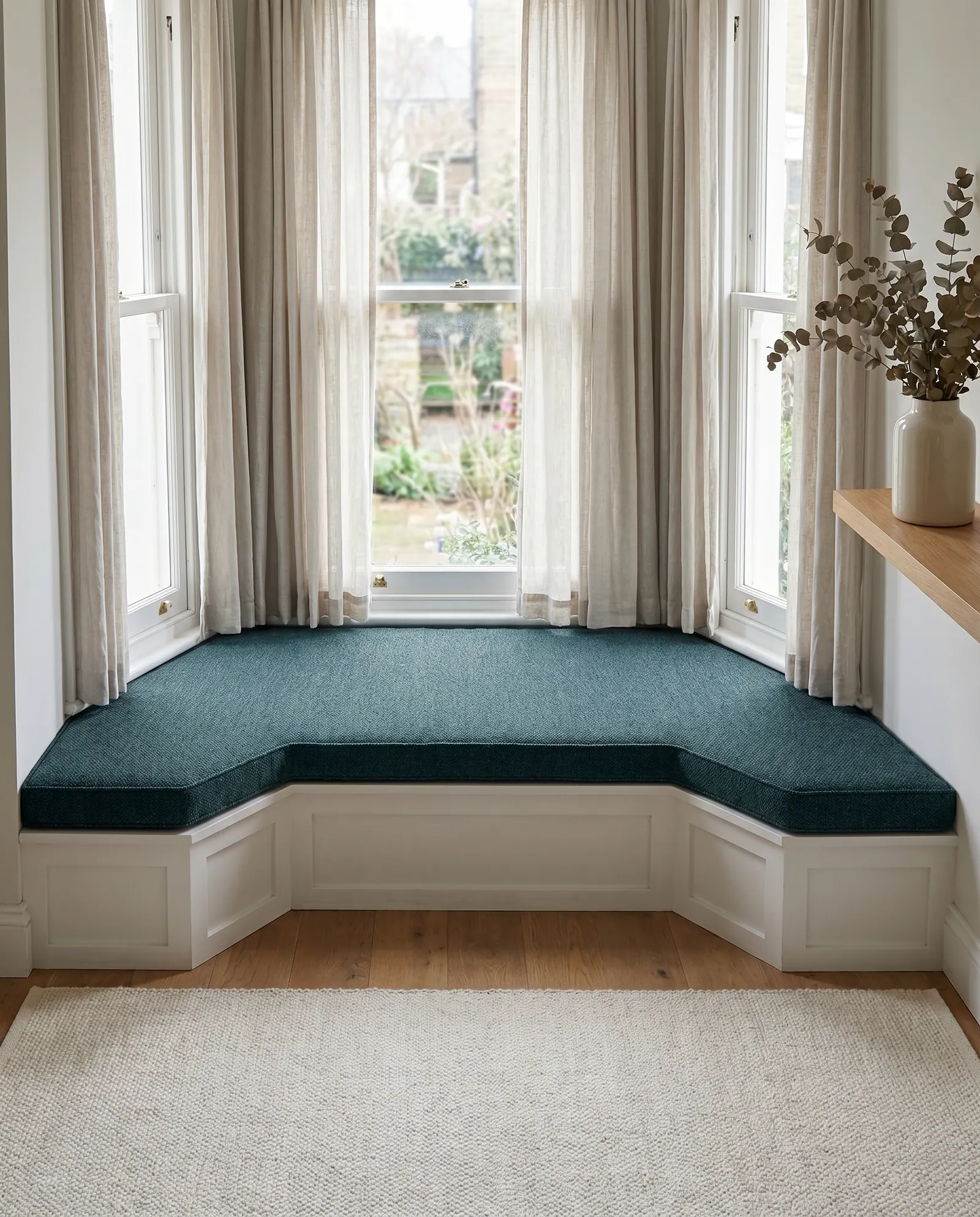
Cincinnati's Over-the-Rhine is believed to hold the largest collection of Italianate architecture of any neighborhood in America, and the style is known for tall, narrow windows. Columbus's Victorian Village adds Queen Anne, Second Empire and Foursquare houses. Many of these old houses have bays, and a bay is a trapezoid or a hexagon, never a rectangle. Start at the bay window cushions hub and run your numbers through the bay window calculator. How many edges does your bay really have?
Cleveland Heights built most of its two-family doubles between 1915 and 1930, each unit with a generous porch facing the street: an upper porch and a lower porch, two sets of cushions. On the Marblehead Peninsula, Lakeside's cottages, begun in 1873, are narrow, two-story and front-gabled with prominent porches. The Great Lakes cottage guide covers closing day, and the Midwest overview covers the rest of the region.
Measuring an Ohio bay: six numbers and one sketch
Front edge
Wall to wall along the front of the seat, in a straight line, with a rigid tape on the seat surface itself.
Back edge
Along the glass or the wall. On a bay it is shorter than the front.
Each slant, separately
Corner to corner as a straight line. Left and right are rarely identical in an old house, so write both.
Returns
Any short straight ends at the front corners. Two small returns turn a trapezoid into a hexagon.
Depth at 90 degrees
Straight from the back to the front edge, never along a slant. Take it at more than one point if the wall wanders.
Obstacles
Radiators, casings, window handles. Mark each one on the drawing with its size and its distance from a named end, then type every number as well as drawing it.
Fabric, build and tolerance by Ohio seat
Indoor seats use the standard 32 kg/m³ foam, about 2.0 lb/ft³. Outdoor seats use water-repellent, UV-resistant woven fabric over the same foam, which is not quick-dry.
| Seat | Fabric | Build | Tolerance note |
|---|---|---|---|
| Victorian bay over a cast iron radiator | Linen-look or velvet | Two pieces, 3 to 4 in (7.5 to 10 cm) thick | Split so the heat has a way out and each half lifts off |
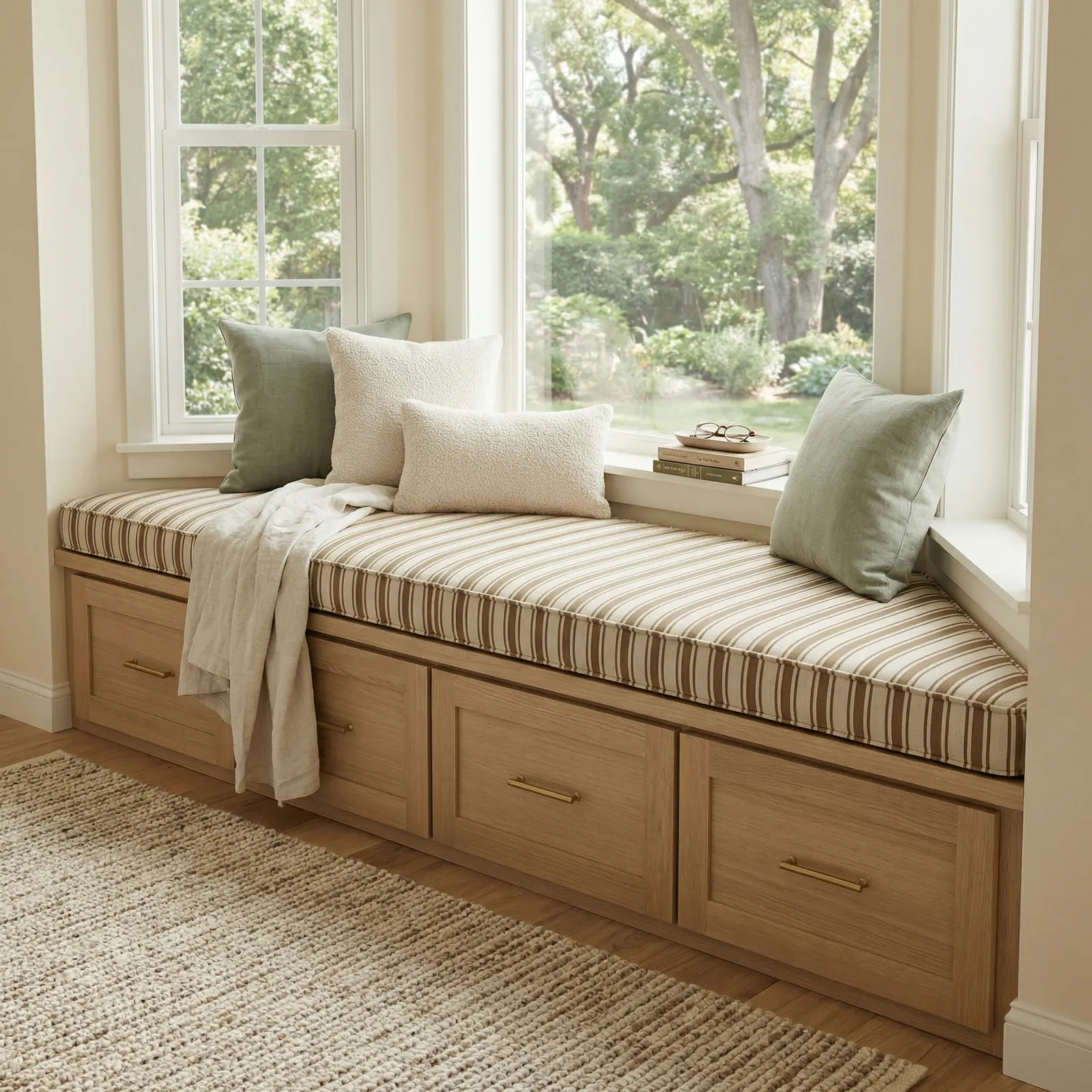
| Western Reserve window seat with a casing | Linen-look or striped cotton | Notched back edge, full depth at the ends | Notch depth equals casing depth; measure to 1/4 in |
| Three- or five-sided bay | Velvet or corduroy | One piece if it fits a single cut; split at lid lines | Finished size lands within about 1/2 to 1 in (1.3 to 2.5 cm) |
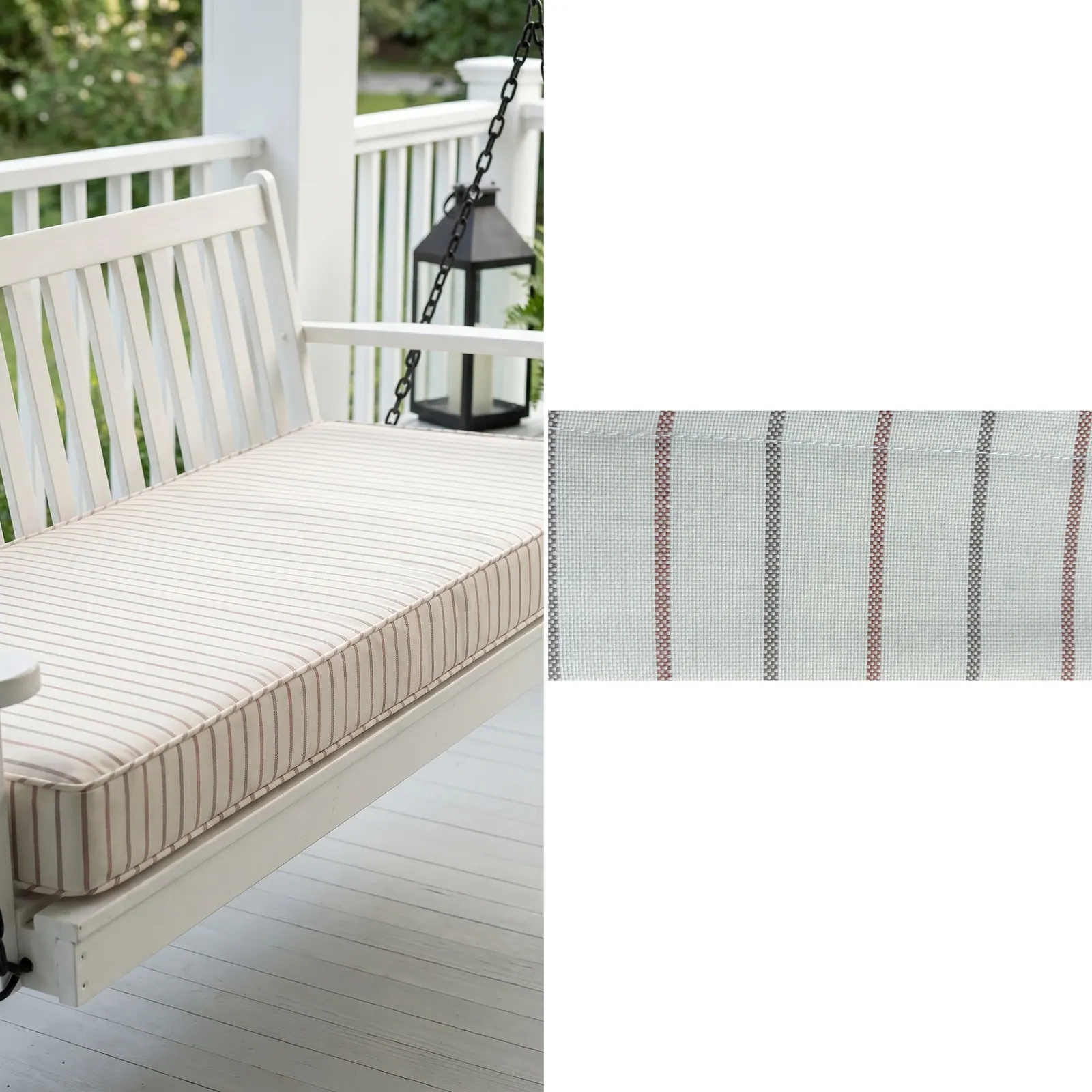
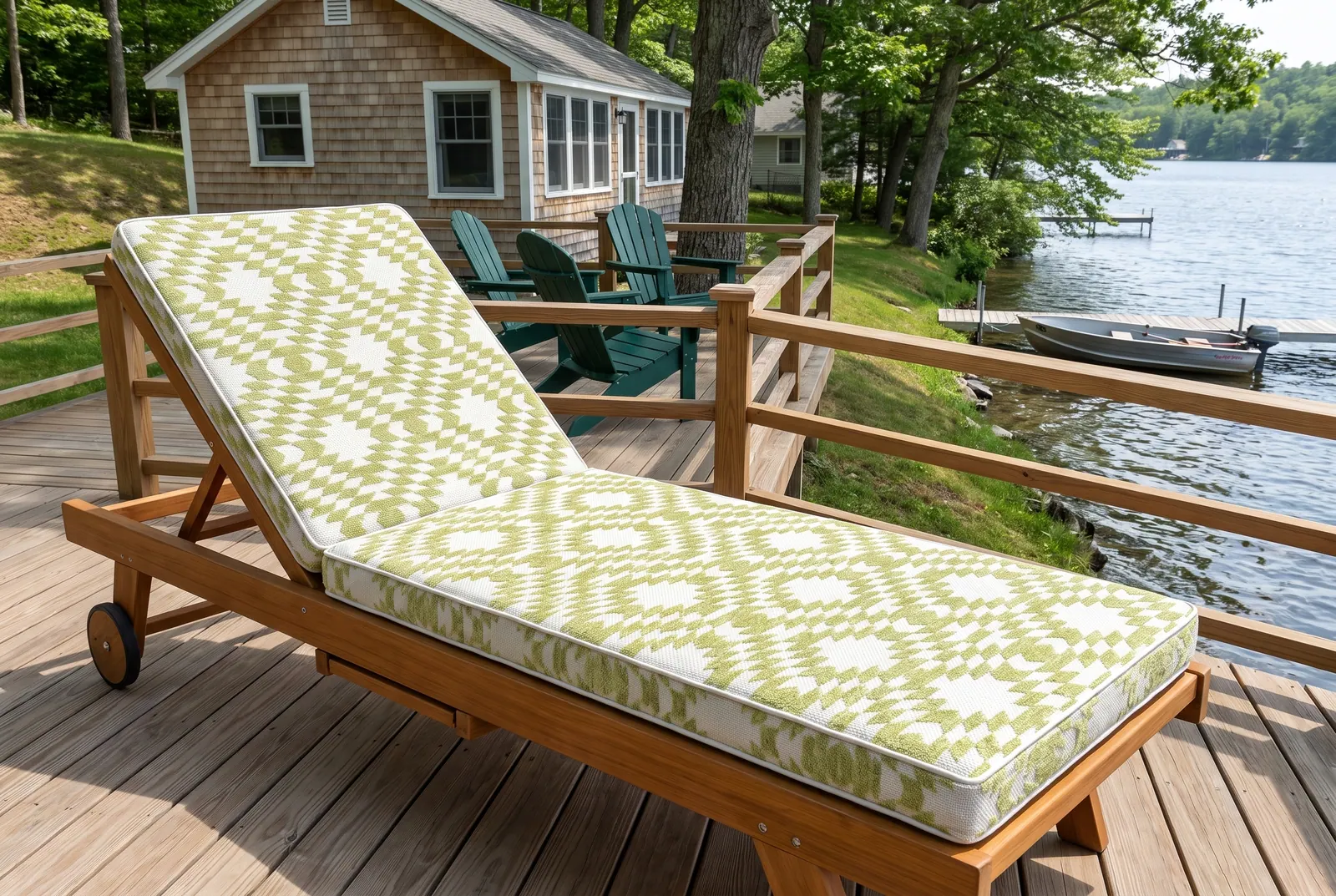
| Porch swing in southern Ohio | Outdoor fabric | 3 to 4 in (7.5 to 10 cm) seat, back as its own piece, ties at the back corners | Measure inside the arms, not the swing's nominal length |
| Cleveland double, upper or lower porch | Outdoor fabric | Seat pads with ties | Size each piece for the carry up the stairs |
| Lake Erie cottage deck | Outdoor fabric | Plain box cushions, ties for the lake wind | No tufting: it lets water in, even in outdoor fabric |
The trapezoid that had six sides
A buyer in the US asked whether corduroy would work on a trapezoid bay seat. Then they looked again and found two short extra edges. It was a hexagon.
The workshop turned the sketch into a template: front 78 in (198 cm), back 46.5 in (118 cm), angled sides 23 in (58 cm), end returns 5 in (13 cm), depth about 22 in (56 cm). The order went through the ranges that fit 78 in and 22 in, with the full shape written in the personalization box, in navy corduroy.
Here is the check I run on numbers like these, partner. The back is 31.5 in shorter than the front, so each slant covers 15.75 in (40 cm) sideways. A 23 in slant then rises √(23² − 15.75²) ≈ 16.76 in (42.6 cm). Add the 5 in return and the depth comes to about 21.76 in (55.3 cm), which closes to 22 in within 1/4 in. If your own numbers miss by more than about an inch, one of them is wrong. Re-measure before anything is cut.
Photographs for homes like these
Open any photograph large; each one has its own link and a Save button.
 Save
 Save
 Save
 Save
 Save
The Ohio storage year
- April: porch swing cushions come out after the last freeze. Cleveland still averages 8 freezing nights in April.
- Wet weeks: stand soaked cushions on edge under cover and get them dry within 24 to 48 hours, the EPA's window for stopping mold.
- Storm nights: swing and porch cushions come inside. Ties hold against a breeze, not a squall line.
- Fall: wash the zippered covers at 86°F (30°C) on a gentle cycle and air dry them completely.
- Before the first freeze: store foam and covers fully dry, off concrete, where air moves. Never seal damp cushions in plastic.
- Winter indoors: over a radiator, leave the gap between the two cushions open.
Angles are just lengths in disguise. Give me the front, the back, both slants and the depth, and your bay will tell on any number that's wrong.
Nate
Buyer questions: bays, radiators and casings
- A common question
My window seat sits over a radiator. Should the cushion be one piece or two?
The workshop's answerTwo. For a 106 x 15 in (269 x 38 cm) radiator window the workshop recommended two 53 x 15 in (135 x 38 cm) cushions, so the radiator area isn't sealed off.
- A common question
What do you need to cut a trapezoid or clipped-corner bay window cushion?
The workshop's answerEvery edge: front, back, both sides, any small clipped-corner edges, and the depth measured straight from the highest point down to the base line. If the numbers don't add up, the workshop works the depth out from the sides and asks you to confirm. A top of 86 in, a bottom of 126 in and sides of 26.5 in (218, 320 and 67 cm) gave about 17.4 in (44 cm). Mark cut-outs, such as a window handle, too.
- A common question
My bay window sketch is hard to read. How should I send the measurements?
The workshop's answerType every side length in the message as well as sending the sketch. One buyer's angled-top bay read A = 4.3, B = 4.3, C = 78.5, D = 48, E = 24, F = 24 and G = 23 in: letters on the drawing, numbers in the text.
- A common question
The window casing overhangs my seat. Can you notch the cushion around it?
The workshop's answerYes. For a 109.25 x 25 in (277 x 64 cm) seat with a casing 0.75 in (2 cm) deep, the workshop drew a notch 0.75 in deep and 96.25 in (244 cm) wide along the back edge, keeping the full 25 in depth for the 6 in on the left and the 7 in on the right. Send a sketch and a photo, and you approve a diagram before the quote.
- A common question
Do the back cushions on my porch chairs need straps to stay put?
The workshop's answerOften not. Back cushions made with double piping have enough structure to sit in place without sliding. Straps are still possible for a small extra cost, and a non-slip base on the seats is another option.

Have it made
Have it made for your home — ask Nate’s workshop
Precision starts on the phone. Give the workshop your measurements and they will read them back to you, edge by edge. — Nate
Leave your details and the workshop will call you to confirm measurements, fabric, foam and piping. No prices, dates or payment on this page: it is a request, not an order.
Ohio questions, with the arithmetic shown
Do porch swing cushions in Ohio need ties?
On a swing, yes. Ties are never standard, so ask for them at order time with the count and positions written in, for example two at the back corners. Ohio ranks tenth nationally for porch swing cushion searches, and every one of those swings moves.
How should I store patio cushions through a Lake Erie winter?
Clean, dry and breathing. Wash the covers at 86°F (30°C) on a gentle cycle, dry everything completely, and store it off the floor where air moves, never sealed in plastic. Cleveland averages 118 freezing nights, and water left in foam freezes.
How close to my measurements will a custom bay cushion be?
It is cut to your numbers, and the finished cushion usually lands within about 1/2 to 1 in (1.3 to 2.5 cm); very long one-piece cushions vary most. Measure it after three to four days out of the vacuum pack, across the flat middle, and photograph the tape.
Should a bay seat with lift-up lids get one cushion?
No. Split the cushion at every lid line so each section lifts with its own lid. One buyer with a bay seat of three flip-up sections was advised to order three separate cushions, drawn and measured one by one.
± 1/4 in — Nate
The atelier
Keep going
Across the Map
Nearby places
Close by on the map