A Reading by NateBay Window Cushions
A navy floral bay window seat cushion in three pieces, and what it borrows from the patio
Nate answers three questions about thickness, sizes and fabric codes, then reads a three-sided bay the way a boat berth gets read: as honest pieces, not one big guess.

 Save
The quick answer
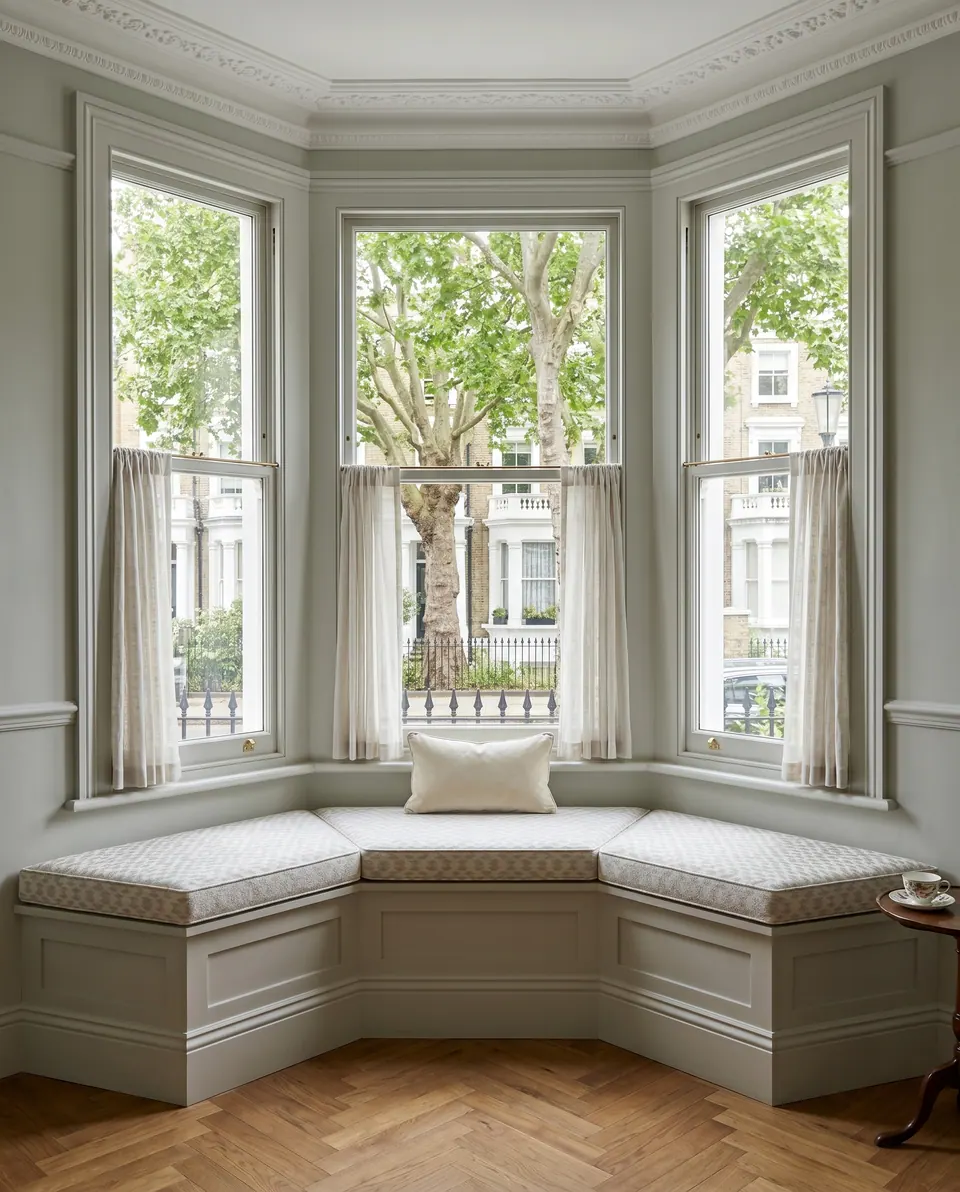
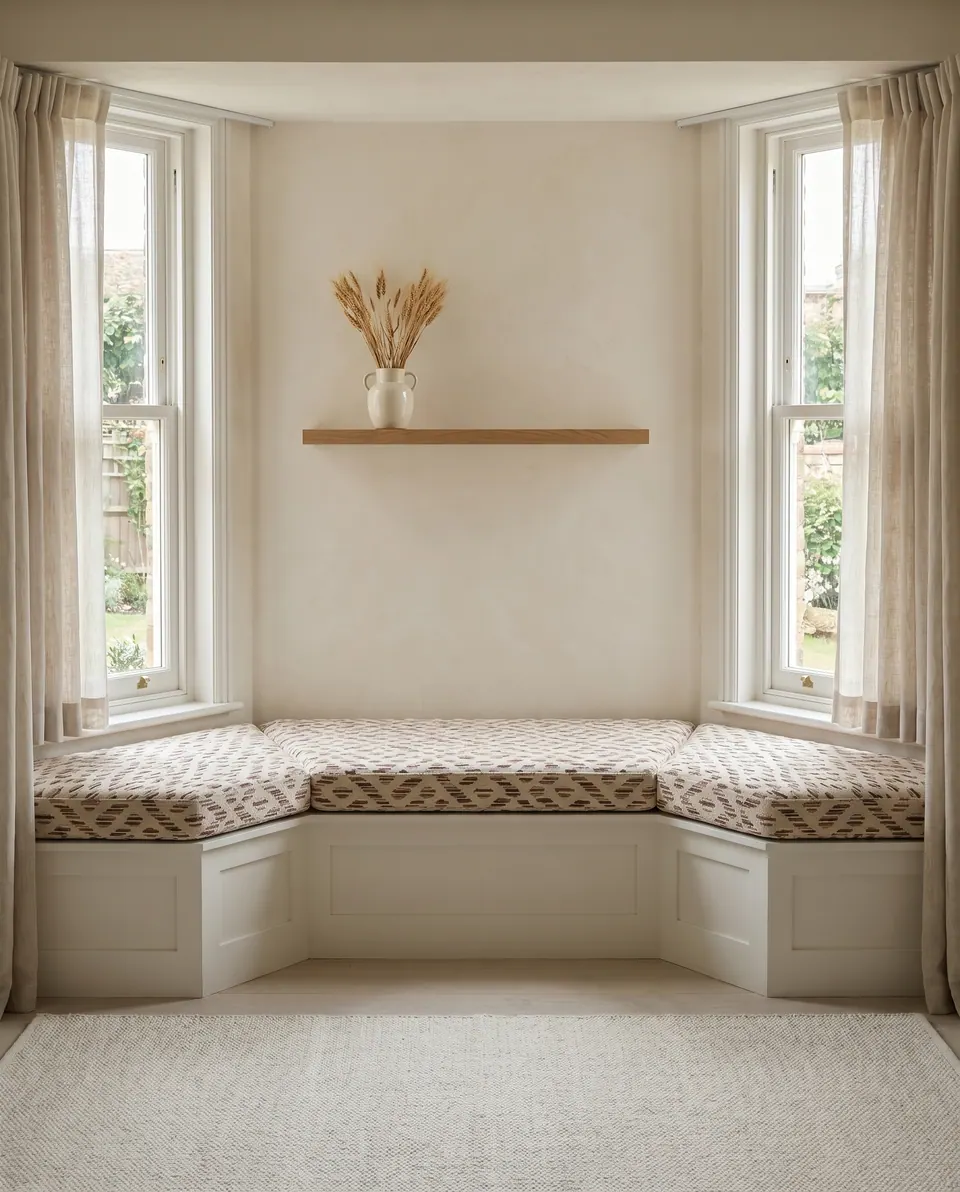
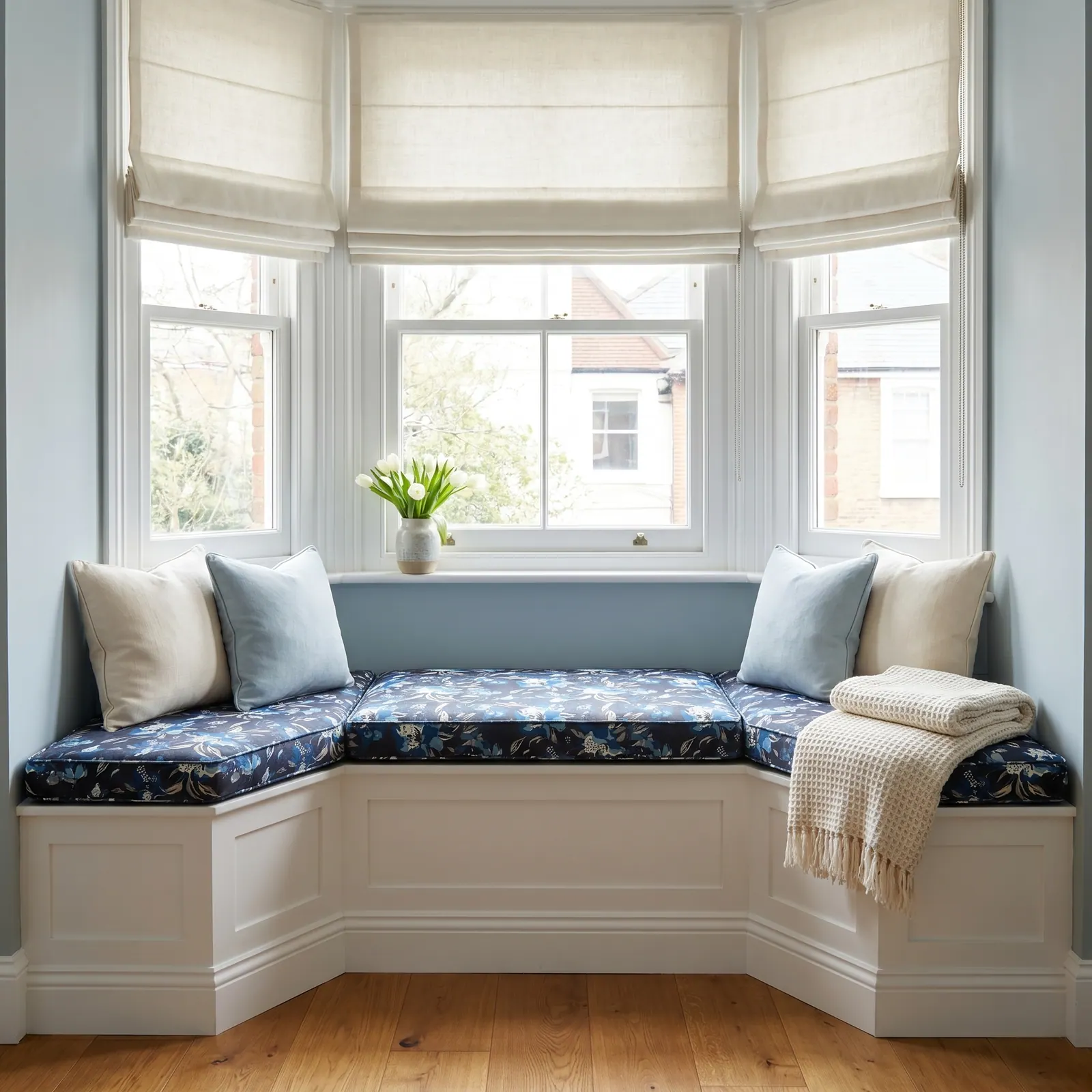
A three-sided bay window cushion works best as three pieces: a center rectangle and two end pieces cut to each wall's angle, with the joins under the mullions. Borrow two habits from outdoor cushions, lift-out pieces and a paper template for odd shapes, and leave the stiff outdoor fabric outside. Standard thickness is 4 in (10 cm); other thicknesses are made on request.
Three bay-window questions
- A common question
How thick are your cushions, and can I pick something other than the standard?
The workshop's answerThe standard is 4 in (10 cm), but any thickness can be made. Buyers have gone thinner, at 3 in (7.5 cm) and even 2 in (5 cm), and thicker, at 6, 8 and 9 in (15, 20 and 23 cm). Thicker cushions cost more. Write the thickness you want in the order note.
- A common question
My window seat falls between two sizes in the drop-down. Which one do I click?
The workshop's answerPick the closest option, usually the one just above yours, then type your exact dimensions and fabric code in the note. A 16 x 56 in seat went through the 16 x 55 in option, and a 17 x 36 x 4 in one through 18 x 36 in. The workshop sews to the note, not to the option.
- A common question
Which fabric code is the cushion in your listing photo?
The workshop's answerAsk, and the workshop will name it from the photo; one window bench, for example, is L-54 with L-52 piping. Sunlight and camera angle can shift a tone slightly on screen, but it is the same fabric.
Now, the reading
The bay that refused to be symmetrical
A buyer in the US wrote to the workshop about a bay window seat that was neither rectangular nor symmetrical. They sent photos and offered to cut a paper template to the exact outline.
Good instinct. The workshop asked for a paper sketch with every side measured, then came back for a few extra dimensions before it would quote. Here is why. When the sides of a bay don't mirror each other, one missing length lets the outline close two different ways, and only one of them is your window.
A full-size paper template settles that on the floor instead of in an email. It is a habit borrowed from boat work, where hardly a berth has a square corner. The paper template Pattern shows how to make one, and the bay window calculator checks the angles before you commit.
Pinned by Nate: a bay in three pieces
Five pins, from the center rectangle to the white tulips on the sill.
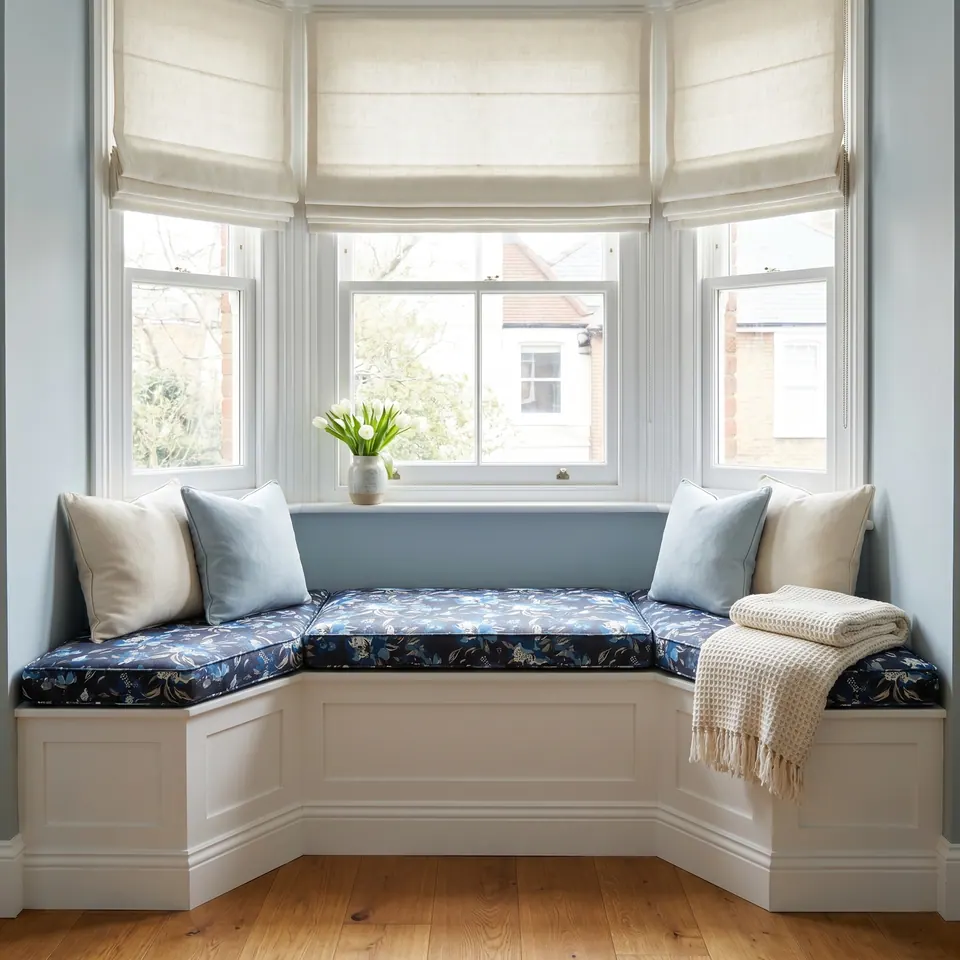
- Center cushion
A straight rectangle for the middle window, with joins falling at the mullions.
- Angled end piece
Each side piece is cut to its own wall angle so no bench top shows.
- Waffle throw
Folded over the right piece to soften the corner join.
- Pale blue pillow
Matched to the wall paint so the navy print stays the only busy element.
- Tulips on the sill
White tulips repeat the pale flowers in the print.
- Center cushionA straight rectangle for the middle window, with joins falling at the mullions.
- Angled end pieceEach side piece is cut to its own wall angle so no bench top shows.
- Waffle throwFolded over the right piece to soften the corner join.
- Pale blue pillowMatched to the wall paint so the navy print stays the only busy element.
- Tulips on the sillWhite tulips repeat the pale flowers in the print.
Where the seams land, and why the print is navy
Start with proportion. The center cushion is a plain rectangle filling the middle window. Each end piece is a trapezoid cut to its own wall angle, so no bench top shows at the sides. The joins land under the window mullions, where the eye already expects a vertical line. Put a seam in the middle of a pane and it reads as a mistake. Put it under a mullion and it reads as a plan.
Self piping runs around all three pieces. On a busy floral, contrast piping would draw six extra corners across the seat. Self piping lets three cushions read as one seat that happens to lift out in thirds.
The navy floral is the darkest thing in the frame, on purpose. Cool spring daylight through linen roman blinds would wash out a pale print. Navy holds its ground against pale blue walls and the white paneled base, and the oak floorboards add the only warm note, far enough below not to argue.
Every prop has a job. Two pale blue pillows match the wall paint. Two ivory pillows match the blinds. Neither carries a pattern, so the floral stays the only busy element. The cream waffle-knit throw is folded over the right-hand join, softening the one spot where two cushions meet at an angle. White tulips on the sill repeat the pale flowers in the print.
The idea to copy: ask for separate pieces with the same piping. More three-sided seats live among our bay window cushions, and the 3-sided bay Pattern walks through the measuring. How many sides does your bay have, partner?
What to borrow from the patio, and what to leave out there
| Outdoor habit | In a living-room bay | Borrow it? |
|---|---|---|
| Seats made in lift-out pieces | Three pieces split under the mullions, each out for cleaning on its own | Yes |
| Paper templates for odd shapes | An asymmetric bay closes correctly on the first cut | Yes |
| Counting sun hours | A bay seat sits in direct sun for much of the day; check fading before a dark print | Yes |
| Stiff, water-repellent weave | No rain to shed indoors; a softer upholstery fabric sits better | Leave it outside |
| Dry-fast open-cell foam | Built to drain water; an indoor bay has none to drain | Leave it outside |
On the cutting table: the three-piece bay
| Cushion | Three-piece bay window seat set |
|---|---|
| Pieces | Center rectangle plus two end trapezoids, each cut to its own wall angle |
| Joins | Under the window mullions |
| Fabric | Navy floral print on an ivory ground |
| Piping | Self piping on every piece |
| Edge | Box edge |
| Thickness | Standard 4 in (10 cm); thinner or thicker on request |
| Pillows | Two pale blue, two ivory, all plain |
| Best for | Three-sided living-room bays, symmetrical or not |

Have it made
Have this made — ask Nate’s workshop
Every edge and both diagonals, to the nearest 1/4 in. If the numbers do not close, the workshop will say so on the call. — Nate
Leave your details and the workshop will call you to confirm measurements, fabric, foam and piping. No prices, dates or payment on this page: it is a request, not an order.
A bay window seat cut in three pieces looks planned when the joins fall under the window mullions, where the eye already expects a line.
Nate
Questions buyers ask next
Should a three-sided bay window cushion be one piece or three?
Three, in most bays. A center rectangle and two angled end pieces each follow their own wall, lift out separately for cleaning, and put the joins under the mullions, where a line already belongs.
Is outdoor fabric worth using on an indoor bay window seat?
Rarely. Outdoor weaves are built to shed rain and dry fast, which an indoor bay never asks of them. Borrow the outdoor habits instead: lift-out pieces and a paper template for odd shapes.
What do I send the workshop for an asymmetric bay seat?
A sketch with every side measured, plus any extra dimensions the workshop asks for. If the bay is truly irregular, a full-size paper template of the seat top is the surest record of the outline.
What pillows suit a busy floral window seat?
Plain ones pulled from the room, not the print. Here pale blue pillows match the wall paint and ivory ones match the linen blinds, so the navy floral stays the only pattern in the bay.
± 1/4 in — Nate