A Reading by NateBay Window Cushions
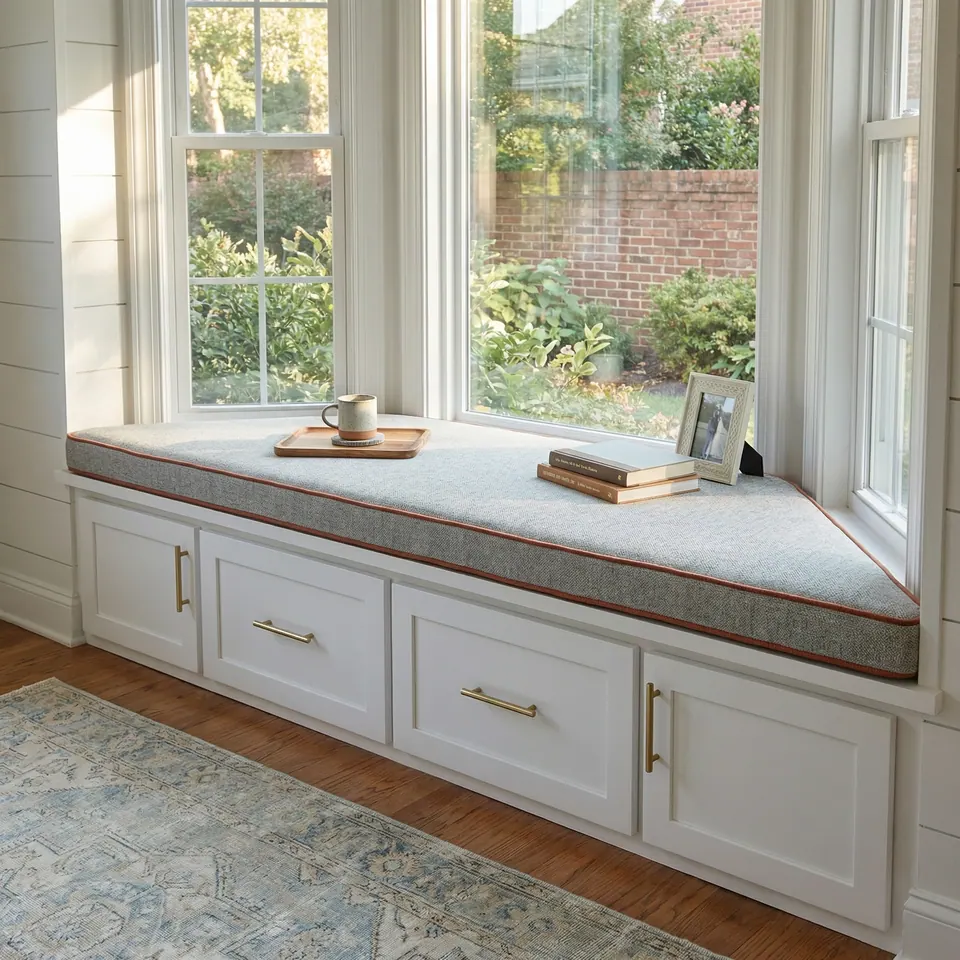
A three-piece bay window seat cushion in cream and rust jacquard, and how the cloth wears
Three pieces, one small woven dash, and a hexagon that tried to pass as a trapezoid. Notes on how this jacquard feels, wears and washes.

 Save
The quick answer
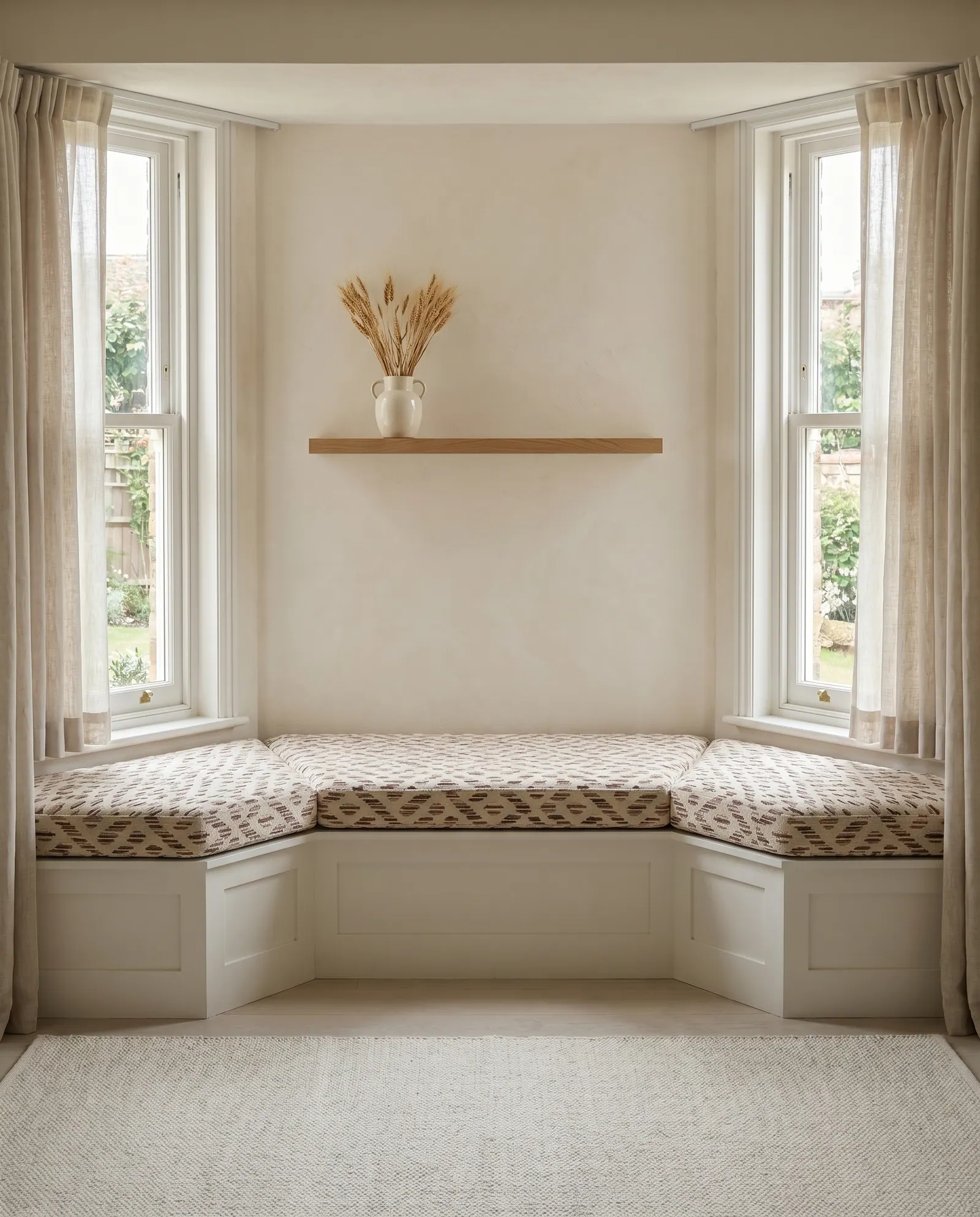
A cream jacquard with a small woven rust dash is a forgiving choice for a bay window seat cushion: the pattern is part of the weave, so it won’t rub off, and small marks disappear into it. Cut in three pieces, a straight center and two angled wings, each cover zips off and washes at 86°F (30°C).
One wing of the bay seat, cut open
Jacquard cover. Cream ground with the rust dashes woven in, not printed on. The cover unzips and machine washes at 86°F (30°C) on a gentle cycle; air dry it.
Self piping. Cut from the same jacquard, so the edge adds no new color to a small repeat.
Fiber wrap. Polyester fiber (Dacron) batting around the foam: it fills the cover out and softens the edges.
Foam core. About 2 lb/ft³ (32 kg/m³) high-resilience foam, 4 in (10 cm) as standard, cut separately for the center and each wing.
Zipper. Along the back band, as hidden as possible. The zipper side faces down or toward the wall.
Base panel. The underside of the cover. A non-slip fabric backing can cover the whole of it instead.
Three pieces, and why the middle one is straight
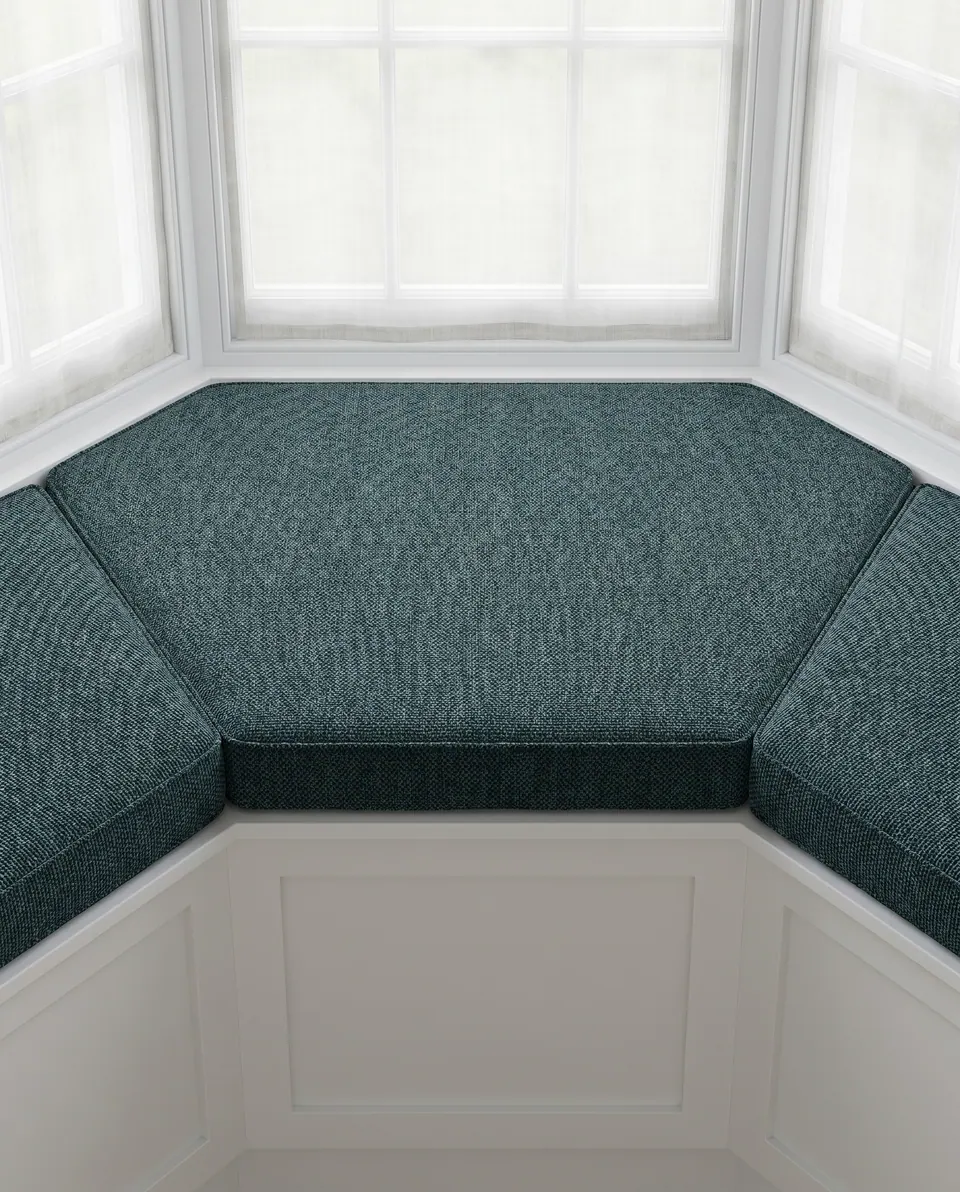
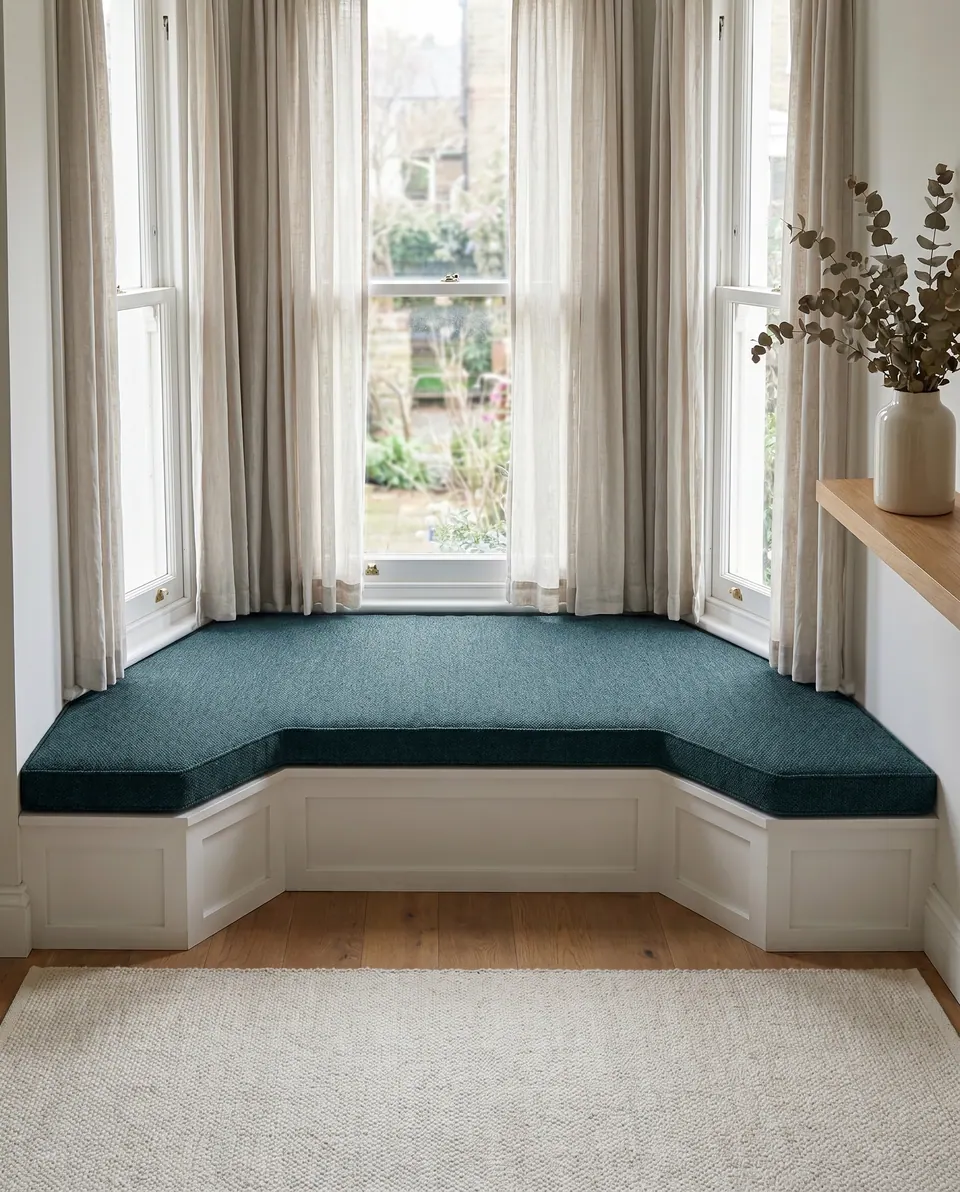
Count the pieces before anything else: three. A straight center section and two wings, each wing cut to the bay angle and butted against the center. Nothing clever. Just honest joins.
The center matters most. It runs parallel to the back wall, so the rust dashes run parallel too. Make the whole seat one shaped piece and the pattern has to pick a single direction, and the wings look crooked against their own windows. Angles are just lengths in disguise, and here the lengths behave.
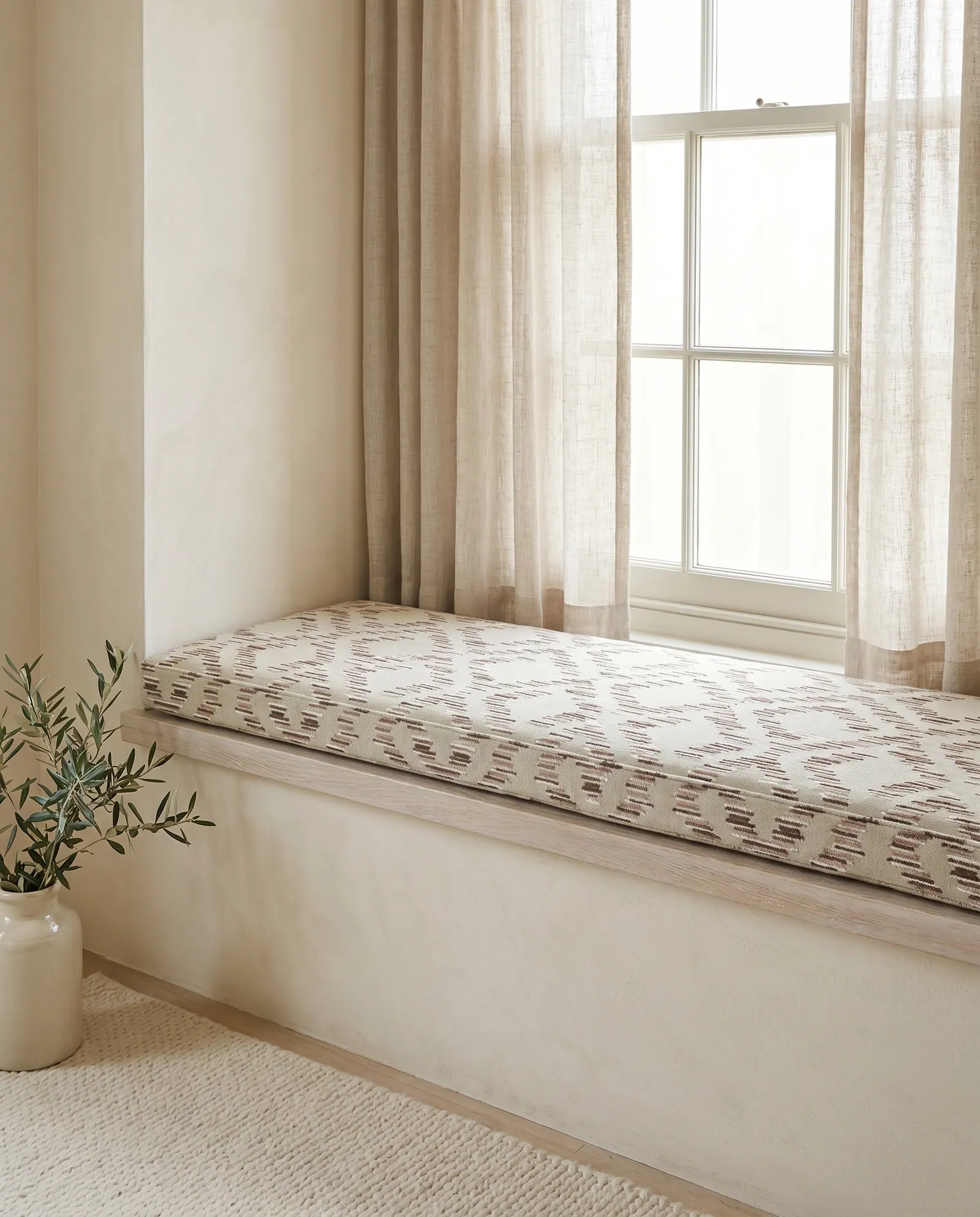
Whoever styled this bay likes symmetry: two sash windows, one oak shelf dead center, one white jug of dried wheat. The wheat is the same rust as the dashes, so one prop ties wall to seat. Sheer linen curtains soften the light. The paneled base stays plain white so the patterned top is the only texture at eye level, and the cream wool rug and limewash plaster keep the whole corner pale.
The piping is self piping. On a small repeat, a contrast welt draws a second outline the eye doesn’t need. For a bay window cushion you want to keep light, a pale ground with a tiny warm pattern beats a solid.
Five points on the bay
Five marks on the photo: three pieces of cushion, one prop, one plinth.
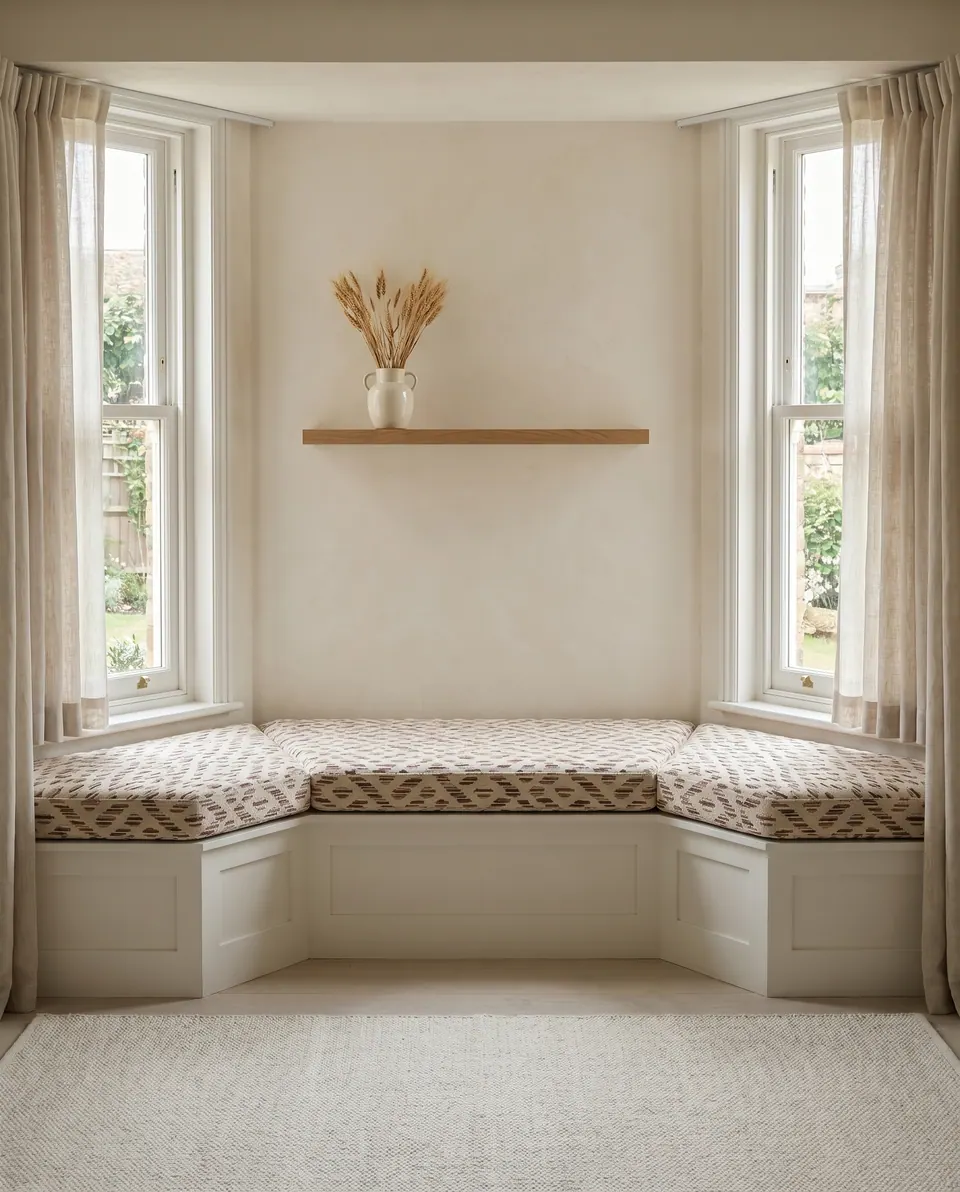
- Center section
The straight middle piece keeps the dash pattern running parallel to the wall.
- Angled side piece
Each wing is cut to the bay angle and butts neatly against the center.
- Right wing
Three pieces are easier to lift, wash and fit than one large shaped cushion.
- Wheat on shelf
The wheat and the pattern's dashes share one rust tone, so a single prop links wall and seat.
- Paneled plinth
Plain white panels keep the patterned top the only texture at eye level.
- Center sectionThe straight middle piece keeps the dash pattern running parallel to the wall.
- Angled side pieceEach wing is cut to the bay angle and butts neatly against the center.
- Right wingThree pieces are easier to lift, wash and fit than one large shaped cushion.
- Wheat on shelfThe wheat and the pattern's dashes share one rust tone, so a single prop links wall and seat.
- Paneled plinthPlain white panels keep the patterned top the only texture at eye level.
The hand of a small-dash jacquard
A jacquard has its pattern woven in, not printed on. Run a thumb across this one and the rust dashes are threads, part of the cloth, with a slight texture where they cross the cream. So the pattern will not scuff off at the front edge, where heels and knees rub most.
Wear first. A small repeat forgives. A crumb or a faint mark that would stand out on plain cream gets lost among the dashes. From across the room the seat reads as texture; up close it reads as pattern. That is useful on a seat that faces the light all day, and sun through glass is worth reading if your bay faces south.
Cleaning next. The covers zip off and machine wash at 86°F (30°C) on a gentle cycle; air dry them. Here the three-piece cut pays again. Each wing is easier to lift, wash and refit than one big shaped cover, and you can wash the wing by the door without touching the rest.
What does your bay measure along the front, partner?
The trapezoid that turned out to be a hexagon
A buyer asked whether corduroy would work on a trapezoid bay seat. Then they measured again and found two short extra edges at the ends. Four sides had become six.
We turned the sketch into a template:
- Front: 78 in (198 cm)
- Back: 46.5 in (118 cm)
- Angled sides: 23 in (58 cm) each
- End returns: 5 in (13 cm) each
- Depth: about 22 in (56 cm)
Then the check. The front is 31.5 in longer than the back, so each angled side steps in 15.75 in. Assume the 5 in returns run straight back; then each angled side climbs the other 17 in of depth. Fifteen and three-quarters across, seventeen deep: the diagonal works out to 23.2 in. The buyer wrote 23 in. That closes inside ± 1/4 in, so the drawing is honest.
The buyer picked the size option that covered 78 in and 22 in, wrote the full shape in the order note and chose navy corduroy. The bay window calculator runs the same check.
- Sizes
- Front 78 in (198 cm), back 46.5 in (118 cm), angled sides 23 in (58 cm), end returns 5 in (13 cm), depth about 22 in (56 cm)
- Fabric
- Navy corduroy
The lesson: A bay seat with short end returns is a hexagon, not a trapezoid; measure every edge.
Sizes, shapes and a short cushion
- A common question
Can you make a window seat cushion in my exact size, something like 68 × 39.5 in?
The workshop's answerYes, any custom size. Recent window seat and bench sizes include 68 × 39.5 in, 32 × 81 in and 24 × 76 in. You will also be asked whether you want a matching backrest or just the seat for now.
- A common question
My bench is an L. Can I have a back cushion on one side only?
The workshop's answerYes. One L-shaped bench, 84 × 22 in on one run and 62.5 × 21.5 in on the other, was made in sage corduroy with a foam wedge backrest along the 84 in side only. Standard thickness is 4 in, and it can be changed.
- A common question
My cushion measures shorter than I ordered. Was it cut wrong?
The workshop's answerProbably not. Cushions ship vacuum-packed, so the foam measures short at first. Take it out of the packaging soon and give it about a week to regain its shape, then measure again. One cushion measured 103 in straight out of the pack against 105.25 in ordered.
A bay window seat with two short end returns is a hexagon, not a trapezoid. Measure all six edges and the depth before you order.
Nate
On the cutting table: the three-piece bay
| Cushion | Three-piece bay window seat cushion: straight center, two angled wings |
|---|---|
| Fabric | Cream jacquard with a small woven rust dash |
| Piping | Self piping on top and bottom seams |
| Edge | Box edge |
| Thickness | 4 in (10 cm) standard; other thicknesses on request |
| Foam | About 2 lb/ft³ (32 kg/m³) high-resilience foam |
| Care | Zip-off covers, machine wash at 86°F (30°C) gentle, air dry |
| Best for | Symmetrical bays, pale rooms, seats that face strong light |

Have it made
Have this made — ask Nate’s workshop
Send the numbers in inches: length × depth × thickness, plus any angle. The workshop checks them with you, because foam has no undo button. — Nate
Leave your details and the workshop will call you to confirm measurements, fabric, foam and piping. No prices, dates or payment on this page: it is a request, not an order.
Questions buyers ask next
Is a jacquard the same as a printed pattern?
No. In a jacquard the pattern is woven into the cloth on the loom, so the design is made of the threads themselves. It can’t scuff or wash off the way a surface print can.
Why cut a bay window cushion into three pieces?
Three pieces follow the bay with a straight center and two angled wings. Each piece is easier to lift, wash and fit than one large shaped cushion, and the pattern stays parallel to each window.
Does self piping or contrast piping suit a small-pattern fabric?
Self piping, usually. On a small repeat, a contrast welt draws a second outline around a surface that already has plenty to look at. Self piping keeps the edge crisp and quiet.
How thick should a bay window seat cushion be?
Four inches (10 cm) is the standard thickness, and it can be changed. Check the finished seat height against your knees before choosing thinner or thicker.
± 1/4 in — Nate
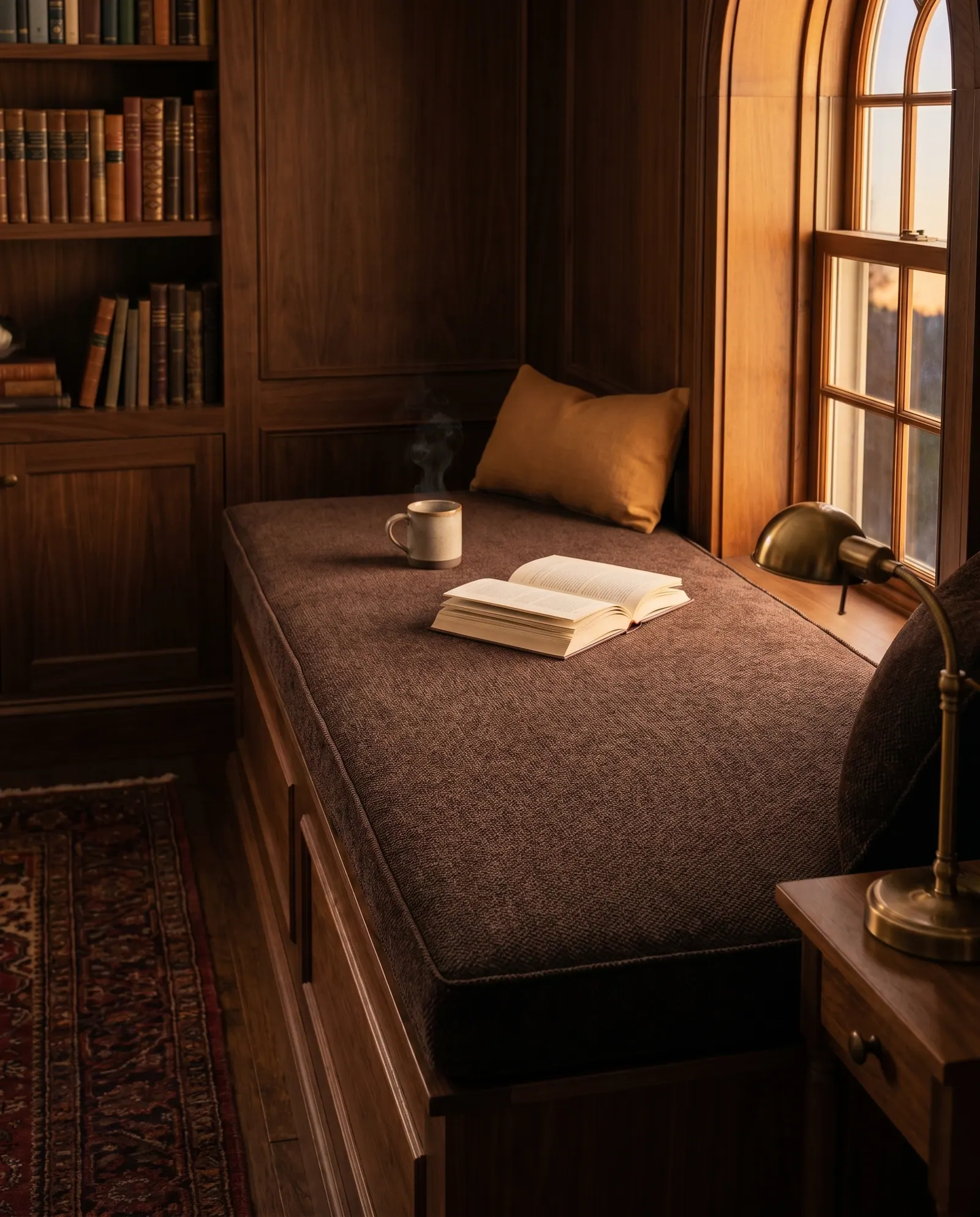
More patterned seats and bays
 Save
 Save
 Save
 Save
 Save
 Save