A Reading by NateBay Window Cushions
A Black and Cream Geometric Bay Window Cushion, Before and After
One slim, graphic pad on an oak drawer bench, and a white three-window bay goes from empty to finished. Here is the geometry behind it.

 Save
The quick answer
A bay window cushion makes the biggest change when it is the only strong pattern in a pale room and stays slim, so the windows remain the tallest element. This black-and-cream geometric jacquard follows only the straight center run of the bay, the simplest cut to get right. For a full bay, measure the back wall and front edge separately and label every angled edge.
The cushion, cut open
Cover fabric. A removable, zippered cover. Machine wash at 86°F (30°C) on a gentle cycle and air dry.
Piping. A fabric-covered cord sewn into the seams. It sits on the seam line, so it does not change the size.
Fiber wrap. Polyester fiber (Dacron) batting around the foam: it fills the cover out and softens the edges.
Foam core. About 2.0 lb/ft³ (32 kg/m³) high-resilience foam, firm to medium-firm, cut to the ordered size.
Zipper. Along the back band, as hidden as possible. The zipper side faces down or toward the wall.
Base panel. The underside of the cover. A non-slip fabric backing can cover the whole of it instead.
Before: white walls. After: one graphic line
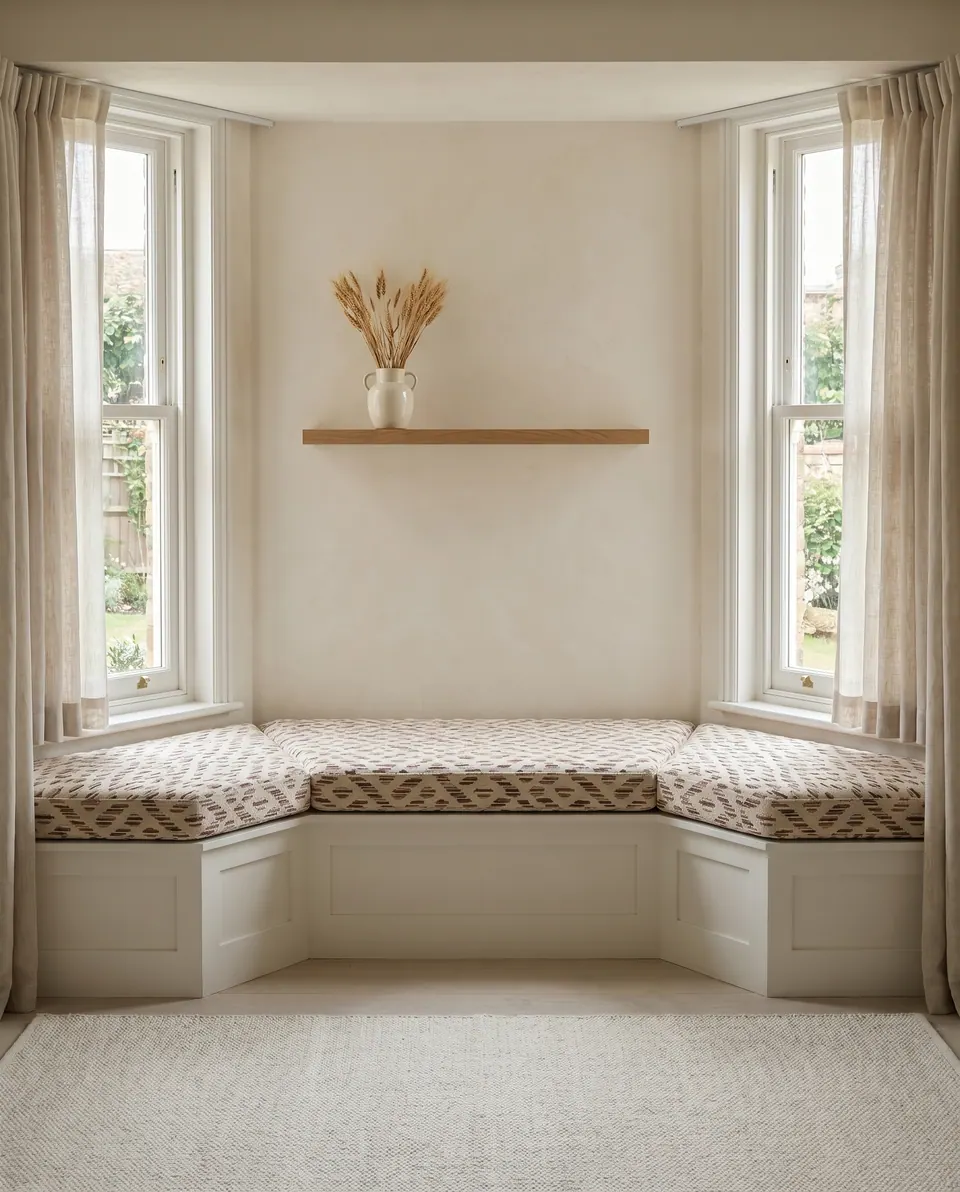
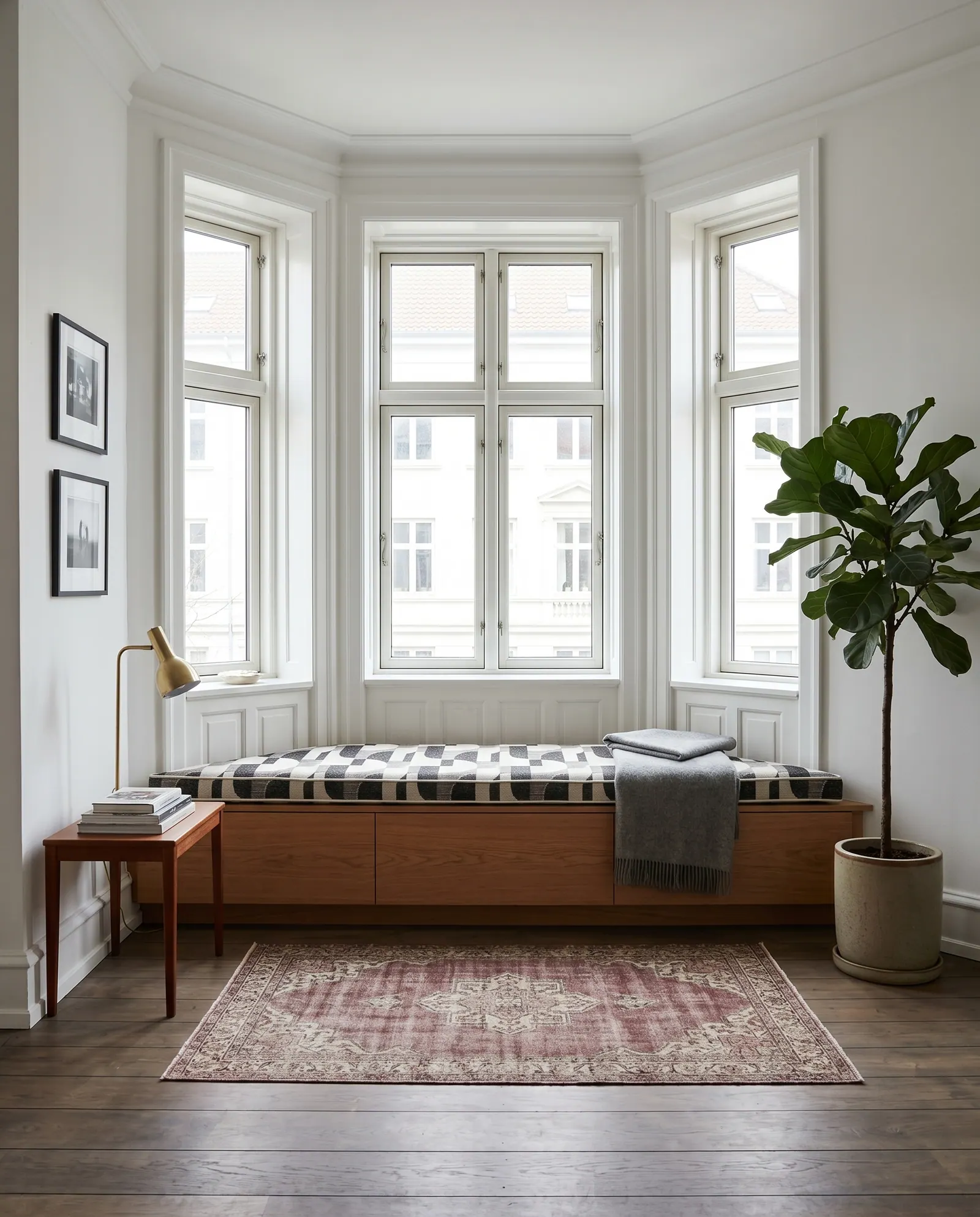
Before: a tall white bay, three windows, an oak storage bench with drawer fronts, a dark wide-plank floor. Clean, correct, and a little cold. After: one bay window cushion in a black-and-cream geometric jacquard, and the room has a center of gravity.
The cushion is the only strong pattern in the frame, which is exactly why it can be bold. Its black half-moons repeat the two black-framed monochrome photographs on the left wall. Pattern plus one echo reads as a plan; pattern alone reads as an accident.
The pad is slim on purpose. On a long, low drawer base, a thin cushion keeps the bench low, so the windows stay the tallest element in the room. Box edge, self piping: the outline stays inside the pattern and doesn't introduce a third color.
Now the balance sheet. Left side: a brass reading lamp, the only warm metal, plus the frames. Right side: a fiddle leaf fig in a concrete planter, tall enough to answer the lamp. A gray fringed wool throw folded over one end softens the print. A faded rose Persian rug warms a room otherwise built from white, gray and black, and a teak side table with stacked books waits for whoever sits down first.
Bright northern daylight comes in flat and even through three panes, and a woven pattern from our jacquard and damask family reads crisp in it. One more note, partner: this cushion follows only the straight center run of the bay. That is the simplest cut to get right, and the one I'd start with in any living room.
Five pins across a white bay
Five pins, from the geometric pad to the faded rug, showing how one bold cushion balances a pale room.
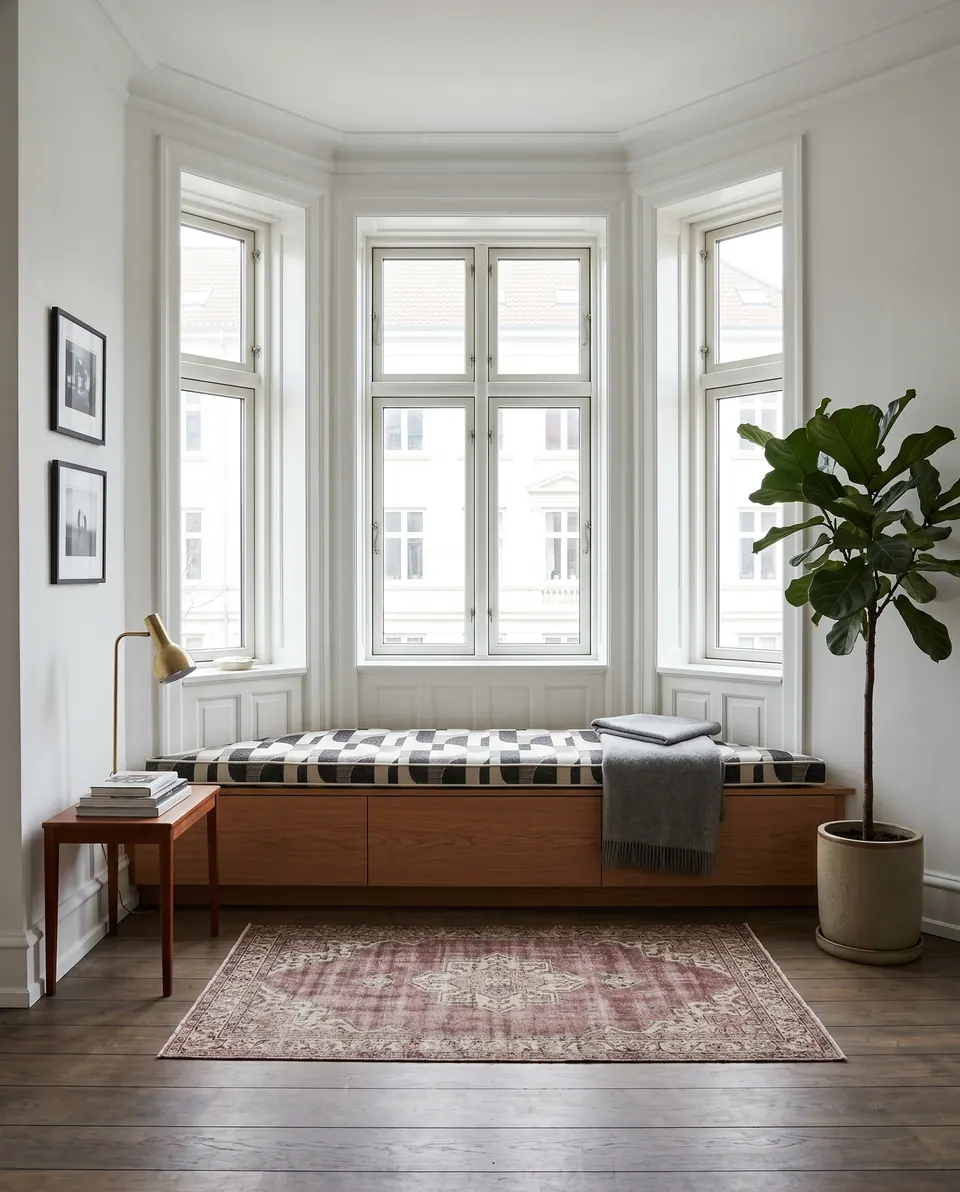
- Geometric bay cushion
A slim pad on a long drawer base keeps the windows the tallest element.
- Gray wool throw
Folded over one end, it softens the graphic print.
- Brass reading lamp
The only warm metal, balancing the black-and-cream pattern.
- Fiddle leaf fig
Tall greenery on the right balances the lamp and frames on the left.
- Faded Persian rug
Rose tones warm a room otherwise made of white, gray and black.
- Geometric bay cushionA slim pad on a long drawer base keeps the windows the tallest element.
- Gray wool throwFolded over one end, it softens the graphic print.
- Brass reading lampThe only warm metal, balancing the black-and-cream pattern.
- Fiddle leaf figTall greenery on the right balances the lamp and frames on the left.
- Faded Persian rugRose tones warm a room otherwise made of white, gray and black.
Measuring the bay: five lines on one drawing
Draw it from above
Sketch the seat as seen from the ceiling. It does not need to be to scale; it needs to be complete.
Label the back and the front
Write the back wall length and the front edge length separately. On a bay they are never the same number.
Write the depth
Measure straight from the back wall to the front edge at a right angle, not along a slanted side.
Write every angled edge
Measure each side section along the edge itself. Angles are just lengths in disguise.
Photograph the drawing and the window
Send both. The photo catches what the drawing forgot.
105 inches long and still not enough information
One buyer wrote in asking how to measure a multi-angled bay window seat. The workshop's answer: draw the shape from above, label the back, the front, the depth and every angled edge, then send photos of the drawing and of the window.
The seat came to about 105 in long and 17 7/8 in deep (267 x 45.5 cm). The workshop told them which size range to select, then pointed out that the lengths of the angled edges were missing from the drawing, and asked for them before the file was uploaded.
Two numbers price a bay; every edge builds it. An overall length and depth with no side lengths could describe a dozen different shapes. The bay window calculator and the three-sided bay Pattern walk through each line. How many edges does your bay seat have, counted along the front?
Buyer questions: look-alike fabrics, stripe piping and the wrong thickness
- A common question
In a review photo the cushion looks like velvet, but the swatch looks like leather. Which fabric is it, and is it right for me?
The workshop's answerThat cushion was made in G-42, a leather-textured, highly durable pet-friendly fabric chosen by a customer with a large dog to prevent damage. Without pets, the workshop recommends the Soft or Velvet collections instead: more comfortable for daily use, in very similar colors.
- A common question
The striped fabric I picked has no plain version. What do I use for the piping?
The workshop's answerThe striped lines come only in stripes, with no matching solid in the same tone. Use the same stripe for the piping, or choose a solid color from another chart.
- A common question
I ordered the wrong thickness. What are my options now?
The workshop's answerPlace a new order in the right size. When one buyer needed 2 in (5 cm) instead of 4 in (10 cm), the workshop refunded part of each order. When cushions were made to the requested size but ordered too small, that buyer was offered a return at their own expense or a discount on a new order.
On the cutting table: the bay cushion
| Piece | Straight-run bay window cushion |
|---|---|
| Fabric | Black-and-cream geometric jacquard |
| Piping | Self piping |
| Edge | Box edge |
| Profile | Slim, so the windows stay the tallest element |
| Base | Oak storage bench with drawer fronts |
| Cut | Center run only; angled side sections left bare |
| To measure | Back wall, front edge, depth and every angled edge |

Have it made
Have this made — ask Nate’s workshop
Every edge and both diagonals, to the nearest 1/4 in. If the numbers do not close, the workshop will say so on the call. — Nate
Leave your details and the workshop will call you to confirm measurements, fabric, foam and piping. No prices, dates or payment on this page: it is a request, not an order.
A bay window cushion is priced from two numbers but built from every edge: write the back, the front, the depth and each angled side on the drawing.
Nate
Questions buyers ask next
Can a bold geometric cushion work in a minimal room?
Yes, if it is the only strong pattern. Repeat one of its colors somewhere else, as the black picture frames do here, and keep the rest of the room to white, gray and wood so the cushion reads as intentional.
Should a bay window cushion cover the angled side sections too?
It can, but a cushion on the straight center run alone is the simplest cut to get right. A full bay cushion needs every angled edge measured along the edge itself, plus separate back and front lengths.
Why keep a bay window cushion slim on a low drawer bench?
A slim pad keeps the bench low, so the windows stay the tallest element and the view stays open. On a long, low base, a thick cushion would cut across the bottom of the glass and make the bay feel shorter.
± 1/4 in — Nate