A Reading by NateBay Window Cushions
Anatomy of a three-piece bay window cushion in dove gray
Nate takes a townhouse bay apart piece by piece, then does the same with its colors: light, middle and one dark.

 Save
The quick answer
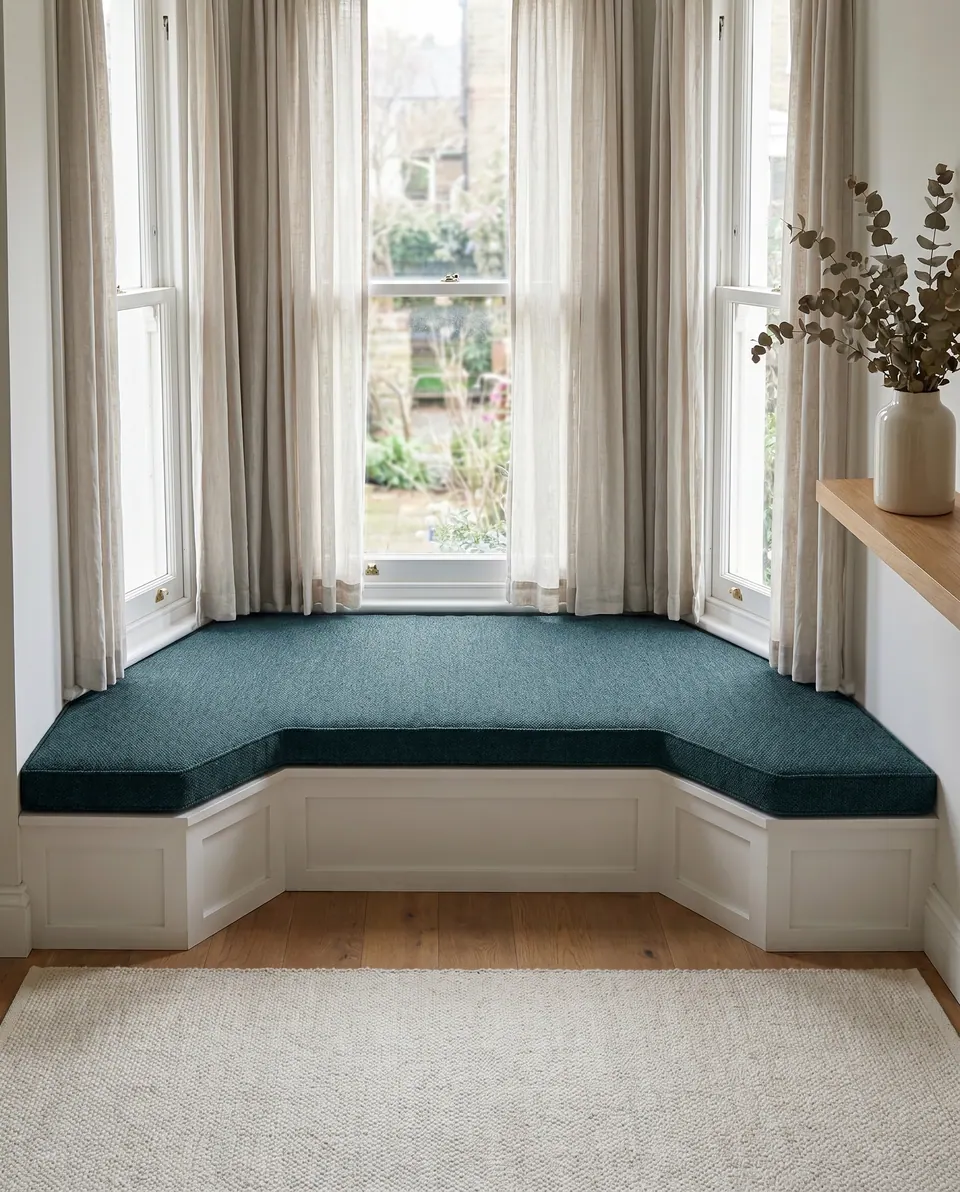
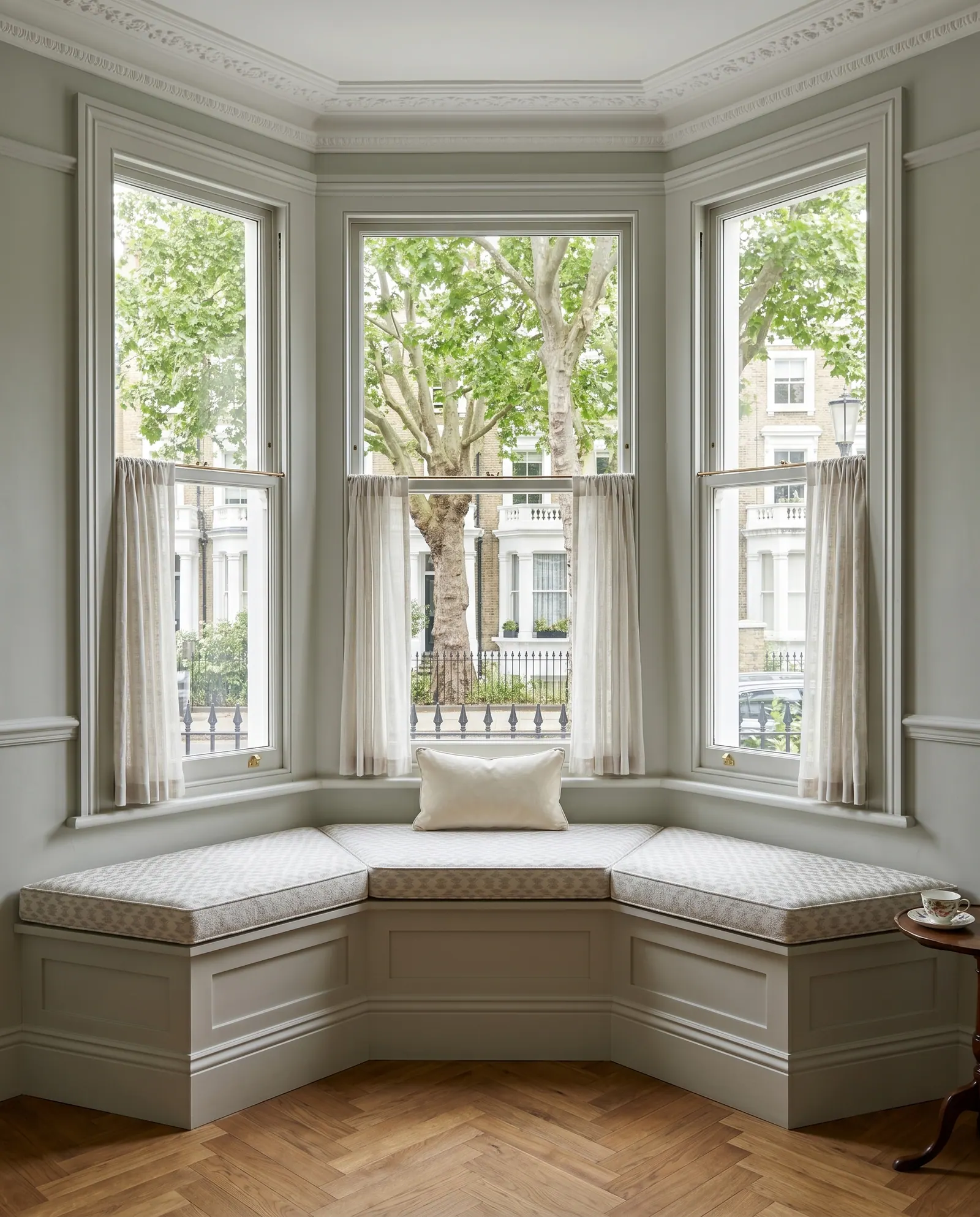
A bay window cushion is easiest to make and live with as three pieces: a straight center rectangle and two end sections cut to the bay's angles, so only the ends need angled cutting and each piece lifts out on its own. Here the dove gray geometric nearly matches the sage-gray paneling, and a walnut table supplies the only dark note.
The cushion, cut open
Cover fabric. A removable, zippered cover. Machine wash at 86°F (30°C) on a gentle cycle and air dry.
Piping. A fabric-covered cord sewn into the seams. It sits on the seam line, so it does not change the size.
Fiber wrap. Polyester fiber (Dacron) batting around the foam: it fills the cover out and softens the edges.
Foam core. About 2.0 lb/ft³ (32 kg/m³) high-resilience foam, firm to medium-firm, cut to the ordered size.
Zipper. Along the back band, as hidden as possible. The zipper side faces down or toward the wall.
Base panel. The underside of the cover. A non-slip fabric backing can cover the whole of it instead.
Pinned by Nate: five points across the bay
Five pins map the bay from the left angled section through the center piece to the walnut table on the right.
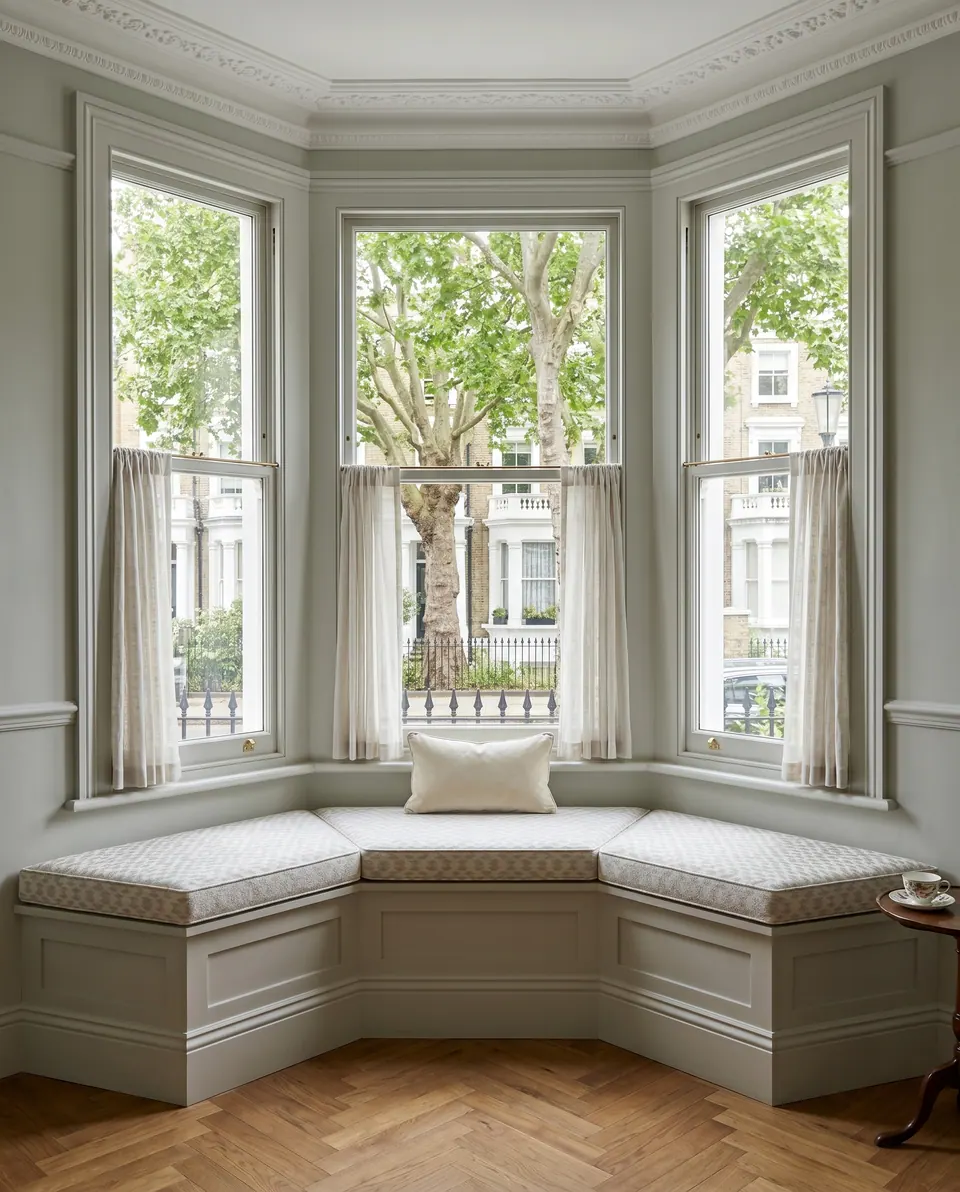
- Left angled cushion
Each side section is cut to its own angle, so the three pieces meet without gaps at the corners.
- Center cushion
The center piece is straight; the angles live only in the side cushions, which keeps cutting simple.
- Single ivory pillow
One pillow in the middle respects the symmetry of the bay.
- Linen café curtains
Half-height curtains give privacy from the street while light still falls on the seat.
- Walnut wine table
The only dark wood in the room anchors a pale scheme and holds the teacup.
- Left angled cushionEach side section is cut to its own angle, so the three pieces meet without gaps at the corners.
- Center cushionThe center piece is straight; the angles live only in the side cushions, which keeps cutting simple.
- Single ivory pillowOne pillow in the middle respects the symmetry of the bay.
- Linen café curtainsHalf-height curtains give privacy from the street while light still falls on the seat.
- Walnut wine tableThe only dark wood in the room anchors a pale scheme and holds the teacup.
Three pieces, two angles, one straight run
Read a bay seat from left to right and you get three lengths and two angles. This bay window cushion follows them exactly.
- Left section. Cut to its own angle at the inside end, so it meets the center piece flush, with no triangle of bare paint at the corner.
- Center section. A plain rectangle. No angles, no drama. Angles are just lengths in disguise, and this piece has none to hide.
- Right section. The mirror of the left, measured separately anyway, because older walls are rarely true mirror images.
Why split it? Each piece is easier to lift, and the angled cutting lives only in the two ends. The cushion is kept slim so the painted panels below stay the feature; a thick slab would hide the best carpentry in the room.
The edge is a box with self piping. On a sectioned bay, contrast piping would outline every joint and chop the seat into three boxes; self piping lets the eye read one long seat. Turn your own wall and front lengths into these three shapes with the bay window calculator.
Color story: light, middle, one dark
Now the colors, partner. I treat them like a tolerance stack.
- Light: white window trim, linen café curtains, the ivory pillow, the white stucco across the street.
- Middle: the dove gray cushion, the sage-gray paneling, the herringbone oak floor.
- Dark: one walnut tripod wine table.
The cushion's small gray-and-white geometric sits almost exactly on the value of the paneling below it. That's deliberate: the bay reads as one built thing instead of furniture parked in a window. The cloth is an outdoor acrylic, a practical weave for a seat that lives in a window all year. Cool, even north light flattens sheen and keeps gray honest, where warm late sun can nudge it toward beige.
Every prop has a job. The walnut table, the only dark wood, anchors the pale scheme and holds a gold-rimmed teacup, the only metal in sight. One pillow sits centered because the bay is symmetrical. The café curtains cover the lower sashes for privacy while light still lands on the seat. The plaster cornice, the plane trees and three tall sashes are the decoration; the cushion stays out of their way.
What's the darkest thing in your room? Find it before you pick a gray.
On the cutting table: three pieces in dove gray
| Product | Three-piece bay window seat cushion |
|---|---|
| Layout | Straight center rectangle plus two angled end sections |
| Fabric | Outdoor acrylic, small dove gray and white geometric |
| Piping | Self piping |
| Edge | Box edge, kept slim |
| Standard foam | about 2.0 lb/ft³ (32 kg/m³) high-density foam, wrapped in polyester fiber |
| Very long runs | Made and shipped in two pieces |
| Best for | Symmetrical bays with painted paneling and cool light |

Have it made
Have this made — ask Nate’s workshop
Every edge and both diagonals, to the nearest 1/4 in. If the numbers do not close, the workshop will say so on the call. — Nate
Leave your details and the workshop will call you to confirm measurements, fabric, foam and piping. No prices, dates or payment on this page: it is a request, not an order.
Add 3/8 inch or take it off? Neither.
A buyer wrote in with photos and measurements of their bay and one reasonable question: should they add 3/8 in (1 cm) for a snug fit, or subtract it?
The shop's answer was neither: send the exact measurements and let the maker set the allowances. Then it drew a schematic of the bay for approval.
Color came next. A few fabrics in the listing photos weren't in the catalog but were still in stock, so the shop sent close-ups from its linen and soft-fabric charts. The buyer chose a terracotta soft fabric at 3 1/8 in (8 cm) thick, with linen piping as the closest linen to another soft shade; contrasting linen piping gives a sportier look. The order went in by choosing the depth and length range and attaching the approved drawing.
Allowances are the maker's job, not yours. Pad your numbers, let the maker pad them again, and the ends bulge.
Buyer questions: long seats, firm foam, cost by size
- A common question
Can a window seat cushion 8 to 11 feet long be made as one piece?
The workshop's answerUsually not. Very long cushions are made and shipped in two pieces: seats of 98, 105, 136 and 141 in were all offered that way, and a single 104 in (265 cm) piece isn't possible. Shorter, deeper shapes differ; a 75 x 38 in (191 x 97 cm) daybed cushion can be one piece, though two 38 x 38 in squares were suggested first.
- A common question
Is the foam high density? A saggy seat is the one thing I don't want.
The workshop's answerYes. The standard foam is about 2.0 lb/ft³ (32 kg/m³) high-density, long-life foam. It's genuinely firm, holds its shape and doesn't sag with daily use, so there's no need to pay for an upgrade. It's wrapped in a polyester fiber (Dacron) layer before it goes into the cover, for a fuller, softer finish.
- A common question
Roughly what does a custom bench or bay window seat cushion cost?
The workshop's answerQuotes go by size; ask the workshop to state the shipping cost on yours. A 14 x 18 in (36 x 46 cm) pad sits at the low end; a 51 x 30 in (130 x 76 cm) bay seat and a 16 x 105 in seat in two pieces climb from there. Send your measurements for an exact figure.
Cut a bay window cushion in three: a straight center and two angled ends. Only the ends need angled cutting, and each piece lifts out alone.
Nate
Questions buyers ask next
Why do only the end sections of a bay window cushion need angled cuts?
The angles live where the side walls meet the center wall. The center piece runs along a straight wall and stays a rectangle; each end piece takes one angle at its inside end.
How close should a gray cushion be to painted window seat paneling?
Within a shade, if you want the seat to read as joinery. Hold the swatch against the paint in the room's own light; a much lighter or darker gray looks like a separate pad.
Does contrast piping suit a bay window cushion made in sections?
It tends to fight the layout. Contrast piping outlines every joint and breaks the seat into boxes, while self piping reads as one continuous seat along the window.
Should I add a little to my bay window measurements for a snug fit?
No. Send exact measurements, let the maker set the allowances, then approve the drawing they return. Padding on both sides makes the cushion oversized.
± 1/4 in — Nate