A Reading by NateBay Window Cushions
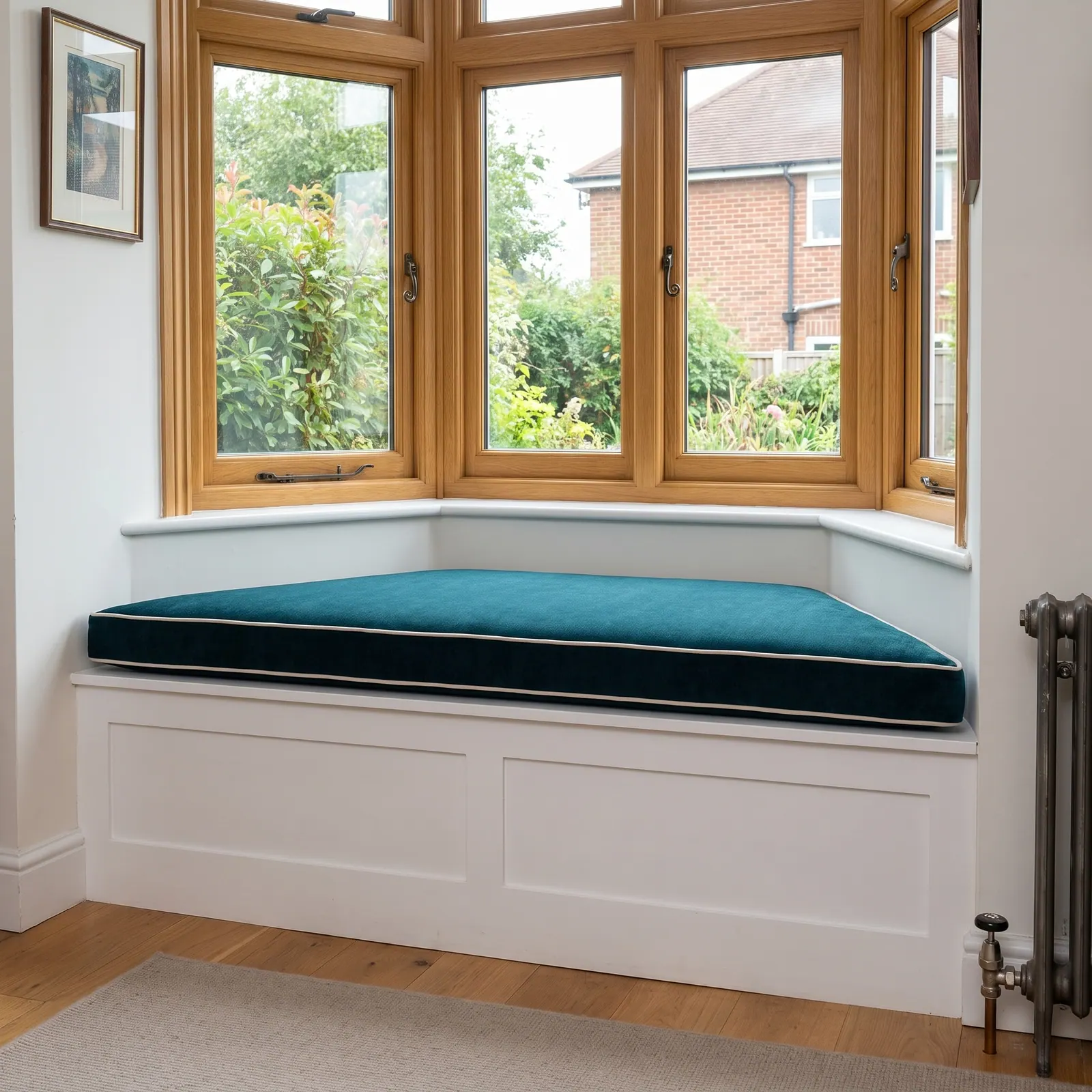
Anatomy of a deep teal bay window cushion: clipped corners, a box edge and two welts
Every edge on this cushion is a decision you can measure. Four corners, two welts, one depth, and a color chosen by the window frames rather than the sofa.

 Save
The quick answer
A bay window cushion with clipped corners follows the short angled sides of the bay, and a box edge with piping on both the top and bottom seams makes it read as one neat slab. Here the fabric is a deep teal linen-look beside honey oak casements. To order, measure every side and the depth, and send a drawing with lettered edges.
The cushion, cut open
Cover fabric. A removable, zippered cover. Machine wash at 86°F (30°C) on a gentle cycle and air dry.
Piping. A fabric-covered cord sewn into the seams. It sits on the seam line, so it does not change the size.
Fiber wrap. Polyester fiber (Dacron) batting around the foam: it fills the cover out and softens the edges.
Foam core. About 2.0 lb/ft³ (32 kg/m³) high-resilience foam, firm to medium-firm, cut to the ordered size.
Zipper. Along the back band, as hidden as possible. The zipper side faces down or toward the wall.
Base panel. The underside of the cover. A non-slip fabric backing can cover the whole of it instead.
Pinned by Nate: two seams, two frames and a radiator
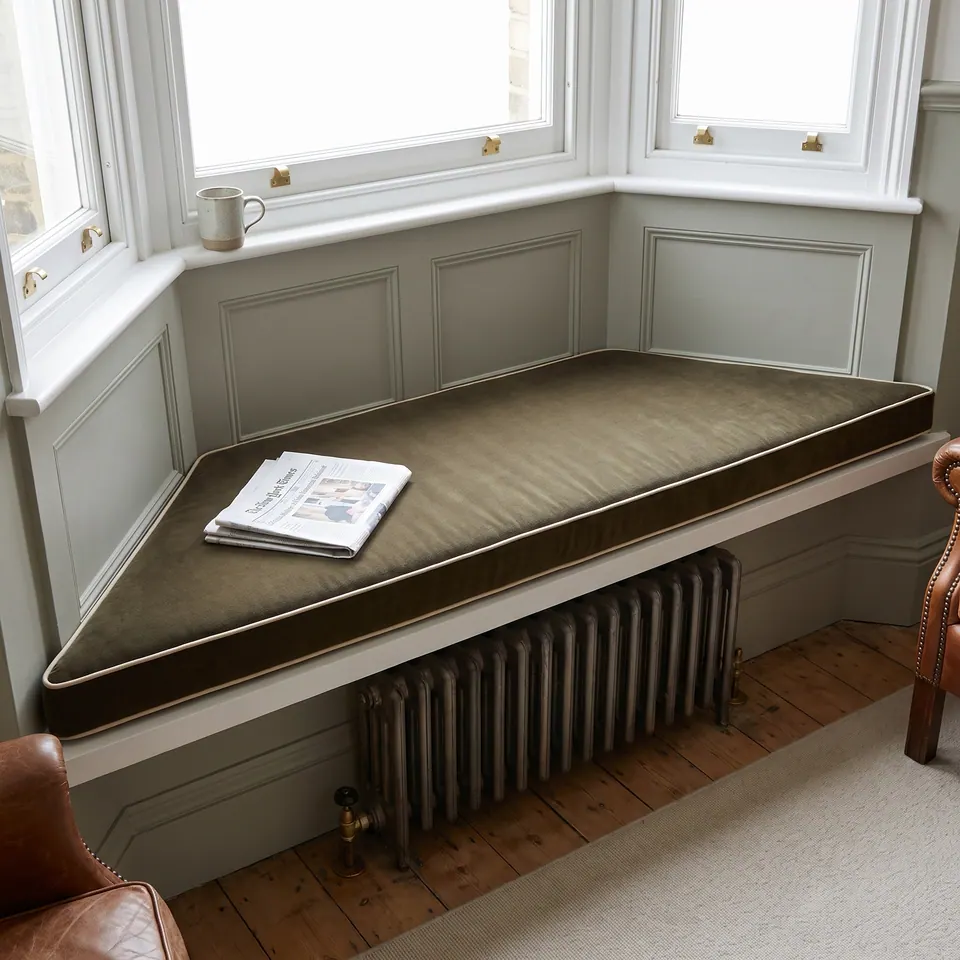
Five pins, two of them on seams: the teal top, the double welt, the oak casements, the framed print and the radiator.
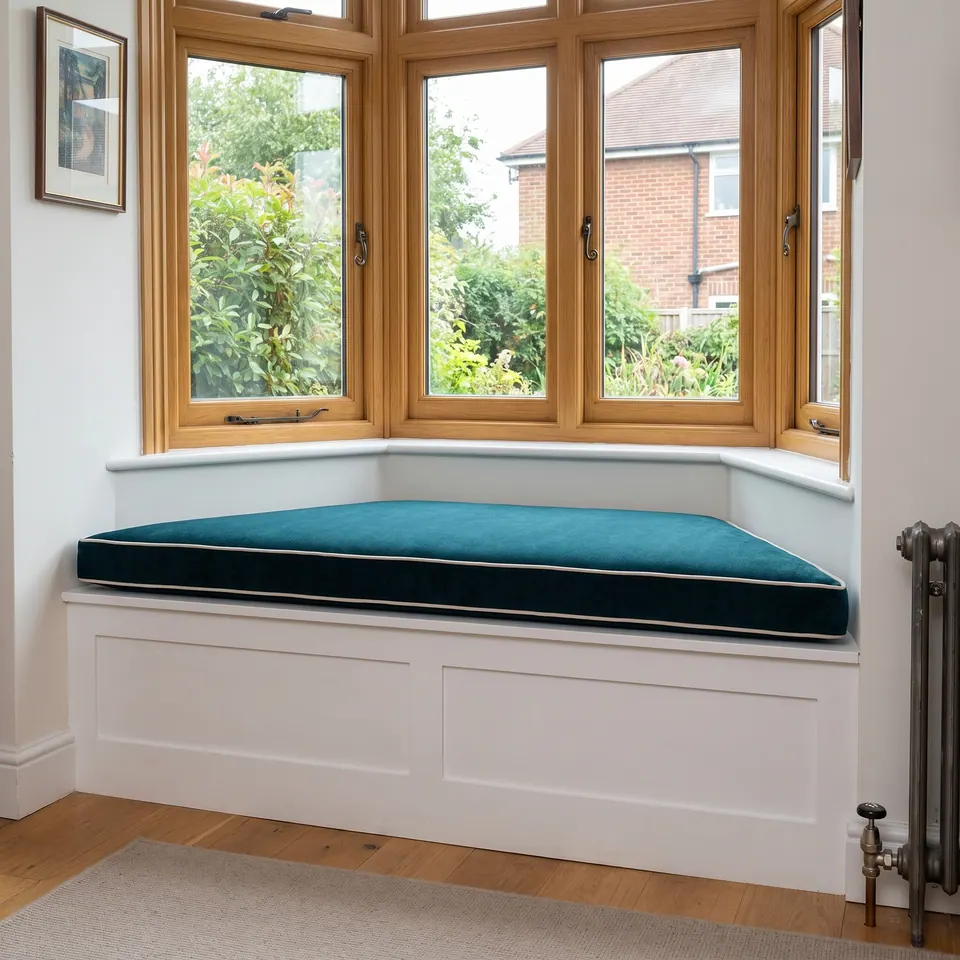
- Deep teal top
A cool deep color complements the honey oak frames.
- Top and bottom piping
Ivory piping on both seams makes the cushion read as a neat slab.
- Oak casements
A brown cushion would merge into these frames; teal stands apart.
- Framed print
One picture beside the bay balances the window.
- Radiator
Period radiator and brass valve keep the room grounded.
- Deep teal topA cool deep color complements the honey oak frames.
- Top and bottom pipingIvory piping on both seams makes the cushion read as a neat slab.
- Oak casementsA brown cushion would merge into these frames; teal stands apart.
- Framed printOne picture beside the bay balances the window.
- RadiatorPeriod radiator and brass valve keep the room grounded.
Cross-section: slab, welt, slab
Cut this cushion in half across its depth, partner, and the section is a plain rectangle: a flat top panel, a flat bottom panel and a straight side wall between them. That is a box cushion. On a bay seat it is the right call, because the white paneled plinth underneath has a square front, and a box edge repeats that square.
Now the welts. Ivory piping runs along the top seam and the bottom seam, both. One welt outlines the top; two welts frame the side wall as its own band. That is what makes the cushion read as a neat slab from across the room instead of a soft pad. A welt shows every wobble in the seam under it, so the cutting has to be exact.
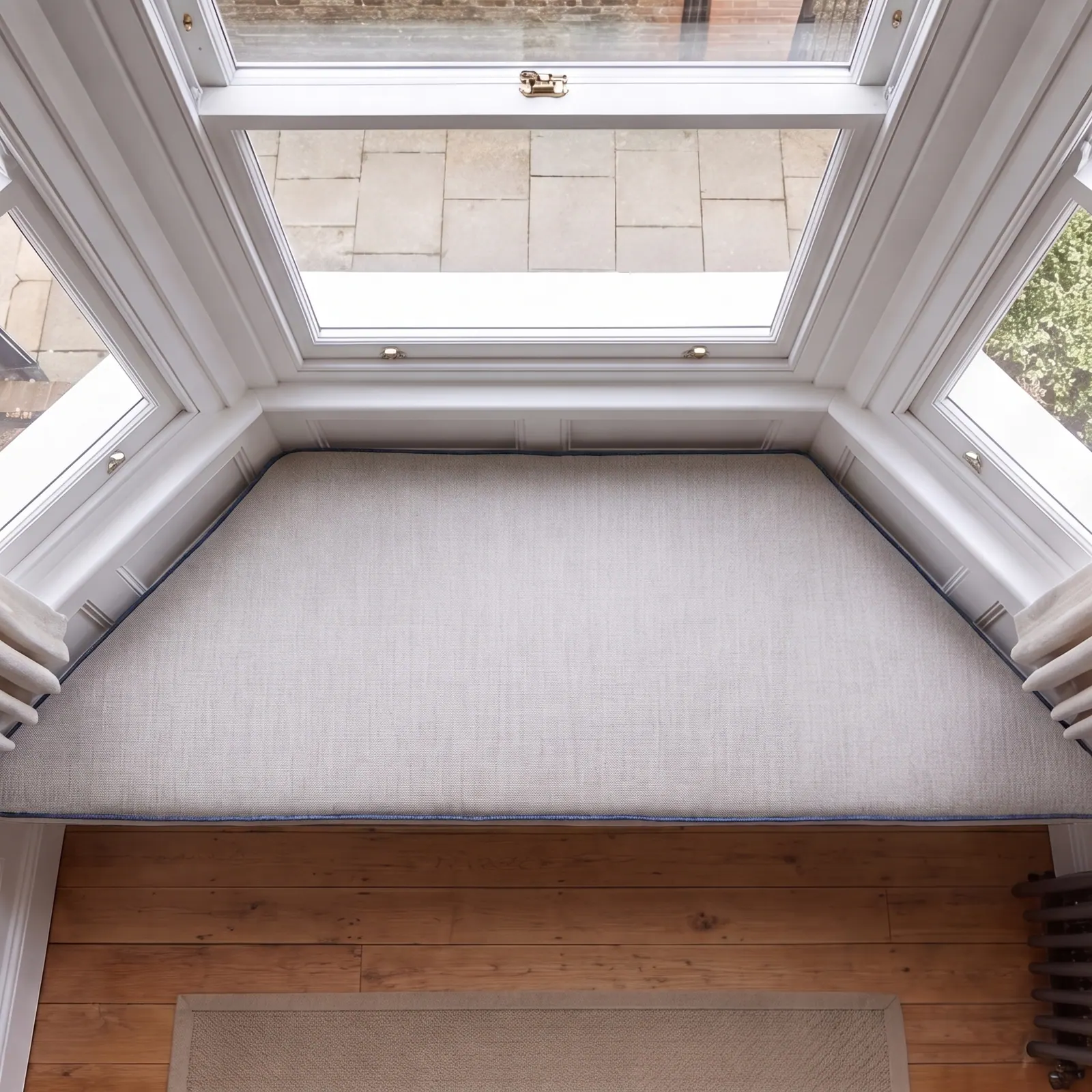
Then the corners. The front corners are clipped, cut on a short diagonal that follows the angled sides of the bay. Angles are just lengths in disguise: a clipped corner is one more short edge on the drawing, with its own number. Leave it off and the cushion jams against the side wall or leaves a triangle of bare paint.
Last, the color. Honey oak casements fill the top of the photo, and a brown or tan cushion would merge into them. Deep teal is the cool opposite of that warm wood, so both look richer, and the garden greens through the glass tie the teal to the view. A framed print balances the bay on one side; a cast iron radiator with a brass valve grounds it on the other. Which color are your window frames? Start there, not with the sofa. The workshop's linen-look fabrics include deep blues and greens, and more bay window cushions are in the Atlas.
Measuring a clipped-corner bay, one edge at a time
Draw the outline and letter every edge
Sketch the seat from above and give each straight edge a letter, including the short diagonal at each clipped corner. A clipped corner is its own edge, not a rounding.
Measure the front and the back
Run the tape along the front edge and along the back. On an angled seat they differ, and on the seat in the story below by more than 46 in (117 cm).
Measure each angled side on its own
Two sides that look equal rarely are. In the story below, E and F came out 3/8 in (1 cm) apart.
Measure the depth square to the front
Depth is the straight line from the front edge to the back at a right angle, not along a side. Together with the longest edge, it sets the price of a trapezoid.
Upload the confirmed template
Send the lettered drawing and a photo. When the workshop returns a template drawing and you agree it, upload that confirmed template with the order.
A 154 5/16-inch front, drawn before it was cut
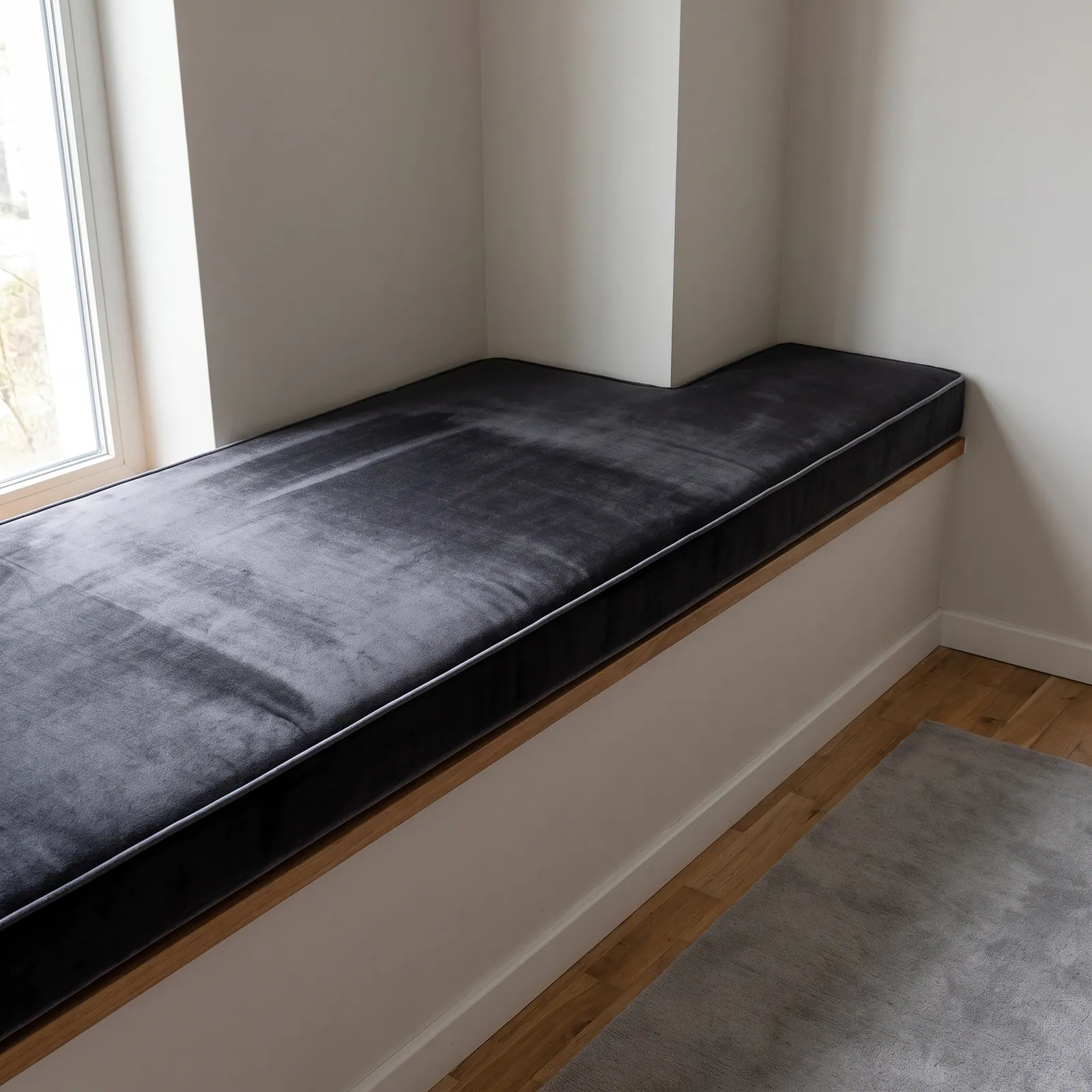
A buyer in the US wrote to the workshop about a very wide angled window seat with two questions: which fabric wipes clean, and can a top this long be made in one piece?
They sent lettered measurements, which is exactly right. A and B, 3 9/16 in (9 cm) each. C, the front, 154 5/16 in (392 cm). D, the back, 108 in (274 cm). E and F, 25 3/4 in and 26 1/8 in (65.4 and 66.4 cm). G, the depth, 15 in (38 cm).
The workshop drew a visual template from those letters and confirmed the one-piece build, with velvet suggested for wiping down. It was priced on the listing by choosing the 15 in depth and the 154 5/16 in length. Production was quoted at 3-5 business days, plus 2-4 business days of shipping.
The lesson: price a trapezoid by its depth and longest edge. The bay window calculator and the trapezoid cushion calculator gather the same numbers, and our 3-sided bay notes show where to hold the tape.
On the cutting table: the teal bay seat
| Product | Bay window cushion, one piece |
|---|---|
| Shape | Trapezoid with clipped front corners |
| Edge | Box edge |
| Piping | Contrast ivory welt on the top and bottom seams |
| Fabric | Linen-look in deep teal |
| Base | White paneled plinth under oak casements |
| Priced by | Depth and longest edge |
| Drawing | Every edge lettered, clipped corners included |
| Best for | Living room bays with natural wood window frames |

Have it made
Have this made — ask Nate’s workshop
Precision starts on the phone. Give the workshop your measurements and they will read them back to you, edge by edge. — Nate
Leave your details and the workshop will call you to confirm measurements, fabric, foam and piping. No prices, dates or payment on this page: it is a request, not an order.
Buyer questions: texture without wrinkles, velcro and a two-unit listing
- A common question
I want a sturdy, textured fabric that won't wrinkle like linen. Do my colors have that coarse feel?
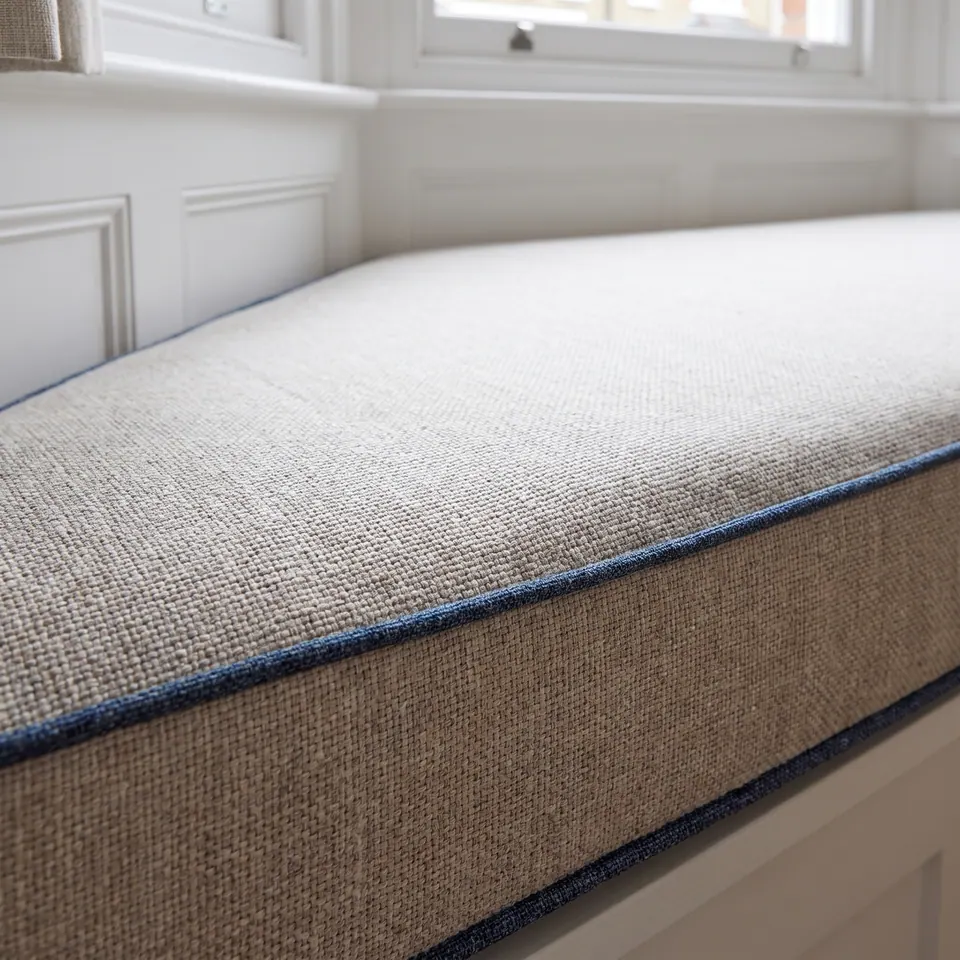
The workshop's answerThe workshop photographed the chosen colors, an off-white body with wine-red piping, and confirmed the textured fabric in the listing photo is the same fabric in another color. Order samples first to judge the texture in hand.
- A common question
Can you add heavy-duty velcro strips to hold the cushions on my bench?
The workshop's answerFor a banquette, the workshop suggested ties instead, or a base made from non-slip fabric so the cushion won't slide, and asked for a photo of the bench to decide.
- A common question
The listing shows 36 x 20 in and 35½ x 19¾ in (90 x 50 cm). Which size will I actually get?
The workshop's answerThe centimeter size, 35½ x 19¾ in (90 x 50 cm), which is about 35 3/8 x 19 3/4 in, a little under 36 x 20. If the exact inch size matters, write it in the order notes.
A clipped corner on a bay window cushion is one more short edge on the drawing, with its own number. Skip it and the cushion jams against the side wall.
Nate
Questions buyers ask next
What is a clipped corner on a window seat cushion?
A corner cut on a short diagonal instead of a right angle, so the cushion follows an angled wall or window side. On a bay, clipped front corners let a box cushion sit snug without jamming or leaving a gap.
Why put piping on both the top and bottom seams of a box cushion?
Double piping frames the side wall as its own band, so a box cushion reads as a crisp slab from across the room. A single top welt looks softer. Contrast ivory on deep teal makes both lines visible.
What cushion color goes with honey oak window frames?
A cool, deep color such as teal, navy or forest green. It sits opposite the warm wood, so both look richer. A brown or tan cushion tends to merge into the frames and flatten the whole bay.
± 1/4 in — Nate
More photographs to read
 Save
 Save
 Save
 Save
 Save
 Save