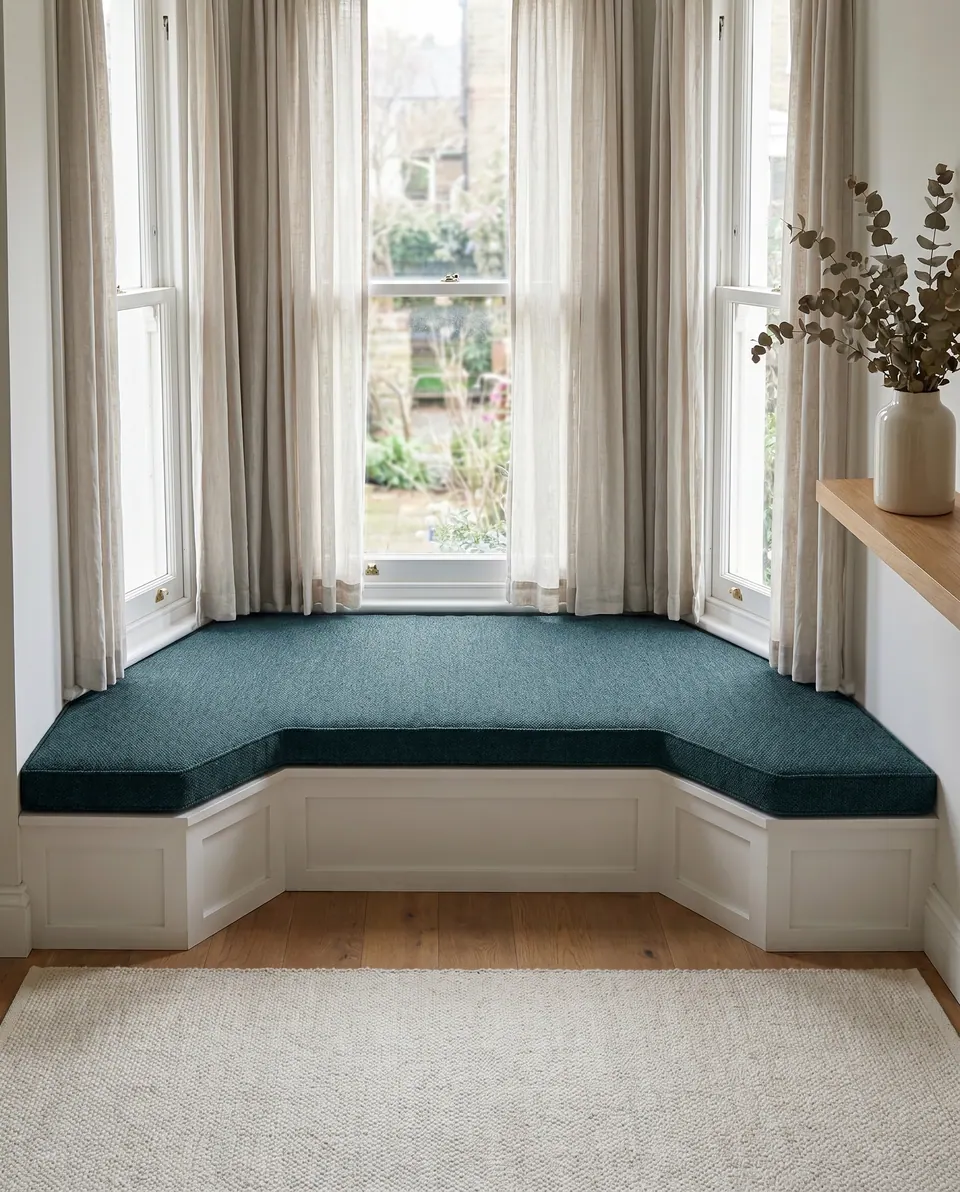
A Reading by NateBay Window Cushions
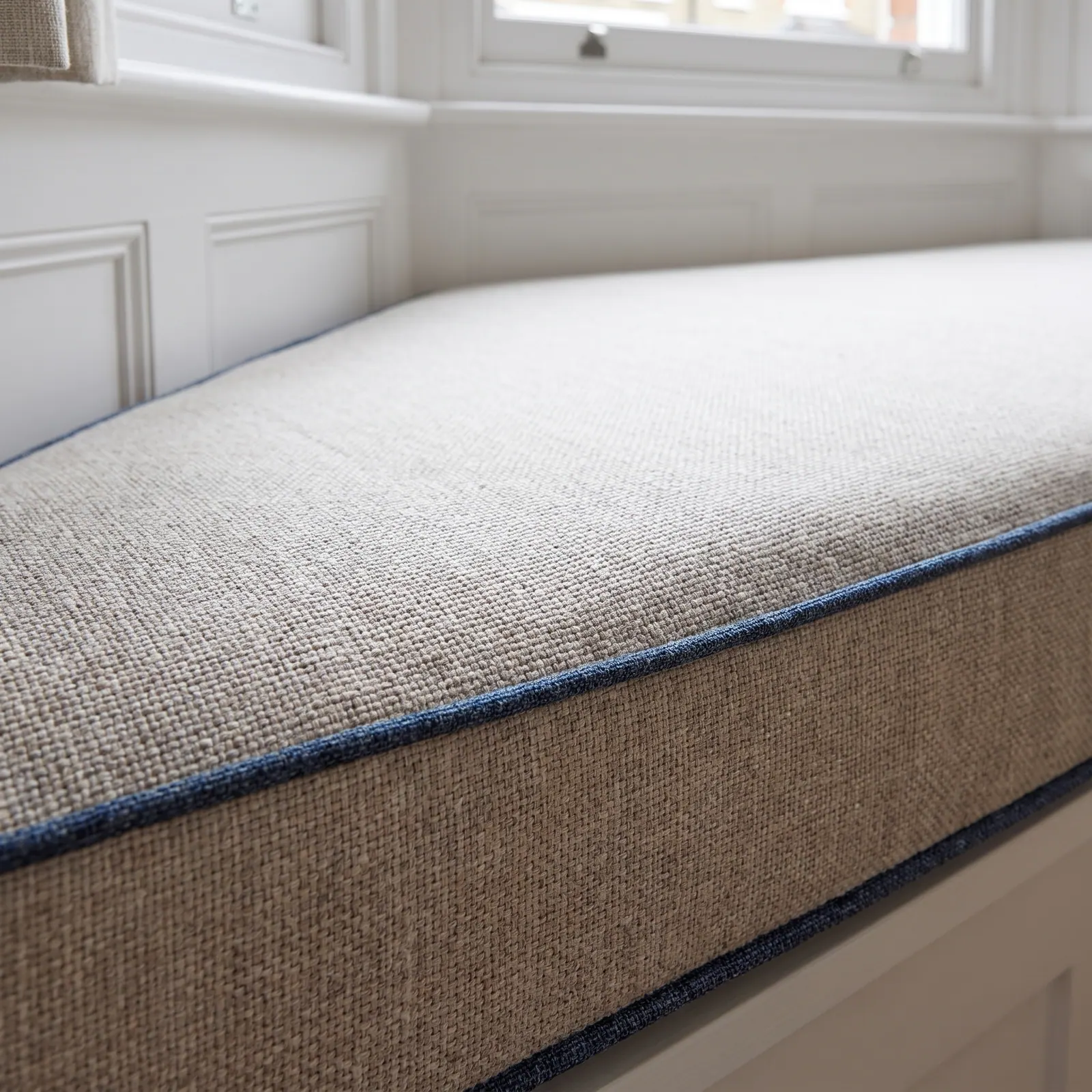
The Front Edge of an Oatmeal Bay Window Seat Cushion, Measured
One close-up, one seam line, and a welt that sits exactly where it should. My notes on why a box edge with indigo piping top and bottom holds its shape.

 Save
The quick answer
For a bay window cushion whose front edge faces the room, choose a box edge with piping on both the top and bottom seams: a welt stitched on the seam line keeps the edge square for years. An oatmeal linen-look weave hides lint and catches side light. For a low-profile window seat, 2 to 3 in (5 to 8 cm) thick is the usual suggestion.
Notebook entry: four things this close-up measures
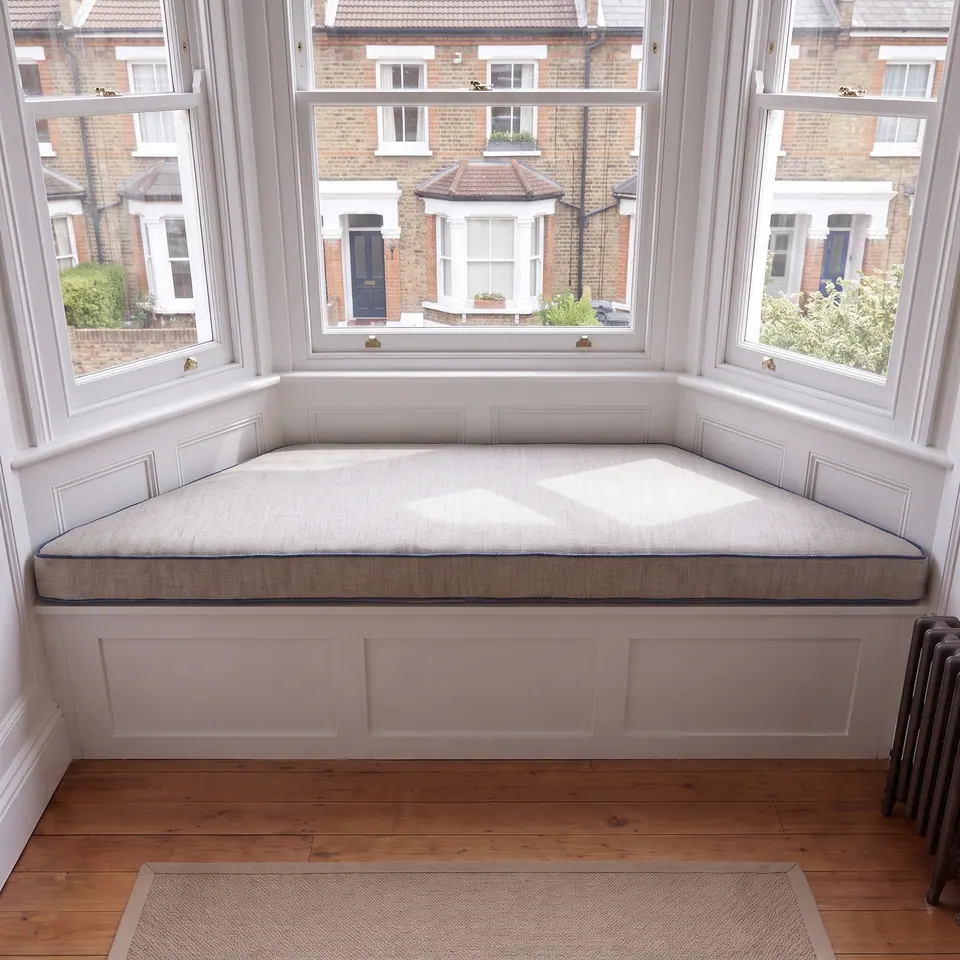
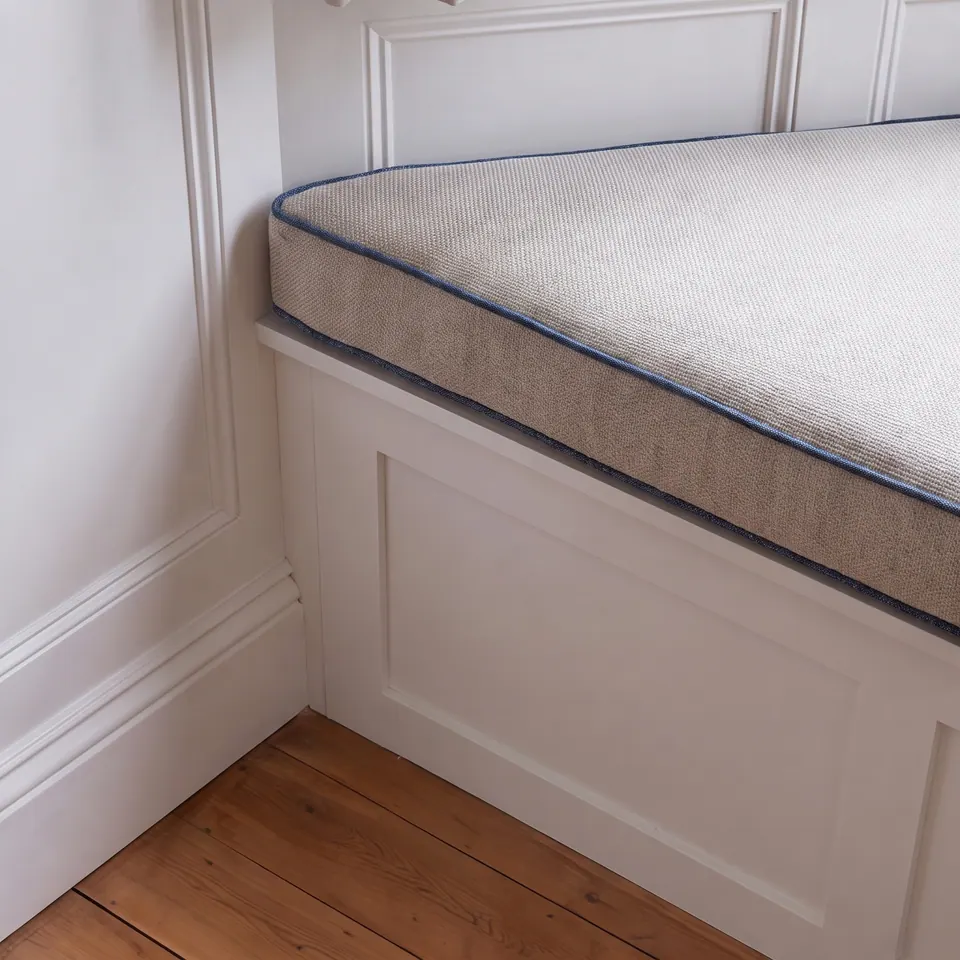
A few inches of fabric decide whether a bay window cushion still looks sharp in five years. This frame holds the front edge of a trapezoid box cushion in oatmeal linen-look cloth, sitting on a white paneled window seat under a sash window. The subject is the edge. Everything else is background, on purpose.
Notes, in order:
- The welt. Indigo piping runs along the top seam and the bottom seam, and in both places it sits exactly on the seam line. Not 1/8 in (3 mm) above, not wandering below. Piping is a cord in a fabric sleeve; stitched on the line, it works like a rail, and that is what keeps a box edge square.
- The gusset. The side panel, or gusset, is deep enough to show the weave as a band of color. On a window seat the front gusset is what the room sees most.
- The weave. A slubby basket weave in flecked oatmeal. The flecks hide lint and crumbs, and the texture catches side light off the bay glass. That is linen-look fabric doing its job.
- The paneling. White joinery, no pattern. It keeps the texture the focus. Fine by me.
One rule from this page: if a cushion's front edge faces the room, ask for piping on both the top and bottom seams. A welt on top with a bare seam below looks unfinished from sofa height, which is exactly where people look at a window seat from.
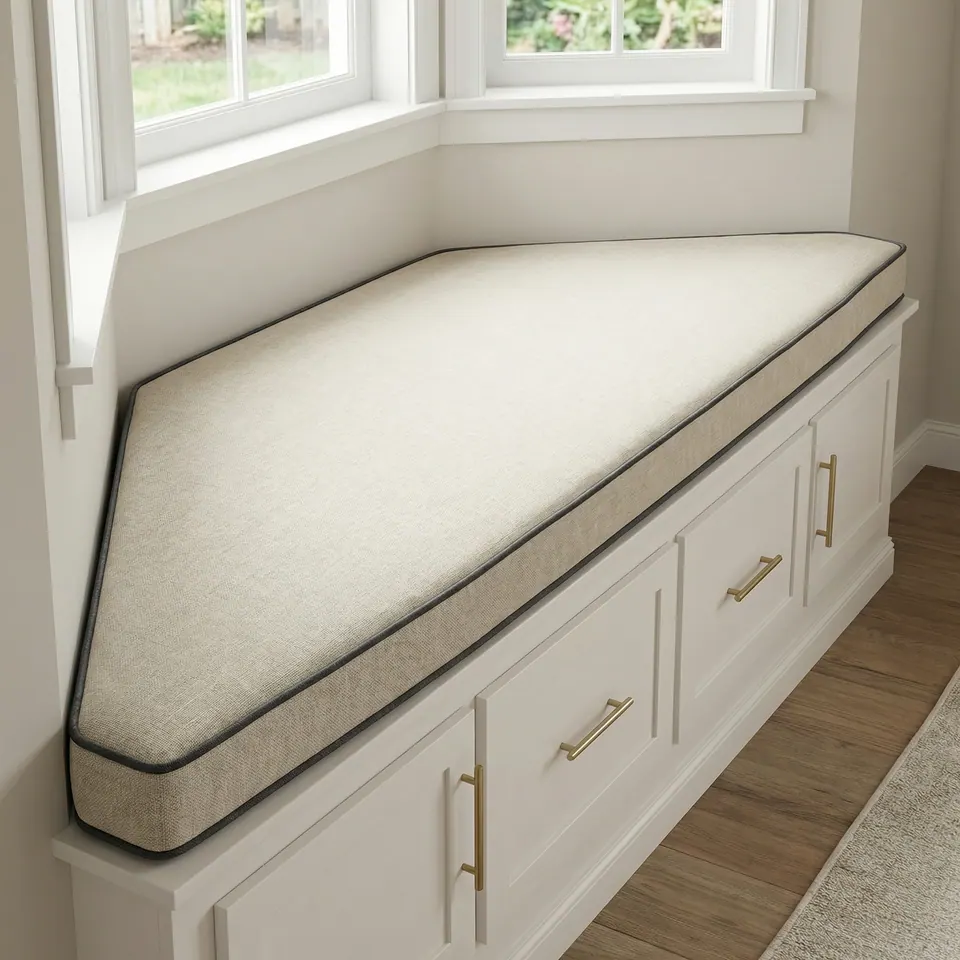
Shape note. A bay seat is rarely a rectangle. Write down the back edge, front edge, depth and both sides, then let the bay window calculator check the angles. Angles are just lengths in disguise. For the edge options side by side, see box edge versus knife edge. What does your front edge measure against the back, partner?
Four pins along one front edge
Four pins mark the welt, the weave, the gusset and the paneling, the four things this close-up is really about.
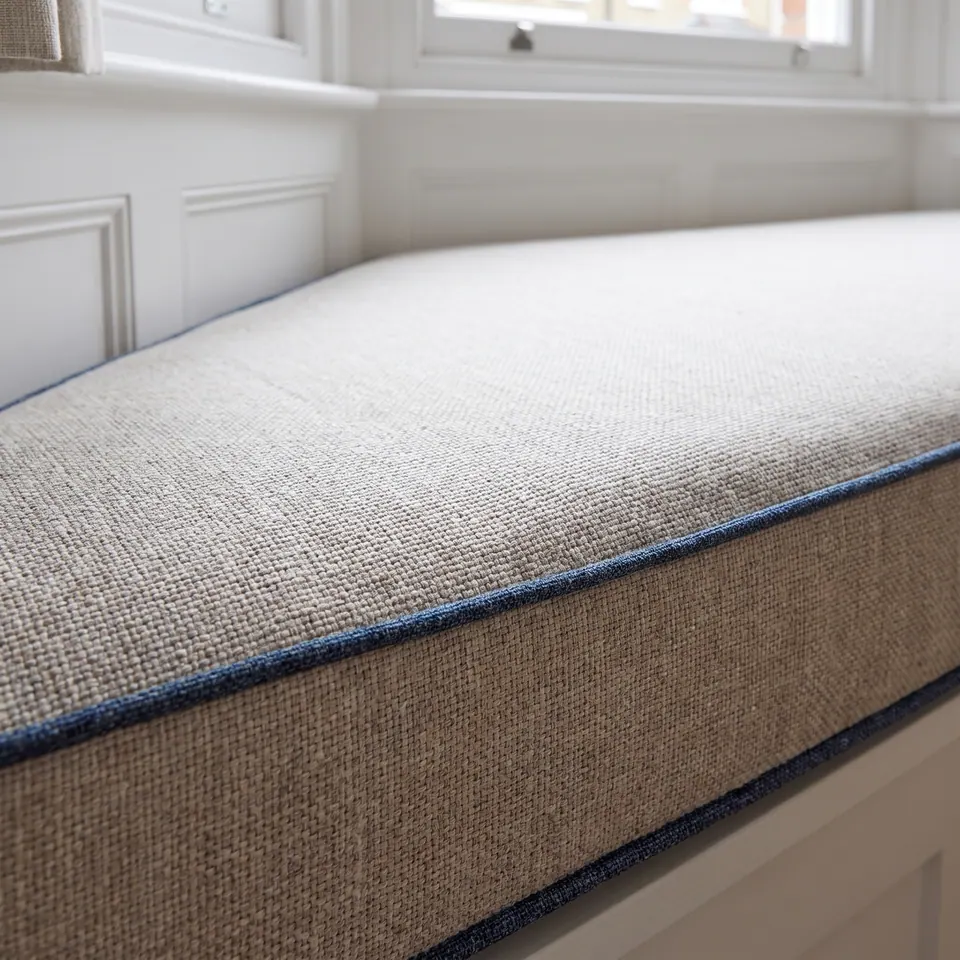
- Indigo welt
The piping sits exactly on the seam line, which keeps the box edge sharp.
- Basket weave
Flecked oatmeal hides lint and crumbs and catches side light.
- Box gusset
A deep side panel shows the weave as a band of color.
- Wall paneling
White joinery keeps the texture the focus.
- Indigo weltThe piping sits exactly on the seam line, which keeps the box edge sharp.
- Basket weaveFlecked oatmeal hides lint and crumbs and catches side light.
- Box gussetA deep side panel shows the weave as a band of color.
- Wall panelingWhite joinery keeps the texture the focus.
Box, knife, rounded, angled: what each does to the front line
| Edge or corner | How it is built | What the front line does | Use it for |
|---|---|---|---|
| Box edge | Top and bottom joined by a straight gusset | Stays square, best with piping on the seam line | Window and bay seats seen from the room |
| Knife edge | Top and bottom sewn straight together | Tapers to a thin rim with no side band | Thin pads and throw pillows |
| Rounded corners | Corners cut to a marked radius | Softens the plan, keeps the box side | Seats that stick out into a walkway |
| Angled corners | Corners cut to measured angles | Follows the bay walls instead of fighting them | Trapezoid, 3-sided and 5-sided bays |
A bay seat sent in millimeters, with green piping on the wish list
A buyer wrote to the workshop with a photo of a bay window seat and one line of numbers in millimeters: 27 x 74 in (685 x 1880 mm), which is about 27 x 74 in (68.5 x 188 cm). The workshop quoted from those numbers, then confirmed the quote once it had seen the shape in the photo. A bay seat is a trapezoid until proven otherwise.
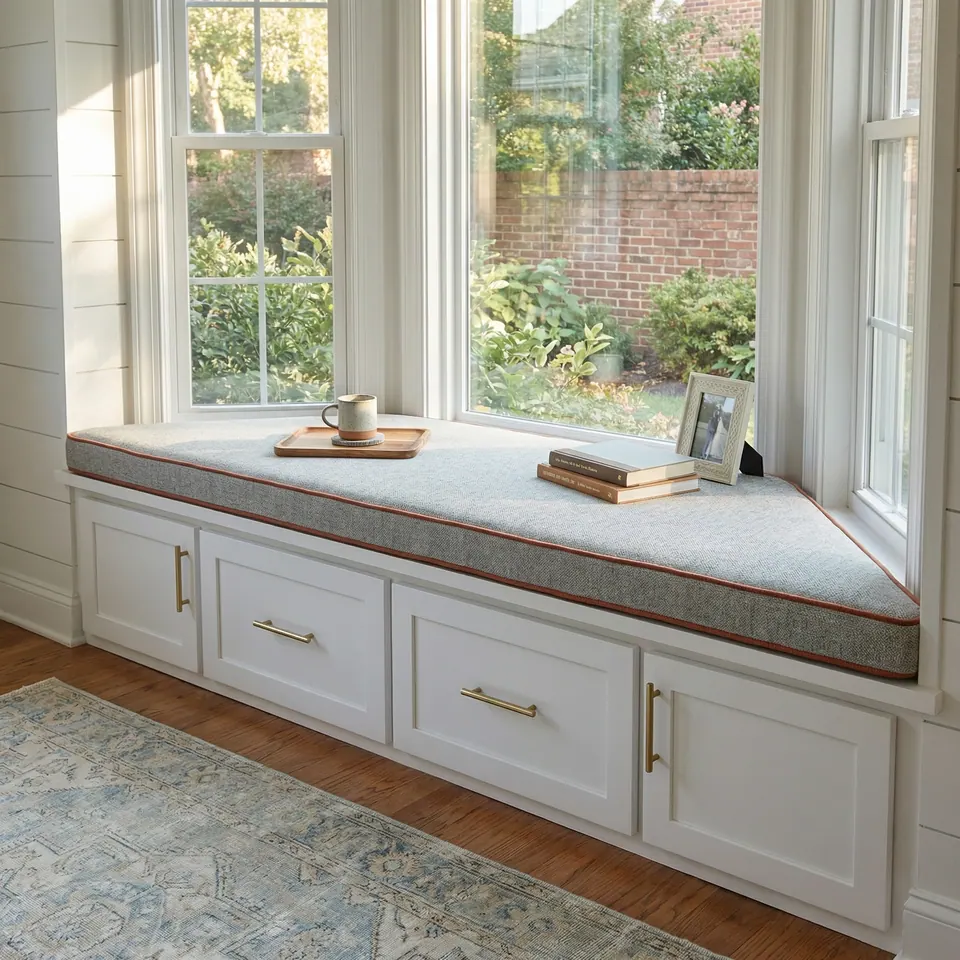
She wanted the linen from a listing photo with dark green piping. The workshop showed her its dark green linen as the piping cloth, so the welt would come from the same family as the body fabric rather than an unrelated cord.
Two entries for the notebook. Send a photo of the actual seat with the numbers written on it. And name the piping fabric, not only its color.
Buyer questions: low profiles, thin pads and a delivery question
- A common question
How thick should a window seat cushion be so it doesn't ride up over the window?
The workshop's answerFor a narrow window seat the workshop suggested 2 or 3 in (5 or 8 cm), and it confirms the final thickness with you before production. Measure the height available under the window frame first.
- A common question
Will a thinner cushion cost less than a 4 in one, since it uses less material?
The workshop's answerPrice depends mainly on length and width, so send your dimensions first. A thin cushion still takes the same fabric, labor and materials. Even two window cushions just 3/4 in (2 cm) thick were priced mainly on their footprint.
- A common question
Do you ship custom cushions to Canada, and what does delivery cost?
The workshop's answerYes, custom cushions have gone to Canada by courier. The shipping cost comes with the quote for your address, and one buyer who asked had an order there with no shipping charge.
Measurement table: the front edge
| Piece | Bay window cushion, trapezoid, box edge |
|---|---|
| Fabric | Oatmeal linen-look basket weave |
| Piping | Indigo contrast welt on top and bottom seams |
| Gusset | Deep enough to show the weave as a band |
| Low-profile thickness | 2 to 3 in (5 to 8 cm) for a narrow seat |
| Measure | Back edge, front edge, depth, both sides |
| Tolerance | ± 1/4 in (6 mm) on every side |
| Setting | White paneled window seat under a sash window |
| Best for | Bay and window seats whose front edge faces the room |

Have it made
Have this made — ask Nate’s workshop
Send the numbers in inches: length × depth × thickness, plus any angle. The workshop checks them with you, because foam has no undo button. — Nate
Leave your details and the workshop will call you to confirm measurements, fabric, foam and piping. No prices, dates or payment on this page: it is a request, not an order.
If a window seat cushion's front edge faces the room, ask for piping on both the top and bottom seams; a welt stitched on the seam line keeps a box edge square.
Nate
Questions buyers ask next
Does a window seat need piping on the bottom seam as well as the top?
If the front edge faces the room, yes. Piping on both seams frames the gusset as a band and keeps the lower edge as straight as the upper one. Against a wall or deep in a recess, a top welt alone is fine.
Does a linen-look fabric show crumbs on a window seat?
Less than a flat solid. A flecked basket weave in a mid-tone like oatmeal breaks up lint and crumbs, and its texture reads well in the side light a bay window throws across the seat.
How do I measure a trapezoid bay seat for a box cushion?
Write down the back edge, front edge, depth and both side edges, plus the height free under the window frame. A drawing with all four sides lets the maker cut angled corners that follow the bay walls.
Can the piping be cut from a different fabric than the cushion?
Yes. A contrast welt is usually cut from a solid in the same fabric family, such as dark green linen piping on a linen body, so the texture stays matched while the color changes.
± 1/4 in — Nate