A Reading by NateBay Window Cushions
An oatmeal trapezoid bay window cushion: the room before, the line after
Nate takes one low-angle photo of a white bay cabinet and works out what a single oatmeal cushion changes, edge by edge.

 Save
The quick answer
An oatmeal linen-look bay window cushion with charcoal piping is the safest makeover for a bare bay cabinet: it suits almost any room and draws a clean line around the whole trapezoid. The short end angles back into the bay, and dark piping repeats the dark wood floor, so the white joinery stops looking unfinished.
The cushion, cut open
Cover fabric. A removable, zippered cover. Machine wash at 86°F (30°C) on a gentle cycle and air dry.
Piping. A fabric-covered cord sewn into the seams. It sits on the seam line, so it does not change the size.
Fiber wrap. Polyester fiber (Dacron) batting around the foam: it fills the cover out and softens the edges.
Foam core. About 2.0 lb/ft³ (32 kg/m³) high-resilience foam, firm to medium-firm, cut to the ordered size.
Zipper. Along the back band, as hidden as possible. The zipper side faces down or toward the wall.
Base panel. The underside of the cover. A non-slip fabric backing can cover the whole of it instead.
Before and after: one cushion on a white bay cabinet
A bay cabinet without a cushion is furniture waiting for a job, partner.
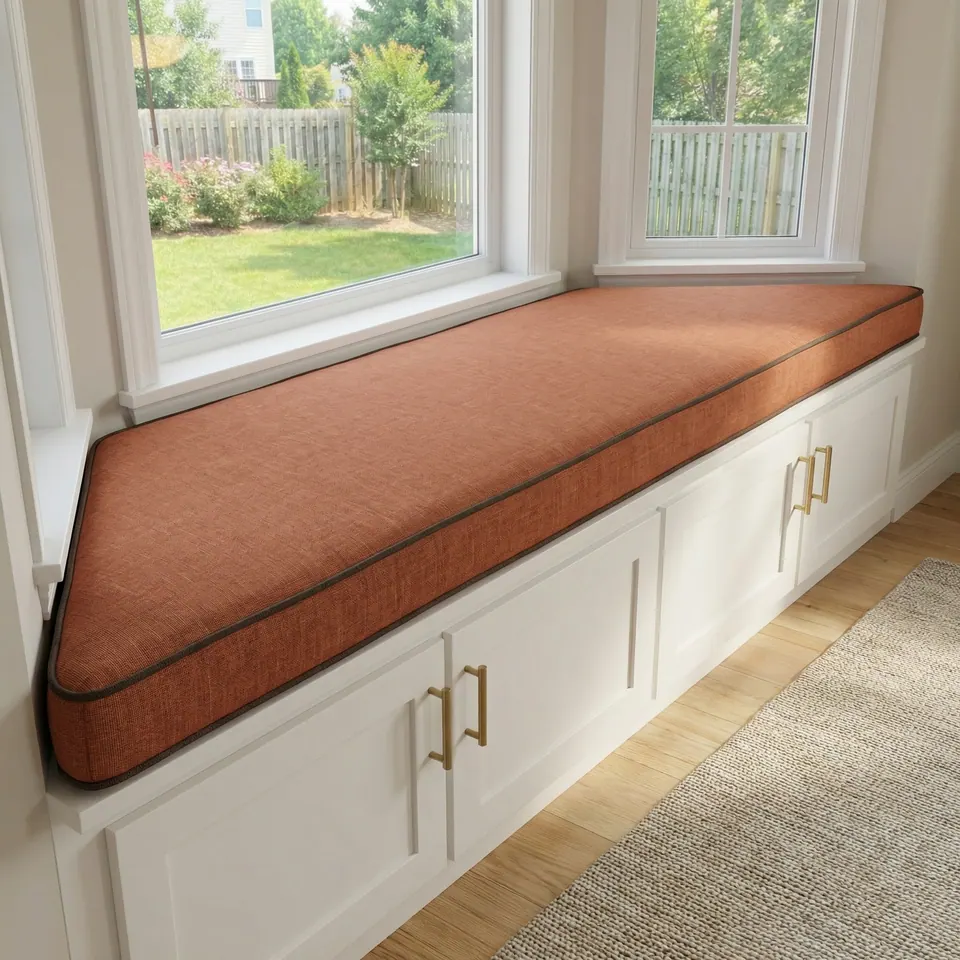
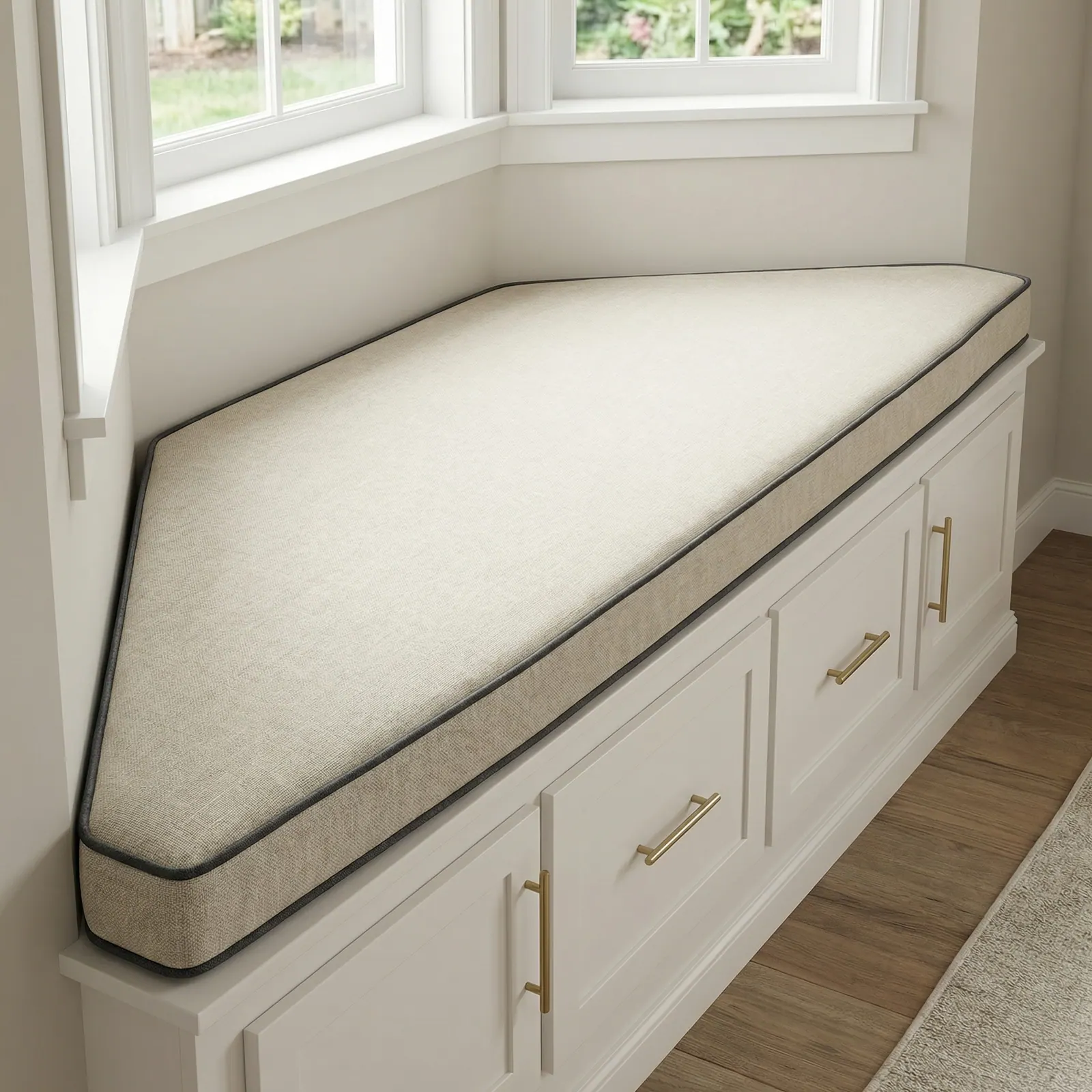
Picture the room the day before: white cabinet doors and drawers with brass bar pulls, a dark wood floor, the edge of a pale rug. Tidy, cool, and nowhere you would sit for long. The eye slides right off the white top.
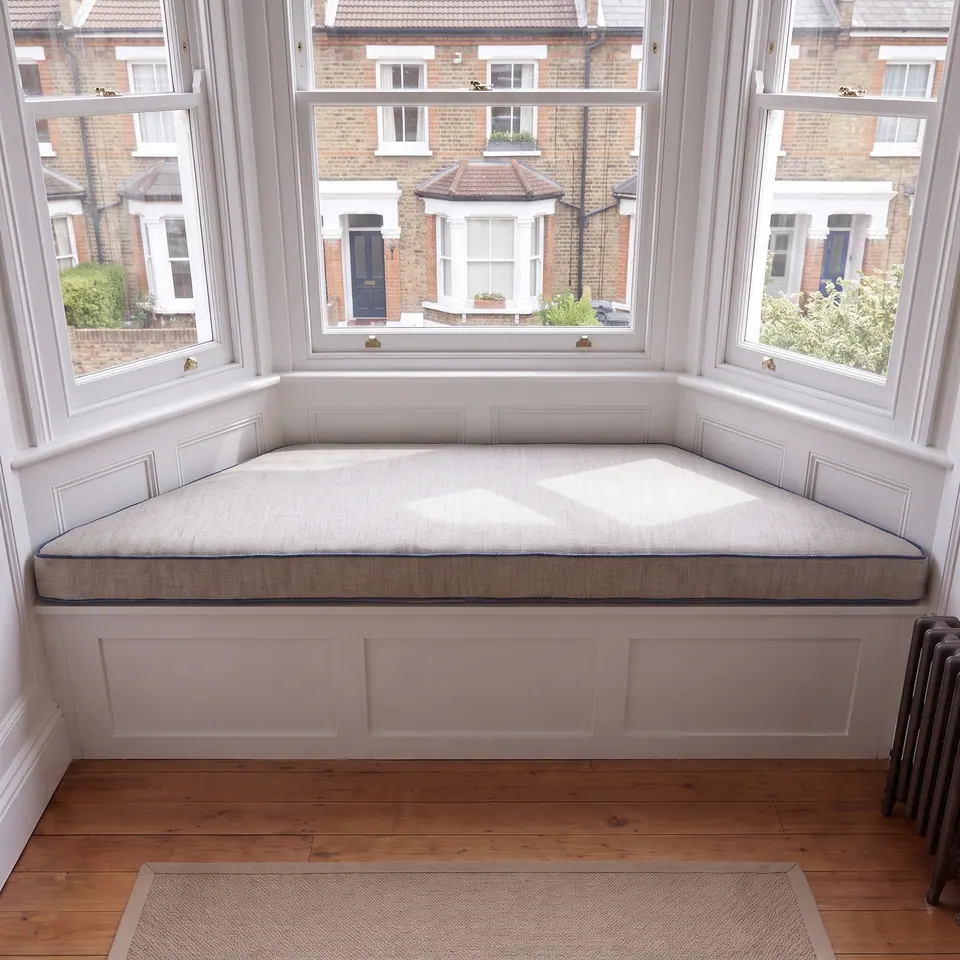
Now the after, shot low along the cabinets. An oatmeal bay window cushion in a linen-look fabric, box-edged, with charcoal piping. The low angle shows the defining cut of a trapezoid cushion: the short end angles back into the bay instead of stopping square.
One cushion changed three things: - The line. Charcoal piping runs the top edge and the back edge, so the shape is drawn from every side, not just the front. - The temperature. Oatmeal warms the white joinery a shade; the brass pulls finish the job. - The floor. Dark piping repeats the dark wood floor at seat height, so cabinet and floor read as one room.
Oatmeal with a dark welt is the least risky pairing I know for a bay. It suits most rooms and survives a repaint. More living-room seats in living room cushions. What is your bay cabinet doing right now besides holding things?
Pinned by Nate: five parts of the finished bay
Five pins, from the short angled end to the brass bar pull and the dark floor below.
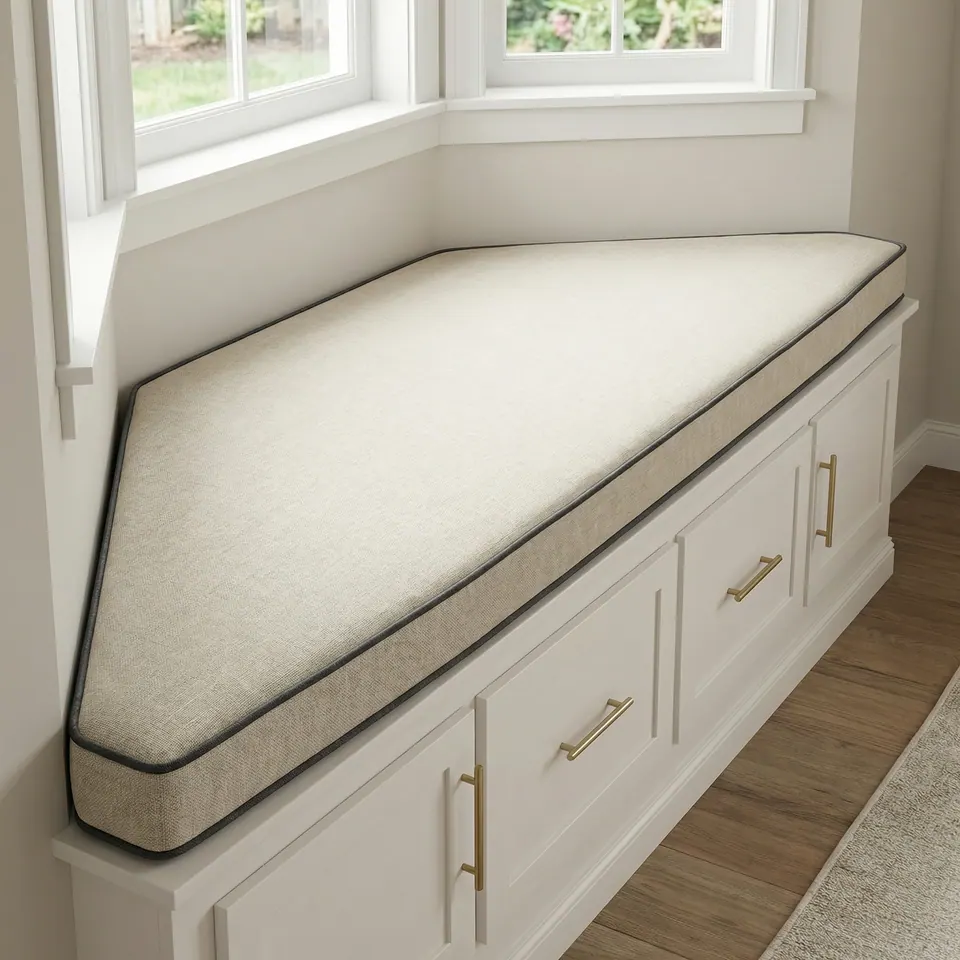
- Short angled end
This end angles back into the bay, the defining cut of a trapezoid seat.
- Charcoal piping, top edge
Dark piping on natural linen draws a clean line around the whole shape.
- Piped back edge
Piping runs along the back too, so the cushion looks finished from every side.
- Brass bar pull
Brass warms up an otherwise cool neutral pairing.
- Dark wood floor
The dark floor repeats the charcoal piping at ground level.
- Short angled endThis end angles back into the bay, the defining cut of a trapezoid seat.
- Charcoal piping, top edgeDark piping on natural linen draws a clean line around the whole shape.
- Piped back edgePiping runs along the back too, so the cushion looks finished from every side.
- Brass bar pullBrass warms up an otherwise cool neutral pairing.
- Dark wood floorThe dark floor repeats the charcoal piping at ground level.
The bay window cushion, layer by layer
Footprint: a trapezoid
Front, back, depth and two angled ends. Here the short end turns back into the bay. Measure it as a length, write it to the nearest 1/4 in, and the angle takes care of itself.
Core: foam chosen twice
Density and firmness are separate choices: one decides how long the foam lasts, the other how it sits. The foam firmness finder helps with the second.
Wall: the box edge
A straight side panel between top and bottom keeps the angled end crisp where it meets the bay, instead of thinning out like a knife edge.
Line: charcoal piping
Piping sits on the seams, top and back here, and does not change the cut size. Running it along the back edge makes the cushion look finished from the window side too.
Skin: a zippered cover
The workshop sews the cover and inserts the foam itself, and every cover zips off for washing.
The 104-inch bay that wasn't on the menu
A buyer in the US had a large angled-top bay seat, 104 in (264 cm) on its widest side. That size wasn't in the listing's drop-down. Menus stop well before real houses do.
So the buyer sent a lettered drawing, seven edges from A to G: 4, 4, 104, 57, 31, 31 and 24.5 in (10, 10, 264, 145, 79, 79 and 62 cm), and asked how the piping color is chosen.
The first attachment never arrived, so the workshop asked for the drawing again. With it in hand, it quoted the seat in linen L-24 and sent a custom order link.
Tolerance is kindness to your future self, and so is lettering. Name every edge with a letter and a length, and nobody has to guess which 31 is which. The custom shape drawing pattern and the bay window calculator cover the rest.
On the cutting table: the oatmeal bay seat
| Product | Trapezoid bay window seat cushion |
|---|---|
| Fabric | Oatmeal linen-look |
| Piping | Contrast welt in charcoal, top and back edges |
| Edge | Box edge |
| Short end | Angled back into the bay |
| Base | White bay cabinet with drawers and brass bar pulls |
| Floor | Dark wood with the edge of a pale rug |
| Best for | A bay seat that has to suit almost any room |

Have it made
Have this made — ask Nate’s workshop
Send the numbers in inches: length × depth × thickness, plus any angle. The workshop checks them with you, because foam has no undo button. — Nate
Leave your details and the workshop will call you to confirm measurements, fabric, foam and piping. No prices, dates or payment on this page: it is a request, not an order.
Buyer questions: density, softer backs and very long runs
- A common question
Is foam density the same thing as firmness? Could I get high-density foam that's only medium firm?
The workshop's answerThey're different. Density is the foam's quality and weight, which drives how long it lasts; firmness is how it feels when you sit. The workshop can supply high-density foam in a medium firmness.
- A common question
What filling do you recommend for the back cushions on a banquette?
The workshop's answerShredded foam for back pillows, which is softer than the solid foam used in seats. The seat cushions stay high-density foam.
- A common question
How long can a single cushion be before it has to be split?
The workshop's answerVery long runs get split. A 170 in (432 cm) cushion had to be made in 3 pieces, and a 160 in (406 cm) back was suggested as two 80 in (203 cm) pieces. A 116 in (295 cm) seat could be one piece or two of 58 in (147 cm); two pieces are more practical, but one is possible.
Oatmeal linen with charcoal piping is the bay window cushion that suits most rooms: the dark welt repeats a dark wood floor at seat height.
Nate
Questions buyers ask next
What does charcoal piping do on an oatmeal cushion?
It draws a clean dark line around the whole trapezoid, top and back, so the angled end reads as a deliberate cut. Against a dark wood floor it also repeats the floor color at seat height, tying cabinet and room together.
Why is the short end of a bay cushion angled?
Because the bay's side windows meet the center section at an angle, and the cushion follows that line so it sits tight to the cabinet ends. Measure the angled end as a length, along with the front, back and depth, and the angle is defined.
Can a bay seat wider than the size menu still be ordered?
Yes. When a bay is wider than the listing's options, as with one 104 in seat, send a lettered drawing with every edge length. The workshop quotes from the drawing and sends a custom order link.
Is oatmeal a safe color for a bay cushion?
It is one of the most forgiving. Oatmeal sits between warm and cool, so it works with white cabinets, brass hardware and dark or pale floors, and it survives a repaint. Add color with pillows you can change.
± 1/4 in — Nate