A Reading by NateL-Shaped Corner Bench Cushions
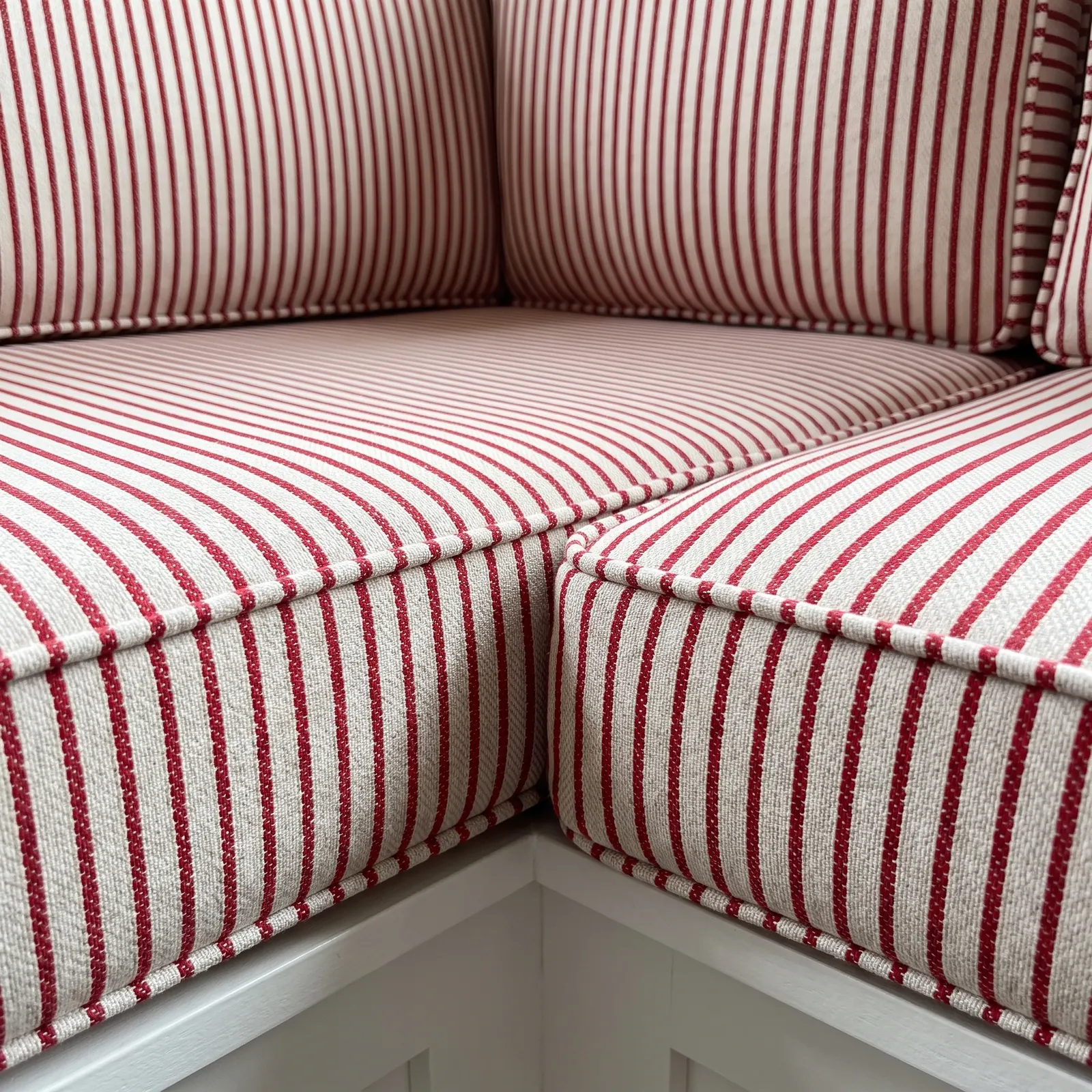
Red Ticking Stripe on an L-Shaped Bench Cushion, Up Close and From the Door
From across the kitchen it's a red stripe. From ten inches it's a dotted line of piping and three stripe runs that agree with each other. Both views count.

 Save
The quick answer
An L-shaped bench cushion in ticking stripe looks right from across the room only if the stripes on the seat, box side and back all run the same way, so the corner doesn't look twisted. Up close, self piping cut from the same stripe turns each edge into a fine dotted line. At the corner, shorten the second seat by the seat depth.
Ten feet back, ten inches close
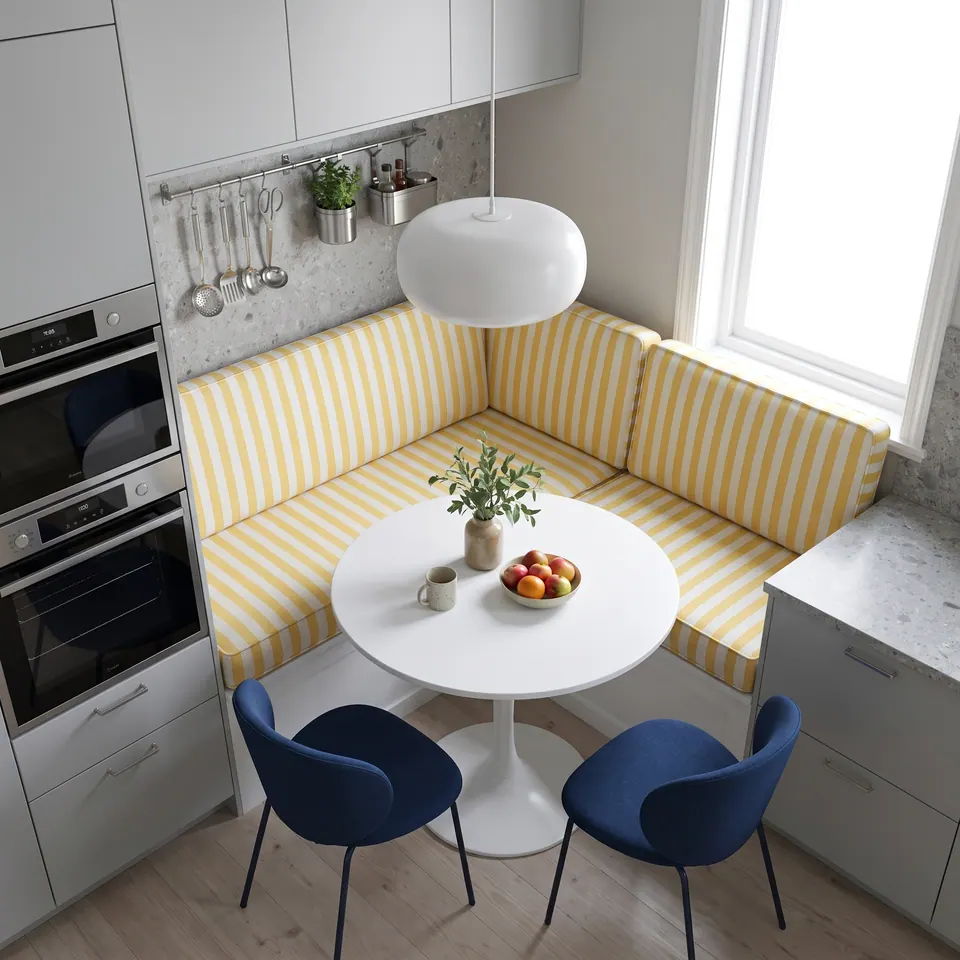
Stand at the kitchen door, about ten feet back, and this L-shaped bench cushion is simple: cherry red on natural cream, a banquette that turns a corner. Walk up to ten inches and it turns into a list of decisions.
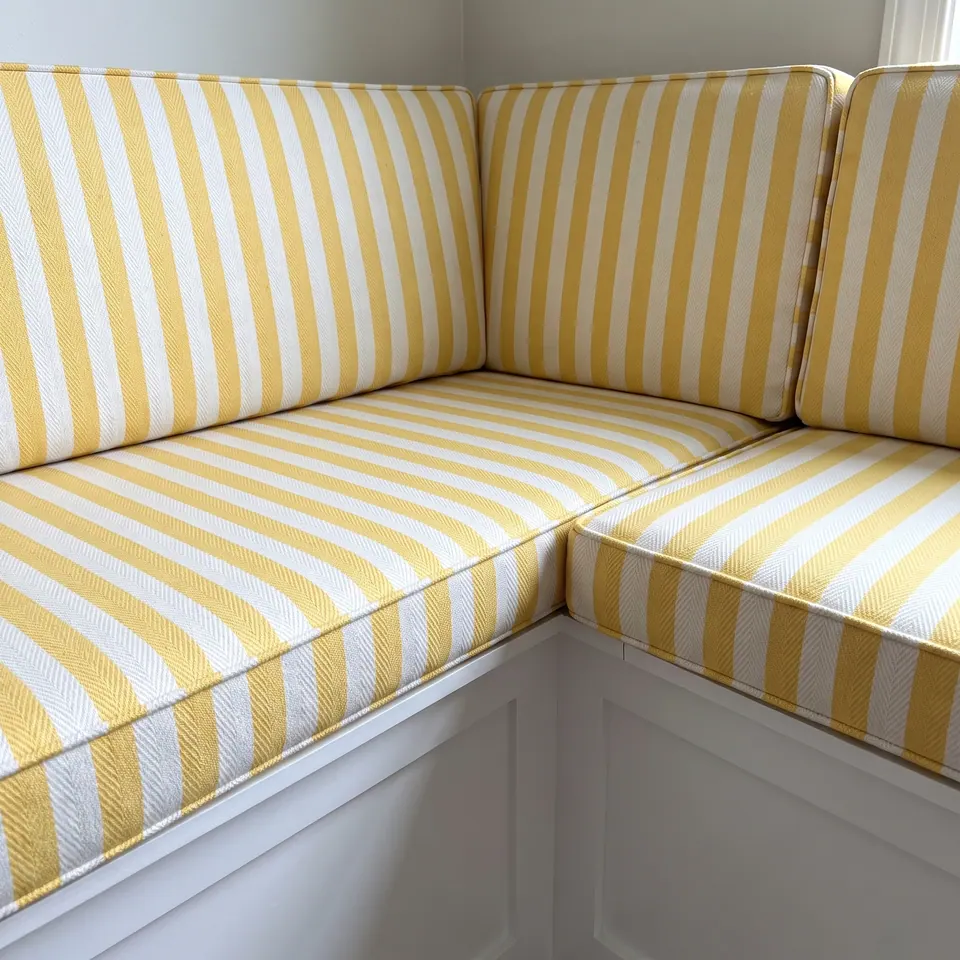
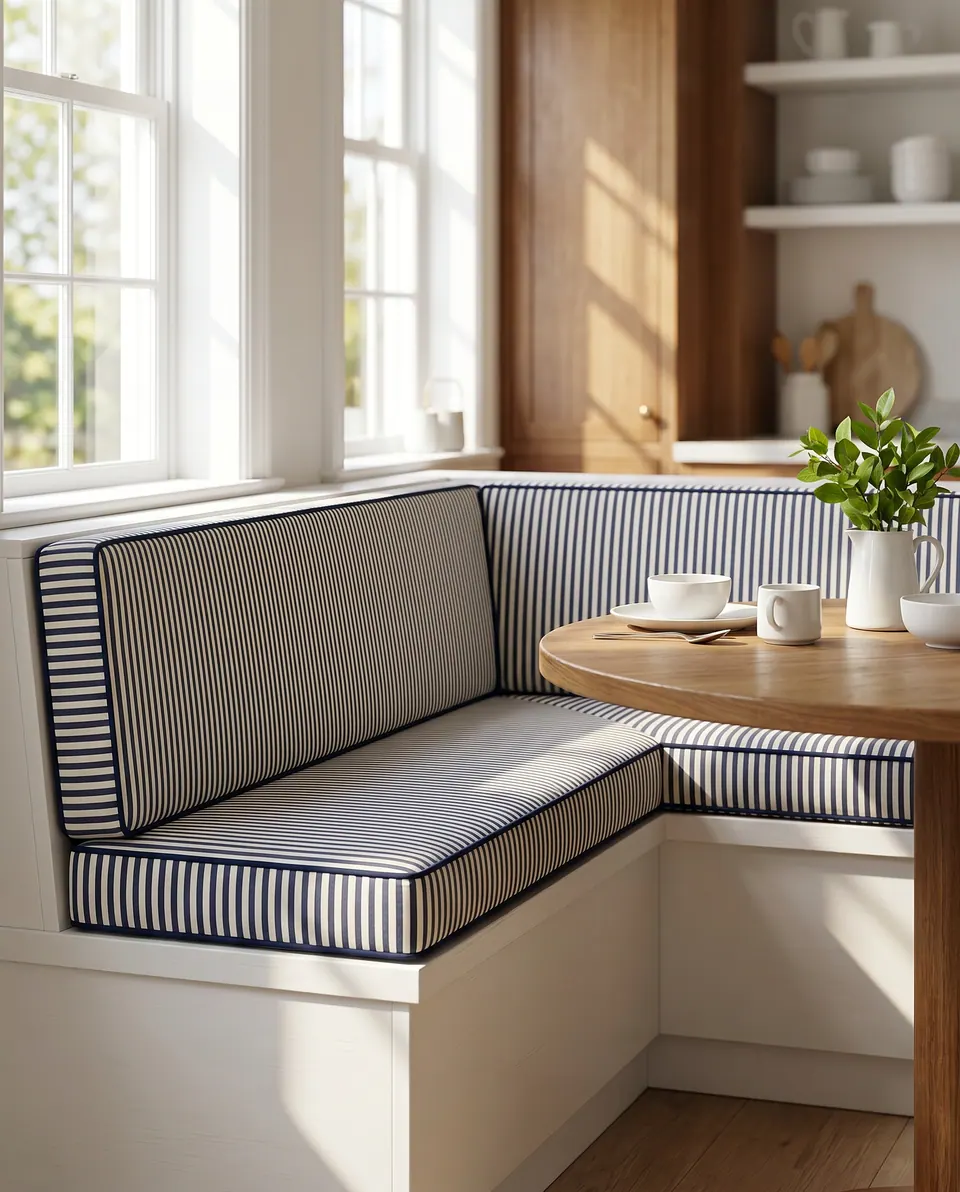
Decision one: the piping. It is self piping cut from the same ticking, so the cord carries the stripe around every edge. Up close the welt reads as a fine dotted line of red and cream. From the door it melts into the edge, which is the point: no second color competing with the stripe.
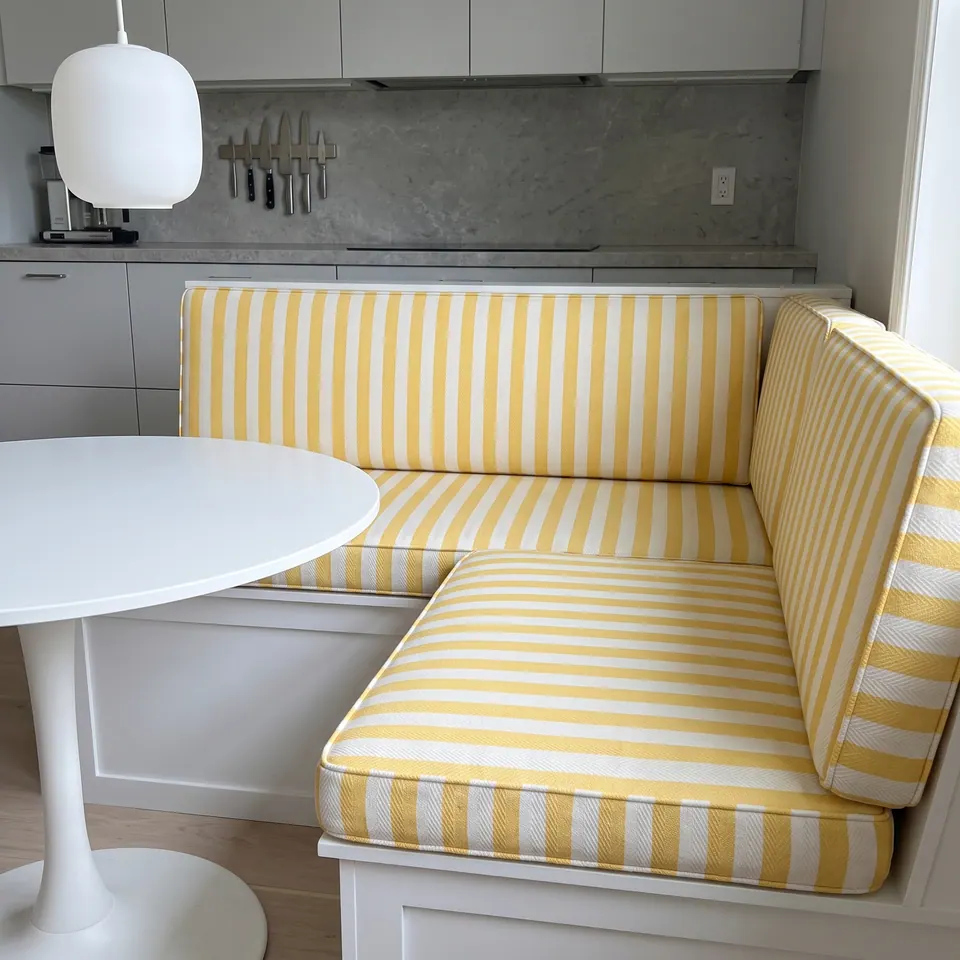
Decision two: direction. On the seat the stripes run front to back and line up with the back cushion above. On the box side they run the same way as the seat. Turn one piece 90 degrees and the corner looks twisted from across the room, even if every seam is perfect. Of everything in this close-up, direction is the one detail that still reads at ten feet.
Decision three: the corner. Two back cushions meet tightly with no filler strip. That only happens when the lengths were cut to allow for each other, and the table below shows how.
The cloth is a sturdy woven twill from our striped cotton and ticking family, which suits daily kitchen nook use. What does your nook measure along each wall, partner? Write both runs down before you read the table.
Four pins at the corner join
Four pins at close range, from the striped welt to the tight back join, each one a detail that decides the ten-foot view.
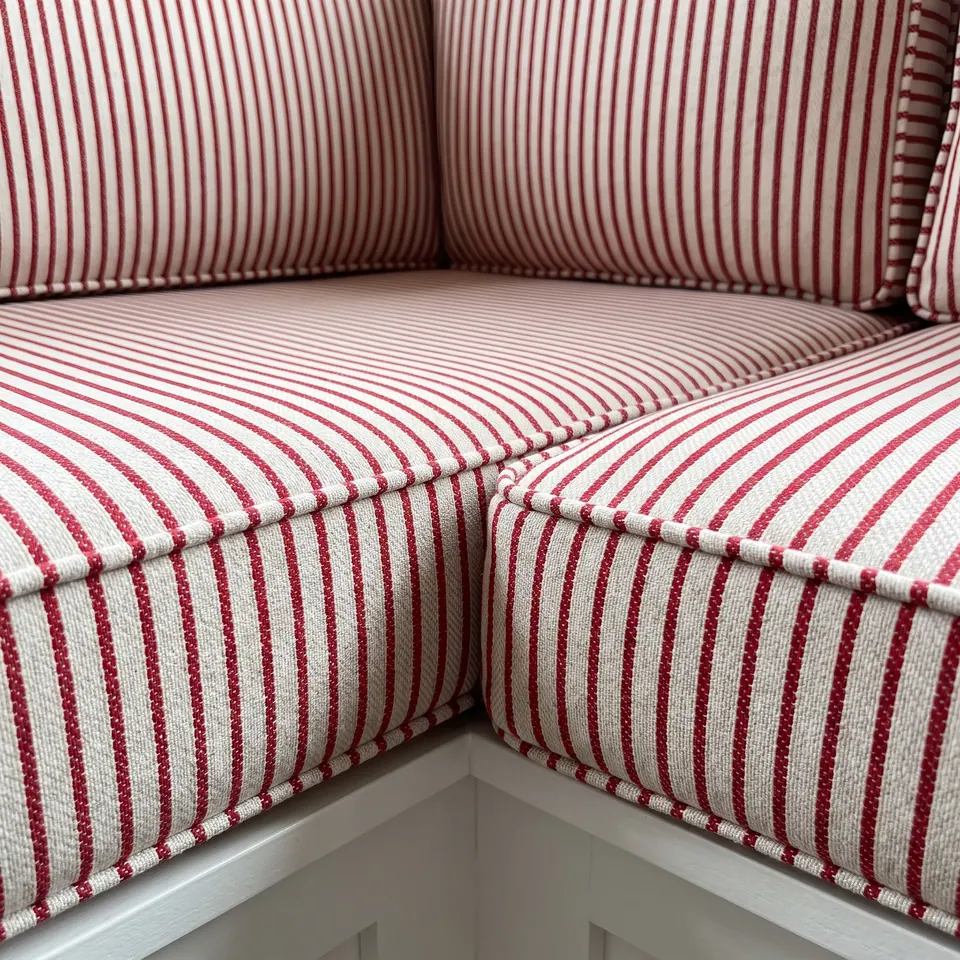
- Striped self piping
The piping is cut from the same stripe, so the welt reads as a fine dotted line.
- Box side stripes
Stripes on the box side run the same way as the seat so the corner doesn't look twisted.
- Seat stripe run
Front-to-back stripes on the seat line up with the back cushion above.
- Corner back join
Two back cushions meet tightly in the corner with no filler strip.
- Striped self pipingThe piping is cut from the same stripe, so the welt reads as a fine dotted line.
- Box side stripesStripes on the box side run the same way as the seat so the corner doesn't look twisted.
- Seat stripe runFront-to-back stripes on the seat line up with the back cushion above.
- Corner back joinTwo back cushions meet tightly in the corner with no filler strip.
Notebook table: cutting an L from two wall runs
| Piece | Wall run | Cut length | Rule |
|---|---|---|---|
| Seat, short run | 74 in (188 cm) | 74 in (188 cm) | Runs wall to wall |
| Seat, long run | 180 in (457 cm) | 161 in (409 cm) | Minus the 19 in (48 cm) seat depth |
| Back, short run | 74 in (188 cm) | 74 in (188 cm) | Runs wall to wall |
| Back, long run | 180 in (457 cm) | 178 in (452 cm) | Minus the back cushion's thickness |
A new breakfast nook, 74 in by 180 in
A buyer wrote in about a newly built L-shaped breakfast nook. They wanted seat and back cushions in brown and ivory stripes, plus two round pillows, which the workshop added free. The corner was the worry, so the workshop asked for wall-to-wall measurements: runs of 74 in (188 cm) and 180 in (457 cm), 19 in (48 cm) deep, with backrests 14 in (36 cm) high.
To avoid overlap, the seats were made at 74 in and 161 in (188 and 409 cm), and the backs at 74 in and 178 in (188 and 452 cm). With about 250 active orders on the tables, dispatch was estimated at 7 to 10 days.
The rule fits on an index card. At an L corner, shorten the second seat by the seat depth and the second back by the back thickness. Angles are just lengths in disguise; at 90 degrees they are plain subtraction. The L-shaped corner joint Pattern draws it out, and stripe direction covers the rest.
Buyer questions: more fabrics, curved backs and foam alone
- A common question
Are the fabrics in the listing the only ones I can choose from?
The workshop's answerThe listing shows the most popular, most-ordered fabrics. Tell the workshop the material or look you're after, and it can offer options beyond the listing.
- A common question
Could you make an arched, curved back cushion for my banquette?
The workshop's answerA single curved back piece is very tricky, because even a small measuring error causes fitting problems. A back cushion that is wider at the bottom, wedge style, is a model the workshop makes often, and it gives excellent back support. Send dimensions and fabric for a quote.
- A common question
Can I buy just the foam inserts for an L-shaped backrest, without covers?
The workshop's answerYes. The workshop sells foam-only L-shaped backrest inserts, for example as a pair, through a dedicated purchase link.
On the cutting table: the ticking corner
| Piece | L-shaped corner seat with two back cushions |
|---|---|
| Fabric | Cherry red and natural cream ticking stripe, woven twill |
| Piping | Self piping cut from the stripe |
| Edge | Box edge |
| Stripe direction | Front to back on the seat, matched on box sides and backs |
| Corner | Backs butt tightly, no filler strip |
| Cut rule | Second seat minus seat depth; second back minus back thickness |
| Best for | Breakfast nooks and farmhouse kitchen banquettes |

Have it made
Have this made — ask Nate’s workshop
Precision starts on the phone. Give the workshop your measurements and they will read them back to you, edge by edge. — Nate
Leave your details and the workshop will call you to confirm measurements, fabric, foam and piping. No prices, dates or payment on this page: it is a request, not an order.
Ticking stripes on an L-shaped bench must run the same way on the seat, box side and back; turn one piece 90 degrees and the corner looks twisted.
Nate
Questions buyers ask next
Is ticking stripe practical for a kitchen banquette?
Yes. Ticking is a sturdy woven cloth suited to daily kitchen use, and a stripe hides the corner join well when every piece runs the same direction. Ask for self piping if you want the pattern to wrap the edges.
Which way should the stripes run on a bench seat?
On this corner seat they run front to back, lining up with the back cushion above. Whatever you choose, keep the seat, the box side and the back consistent, or the corner will look twisted from across the room.
Do two back cushions need a filler piece where they meet in a corner?
Not when the lengths are cut for it. Shorten the second back by the first back's thickness, and the two meet tightly in the corner with no filler strip and no overlap.
± 1/4 in — Nate