 Save
A Reading by NateL-Shaped Corner Bench Cushions
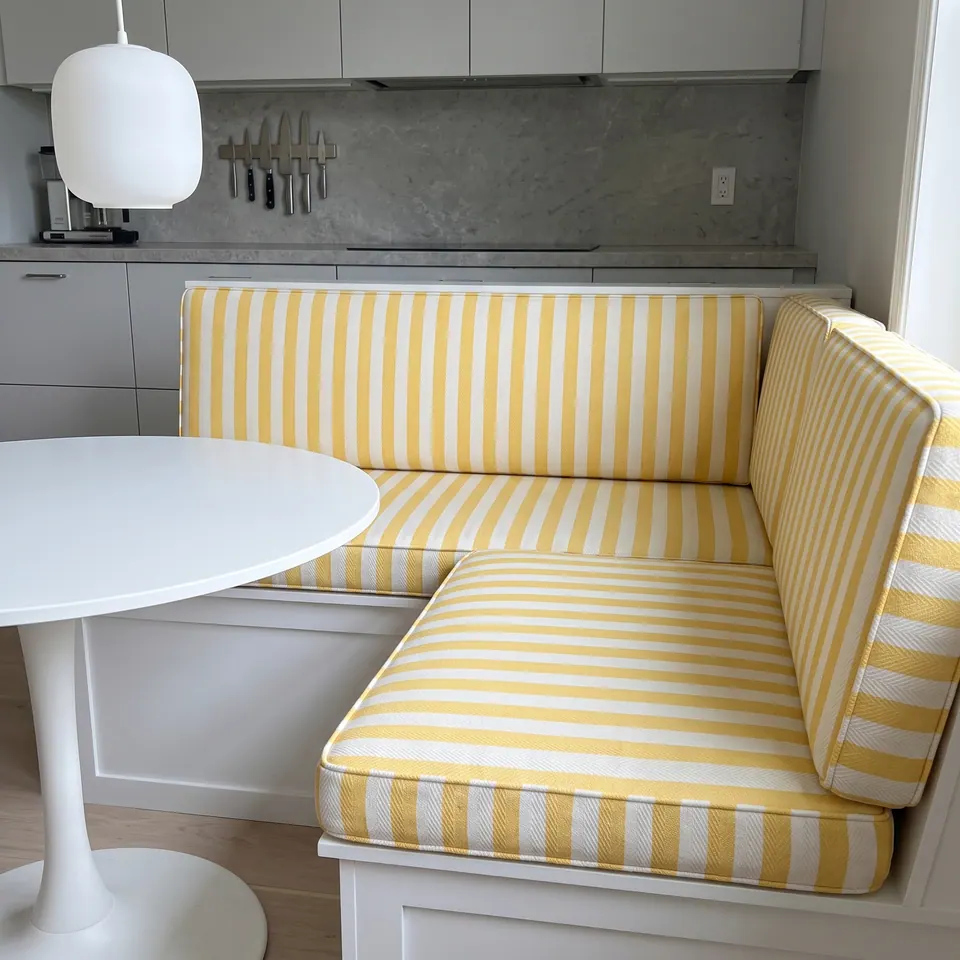
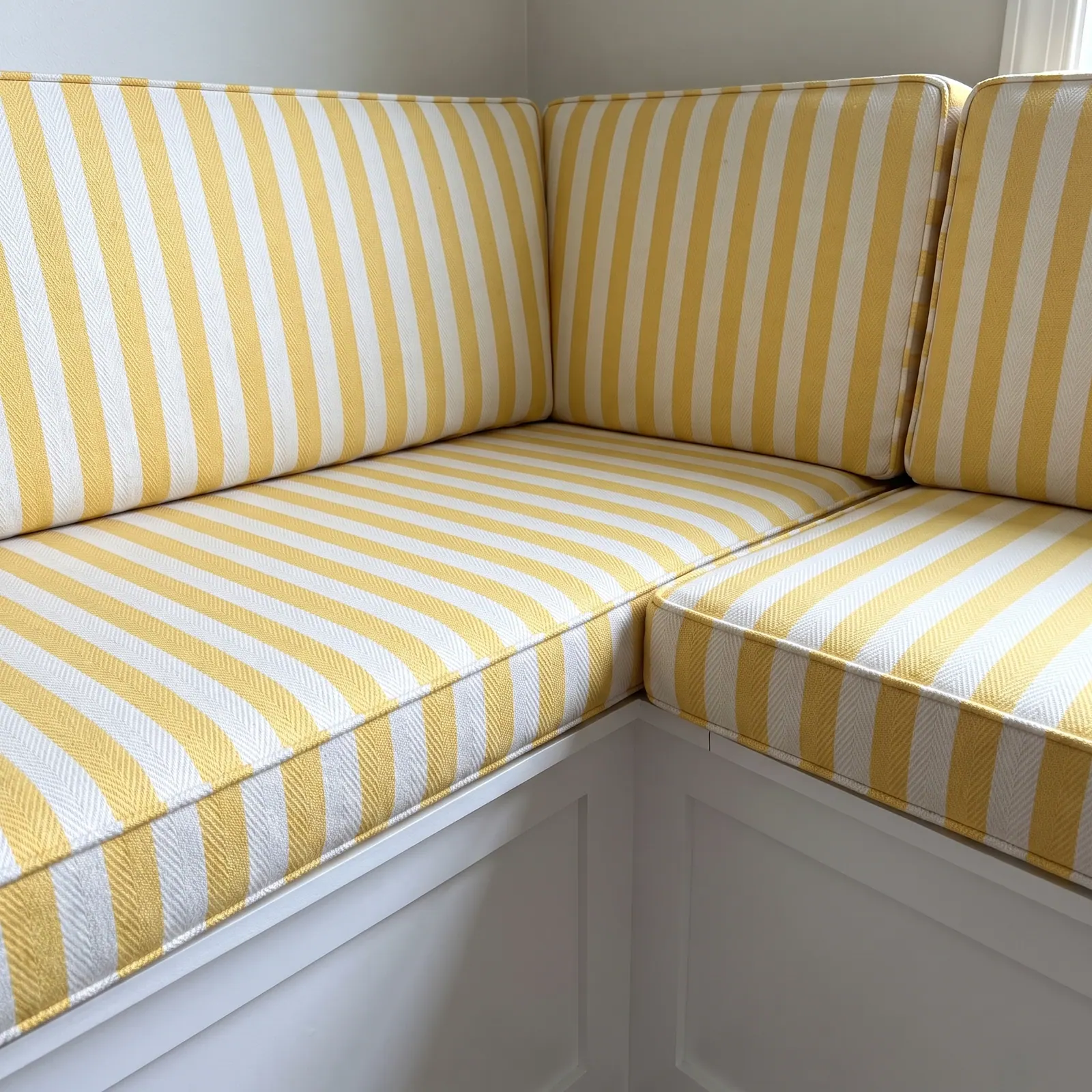
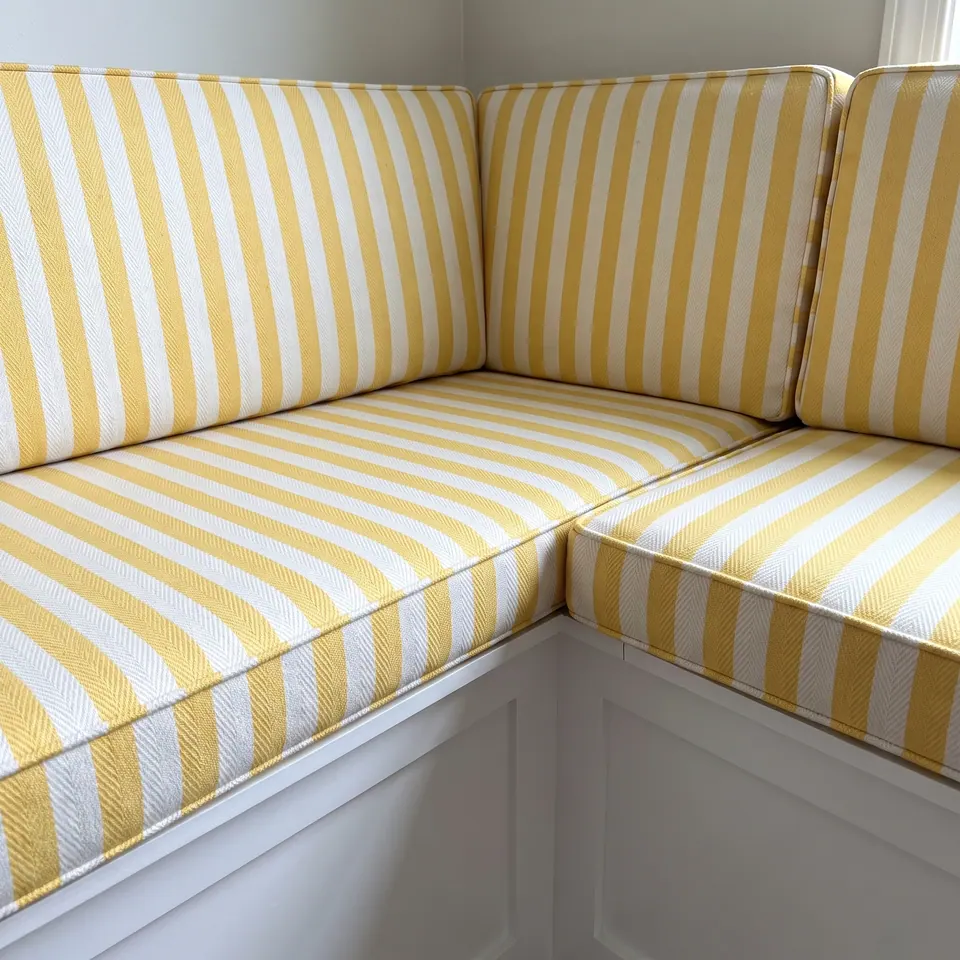
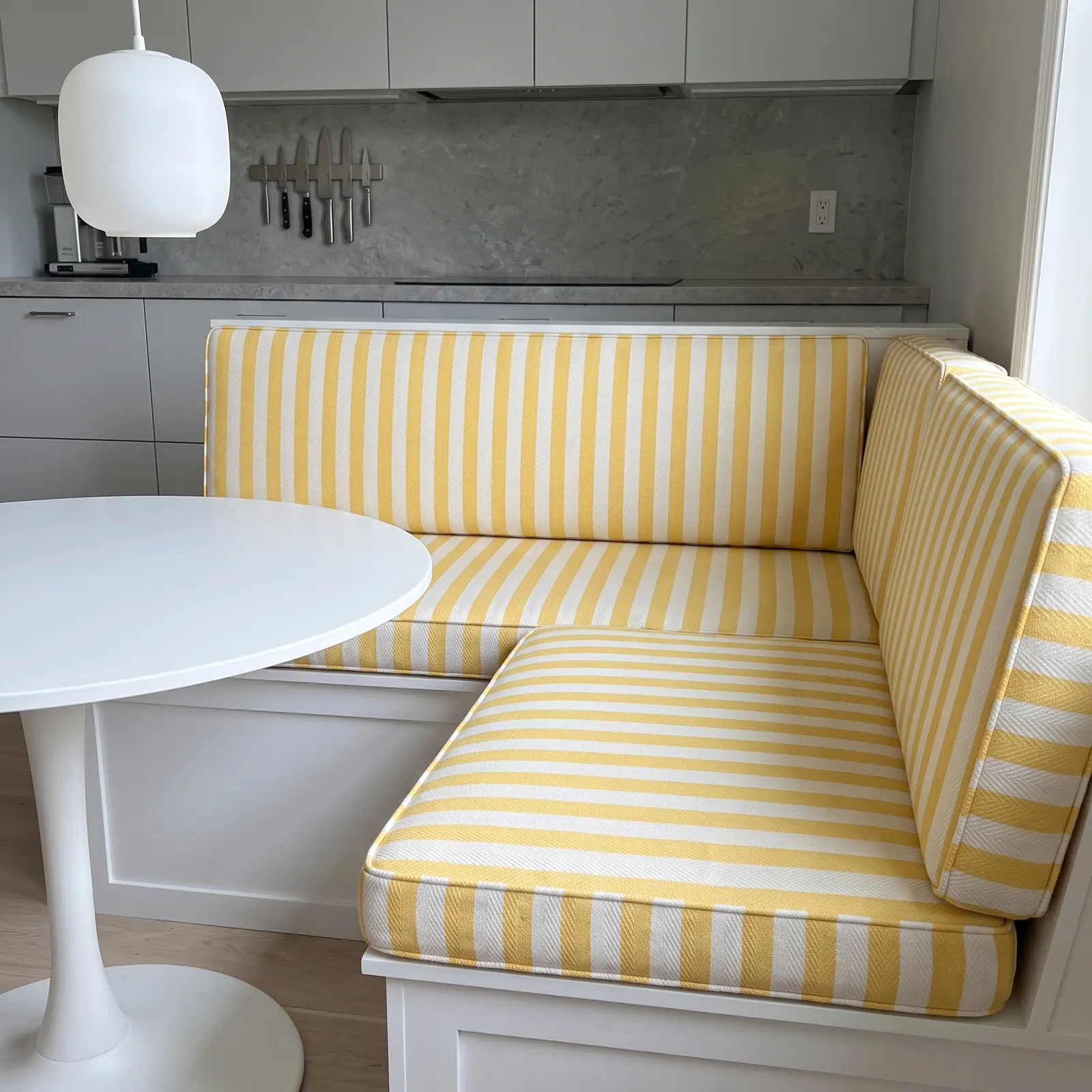
Yellow herringbone stripe L-shaped bench cushions, read at the corner joint
Nate gets close to a sunny corner banquette and measures what the edge and the corner are doing: a box edge, self piping, and a corner back pad that steps forward.

Swatch strip measured from the photograph
- umber#74675426%
- camel#98886925%
- sand#c6bca020%
- oatmeal#dfd5b715%
- linen#e7e8e115%
The quick answer
On an L-shaped bench cushion, the corner decides everything: edge style, back pads and run lengths. A box edge with self piping keeps a striped set tidy, and the corner back pad should sit slightly forward of the long back so the return seat fits beneath it. Measure each run separately, and for equal flush pieces, divide the total length evenly.
Swatch strip: one yellow, woven in a chevron
- Sunny yellow#F2C12EThe stripe band. Warm and clear, no green in it.
- Twill shadow#D6A424The darker yellow the herringbone weave makes in its V's.
- Stripe white#F8F4E8The ground between bands, a soft white rather than stark.
- Paneled bench white#ECEBE5The banquette base, a shade cooler than the stripe white.
- Window light#FFF6DCSoft daylight that keeps the yellow fresh, not orange.
Pinned by Nate: the yellow corner cushions
Four pins on the weave, the stripe line, the corner pad and the return edge.
- Herringbone stripe weave
Each yellow band has a woven chevron texture, more tailored than a printed stripe.
- Long seat stripes
Seat stripes run front to back and line up with the back cushion above.
- Corner back pad
The corner back cushion sits proud of the long back, leaving room for the return seat.
- Return seat edge
Self-piping in the same stripe keeps the edge soft rather than outlined.
- Herringbone stripe weaveEach yellow band has a woven chevron texture, more tailored than a printed stripe.
- Long seat stripesSeat stripes run front to back and line up with the back cushion above.
- Corner back padThe corner back cushion sits proud of the long back, leaving room for the return seat.
- Return seat edgeSelf-piping in the same stripe keeps the edge soft rather than outlined.
Box, knife, rounded, angled: reading the corner
A striped L-shaped bench cushion shows every mistake at the corner. This one shows none. Let's measure why, partner.
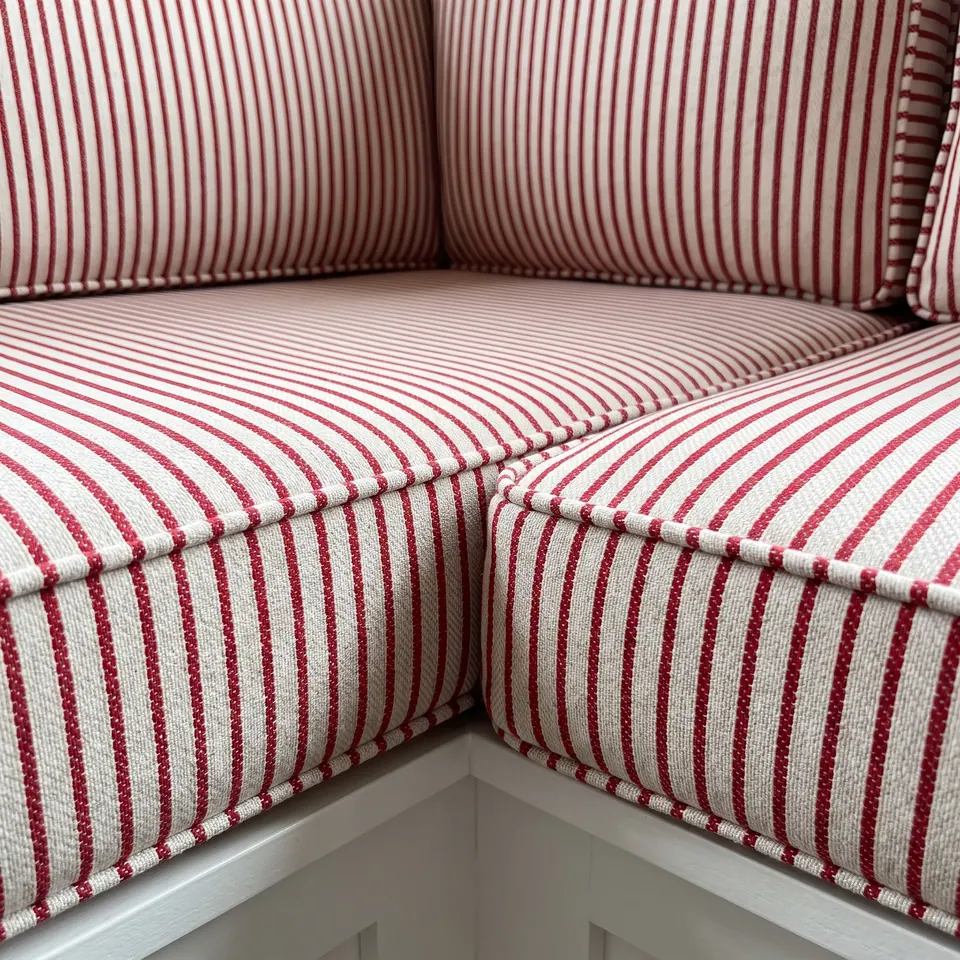
The weave. Each yellow band is a herringbone twill, so up close it carries a small chevron texture. A woven stripe follows the grain of the cloth by construction, which matters when three faces have to meet.
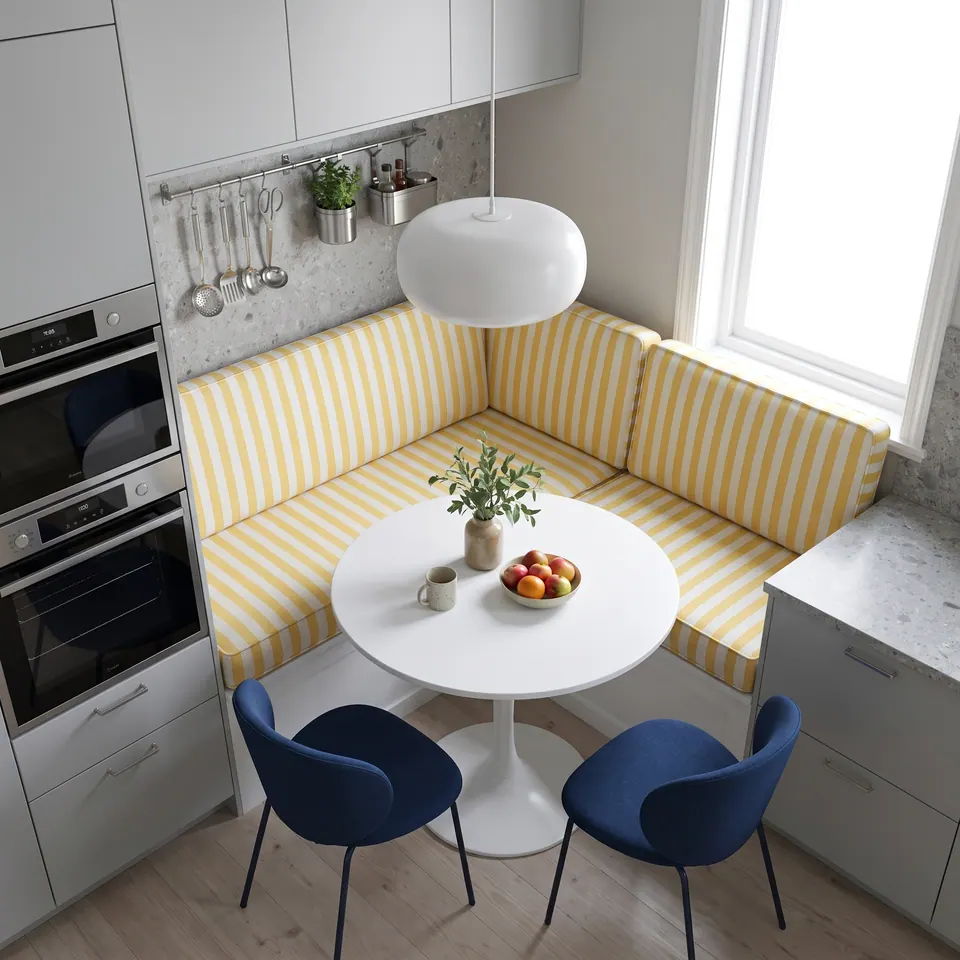
The alignment. Seat stripes run front to back and land under the back-cushion stripes above them. Back, seat, box side: one continuous ladder.
The corner. The corner back pad sits proud of the long back. It steps forward so the return seat tucks in beneath it without a gap or a pinch. Angles are just lengths in disguise; here the corner is solved by the depth of one pad.
The edge. Box edge, self piped in the same stripe. The welt marks the seam softly instead of outlining it.
Your four options for edge and corner:
- Box edge. Flat side band, square profile; the stripe wraps the front. The banquette standard.
- Knife edge. Two panels meet at the rim and thin toward it. Casual, and hard to line up across an L.
- Rounded corners. Soften the front corners where knees and hips pass. Give the radius.
- Angled corners. A clipped front corner for benches built at 45°. Give each corner length.
Work out the pieces with L-shaped bench cushion measurements and the corner joint options. More sets live in L-shaped cushions, and the cloth sits with striped cotton and ticking.
Which corner does your bench have: square, rounded or clipped?
Cut sheet: the yellow corner
| Cushions | L-shaped corner banquette set: seats plus back pads |
|---|---|
| Fabric | Woven herringbone stripe, sunny yellow and white |
| Edge | Box edge |
| Piping | Self piping cut from the same stripe |
| Stripe direction | Front to back on the seats, lined up with the backs |
| Corner | Corner back pad set forward of the long back |
| Flush pieces | Total run divided evenly; write each size smaller for a gap |
| Oversize runs | Past the 90 in (229 cm) menu limit: custom link plus sketch |
| Best for | Breakfast corners and kitchen banquettes |

Have it made
Have this made — ask Nate’s workshop
Every edge and both diagonals, to the nearest 1/4 in. If the numbers do not close, the workshop will say so on the call. — Nate
Leave your details and the workshop will call you to confirm measurements, fabric, foam and piping. No prices, dates or payment on this page: it is a request, not an order.
Two L-shaped sofas, eight boxes and one soft bolster
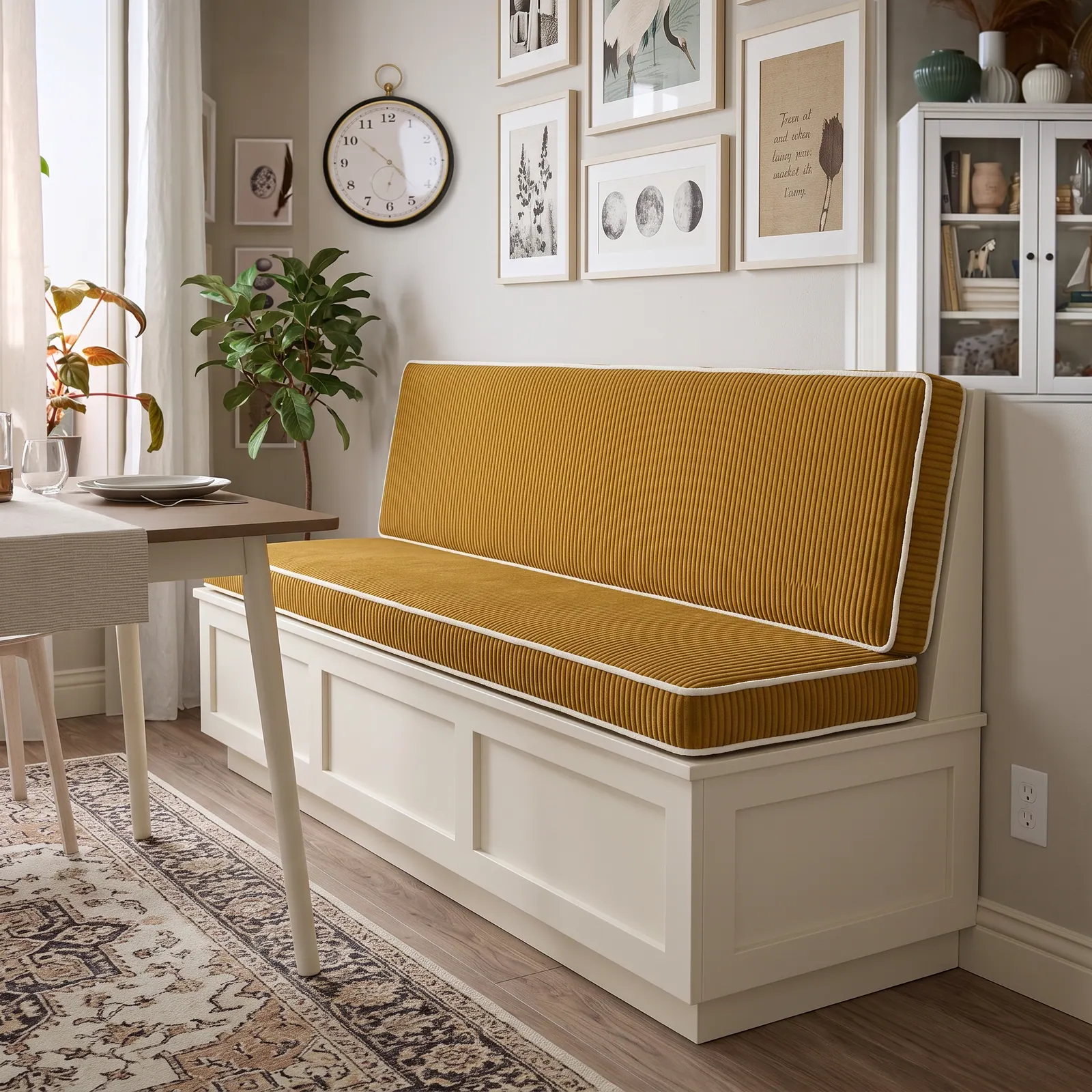
A buyer in the US bought an L-shaped teddy corner sofa, liked it, and ordered a second one in mustard corduroy so the two could join into one big sectional or a bed. The workshop agreed to add two extra straight backrests without sides, at no charge.
The order shipped in eight packages. Seven arrived. One had a hole that exposed the mattress, and the two extra straight backrests were missing. One corner bolster was still soft in the middle after 3 days.
The workshop made and shipped the two straight backrests, then a replacement corner backrest. The pair now works as a conversation pit by day and a bed larger than king size by night.
Two notes for your file. On a multi-parcel order, keep a list of what each box should hold and check it off as the boxes arrive. And flag any compressed bolster that is still soft after 48 to 72 hours.
- Sizes
- Two L-shaped teddy corner sofas; larger than king size in bed mode
- Fabric
- Corduroy, mustard
The lesson: On multi-parcel orders, list each box's contents; check a compressed bolster that is still soft after 48 to 72 hours.
Buyer questions: leg notches, extra-long runs and flush pieces
- A common question
Can you shape a cushion around the square legs at the corners of my bench, and add ties so it stays put?
The workshop's answerYes. Cushions that fit around bench legs are made through the custom-shape (trapezoid) listing, which asks for a simple drawing with every exact measurement. For ties, say exactly where each one goes and how long it should be; ties are a small extra charge.
- A common question
My cushion is longer than the biggest size in the menu, over 90 inches. Can I still order it?
The workshop's answerYes. A trapezoid cushion with a 98.5 in (250 cm) back edge went past the drop-down options, so the workshop sent a custom payment link. It also asked for a quick sketch with all the dimensions so nothing got misread.
- A common question
Can several cushions sit flush against each other on one bench?
The workshop's answerYes. Measure each section and send the exact width, depth and thickness of every cushion. For two equal backrests on one bench, divide the total length by two; if you'd like a small gap between pieces, write each measurement slightly smaller.
On an L-shaped bench cushion, set the corner back pad slightly forward of the long back so the return seat tucks in without a gap.
Nate
Questions buyers ask next
Box edge or knife edge for a striped banquette?
Box edge. The flat side band lets the stripe wrap the front cleanly and keeps every piece the same height where they meet. A knife edge thins toward the rim, so the stripes meet at one seam and are harder to line up across an L.
How do I keep stripes from mismatching at the corner of an L-shaped cushion?
Say in the order note that stripes run front to back on every seat and line up with the back cushions. Send a sketch that marks which piece is the corner, and keep the corner back pad as its own piece.
Should an L-shaped bench cushion be one piece or several?
Often two or more. Splitting at the corner keeps each piece easy to lift and cover. Send photos and a sketch with every run, and the workshop will advise; one L-bench with 45° corners was made as two cushions.
What is a herringbone stripe?
A stripe woven in herringbone twill, so each colored band carries a small V-shaped texture. It looks more tailored than a flat printed stripe and, being woven, follows the grain of the cloth.
± 1/4 in — Nate
More photographs to read
 Save
 Save
 Save
 Save
 Save
 Save