 Save
A Reading by MaggieBanquette & Kitchen Nook Cushions
The piping decision on a curved-corner banquette cushion
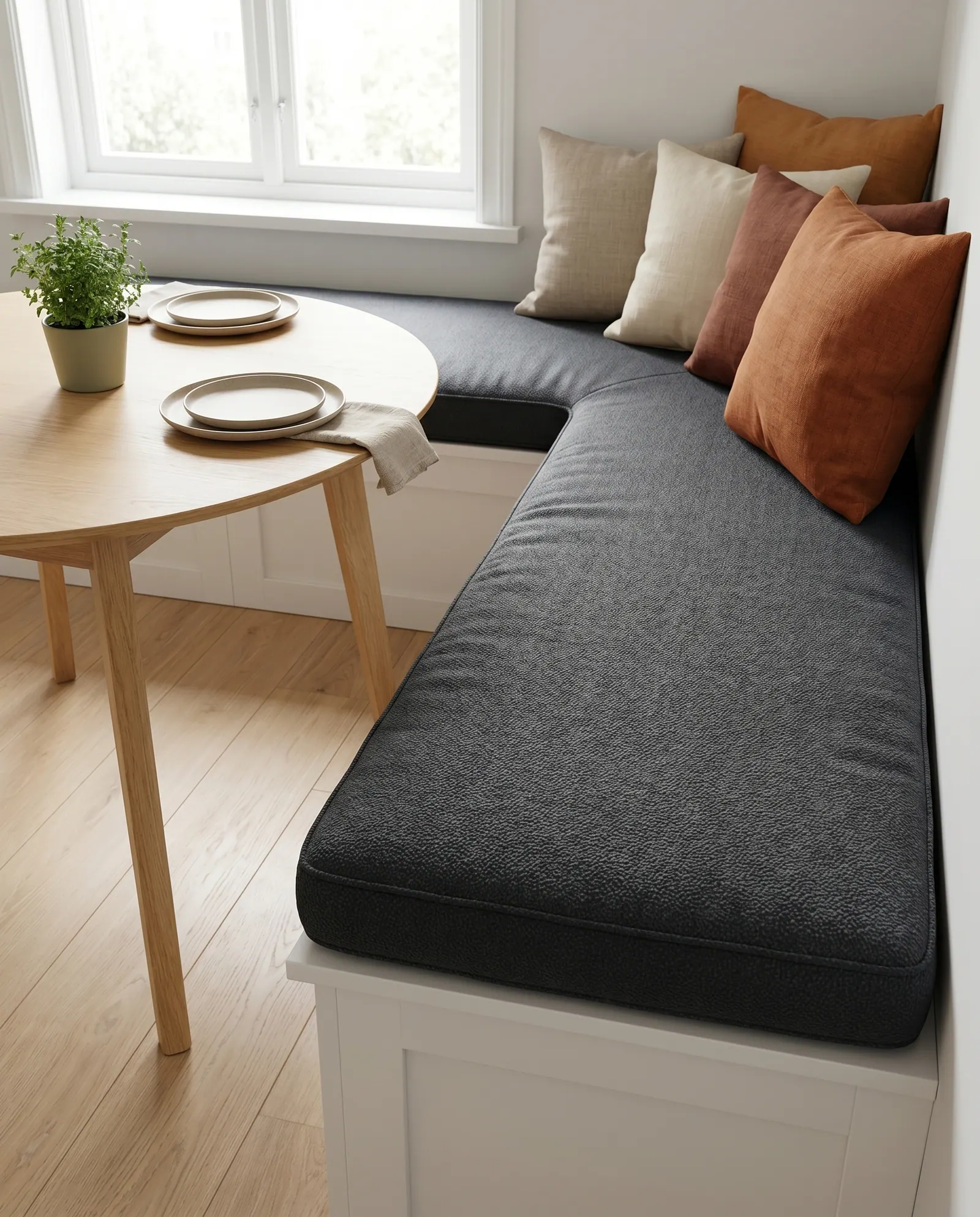
Piping is the signature of a cushion, and on a curve it either behaves or it tattles. Here it behaves, because somebody chose charcoal on charcoal.
The rounded inner corner lets the charcoal cushion wrap the nook in one smooth line.

The quick answer
On a banquette cushion with a curved inside corner, choose self piping: charcoal on charcoal runs round the radius in one unbroken line, while a contrast welt would ring the bend and show every wobble. Save contrast piping for straight runs, pipe the top and bottom edges, and keep the zipper hidden on the back edge against the wall.
The curve that makes the piping choice for you
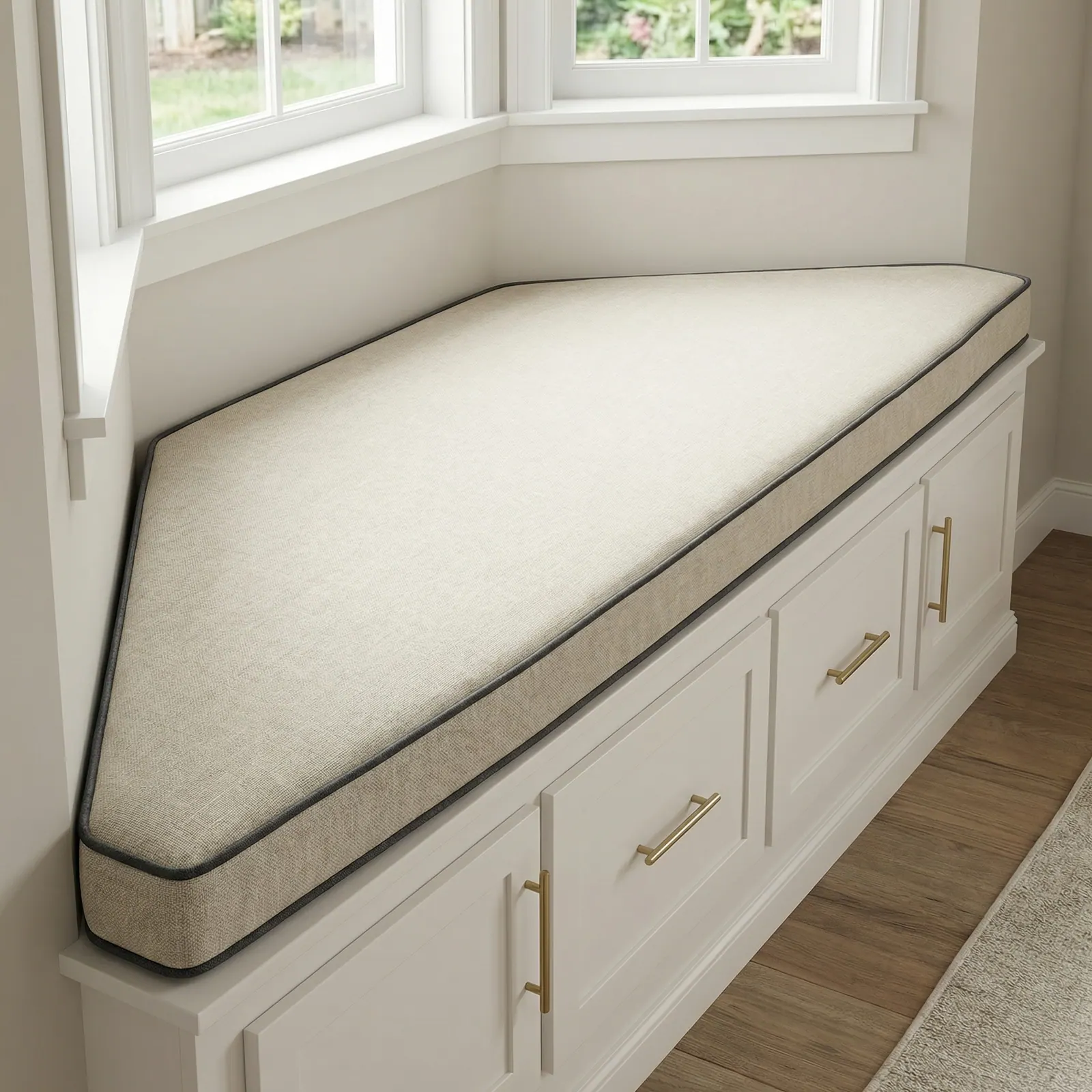
A banquette cushion is judged at the corner, and this one passes before anyone sits down. The inside corner is cut on a curve instead of a sharp miter, so nobody lands on a hard seam, and the cushion follows the white bench the way proper upholstery would.
That curve settles the piping question. Self piping, charcoal on charcoal, runs round the radius in one unbroken line. A contrast welt there would draw a bright ring round the bend and show every tiny wobble in it. On a curved corner bench cushion, dear, quiet piping is the kind choice. The whole argument is laid out in matching, contrast or no piping.
Charcoal is the workhorse color for a breakfast nook. Crumbs, coffee and paw marks vanish into the nubbly performance weave, which is why this seat sits with the performance and pet-friendly fabrics. The risk with dark is a heavy room, and the photo handles it twice. The bench base is white. And the pillows run in a deliberate gradient, oatmeal and cream through rust, burnt orange and terracotta, so they carry the color and the seat doesn't have to.
The round oak table is the host's trick. A round top lets people slide in from either leg of the L without meeting a corner with their knees. Two stoneware plates, a linen napkin and a potted herb in a cream pot keep the table plain, and the light oak floor repeats the tabletop. Bright, even daylight shows the weave honestly.
Copy the idea: keep the frame white, keep the piping quiet, and let the pillows do the talking. More nooks are gathered under banquette cushions and kitchen nook cushions.
Self, contrast or no piping on a curved banquette corner
| Piping | What it does to the line | Choose it when |
|---|---|---|
| Self piping | Outlines the box in the body color, crisp but quiet | The cushion curves, the weave is busy or the color is dark, as here |
| Contrast piping | Draws the shape in a second color, so every run and every wobble shows | Runs are straight and you want the outline to be the design |
| No piping | Leaves a soft edge with no drawn line | You want a relaxed, upholstered look more than a tailored one |
Pinned by Maggie: five points round the L
Five pins round the nook, from the curved inside corner to the white base that keeps a dark seat light.
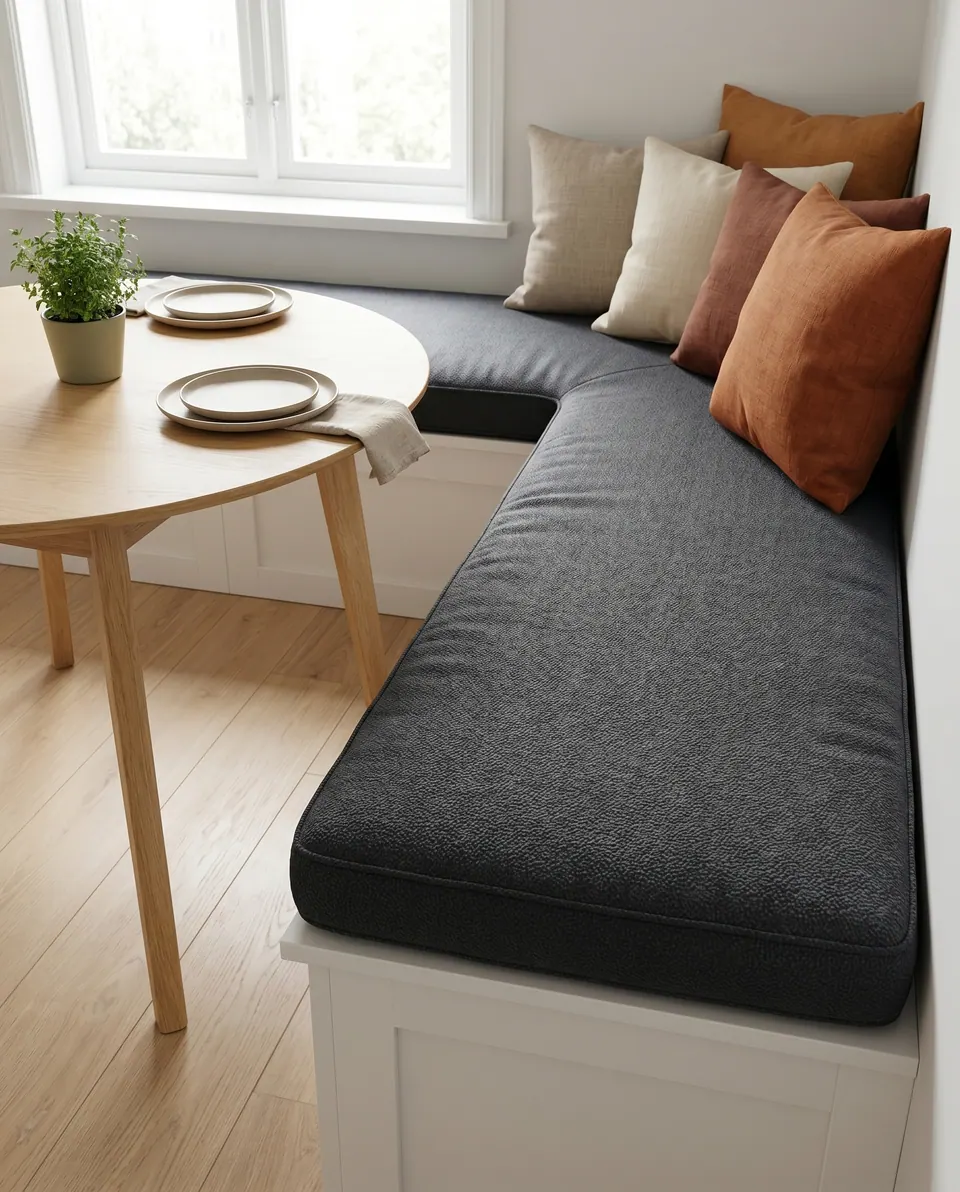
- Charcoal long run
Dark nubbly weave hides crumbs, coffee and paw marks at a dining nook.
- Curved inside corner
A radiused corner avoids a hard seam where the two legs meet.
- Graduated pillows
Oatmeal through rust to orange pillows bring warmth to the dark seat.
- Round oak table
A round top lets people slide in from either side of the L.
- White bench base
A white frame keeps a charcoal cushion from making the room heavy.
- Charcoal long runDark nubbly weave hides crumbs, coffee and paw marks at a dining nook.
- Curved inside cornerA radiused corner avoids a hard seam where the two legs meet.
- Graduated pillowsOatmeal through rust to orange pillows bring warmth to the dark seat.
- Round oak tableA round top lets people slide in from either side of the L.
- White bench baseA white frame keeps a charcoal cushion from making the room heavy.
Piped top and bottom, 110 inches of it
A buyer got in touch with a built-in L banquette and a spec I could have written myself. Four pieces: box cushions with hidden zippers on the back edges, piping on the top and bottom edges, high-density seats 3 in (7.6 cm) thick and backs 2 in (5 cm) thick.
The seats measured 110 x 18 1/2 x 3 in (279 x 47 x 7.6 cm) and 32 x 18 1/2 x 3 in (81 x 47 x 7.6 cm). The backs measured 108 x 11 x 2 in (274 x 28 x 5 cm) and 50 x 11 x 2 in (127 x 28 x 5 cm). The long seat ran into the corner, and the short back ran into the corner wall, with the 2 in (5 cm) back overlap already subtracted.
For that set the workshop quoted 1 to 2 weeks of production, shipping included, and offered performance fabrics in olive and moss greens. The lesson: at an L corner, decide which seat runs into the corner, then subtract the back cushion thickness from the seat that meets it. L-shaped bench cushion measurements has the drawing, and measuring a rounded corner covers the curve.
On the cutting table: the curved nook
| Product | L-shaped banquette cushion |
|---|---|
| Corner | Curved inside radius, no hard miter seam |
| Fabric | Charcoal performance weave with a nubbly texture |
| Piping | Self piping, charcoal on charcoal |
| Edge | Box |
| Base | White paneled bench |
| Pillows | Oatmeal, cream, rust, burnt orange, terracotta |
| Table | Round oak, easy to slide in from either leg of the L |
| Best for | Breakfast nooks with kids, coffee and pets |

Have it made
Have this made — ask Maggie’s workshop
Have the tape measure handy when they call. Old cushions shrink and sag; the seat underneath does not. — Maggie
Leave your details and the workshop will call you to confirm measurements, fabric, foam and piping. No prices, dates or payment on this page: it is a request, not an order.
Buyer questions: thin seats, a better price and a short centimeter
- A common question
My window won't open if the cushion is any taller. Can you make one only 3/4 in (2 cm) thick?
The workshop's answerYes, ¾ in (2 cm) cushions are made to order. At that thickness the foam must be cut evenly and sized to the cover, or the cushion bulges above your limit, so state your absolute maximum height including the cover.
- A common question
Could you come down a little on the price?
The workshop's answerOften, within limits. The shop has trimmed quotes on request, once lowering a seating set twice before calling the last figure its best price.
- A common question
My cushion measures about ½ in (1 cm) less than I ordered. How accurate should the finished size be?
The workshop's answerCushions are handmade and filled with soft foam, so variations of about 3/8 in (1 cm) are within the stated tolerance. When a 16 1/8 in (41 cm) depth came out 3/8 to 3/4 in (1 to 2 cm) short, the shop remade it anyway.
On a curved banquette corner, self piping keeps one unbroken line; a contrast welt draws a ring round the bend and shows every wobble.
Maggie
Questions buyers ask next
Is charcoal a sensible color for a breakfast nook banquette?
It is the workhorse choice. A dark, nubbly performance weave hides crumbs, coffee and paw marks. Keep the bench base white and let warm pillows carry the color so the nook stays light.
Should an L-shaped banquette cushion have a curved or a square inside corner?
A curved inside corner avoids a hard seam where the two legs meet, so nobody sits on a joint. A square corner is simpler to draw; either way, decide first which seat runs into the corner.
Which edges of a banquette seat should carry piping?
Top and bottom, as one buyer specified for a four-piece L set, with the zipper hidden on the back edge. The front then shows two clean lines and no hardware.
Why arrange nook pillows in a color gradient?
A run from oatmeal through rust to burnt orange warms a dark seat in steps, so no single pillow jumps out. It reads as planned, and the charcoal stays calm underneath.
Stitch straight — Maggie
More photographs to read
 Save
 Save
 Save
 Save
 Save
 Save