 Save
A Reading by NateL-Shaped Corner Bench Cushions
Ordering a sage L-shaped mudroom bench cushion so it is right the first time
Nate reads a corner boot bench with a golden retriever keeping watch, then writes out the message, codes and numbers that get an L-shaped order through without a pause.
Sage sits comfortably between the golden dog, the white beadboard and the gray terrazzo, and forgives muddy-paw days.

The quick answer
Order an L-shaped bench cushion as two separate pieces that meet at the corner, each with its own size range, the same thickness written on both, and the fabric code in the note. Keep each piece under about 79 to 90 in (200 to 230 cm). Firm 32 kg/m³ foam holds the box edge where boots get pulled on.
The hardest-working seat in the house gets the simplest order
An entry corner is where a cushion earns its keep. Someone drops down to pull on boots, a tote lands on it, a golden retriever parks beside it and sheds. This one handles all of it.
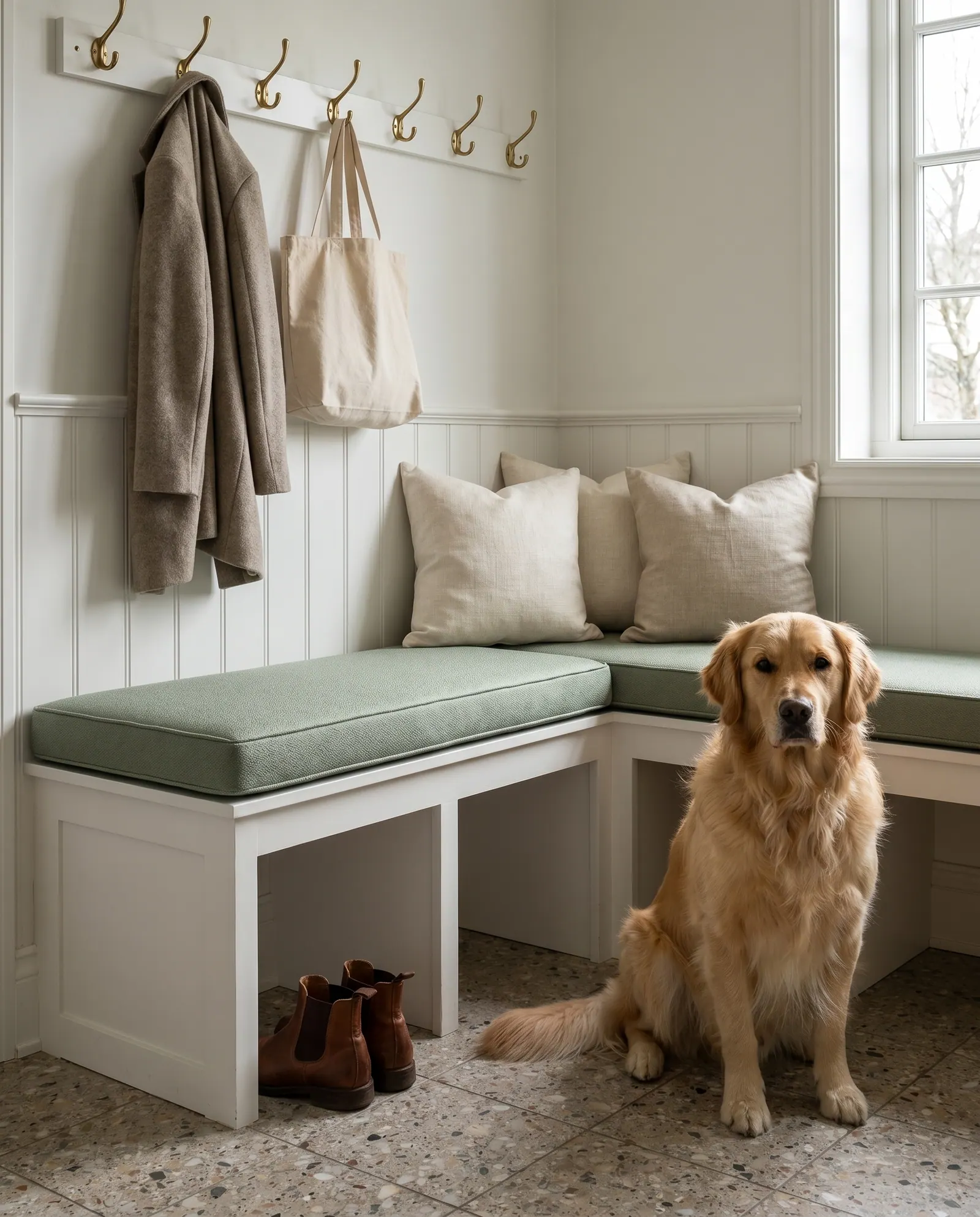
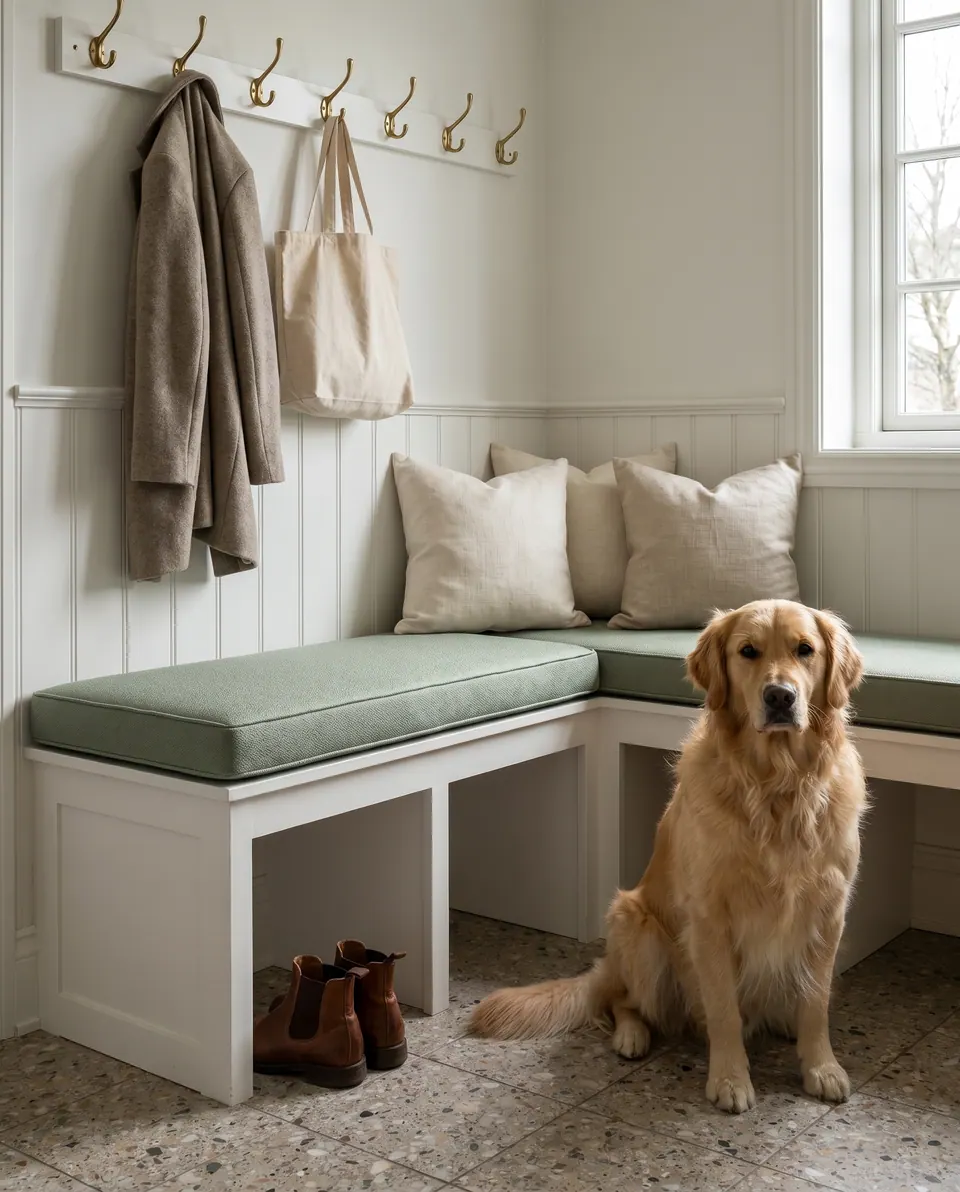
It is a sage L-shaped bench cushion on a white beadboard corner bench under a row of brass coat hooks, speckled terrazzo on the floor. Read it like a drawing, partner:
- Long leg. A firm box profile. The edge stays square when someone sits on the front lip.
- Corner joint. Two separate pieces meet here. Each lifts out alone, which is easier to clean than one big L-shaped cover.
- Color. Sage hides golden hair and grit far better than white would, and still looks fresh next to beadboard.
- Pillows. Three plain oatmeal linen pillows soften the corner without a pattern to argue with the coats and bags.
- Hooks. Warm brass lifts the cool sage and white.
The fabric sits in the performance and pet-friendly family, and more entries like this are under mudroom and entryway bench cushions. Before you write the order, sketch the L in the bench cushion builder and read how the corner joint works. How long is the long leg of your bench? Then write the note like this.
Pinned by Nate at the boot bench
Five pins, from the long leg of the L to the brass hooks overhead, with the dog in between.
- Long leg of the L
A firm box profile keeps its edge when someone sits to pull on boots.
- Corner joint
Two separate pieces meet here, easier to lift out and clean than one L-shaped cover.
- Golden retriever
Sage hides golden hair and grit far better than white would in an entry.
- Oatmeal linen pillows
Plain pillows soften the corner without fighting coats and bags for attention.
- Brass coat hooks
Warm brass lifts the cool sage and white beadboard.
- Long leg of the LA firm box profile keeps its edge when someone sits to pull on boots.
- Corner jointTwo separate pieces meet here, easier to lift out and clean than one L-shaped cover.
- Golden retrieverSage hides golden hair and grit far better than white would in an entry.
- Oatmeal linen pillowsPlain pillows soften the corner without fighting coats and bags for attention.
- Brass coat hooksWarm brass lifts the cool sage and white beadboard.
The order message, written the way the workshop reads it
Split the L into two pieces
One long piece, one short piece, meeting at the corner. Each goes in the cart as its own cushion, with its own size range.
Pick the range that covers each piece
The range sets the price; the note sets the cut. Check that the range you pay for actually covers that piece.
Write exact sizes with units
Length x depth x thickness, fractions included, inches or cm named. Example: 83 3/8 x 19 1/8 x 3 in.
Write the same thickness on both
An L with 2 in on one leg and 3 in on the other sits like a step. If you want them to match, write 3 in twice.
Name fabric and piping by code
Codes, not color names. Sage can mean ten shades; a code means one. If you are unsure, ask for a swatch or a fresh close-up first.
Attach a photo
A photo of the bench, or of earlier cushions you want matched, catches mistakes the numbers hide.
Two cushions, two thicknesses, and a production pause
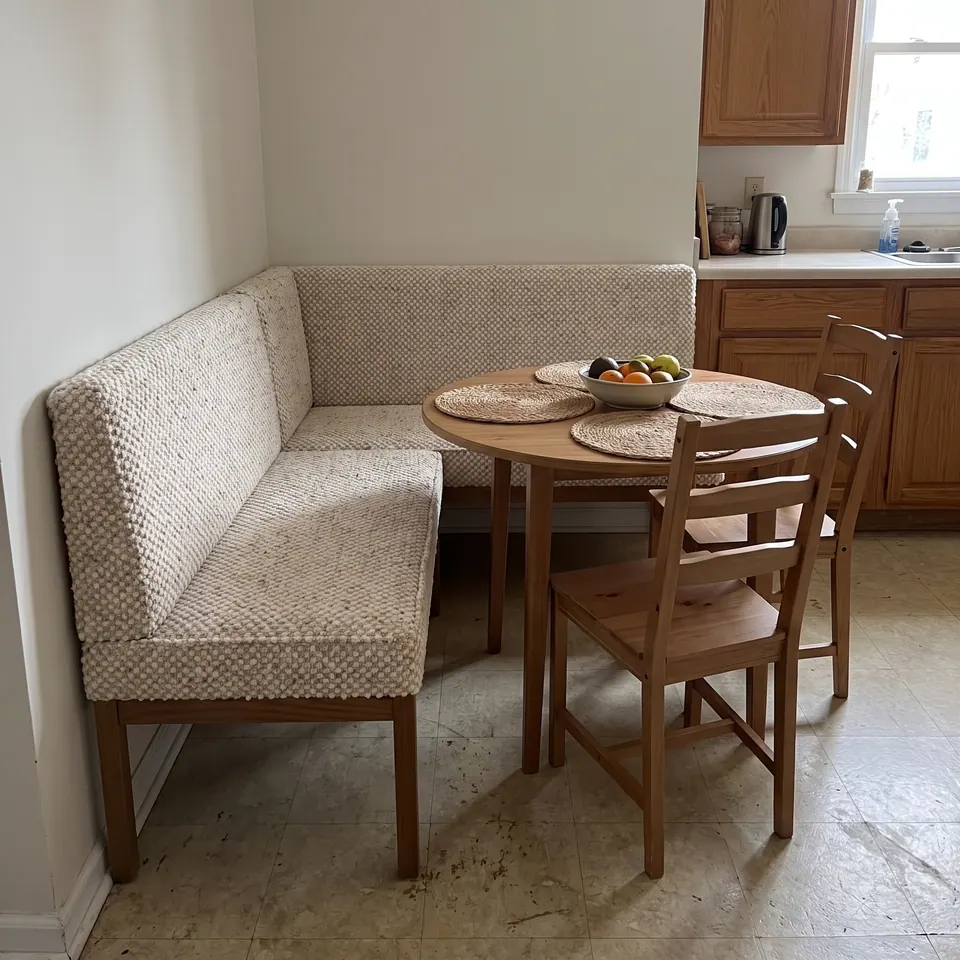
A buyer in the US ordered an L-shaped kitchen bench as two cushions meeting at the corner rather than one L piece. Smart choice. Then the order came through with 2 in (5 cm) written on one piece and 3 in (7.5 cm) on the other, and the size range paid for did not match the second cushion's size.
The workshop paused production and asked. Two fabrics were in play, and the buyer shared photos of earlier cushions to match against.
Final pieces: about 83 3/8 x 19 1/8 in (212 x 48.5 cm) and 23 5/8 x 19 in (60 x 48 cm), both 3 in (7.5 cm) thick in 32-density foam. The pause cost a message; a wrong cut would have cost a remake. Tolerance is kindness to your future self, and so is a note that agrees with the cart.
- Sizes
- 83 3/8 x 19 1/8 in (212 x 48.5 cm) and 23 5/8 x 19 in (60 x 48 cm), both 3 in (7.5 cm) thick
The lesson: In an L, order each cushion separately with matching thickness and correct size ranges.
Buyer questions: long seats, wrong numbers and the foam inside
- A common question
What's the longest single cushion you'll make? Should a really long seat be split?
The workshop's answerThe workshop recommends about 79 to 90 in (200 to 230 cm) per piece at most. Longer seats are split so they fit better, last longer and are easier to handle: a bay seat over 14 ft (4.3 m) went in two pieces, and a 16 ft (5 m) sofa seat in three. One piece can still be made on request, as an 84 x 59 1/2 in (214 x 151 cm) window seat was.
- A common question
I typed the wrong measurements. Can I still fix them?
The workshop's answerUsually, yes, if you write before production starts. The workshop confirms the corrected sizes in writing and sends a payment link for any price difference. Once, the fabric had already been cut, and the workshop still stopped and recut it to the corrected size.
- A common question
What foam goes inside, how firm is it, and is it wrapped?
The workshop's answerHigh-resilience foam at about 2.0 lb/ft³ (32 kg/m³), firm to medium-hard and long-lasting, so you do not sink in. It is wrapped in polyester fiber (Dacron) wadding before it goes into the cover, which fills the cover out and gives fuller, softer edges.
On the cutting table: the corner boot bench
| Cushion | L-shaped bench cushion in two pieces meeting at the corner |
|---|---|
| Fabric | Sage green performance weave |
| Piping | Self piping |
| Edge | Firm box profile |
| Foam | about 2.0 lb/ft³ (32 kg/m³) high-resilience foam, Dacron wrapped |
| Longest piece | About 79 to 90 in (200 to 230 cm) recommended |
| Example pieces | 83 3/8 x 19 1/8 in and 23 5/8 x 19 in, 3 in thick |
| Pillows | Three plain oatmeal linen |
| Best for | Mudrooms, entries and kitchen corners shared with dogs |

Have it made
Have this made — ask Nate’s workshop
Precision starts on the phone. Give the workshop your measurements and they will read them back to you, edge by edge. — Nate
Leave your details and the workshop will call you to confirm measurements, fabric, foam and piping. No prices, dates or payment on this page: it is a request, not an order.
On an L-shaped bench cushion, write the same thickness on both pieces; 2 in on one leg and 3 in on the other sits like a step.
Nate
Questions buyers ask next
Is one L-shaped cover or two separate cushions better for a mudroom?
Two separate pieces meeting at the corner are easier to live with in an entry. Each lifts out on its own for cleaning or shaking out grit, and each can be ordered with its own size range.
What cushion color hides dog hair on an entry bench?
A mid-tone like sage hides golden dog hair and tracked-in grit far better than white, and still looks fresh against white beadboard. Match the tone of your dog and your floor rather than the walls.
Why use fabric codes instead of color names in an order?
A color name can cover a dozen shades; a fabric code means one. Put the main fabric and piping codes in the personalization note, and ask for a swatch or a fresh close-up if you are unsure.
What foam firmness holds up on a boot bench by the door?
Firm enough that the front edge holds when someone perches to pull on boots. High-resilience foam at about 2.0 lb/ft³ (32 kg/m³), 3 in (7.5 cm) thick, keeps a square box profile in daily use.
± 1/4 in — Nate
More photographs to read
 Save
 Save
 Save
 Save
 Save
 Save