 Save
- Mustard corner cushion
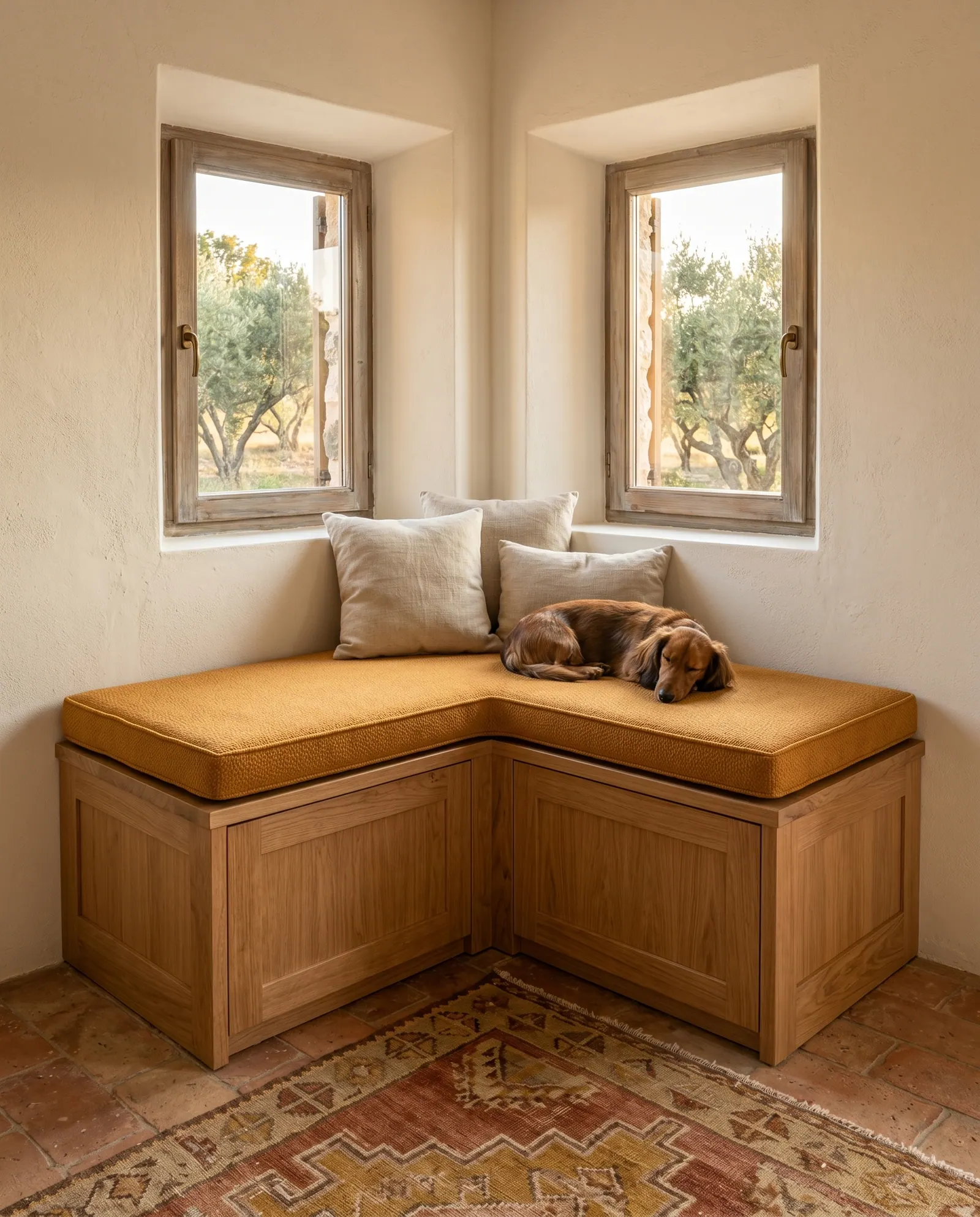
Mustard matches the dry grass and ochre tones of the olive grove outside.
- Angled corner join
The corner is cut on the diagonal so both runs meet in one clean line.
- Sleeping dachshund
The corner makes a natural pet bed with walls on two sides.
- Linen pillows
Three oatmeal pillows fill the corner where sitting upright is hardest.
- Deep-set window
Thick plaster reveals frame the olive trees like pictures.
Plate L-shaped corner cushion — mustard performance weave — self piping
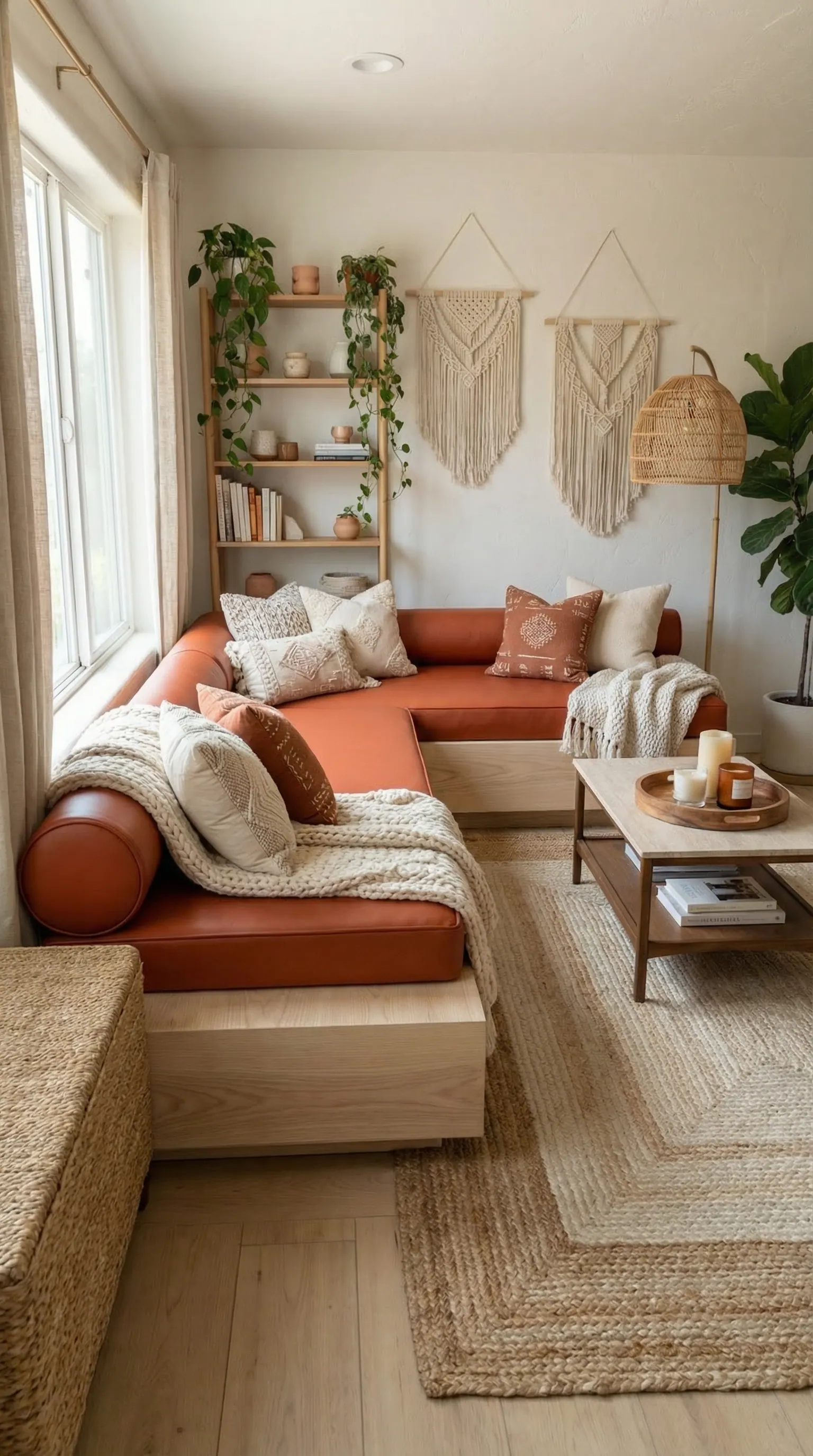
A mustard corner seat wraps two oak boxes under deep windows looking onto an olive grove.
A Reading by NateL-Shaped Corner Bench Cushions
What's inside an L-shaped bench cushion: the mustard corner seat, by the numbers
Two oak boxes, one plaster corner, one sleeping dachshund. A corner is the hardest place in a room to sit upright, so the foam does more work here than the fabric.

The quick answer
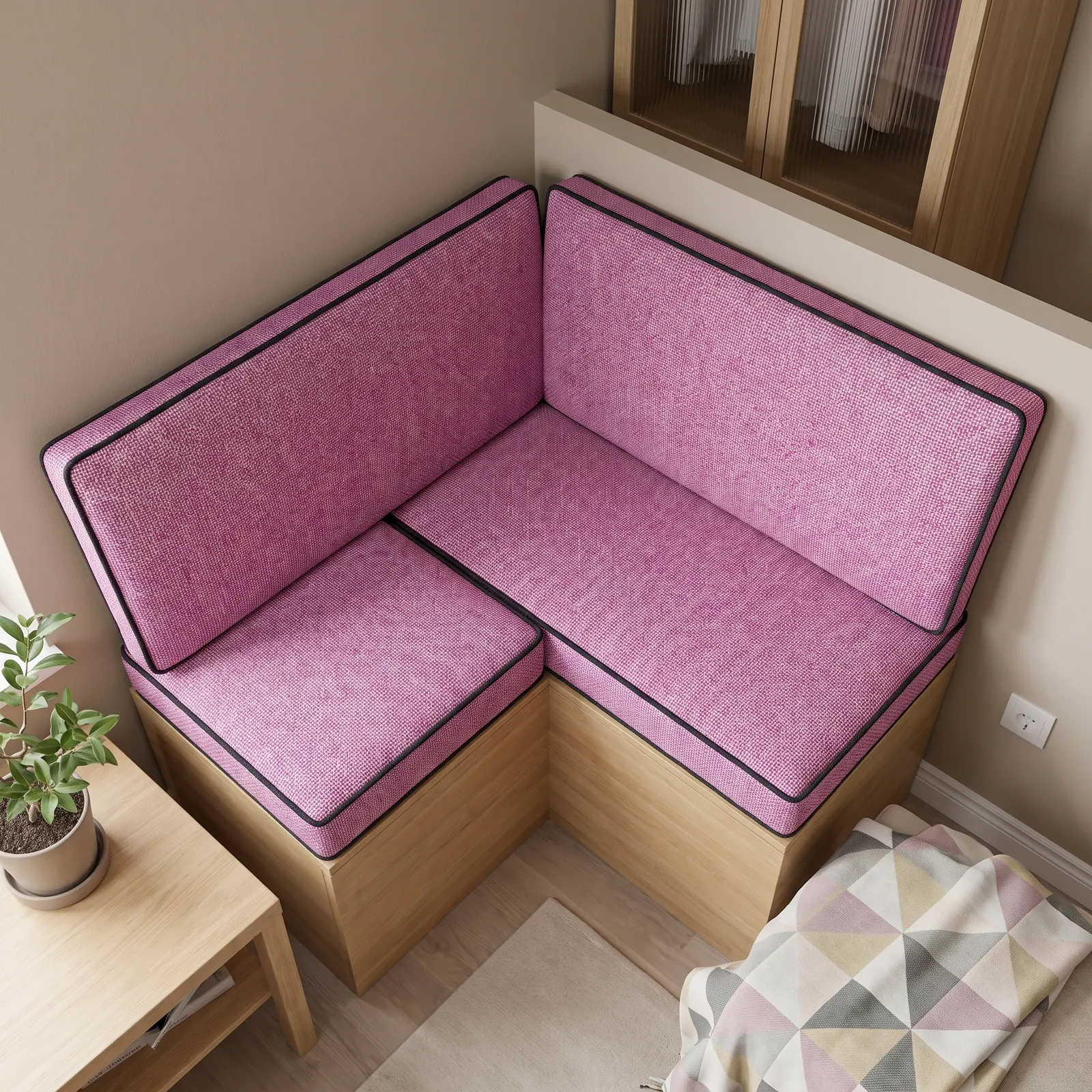
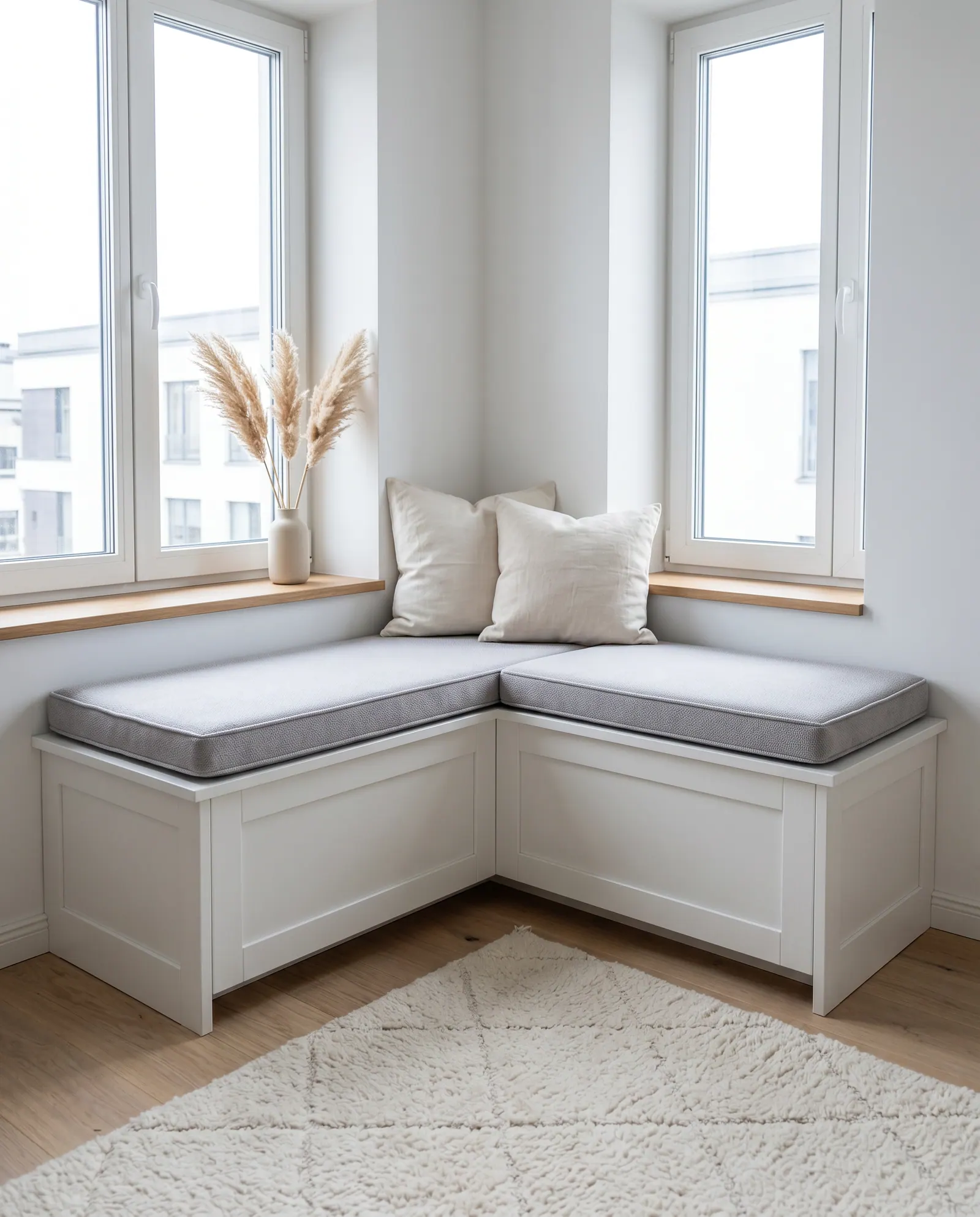
An L-shaped bench cushion is usually made as two box cushions of 32-density polyurethane foam, about 2.0 lb/ft³ (32 kg/m³), 4 in (10 cm) thick and wrapped in polyester wadding. One piece runs into the corner; the other is shortened by the seat depth. Firmness sits around 6 to 7 on a 1 to 10 scale, and softer foam is available on request.
The plate: five pins on a corner seat
Five pins, from the diagonal join to the dachshund who found the best seat first.
The numbers match the pins on the plate.
- Mustard corner cushionMustard matches the dry grass and ochre tones of the olive grove outside.
- Angled corner joinThe corner is cut on the diagonal so both runs meet in one clean line.
- Sleeping dachshundThe corner makes a natural pet bed with walls on two sides.
- Linen pillowsThree oatmeal pillows fill the corner where sitting upright is hardest.
- Deep-set windowThick plaster reveals frame the olive trees like pictures.
Reading the corner: color, join and the dog
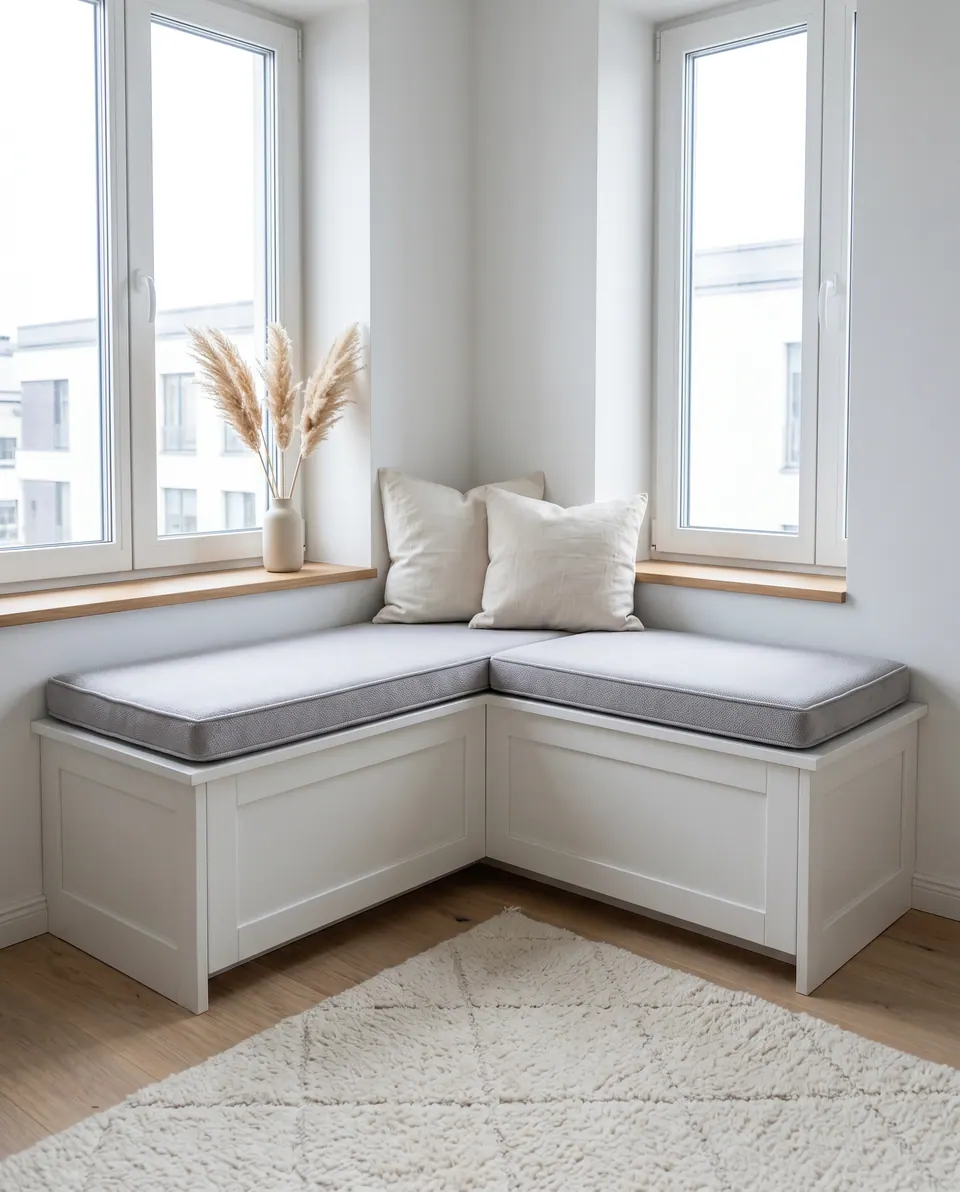
Start with the geometry, partner. Two oak storage boxes wrap a whitewashed plaster corner between two deep-set windows, and a mustard box cushion runs along both. Where the runs meet, the seam is cut on the diagonal, so the corner reads as one clean line instead of a square pocket.
That diagonal is a choice, not the default. The workshop normally builds an L-shaped bench cushion as two pieces: one runs into the corner, the other is shortened by the seat depth. Want the mitered look? Draw it. Production follows the drawing, not the photo.
The color came in through the window: dry grass, olive bark, terracotta floor tiles. The red and ochre kilim repeats it at floor level. Three oatmeal linen pillows fill the corner, where sitting upright is hardest, and the thick plaster reveals frame the olive trees like two pictures.
Then the dachshund. A corner with walls on two sides makes a natural pet bed, which is why the cover is a tightly woven performance weave. Claws will mark any fabric. A tight weave with no loops just gives them less to catch.
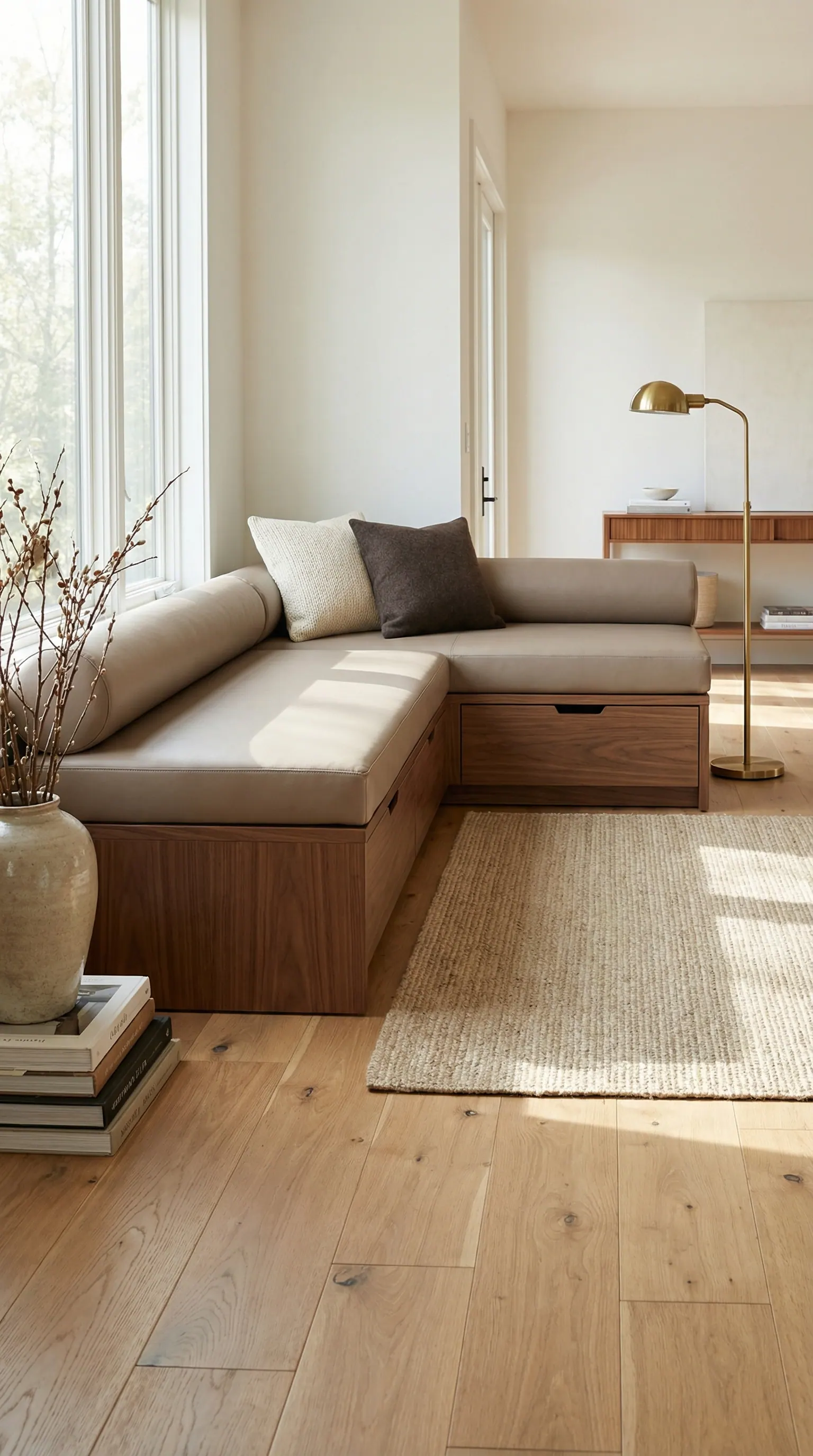
What sits under your corner: open boxes, a hinged lid or a solid plinth? If it lifts, read storage bench cushions and the hinge before you draw.
What goes inside a corner seat
| Fill | How it feels | Where it belongs |
|---|---|---|
| 32-density foam, about 2.0 lb/ft³ (32 kg/m³) | Medium-firm to firm; a flat, structured top | Seats, benches and window seats: the standard |
| 28-density foam, on request | One step softer | Sitters who find the standard too firm |
| Extra 3/4 in (2 cm) wadding layer | A softer top over the same firm core | Long sitting in a corner |
| Shredded foam in an inner cover | Softer than solid foam, not very soft | Back pillows and throw pillows |
Two mustard corners, eight parcels, one soft bolster
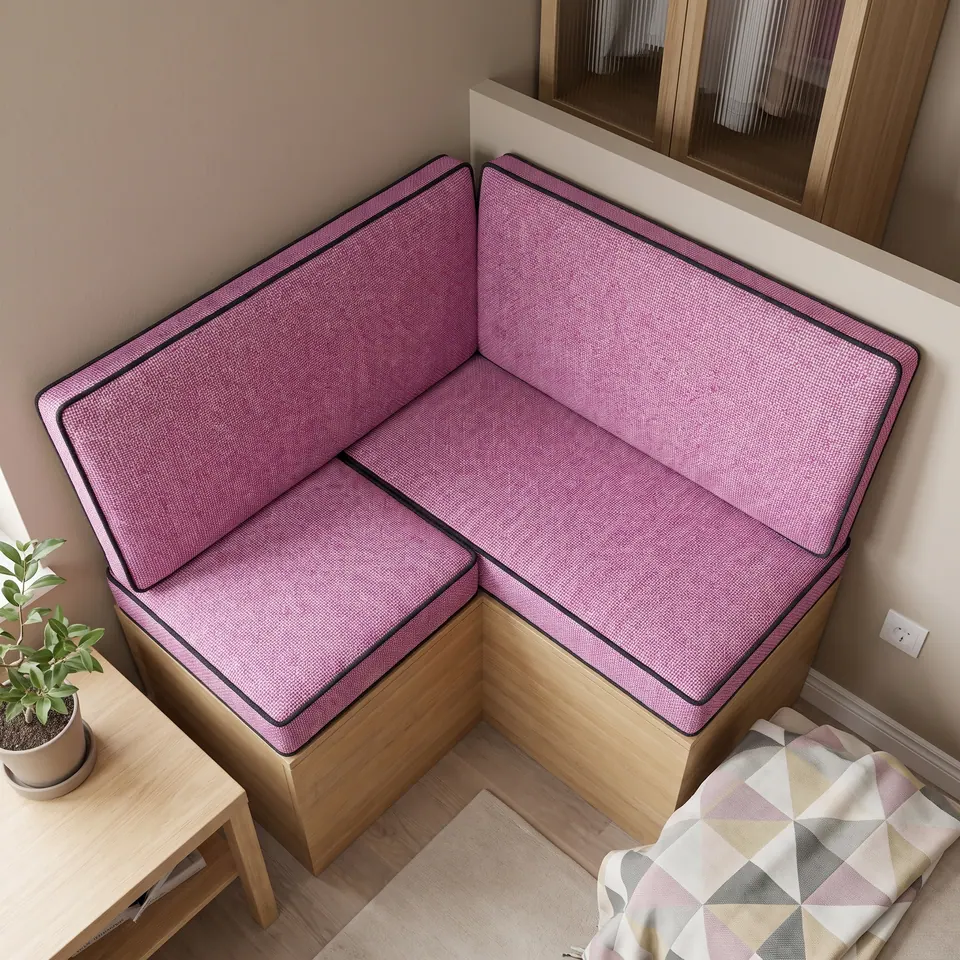
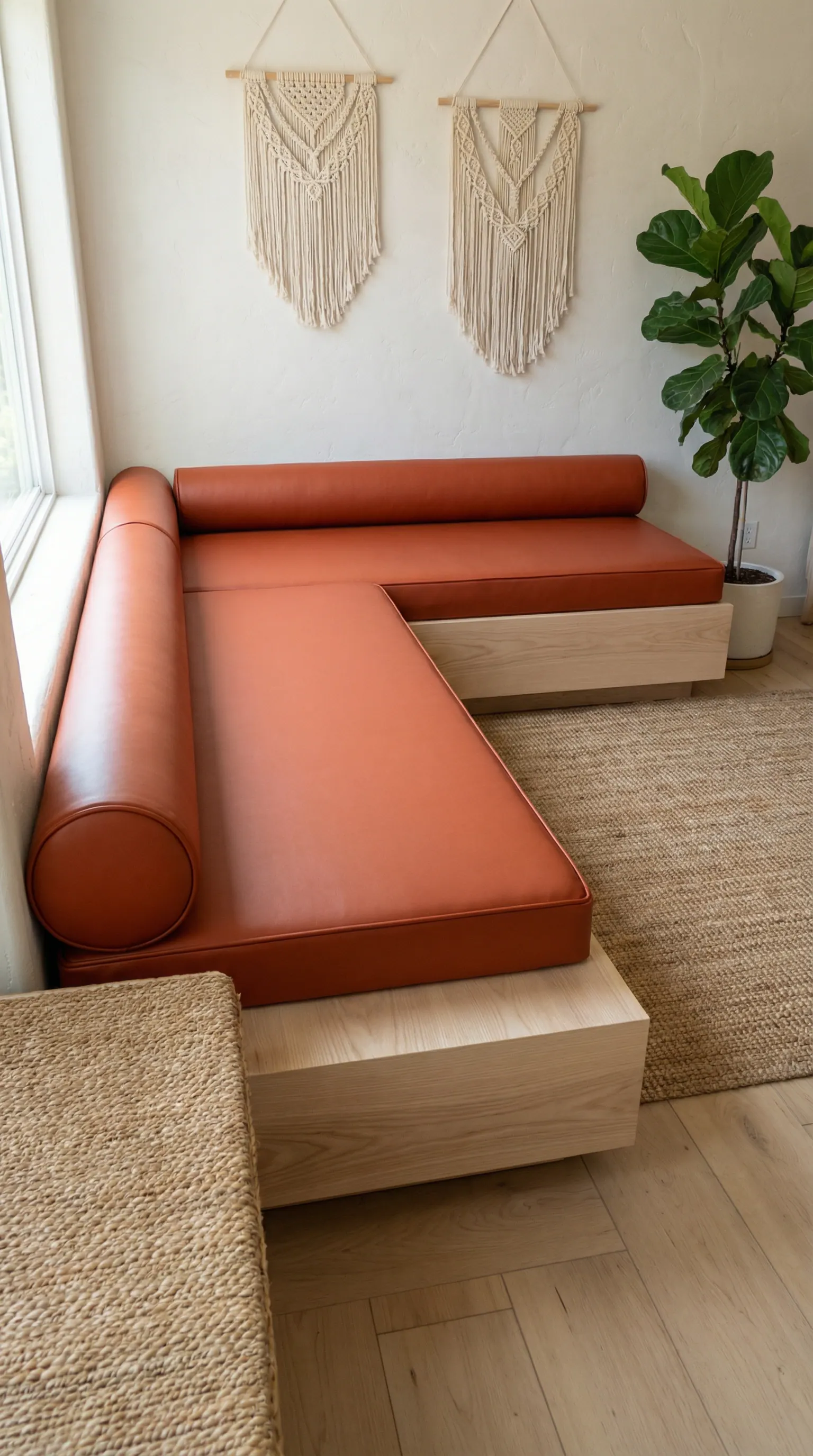
A buyer in the US owned an L-shaped teddy corner sofa and ordered a second one in mustard corduroy, so the two could join into one big sectional, or one bed larger than a king. The workshop agreed to add two straight backrests without sides, at no charge.
Eight packages were due. Seven arrived, one with a hole that exposed a mattress, and the two straight backrests were in none of them. One corner bolster was still soft in the middle after 3 days.
The workshop made and shipped the two straight backrests, and later a replacement corner backrest. The buyer now uses the pair as a conversation pit and as one giant bed, and loves both.
Tolerance note: most vacuum-packed foam recovers in 24 to 72 hours. A bolster still soft past that window is worth a photo and a message.
- Sizes
- Two L-shaped teddy corner sofas, larger than a king bed when joined
- Fabric
- Mustard corduroy
The lesson: For multi-parcel orders, list what is in each box, and check any compressed bolster that is still soft after 48 to 72 hours.
Buyer questions: stripe widths, end backrests, a size between sizes
- A common question
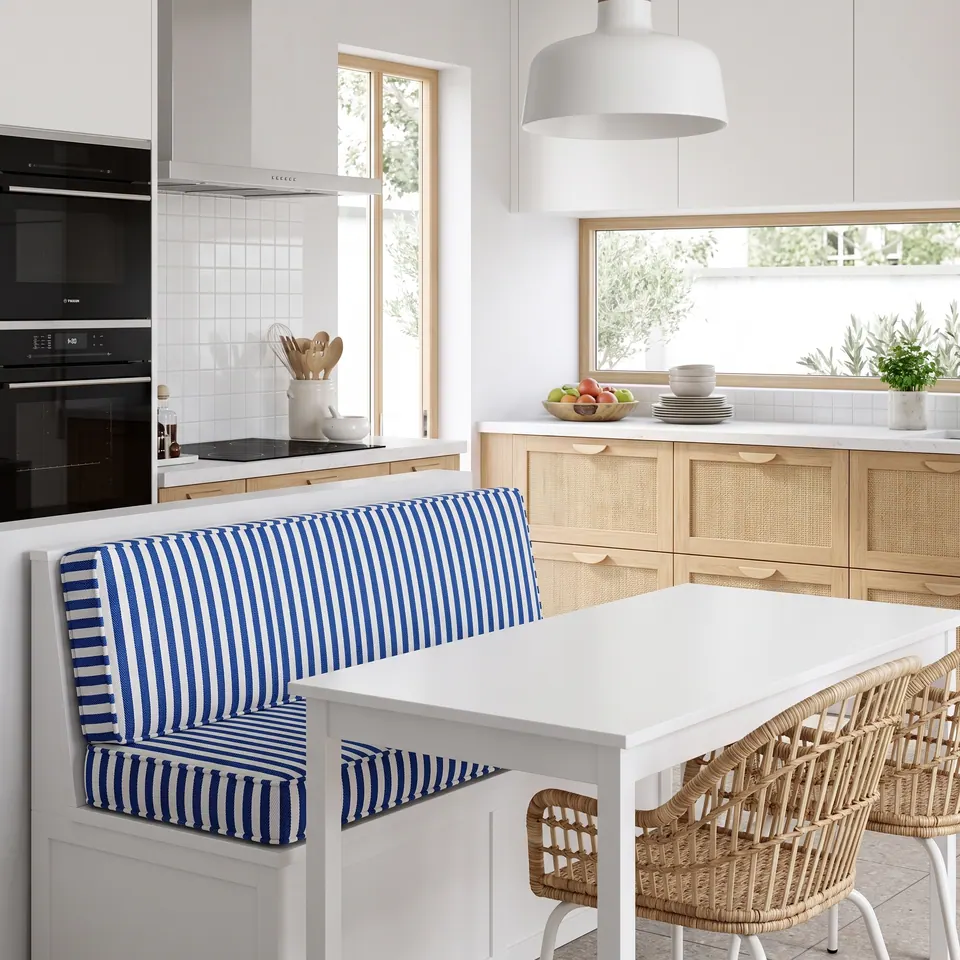
How wide are the stripes on N01 and N02?
The workshop's answerN01 has the bolder stripe, about 0.55 in (1.4 cm) wide; N02 the finer one, about 0.28 in (0.7 cm).
- A common question
Instead of one full-length backrest, can I have two short back pillows, one at each end of the bench against the walls?
The workshop's answerYes. Write in the personalization box that you want 2 backrest pillows, each 25 in wide or your chosen width, placed at the ends. Standard backrest pillows are about 15 3/4 in (40 cm) tall.
- A common question
I need a black window seat cushion about 11 3/8 x 50 3/8 in (29 x 128 cm). How do I order a size that isn't listed?
The workshop's answerChoose the nearest larger listed size, about 11 3/4 x 55 1/8 in (30 x 140 cm), and place the order with your exact measurements. The cushion is made to the size you give.
On the cutting table: the corner seat
| Piece | L-shaped corner cushion over two storage boxes |
|---|---|
| Fabric | Mustard performance weave, tightly woven |
| Piping | Self piping on the top and bottom seams |
| Corner | Default: two pieces, one shortened by the seat depth; a diagonal join if drawn |
| Thickness | 4 in (10 cm) standard; 2, 3 and 5 in (5, 7.5 and 12.5 cm) also offered |
| Foam | 32-density, about 2.0 lb/ft³ (32 kg/m³), polyester wadding wrap |
| Firmness | About 6 to 7 on a 1 to 10 scale |
| Back support | Loose pillows; standard backrests are about 15 3/4 in (40 cm) tall |
| Tolerance | About 1/2 to 1 in (1 to 2 cm), handmade |

Have it made
Have this made — ask Nate’s workshop
Send the numbers in inches: length × depth × thickness, plus any angle. The workshop checks them with you, because foam has no undo button. — Nate
Leave your details and the workshop will call you to confirm measurements, fabric, foam and piping. No prices, dates or payment on this page: it is a request, not an order.
An L-shaped bench cushion is usually two pieces: one runs into the corner, the other is shortened by the seat depth, so each keeps a straight, firm edge.
Nate
Questions buyers ask next
Is 32-density foam too firm for a corner window seat?
For most sitters, no. It is medium-firm to firm, holds a flat top and does not sag into the corner. If you prefer softer, ask for 28-density foam, or keep the firm core and add a 3/4 in (2 cm) wadding layer on top.
Should the corner of an L-shaped cushion be mitered?
It can be, if you draw the diagonal. The default is a butt joint, with one piece running into the corner and the other shortened by the seat depth, which fits better and ships more safely.
Can an L-shaped cushion be made in one piece?
It is possible but not recommended. Two pieces meeting at the corner fit better and travel more safely, and complex shapes may be split into 2 or 3 pieces so each one keeps its edges straight.
How thick should a corner bench cushion be?
4 in (10 cm) is the standard for everyday seating. 3 in (7.5 cm) gives a neater, lower profile on a window seat, and in-between sizes such as 4 1/2 in can be written into the order note.
± 1/4 in — Nate
Corner seats, pets and L-shaped benches
 Save
 Save
 Save
 Save
 Save
 Save