The Pattern Room · a measuring pattern
Specifying custom cushions for a client, line by line
Your client will remember the color. The workshop needs the numbers. A good spec sheet carries both, one row per cushion, so nothing is left to a guess made in someone else's light.
 Save
The quick answer
Specify custom cushions for a client one row per piece: location, shape, length x depth x thickness in inches, fabric code plus a backup code, piping code, edge, zipper side, ties, back height measured from the top of the seat cushion, and quantity. Approve color from swatches in the client's own light. Trade pricing is agreed per project; there is no fixed program.
The most expensive word on a client order is "same"
The most expensive word on a client order is same. Same green as the shade. Same length as the other bench. Same piping, please. Each one is a small act of trust, and each one leaves the workshop guessing.
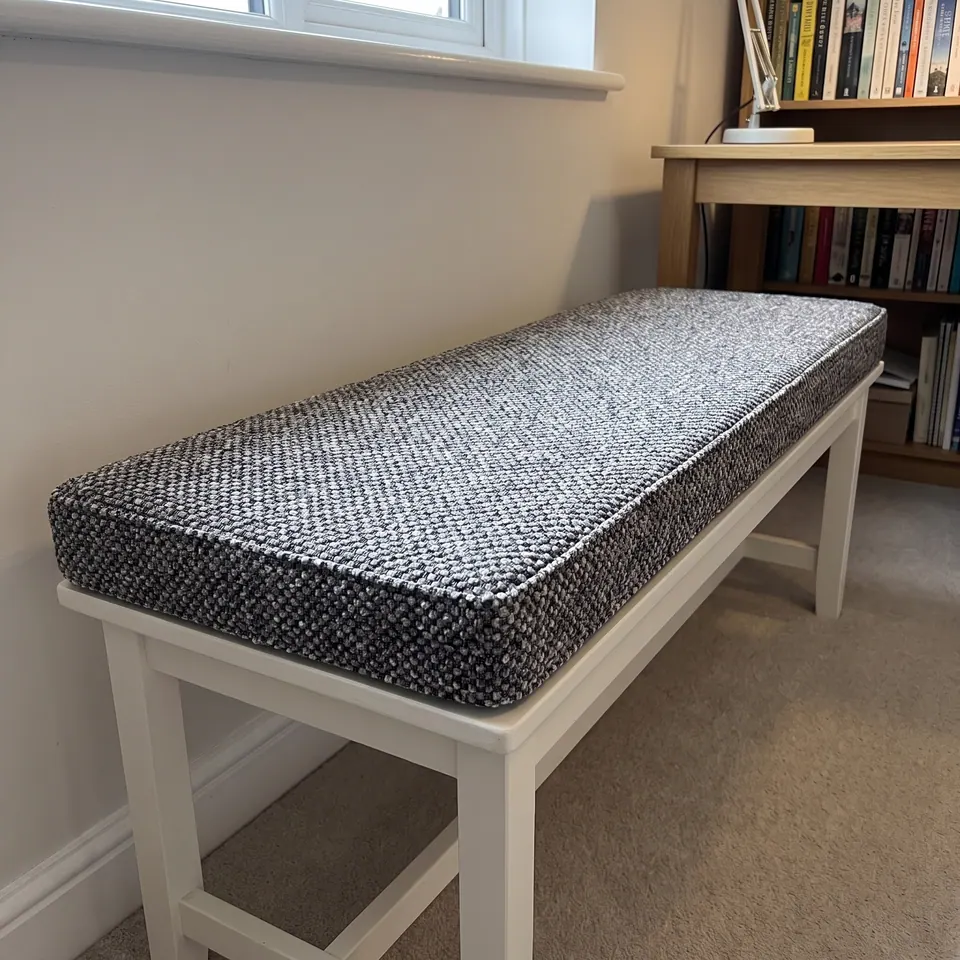
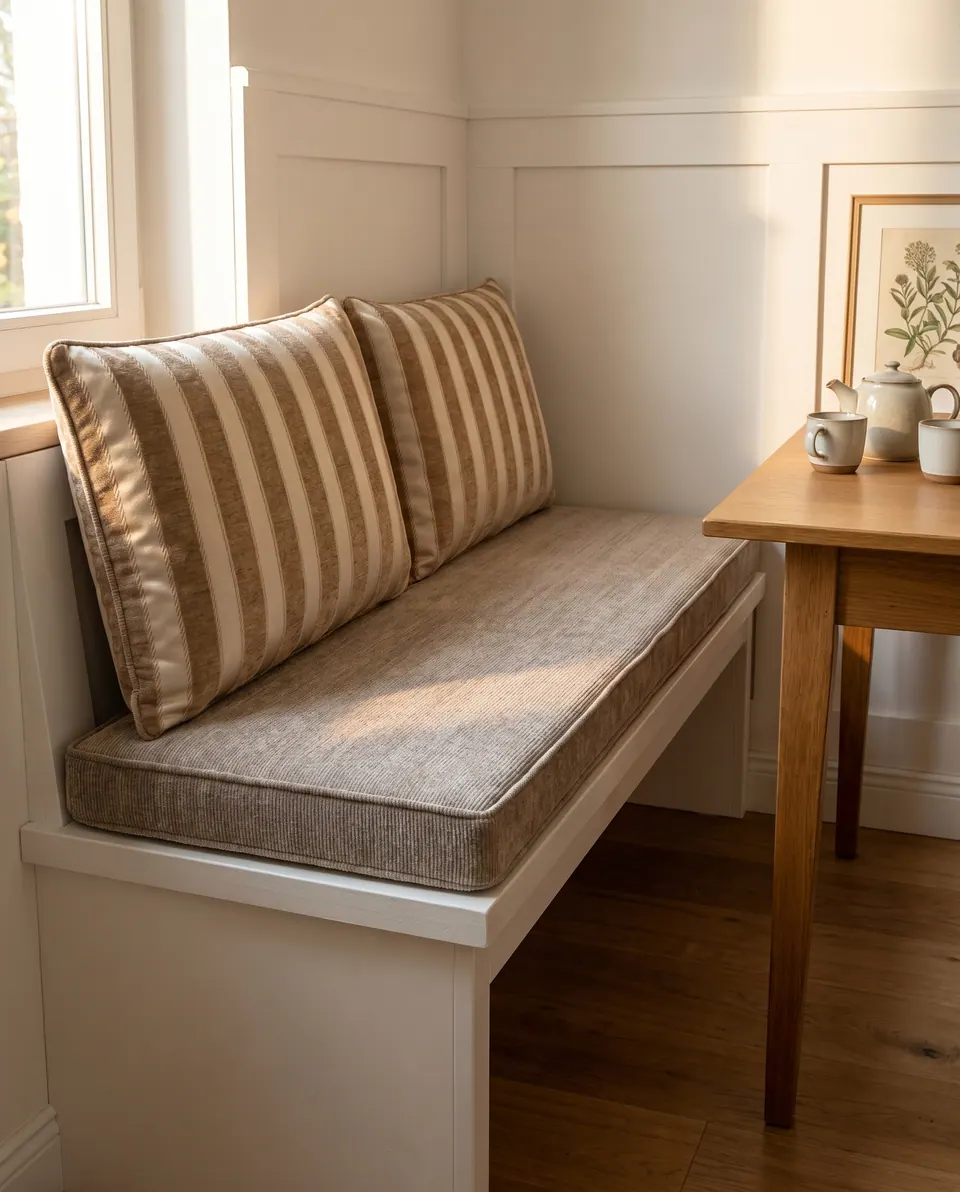
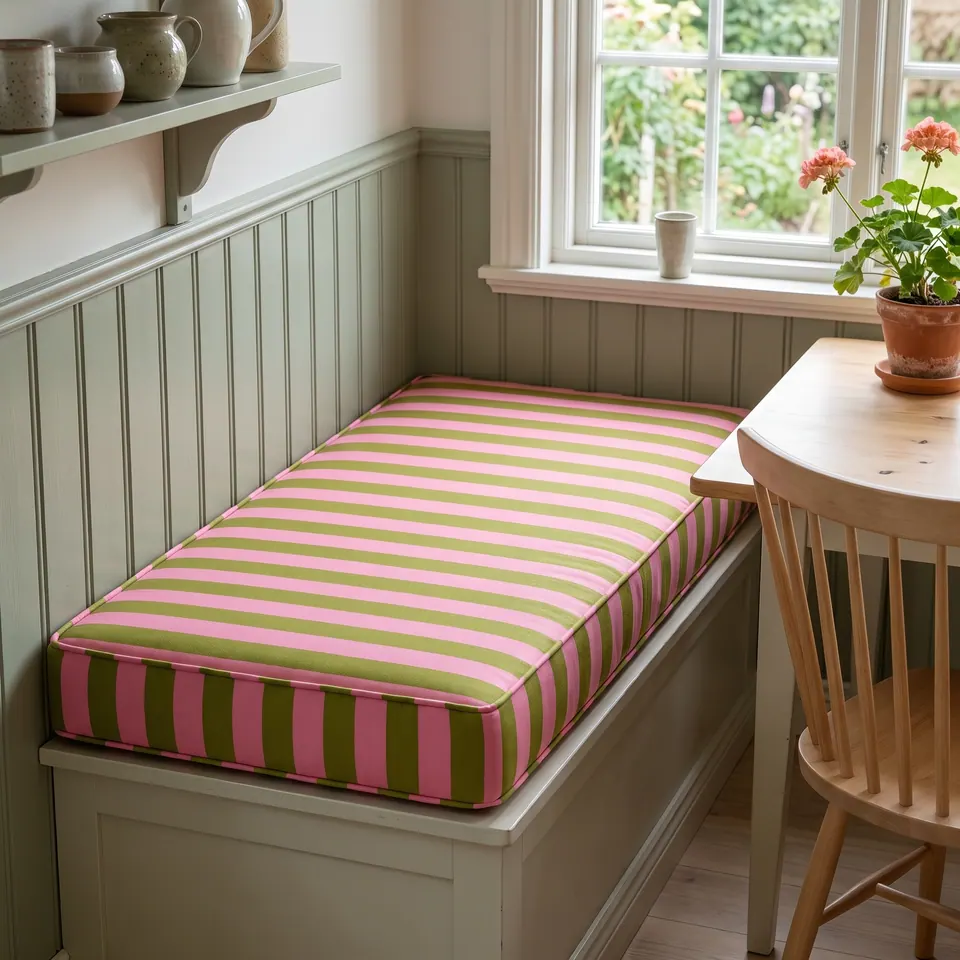
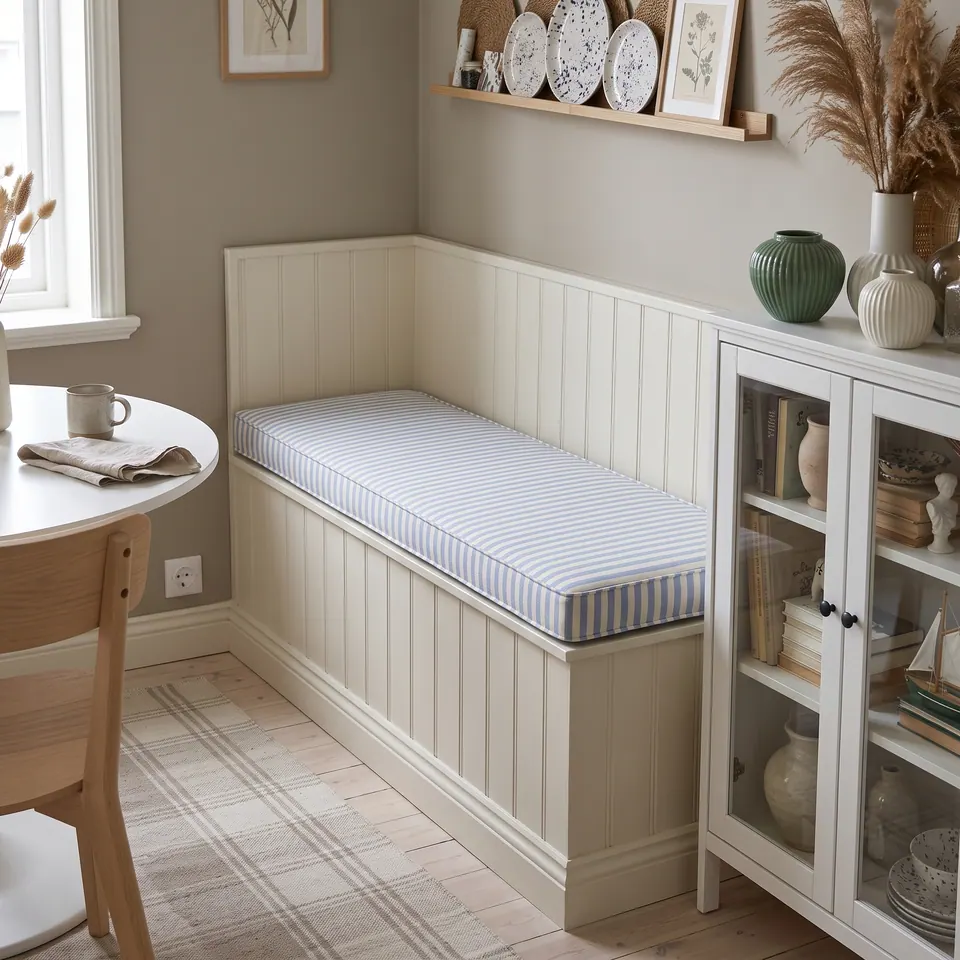
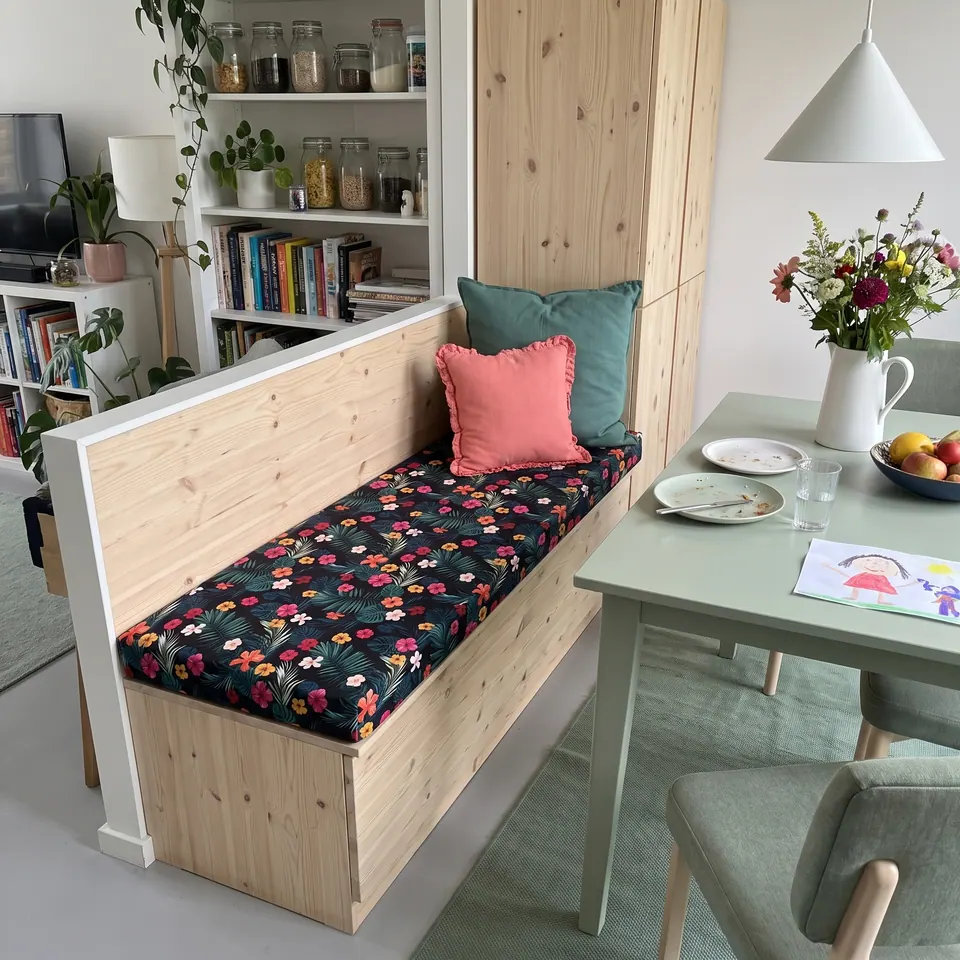
Custom cushions for interior designers go best when the order reads like a drawing. Designer and architect projects come to the workshop too: a banquette matched to a patterned Roman shade, three built-in benches across one house, a wellness studio seat tucked under a window. The ones that sailed through had a sheet with one row per cushion and no room left for same.
Here is that sheet, my friends, column by column, with the reason behind each one. Fill it in pencil, then send it with your drawings.
The spec sheet: eleven columns, one row per cushion
One row for every piece, even twins. Finished sizes, piping included, in one unit system.
| Column | What to write | Why the workshop needs it | From a real order |
|---|---|---|---|
| Location | Where the piece sits: "kitchen banquette, long run" | Keeps the pieces of a set from being swapped | An architect named a primary bench, a family room bench and a three-part living room run |
| Shape | Rectangle, or custom shape with its own drawing | Angles, notches and curves are cut from a drawing with every edge measured | A banquette with a 45-degree corner went to custom-shape ordering |
| L x D x T | Inches only (or centimeters only), as the finished size | Mixed units invite rounding errors; a built-in needs a hard maximum | 76 x 21 1/8 x 6 in (193 x 54 x 15 cm) |
| Fabric code | The exact chart number | Neighboring numbers can differ only in tone | Linen L01 |
| Backup code | A second code, in the order note | Used if the first choice has run out, so waiting on a reweave at the mill doesn't hold up the order | Taupe velvet 106 named as the fallback |
| Piping | A code, or "self", or "no piping" | Piping is included either way, and contrast can come from any chart | L01 body with L19 piping |
| Edge | Box edge, and whether it is tufted | Tufted pieces are sewn closed and can't take a zipper | Untufted, so a toddler's covers could be washed |
| Zipper side | Back edge (wall side) or underside | Keeps the zipper out of the client's sightline | Zipper at the back of a trapezoid lounge-chair seat |
| Ties / grip | Tie positions, length and color, or a non-slip base | Neither is standard; both are added only on request | Four ties set 2 in (5 cm) from each end |
| Back height | Measured from the top of the seat cushion | A back cushion stands on the seat, not on the frame | 14 to 16 in (36 to 41 cm) tall, sized around a window lever |
| Quantity | A number, on every row | In past projects, volume pricing came up once an order reached about five or six pieces | Three seating areas, with backs and cylinder pillows |
Examples come from separate real orders, not one project.
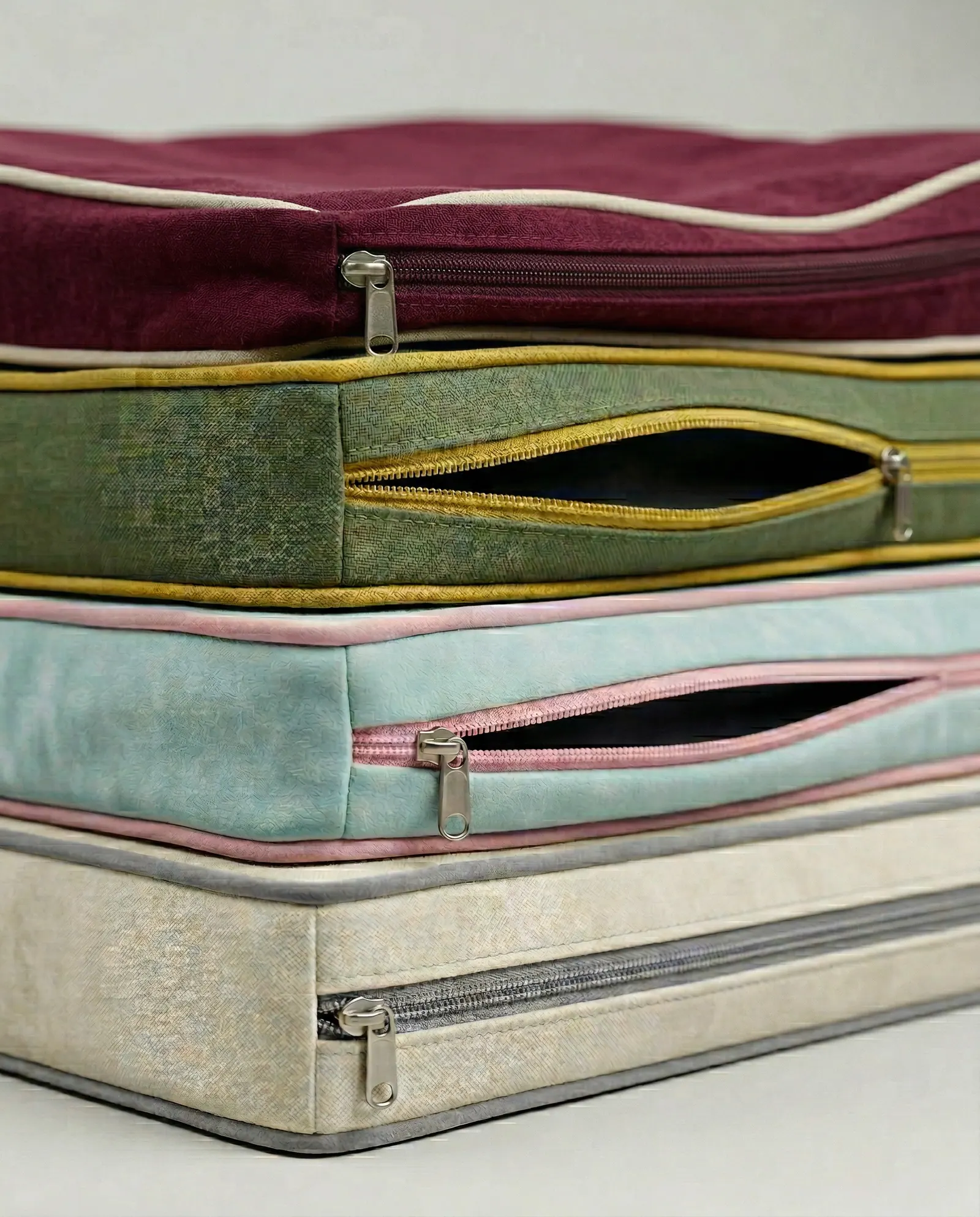
Four covers, four piping answers
- Burgundy velvet, ivory piping#5E2A2C + #EDE6D6A pale cord on deep pile draws the box shape in light
- Olive, mustard piping#7A7358 + #C9A13BWarm on warm: the edge glows instead of shouting
- Aqua velvet, blush piping#8FC4BF + #E6B8B4A soft complementary outline
- Oatmeal, gray piping#D8CFBD + #9B9B97The quiet answer for a pale room
Colors are read from the photograph, and your screen will shift them. For how to choose between matching, contrast and none, see cushion piping: matching, contrast or none.
From first swatch to a signed-off order
Get the swatches into the studio
Ask for a complete swatch set; designers have received every color for a small shipping fee. Each swatch is about 6 x 6 in (15 x 15 cm), and new production fabric looks a little cleaner and brighter than a chart swatch. The Answer on the full swatch set for designers has the details.
Approve color in the client's own light
Tape the shortlist where the cushions will sit and look at it in the morning, late in the afternoon and under the lamps. Greens and blue-grays shift the most: olive velvet 123 reads yellow-lime under cool white light and calm under warm light. Daylight never lies; your screen sometimes does. The Pattern on fabric swatches before ordering has the full routine.
 Save
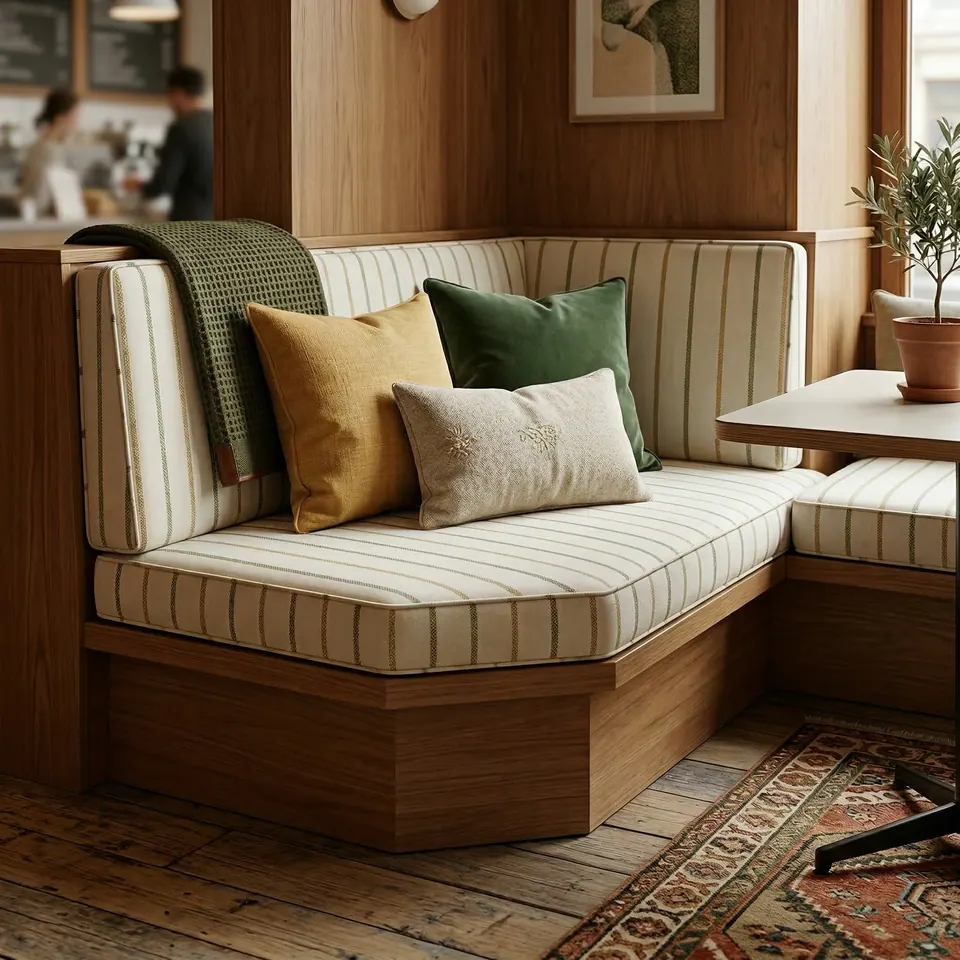
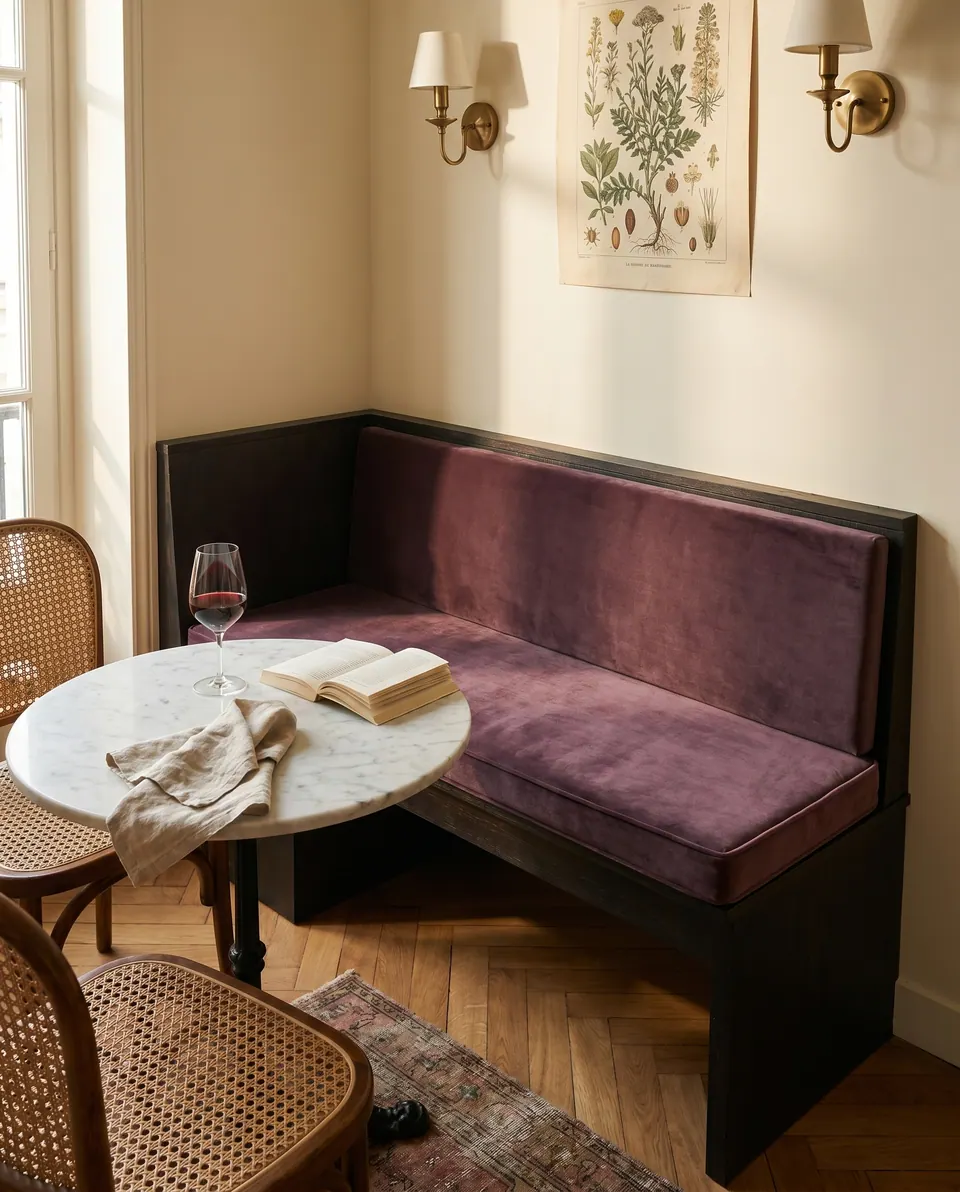
Aubergine velvet seat and back cushions turn a dark wood banquette into a bistro corner at home. Take the final site measurement
Measure again once the built-ins are finished. One designer was quoted a floor cushion at 48 x 82 in (122 x 208 cm) and ordered it at 48 x 79 1/2 in (122 x 202 cm) after the last site visit. Two and a half inches is the gap between fitted and forced.
Send the sheet with a drawing for each shape
Every dimension on the drawing, one unit system, fabric codes attached. The workshop checks that the numbers close before quoting: two 50 in (127 cm) backs don't fit a 103 in (262 cm) run, and it will tell you so.
Decide who owns each corner
On an L or U banquette, one cushion runs into the corner and the other stops against it. The short cushion is the wall run minus the depth of the cushion that owns the corner. Write that on the drawing.
Confirm every color by name or number
After checkout, restate each piece's body and piping code in one message. A design studio that ordered six cushions in four colors from unlabeled sample photos confirmed every color by name before production, which is exactly how it should go.
Agree the price, then check the photos
Trade pricing is set per project in messages, with no fixed program, and the client order can be paid through an invoice-style custom link; see the Answer on trade pricing for designers. Before the box is sealed, ask for the pre-dispatch photos and check the ties, grip base, zipper side and piping codes.

Have it made
Measured it? Have Élodie’s workshop make it
A fabric reads one way at noon and another at dusk. Mention your light, and the workshop will weigh it with you. — Élodie
Leave your details and the workshop will call you to confirm measurements, fabric, foam and piping. No prices, dates or payment on this page: it is a request, not an order.
A Roman shade, a 103-inch run and a corner nobody owned
A designer wrote to the workshop about a new L-shaped corner banquette for a client, and a patterned Roman shade that everything had to answer to. They matched the cushions to the shade from samples, not from a screen, and chose 3 in (7.5 cm) seats in fabric H-10 with Denim 30 contrast piping, plus lumbar pillows 12 in (30 cm) tall.
Before quoting, the workshop caught the first snag: two 50 in (127 cm) backs don't add up to a 103 in (262 cm) run. That was fixed on paper. The second snag slipped through. The short-side seat was ordered at 61 in (155 cm), the full wall run, when it should have been the run minus the 19 in (48 cm) depth of the long seat that owned the corner. The lumbar pillows had gone in at the wrong length, too.
The workshop remade the short seat at 40 in (102 cm) and two pillows at 30 in (76 cm), and shared the cost with the designer. Notice what was never remade: the color. The swatch had already met the shade.
- Measured
- 3 in (7.5 cm) seats; short seat remade at 40 in (102 cm), not 61 in (155 cm); lumbar pillows 30 x 12 in (76 x 30 cm)
- What it taught
- On an L-banquette, the short cushion is the wall run minus the depth of the cushion that owns the corner.
Sills, levers and a 6-inch architect's bench
Back cushions are where client drawings most often go wrong, because they depend on things that aren't cushions.
A designer planning a wellness studio wanted a 75 x 20 x 3 in (191 x 51 x 7.5 cm) bench cushion with a matching back leaning against a windowsill. The window trim began 4 in (10 cm) above the seat cushion, and a window lever sat 11 in (28 cm) above it. The workshop suggested a back 14 to 16 in (36 to 41 cm) tall and 3 to 4 in (7.5 to 10 cm) thick, so the lever stayed behind it, and loose, so the window could still open.
An architect specifying three built-in seating areas in one house chose 6 in (15 cm) cushions with backs and small cylinder pillows. The advice there is the rule for every sheet: measure the back height from the top of the seat cushion, not from the bench. For restaurant and rental work, see commercial cushion specs.
What is the one object in your client's room that the cushions must answer to?
Where client orders go sideways
- Writing "same green" instead of a code. Neighboring chart numbers can differ only in tone.
- Approving color on a monitor. Greens, blue-grays, oranges and pinks shift the most between screen and room.
- Giving the full wall run for both legs of an L.
- Measuring a back cushion from the bench frame instead of the top of the seat cushion.
- Mixing inches and centimeters on one drawing.
- Asking for side-to-side stripes on a long cushion. The roll is about 55 in (140 cm) wide, so a 57 1/2 in (146 cm) bench gets stripes running front to back unless you accept a seam.
- Promising a client both a tufted look and zip-off covers. Tufted pieces have no zipper.
A spec sheet is a promise in columns: one row per cushion, one code per color, and a backup for the day the mill runs out.
Élodie
Buyer questions: designers and architects, asking first
- A common question
I'm an interior designer. Is there a trade discount?
The workshop's answerThere's no formal trade program with a fixed rate. Designer pricing is agreed per project, usually in direct messages, and in past projects volume pricing came up at about five or six pieces. You can have samples or a full swatch set sent to your studio first, then pay for the client order through an invoice-style custom link.
- A common question
Can you make banquette or booth cushions for a client project?
The workshop's answerYes. Send a drawing with every dimension, all in inches or all in centimeters, never mixed, plus your fabric codes. The drawing is checked for inconsistencies, such as two 50 in (127 cm) cushions on a 103 in (262 cm) run, before quoting. U-shaped and long booths are made as separate pads, for example two 24 x 19 in (61 x 48 cm) ends and one 14 ft x 19 in (427 x 48 cm) run, and matching lumbar pillows can be made 12 in (30 cm) tall in custom lengths. The quote then gives production and delivery times for the whole set.
- A common question
My client wants no piping. Is that cheaper?
The workshop's answerAny cushion can be made without piping, but it costs the same, because piping is already included. Write "no piping" next to the fabric code and the edges are sewn plain and flat. You can mix within a set, piped seats with plain backs, and light linens look especially clean without it. For a subtle edge rather than none, choose self welt: piping in the cushion's own fabric.
- A common question
Can you match a paint color, a CMYK value or another maker's fabric exactly?
The workshop's answerNot exactly. The workshop doesn't carry other makers' fabrics and can't guarantee a match to a printed or digital color reference. It names its closest chart codes and sends close-up photos, and for large pieces, or when matching existing furniture, it strongly recommends ordering samples to compare side by side at home.
- A common question
Which code is olive green, and will it look too bright in the room?
The workshop's answerOlive is velvet 123, a muted, earthy olive that sits well against warm wood; linen L24 is the non-velvet alternative. 123 shifts with the light: yellow-lime under cool white light, much calmer under warm light. Greens are the hardest colors to judge on a screen, so check close-ups in the room's own lighting or order samples first.
Trade questions, answered briefly
Can the workshop send a full swatch set to a design studio?
Yes. Designers have been sent a complete set of every color for a small shipping fee, from one sample purchase with the ranges named in a message. Swatches are about 6 x 6 in (15 x 15 cm), enough to judge color and hand, not yardage for a pillow.
What happens if the client's fabric runs out?
If you named a backup code in the order note, the workshop uses it. Otherwise you can wait while the mill weaves the fabric again, which adds time to the order, or switch codes and start right away. Discontinued fabrics leave the chart, and the nearest in-stock match is suggested.
How long does a client banquette order take?
Ask for production and delivery times in writing with the quote; banquettes and booth sets vary with size and shape. Curved or complex shapes take longer to make, because they go to the most experienced craftsman. Put the client's deadline in the quote request so it is confirmed before you pay.
Can leather piping be specified?
Yes, the welt can be leather instead of fabric. In past quotes three stock leather colors came at no extra charge; a particular shade, such as a specific cognac, can be sourced, and the quote shows the difference. Name the leather color along with the measurements and fabric codes.