 Save
A Reading by MaggieBanquette & Kitchen Nook Cushions
A powder-blue striped banquette cushion in a greige dining nook, and how to order one right the first time
A soft stripe, a plate ledge and a nook that looks planned because it was. Here's the ordering checklist behind it.
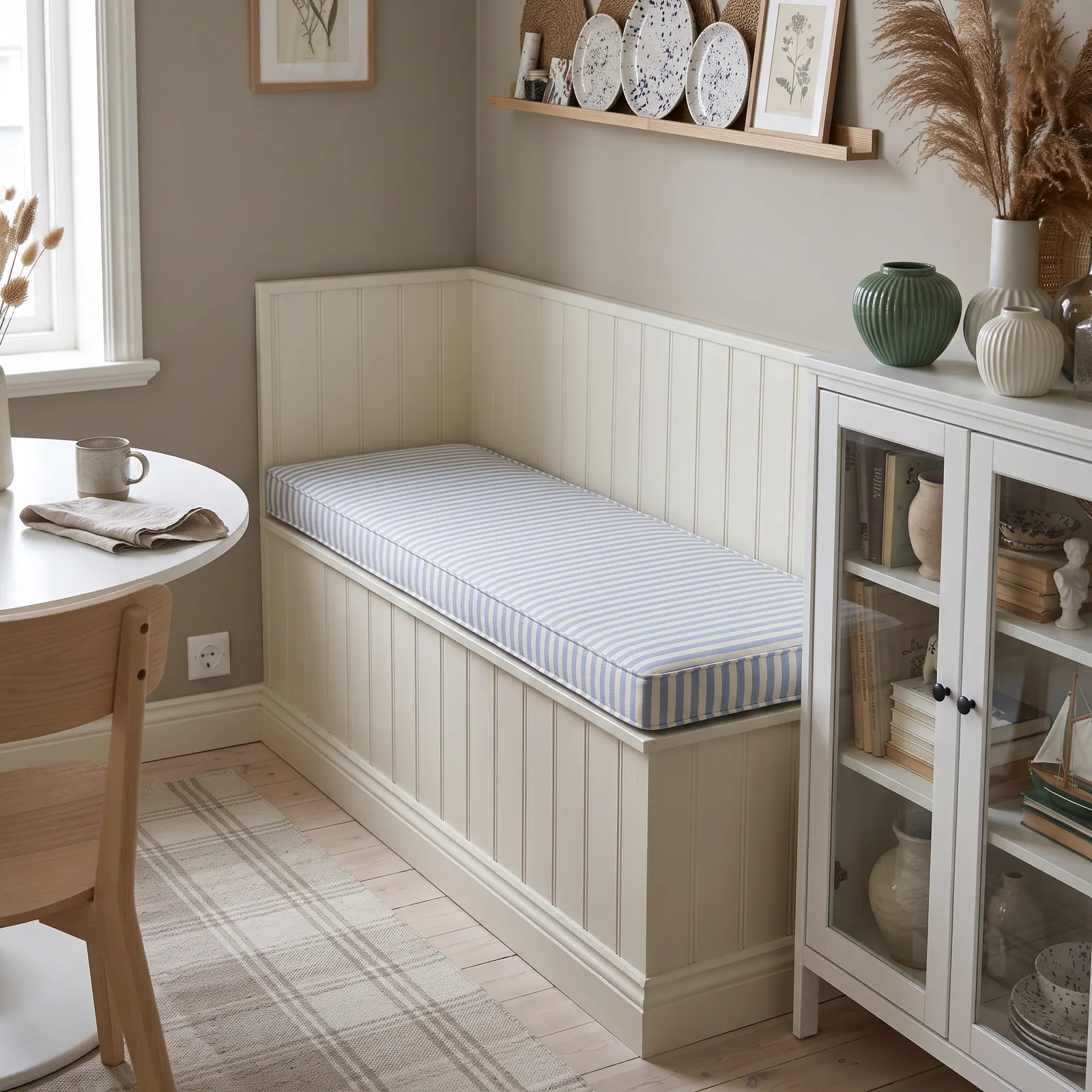
A soft blue stripe on cream beadboard, with speckled plates above and a glass cabinet beside, makes a gentle dining nook.

The quick answer
To order a banquette cushion right the first time, send one message with the bench's true measurements, a drawing for any L or notch, the thickness, and two fabric codes: one for the body, one for the piping. Order swatches first if you're matching something, and read the workshop's summary before the fabric is cut.
Why the stripes run toward you
Every surface in this nook is soft: greige walls, cream beadboard, a pale floor, a checked flatweave rug. So the banquette cushion only needs a little color, and a powder-blue stripe gives exactly that much.
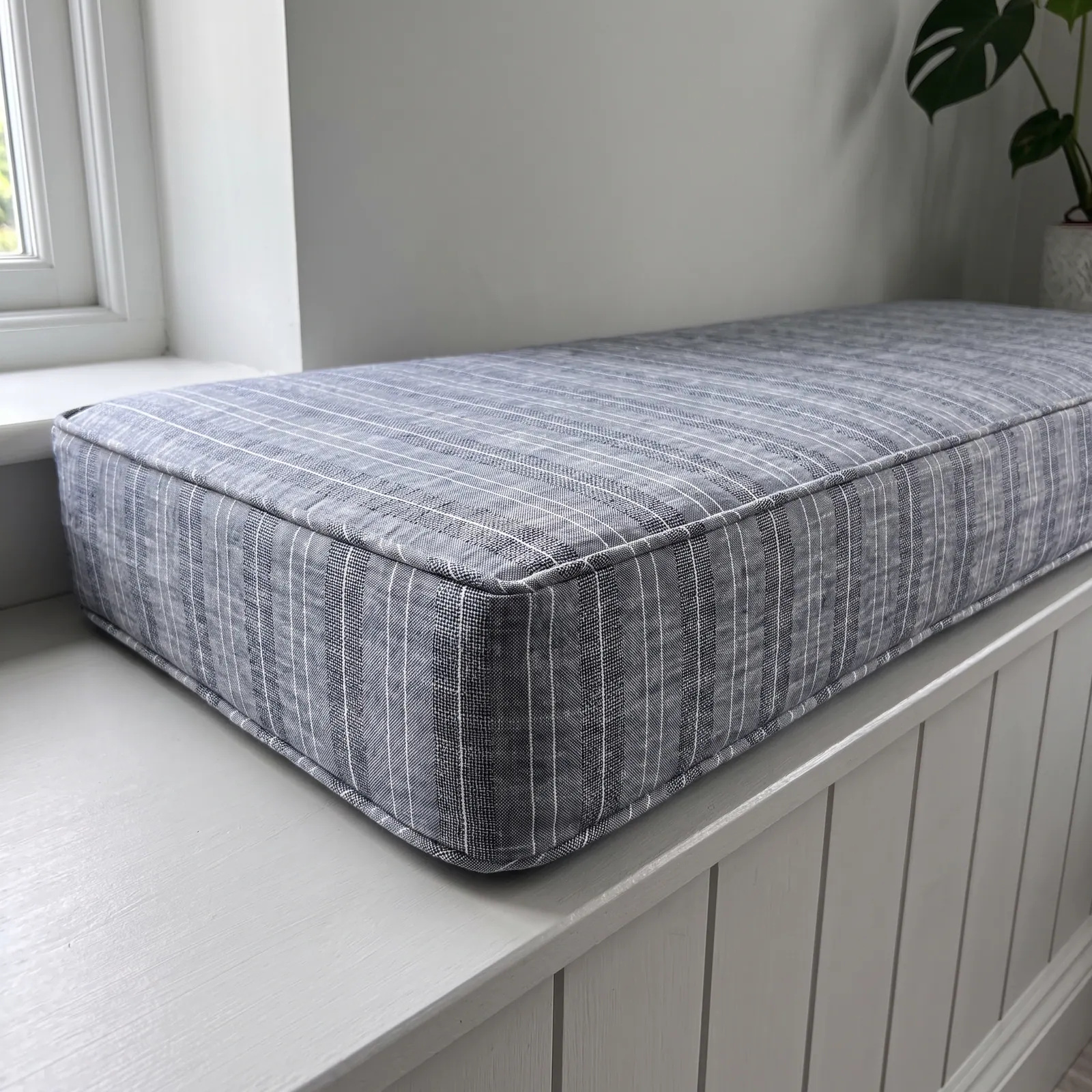
Notice the stripe direction. The stripes run from the wall to the front edge, the same way as the beadboard below, so bench and cushion read as one built piece. That's also the default on a long striped cushion, dear. The fabric roll is about 55 in (140 cm) wide, so stripes run front to back and a very long piece needs a seam. Ask about it before you order, not after.
The self-piped front welt follows the top of the beadboard, so the cushion sits flush. Up on the ledge, blue-flecked plates repeat the stripe at a smaller scale, and a dark green ribbed vase adds the one deeper tone that keeps the room from washing out. Pampas grass gives it height. A mug and a linen napkin on the round table say what the bench is for: an ordinary Tuesday breakfast. What would your nook's one color be?
Pinned by Maggie
Five details that make a small nook look planned.
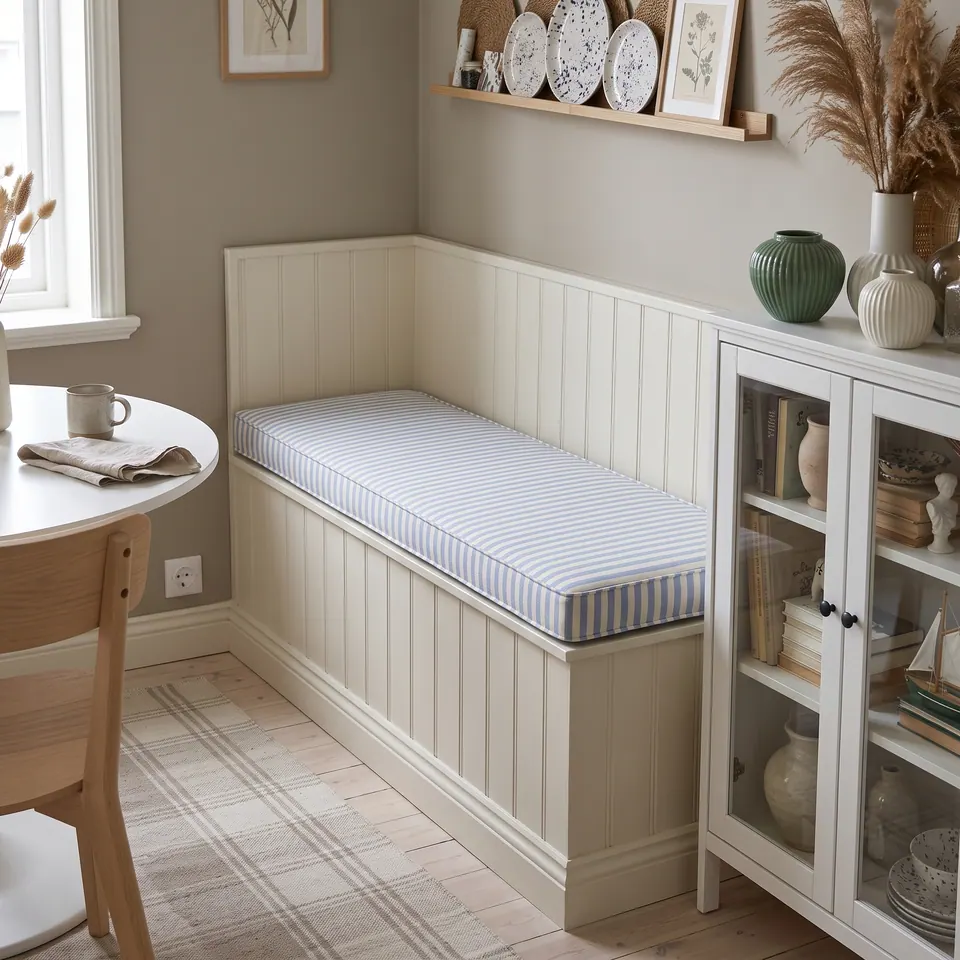
- Powder-blue ticking
Just enough color to mark the seat in a room of soft neutrals.
- Self-piped front edge
The welt follows the beadboard top so the cushion sits flush.
- Speckled plates
Blue-flecked plates above repeat the cushion color at a small scale.
- Green ribbed vase
The one deeper color in the nook keeps it from feeling washed out.
- Round table setting
A mug and napkin show the bench in use for everyday meals.
- Powder-blue tickingJust enough color to mark the seat in a room of soft neutrals.
- Self-piped front edgeThe welt follows the beadboard top so the cushion sits flush.
- Speckled platesBlue-flecked plates above repeat the cushion color at a small scale.
- Green ribbed vaseThe one deeper color in the nook keeps it from feeling washed out.
- Round table settingA mug and napkin show the bench in use for everyday meals.
One order message, six lines
True size
Write the bench's real measurements, nothing subtracted. The workshop adds the fit allowance itself.
Shape
Anything that isn't a rectangle gets a drawing with every edge written on it: an L, a notch, a clipped corner. Add a photo of the nook, or sketch it in the bench cushion builder.
Thickness
Name it in inches. 2, 3, 4 and 5 in (5 to 12.5 cm) are the standard options.
Two codes
The main fabric code and the piping code, written separately. Neighboring numbers on a chart can differ only in tone.
Swatches first
If you're matching a wall or an old sofa, order samples of a few codes, piping candidates included, and judge them in your own light.
Read the summary
Before cutting, the workshop confirms codes, sizes with units, and thickness. Changes are free until the fabric is cut.
Mauve and lilac, one number apart
A buyer in the US had a small L banquette: one leg 18 x 70 in (46 x 178 cm), the other 18 x 42 in (46 x 107 cm), and they wanted it in one piece. Instead of describing it, they sent a photo and a sheet of re-measured dimensions, chose a slim 2 in (5 cm) thickness, and named two codes: velvet 117, a dusty mauve, for the body, and 116, a light blush lilac, for the piping.
Two neighbors on the same chart: that's the tone-on-tone trick, and it only works when both numbers are written down. The workshop quoted it through a custom link, and nobody had to guess. On a smaller L, one piece can work with a clear measured sketch, though two pieces meeting at the corner stay the usual advice for banquette cushions.
- Sizes
- 18 x 70 in (46 x 178 cm) + 18 x 42 in (46 x 107 cm), 2 in thick
The lesson: Smaller L-banquettes can be one piece if you send a clear measured sketch.
Backrests, tufts and notched corners
- A common question
Can I order just the L-shaped backrests for my floor sofa or daybed?
The workshop's answerYes. Choose 'L-shaped backrest' in the options. Each one covers a 39 x 39 in (99 x 99 cm) corner, so two cover a 39 x 79 in (99 x 200 cm) sofa. One buyer used them on a 75 x 38 in daybed from another maker.
- A common question
Can I have tufted bench cushions with zippers, so I can wash the covers?
The workshop's answerNot both at once. Tufted, French-style cushions can't have zippers, so you choose tufted with no zipper, or a plain boxed cushion with a zipper and a removable cover. Linen and linen-cotton are both available from the color chart.
- A common question
My nook has a notch cut out of each corner. Can the cushion follow it?
The workshop's answerYes, corners can be customized. Send a drawing with the sizes; the workshop redraws it in centimeters as a standard template and asks you to confirm it before production.
Write two codes on a cushion order, one for the main fabric and one for the piping, because neighboring chart numbers can differ only in tone.
Maggie
What goes in the order note
| Cushion | Banquette box cushion on a corner bench |
|---|---|
| Fabric | Powder blue and ivory stripe, linen family |
| Stripe direction | Wall to front edge, the default on long pieces |
| Piping | Self piping along the front edge |
| Edge | Box edge, flush with the beadboard top |
| Thickness | 2, 3, 4 or 5 in (5 to 12.5 cm) standard |
| Codes to write | Main fabric and piping, separately |
| Best for | Small dining nooks and breakfast corners |

Have it made
Have this made — ask Maggie’s workshop
Have the tape measure handy when they call. Old cushions shrink and sag; the seat underneath does not. — Maggie
Leave your details and the workshop will call you to confirm measurements, fabric, foam and piping. No prices, dates or payment on this page: it is a request, not an order.
Questions buyers ask next
How many fabric samples should I order before a banquette cushion?
A handful: your top choices for the main fabric plus one or two piping candidates, written in the order note. Samples are roughly palm-sized, about 4 to 6 in (10 to 15 cm) square; ask how long they're taking when you order. See swatches before ordering.
On a long striped banquette cushion, do the stripes run lengthwise or front to back?
Front to back, across the cushion, by default, because the fabric roll is about 55 in (140 cm) wide. A long striped piece needs a seam, and stripes are pattern-matched on one face only. The stripe direction Pattern shows it.
Can I change the fabric after I've ordered?
Yes, until production starts. Changes to fabric, color, piping or size are free until the fabric is cut. After cutting, a change means a remake at production cost, so read the workshop's confirmation carefully.
Stitch straight — Maggie
More dining nooks and corner benches
 Save
 Save
 Save
 Save
 Save
 Save