A Reading by MaggieBanquette & Kitchen Nook Cushions
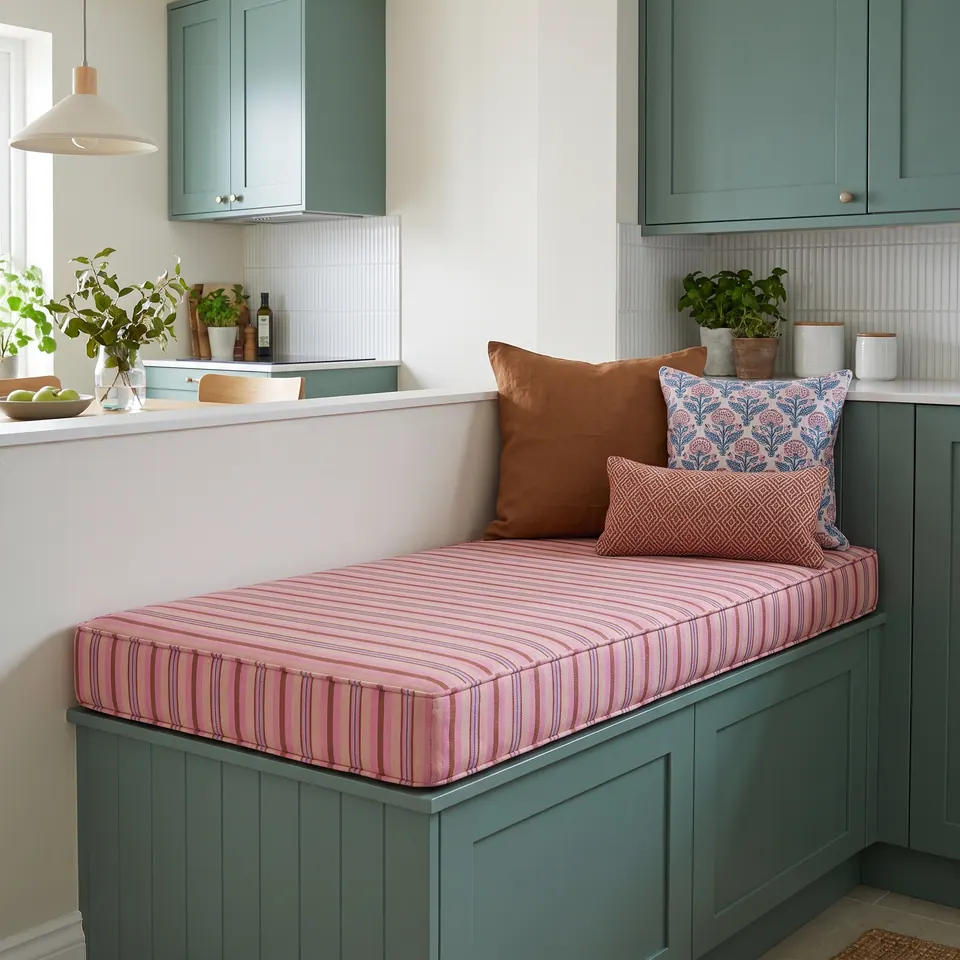
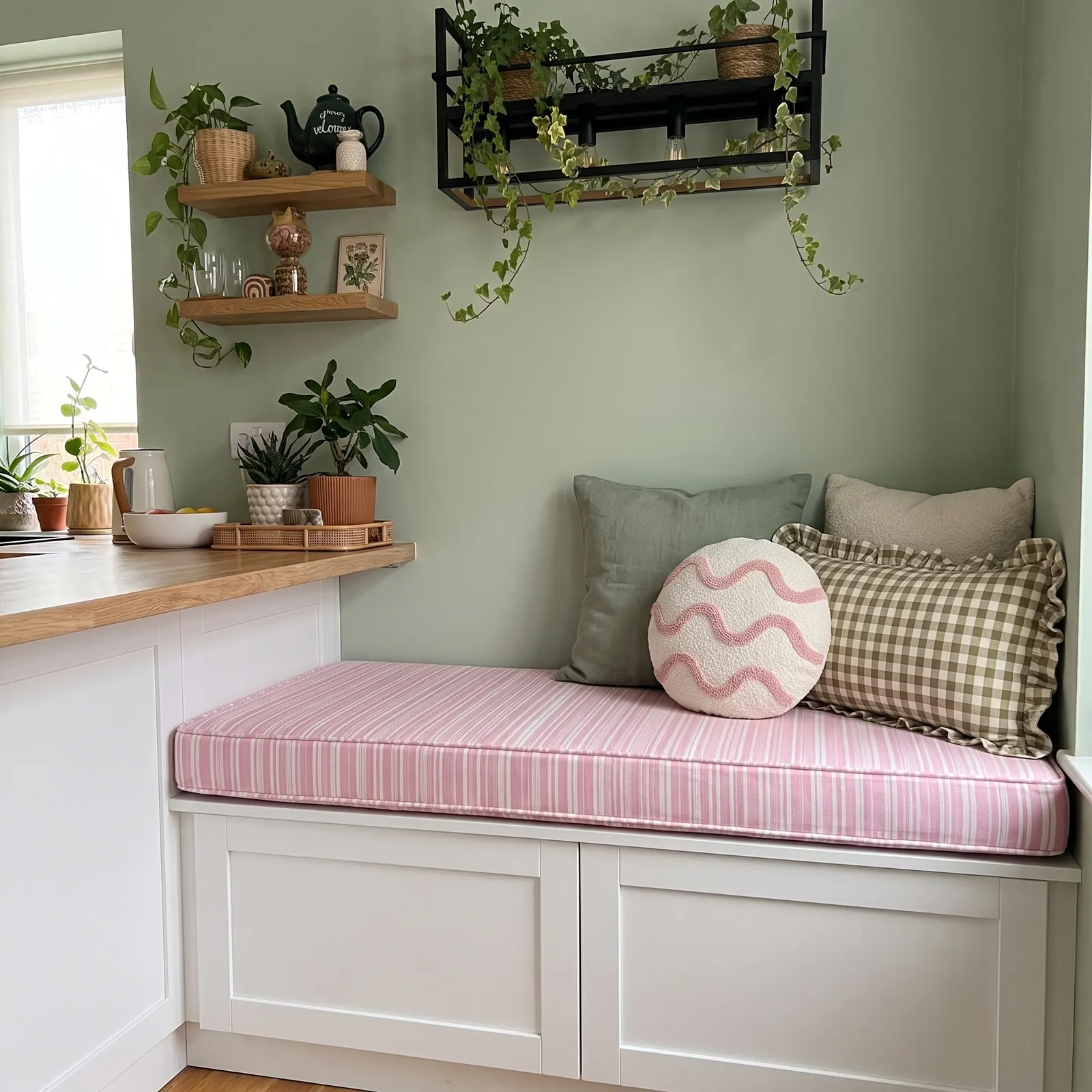
Candy-pink stripes on a kitchen corner banquette cushion, from Maggie's notebook
A small breakfast perch against sage walls, read line by line: why one loud stripe makes a narrow corner feel wider, and what to write down before you order.

 Save
The quick answer
A striped banquette cushion makes a small kitchen nook feel generous when it is the only bright thing in the corner. Here a candy-pink and white stripe sits on a white shaker bench, with sage, oak and white around it. For a corner banquette, send both run lengths and the seat depth; half and quarter inches are fine.
Notebook, page one: one loud stripe in a quiet corner
The smallest seat in a kitchen should be the brightest thing in it. I wrote that on the first page of my notebook years ago, after I covered a breakfast nook in beige and watched it vanish into the cabinets.
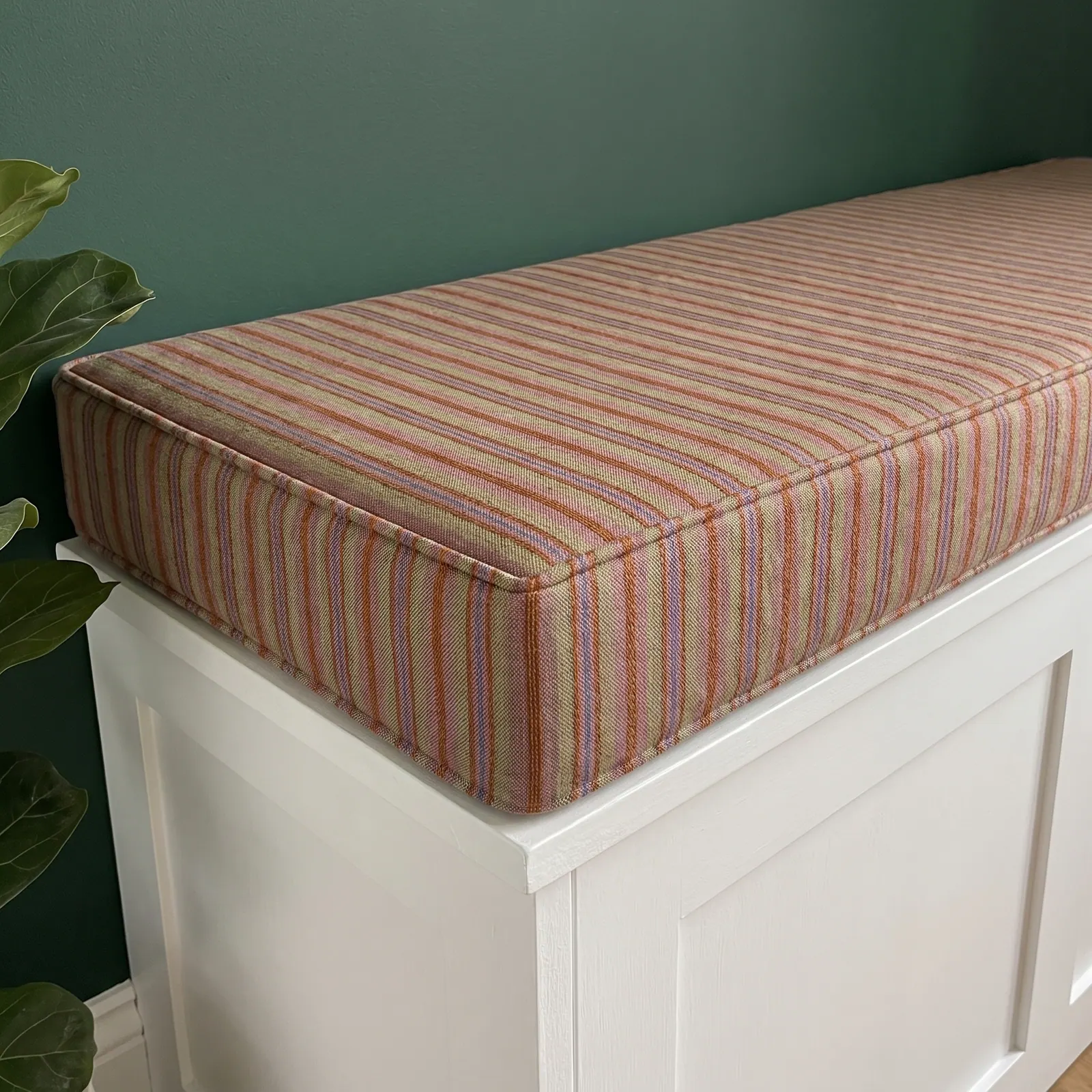
This corner gets it right. The banquette cushion is a candy-pink and white stripe in a linen weave, box-edged, with self piping cut from the same stripe. No contrast welt fences it in, so the stripes run clean to the edge and the seat reads longer than it is. On a narrow bench, every outline you add is a fence, dear.
Everything else steps back: sage walls, oak floating shelves, a butcher-block worktop, a white kettle and jug. The daylight is soft, so the pink stays candy instead of going hot.
Then the props, each with a job: - Sage linen pillow at the back, matching the paint, so the wall seems to carry on into the seat. - Oatmeal linen pillow beside it, a second plain note. - Round cream pillow with a tufted pink wave, the one bold motif; a round shape gives the group a middle. - Olive gingham with a ruffle in front, a small check that repeats the wall color in pattern. - Black teapot and black wall rack with trailing plants, which pull the green down toward the bench and give a pale room some weight.
Notice that the pillows gather toward one end. The rest of the stripe stays open to sit on, and open seat is what makes a small nook feel generous. More corners like this one live under kitchen nook cushions, and the weave itself under linen and cotton-linen.
Pinned by Maggie
Five pins, from the pink stripe on the seat to the trailing plants on the wall rack above it.
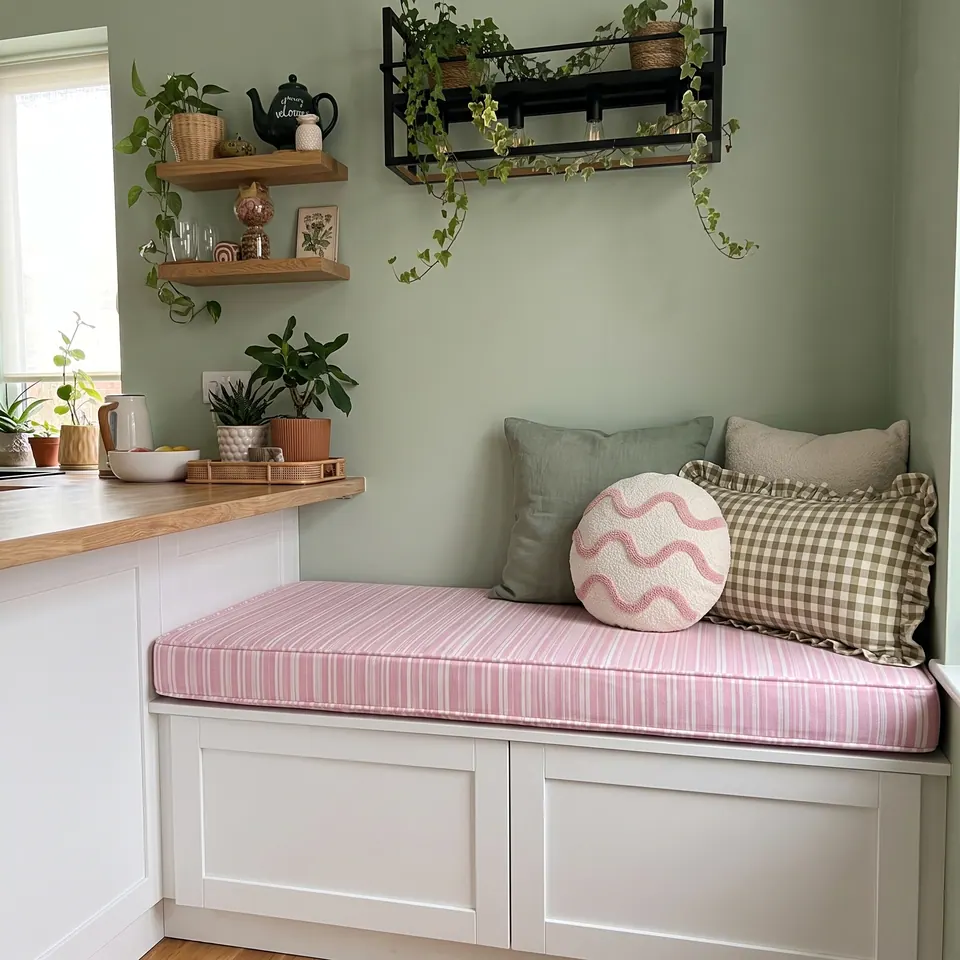
- Pink satin stripe
The brightest thing in the kitchen, so everything around it stays sage, oak and white.
- Wave round pillow
A bold motif on a round shape gives the pillow group a clear middle.
- Ruffled gingham
A small olive check in front repeats the wall color in pattern.
- Sage linen pillow
A plain pillow matching the paint anchors the busier ones in front.
- Wall rack of plants
Trailing ivy draws the green of the shelf down toward the bench.
- Pink satin stripeThe brightest thing in the kitchen, so everything around it stays sage, oak and white.
- Wave round pillowA bold motif on a round shape gives the pillow group a clear middle.
- Ruffled ginghamA small olive check in front repeats the wall color in pattern.
- Sage linen pillowA plain pillow matching the paint anchors the busier ones in front.
- Wall rack of plantsTrailing ivy draws the green of the shelf down toward the bench.
The corner banquette that arrived without a depth
A buyer in the US wrote to the workshop about a big corner banquette: 85.5 in (217 cm) along one wall and 94.5 in (240 cm) along the other, to be covered in royal blue. Two good numbers. The shop still could not quote, because a corner banquette has a third number, the seat depth.
The buyer estimated 24 in (61 cm), and the quote went out with high-density foam. Right, then: an estimate starts the conversation, a tape measure finishes it. Measure from the wall to the front edge of the seat before anything is cut. The L-shaped bench cushion Pattern shows where corners trip people up.
So, what does your bench measure from the wall to the front edge?
Notebook, page two: what to write down for a narrow nook
Measure each run along the wall
Tape from the corner to the end of the bench on each side. Write the number you read, not a rounded one.
Measure the seat depth
From the wall to the front edge of the bench top. Without it, nobody can quote a corner.
Keep the fractions
18.5 or 51.25 in is fine. Pick the nearest size range for pricing, then type the exact numbers in the personalization box. Centimeters are welcome too.
Choose a slim thickness
2, 3, 4 and 5 in (5 to 12.5 cm) are standard, and 2.5 in can be made. In a small nook, a slimmer cushion keeps the corner from looking stuffed.
On the cutting table
| Piece | Kitchen corner banquette seat cushion |
|---|---|
| Fabric | Candy pink and white striped linen |
| Edge | Box edge |
| Piping | Self piping cut from the same stripe |
| Thickness | 2, 3, 4 or 5 in (5 to 12.5 cm); 2.5 in on request |
| Measurements | Half and quarter inches, or centimeters |
| For a corner | Both run lengths plus the seat depth |
| Pillows | Plain sage and oatmeal behind, pattern in front |
| Best for | Narrow breakfast nooks and kitchen corners |

Have it made
Have this made — ask Maggie’s workshop
I once cut a lovely cushion two inches short, and I have not forgotten it. That is why the workshop goes over your measurements with you on the phone. — Maggie
Leave your details and the workshop will call you to confirm measurements, fabric, foam and piping. No prices, dates or payment on this page: it is a request, not an order.
Buyer questions: fractions, 2.5-inch foam and a photo's piping code
- A common question
Do my bench measurements have to be whole inches, or can you work to 18.5 x 51.25?
The workshop's answerHalf and quarter inches are fine. Pick the nearest size range in the dropdown, which only sets the price, then type your exact measurements, here 18.5 x 51.25 in (47 x 130 cm), in the personalization box. That is what the cushion is cut from. Centimeters work too, and the workshop actually prefers them.
- A common question
I don't want a thick cushion. Can you make one 2.5 inches thick?
The workshop's answerYes. The product page offers 2, 3, 4 and 5 in (5 to 12.5 cm), and 2.5 in can be made on request. If you picked the wrong thickness, tell the shop before production and the order is adjusted.
- A common question
Which fabric and piping colors are on the cushion in your listing photo?
The workshop's answerThe shop names the codes. In the stacked velvet photo, the second cushion is P-60 with P-61 piping, and the navy one with ivory piping is P-66 with P-52. One linen example is L-02 with L-07 piping. Expect a slight tone difference between a photo and the real fabric.
A corner banquette cushion needs three numbers, not two: the length of each run along the wall and the seat depth from the wall to the front edge.
Maggie
Questions buyers ask next
How deep should a kitchen banquette cushion be?
As deep as your bench top, measured from the wall to the front edge. There is no standard to copy. One corner banquette from a past order came to about 24 in (61 cm), and the quote waited until that number arrived.
Should a striped kitchen bench cushion have contrast piping?
On a small seat, self piping cut from the stripe keeps the outline quiet and lets the stripes run to the edge. Contrast piping draws a border, which suits a larger banquette where you want the shape to stand out.
Do pink stripes work against sage green walls?
Yes, when the pink is the only warm, bright note. In this nook sage, oak and white stay quiet around the stripe, and one plain sage pillow ties the seat back to the paint.
Where should pillows go on a narrow banquette?
Group them toward one end or the corner, plain ones at the back and patterned ones in front. The rest of the cushion stays open to sit on, which makes a small bench look bigger.
Stitch straight — Maggie
More photographs to read
 Save
 Save
 Save
 Save
 Save
 Save