 Save
- Apricot multi-stripe
The only strong color in a greige room, so the corner reads as the place to sit.
- Corner return cushion
Two separate cushions meet in the corner with stripes running the same way.
- Oak-framed gallery wall
Small frames above soften the long bare wall over the bench.
- Paper lantern pendant
A soft white shade over the table keeps the light gentle at dinner.
- Peonies on the table
Pink flowers echo the salmon threads in the cushion.
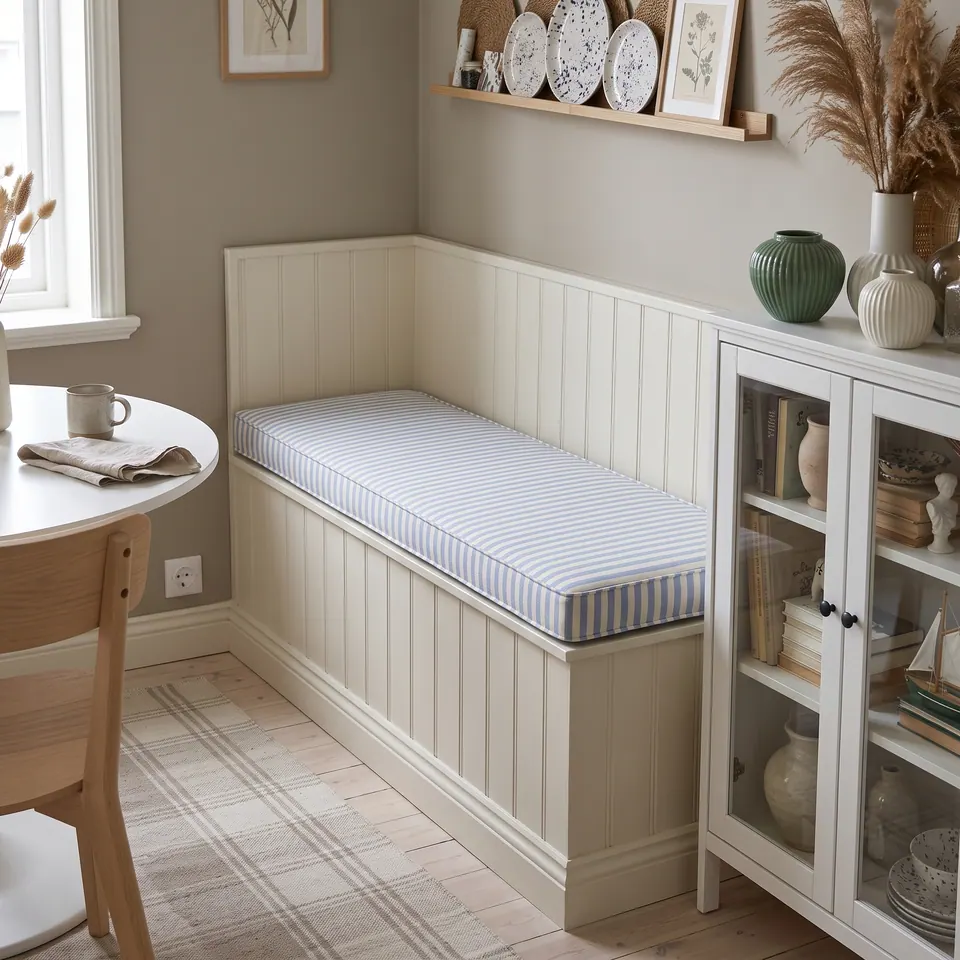
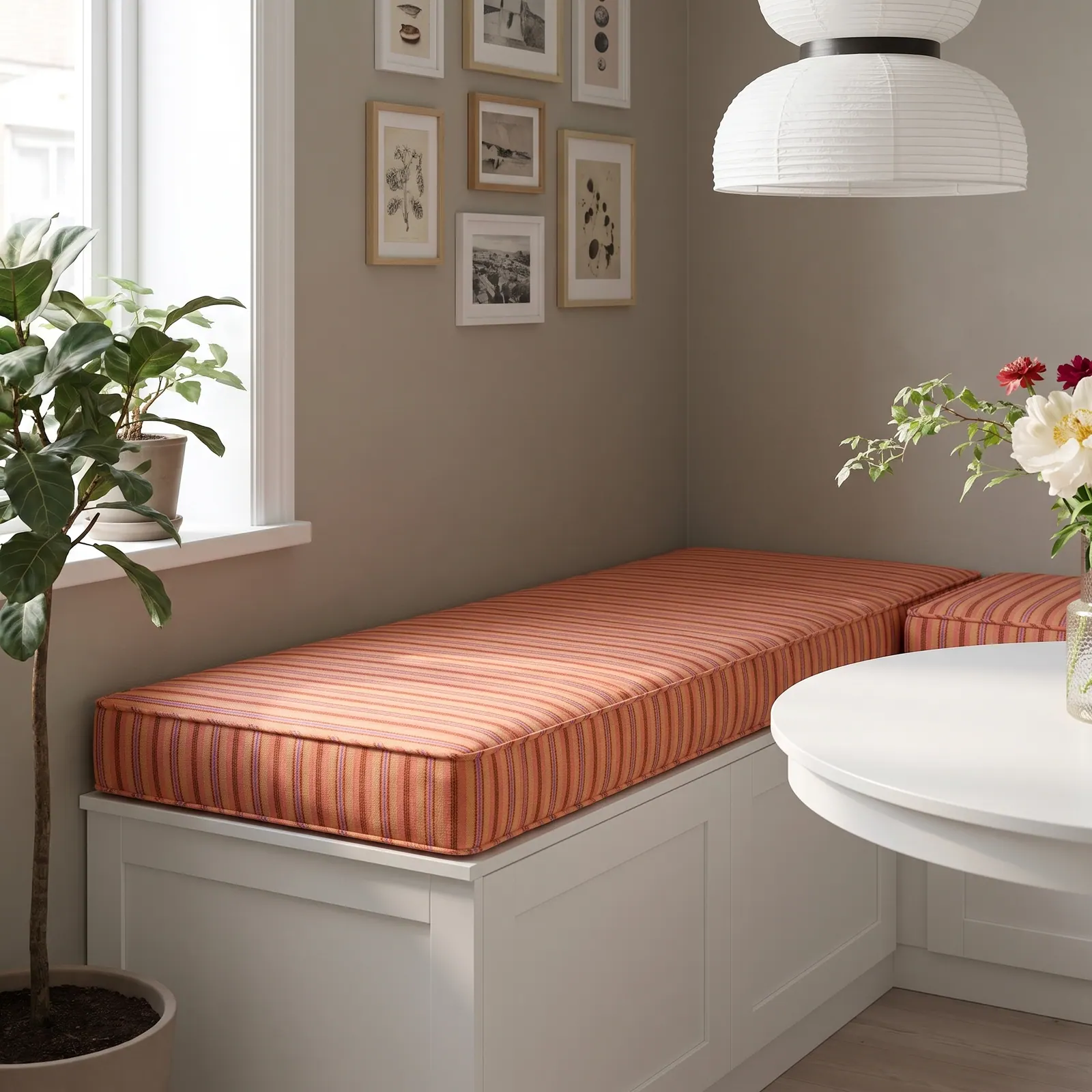
Plate Apricot stripe corner banquette under a paper lantern
Warm apricot stripes on a white L-shaped banquette give a greige dining corner its color.
A Reading by MaggieBanquette & Kitchen Nook Cushions
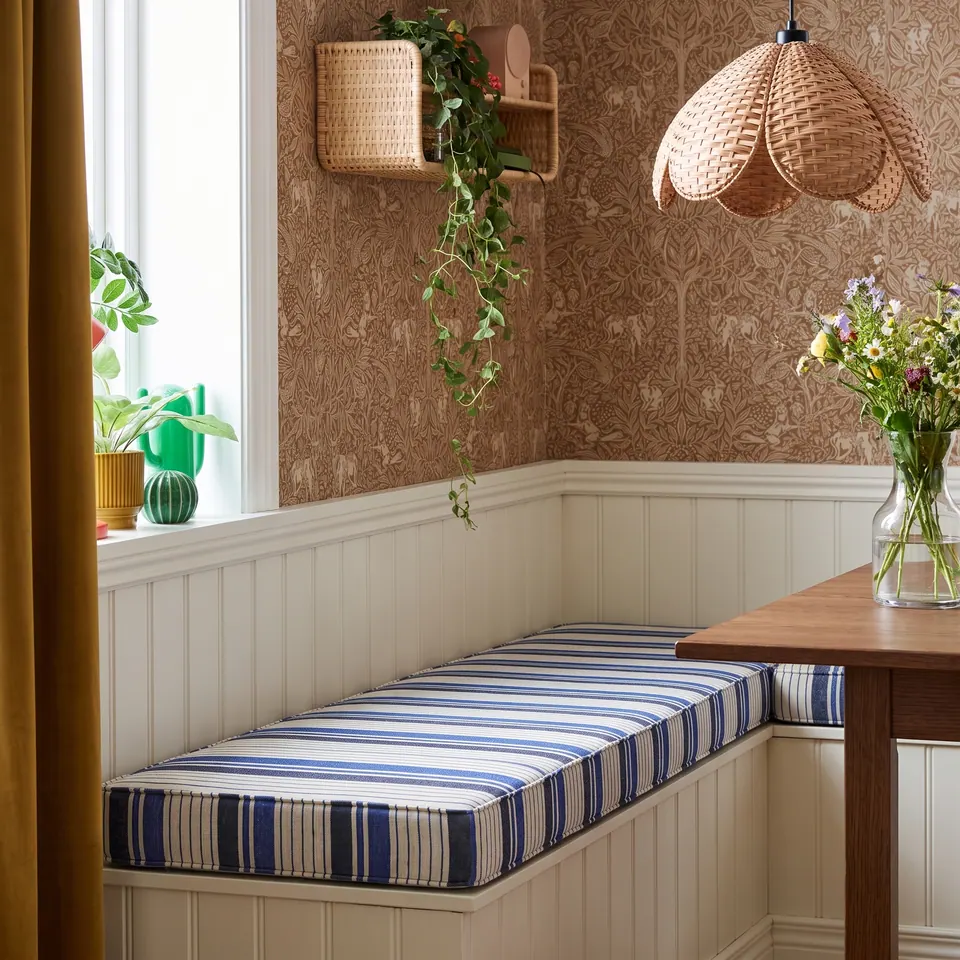
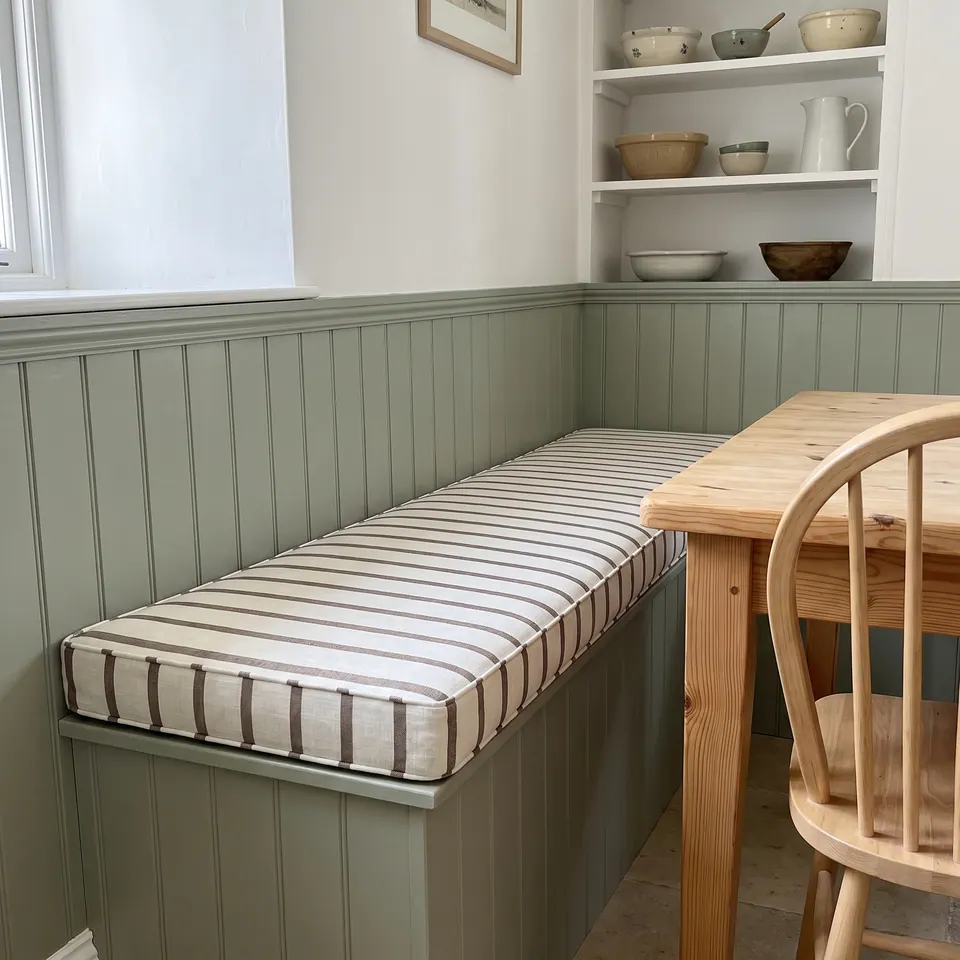
An apricot stripe L-shaped banquette, seen from the doorway and up close
Stand in the doorway first. A banquette is judged from across the room long before anyone sits on it, and this one knows it.

The quick answer
From ten feet away a banquette cushion is read by color block, stripe direction and the corner join, not by thread detail. On this white L-shaped banquette, apricot and salmon stripes are the only strong color in a greige room, and two separate cushions meet at the corner with stripes running front to back so the join lines up.
Pinned by Maggie: five things you see from the doorway
Five pins start with the stripe and the corner return, then climb to the gallery wall, the paper lantern and the peonies on the table.
The numbers match the pins on the plate.
- Apricot multi-stripeThe only strong color in a greige room, so the corner reads as the place to sit.
- Corner return cushionTwo separate cushions meet in the corner with stripes running the same way.
- Oak-framed gallery wallSmall frames above soften the long bare wall over the bench.
- Paper lantern pendantA soft white shade over the table keeps the light gentle at dinner.
- Peonies on the tablePink flowers echo the salmon threads in the cushion.
The ten-foot view: color, direction, one clean join
From the doorway you see three things and only three. A block of warm color in a pale room. Stripes all marching the same way. A corner where two cushions meet without a hiccup.
The color does the heavy lifting. Walls are greige, the banquette and pedestal table are white, and the apricot and salmon stripe is the only strong color, so the corner announces itself as the place to sit.
Direction is the second read. On both runs of this banquette cushion the stripes go front to back, so where the two pieces butt together they line up. Turn one piece the other way and from ten feet the corner looks like a mistake, however perfect the seams. The long argument is in which way a stripe should run.
The join is the third. Two separate cushions, not one bent piece: easier to fit, to lift and to clean. Ask me how I know. I once wrestled a single bent L into its cover and lost.
Up close: self piping, a box edge and a lilac thread
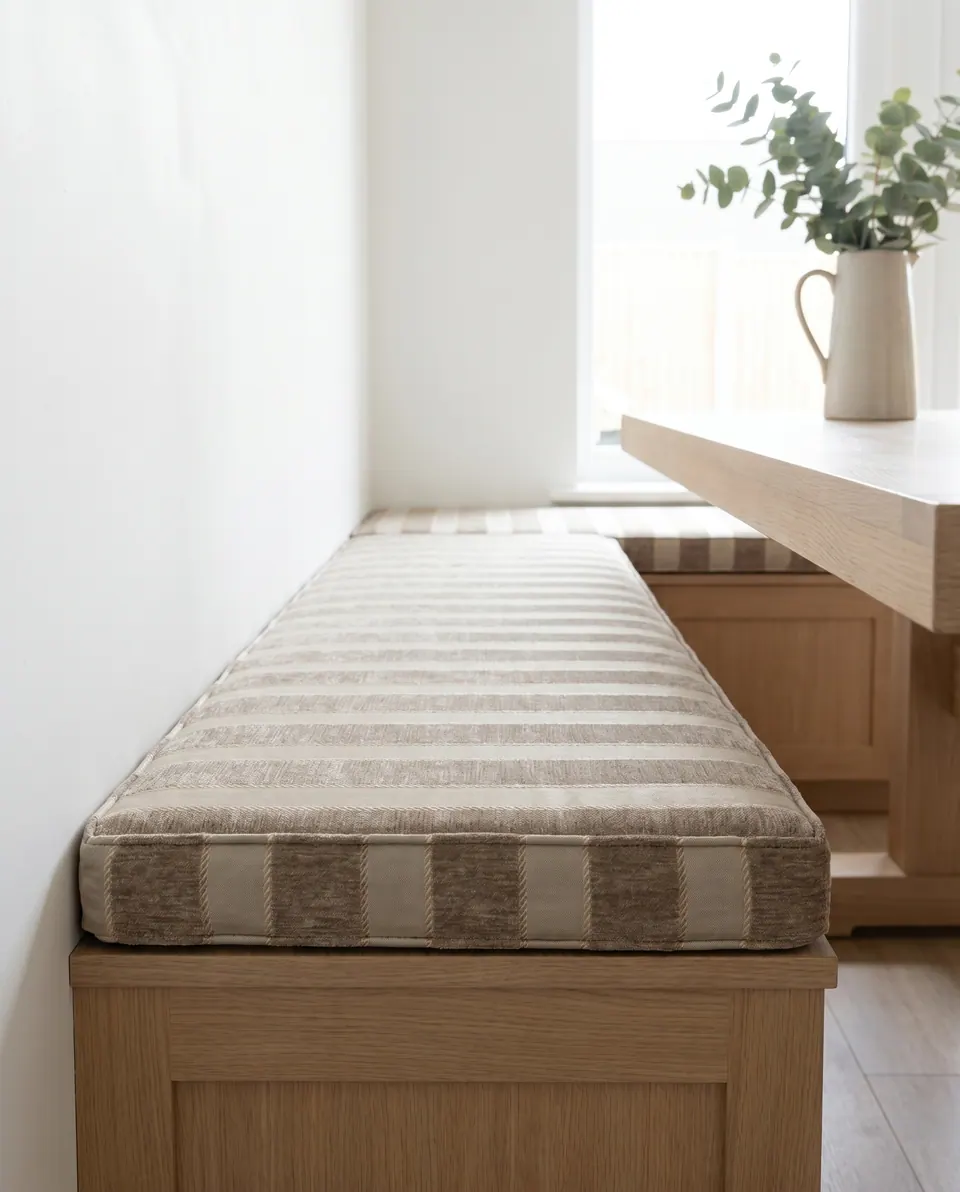
Walk closer and the cushion tells a different story. The stripe is not just apricot. There are salmon bands and a fine lilac thread, and nobody sees the lilac from the doorway.
The piping is self piping, cut from the same striped linen. From across the room it disappears, which is the point: a contrast welt would outline a cushion that is already the loudest thing in the room. Up close, the self welt keeps the box edge crisp. A straight welt is a kind of honesty, and on a long run a wander shows.
Above, small oak-framed prints soften the bare wall, the double paper lantern keeps dinner light gentle, a potted ficus fills the corner, and peonies repeat the salmon. That is ten-foot styling; the close-up belongs to whoever sits down. For how this cloth behaves, see linen and cotton-linen, and for the joint itself, the L-shaped corner join.
When the buyer couldn't find the right beige on a chart
A buyer got in touch about a banquette: a seat cushion 78 x 27 1/8 in (198 x 69 cm), plus a back cushion of standard height and the same 78 in length, in light beige linen. The workshop quoted it two ways, with the backrest and as a seat only, and after some back and forth they ordered the pair.
The sticking point was color. They couldn't find a chart that showed the beige they had in mind, so the workshop stopped sending charts and named one fabric: a beige-gray linen, code 559. One named swatch settled what a whole chart could not.
That is the close-up problem in a different coat. From ten feet, beige is beige. At the swatch it is gray-beige or sand or oat, and only one of those is right. What color is the wall behind your banquette? Start there. For an angled corner, the bay window calculator checks the geometry.
Buyer questions: remakes, everyday thickness and a clipped bay
- A common question
My cushion came in the wrong size, or with the fabric and piping colors swapped. Will you fix it?
The workshop's answerSend photos first. When the mistake was the workshop's, past remakes included cushions cut 24 x 40 in (61 x 102 cm) instead of 16 x 40 in (41 x 102 cm), one made 15 in (38 cm) long instead of 19 1/4 in (49 cm), and a set with the main and piping colors reversed. For yours, show the tape measure along the wrong edge, or the swapped piping, in the photo.
- A common question
What thickness and foam should I pick for a bench we sit on every day?
The workshop's answerFor everyday seating, 4 in (10 cm) of high-density 32 kg/m³ foam: comfortable, yet firm enough to hold its shape. That is also the pick for a tailored built-in window seat; outdoor benches do well at 3 to 4 in (7.5 to 10 cm). Because the foam is firm, 2 to 2.5 in (5 to 6 cm) cushions still stay supportive in dining nooks.
- A common question
Our bay window seat is a trapezoid with small clipped corners. Which measurements do you need?
The workshop's answerEvery edge: front, back, both sides, each small clipped-corner edge, and the depth, taken straight from the highest point down to the base line. If the numbers don't add up, the workshop works the depth out from the sides and asks you to confirm: an 86 in (218 cm) top, 126 in (320 cm) bottom and 26.5 in (67 cm) sides gave about 17.4 in (44 cm). Mark cut-outs like a window handle too.
On the cutting table: the apricot stripe banquette
| Cushions | Two box cushions meeting at the corner of an L |
|---|---|
| Fabric | Linen multi-stripe in apricot, salmon and lilac (CK-15) |
| Stripe direction | Front to back on both runs, so the corner join lines up |
| Piping | Self piping in the same stripe |
| Everyday thickness | 4 in (10 cm); 2 to 2.5 in (5 to 6 cm) still stays supportive in a dining nook |
| Foam | High-density, about 2 lb/ft³ (32 kg/m³) |
| Base | White shaker-paneled corner banquette |
| Room | Greige walls, gallery wall, paper lantern, round pedestal table |
| Best for | A kitchen nook that needs one warm color to say where to sit |

Have it made
Have this made — ask Maggie’s workshop
Have the tape measure handy when they call. Old cushions shrink and sag; the seat underneath does not. — Maggie
Leave your details and the workshop will call you to confirm measurements, fabric, foam and piping. No prices, dates or payment on this page: it is a request, not an order.
A striped banquette cushion is judged from ten feet: color block, stripe direction and one clean corner join matter more than any thread.
Maggie
Questions buyers ask next
Which way should the stripes run where two banquette cushions meet in a corner?
Front to back on both runs, as on this apricot banquette. Where the two cushions meet, the stripes then line up and the join reads as one seat from across the room. If one piece runs lengthwise, the corner looks crooked however neat the seams are.
Should the piping contrast with a bold striped banquette cushion?
Usually not. Self piping, cut from the same stripe, vanishes from a distance and keeps the edge crisp up close. A contrast welt would outline a cushion that is already the strongest color in the room, adding one more line for the eye to sort out.
How do you make a striped banquette the focal point of a neutral kitchen?
Keep everything around it pale. Here greige walls, a white shaker base and a white pedestal table leave the apricot and salmon stripe as the only strong color, and peonies on the table repeat its pink. The corner then reads as the place to sit.
Stitch straight — Maggie