The Cutting Table · a common question
How do I measure a cushion with rounded corners or a curved end?
Also asked as:rounded corners on three edgeslong bench with one side curved
Curves scare people off custom cushions, partner. They shouldn't. A curve is a straight edge that changes its mind at a spot you can measure.

The quick answer
To measure a rounded-corner cushion, write each edge as if the corners were square, then mark where each curve begins along both edges, such as 8 in (20 cm) from the corner. For a curved end, add the curve's span and its depth. Or trace the curve on paper, photograph it beside a tape measure, and the workshop sends a template to confirm.
 Save
Key facts
- Give every edge length as if the corners were square.
- A rounded corner is defined by where the curve starts, measured from the corner along both edges.
- Note each corner separately if the curves differ.
- A curved end needs the span between where the curve starts and ends, plus its depth from top to bottom.
- A curved top needs each side's straight run, the width where the curve starts and the total height to the top of the curve.
- A paper tracing photographed beside a tape measure is accepted.
- The workshop sends a template to confirm and asks before cutting if anything is missing.

Have it made
Have Nate’s workshop cut this for you
Precision starts on the phone. Give the workshop your measurements and they will read them back to you, edge by edge. — Nate
Leave your details and the workshop will call you to confirm measurements, fabric, foam and piping. No prices, dates or payment on this page: it is a request, not an order.
How do you measure a rounded corner on a cushion?
Measure each edge to where the corner would be if it were square. Then, at each rounded corner, measure how far from that imaginary corner the curve begins, along both edges.
If the corners differ, write each one down; one buyer's three curves started at about 7, 7 7/8 and 8 5/8 in (18, 20 and 22 cm). Angles are just lengths in disguise, and so are curves. The rounded-corner pattern shows the drawing.
The numbers for each kind of curve
Rounded corners
Distance from the square corner to where the curve starts, along both edges.
A curved end
The span between where the curve starts and ends, and the depth from the top of the curve to the bottom: its chord and rise.
A curved top
Each side's straight run before the curve, the width where the curve starts, and the total height from the bottom edge to the top of the curve.
After you upload the drawing
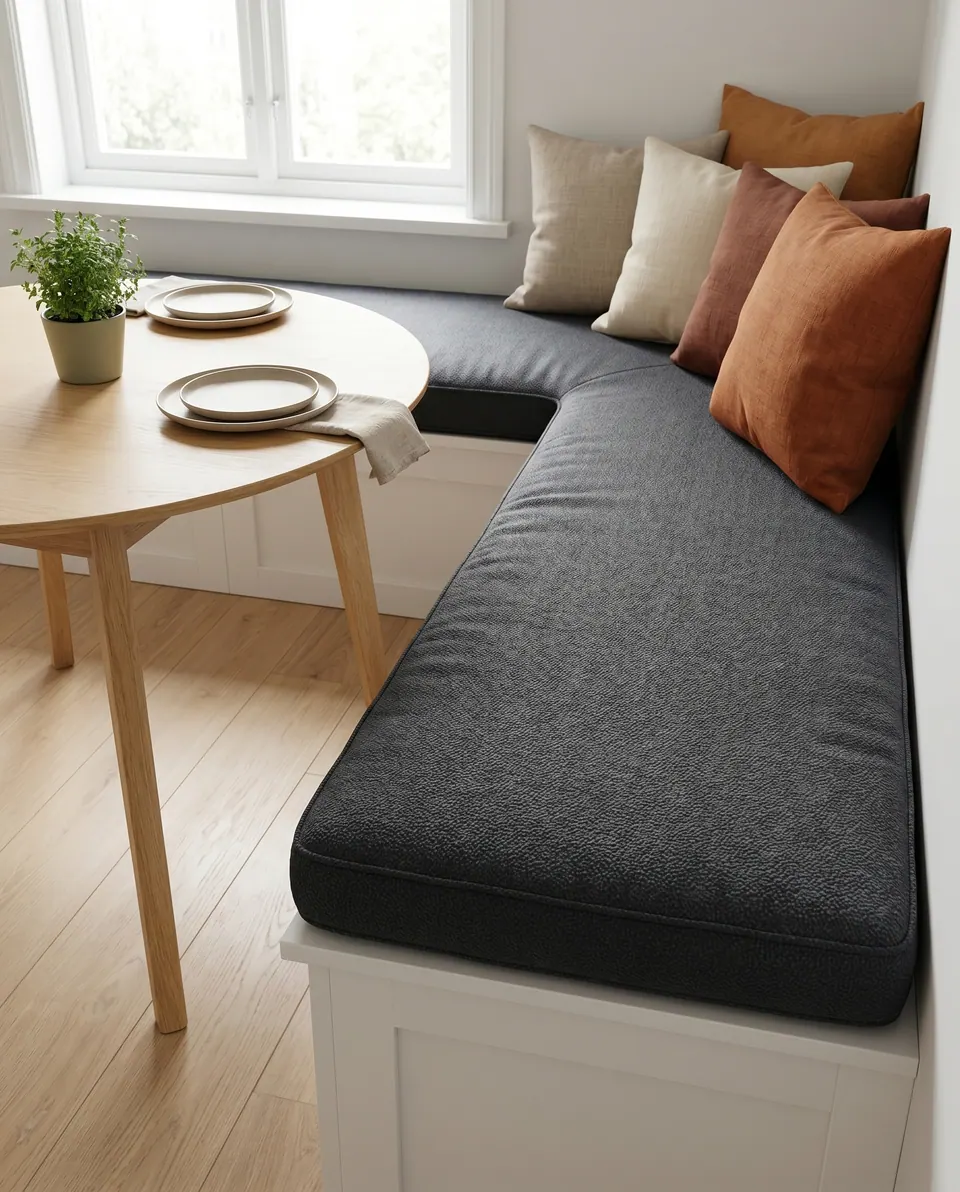
Put every number on one drawing, add photos of the seat, and upload both on the custom-shape listing. The workshop sends a template to confirm and asks before cutting if anything is missing. A banquette cushion with one curved end needs just two extra numbers. Which of your corners is the odd one out?
A curved end on a bench cushion needs two numbers: the span between where the curve starts and ends, and its depth from top to bottom.
Nate
Buyer questions
- A common question
My bench has rounded corners. How do I give you the curves?
The workshop's answerWrite each edge's full length as if the corners were square, then mark how far from each corner the curve begins, each one separately if they differ. Or trace the corner and photograph it beside a tape measure.
- A common question
How do I measure a cushion with a curved top?
The workshop's answerThree numbers: how far each side runs straight before the curve begins, the width where the curve starts, and the total height from the bottom edge to the top of the curve.
- A common question
How do I measure a bench with one curved end?
The workshop's answerMeasure from the top of the curve to the bottom, and the distance between where the curve starts and ends. Write both on your drawing; missing numbers get asked about before cutting.
Questions buyers ask next
Do I need a paper template for a rounded corner?
Not usually. Two numbers per corner describe a simple round. A paper tracing helps when the curve isn't a simple arc; photograph it beside a tape measure so the scale is clear.
Where do I measure the depth of a curved end?
From the top of the curve straight down to the line where the curve starts, square to that line. Measure the span along that same line, from where the curve begins to where it ends.
Should I take a little off so a curved cushion fits?
No. Send the exact size of the space and deduct nothing. The cushion is made to your numbers, and the fitting allowance is handled in production; piping sits on the seams without changing the size.