 Save
- One-piece bench cushion
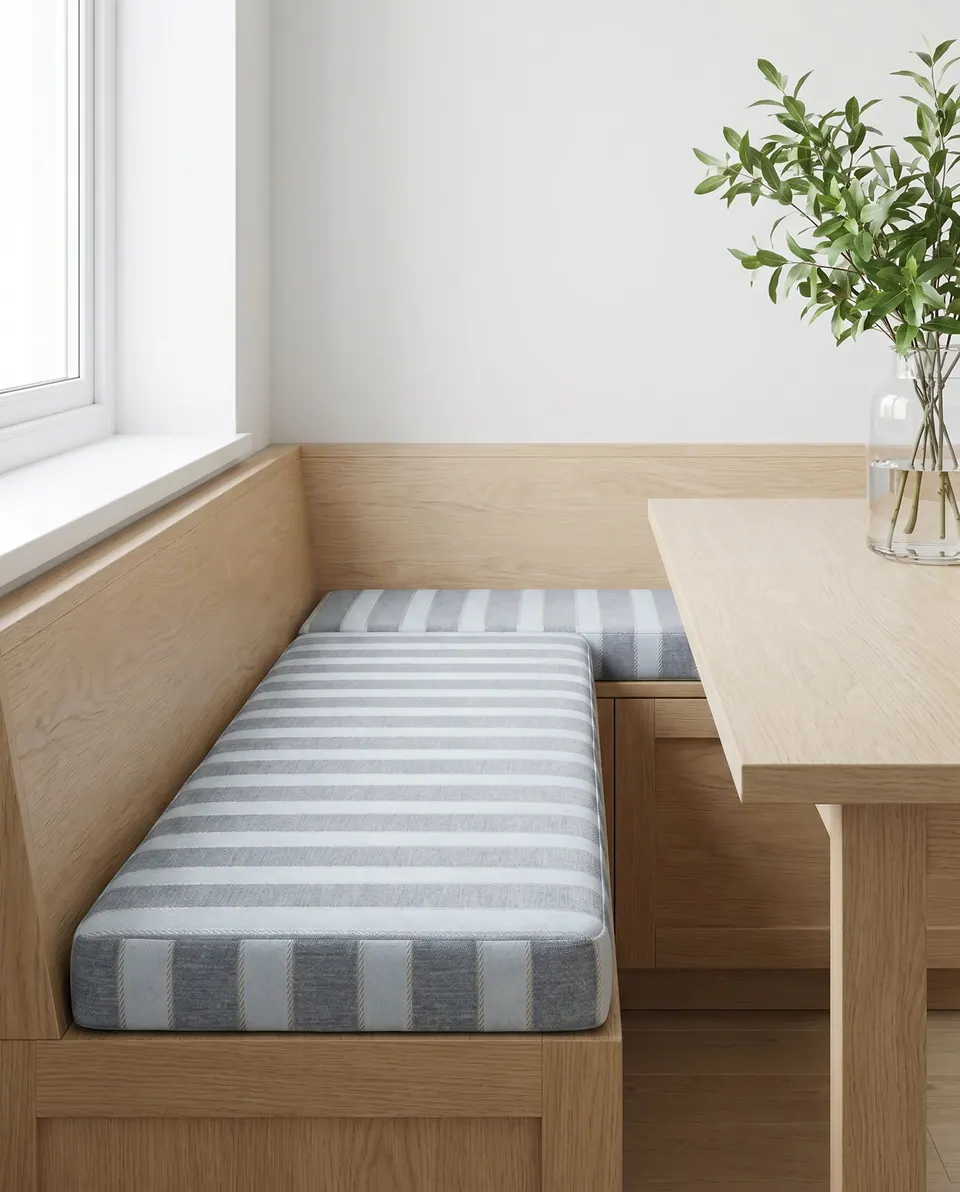
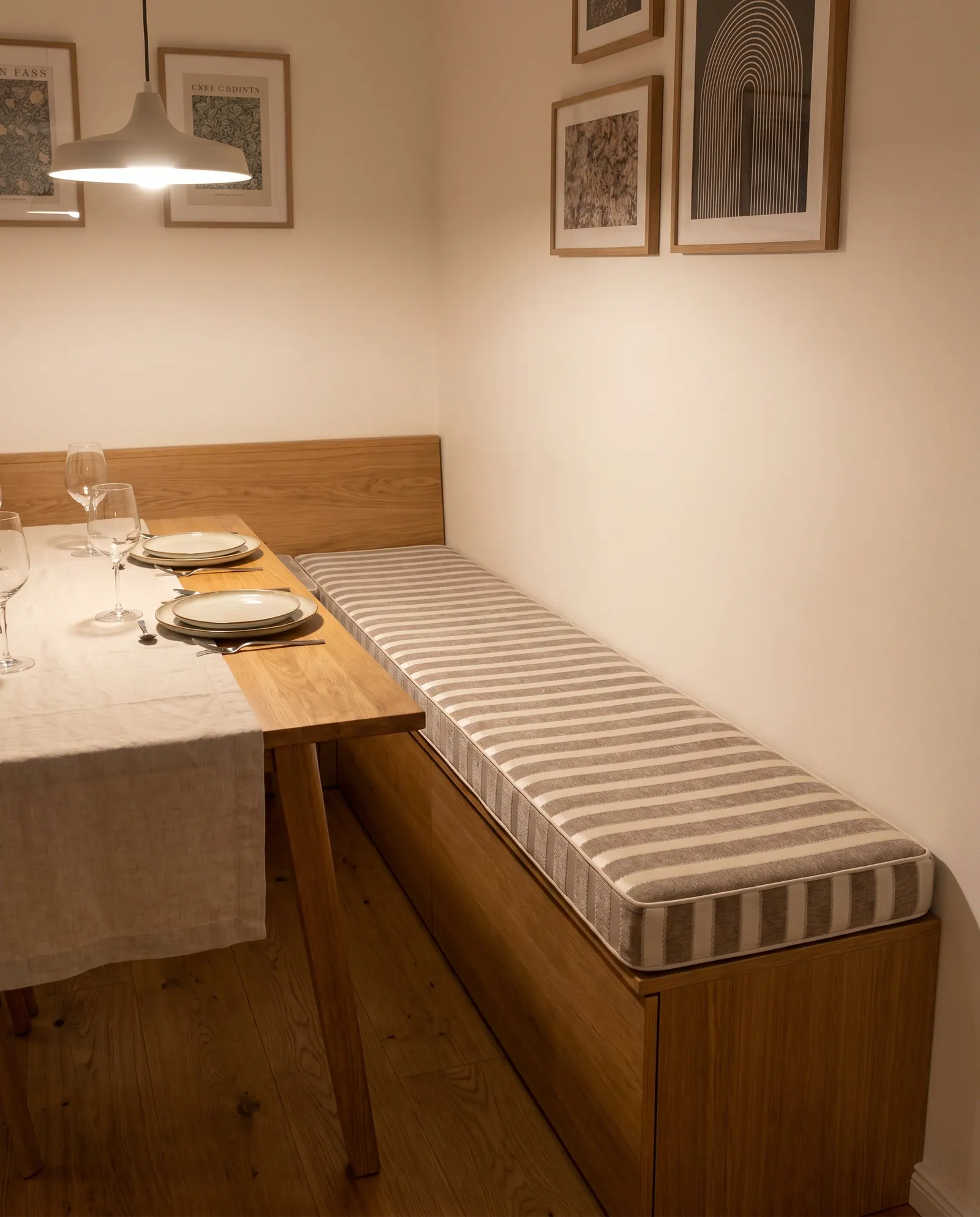
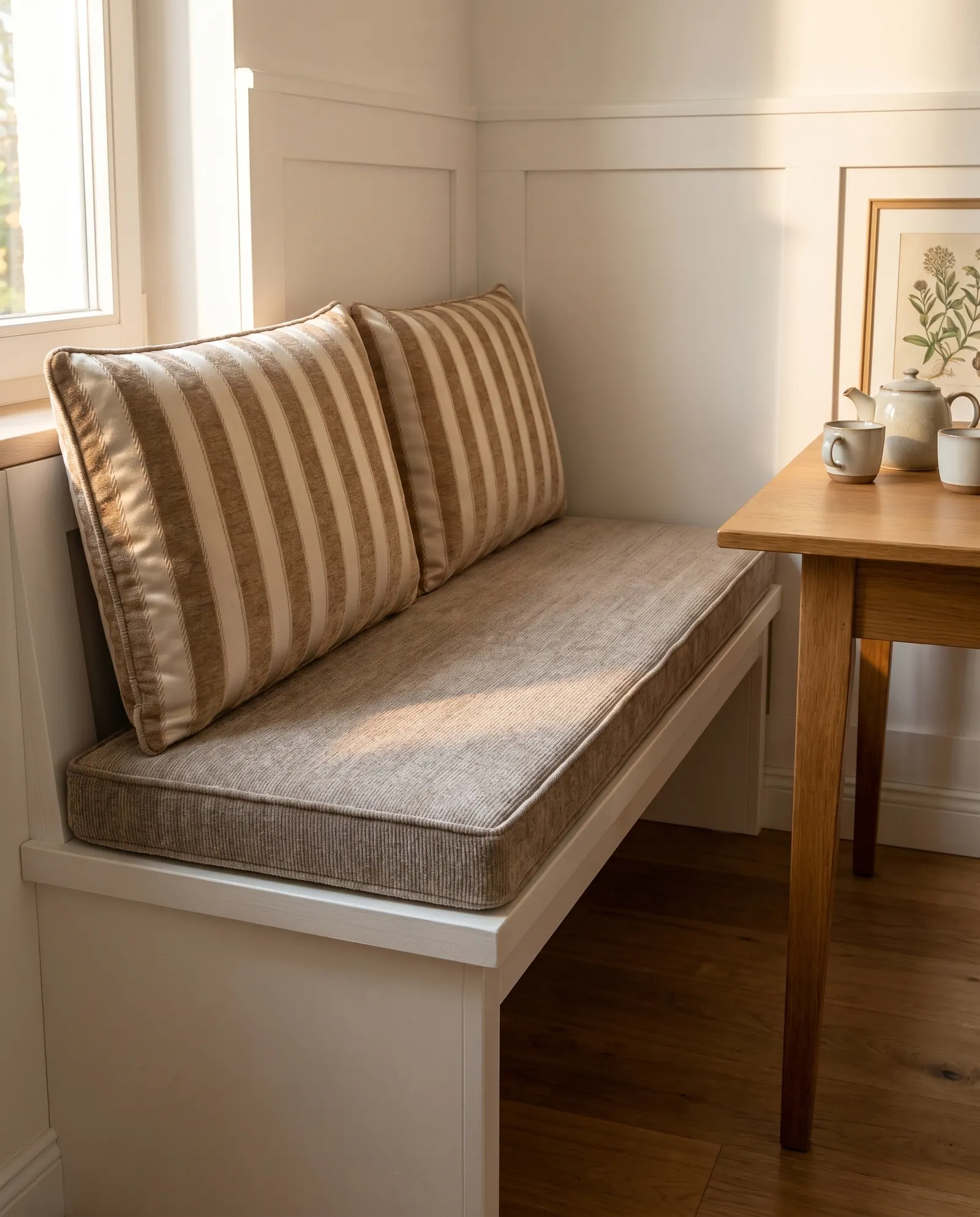
A single long cushion runs the full bench, with stripes across the depth so there is no busy mid seam.
- Striped box edge
The stripes continue down the box side, which keeps the edge looking crisp under side light.
- Oak back panel
The cushion stops at the timber panel, leaving warm wood as a frame on the wall side.
- Enamel pendant
One low pendant pools light on the table and leaves the bench softly lit.
- Linen place settings
A linen runner and white plates keep the table in the same muted palette as the stripe.
Plate Gray stripe banquette on oak, by lamplight
A single long striped cushion softens an oak storage banquette without breaking its clean line.
A Reading by MaggieBanquette & Kitchen Nook Cushions
A gray and white striped banquette cushion on oak, and the mistakes it sidesteps
Right, then. A long striped cushion is where good intentions go to wobble. This one doesn't, and I can list exactly why.

The quick answer
A banquette cushion on a long oak storage bench looks tailored when it is one piece, with stripes running across the depth, stripes carried down the box side, and an end that stops cleanly at the back panel. Measure the bench top, not the floor, and send the exact depth rather than a rounded one.
A striped banquette cushion under one pendant, at dusk
A long striped cushion is the easiest place in a kitchen to go wrong, and this photograph gets almost everything right.
One white enamel pendant hangs low over the table and pools the light there, leaving the bench softly lit. In that dusk, the pebble gray and white stripe reads almost like mattress ticking, relaxed and a little farmhouse, which makes a nice argument with the tidy row of four framed prints on the wall, the arch graphic among them.
The banquette cushion is one piece, running the full length of the oak storage bench, with the stripes crossing the depth from wall to front. No seam halfway along breaks the rhythm. The stripes carry on down the box side, so the edge stays crisp under side light, and self piping in the same cloth finishes it without fuss. At the back it stops at the timber panel, leaving warm wood showing between the cushion and the wall.
The table is dressed in the same quiet key: a natural linen runner, white plates, wine glasses and plain cutlery. Nothing competes with the stripe, and the oak table matches the oak bench, so the gray and white is the only pattern in the corner.
I have made most of the mistakes this cushion avoids, dear, a few of them twice. The list is below, so you don't have to. More kitchen nook cushions follow the same rules, and one piece or two covers the length question. How long is your banquette, and have you decided yet?
Pinned by Maggie at the banquette table
Five pins, from the enamel pendant to the stripe running down the box side.
The numbers match the pins on the plate.
- One-piece bench cushionA single long cushion runs the full bench, with stripes across the depth so there is no busy mid seam.
- Striped box edgeThe stripes continue down the box side, which keeps the edge looking crisp under side light.
- Oak back panelThe cushion stops at the timber panel, leaving warm wood as a frame on the wall side.
- Enamel pendantOne low pendant pools light on the table and leaves the bench softly lit.
- Linen place settingsA linen runner and white plates keep the table in the same muted palette as the stripe.
Six mistakes this banquette sidesteps
- A seam halfway along a long stripe. Here one piece runs the whole bench.
- Stripes that stop at the top edge. These carry down the box side, so the edge stays crisp.
- A cushion that swallows the woodwork. This one stops at the oak back panel.
- Measuring the floor instead of the bench top. They can differ, so measure the top.
- Rounding the depth. 20 in (51 cm) is not 19 3/4 in (50 cm), and a fitted banquette knows the difference.
- Matching green by its name. Two greens with one name can look nothing alike in two fabrics.
An L-shaped nook, two fabrics, one green
A family in the US was building a corner kitchen banquette, an L-shaped built-in, and wanted two corduroy seat cushions to form the L, plus five back pillows in a fabric that would sit well beside them.
The seats were 16 7/8 x 50 1/4 in (43 x 128 cm) and 17 3/8 x 77 5/8 in (44 x 197 cm). The backs were two at 25 1/2 x 18 in (65 x 46 cm) and three at 30 5/8 x 18 in (78 x 46 cm), every piece 3 in (7.5 cm) deep. The workshop filled the backs with softer shredded foam.
The color was the hard part. The seats were green corduroy, COR-207. Plain velvet greens looked too different beside it, so the backs were made in a closely matching green from the soft range, 928. That order took 7 to 10 days to make and 3 to 5 days to deliver.
Match colors across fabric types, not by the color name. For the corner itself, see how an L-shaped cushion meets at the joint.
Buyer questions on bolsters, drawings and a green
- A common question
For a bench cushion with a back bolster, how deep should the cushion be, and how thick the bolster?
The workshop's answerThe standard bolster is 8 in (20 cm) across. For 31 1/2 in (80 cm) of seating depth, the workshop suggests 39 3/8 in (100 cm) of total depth so the bolster has room. Exact sizes are possible too, such as a 31 1/2 x 78 3/4 in (80 x 200 cm) mattress 8 in (20 cm) thick, instead of the standard 4 in, with an 11 3/4 in (30 cm) bolster.
- A common question
What's the best way to send you measurements for a built-in bench?
The workshop's answerDraw the seat on paper with every dimension and send it. Measure the bench top, not the floor, because the two can differ, and be exact about depth: 20 in (51 cm) is not 19 3/4 in (50 cm).
- A common question
Can the back pillows be in a different fabric from corduroy seats and still match?
The workshop's answerYes, if the color is matched by eye rather than by name. When plain velvet greens looked too different beside green corduroy seats, the workshop made the backs in a closely matching green soft fabric, filled with softer shredded foam.
On the cutting table: the striped oak banquette
| Cushion | One-piece box cushion, full length of the bench |
|---|---|
| Fabric | Pebble gray and white stripe |
| Stripe direction | Across the depth, carried down the box side |
| Piping | Self piping in the stripe |
| Frame | Oak storage banquette with a timber back panel |
| Light | One low white enamel pendant, evening |
| Table | Natural linen runner, white plates |
| Measure | The bench top, not the floor; exact depth |
| Best for | Long, narrow dining banquettes |

Have it made
Have this made — ask Maggie’s workshop
Numbers first, fabric second, piping last. Jot down what you have, and the workshop will go down the list with you, item by item. — Maggie
Leave your details and the workshop will call you to confirm measurements, fabric, foam and piping. No prices, dates or payment on this page: it is a request, not an order.
On a long striped banquette cushion, run the stripes across the depth and down the box side, so no seam breaks the stripe halfway along.
Maggie
Questions buyers ask next
Should a long dining bench cushion be one piece or two?
One piece looks cleanest on a banquette like this, with no seam breaking the stripe. Very long seats are easier to lift and place in two pieces, so weigh the look against handling before you order.
Which way should stripes run on a banquette cushion?
Running across the depth, from wall to front edge, lets the stripe repeat evenly along a long bench and carry down the box side. Ask the workshop about fabric width first, since some stripe directions on long pieces need a seam.
Can banquette back pillows be softer than the seat?
Yes. On one L-shaped nook the workshop filled the back pillows with softer shredded foam, which gives a back a more relaxed lean than a solid slab while the seats keep their shape.
Why leave the oak back panel showing above the cushion?
Warm wood above a gray stripe frames the seat and keeps the banquette looking built-in rather than upholstered wall to wall. A cushion that stops at the panel is also easy to lift for the storage underneath.
Stitch straight — Maggie
More stripes and patterns at the table
 Save
 Save
 Save
 Save
 Save
 Save