A Reading by NateL-Shaped Corner Bench Cushions
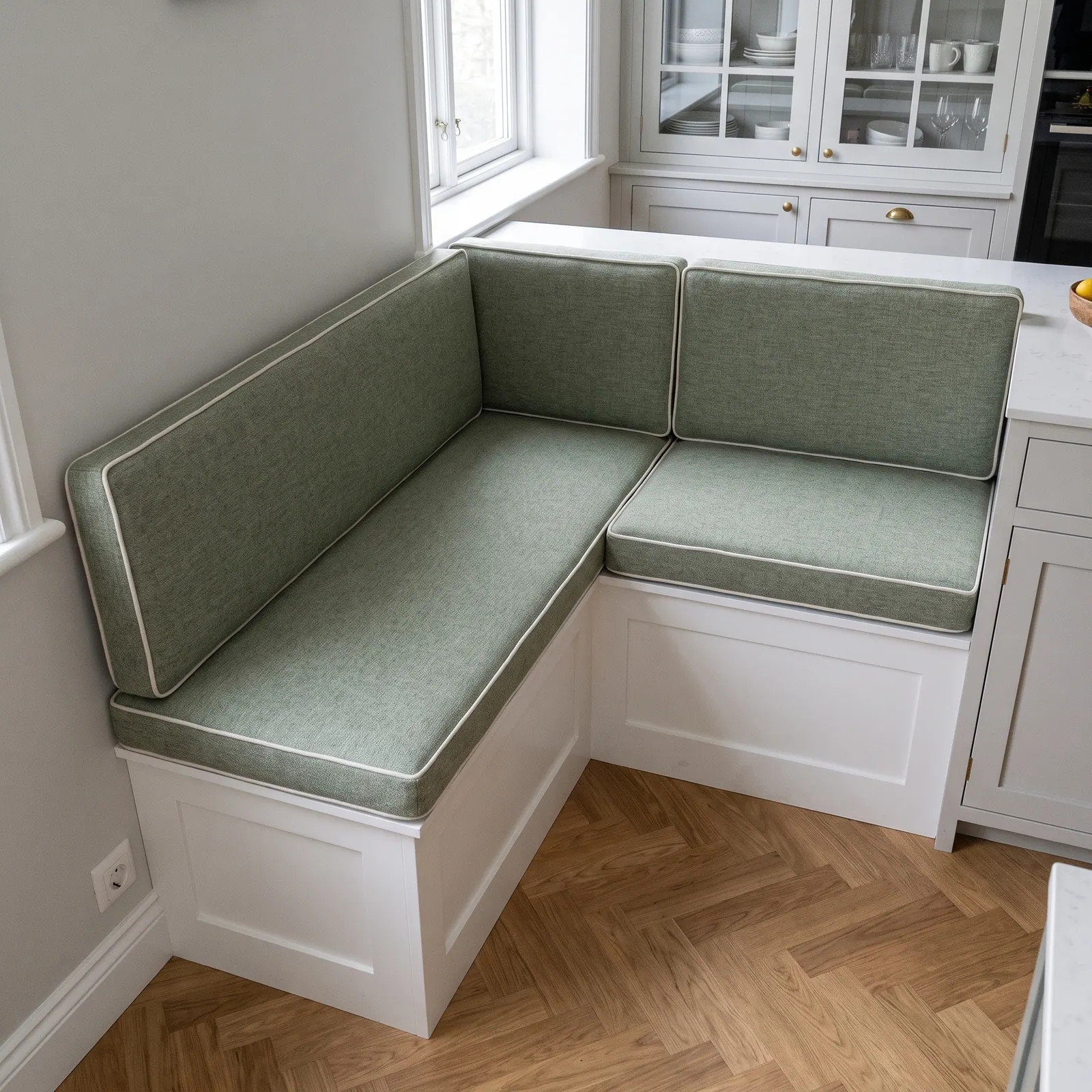
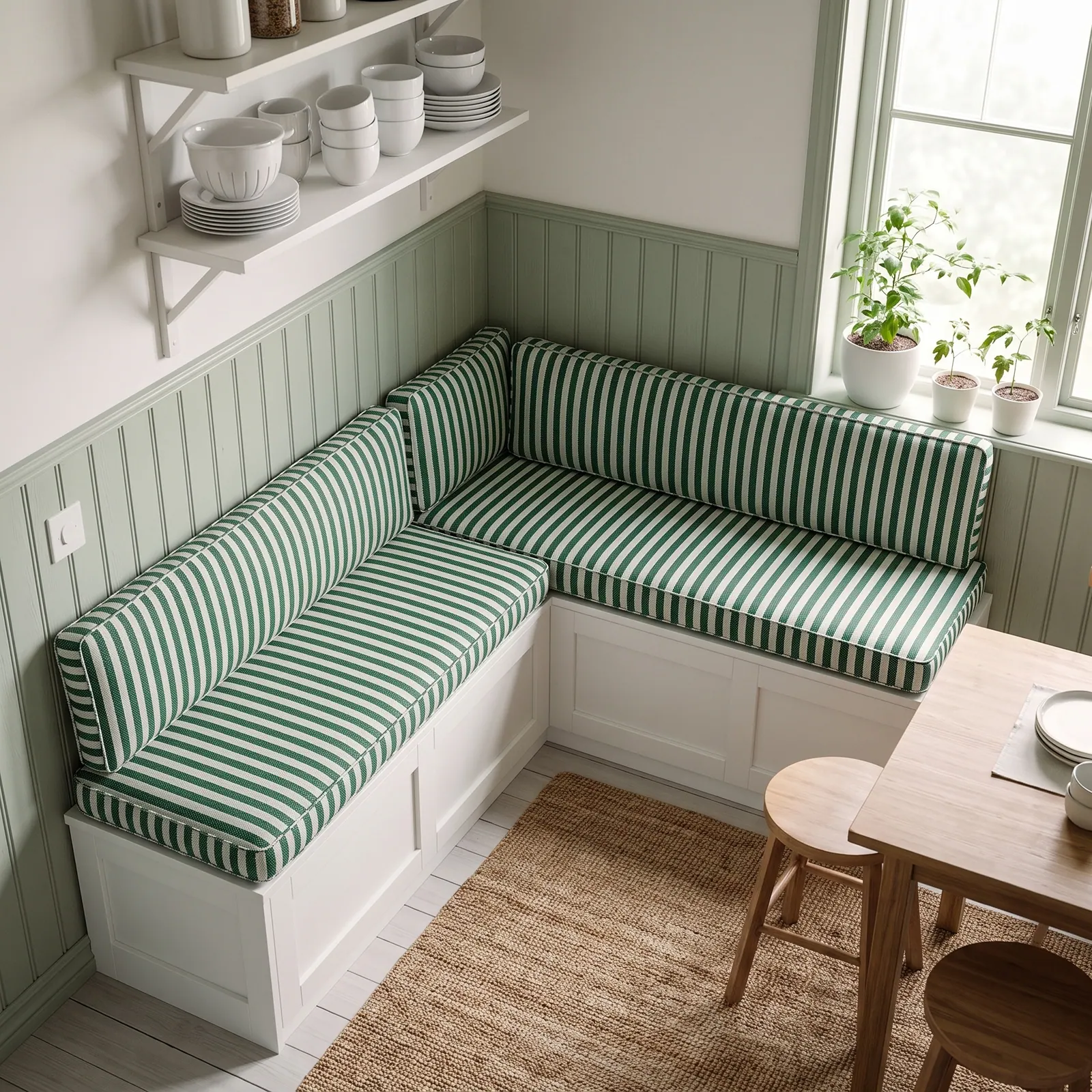
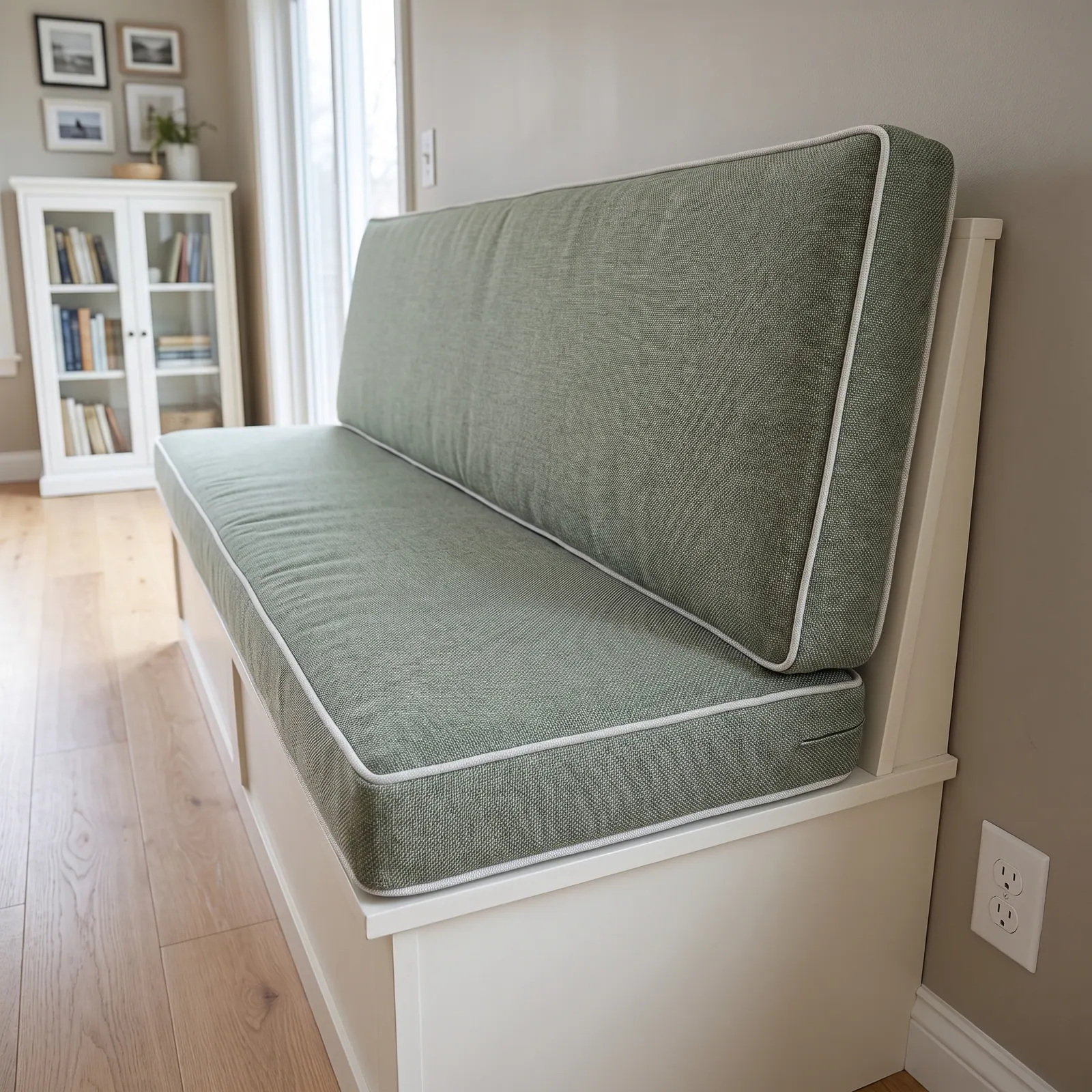
A sage L-shaped bench cushion set in a kitchen nook, read edge by edge
Two seats, three backs, one butt joint and a lot of ivory piping. The edges decide whether an L looks built-in or bolted on. Here are the numbers.

 Save
The quick answer
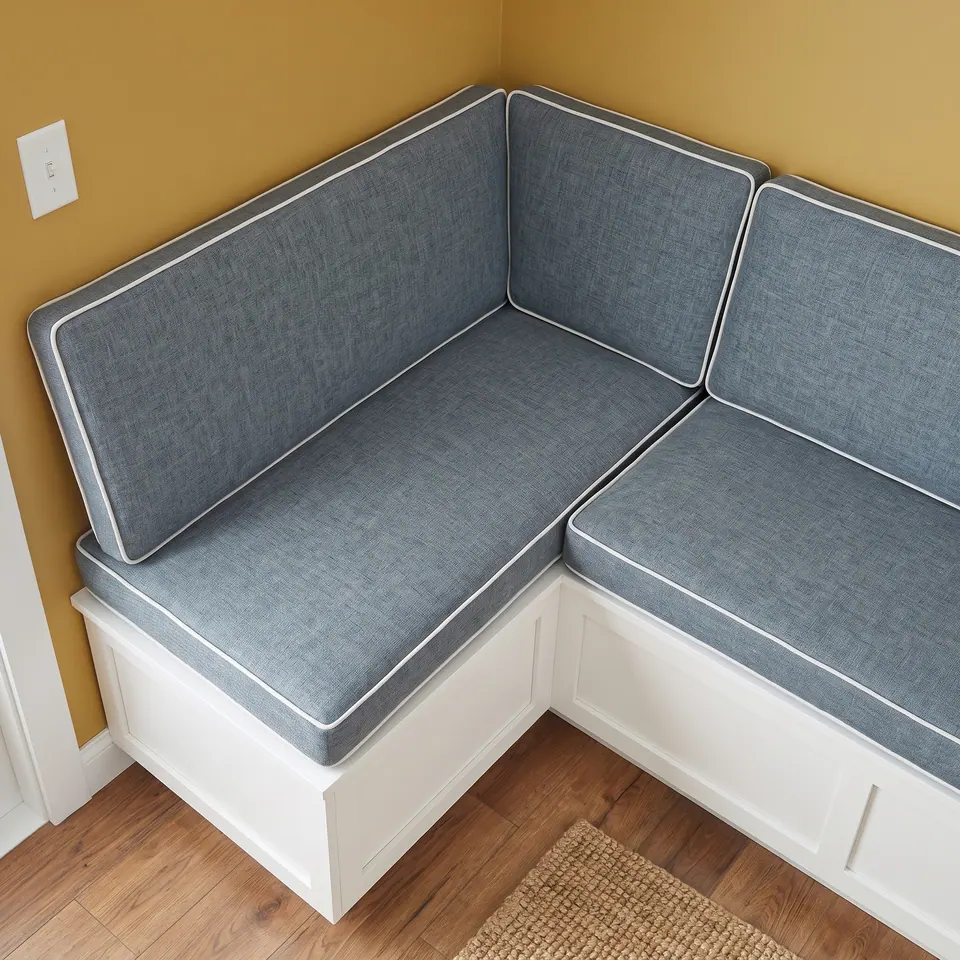
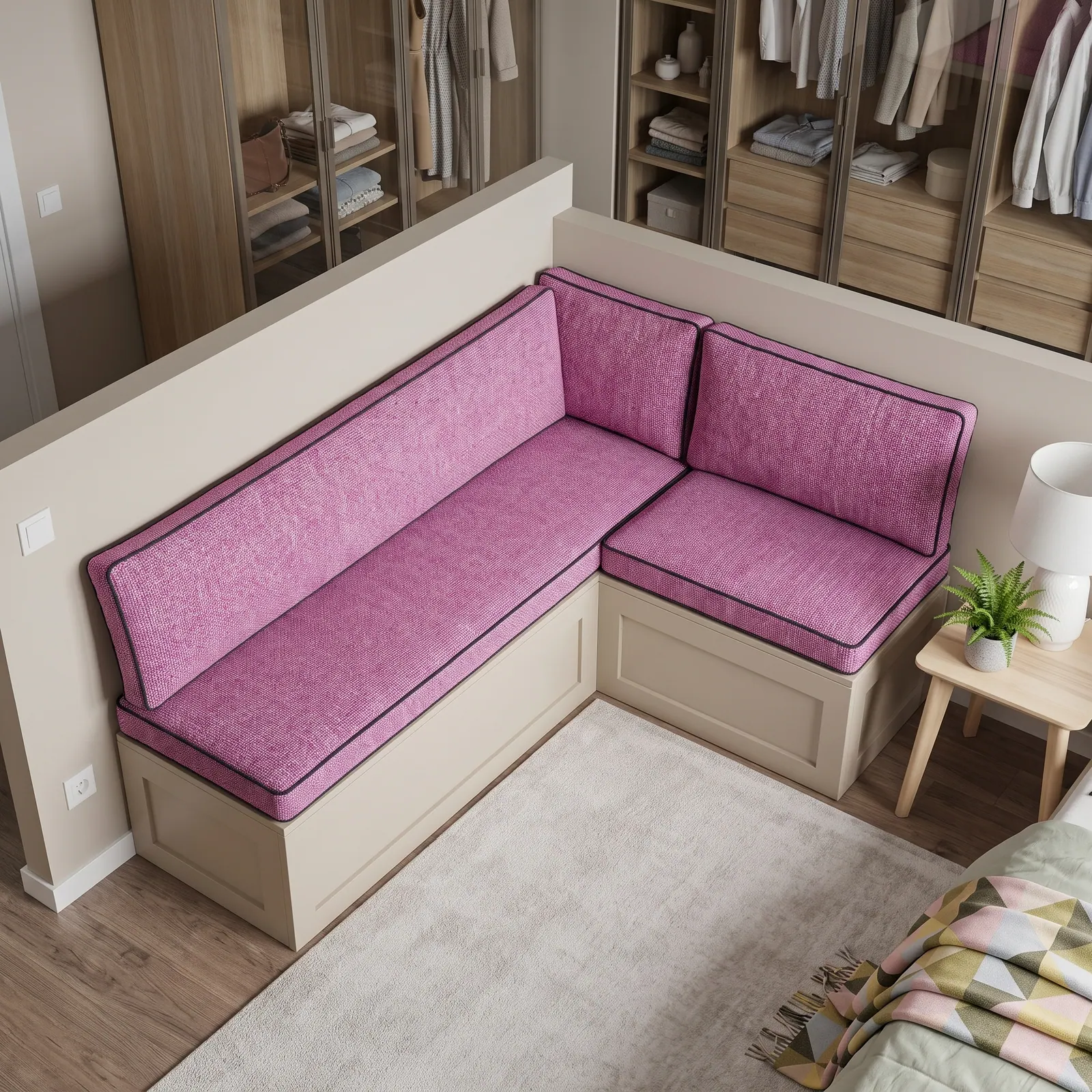
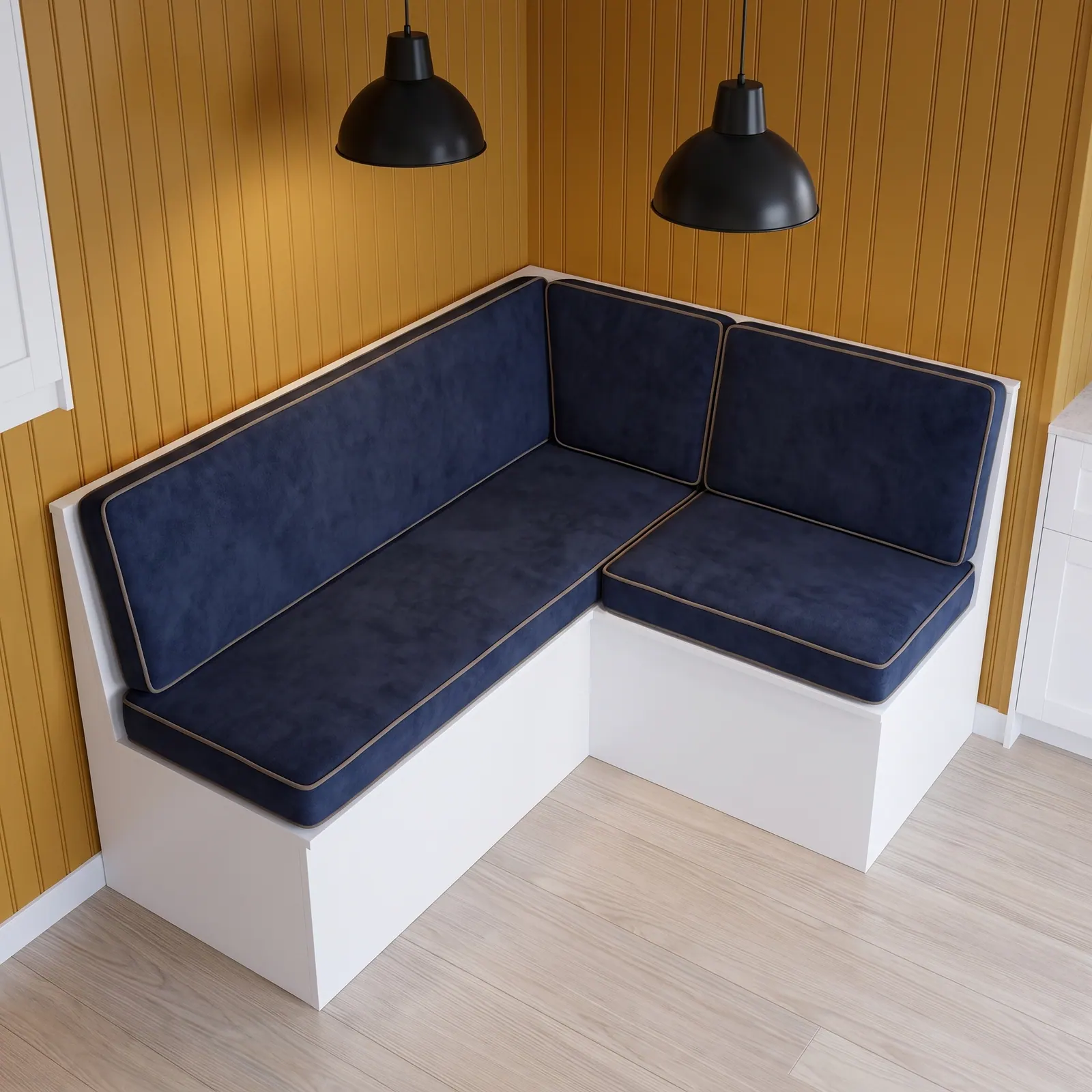
An L-shaped kitchen nook cushion is usually two straight box cushions: one runs into the corner, and the short side equals its wall run minus the depth of that corner cushion. A 61 in run beside a 19 in deep corner cushion needs about 42 in. Square box edges with piping on each face let the two pieces butt cleanly.
Field notes: three backs, two seats, one joint
Count the pieces first, partner. Two seat cushions and three backs on a white paneled corner bench that ends at a kitchen island. One back pad runs the long wall. A short one fills the corner so the L has no gap. A third leans on the end of the island and closes the nook.
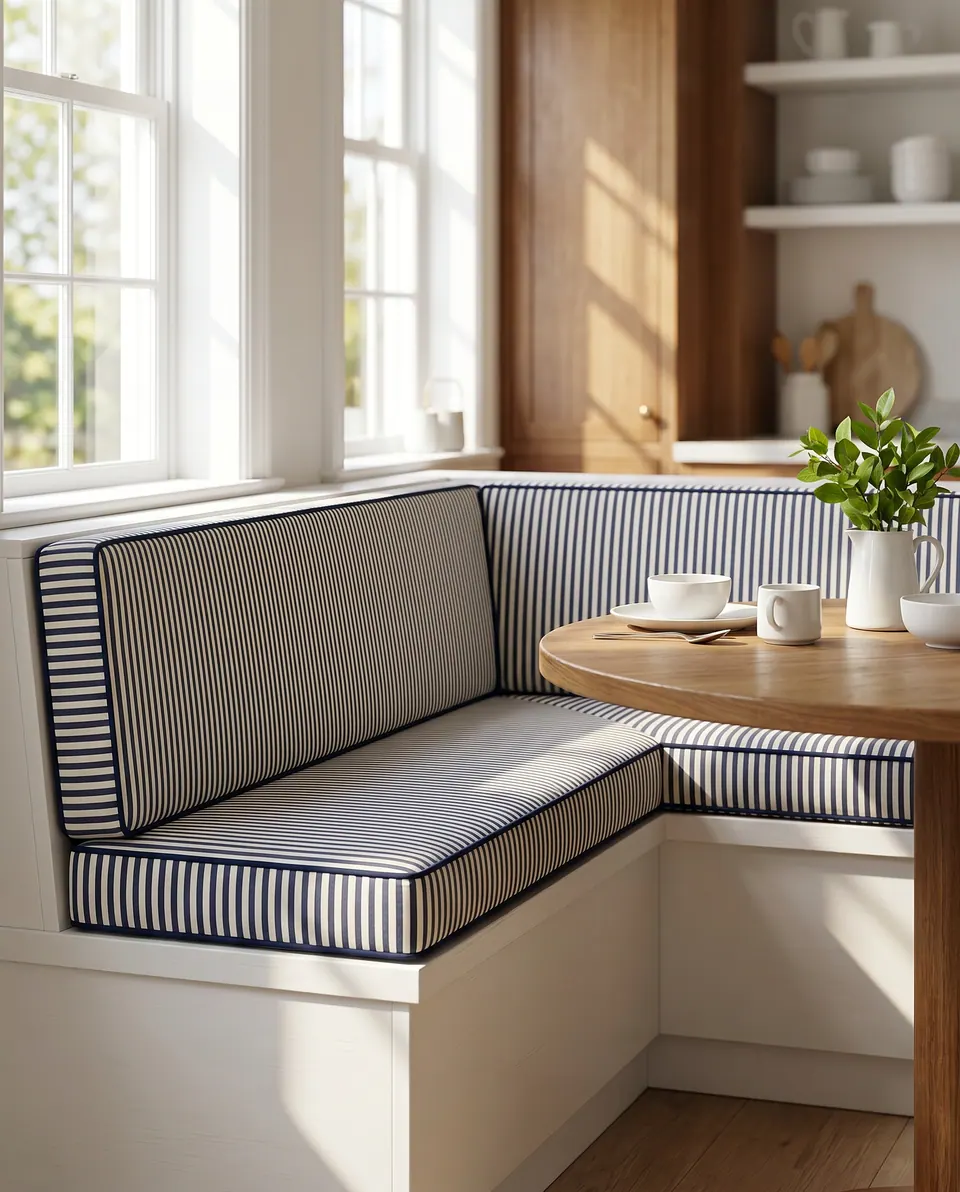
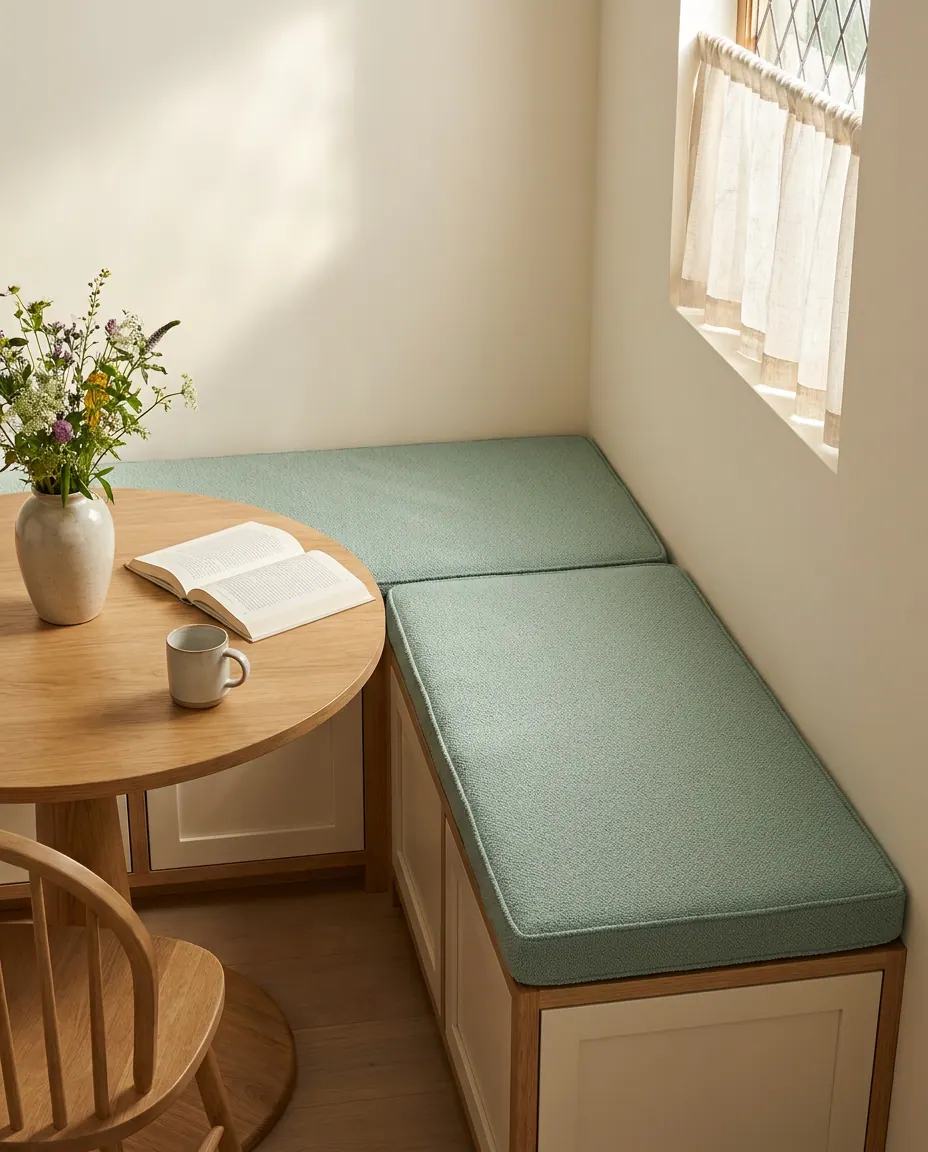
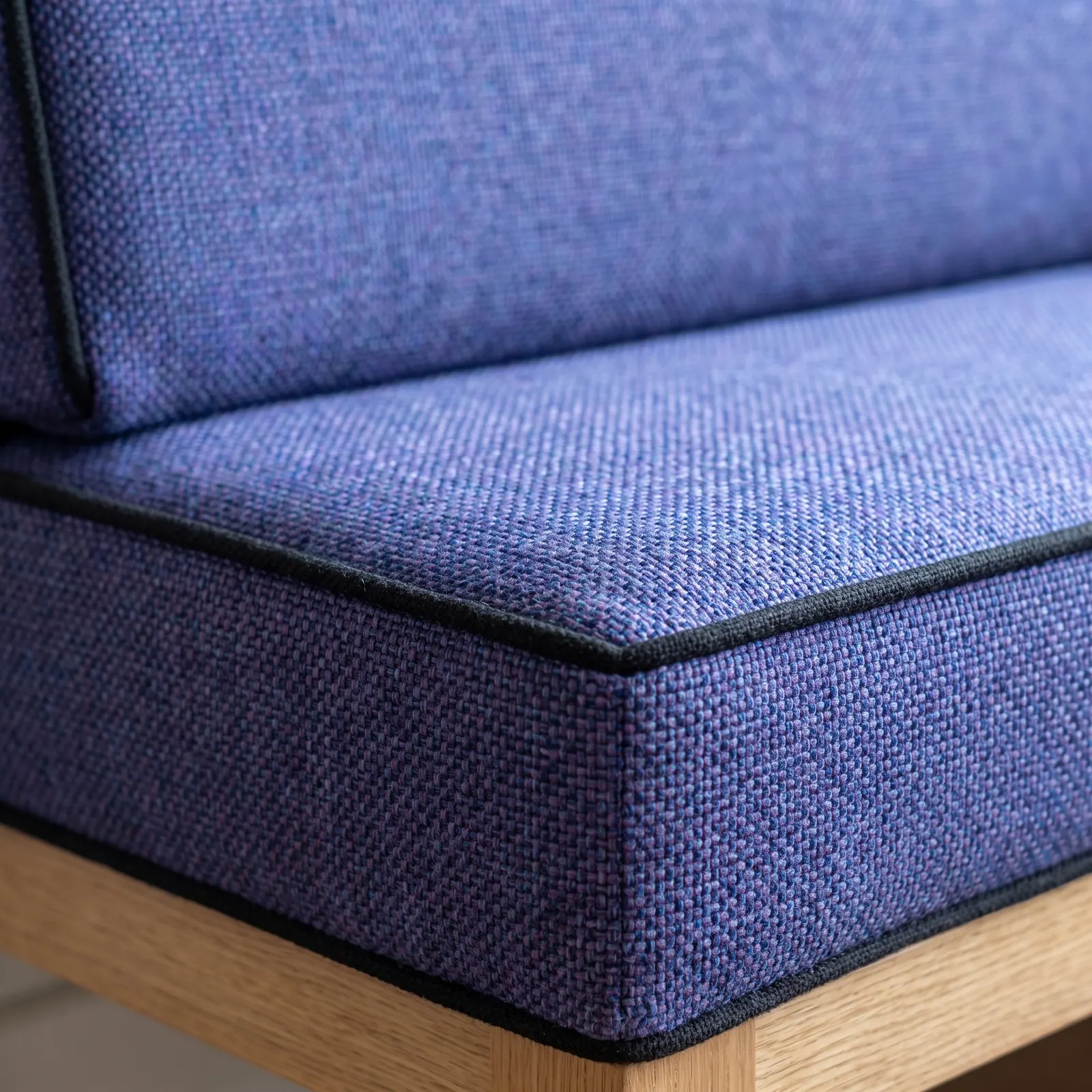
Now the edges. Every piece is a box cushion: straight side walls, square corners, ivory piping top and bottom. Where the short seat meets the long one, you get two piped faces butting together. That is the whole trick of an L-shaped bench cushion. Two complete boxes, pressed tight, read as one seat. A knife edge, which tapers to a single seam, would leave a V-shaped valley at that joint.
Color next. The sage pads sit in the same family as the pale gray shaker cabinets, so the bench reads as joinery, not furniture. The ivory piping repeats the white stone worktop and the crockery behind the glass-front dresser. The herringbone oak floor supplies the warmth the greens don't. The bowl of lemons is the only strong yellow in the room, which is exactly enough.
The rule to copy: in an open kitchen nook, match the cushion to the cabinet color family and let the floor be the warm thing.
The corner, in numbers
| Measure | Inches | Centimeters |
|---|---|---|
| Short wall run, from the back corner | 61 | 155 |
| Depth of the long cushion in the corner | 19 | 48 |
| Short cushion = run − depth | 42 | 107 |
| One buyer's long piece | 102 x 18 | 259 x 46 |
| One buyer's short piece | 70 x 18 | 178 x 46 |
| Drawing accepted if it closes within | ± 1/4 | ± 0.6 |
From past orders. Measure both runs from the back corner, then subtract.
Pinned by Nate
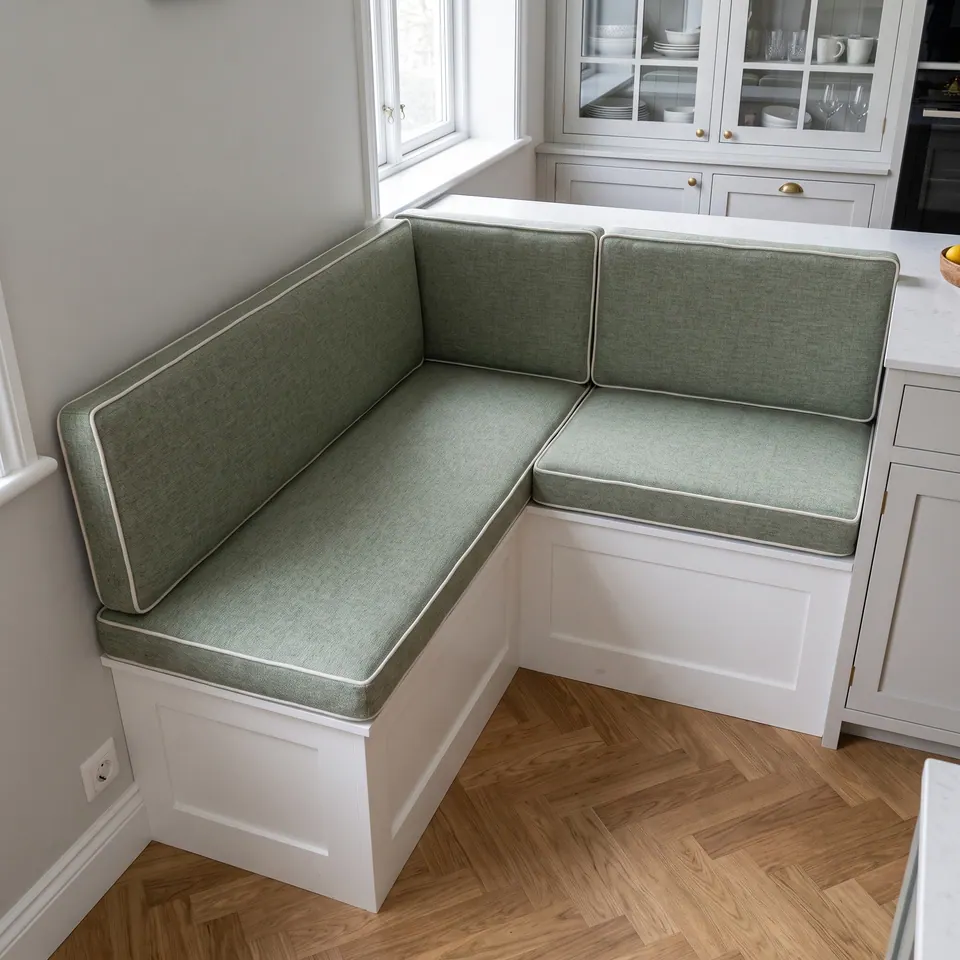
Five pins, from the long wall back to the herringbone floor.
- Long wall back
Sage pads blend into the gray joinery so the bench looks like part of the kitchen.
- Short corner back
A short middle back cushion fills the corner so the L has no gap.
- Island-side back
The third back pad rests against the island end, closing the nook.
- Butting seat pad
The shorter seat butts into the long one with piping on each face.
- Herringbone oak
Warm wood underfoot keeps the cool greens and whites from feeling clinical.
- Long wall backSage pads blend into the gray joinery so the bench looks like part of the kitchen.
- Short corner backA short middle back cushion fills the corner so the L has no gap.
- Island-side backThe third back pad rests against the island end, closing the nook.
- Butting seat padThe shorter seat butts into the long one with piping on each face.
- Herringbone oakWarm wood underfoot keeps the cool greens and whites from feeling clinical.
Four edges, ranked by how forgiving they are
Angles are just lengths in disguise. So are notches and curves, up to a point.
- Square box corners. This photo. Most forgiving: straight cuts, piping on every face, clean butt joints.
- Notched box. A cut-out around a post or pillar. Still simple, once you mark where the post starts and how deep it goes. See notched cushions.
- Angled corner. Two trapezoids instead of two rectangles. Needs a drawing that closes within ± 1/4 in (0.6 cm).
- Curves. Measurable with a flexible tape along both edges, plus depths at the center and ends. A kidney shape with too many curves can be turned down, because a precise fit can't be promised by mail.
If your nook has any of the last three, draw it before you order. The trapezoid cushion calculator helps with the angled kind.
A pillar in the middle of the L
A buyer wrote to the workshop with an L-shaped bench and a structural pillar breaking up the seat, all measured in millimeters. The workshop offered two builds: one cushion cut around the pillar, or separate sections butting against it. The finished cushion went out in mushroom after 5 to 7 business days of making and 2 to 4 days in transit, with a photo sent before dispatch.
The buyer came back twice: once for the same size in a linen color, and once for two covers only, in brown, to fit the foam already at home. Separate pieces that butt together are the easier fit. A notch looks tidier. Both work.
- Sizes
- Measured in millimeters; one L around a pillar
- Fabric
- Mushroom; later a linen color and brown covers
The lesson: Around a pillar, choose between one cushion with a notch and separate pieces that butt together.
Buyer questions: corners, curves and condensation
- A common question
For an L-shaped banquette, should I order one L cushion or two pieces, and how long is the short side?
The workshop's answerTwo straight pieces work well; one buyer ordered 70 x 18 in and 102 x 18 in. The short side is the total run minus the depth of the long cushion sitting in the corner: a 61 in run beside a 19 in deep cushion needs about 42 in, not 61. Very large banquettes may be split into more pieces.
- A common question
Can you make cushions for a curved, banana-shaped bench?
The workshop's answerThe workshop first asked for the straight end-to-end length, the front and back edges measured along the curve with a flexible tape or string, the depth at the center and at each end, and a thickness of 2 to 3 in (5 to 8 cm), plus a paper or cardboard tracing. After review it declined the kidney-shaped curves, since a precise fit couldn't be guaranteed, and suggested a local upholsterer who could fit them in person.
- A common question
My window seat sits against single-pane glass that runs with condensation. Which fabric wipes clean best?
The workshop's answerVelvet or the soft performance fabric range, which clean more easily than textured or absorbent weaves; soft fabric is the most practical. Both are upholstery fabrics, not waterproof, so wipe moisture away and keep the cushion off a wet surface. Constant damp can bring mildew to any fabric.
On an L-shaped kitchen nook, the short cushion equals its wall run minus the depth of the corner cushion: a 61 in run beside a 19 in deep seat takes 42 in.
Nate
The L, on the cutting table
| Set | Two box seats; three backs (long wall, corner, island end) |
|---|---|
| Joint | Short seat butts the long one, piping on each face |
| Fabric | Sage linen-look |
| Piping | Ivory contrast, top and bottom seams |
| Edge | Box, square corners |
| Thickness | 4 in (10 cm) standard; 3 in (7.5 cm) for a lower profile |
| Foam | 32-density, about 2.0 lb/ft³, fiber-wrapped |
| Care | 86°F (30°C) gentle wash, air dry |
| Best for | Kitchen corners beside an island or peninsula |

Have it made
Have this made — ask Nate’s workshop
Every edge and both diagonals, to the nearest 1/4 in. If the numbers do not close, the workshop will say so on the call. — Nate
Leave your details and the workshop will call you to confirm measurements, fabric, foam and piping. No prices, dates or payment on this page: it is a request, not an order.
Questions buyers ask next
What is the difference between a box edge and a knife edge?
A box edge has a side band, the gusset, so the cushion has straight walls and square corners, like the seats here. A knife edge is two panels joined at one seam and thins toward the edge. Box edges butt together more cleanly on an L.
How do I fit a bench cushion around a post or pillar?
Choose a notch cut around the post or separate pieces that butt against it. Draw the seat from above, mark the post's distance from one end and its width and depth, and the cushion is cut to that drawing.
Can I order new covers later for the same nook cushions?
Yes. Covers only can be made to fit foam you already own, including spare or second-color covers for cushions the workshop made. One nook owner came back for two covers in a new color.
± 1/4 in — Nate
Corner benches, read edge by edge
 Save
 Save
 Save
 Save
 Save
 Save