A Reading by NateL-Shaped Corner Bench Cushions
Edge notes on an L-shaped bench cushion set in navy ticking
Two rectangles, one corner, zero diagonal seams. The edges are where this breakfast nook earns its keep.

 Save
The quick answer
An L-shaped banquette cushion set is simplest as separate box-edge rectangles butted into the corner, one run owning the corner square. Rectangles keep ticking stripes straight and each piece lifts out alone. Send the length of each wall into the corner, the seat depth, and which run overlaps; handmade sizes can vary by about 3/8 in (1 cm).
Why every piece here is a plain rectangle
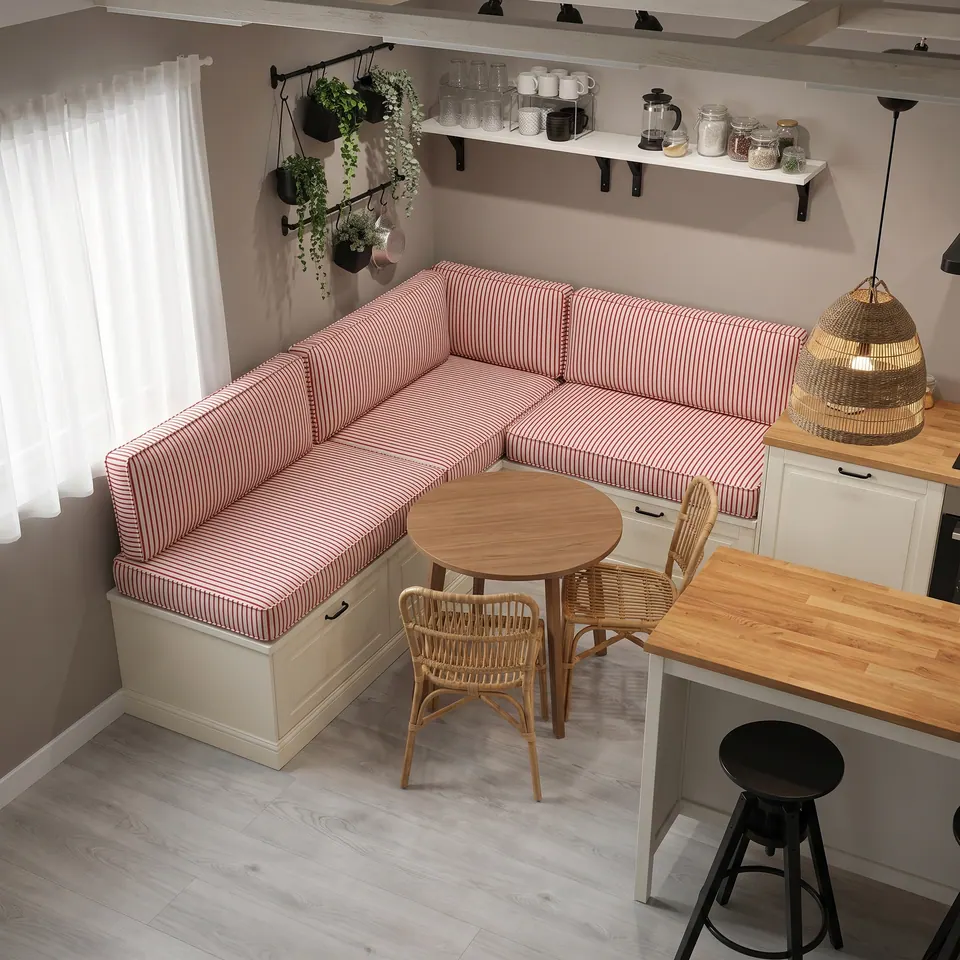
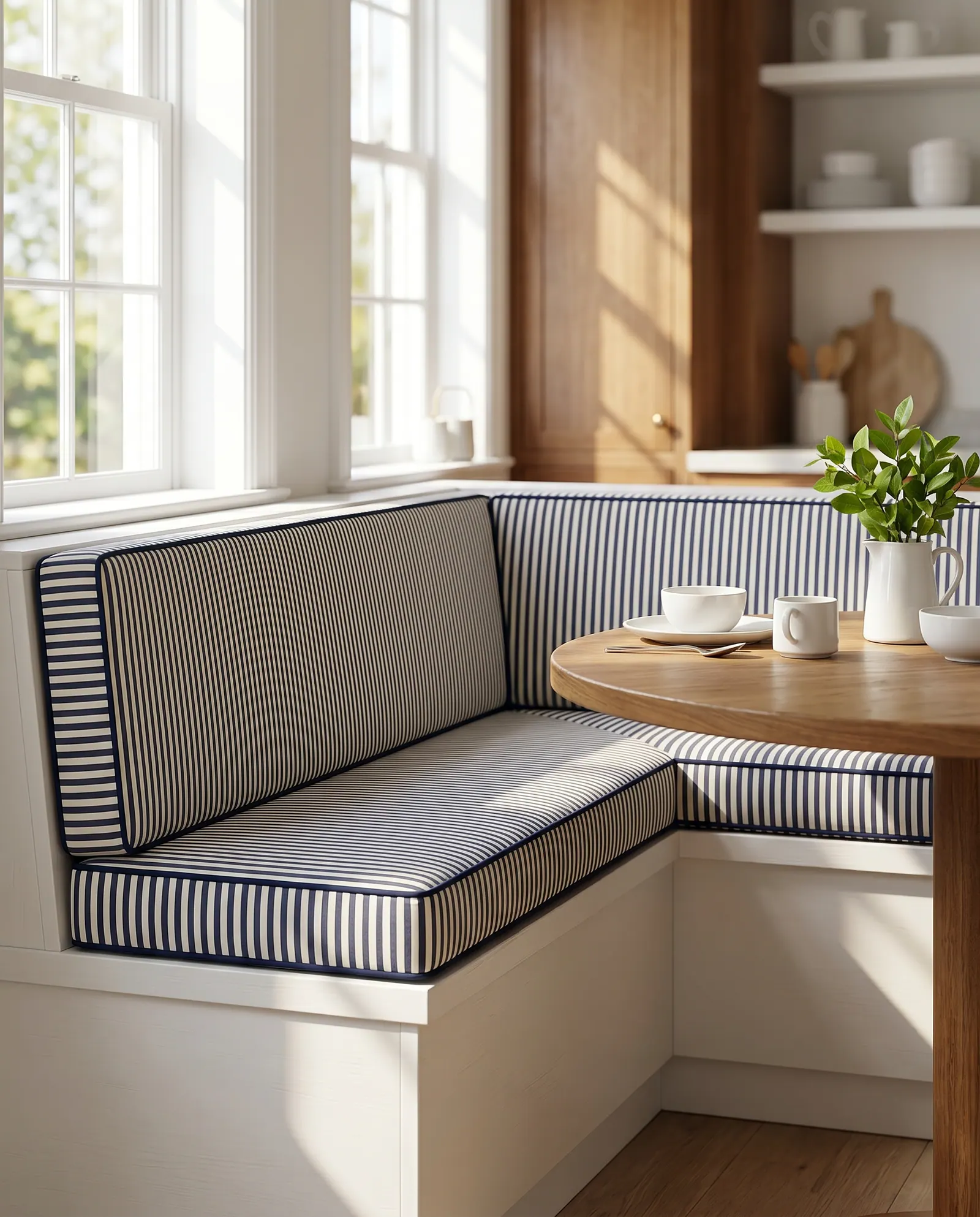
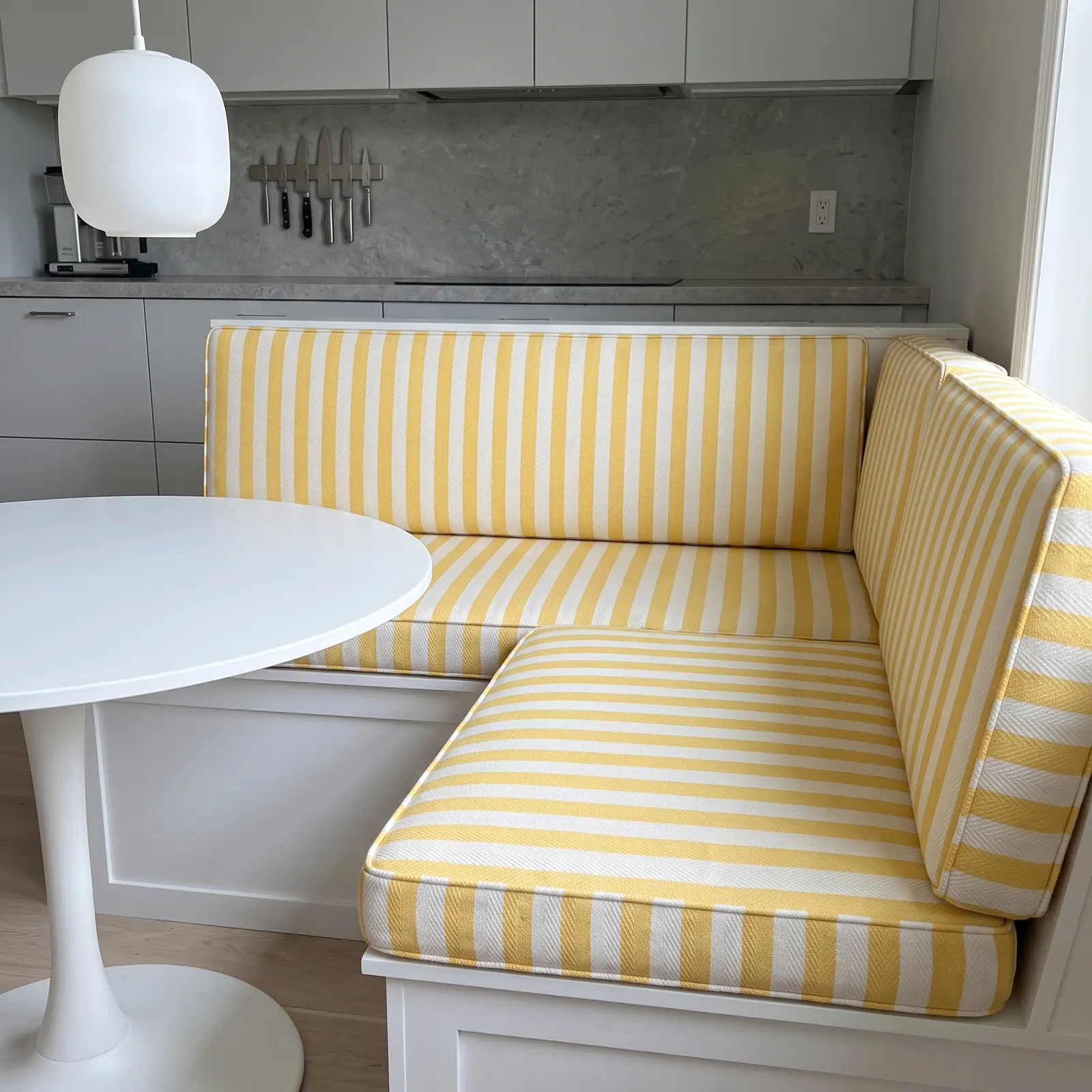
Nobody cut a diagonal seam for this corner, and that is the smartest decision in the photo. Each run of the L-shaped bench cushion is its own rectangle, butted into the corner. Simple shapes, straight stripes.
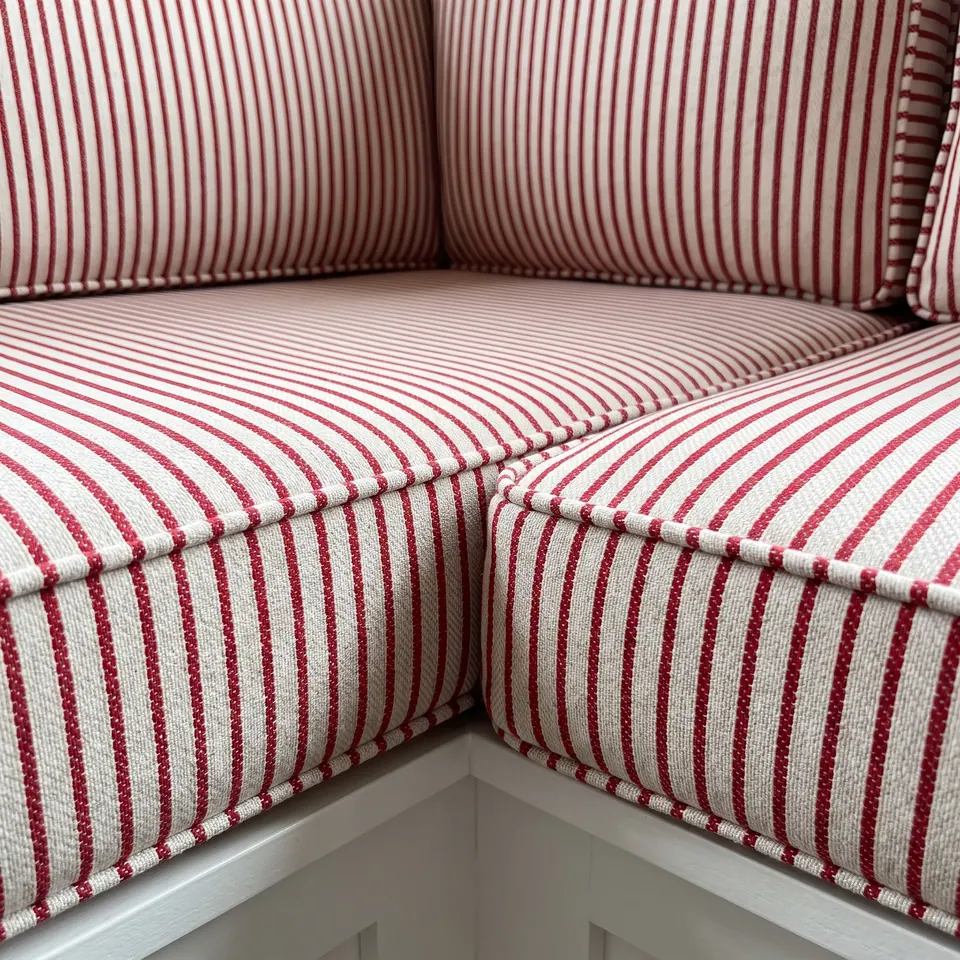
Think about ticking on an angle, partner. A mitered corner turns the stripes 90 degrees at the seam, and every small error shows. Two butted rectangles keep the navy lines running the way they were woven.
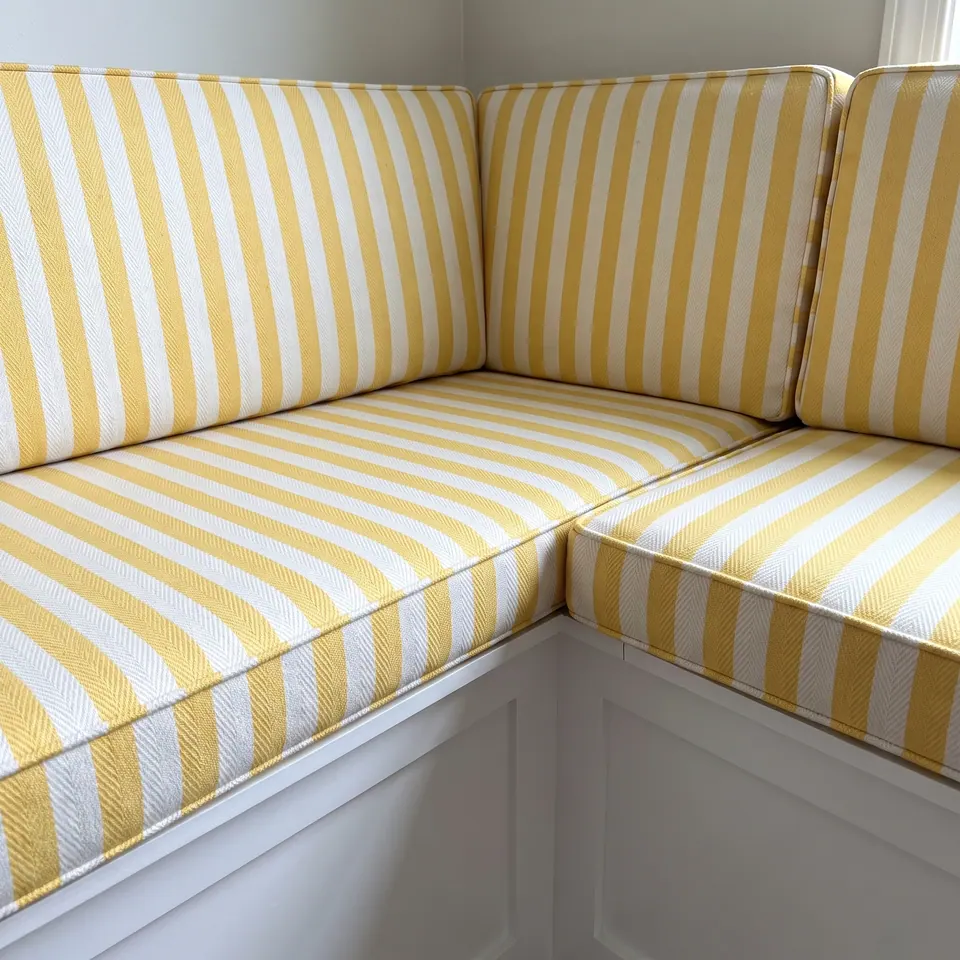
The edge is a box edge on every piece, seat and back. A box edge has a side wall, so the front face stands vertical and the solid navy piping traces each seam like a ruled line. Against white joinery, those lines draw the L for you.
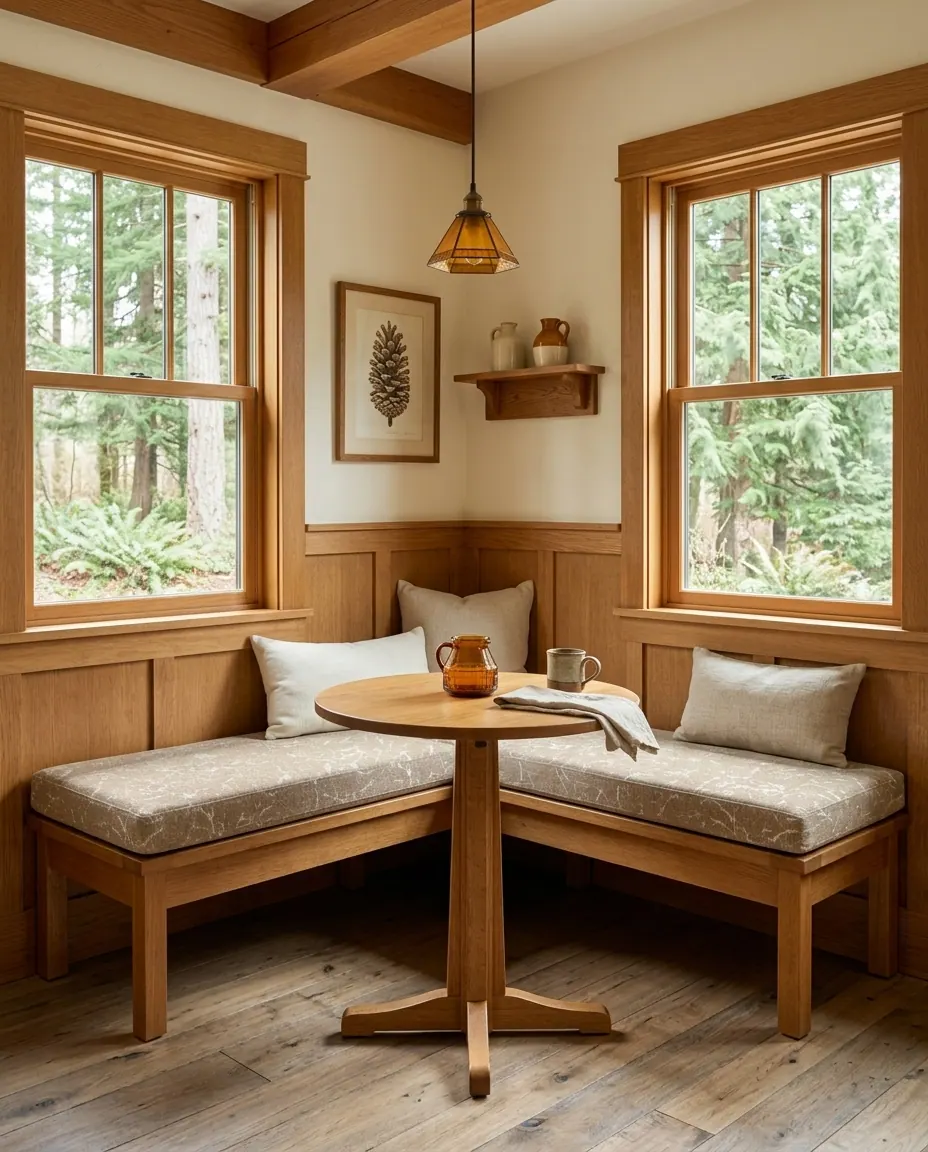
The back cushions are boxes too, standing upright on the seat against the wall. The round oak pedestal table does its part: no corners to bump, so people slide in from either side. White ceramics and a jug of green sprigs keep the table light against all that navy.
Measure twice; the fabric remembers. Decide which run overlaps at the corner before you measure, then read the L-shaped corner joint and box edge versus knife edge. Which run of your nook takes the corner? More sets live under L-shaped cushions and kitchen nook cushions; the fabric family is striped cotton and ticking.
Four edges, one banquette
| Edge or corner | What it looks like | On a banquette |
|---|---|---|
| Box edge | Flat top and bottom joined by a side wall, piped at each seam | Vertical front face and a crisp outline; the choice here |
| Knife edge | Two panels sewn at one seam, thinning toward the edge | Softer and pillow-like; less of a tailored line |
| Rounded corners | Corners curved from a set point on each edge | For benches with radiused corners; mark where each curve starts |
| Angled end | A trapezoid end on a run that turns at an angle | For banquettes that leave the wall at an angle; measure from the shop's diagram |
Pinned by Nate: the nook, point by point
Five pins, from the butted corner join to the round oak table that makes a corner seat easy to reach.
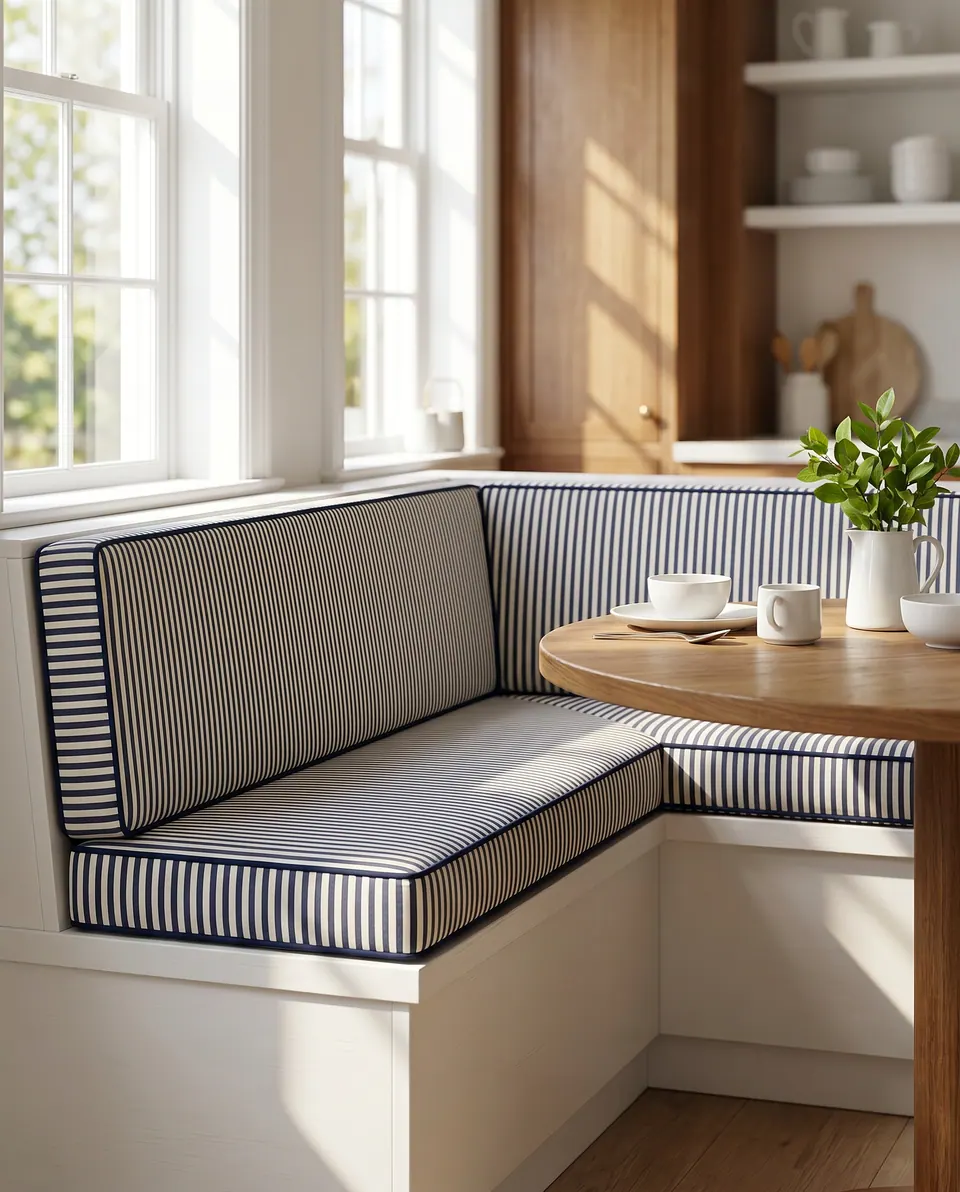
- Navy ticking seat
Each run is a separate rectangle butted into the corner.
- Box back cushion
Back cushions stand upright on the seat against the wall.
- Corner join
Decide which run overlaps at the corner before measuring.
- Solid navy piping
Dark piping outlines the L against white joinery.
- Round oak table
A round top makes sliding into a corner seat easy.
- Navy ticking seatEach run is a separate rectangle butted into the corner.
- Box back cushionBack cushions stand upright on the seat against the wall.
- Corner joinDecide which run overlaps at the corner before measuring.
- Solid navy pipingDark piping outlines the L against white joinery.
- Round oak tableA round top makes sliding into a corner seat easy.
66 in across, 44 in a side, and the wrong shape in the box
A buyer in the US asked for a corner floor cushion with backrests: 66 in (168 cm) across, 44 in (112 cm) along each wall, 14 in (36 cm) high overall. The style photo they sent showed rectangular tufted cushions.
So two rectangular seats arrived. They were too big for the corner. The backrests fit perfectly.
The workshop then made a single 44 x 44 in (112 x 112 cm) corner seat, and the buyer covered the shipping. The line I wrote in my notebook: a style photo shows the look, not the cut. Send a floor-plan sketch with every edge labeled, and point to the exact shape you want. The L-shaped bench measurements pattern shows how to label one.
Buyer questions: tolerance, thickness and angled runs
- A common question
How close to my measurements will the finished cushion be?
The workshop's answerHandmade custom cushions can vary by about 3/8 in (1 cm) in the final dimensions. Fully handmade tufted cushions can differ by 1 to 2 in (2.5 to 5 cm).
- A common question
What's the usual thickness for a breakfast nook seat cushion, and can I go thinner?
The workshop's answerThe shop suggested 6 or 7 in (15 or 18 cm) for a seat cushion. For a buyer whose bench was already high, it made one 3 in (7.5 cm) thick, foam-filled with a removable cover.
- A common question
Our dining banquette comes off the wall at an angle. How do I measure it for you?
The workshop's answerThe shop sends a diagram that shows which measurements it needs. Fill it in for your bench and send it back, and the quote and order link are made from those numbers.
On the cutting table: the ticking nook
| Product | L-shaped banquette cushion set, seats and backs |
|---|---|
| Pieces | One rectangle per run, butted at the corner |
| Fabric | Navy and ivory ticking stripe |
| Stripe | Straight on every piece; no mitered seam |
| Edge | Box edge on seats and backs |
| Piping | Solid navy contrast |
| Tolerance | About ± 3/8 in (1 cm) on handmade sizes |
| Table | Round oak pedestal, easy to slide past |
| Best for | Kitchen nooks and breakfast corners |

Have it made
Have this made — ask Nate’s workshop
Every edge and both diagonals, to the nearest 1/4 in. If the numbers do not close, the workshop will say so on the call. — Nate
Leave your details and the workshop will call you to confirm measurements, fabric, foam and piping. No prices, dates or payment on this page: it is a request, not an order.
A style photo shows the look, not the cut. For a corner seat 44 in along each wall, send a floor-plan sketch with every edge labeled.
Nate
Questions buyers ask next
Why use butted rectangles instead of one L-shaped piece on a banquette?
Rectangles are simpler to cut, keep ticking stripes straight, and each one lifts out on its own. The joint lands in the corner, where it is least noticed, instead of across the middle of a seat.
What is the difference between a box edge and a knife edge?
A box edge has a side wall between top and bottom, so the front stands square and holds piping crisply. A knife edge joins two panels at one seam and thins toward the edge, which looks softer.
Does navy piping suit a white built-in banquette?
It draws the outline. Solid navy piping on navy and ivory ticking traces each box edge, so the L-shape reads clearly against white joinery. Self piping in the stripe would soften that line.
Why pair a round table with a corner banquette?
A round pedestal top has no corners to catch knees, so people can slide into the corner seat from either side. A single central pedestal also leaves the corner free of table legs.
± 1/4 in — Nate
More photographs to read
 Save
 Save
 Save
 Save
 Save
 Save