A Reading by NateL-Shaped Corner Bench Cushions
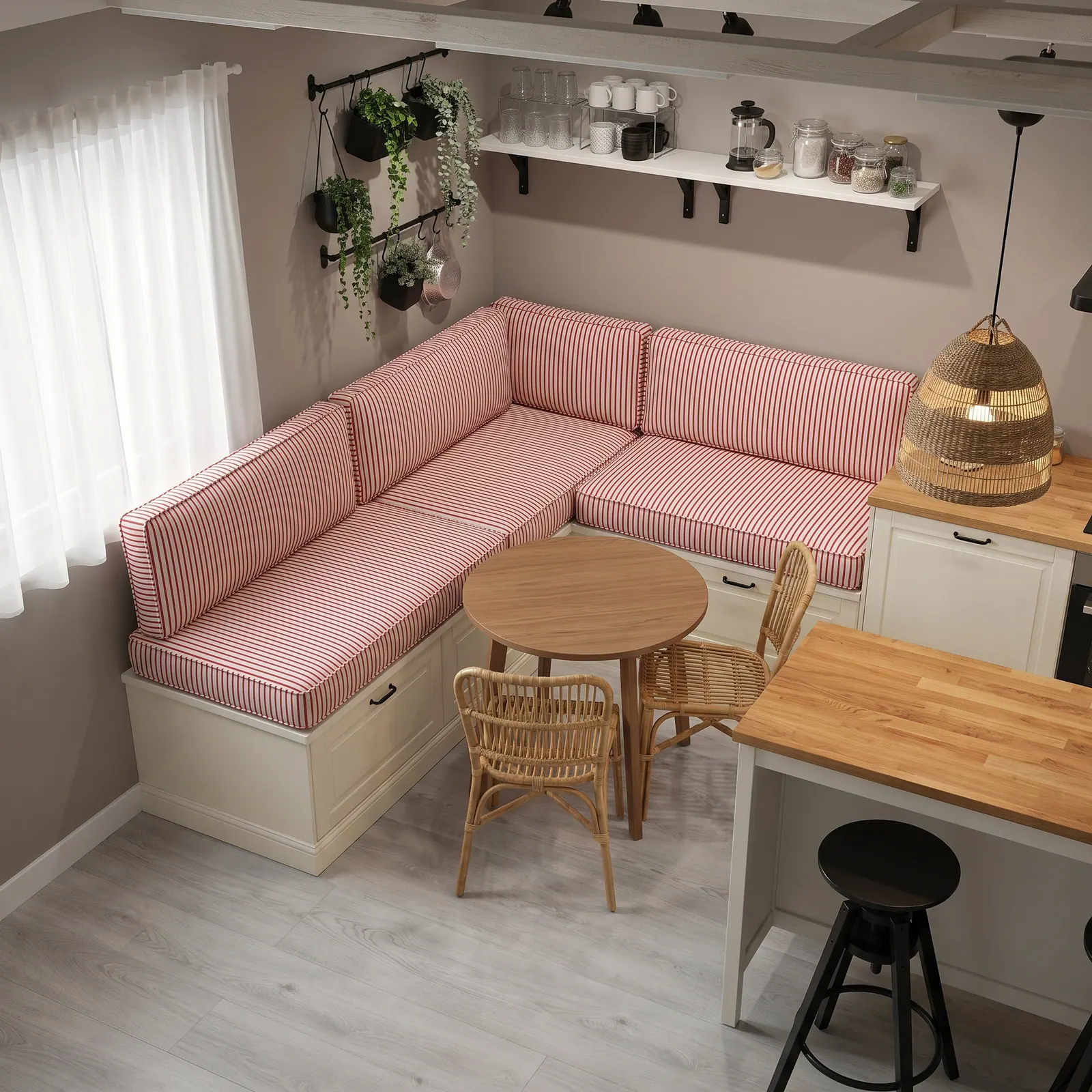
Anatomy of a red pinstripe L-shaped bench cushion set in a small kitchen
Nate takes apart a red and white pinstripe L around a round café table, seat runs, corner and four back pads, and shows why a tight kitchen corner seats so many.

 Save
The quick answer
An L-shaped bench cushion for a small kitchen nook works best as separate pieces: a long run, a short run and a square corner, each 4 in (10 cm) thick, with back pads split two per wall. Separate pieces forgive out-of-square walls, lift out for cleaning and wash one at a time, and a round table lets everyone slide in without corners.
The cushion, cut open
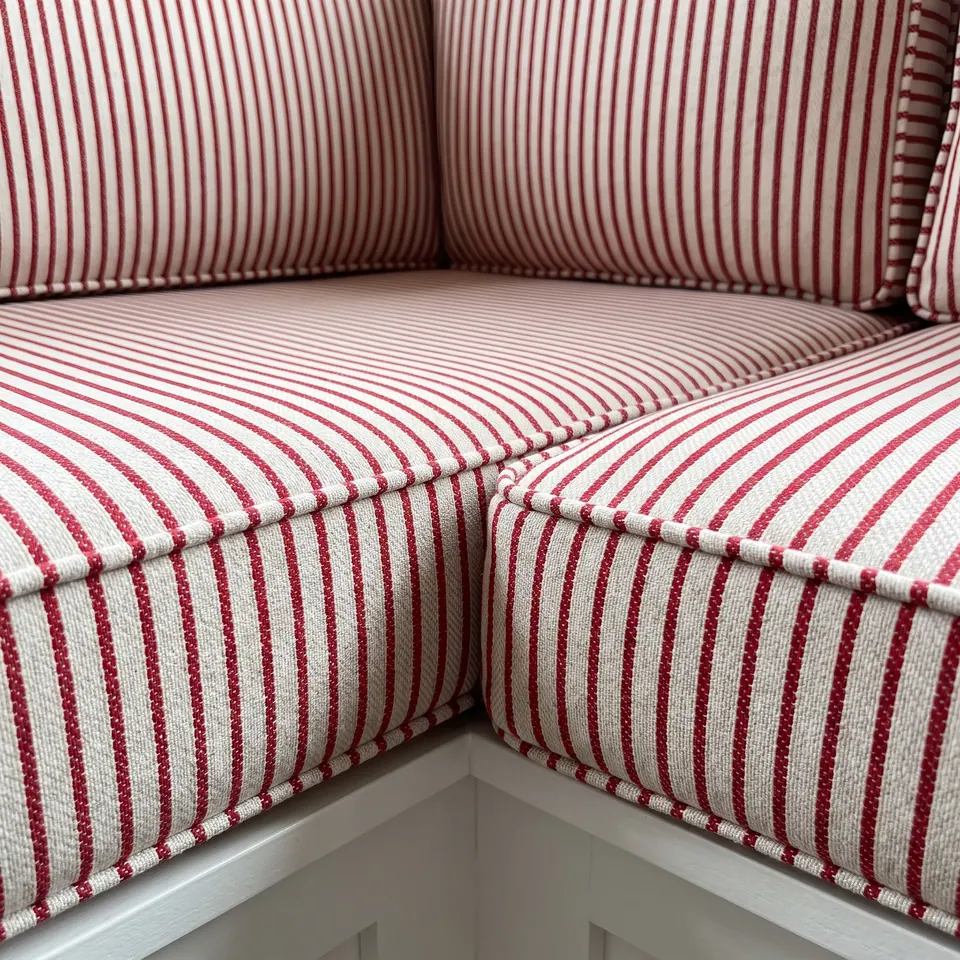
Cover fabric. A removable, zippered cover. Machine wash at 86°F (30°C) on a gentle cycle and air dry.
Piping. A fabric-covered cord sewn into the seams. It sits on the seam line, so it does not change the size.
Fiber wrap. Polyester fiber (Dacron) batting around the foam: it fills the cover out and softens the edges.
Foam core. About 2.0 lb/ft³ (32 kg/m³) high-resilience foam, firm to medium-firm, cut to the ordered size.
Zipper. Along the back band, as hidden as possible. The zipper side faces down or toward the wall.
Base panel. The underside of the cover. A non-slip fabric backing can cover the whole of it instead.
Pinned by Nate
Start at the split back pads on the left wall, then trace the pinstripe seat run to the round table, the hanging herbs and the rattan pendant.
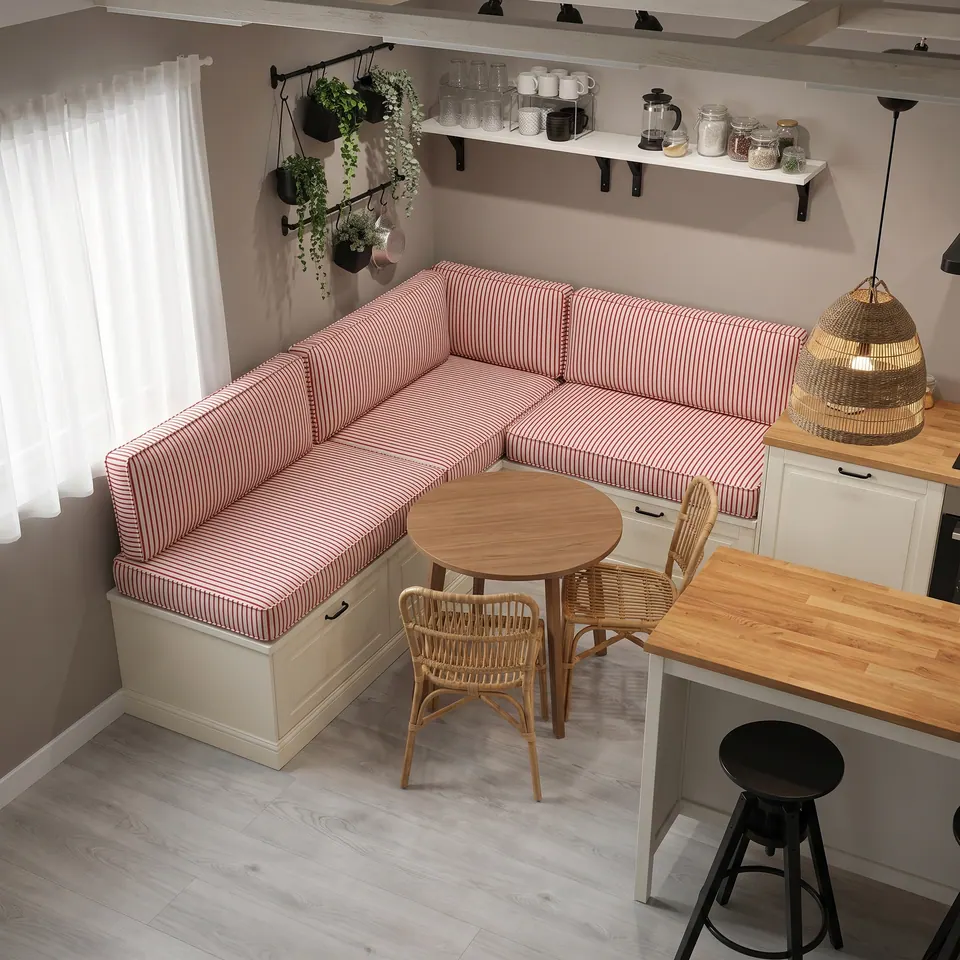
- Split back cushions
Two back pads on each wall make the long runs easier to lift and turn.
- Pinstripe seat run
Fine red stripes keep a long L of seating lively without looking busy.
- Round café table
A round top lets everyone slide in and out without corners in the way.
- Hanging herbs
Green planters over the bench balance the red stripe with a complementary color.
- Rattan pendant
Woven texture keeps the stripe from feeling nautical.
- Split back cushionsTwo back pads on each wall make the long runs easier to lift and turn.
- Pinstripe seat runFine red stripes keep a long L of seating lively without looking busy.
- Round café tableA round top lets everyone slide in and out without corners in the way.
- Hanging herbsGreen planters over the bench balance the red stripe with a complementary color.
- Rattan pendantWoven texture keeps the stripe from feeling nautical.
The L-shaped banquette, piece by piece
Here is the parts list for a small kitchen that seats more people than it should. Two cream drawer benches meet in an L around a round oak café table. Along both walls runs a red and white pinstripe box cushion with self piping, and above it sit four back pads, two per wall.
The anatomy, from the floor up: - Base: cream drawer benches, so the seat hides storage and the floor stays clear. - Seat runs: a long L of box cushions in a fine red stripe. Fine stripes keep a long run lively without shouting. - Edge: self piping. On a stripe this narrow, a contrast cord would add a third color to a two-color cloth. - Backs: split pads instead of one long cushion, so each is easy to lift, turn and wash. - Table: round, so knees and hips slide in and out without meeting a corner.
The props handle balance. Hanging herb planters on a black rail put green, red's complement, right over the bench. A woven rattan pendant and two rattan bistro chairs add texture, which keeps the stripe from feeling nautical. Glass jars on a wall shelf, a black bar stool and a butcher-block counter finish the farmhouse-café mood.
The small-space rule: the eye reads a continuous line as length. One stripe running the full L makes two short walls read as one long seat. How many people does your nook need to seat? Start the count in the kitchen nook cushion atlas, and find the cloth on the striped cotton and ticking shelf.
One continuous L or separate pieces?
| Point | One L-shaped piece | Runs plus a corner square |
|---|---|---|
| Out-of-square walls | Must match the corner angle exactly | Each piece forgives small errors |
| Handling | One large cushion to lift | Light pieces, lifted one at a time |
| Washing | The whole cover at once | One cover at a time |
| Look | Unbroken seat | Visible joints between pieces |
| Drawer access | The whole seat comes off | Lift only the piece above the drawer |
Four cushions or one L? A buyer's real numbers
A buyer wrote in with an L-shaped nook plus a separate narrow bench, and weighed two builds. Build A: four cushions, a long side of 59 x 19 in (150 x 48 cm), a short side of 47 x 19 in (119 x 48 cm), a 19 x 19 in (48 x 48 cm) corner square and a 35 x 10.5 in (89 x 27 cm) straight bench, all 4 in (10 cm) thick. Build B: one continuous L plus the straight bench. Striped linen was on the table.
The shop priced the four pieces one by one, offered them together as a set for less, and checked every measurement against its template before sending the purchase link.
My note on the drawing, partner: a separate corner square often fits better than one L-piece, and it is easier to wash. Measure twice; the fabric remembers. The corner options are drawn out in L-shaped cushion corner joints, and sizes collect in the L-shaped cushion atlas.
On the cutting table: the pinstripe L
| Layout | L-shaped seat runs plus four back pads |
|---|---|
| Fabric | Red and white pinstripe cotton |
| Piping | Self |
| Edge | Box |
| Thickness | 4 in (10 cm) standard; 3 in (7.5 cm) or thicker on request |
| Corner | Separate square piece recommended |
| Backs | Split, two pads per wall |
| Table | Round café top |
| Best for | Small kitchen nooks and breakfast corners |

Have it made
Have this made — ask Nate’s workshop
Send the numbers in inches: length × depth × thickness, plus any angle. The workshop checks them with you, because foam has no undo button. — Nate
Leave your details and the workshop will call you to confirm measurements, fabric, foam and piping. No prices, dates or payment on this page: it is a request, not an order.
Parts bin: piping, payment, thickness
- A common question
I'm not sure which piping color would go best with my main fabric. What would you suggest?
The workshop's answerThe shop suggests combinations and sends example photos: cream piping for a soft contrast, a tone-on-tone green or a contrasting gold on a chenille, or forest green piping with burnt terracotta. Piping can also be the same fabric as the body, and the full range is on the fabric-samples listing.
- A common question
You sent me a custom quote. How do I actually pay for it?
The workshop's answerOn the listing, choose the size option called 'Custom for' followed by your name, which is set to your quoted price, or use the custom order link the shop sends. Then write your fabric code, piping choice and exact size in the personalization or note-to-seller box.
- A common question
How thick is the cushion, and can I change it?
The workshop's answerStandard is 4 in (10 cm), as in most listing photos. Thickness can be customized, for example 3 in (7.5 cm) or thicker, and the shop can send photos of a 3 in example.
In a small kitchen nook, a round table inside an L-shaped bench lets everyone slide in and out without a single corner in the way.
Nate
Questions buyers ask next
Round or square table for an L-shaped kitchen banquette?
Round, in a small room. A round top lets people slide in and out without catching a hip on a corner, and it leaves more walkway in a tight kitchen, as the café table does inside this L.
Do split back pads look less tidy than one long back cushion?
Not when they are matched and evenly spaced. Two pads per wall read as tailored, and each is far easier to lift, turn and wash than one long piece running the whole wall.
How do you keep a red and white stripe from looking nautical?
Add texture and a warm material. Rattan chairs and a woven pendant break up the crisp stripe, and green herbs overhead bring in red's complement. Without them, red and white stripes drift toward the seaside.
Is 3 in thick enough for a kitchen banquette cushion?
It can be. The standard is 4 in (10 cm), which suits most kitchen benches, but 3 in (7.5 cm) is made on request and works where the bench is already tall for the table. Ask for example photos before choosing.
± 1/4 in — Nate