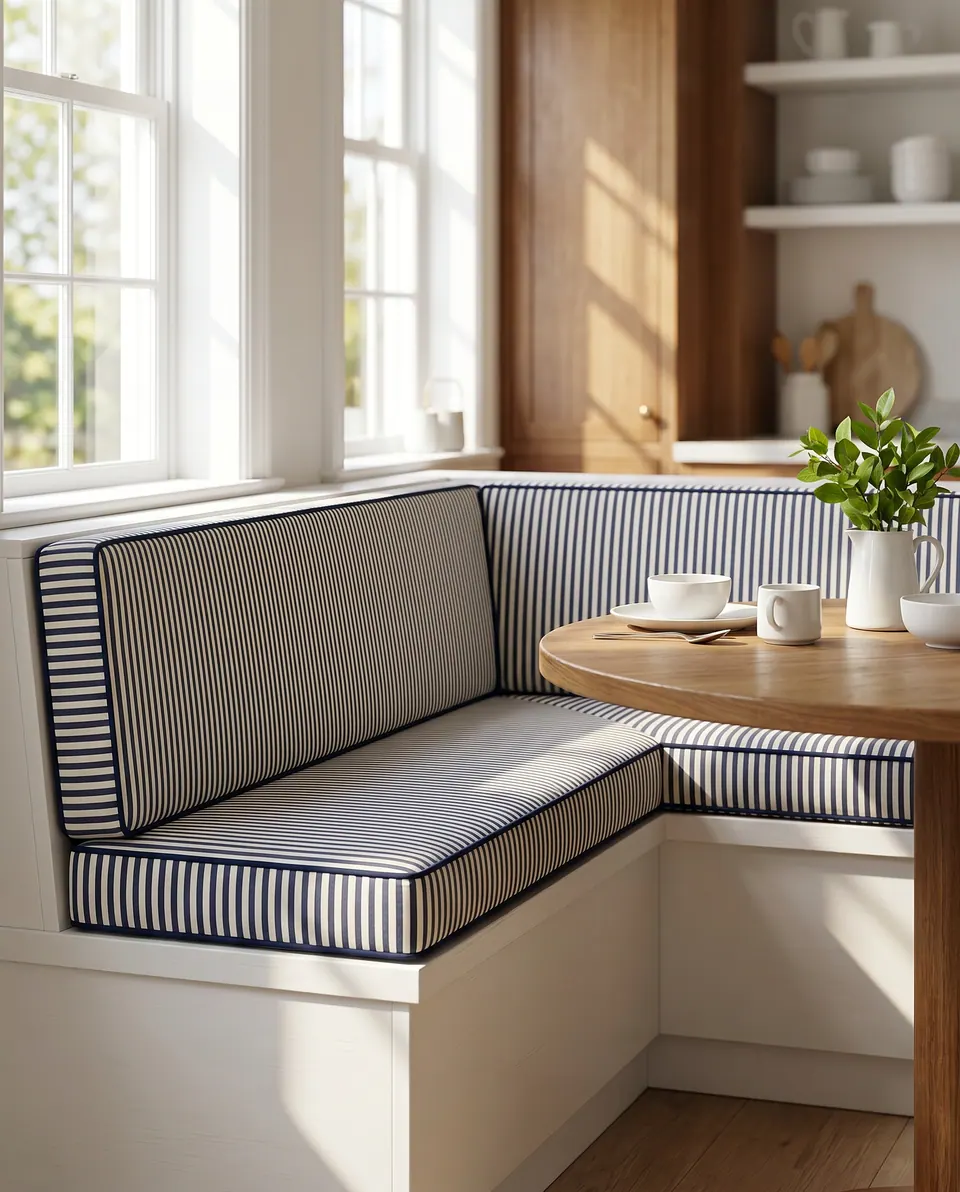
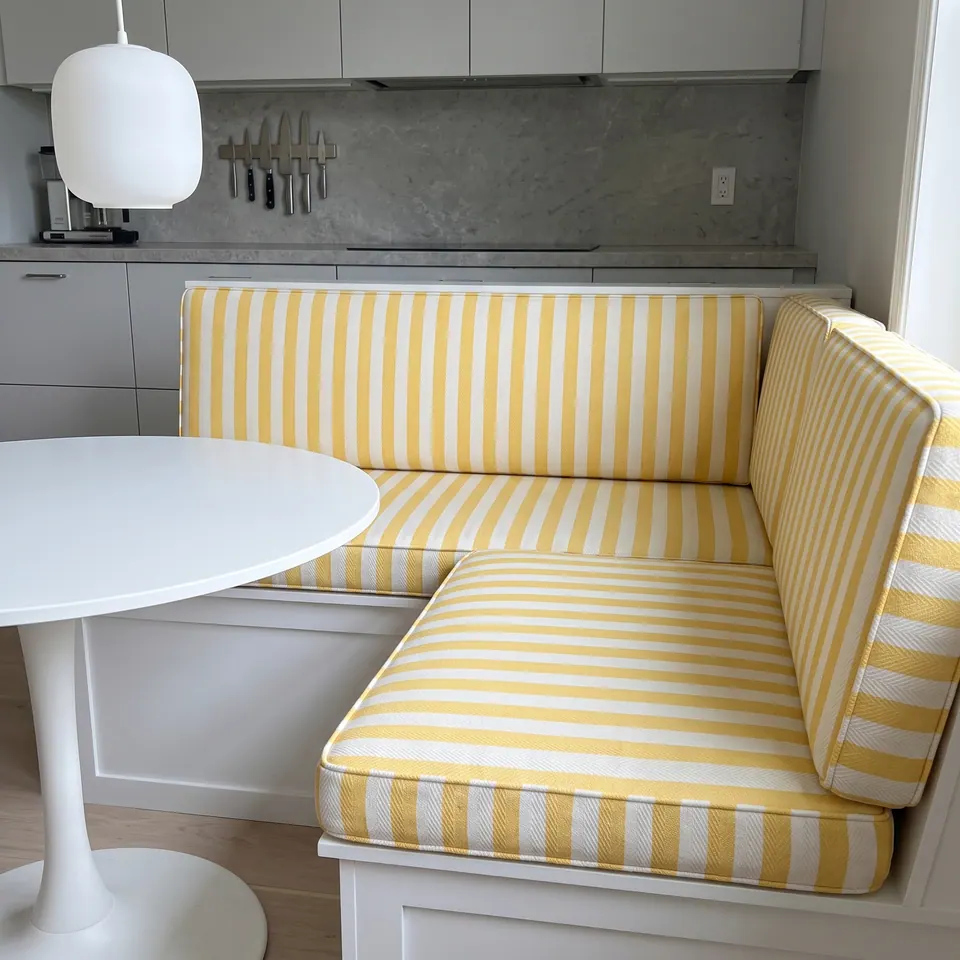
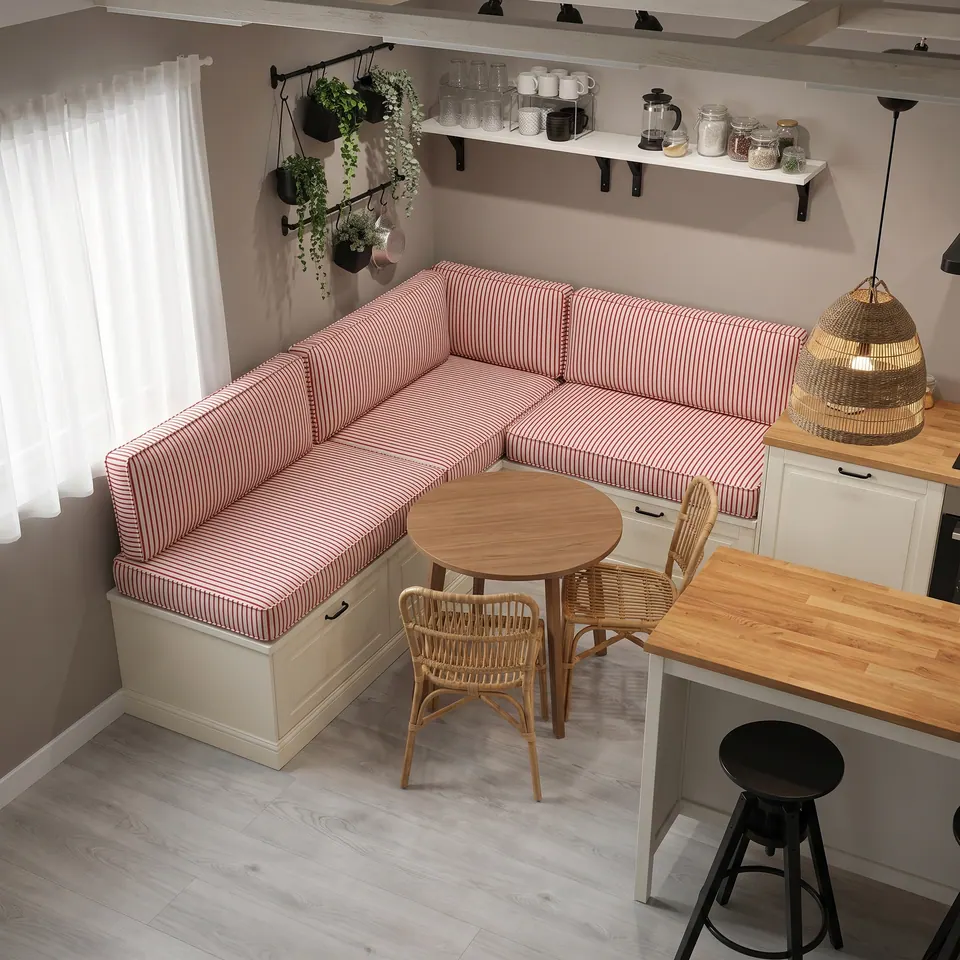
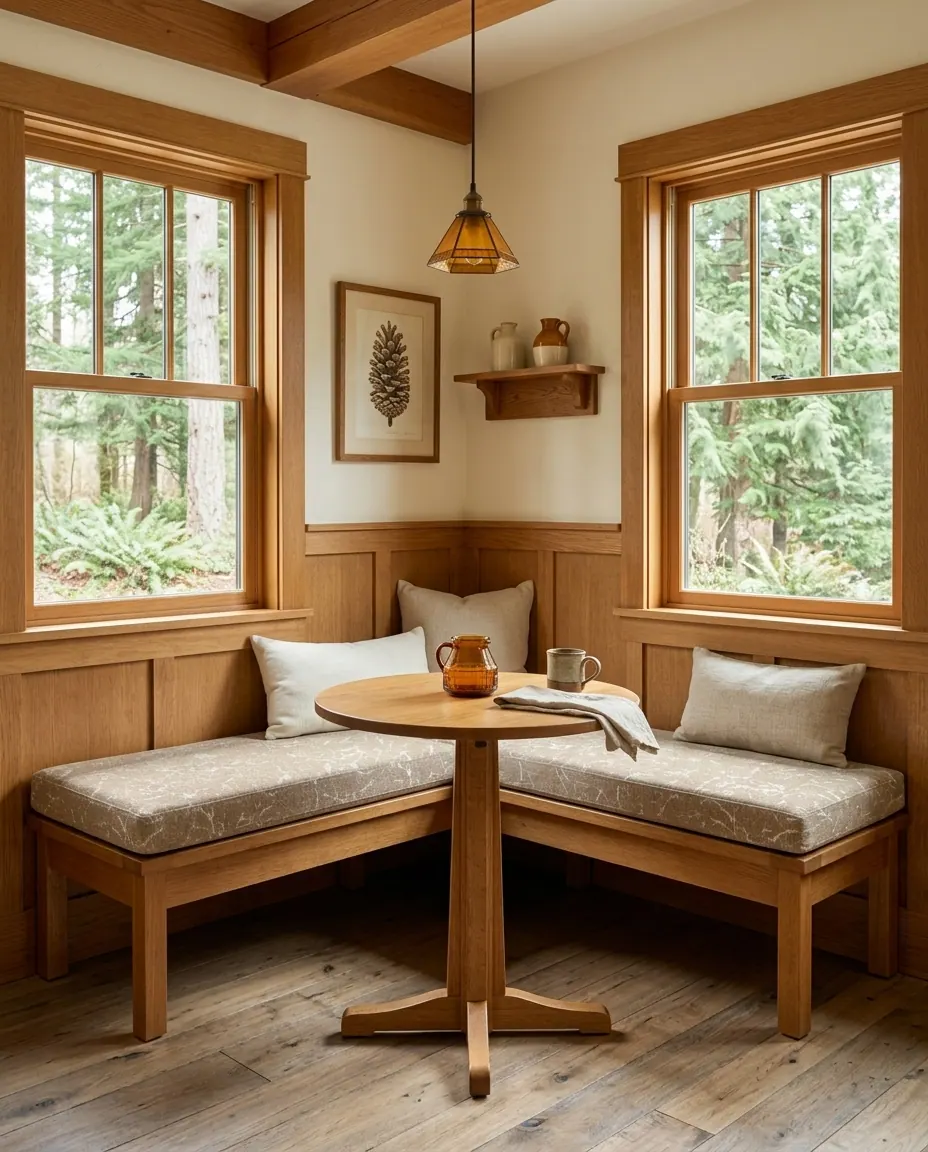
 Save
- Vertical stripe backs
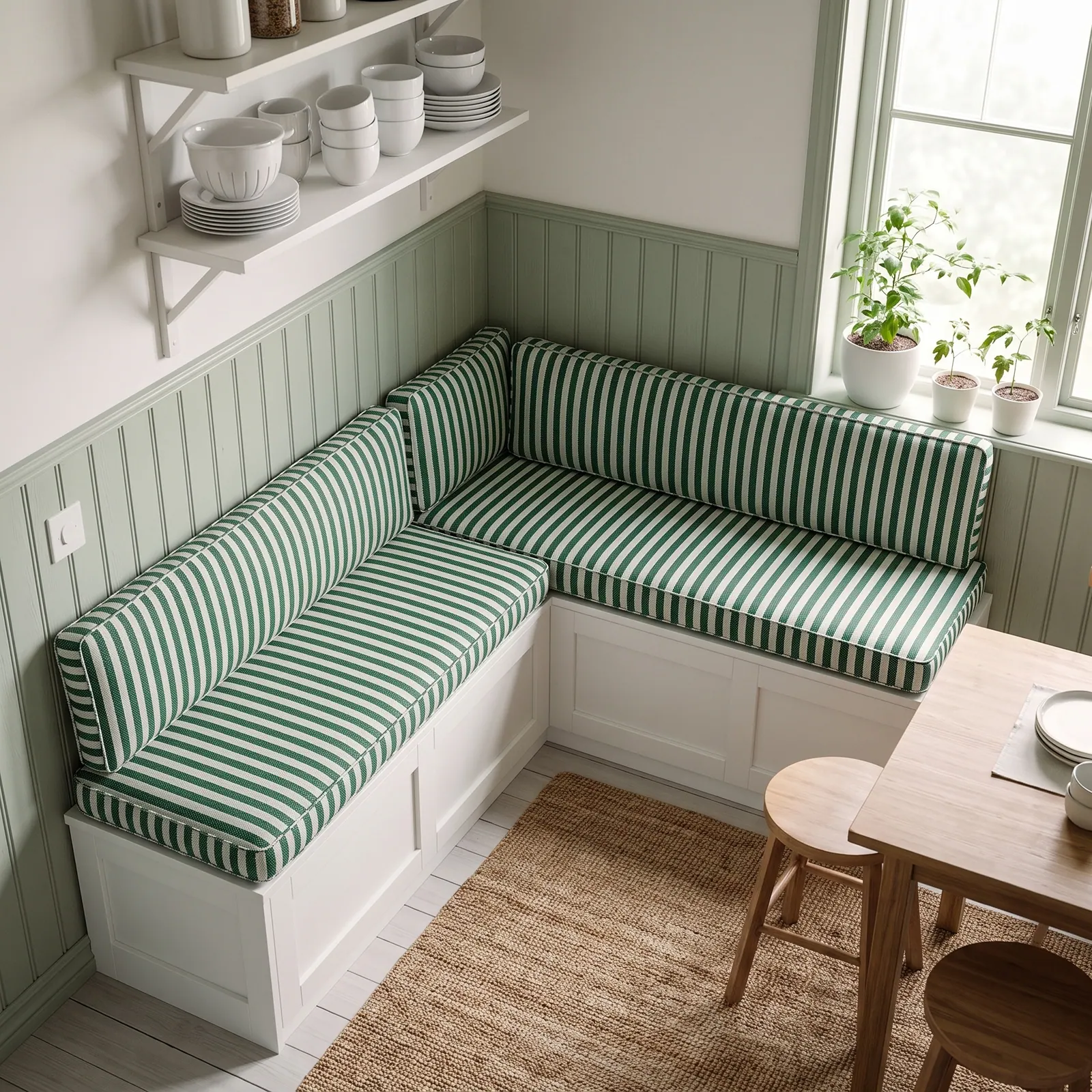
Stripes run top to bottom on the backs to echo the beadboard grooves.
- Front-to-back seat stripe
Seat stripes run toward the sitter, keeping the lines clean where the L turns.
- Window wall back
The long back pad stops at the window so the sill stays free for plants.
- Open dish shelves
White crockery above repeats the white stripe of the fabric.
- Jute rug
A natural rug grounds the crisp green and white stripe.
Plate Green Awning-Stripe Corner Banquette in a Beadboard Cottage Kitchen
A classic green awning stripe makes this beadboard corner bench look original to the house.
A Reading by NateL-Shaped Corner Bench Cushions
A green-stripe L-shaped bench cushion, budgeted line by line
Nate reads a cottage-kitchen corner banquette in green and white awning stripe and sorts the line items: which ones buy you years, and which ones can wait.

The quick answer
On an L-shaped bench cushion, spend on what takes daily load and is hard to redo: the corner geometry, the seats and zippered covers you can wash. Save on the rest. Backrests are sold separately, so add them later and only where people lean, and skip tufting in a kitchen, because a tufted backrest cannot have a zipper.
Pinned by Nate
Five pins mark the vertical stripe on the backs, the front-to-back stripe on the seats, the back pad that stops at the window, the dish shelves and the jute rug.
The numbers match the pins on the plate.
- Vertical stripe backsStripes run top to bottom on the backs to echo the beadboard grooves.
- Front-to-back seat stripeSeat stripes run toward the sitter, keeping the lines clean where the L turns.
- Window wall backThe long back pad stops at the window so the sill stays free for plants.
- Open dish shelvesWhite crockery above repeats the white stripe of the fabric.
- Jute rugA natural rug grounds the crisp green and white stripe.
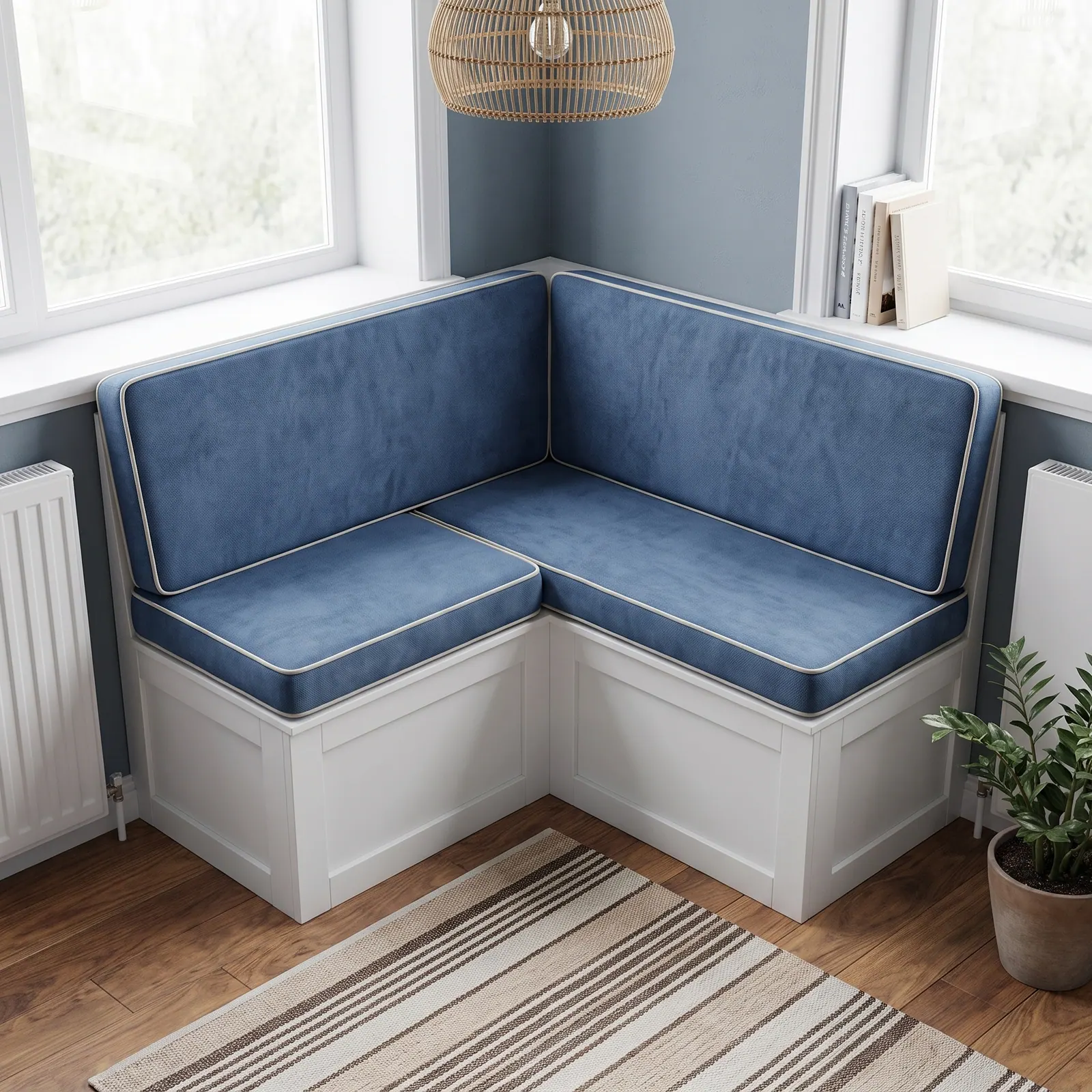
Reading the corner: where the stripes turn
In this photo the stripe direction is worth more than the fabric. Look at where the L turns.
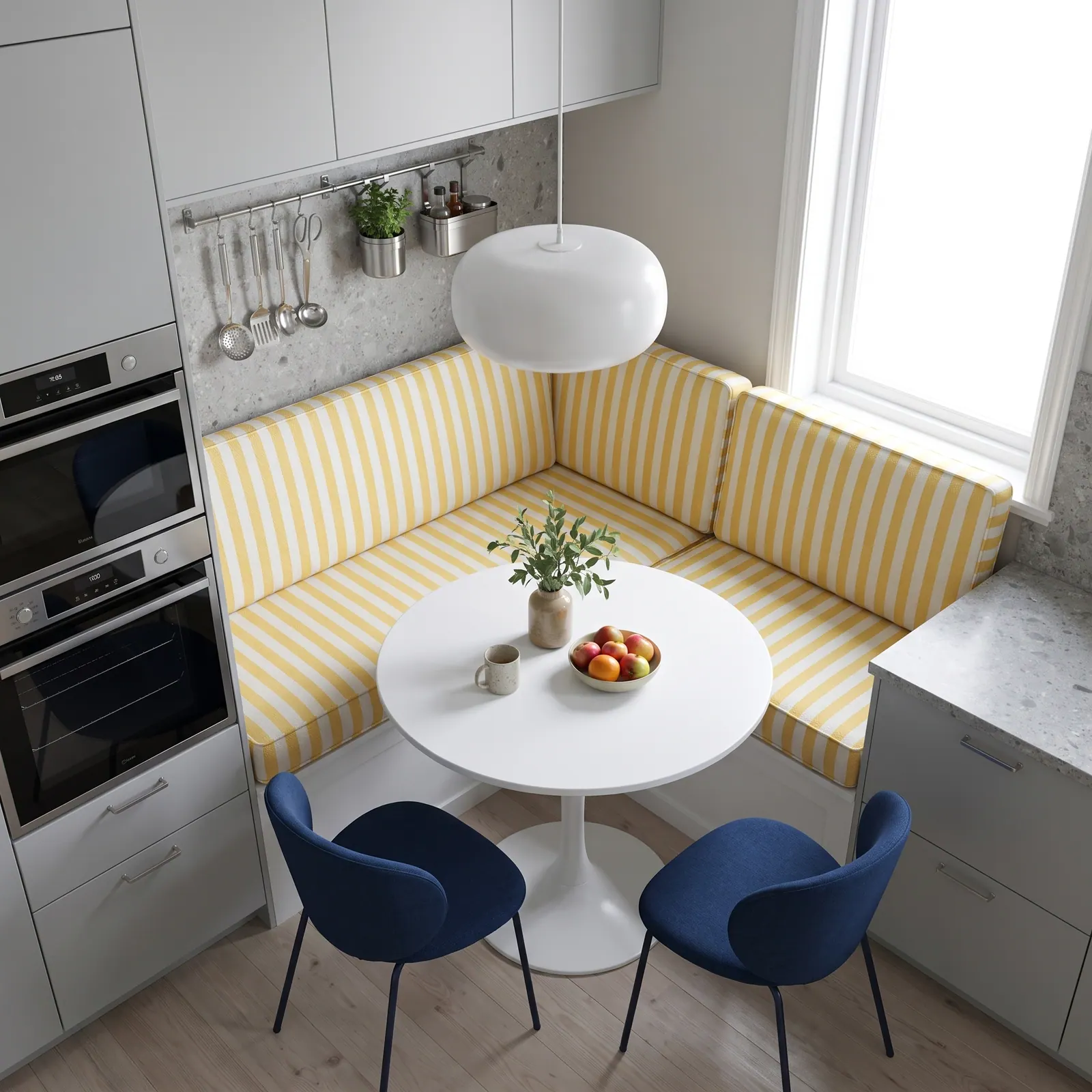
On the backs, the green and white bands run top to bottom, in step with the grooves of the sage beadboard. On the seats they run front to back, toward the person sitting. That choice lets every stripe land cleanly at the corner joint instead of meeting its neighbor at a crooked angle. Angles are just lengths in disguise, and stripes expose every one of them.
The proportions are disciplined too. Box edges with self piping keep the profile square along both runs. The long back pad stops at the window, so the sill stays clear for potted herbs.
The props set the palette. White bowls and plates on the open shelves repeat the white stripe. A jute rug and wooden stools warm up the green. The wooden table set with white plates says breakfast happens here every day, which is exactly why the budget questions matter: a kitchen corner is one of the hardest-working seats in a house.
Before you price one, read the corner joint pattern and the notes on stripe direction. For the same classic look, browse striped cotton and ticking.
L-shaped banquette cushions: spend or save?
| Line item | Spend or save | Reason |
|---|---|---|
| Corner geometry | Spend | Which piece owns the corner is decided once and shows every day |
| Zippered covers | Spend | In a kitchen, a cover that comes off beats a cushion you replace |
| Tufting | Save | Buttons look sharp but rule out a zippered backrest |
| Backrests | Save for now | Sold separately, so add them later and only where people lean |
| Sections at storage lids | Spend the planning time | One cushion per lid keeps every lid usable |
90 x 65 inches, solved from the depth first
A buyer wanted an L-shaped floor sofa in corduroy for a living-room corner with window views. The standard sectional was too big; the footprint could be at most 90 x 65 in (229 x 165 cm).
Here is the arithmetic the shop used. Each sofa is 39 in (99 cm) deep, and depth does not flex.
- Arm one: a 65 in (165 cm) sofa along the short wall.
- Arm two: 90 minus 39 leaves 51, so a 51 in (130 cm) sofa butts against the first one's depth.
- Result: an L of exactly 65 x 90 in (165 x 229 cm).
That order was quoted at 7 days of production and 3 to 5 days of delivery.
The same rule sizes a kitchen banquette. Fix the depth first, then share out the remaining length between the arms. It costs nothing and saves a remake. The L-shaped measuring pattern has the worksheet, partner.
Buyer questions: tufted sizes, backrests alone and lids that flip
- A common question
How do I order the tufted French mattress style in a size that isn't listed?
The workshop's answerOrder through the tufted (French mattress) listing, select the size closest to yours and type the exact measurements and fabric color in the personalization field; the color dropdown may be disabled there. If your size is far from every option, message first so the shop can say which one to pick.
- A common question
Can I buy just a backrest, or just the round bolsters?
The workshop's answerYes, both are sold separately. One buyer ordered two backrests 4 in (10 cm) thick, one 7 x 63.75 in (18 x 162 cm) and one 7 x 56 in (18 x 142 cm). A backrest can have a zipper as long as it isn't tufted.
- A common question
My bay window seat has three lids that flip up. How should the cushions be made?
The workshop's answerSend clear photos and the measurements. The shop recommended three separate cushions, one for each flip-up section, so each lid can open on its own.
On the cutting table: the beadboard corner
| Product | L-shaped bench cushions: two seats and back pads |
|---|---|
| Fabric | Forest green and white awning-stripe cotton |
| Stripe direction | Top to bottom on the backs, front to back on the seats |
| Edge | Box edge |
| Piping | Self piping in the stripe |
| Base | White L-shaped storage bench |
| Wall | Sage green beadboard |
| Back pad | Stops at the window so the sill stays free |
| Best for | A cottage kitchen nook used every day |

Have it made
Have this made — ask Nate’s workshop
Precision starts on the phone. Give the workshop your measurements and they will read them back to you, edge by edge. — Nate
Leave your details and the workshop will call you to confirm measurements, fabric, foam and piping. No prices, dates or payment on this page: it is a request, not an order.
On an L-shaped bench cushion, run the stripes front to back on the seats and top to bottom on the backs, and the pattern meets cleanly at the corner.
Nate
Questions buyers ask next
Where should the money go on a kitchen banquette cushion?
Into what is hard to fix later: the corner joint, the seats that take daily load and covers you can remove after spills. Extras such as tufting or more back pads can be skipped or added later.
Is a tufted banquette cushion harder to keep clean?
It can be, because a tufted backrest can't have a zipper, so its cover doesn't come off for washing. In a kitchen, a plain box cushion with a zippered cover is the easier long-term choice.
How do I fit an L-shaped seat into a fixed footprint?
Start from the depth, which doesn't change, then split the remaining length. With 39 in (99 cm) deep pieces in a 90 x 65 in (229 x 165 cm) corner, one arm is 65 in and the other is 90 minus 39, or 51 in.
± 1/4 in — Nate
More photographs to read
 Save
 Save
 Save
 Save
 Save
 Save