A Reading by NateL-Shaped Corner Bench Cushions
One Dove Gray L-Shaped Bench Cushion Around a 45-Degree Corner
Nate takes a corner reading nook apart the way he used to take apart car seats: runs, angles, the piping line and where the load goes.

 Save
The quick answer
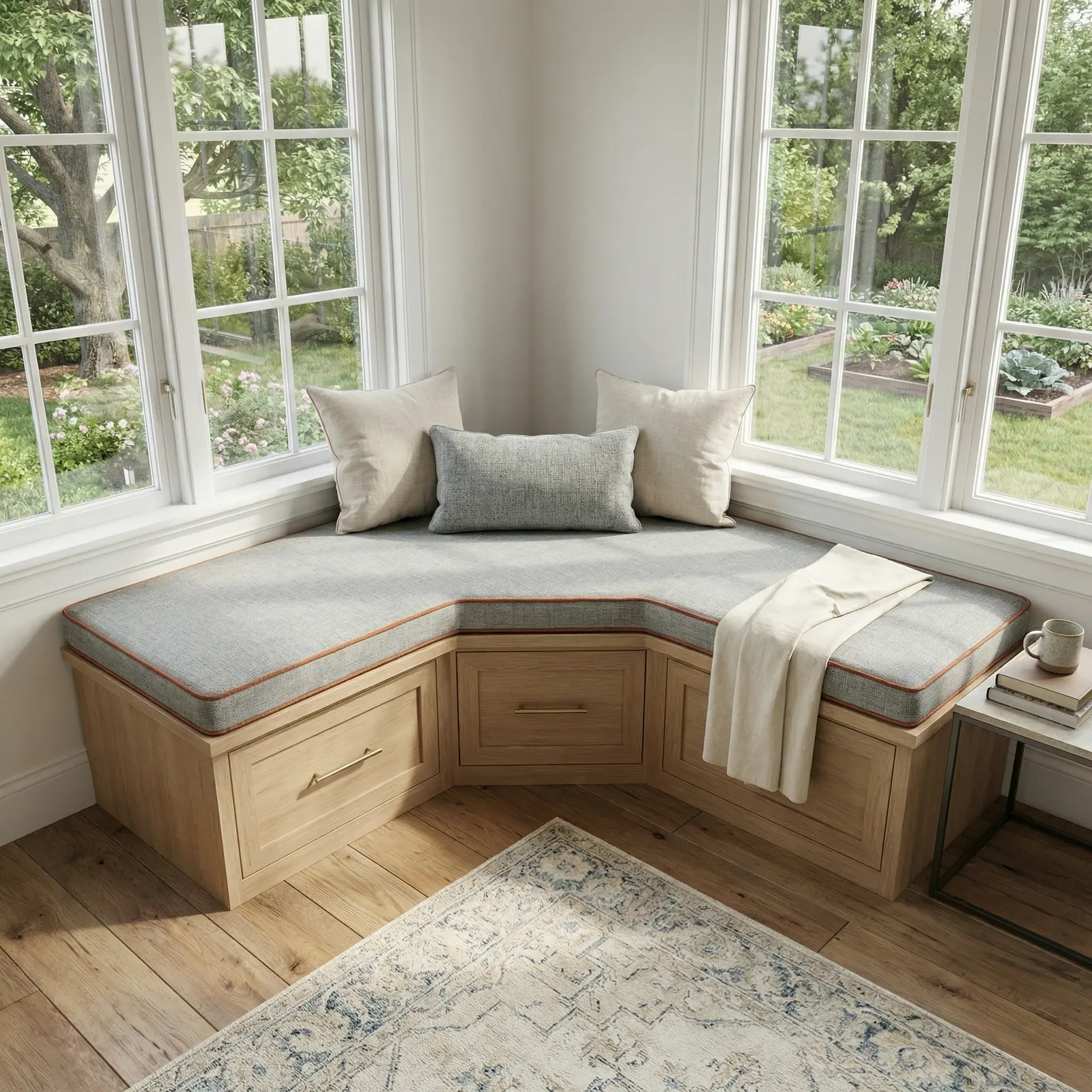
An L-shaped bench cushion for a chamfered corner nook works best as one piece that follows all three runs, left, angled center and right, so there is no seam where people lean. Measure each run along the wall and the front edge, note the 45-degree angles, and order from a card template. Caramel piping here traces the outline in the oak's tone.
The cushion, cut open
Cover fabric. A removable, zippered cover. Machine wash at 86°F (30°C) on a gentle cycle and air dry.
Piping. A fabric-covered cord sewn into the seams. It sits on the seam line, so it does not change the size.
Fiber wrap. Polyester fiber (Dacron) batting around the foam: it fills the cover out and softens the edges.
Foam core. About 2.0 lb/ft³ (32 kg/m³) high-resilience foam, firm to medium-firm, cut to the ordered size.
Zipper. Along the back band, as hidden as possible. The zipper side faces down or toward the wall.
Base panel. The underside of the cover. A non-slip fabric backing can cover the whole of it instead.
Anatomy of a chamfered nook cushion
A corner nook has three seats hiding in it, and most cushion orders only count two. This one counts all three.
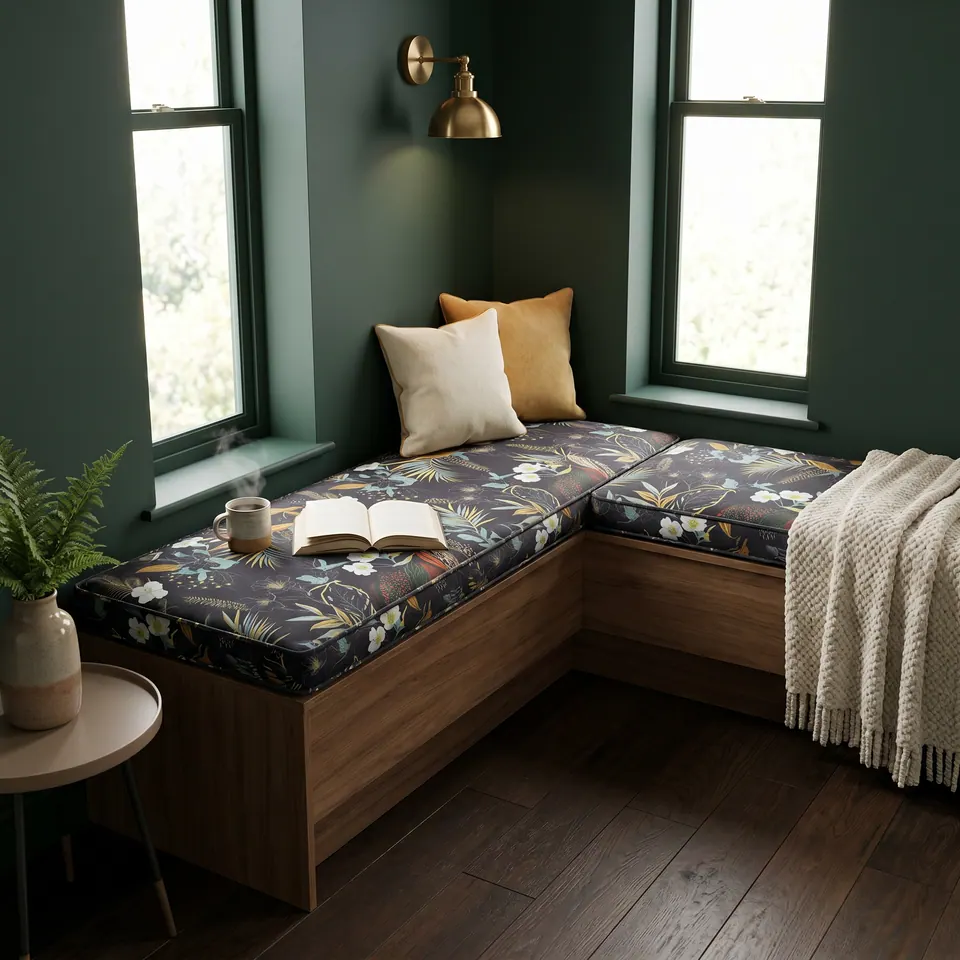
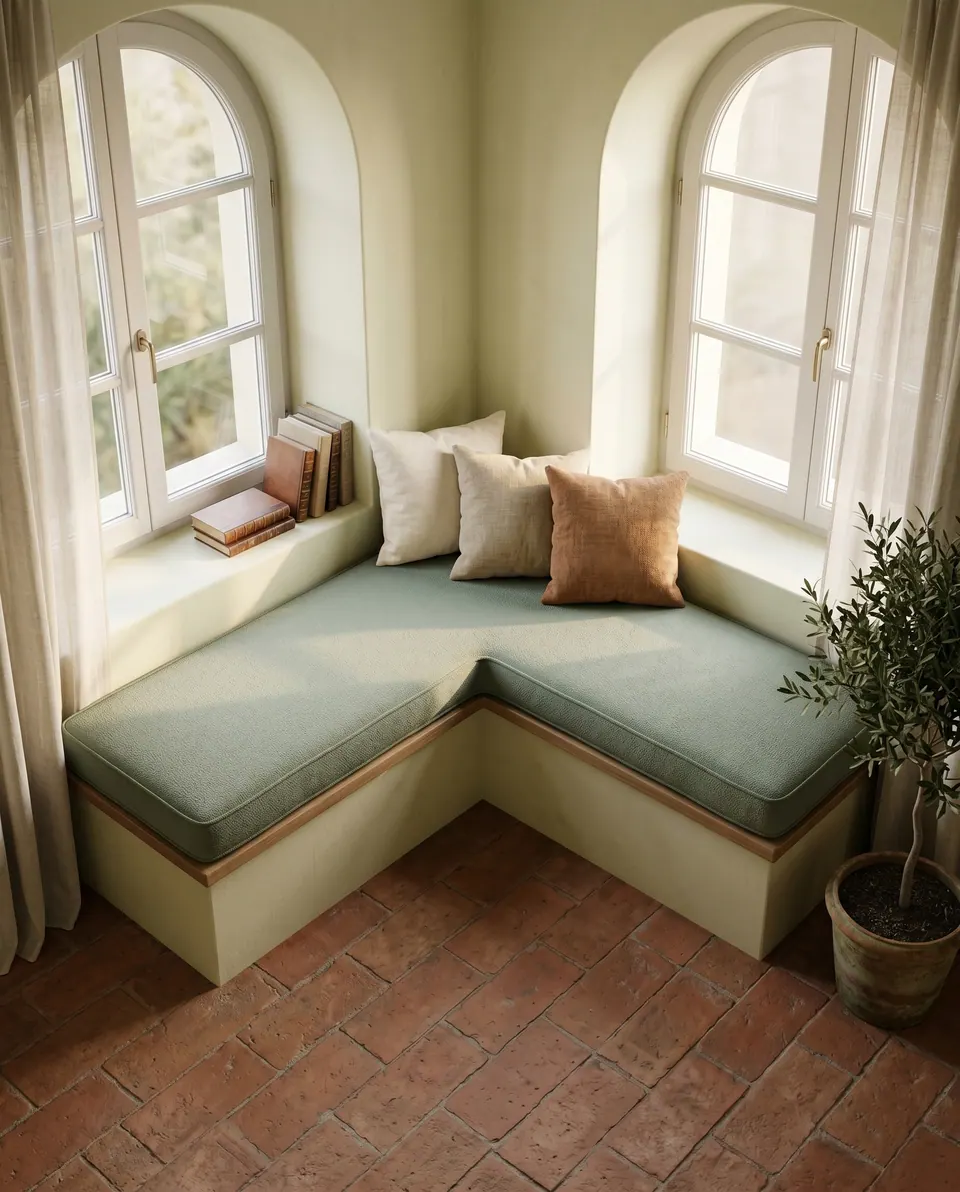
Read the plan from above. The oak drawer base turns the corner in three runs: a left run, a center run set at 45 degrees, and a right run. The L-shaped cushion follows it as one piece, so the chamfered center has no seam. That matters, because the center is exactly where people lean. Two straight pads meeting there would put a join under your spine.
Now the cross-section. A dove gray linen-look top panel, a box gusset standing straight around the edge, and caramel contrast piping at the seam. Caramel matches the oak drawers, so the outline of an unusual shape is drawn in wood tone. On an odd plan that's useful: the eye reads the shape as deliberate.
The load path tells you where the props go. Two ivory pillows frame a gray linen lumbar at the angled center, the natural backrest. A cream throw marks the end nearest the black metal side table, where the books and mug live. Storage sits in drawers with brass pulls, so the cushion never has to lift. In a small space, that's the quiet win: one piece, zero seams, nothing to move.
Cool garden light from the two windows keeps the gray calm, and a faded blue and ivory vintage rug softens the floor. More odd corners are drawn up in the angled corner bench cushions sketch and across our reading nook cushions.
Five pins, left run to open end
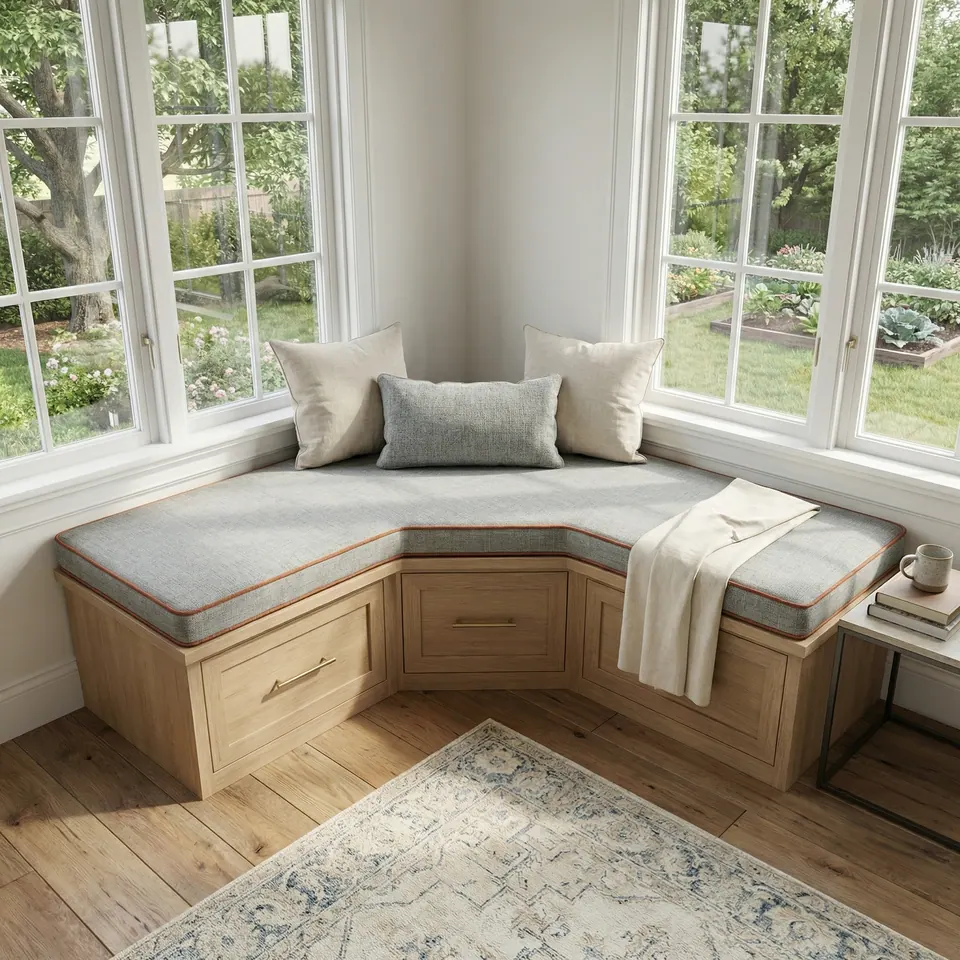
Five pins, left to right: the lumbar at the angle, the ivory squares, the caramel welt, the unbroken chamfer and the side table at the open end.
- Gray lumbar pillow
The lumbar sits at the angled center, the natural backrest of a corner nook.
- Ivory pillows
Two plain ivory squares frame the lumbar and brighten the corner.
- Caramel piping
Caramel matches the oak drawers, so the complex outline is traced in wood tone.
- Chamfered center
One cushion turns the 45-degree corner, so there is no seam between the two runs.
- Side table
Books and a mug sit on a table at the open end, keeping the cushion clear.
- Gray lumbar pillowThe lumbar sits at the angled center, the natural backrest of a corner nook.
- Ivory pillowsTwo plain ivory squares frame the lumbar and brighten the corner.
- Caramel pipingCaramel matches the oak drawers, so the complex outline is traced in wood tone.
- Chamfered centerOne cushion turns the 45-degree corner, so there is no seam between the two runs.
- Side tableBooks and a mug sit on a table at the open end, keeping the cushion clear.
On the cutting table: the nook by the numbers
| Piece | L-shaped bench cushion, one piece around a chamfered corner |
|---|---|
| Plan | Three runs: left, 45-degree center, right |
| Fabric | Dove gray linen-look |
| Piping | Contrast caramel, matched to the oak drawers |
| Edge | Box edge |
| Base | Three-part oak drawer base with brass pulls |
| Pillows | Two ivory squares and one gray lumbar at the angle |
| Square-L split (past order) | 15 3/4 x 63 3/4 in plus 15 3/4 x 47 1/4 in, 3 in thick |
| Best for | Corner reading nooks and chamfered built-in benches |

Have it made
Have this made — ask Nate’s workshop
Every edge and both diagonals, to the nearest 1/4 in. If the numbers do not close, the workshop will say so on the call. — Nate
Leave your details and the workshop will call you to confirm measurements, fabric, foam and piping. No prices, dates or payment on this page: it is a request, not an order.
Measuring the three runs, partner, in order
Draw the plan from above
Sketch the left run, the angled center and the right run. Number every edge, front and back.
Measure each run twice
Take every run along the wall and again along the front edge. Angles are just lengths in disguise: on a chamfer the two numbers differ, and that difference defines the cut.
Check the depth in three places
Measure at both ends and at the middle of the chamfer. Hold ± 1/4 in (6 mm); a 45-degree joint shows every error.
Make a card template
Tape cardboard over the whole seat and trace it. The paper template Pattern shows how.
Mark anything that intrudes
Handles, posts or casings get a cutout, measured from one fixed end.
A square L, two rectangles and the depth rule
A buyer wrote to the workshop with an L-shaped bench and a fair question: how do I measure this? The runs were 63 3/4 in (1620 mm) and 63 in (1600 mm), both taken from the back corner, 15 3/4 in (400 mm) deep, with 3 in (75 mm) cushions planned in fabric 927 and piping in 926.
Measured from the back corner, both runs claim the same corner square; count it twice and you'd order 15 3/4 in too much cushion. So the workshop split the seat into two rectangles: 15 3/4 x 63 3/4 in (40 x 162 cm) running full length, and 15 3/4 x 47 1/4 in (40 x 120 cm) for the second run, with the depth taken off where the pieces meet.
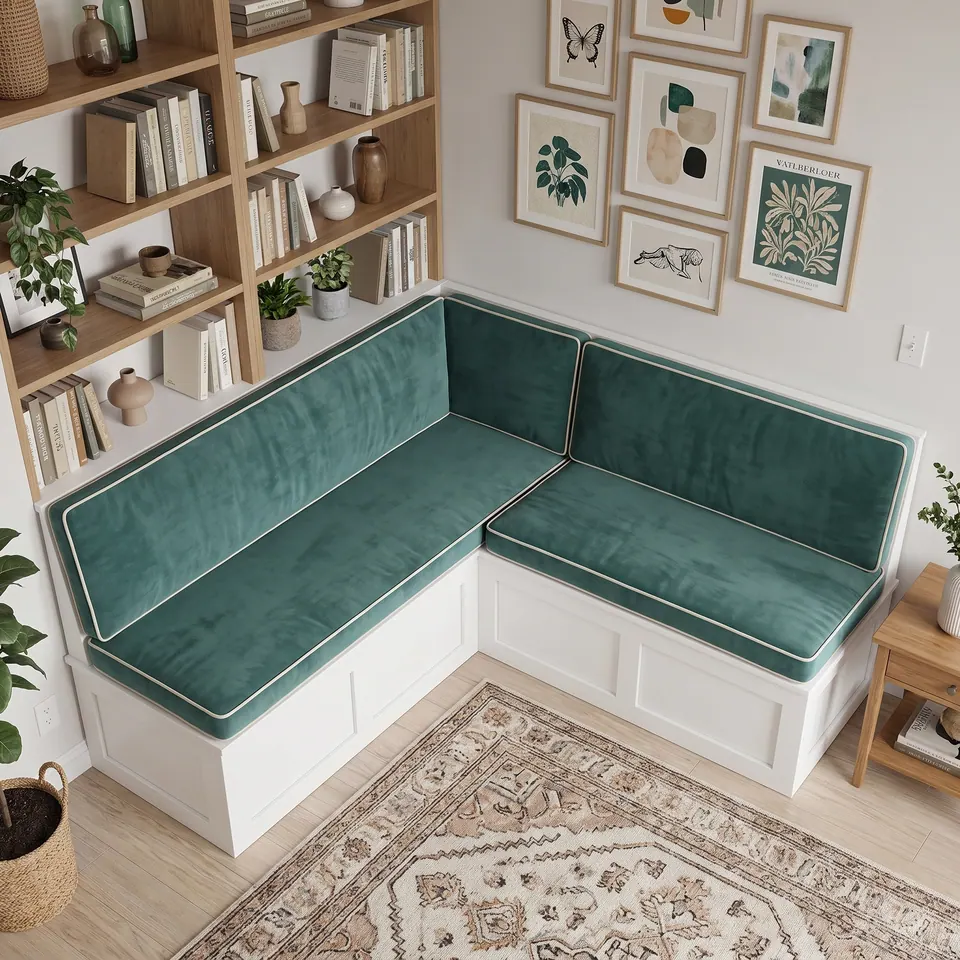
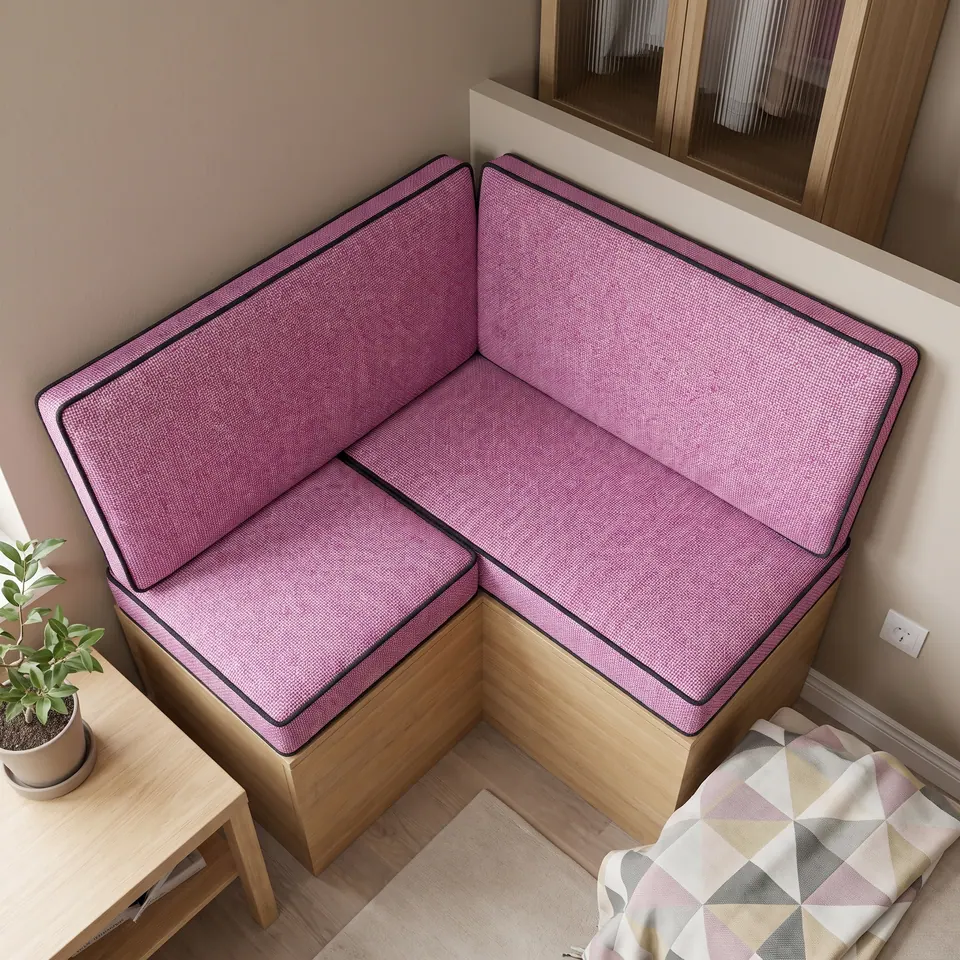
That's the rule for a square L: one cushion runs full length and the other is shortened by the seat depth. A chamfered nook breaks it, because the corner isn't square, and that's when one shaped piece earns its keep. The L-shaped corner joint Pattern draws both joins. Which way does your bench turn?
Buyer questions: tough fabric, a color match and a cutout
- A common question
I need a tough, easy-to-clean fabric for everyday use, and I don't want velvet. What would you pick?
The workshop's answerThe workshop recommends its soft-touch fabric, a poly-cotton that is one of its best sellers, durable and easy to clean. For a kids' playroom it also suggested its thick teddy fabric.
- A common question
Can you match the color of a corduroy ottoman I bought from another seller?
The workshop's answerThe workshop can suggest its closest shade, such as its green corduroy, but it can't guarantee a match to another seller's fabric. It offers its full color card, so you can choose another color or order samples.
- A common question
Handles poke into my window seat. Can the cushion be shaped around them?
The workshop's answerYes. The workshop cuts a custom shape around obstacles, and the extra cutting shows in the quote. One 13 x 92 in (33 x 234 cm) linen window seat cushion was made exactly this way; send the handle positions measured from one end.
On a square L bench, one cushion runs full length and the other is shortened by the seat depth. On a 45-degree chamfer, order one shaped piece.
Nate
Questions buyers ask next
When is a corner nook cushion better made as one piece?
On a square L, two pieces are simpler: one runs full length and the other is shortened by the seat depth. On a chamfered corner, one piece that follows all three runs avoids a seam right where people lean.
How do I measure a bench with a 45-degree corner?
Measure each run along the wall and along the front edge, plus the depth at both ends and at the middle of the angled section. A card template of the whole seat is the safest check before ordering.
Why use contrast piping on an odd-shaped cushion?
Contrast piping draws the outline, so an unusual shape looks deliberate rather than accidental. Match the piping to something already in the room, such as the wood of the base, and it reads as part of the build.
± 1/4 in — Nate