A Reading by NateL-Shaped Corner Bench Cushions
Self piping on a greige L-shaped corner seat, read line by line
Nate takes apart an oak corner platform dressed in greige seat and back cushions, and weighs the one line that decides how the corner reads: self piping, contrast piping or none.

 Save
The quick answer
On an L-shaped bench cushion, self piping keeps the corner quiet, contrast piping draws the joint in ink, and no piping softens every edge. Choose contrast only when the two seats meet cleanly, because a colored welt shows every gap. Decide which cushion runs through the corner first, then the piping; body and piping can be different fabrics if you write both codes.
The cushion, cut open
Cover fabric. A removable, zippered cover. Machine wash at 86°F (30°C) on a gentle cycle and air dry.
Piping. A fabric-covered cord sewn into the seams. It sits on the seam line, so it does not change the size.
Fiber wrap. Polyester fiber (Dacron) batting around the foam: it fills the cover out and softens the edges.
Foam core. About 2.0 lb/ft³ (32 kg/m³) high-resilience foam, firm to medium-firm, cut to the ordered size.
Zipper. Along the back band, as hidden as possible. The zipper side faces down or toward the wall.
Base panel. The underside of the cover. A non-slip fabric backing can cover the whole of it instead.
Cross-section of a corner that closes
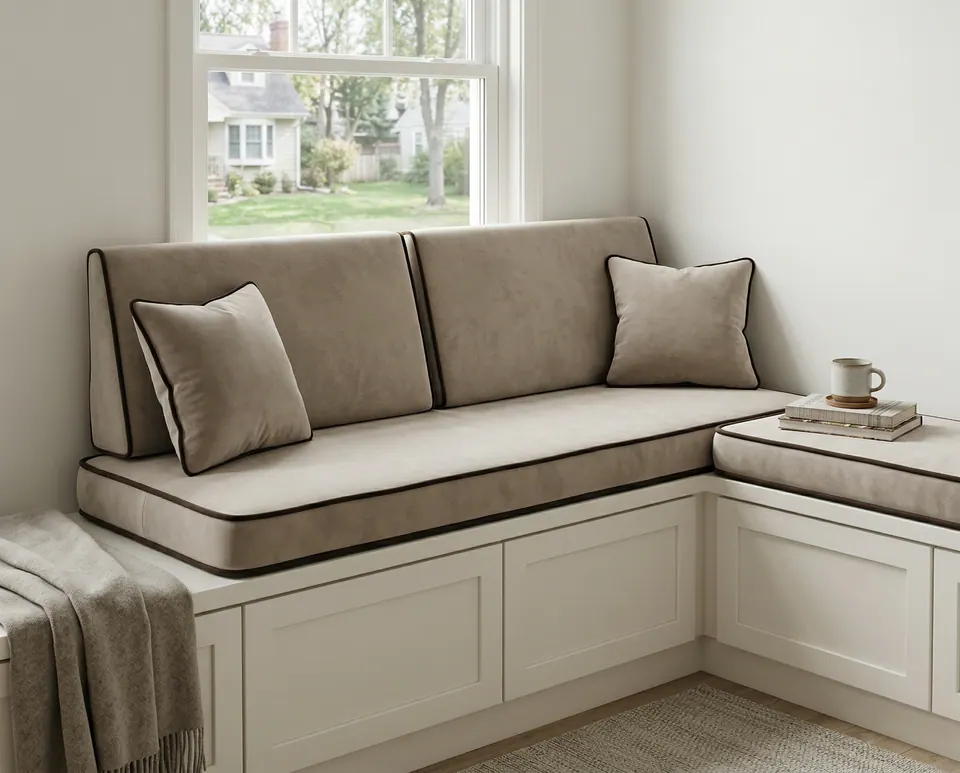
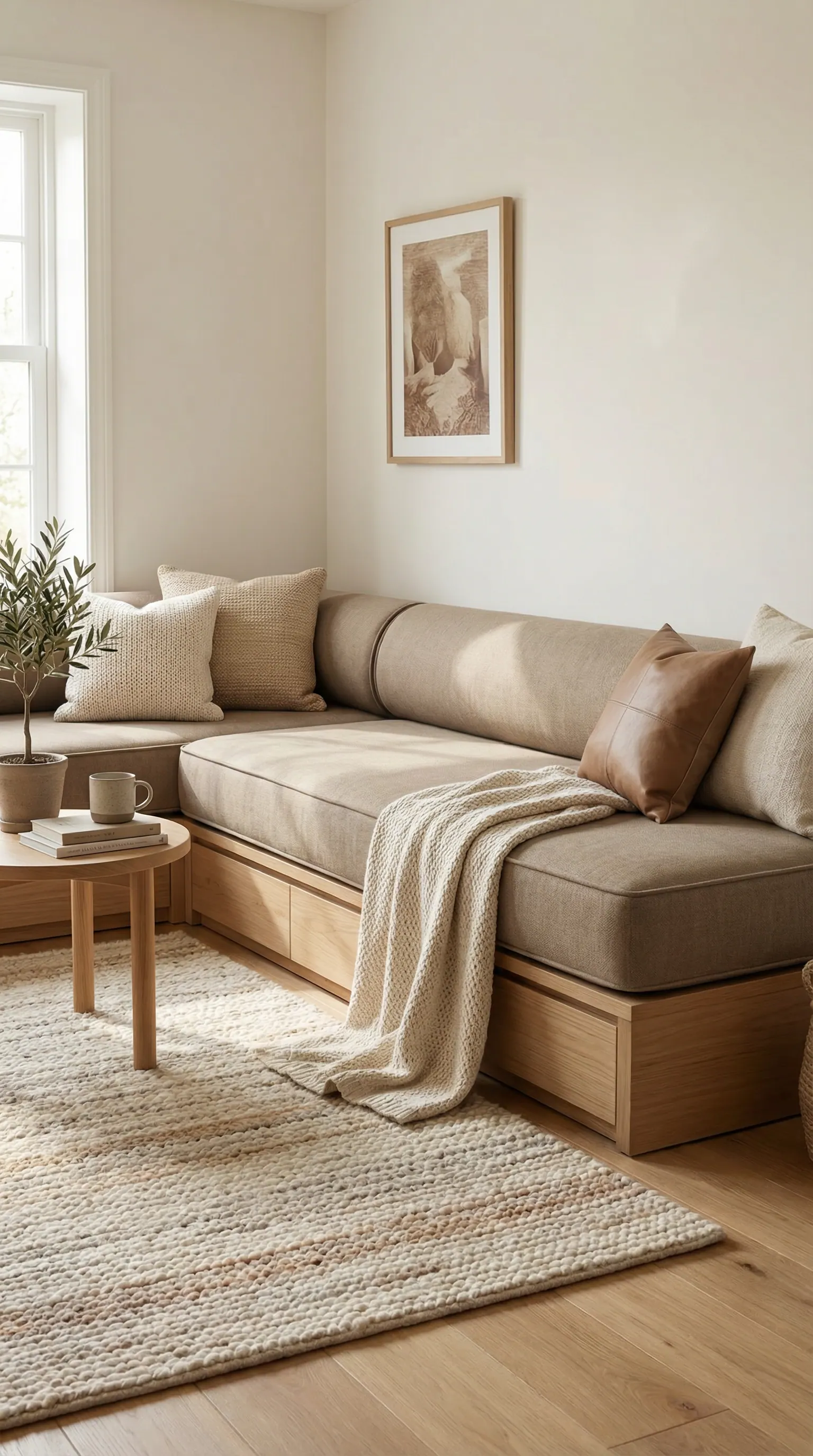
Two cushions, one corner, zero gap. That is the whole job of an L-shaped bench cushion set, and this oak platform does it cleanly.
Here is the build, cut open. The long seat runs all the way into the wall. The short seat butts square against its side. The box backrests follow the same order, so the back joint sits directly above the seat joint and the two lines agree.
The fabric is a greige linen-look weave, and the piping is self piping: a cord covered in the same greige, sewn into every seam. On a corner like this, that choice matters more than the color. Every welt is a drawn line. Self piping draws it in pencil. You see the box shape in the golden afternoon light, but the joint where the two seats meet reads as a shadow, not a stripe.
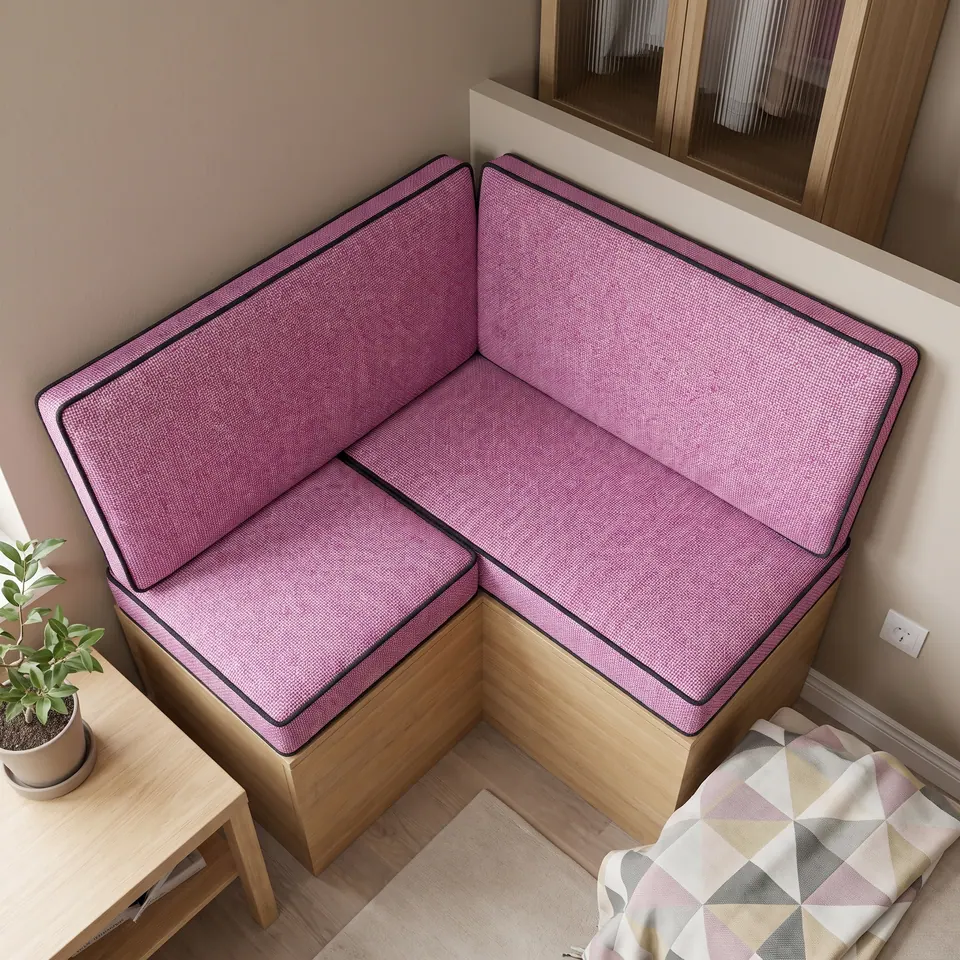
Swap in a contrast welt and the corner turns into a diagram. Every edge gets outlined, including the one where two cushions touch. If that seam is tight, it looks sharp and deliberate. If it wanders by a quarter inch, the eye goes straight there. Angles are just lengths in disguise, and a contrast welt reports every one of them. No piping at all gives the softest line, a relaxed edge that suits a lounge more than a tailored built-in.
The props carry load too, partner. One cognac leather pillow is the single warm point on a field of greige; two cream pillows add depth without a new color. The knit throw breaks up the long front edge. At the open end, a round oak table with an olive tree balances the heavy corner, and the sepia print, striped rug and oak drawers stay in one brown range.
Pinned by Nate: five points on the corner seat
Five pins trace the platform from the cognac leather pillow to the olive tree, each one a decision about warmth, weight or the corner joint.
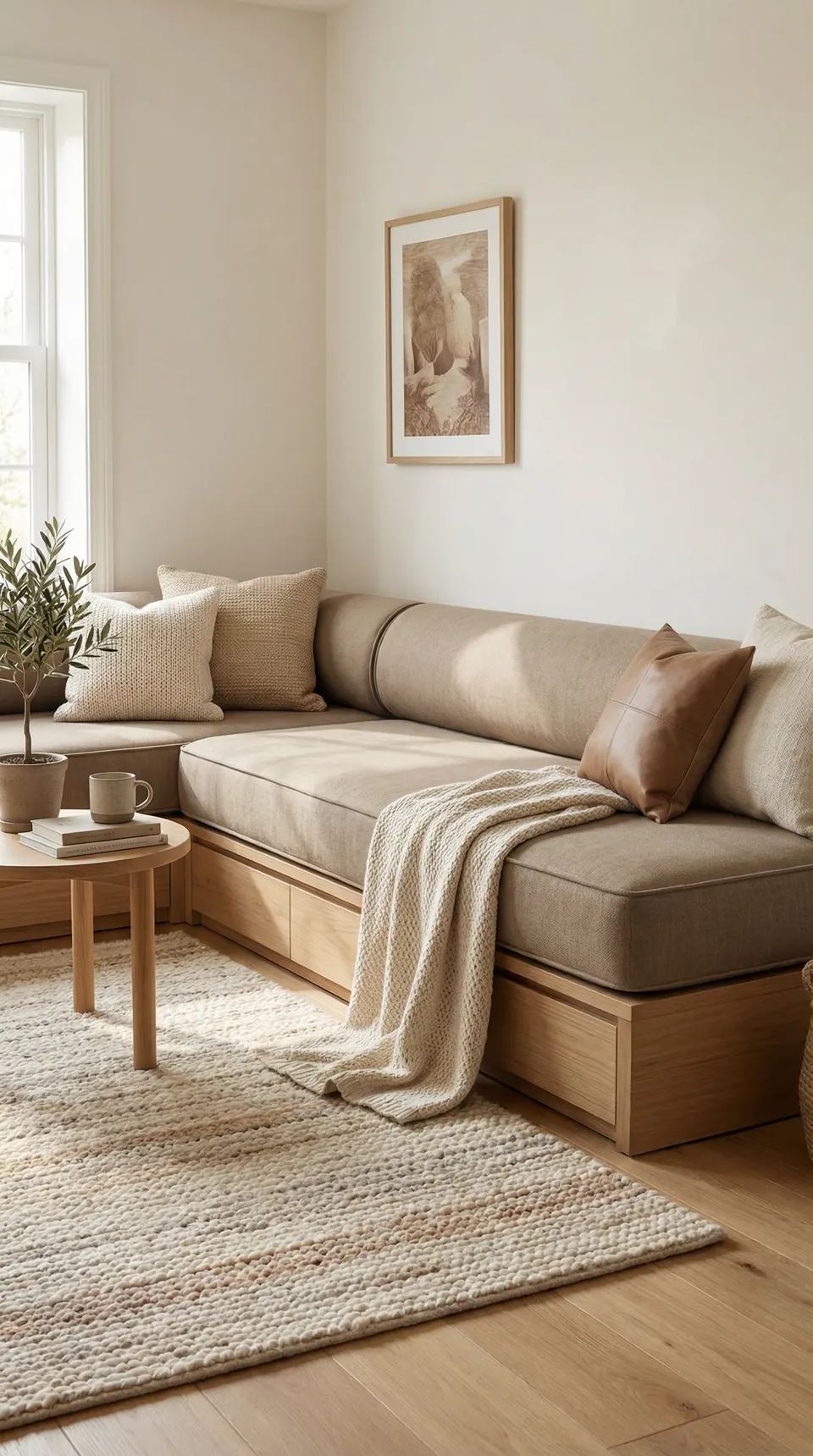
- Cognac leather pillow
One leather pillow gives the soft greige a single point of warmth.
- Corner joint
Seat and back cushions butt cleanly into the corner so there is no gap.
- Backrest cushions
Box backrests in the same fabric turn the platform into a full sofa.
- Cable-knit throw
The throw falls over the front edge and softens the long seat.
- Olive tree on side table
A small tree at the open end balances the corner's weight.
- Cognac leather pillowOne leather pillow gives the soft greige a single point of warmth.
- Corner jointSeat and back cushions butt cleanly into the corner so there is no gap.
- Backrest cushionsBox backrests in the same fabric turn the platform into a full sofa.
- Cable-knit throwThe throw falls over the front edge and softens the long seat.
- Olive tree on side tableA small tree at the open end balances the corner's weight.
Three piping choices on an L-shaped seat
| Piping | What the corner joint does | Pick it when |
|---|---|---|
| Self piping | Reads as a soft shadow line | The platform should read as one sofa |
| Contrast piping | Draws every seam, the joint included | The seats meet tight, like mustard or terracotta on oatmeal |
| No piping | Softest edge, no drawn line | The seat is more lounge than built-in |
Oatmeal, sage and a question about kids
A family wrote to the workshop about an L-shaped banquette they had built into their kitchen and painted sage green. They needed two seat cushions, 63 x 19 in (160 x 48 cm) and 63¾ x 19 in (162 x 48 cm), both 4 in (10 cm) thick. Young kids would be eating on them.
Two questions came first: was linen wise with children, and did the covers come off? The covers are removable and machine washable at 86°F (30°C), and piping is included.
Then color. The workshop's advice was to choose around what stays put, the sage bench and walls, not the table, which can be replaced. That meant a warm oatmeal body with mustard or terracotta piping, and no pure white or cool grays. Mid-tone and washable is the right call with kids at the table.
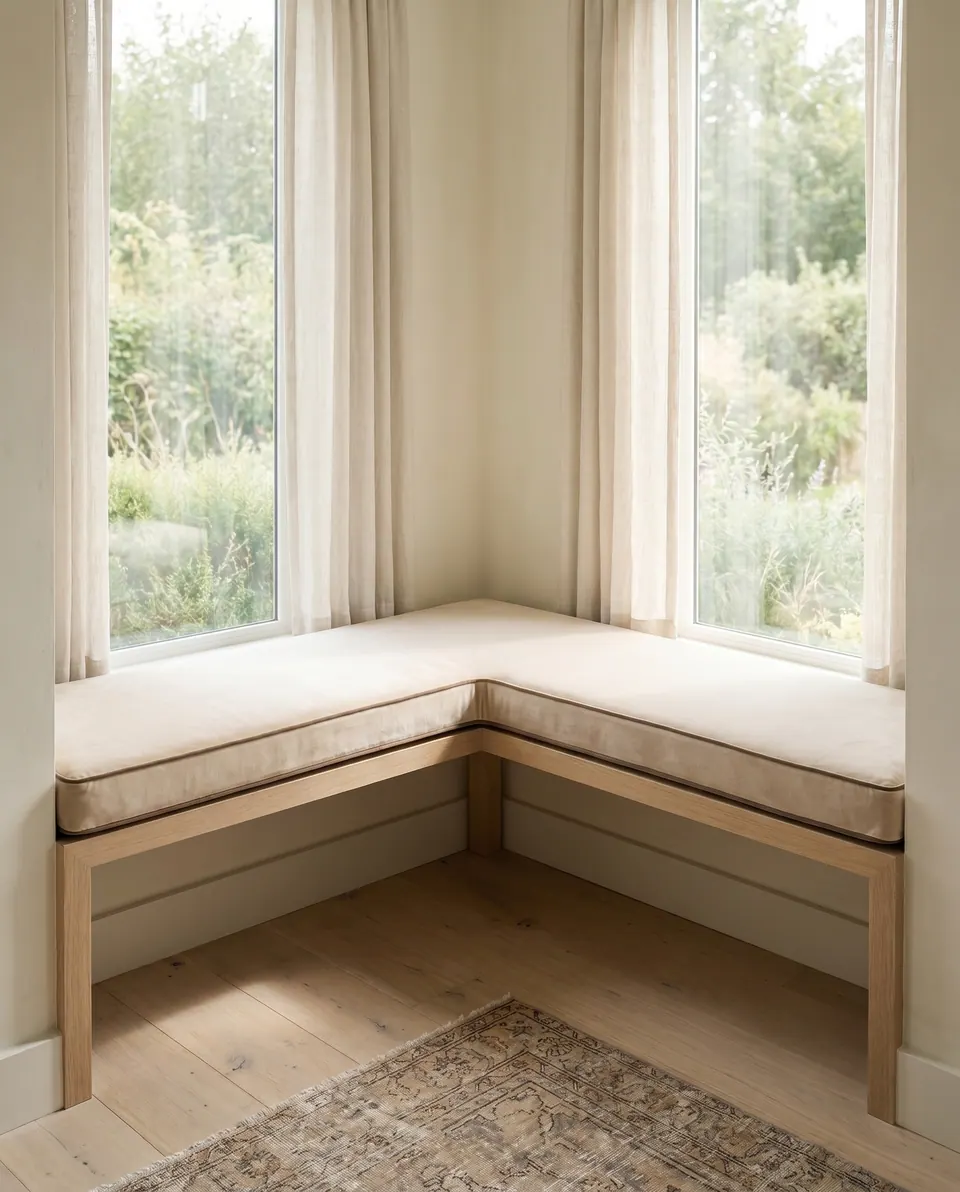
Notice where that contrast went. On a painted sage bench, a mustard welt gives the eye an outline. On oak, as in the photo, greige self piping lets the wood do that job. Our corner joint Pattern shows how to split the two lengths. Which side of your L is the long run?
On the cutting table: the oak corner set
| Product | L-shaped corner seat with seat and back cushions |
|---|---|
| Layout | Long seat runs through the corner; short seat butts against it |
| Backrests | Box backrests in the same order as the seats |
| Fabric | Greige linen-look weave |
| Piping | Self piping in the body fabric |
| Edge | Box edge |
| Covers | Removable; machine wash at 86°F (30°C) |
| Best for | Built-in platforms, window corners and kitchen banquettes |

Have it made
Have this made — ask Nate’s workshop
Every edge and both diagonals, to the nearest 1/4 in. If the numbers do not close, the workshop will say so on the call. — Nate
Leave your details and the workshop will call you to confirm measurements, fabric, foam and piping. No prices, dates or payment on this page: it is a request, not an order.
Buyer questions: mixed fabrics, cut corners, codes
- A common question
Can the cushion body be linen and the piping a different fabric, say velvet?
The workshop's answerYes. A linen body with velvet piping works, and so does any other mix. Write both codes in the personalization note when you order, one for the body and one for the piping, and the cushion is made exactly that way.
- A common question
My seat has a cut corner. Can you make a cushion that follows it?
The workshop's answerYes, odd shapes are made to order. Send a photo, or a drawing of the shape on paper with every measurement written on it, and the workshop quotes from that drawing.
- A common question
Where are the fabric charts, and is a color name enough on the order?
The workshop's answerThe charts are in the listing photos: on the bench cushion listing they are the third, fourth and fifth pictures, and indoor and outdoor listings carry separate charts. Write the exact fabric code, not a color name, because most colors come in several shades. The order waits until the code arrives.
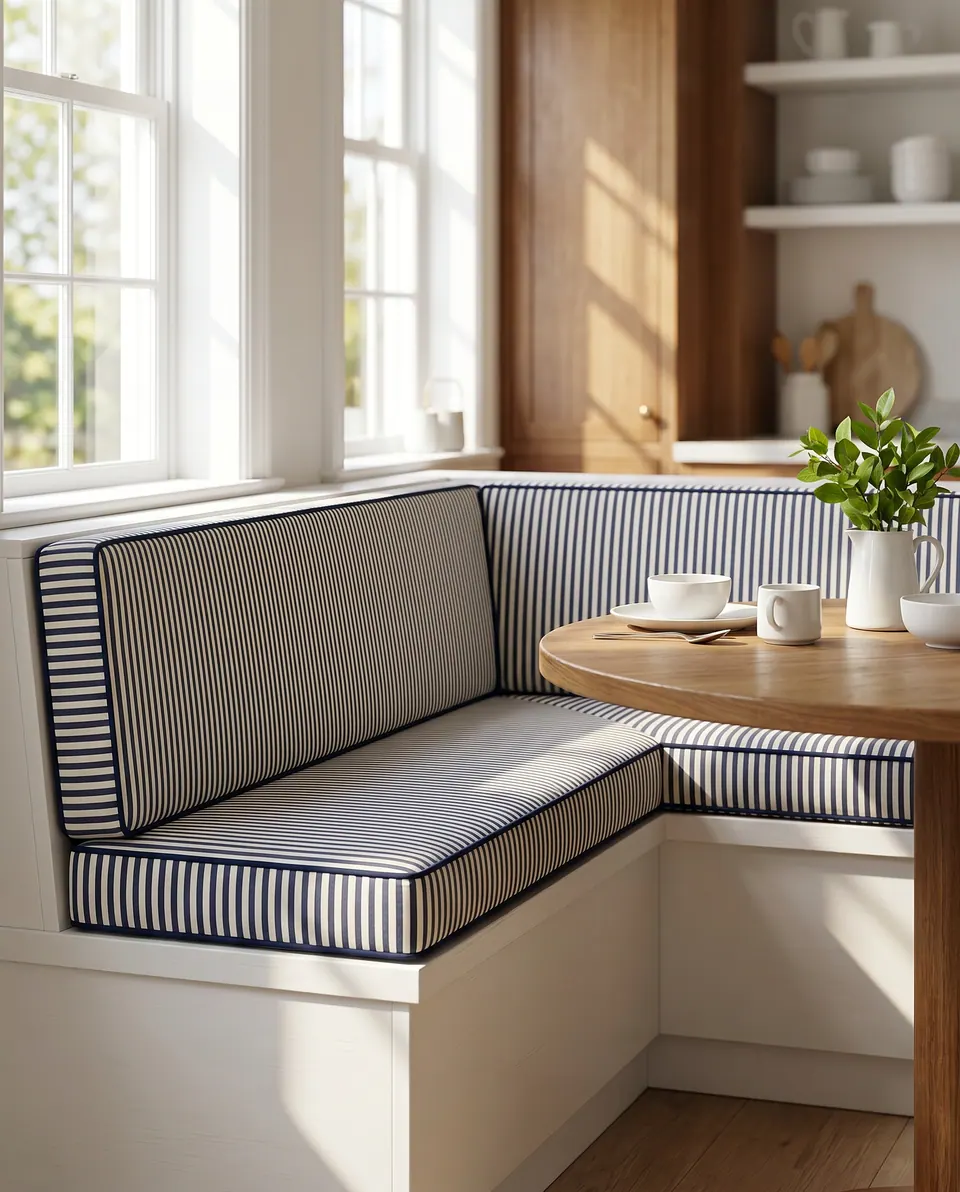
Contrast piping on an L-shaped bench cushion outlines the corner joint. If the two seats meet a quarter inch apart, a pale welt will show it.
Nate
Questions buyers ask next
Does self piping hide a small gap where two L-shaped seat cushions meet?
It helps. Self piping is the same color as the body, so the joint reads as a soft shadow rather than a drawn line. A contrast welt outlines both cushion edges at the joint, which makes any gap or uneven meeting much easier to see.
On an L-shaped platform, which seat cushion should run all the way into the corner?
Usually the long run goes through the corner to the wall and the short seat butts against its side. Decide this before measuring, because it sets the length of both pieces. The backrests should follow the same order so the joints line up.
Can the backrests on an L-shaped seat take a different piping from the seat cushions?
They can, since body and piping are ordered by code, but matching them keeps the platform reading as one sofa. If you want contrast, use it on seats and backs alike so the outline runs continuously around the corner.
Is greige a sensible seat color for a corner bench that kids use every day?
Greige is a mid-tone, which forgives more than pure white or pale cream. For family seating, pair a mid-tone body with removable covers you can machine wash at 86°F (30°C), and choose the color around fixed features such as walls and built-ins.
± 1/4 in — Nate