A Reading by NateL-Shaped Corner Bench Cushions
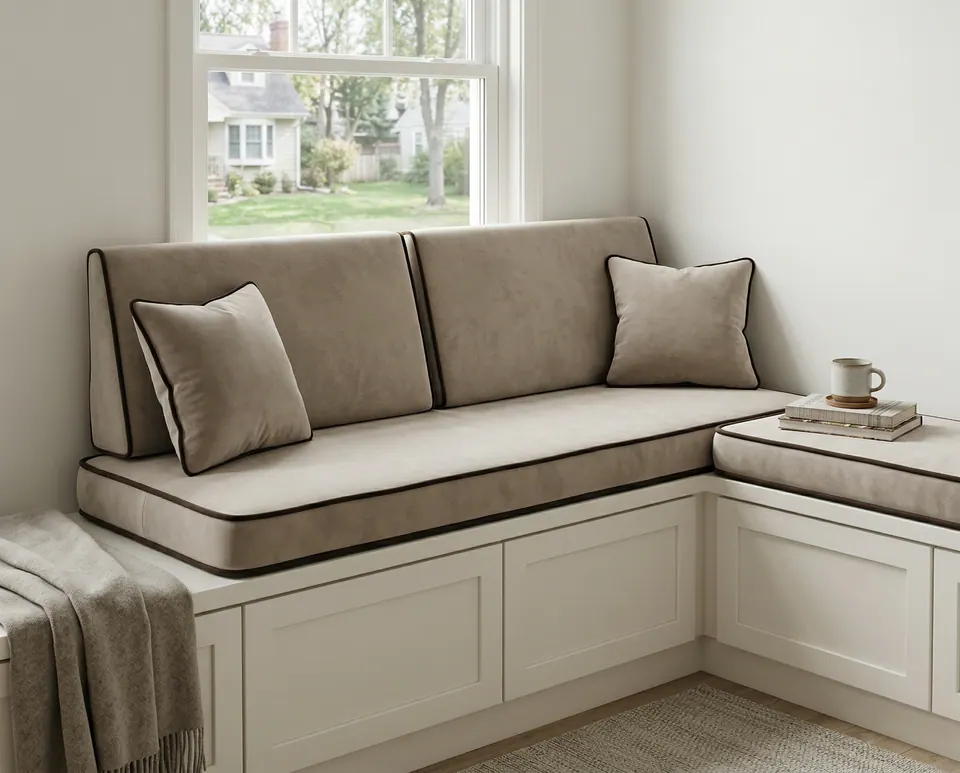
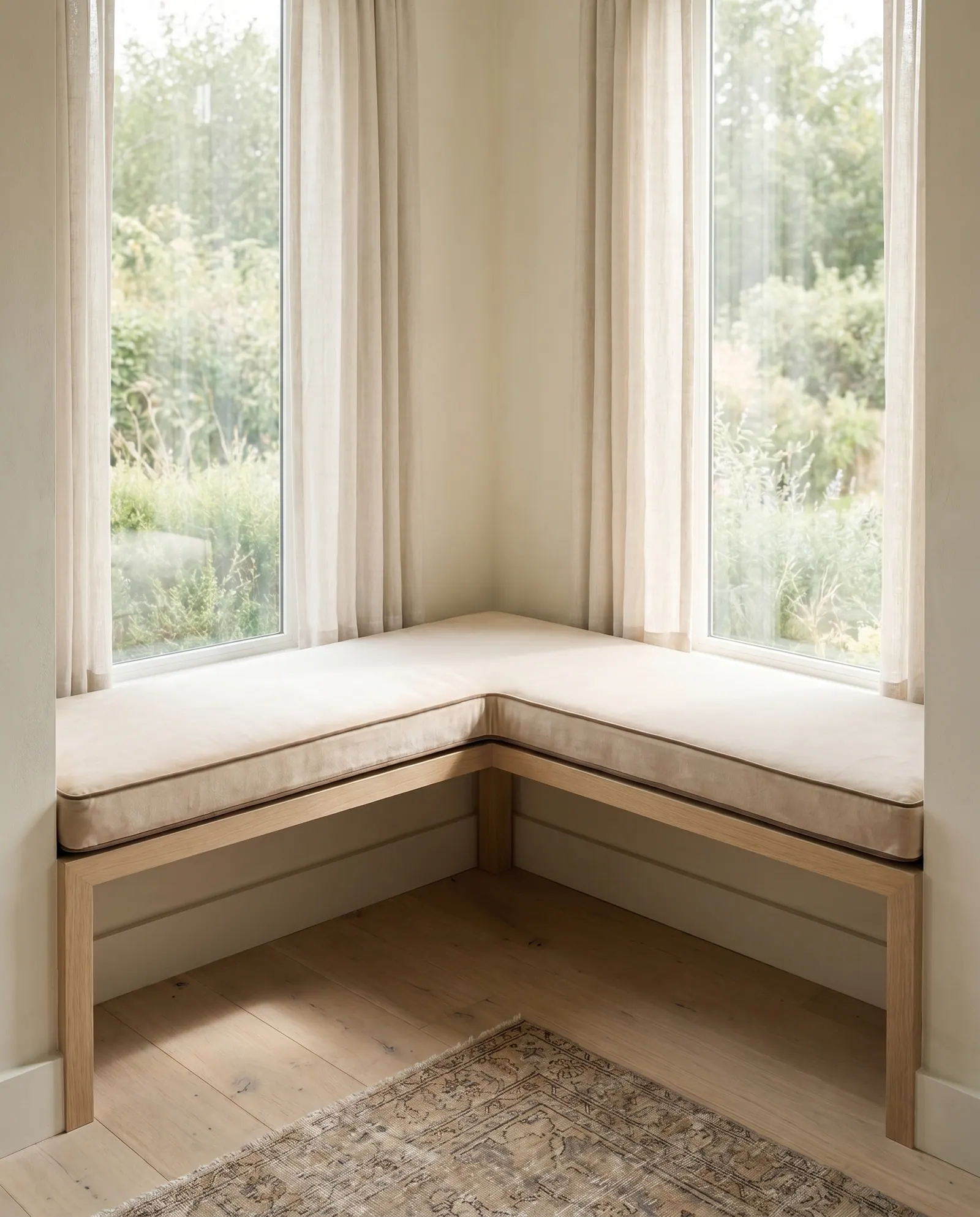
Measuring an L-shaped bench cushion, read from a sand velvet corner seat
Two windows, one oak L-bench, zero pillows. When nothing is styled, the fit is the whole show, so we measure it properly.

 Save
The quick answer
To measure an L-shaped bench cushion, record the back and front length of each run, the depth at both ends of each run, and one thickness for the whole set. Then decide the corner: one L piece, or two cushions with one run passing through. Orders stall on mismatched thicknesses and on sizes that do not match the option paid for.
The cushion, cut open
Cover fabric. A removable, zippered cover. Machine wash at 86°F (30°C) on a gentle cycle and air dry.
Piping. A fabric-covered cord sewn into the seams. It sits on the seam line, so it does not change the size.
Fiber wrap. Polyester fiber (Dacron) batting around the foam: it fills the cover out and softens the edges.
Foam core. About 2.0 lb/ft³ (32 kg/m³) high-resilience foam, firm to medium-firm, cut to the ordered size.
Zipper. Along the back band, as hidden as possible. The zipper side faces down or toward the wall.
Base panel. The underside of the cover. A non-slip fabric backing can cover the whole of it instead.
Pinned by Nate: five checkpoints on the corner bench
Five pins, from the corner join to the faded rug, each one a measurement or a decision.
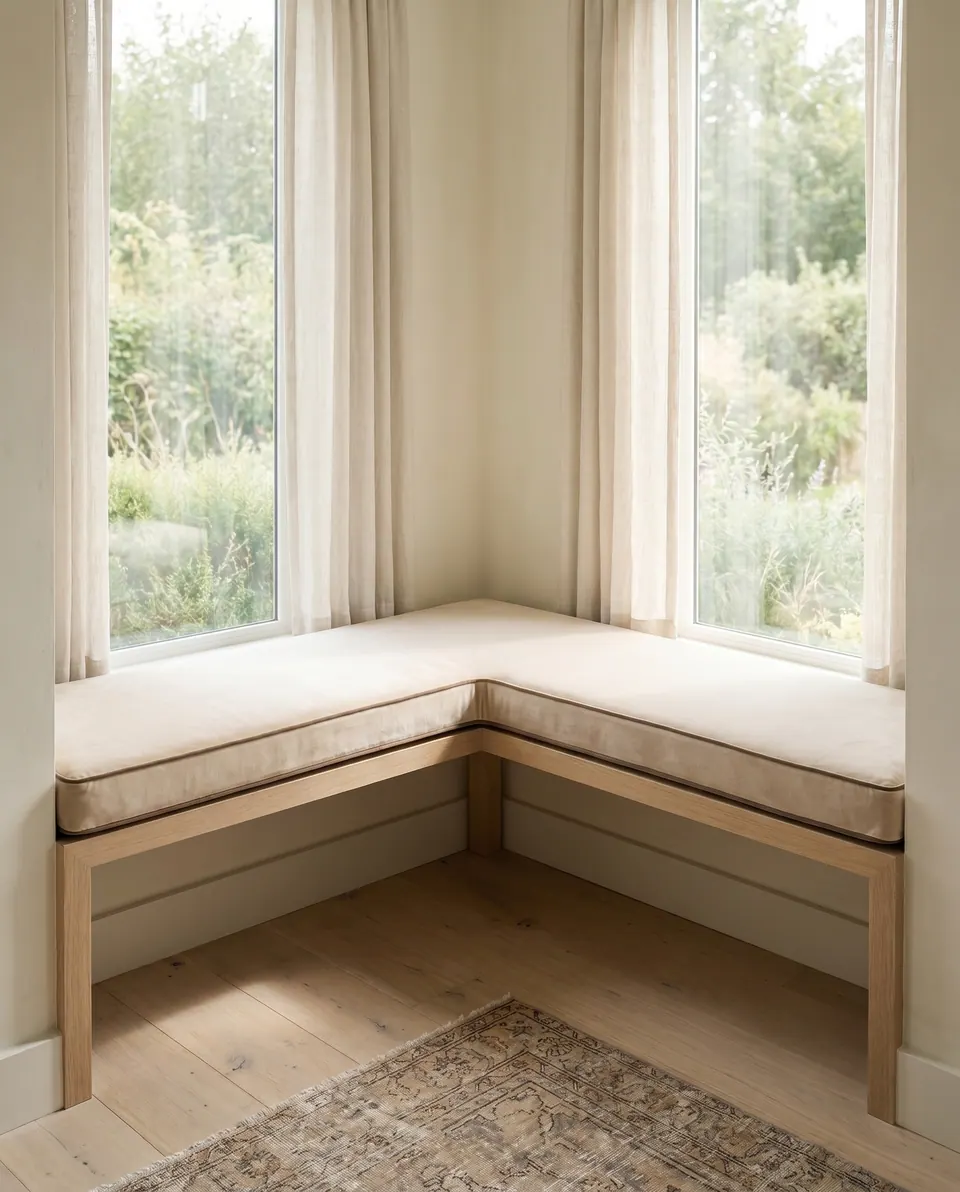
- Corner join
Where the two runs meet, the join follows the frame's corner; decide early whether you want one L piece or two butted pieces that are easier to carry.
- Left run with self piping
Sand-on-sand piping keeps the edge sharp without drawing a line across the window.
- Oak frame leg
The cushion overhangs the slim oak rail just slightly, which softens the edge you sit on.
- Sheer linen curtains
Curtains in the same sand tone make cushion, fabric and wall read as one soft block.
- Vintage rug
A faded rug adds pattern low down, so the seat itself can stay plain.
- Corner joinWhere the two runs meet, the join follows the frame's corner; decide early whether you want one L piece or two butted pieces that are easier to carry.
- Left run with self pipingSand-on-sand piping keeps the edge sharp without drawing a line across the window.
- Oak frame legThe cushion overhangs the slim oak rail just slightly, which softens the edge you sit on.
- Sheer linen curtainsCurtains in the same sand tone make cushion, fabric and wall read as one soft block.
- Vintage rugA faded rug adds pattern low down, so the seat itself can stay plain.
Five measurements for this L, in order
Back edge of each run
Measure the long run and the short run along the wall, from the inside corner to each open end. Write inches to the nearest 1/8 in, with centimeters beside them.
Front edge of each run
Measure the front edges too. On a true L each one is shorter than its back edge by the depth of the other run; that difference is your cross-check.
Depth at both ends
Measure front to back at each end of each run. Freestanding frames and old walls are rarely identical at both ends; hold ± 1/4 in.
The corner decision
One L piece, or two cushions butted at the corner. If two, say which run passes through the corner and which one stops against it.
One thickness on every line
Write the same thickness on both cushions and pick the size option that covers each one. Compare the two lines before you pay.
A plain seat hides nothing
No pillows, no throw, no lamp. Partner, this corner is a fit test in daylight.
The L-shaped bench cushion is sand velvet with self piping, and it matches the sheer linen curtains almost exactly. Cushion, curtain and wall read as one soft block, so your eye runs past the seat to the garden. A cushion that stops 1/2 in short of a wall leaves a dark gap, and on a plain seat there is nothing else to look at.
Start at the corner join. The two runs meet where the oak frame turns. Two butted pieces or one L: either works. Deciding late does not. The corner joint pattern draws both.
Next, the front rail. The velvet overhangs the slim oak edge slightly, which softens the edge you sit on. Measure the frame, then state the overhang you want as its own number, so nobody adds it twice.
Depth stays modest against the slender frame, which keeps the corner light. The faded rug brings pattern in low, so the seat can stay plain. Velvet has a pile, so ask for both runs cut with the pile running the same way.
Which run of your L goes through the corner? Settle that, then use the L-shaped measuring pattern or the bench cushion builder. Finished builds sit in the L-shaped cushions atlas and the velvet library.
The 2 in and the 3 in
A buyer in the US ordered cushions for an L-shaped kitchen bench: two cushions meeting at the corner rather than one L piece. Sensible. The order, though, showed 2 in on one cushion and 3 in on the other, and the size option paid for did not cover the second cushion's size.
The shop paused production and asked. The confirmed pieces came out at about 83 3/8 x 19 1/8 in (212 x 48.5 cm) and 23 5/8 x 19 in (60 x 48 cm), both 3 in (7.5 cm) thick in 32 kg/m³ foam, about 2 lb/ft³.
Two lessons. Order each run as its own cushion with the right size option. Write one thickness on both lines, because a 1 in step at the corner is something you sit on every day.
On the cutting table: the sand velvet L
| Product | L-shaped bench cushion for a corner window seat |
|---|---|
| Fabric | Sand velvet |
| Edge | Box edge |
| Piping | Self piping, sand on sand |
| Corner | One L piece or two butted cushions, chosen before ordering |
| Overhang | Slight, past the slim oak front rail |
| Reference build | 83 3/8 x 19 1/8 in and 23 5/8 x 19 in, both 3 in thick |
| Foam | about 2 lb/ft³ (32 kg/m³) in the reference build |
| Best for | Corner window benches, breakfast nooks and garden rooms |

Have it made
Have this made — ask Nate’s workshop
Precision starts on the phone. Give the workshop your measurements and they will read them back to you, edge by edge. — Nate
Leave your details and the workshop will call you to confirm measurements, fabric, foam and piping. No prices, dates or payment on this page: it is a request, not an order.
Buyer questions: stripes, patterns and very long seats
- A common question
Which of your stripes is the darker navy, and what would go with a beige stripe and blue trim?
The workshop's answerThe N28 and N29 stripes are the deepest navy-black; N29 has thinner stripes, so its pattern looks denser. For a beige stripe body, N02 is the closest direction, with blue piping from the velvet and soft-fabric charts, such as 131 deep navy or 907.
- A common question
Could you make my cushion in a custom stripe using your forest green fabric?
The workshop's answerNo. The shop is not a fabric producer, so it does not create patterns; it customizes size and thickness. The buyer chose two catalog colors instead, 923 forest green and 920 mustard.
- A common question
My window seat is over 150 in long. Will it come as one cushion or two?
The workshop's answerThe shop asks whether you want a very long cushion in one piece or in sections, and it can split it into equal halves. For soft back pillows, one 88 in (224 cm) pillow would sag in the middle, so the shop recommends two 44 in (112 cm) pillows.
On an L-shaped bench cushion made as two pieces, write one thickness on both. A 2 in run meeting a 3 in run leaves a step at the corner you feel every day.
Nate
Questions buyers ask next
Is one L-shaped piece or two butted cushions better for a corner window bench?
Two butted cushions are easier to carry, flip and fit through doors; one L piece has no seam across the seat. Decide before ordering, and if you choose two, say which run passes through the corner and which stops against it.
How much should a velvet bench cushion overhang a slim front rail?
Only slightly. On a slender oak frame, a small overhang softens the edge you sit on without looking loose. Measure the frame itself, then state the overhang you want as a separate number so nobody adds it twice.
Why would a custom L-shaped cushion order be paused before cutting?
In the case retold here, the two cushions showed different thicknesses and the paid size option did not cover one cushion's size. The shop stopped to confirm before cutting, which costs a day and saves a cushion.
Can sand velvet be matched to sheer linen curtains?
Closely, if you compare them side by side in daylight. On this bench the sand velvet and sheer linen read as one soft block that sends the eye out to the garden. Velvet's sheen shifts as you move, so judge it from where you sit.
± 1/4 in — Nate