A Reading by NateL-Shaped Corner Bench Cushions
Anatomy of a striped L-shaped bench cushion in a sunny window corner
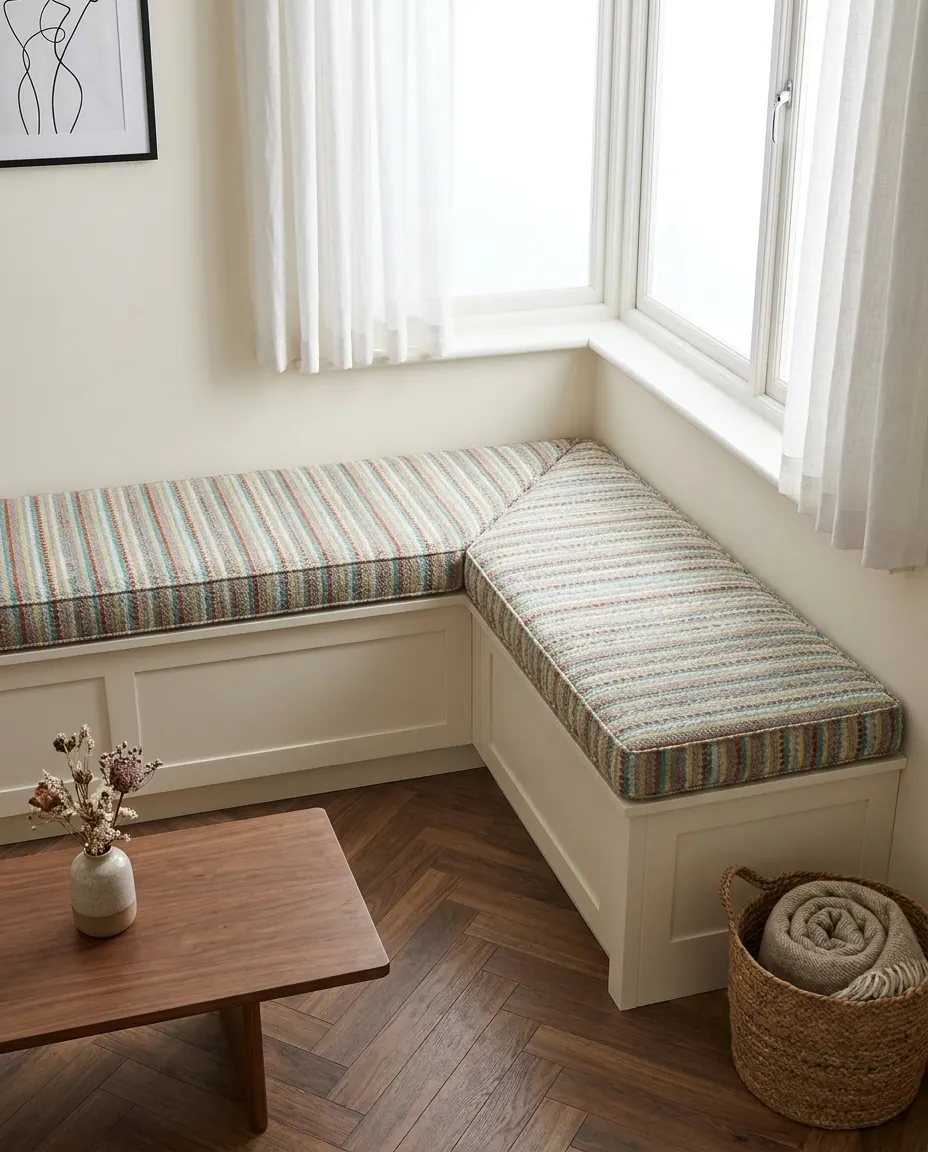
Five colors in one weave, one cream frame, and a diagonal where the stripes change direction. I read this corner bench the way I read a drawing: frame first, then fill, then the joint.

 Save
The quick answer
A multi-stripe L-shaped bench cushion works when everything around it stays quiet: cream paneling, cream walls and sheer curtains let the sage, rust, teal and gray read clearly. Cut the two runs with angled ends so they meet on a diagonal and the stripes follow each side. When you split an L into two cushions, count the corner only once.
The cushion, cut open
Cover fabric. A removable, zippered cover. Machine wash at 86°F (30°C) on a gentle cycle and air dry.
Piping. A fabric-covered cord sewn into the seams. It sits on the seam line, so it does not change the size.
Fiber wrap. Polyester fiber (Dacron) batting around the foam: it fills the cover out and softens the edges.
Foam core. About 2.0 lb/ft³ (32 kg/m³) high-resilience foam, firm to medium-firm, cut to the ordered size.
Zipper. Along the back band, as hidden as possible. The zipper side faces down or toward the wall.
Base panel. The underside of the cover. A non-slip fabric backing can cover the whole of it instead.
Pinned by Nate: five points on the corner bench
Five pins, from the long run and its return to the diagonal join, the blanket basket and the vase of dried flowers.
- Long run cushion
The stripe runs the length of the long side, so the bench looks longer.
- Return cushion
On the short return the stripe turns ninety degrees and follows that side too.
- Angled corner join
The two cushions meet on a diagonal, like a picture-frame corner, so the stripes meet cleanly.
- Blanket basket
A rolled knit in a seagrass basket picks up the stripe's cream and gray.
- Dried flower vase
Dusty pink dried flowers echo the rust in the weave.
- Long run cushionThe stripe runs the length of the long side, so the bench looks longer.
- Return cushionOn the short return the stripe turns ninety degrees and follows that side too.
- Angled corner joinThe two cushions meet on a diagonal, like a picture-frame corner, so the stripes meet cleanly.
- Blanket basketA rolled knit in a seagrass basket picks up the stripe's cream and gray.
- Dried flower vaseDusty pink dried flowers echo the rust in the weave.
Why a busy stripe needs a quiet frame
Five colors run through this weave: sage, rust, cream, gray and teal. On most benches that would be two too many. Here it works, and the reason is arithmetic.
Count the colors in the frame. The storage bench is cream paneling. The walls are cream. The curtains are sheer white. One color, used three times. The busier the fabric, the fewer colors the frame is allowed to carry.
Morning light does the rest. It comes through sheer curtains on two sides of the corner, so the cream stripe sits almost level with the paneling below it and the sage, teal and rust appear to float. Test a stripe like this in the light you actually sit in, at breakfast and again after dinner.
The wood stays low. A dark herringbone oak floor and a walnut coffee table sit below the seat line and answer the rust and gray from underneath. Warm below, cool at eye level, cream in between.
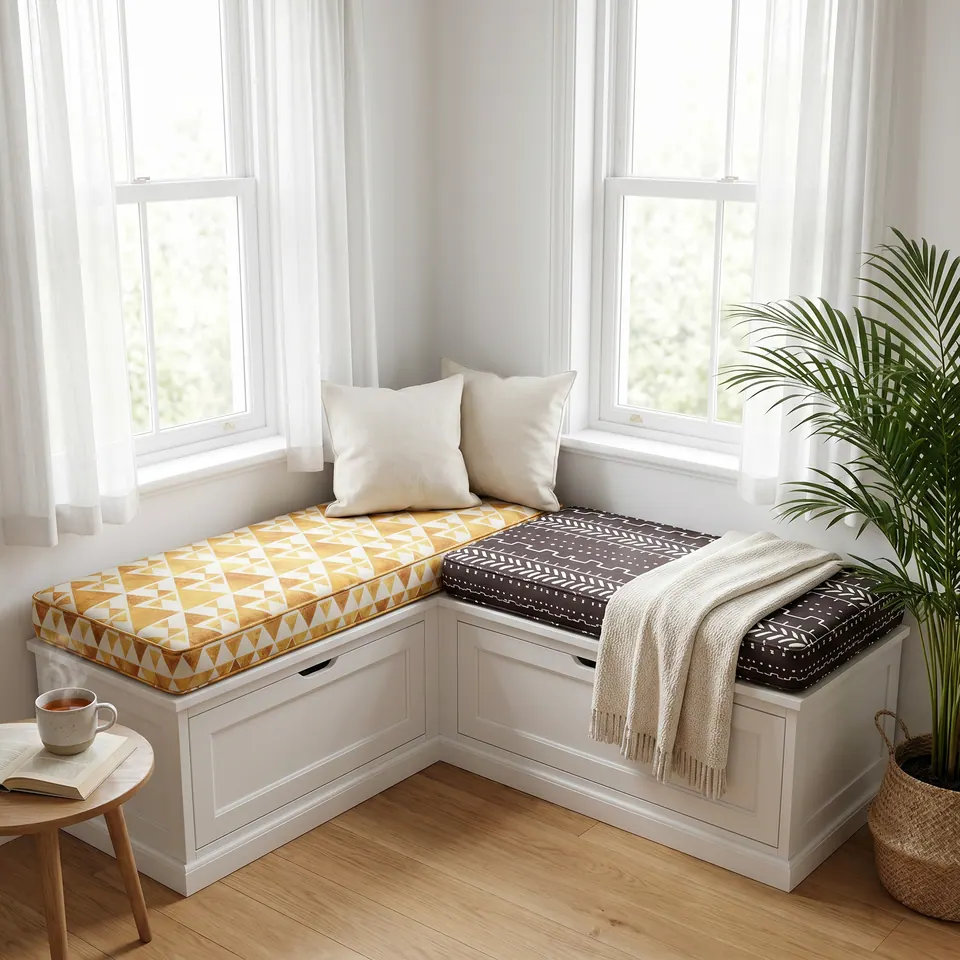
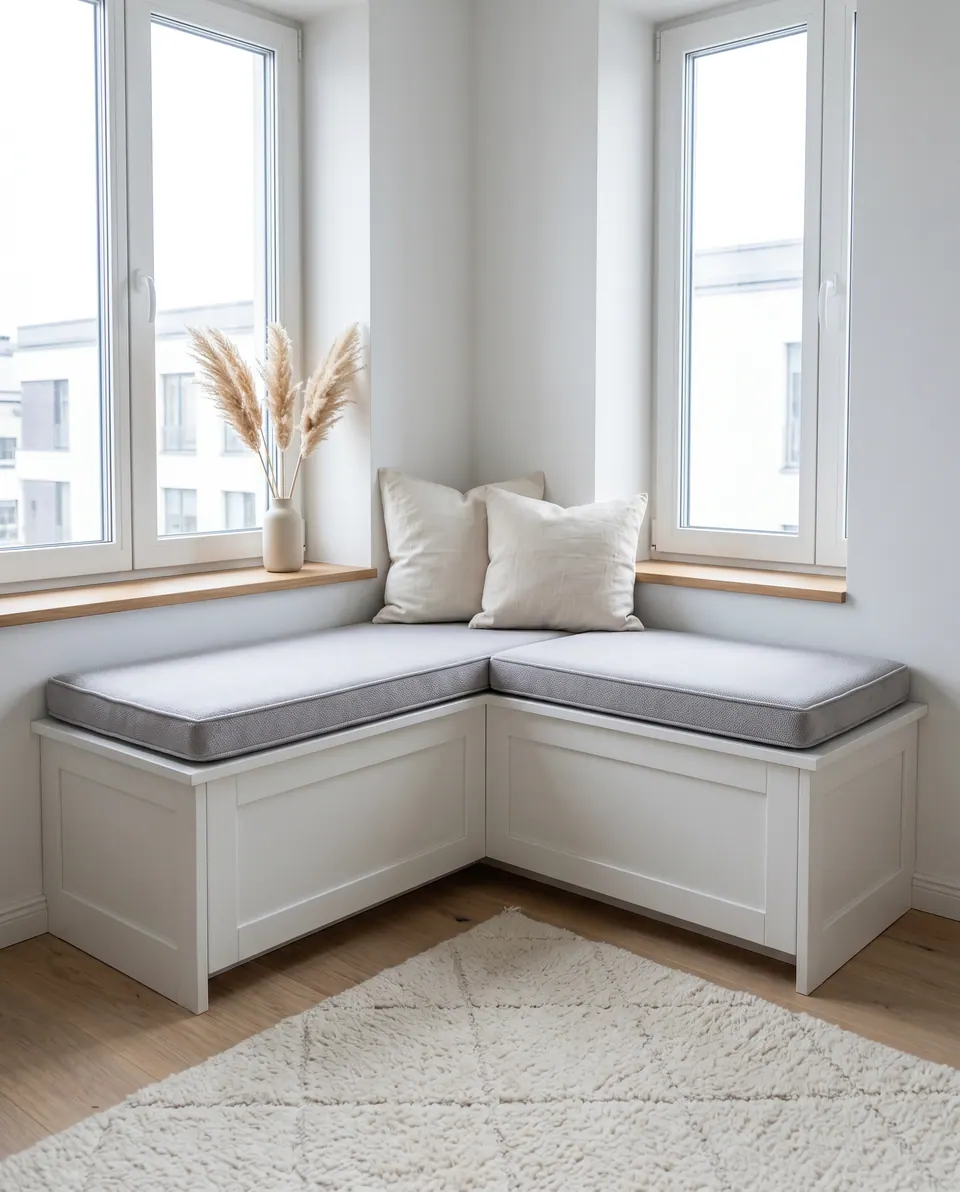
Now the joint. Each cushion is cut with an angled end, so the pair meets on a diagonal like a picture frame. The stripe runs the length of the long side, turns ninety degrees at the join and follows the return. A straight butt joint works too, but the stripes then meet at a right angle and one run looks interrupted.
No pillows sit on the seat. With five colors already working, a pillow would be a sixth voice. The props stay off the cushion: a seagrass basket with a rolled knit blanket repeats the cream and gray, a bud vase of dusty pink dried flowers echoes the rust, and a line-art print adds one thin black line and nothing else.
The weave belongs to the jacquard and damask family, the shape to the L-shaped cushions, and the measuring method for both runs is in L-shaped bench cushion measurements.
Which leg of your L gets the morning sun?
The swatch strip: five stripes and the room around them
- Sage stripe#9CAE88The calm middle stripe that keeps the teal from shouting.
- Rust stripe#B5552FThe warm note; the walnut table and dried flowers answer it.
- Teal stripe#2F7C78The darkest cool color; it gives the weave its edge in bright light.
- Gray stripe#9B9A96Repeated in the rolled knit blanket in the basket.
- Cream ground#EFE7D6Close in value to the paneling, so the colored stripes seem to float.
- Herringbone oak#5A4232The dark floor that anchors the warm stripes from below.
The L that counted its corner twice
A buyer's first order covered only one leg of an L-shaped bench: 54 3/8 x 17 3/4 in (138 x 45 cm). The shop pointed out the missing straight section, 98 3/8 x 17 3/4 in (250 x 45 cm), and advised two separate cushions rather than one connected L. Two pieces are easier to handle and sit more neatly.
Then came the split. When she divided the L, she forgot to take the overlap off one piece, so the shorter cushion came out too long. The overlap is the corner square both legs claimed, and on a bench 17 3/4 in (45 cm) deep that square is 17 3/4 in on a side.
The shop explained that a local upholsterer could cut the foam and shorten the cover. It also refunded part of a correctly sized reorder and did not ask for the first cushion back.
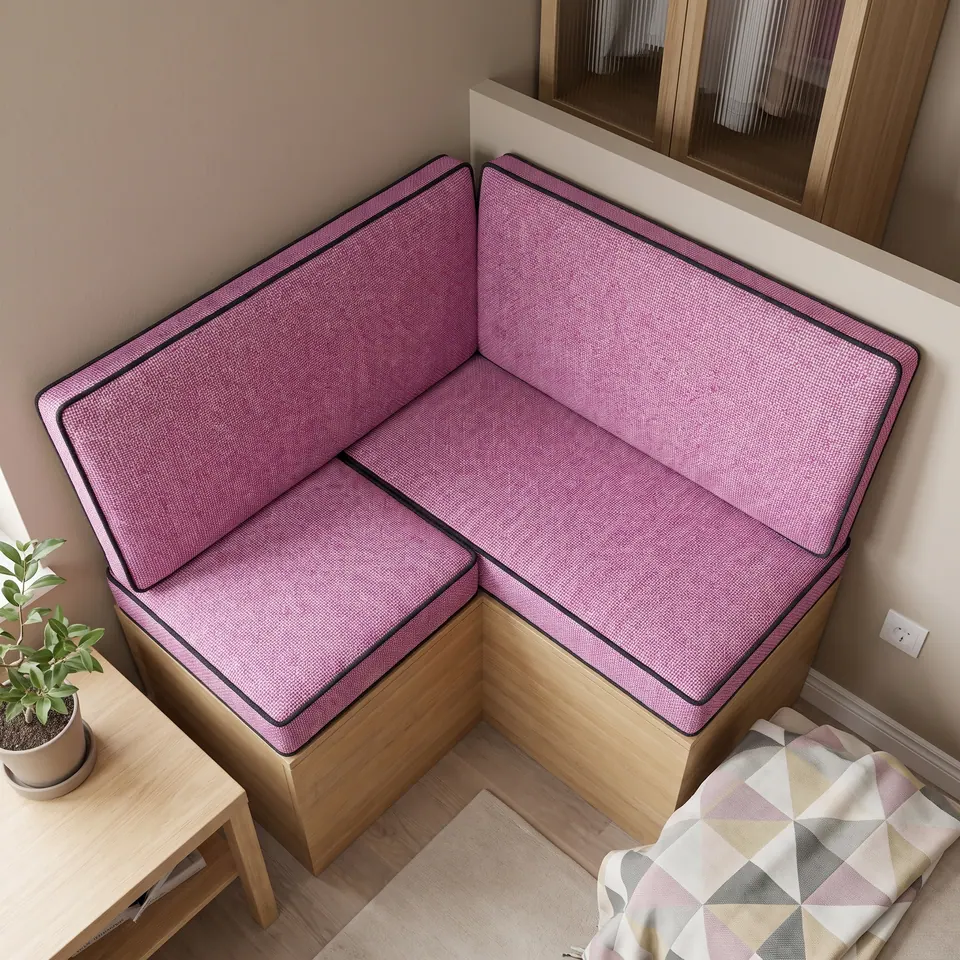
Here is the rule, partner. With a butt joint, one leg owns the corner square and the other gives up the seat depth. With a mitred join like the one in the photo, both pieces run the full wall length at the back and give up the depth along the front, cut at 45 degrees on a square corner. Either way, the corner is counted once. The longer version is in which piece owns the corner.
Buyer questions: drawings, zippers and second thoughts
- A common question
Can you give me a rough price for a trapezoid bay window cushion before I send every measurement?
The workshop's answerNot a reliable one. The price depends on your A to E measurements, so the shop asks for a drawing first. Past quotes show how much size moves it: a 2 x 10 ft bay, a linen trapezoid 137 in (348 cm) along the front and 30 1/4 in (77 cm) deep with contrast piping, a bay over 14 ft made in two pieces, and a cover only for a bay with a 95 in (241 cm) front, where the buyer supplied the foam.
- A common question
Can every fabric take a zipper, so I can pull the covers off and wash them?
The workshop's answerYes. All fabrics are suitable for zippers, and every foam cushion comes with a zippered cover you can remove and wash. The zipper is hidden for a clean look, and you can ask for it on a particular side, for example the 23 in side.
- A common question
I've already placed my order. Is it too late to change the size of one cushion?
The workshop's answerUsually not, if you message before production moves on. A bigger size means paying the difference through a separate payment link, as one buyer did going from 31 1/2 x 31 1/2 in (80 x 80 cm) to 39 3/8 x 39 3/8 in (100 x 100 cm). Small changes, such as 16 x 44 in to 16 x 46 in, were simply updated.
On the cutting table: the corner window bench
| Pieces | Two box cushions forming an L: long run plus return |
|---|---|
| Corner | Angled ends meeting on a diagonal; a straight butt joint is also possible |
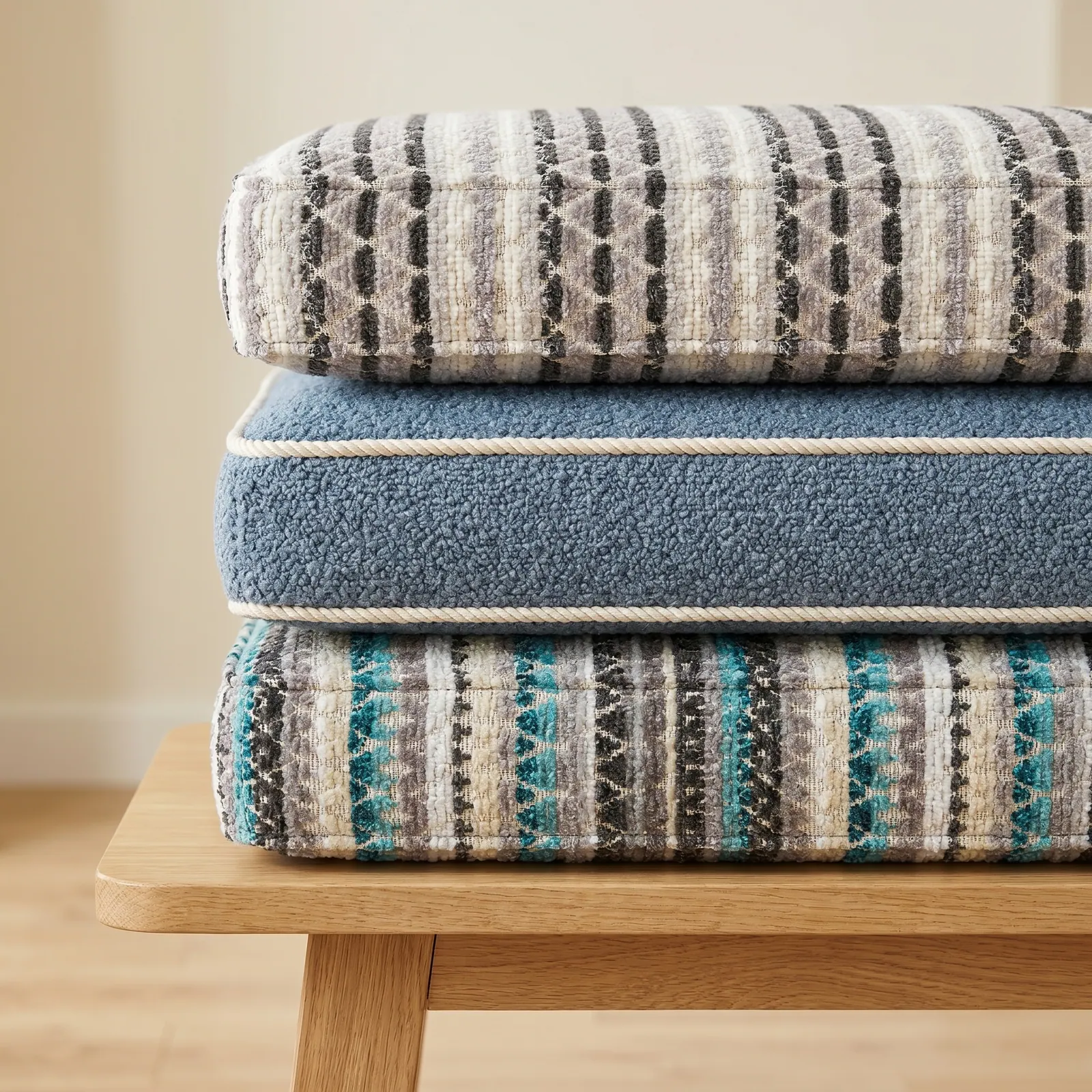
| Fabric | Multi-stripe chenille weave in sage, rust, cream, gray and teal |
| Piping | Self piping, cut from the same stripe |
| Stripe direction | Follows each run and turns 90 degrees at the join |
| Example sizes | 54 3/8 x 17 3/4 in (138 x 45 cm) and 98 3/8 x 17 3/4 in (250 x 45 cm) |
| Covers | Zippered and removable; the zipper side can be specified |
| Best for | Cream built-ins in a bright window corner |

Have it made
Have this made — ask Nate’s workshop
Precision starts on the phone. Give the workshop your measurements and they will read them back to you, edge by edge. — Nate
Leave your details and the workshop will call you to confirm measurements, fabric, foam and piping. No prices, dates or payment on this page: it is a request, not an order.
On an L-shaped bench cushion, the corner gets counted once. With a butt joint, one leg owns the corner and the other gives up the seat depth.
Nate
Questions buyers ask next
Should an L-shaped bench cushion be one piece or two?
Two, in most cases. Two separate cushions are easier to handle and sit more neatly than one connected L, and each can be unzipped and cleaned on its own. Mark which leg is long and where the join falls on your drawing.
How do stripes meet at the corner of an L-shaped cushion?
With angled ends meeting on a diagonal, the stripe follows each run and turns ninety degrees at the join, like a picture-frame corner. With a straight butt joint, the stripes meet at a right angle instead, and one run looks interrupted.
What wall color suits a multi-stripe bench cushion?
The plainest one in the room. In this corner the bench, walls and curtains are all cream, so five stripe colors read clearly. If the room already carries several colors, choose a two-color stripe or a solid for the cushion instead.
± 1/4 in — Nate
More photographs to read
 Save
 Save
 Save
 Save
 Save
 Save