A Reading by NateBay Window Cushions
Olive gold velvet on a trapezoid bay window seat: how it holds up to dinner, dogs and daylight
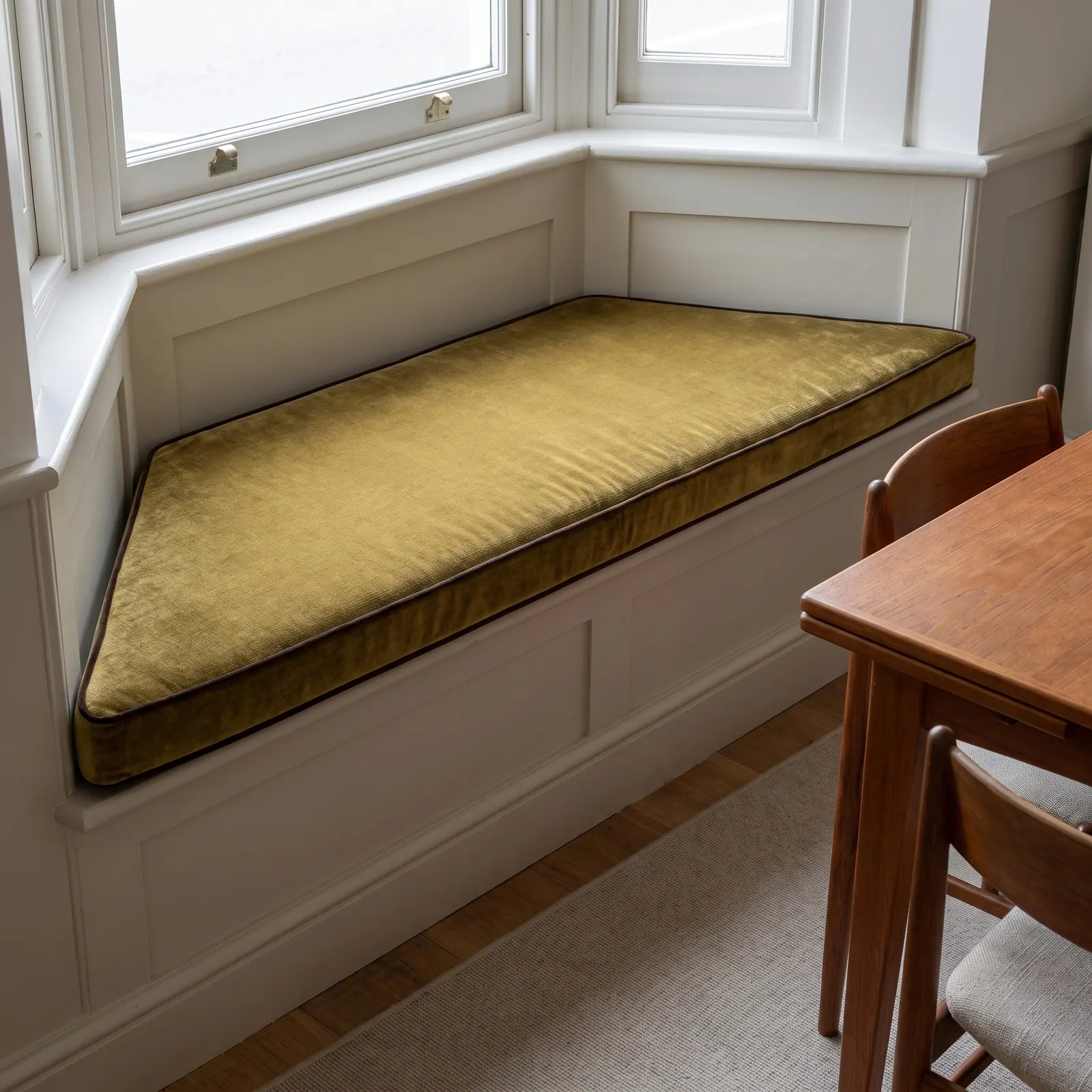
A trapezoid cut to the bay, a brown welt matched to teak, and a dining table right beside it. Here is the engineering read on how this seat will age, load by load.

 Save
The quick answer
A velvet bay window cushion beside a dining table ages well when it is specified for daily loads. Ask for a removable, machine-washable cover for spills, a non-slip base for kids sliding in and out, and the exact end-to-end size so it cannot shuffle. Expect the pile to show a light-and-dark shimmer where people sit.
The cushion, cut open
Cover fabric. A removable, zippered cover. Machine wash at 86°F (30°C) on a gentle cycle and air dry.
Piping. A fabric-covered cord sewn into the seams. It sits on the seam line, so it does not change the size.
Fiber wrap. Polyester fiber (Dacron) batting around the foam: it fills the cover out and softens the edges.
Foam core. About 2.0 lb/ft³ (32 kg/m³) high-resilience foam, firm to medium-firm, cut to the ordered size.
Zipper. Along the back band, as hidden as possible. The zipper side faces down or toward the wall.
Base panel. The underside of the cover. A non-slip fabric backing can cover the whole of it instead.
Pinned by Nate: five coordinates in the dining bay
Five pins, from the sash window at the top of the frame to the cream seat pad in the bottom corner, map where this seat meets the rest of the dining set.
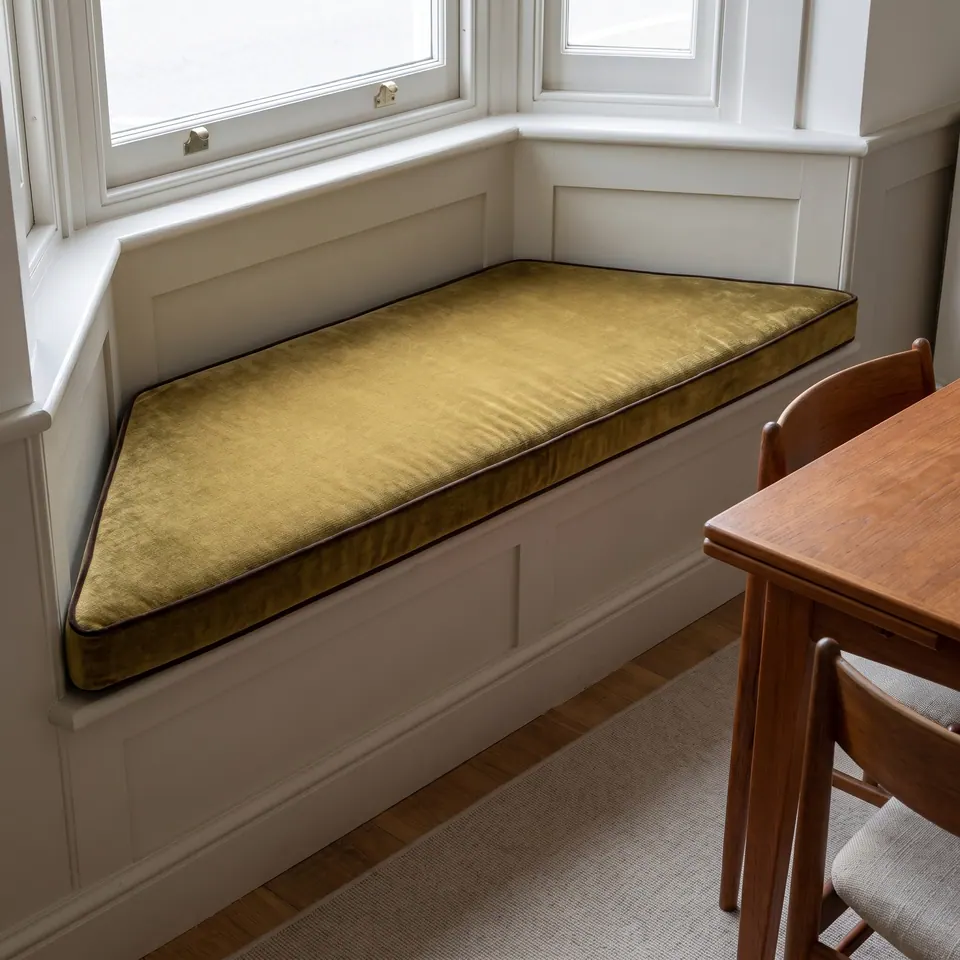
- Olive gold velvet
Velvet shows a light-and-dark shimmer where it is sat on.
- Brown piping
Matches the teak so the window seat reads as part of the dining set.
- Teak table
The bay seat becomes extra seating for guests.
- Cream seat pad
Chair pads and window seat share a soft, warm palette.
- Sash window
Painted frames stay plain so the velvet carries the color.
- Olive gold velvetVelvet shows a light-and-dark shimmer where it is sat on.
- Brown pipingMatches the teak so the window seat reads as part of the dining set.
- Teak tableThe bay seat becomes extra seating for guests.
- Cream seat padChair pads and window seat share a soft, warm palette.
- Sash windowPainted frames stay plain so the velvet carries the color.
Geometry first: a trapezoid that seats guests
The first measurement worth taking from this photo, partner, is the seat height. The bay seat sits at about the height of the teak dining chairs, which turns a window into extra places at the table. That was the whole design brief, and it was solved before anyone picked a fabric.
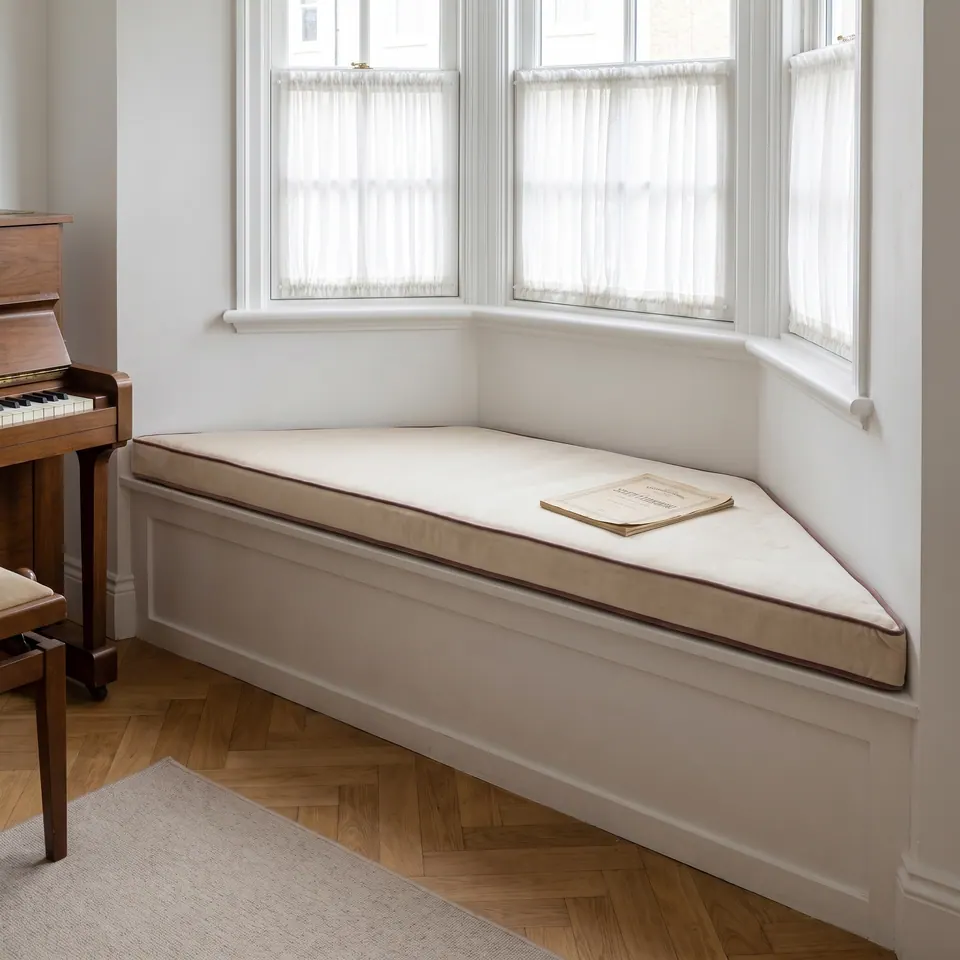
The cushion is a trapezoid, cut to the angled sides of the bay. Angles are just lengths in disguise: measure the back, the front and both sides, and the shape draws itself. The trapezoid cushion calculator does the arithmetic.
The edge is a box, and a brown contrast welt runs along it like a pencil line. Brown, not olive, because the table and chairs are teak. The piping ties the seat to the furniture, so it reads as part of the dining set rather than a separate window treatment.
Color against light: soft daylight comes through a sash window whose frames stay plain white, so the olive gold velvet carries all the color. The white paneled plinth, oak floor and cream rug keep the base quiet, and the cream seat pads on the chairs share the same warm palette.
One more reading, from the pile. Where people have sat, velvet shows a light-and-dark shimmer. On a family dining bay that is not damage; it is the seat keeping a record. Other bays measured the same way are in the bay window cushions section of the Atlas.
The daily-life test: six loads, six specs
| Load | What happens | What to specify |
|---|---|---|
| Sitting, every meal | The velvet pile shows a light-and-dark shimmer where it is sat on | Nothing extra; a mid shade like olive gold wears it as patina |
| Spills | Food and drink land at table height | A removable cover; velvet is one of the easy-clean ranges with machine-washable covers |
| Kids sliding in and out | A loose cushion creeps on a painted plinth | Non-slip base, written in the personalization note |
| Dogs | Claws and constant use | For heavy pet use, tightly woven fabrics from the pet-friendly chart |
| Front-edge perching | Firm foam can feel blocky at the edge | Dacron-wrapped foam to soften the edge |
| Sun | A bay collects light from several sides | Check swatches in your own daylight before ordering |
96 inches on the long side, and a request for feathers
A buyer wrote in with a big trapezoid bay: 96 in (244 cm) on the long side, 55 1/2 in (141 cm) on the short side, 19 1/4 in (49 cm) deep. They wanted the cushion 4 in (10 cm) thick with 20% feather-wrapped foam, in a pale sand color.
The workshop doesn't do feather wrap and said so plainly. It offered Dacron-wrapped foam instead, for the same reason people ask for feathers: a softer surface over a firm core. For the color, it pointed the buyer to the sample listing so the sand could be checked in real daylight first.
The engineering note: feather wrap and Dacron wrap solve the same problem, a hard edge on firm foam. On a dining bay where kids perch on the front edge, that softer edge is what makes the seat feel like furniture. The Pattern on Dacron-wrapped foam has the details.
What does your bay measure on its long side, and did you take that number at the back or the front?
Buyer questions: grip, exact sizes and a lopsided bay
- A common question
Can a bench cushion have a non-slip bottom, and does it come as a separate mat?
The workshop's answerYes, any bench cushion can have one: write 'non-slip base' in the personalization box along with your size and fabric code. It is not a separate piece; the underside of the cover itself is made from non-slip fabric, and it can be dropped from the order before production if you change your mind.
- A common question
Should I send the exact seat size, or take a little off so the cushion fits?
The workshop's answerSend the exact size of the seat, end to end; there is no need to go smaller. The workshop makes the cushion to the measurements you write and does not shorten them, so it fits properly.
- A common question
My bay window seat isn't a rectangle and isn't symmetrical. Can you still make a cushion for it?
The workshop's answerYes, in any size and shape. The easiest route is to draw the seat outline on paper with every side measured and send a photo, or to trace the seat onto a paper template such as butcher paper. The workshop may ask for a few extra measurements before quoting.
On the cutting table: the dining bay seat
| Product | Trapezoid bay window seat cushion |
|---|---|
| Fabric | Velvet in olive gold |
| Piping | Contrast welt in brown, matched to the teak |
| Edge | Box edge |
| Shape | Cut to the bay's angled sides from four measured lengths |
| Seat height | Close to the dining chairs beside it |
| Fill option | Firm foam with Dacron wrap to soften the edge |
| Grip | Non-slip base built into the cover underside, on request |
| Best for | A dining bay that doubles as guest seating |

Have it made
Have this made — ask Nate’s workshop
Precision starts on the phone. Give the workshop your measurements and they will read them back to you, edge by edge. — Nate
Leave your details and the workshop will call you to confirm measurements, fabric, foam and piping. No prices, dates or payment on this page: it is a request, not an order.
Order a trapezoid bay window cushion at the exact end-to-end size; the workshop does not shorten your numbers, so an inch shaved off at home stays missing.
Nate
Questions buyers ask next
Why choose brown piping for an olive gold velvet seat?
Because the table and chairs are teak. A brown welt ties the bay seat to the wood, so it reads as part of the dining set rather than a separate piece. Take the piping color from the dominant wood in the room.
How high should a bay seat be when it doubles as dining seating?
Close to your dining chairs. Finished height is the platform plus the cushion, less a little settle: a 3 in cushion may ride about 2 1/2 in under you. Dining seats usually land around 18 in (46 cm), within 17 to 19 in.
What wraps the foam if feathers aren't an option?
Dacron, a polyester fiber batting. Wrapped around firm foam, it softens the top and the edge so the seat feels less blocky, which is the job most people have in mind when they ask for a feather wrap.
± 1/4 in — Nate