A Reading by NateBay Window Cushions
A dusty rose velvet bay window cushion, and what self piping does at the angled end
A welt costs nothing extra and gets looked at every morning. On a bay seat with an angled end, it is also where a wrong measurement shows first.

 Save
The quick answer
On a bay window cushion, the piping choice decides how loudly the angles show: self piping keeps the long edge quiet, contrast piping draws every corner like a pencil line, and no piping leaves a plain box edge. Piping is included, sits on the seam and never changes the ordered size. Any cushion 1 1/8 in (3 cm) or thicker can carry it.
What the welt does at the angled end
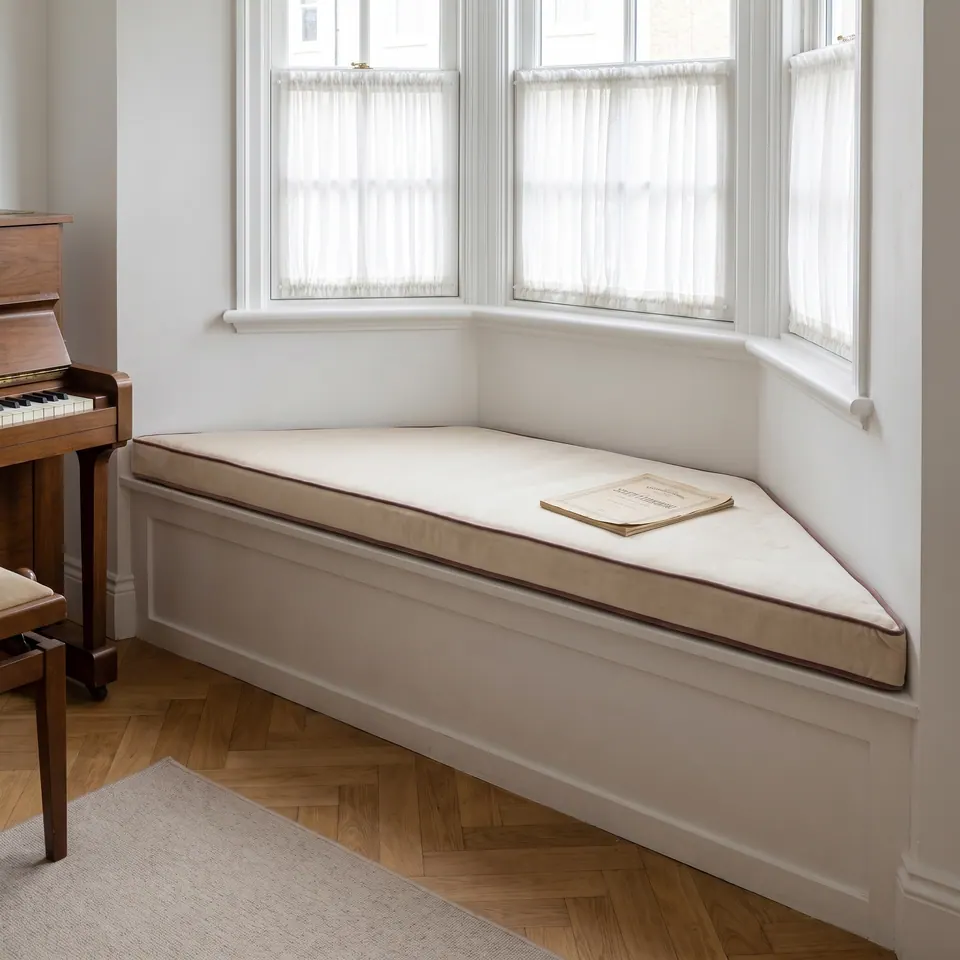
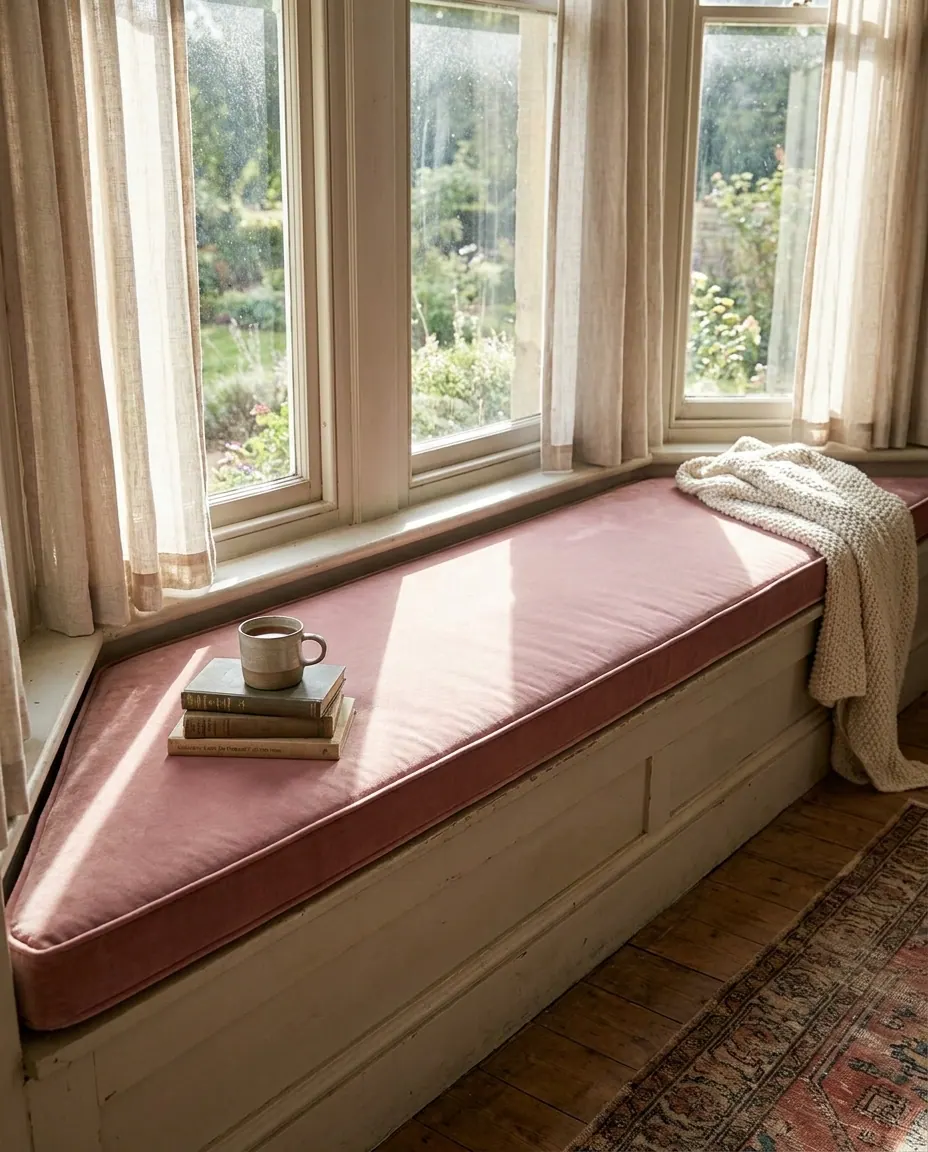
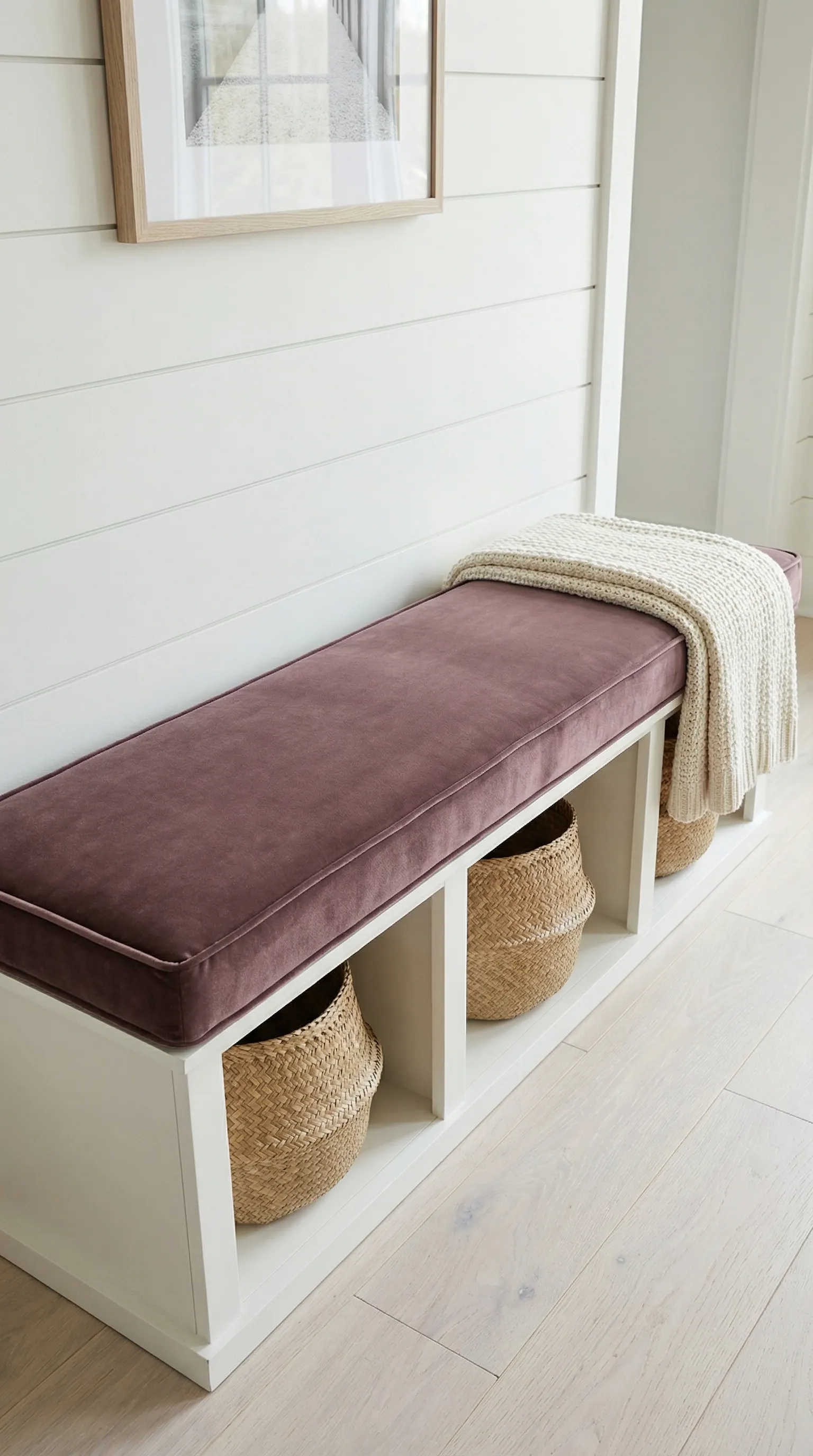
A painted, paneled bay seat, sheer linen curtains, a garden after rain. The cushion is dusty rose velvet, cut so its near end meets the side window at the angle of the bay. The piping runs tight along that angled end and turns the corner cleanly, which only happens when the template is right.
The welt is self piping, the same rose velvet. It keeps the long front edge quiet, so the color does the talking against cream paint and the green yard beyond the glass. A contrast welt would draw every angle like a pencil line: handsome if the angles are true, unforgiving if not.
The props split the seat into thirds: books and a stoneware mug at one end, a chunky knit throw at the other, the middle free. The faded rug repeats the rose at floor level.
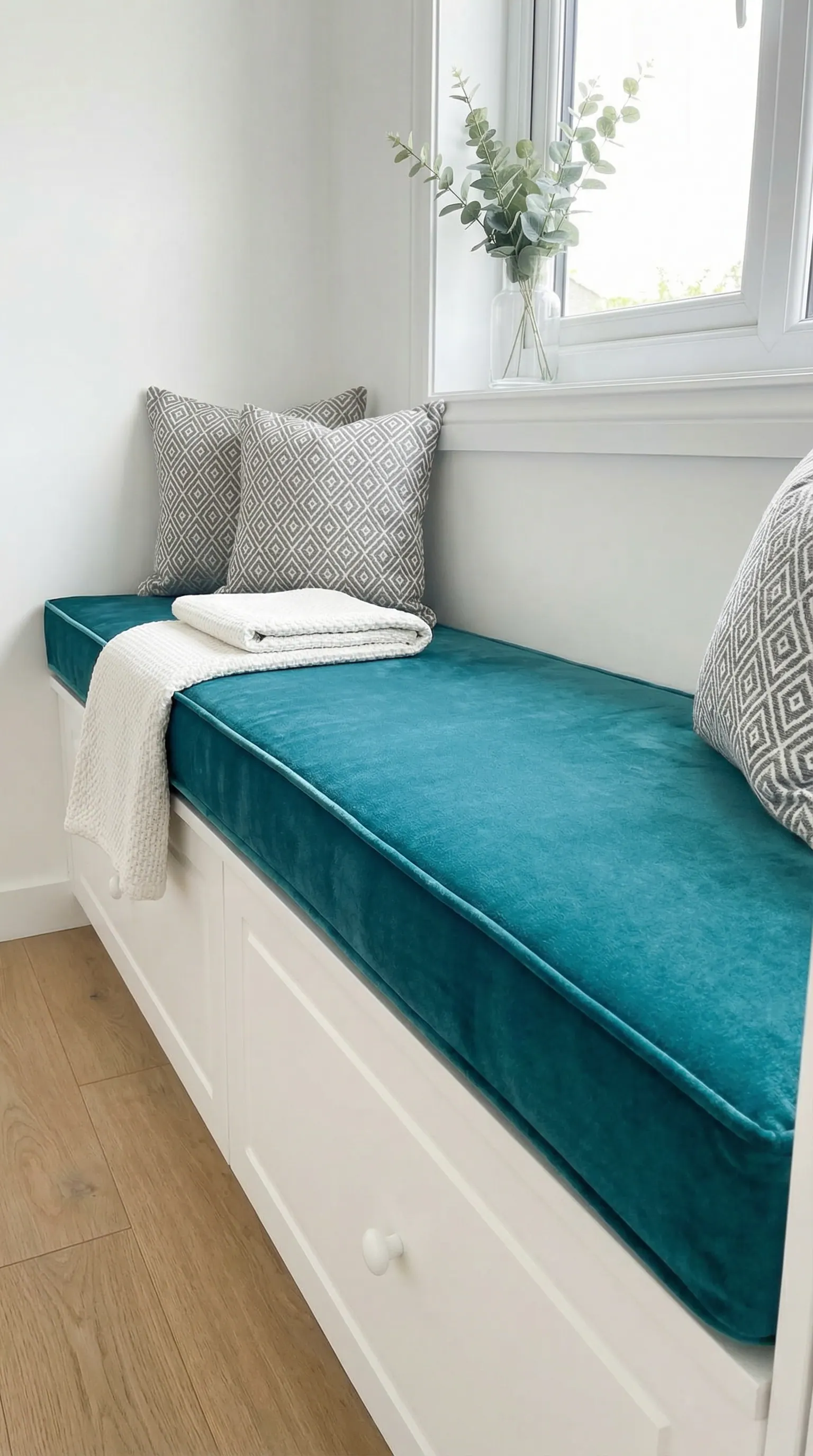
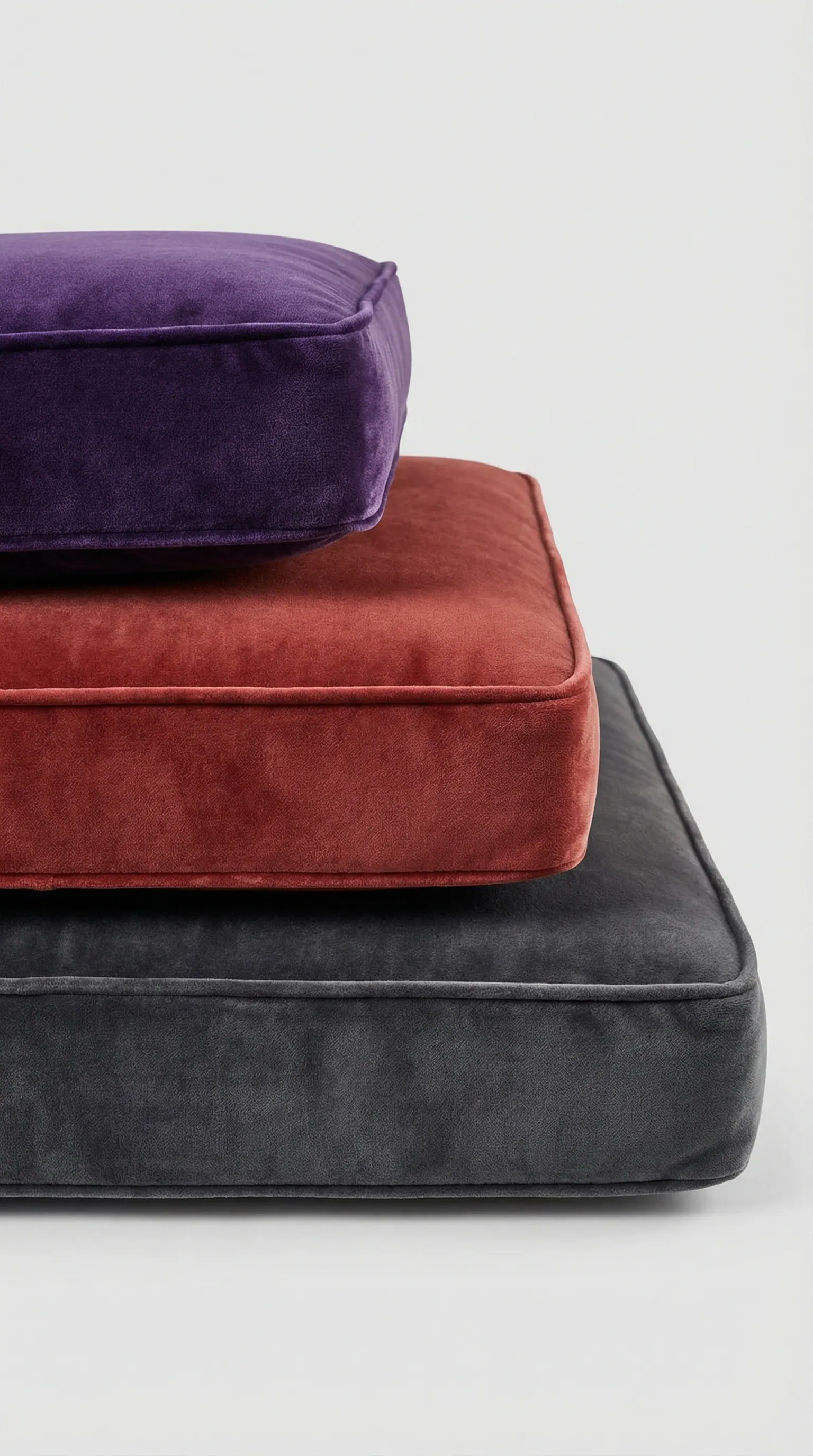
Three choices, partner, and each does something to the line: - Self piping: one outline in the body color; calm on long edges. - Contrast piping: any chart color; draws the shape, and any error in it. - No piping: a plain box edge, at the same cost.
Which line does your bay want? The piping guide compares all three, the trapezoid cushion calculator checks a slant before anyone cuts, and more shapes live under bay window cushions.
A real bay, read back in inches
A buyer's drawing for one slim cushion on an irregular bay seat, converted edge by edge.
| Edge | Inches | cm | Note |
|---|---|---|---|
| Front edge | 98 3/8 | 250 | longest line, most visible welt |
| Back edge | 62 5/8 | 159 | against the wall |
| Window edge | 49 3/8 | 125.5 | runs along the glass |
| Depth | 22 7/8 | 58 | deepest point |
| Thickness | 2 to 2 3/8 | 5 to 6 | firm foam; still takes piping |
Anything 1 1/8 in (3 cm) or thicker can carry piping, so this slim seat could be self-piped, contrast-piped or left plain.
Pinned by Nate
Five pins, from the angled end to the faded rug.
- Angled end
The end of the cushion is cut at the angle of the bay, which is why it sits snug against the side window.
- Books and mug
A stack of books makes a steady little table on a soft seat.
- Knit throw
Chunky cream knit at the far end balances the stack of books at the near end.
- Paneled base
Cream paint on the base lets the rose velvet be the only color at seat height.
- Faded rug
The rug's rose and red pick up the velvet color at floor level.
- Angled endThe end of the cushion is cut at the angle of the bay, which is why it sits snug against the side window.
- Books and mugA stack of books makes a steady little table on a soft seat.
- Knit throwChunky cream knit at the far end balances the stack of books at the near end.
- Paneled baseCream paint on the base lets the rose velvet be the only color at seat height.
- Faded rugThe rug's rose and red pick up the velvet color at floor level.
Measuring a bay for a piped cushion
Measure every edge
Front, back and each window edge, wall to wall, as true numbers.
Take the depth at the deepest point
Long edge, short edge and depth fix the slant.
Trace the angles
Photograph a paper template beside a tape measure.
Write two codes
One for the body fabric, one for the piping, even when they match.
One slim cushion for a bay with extra angles
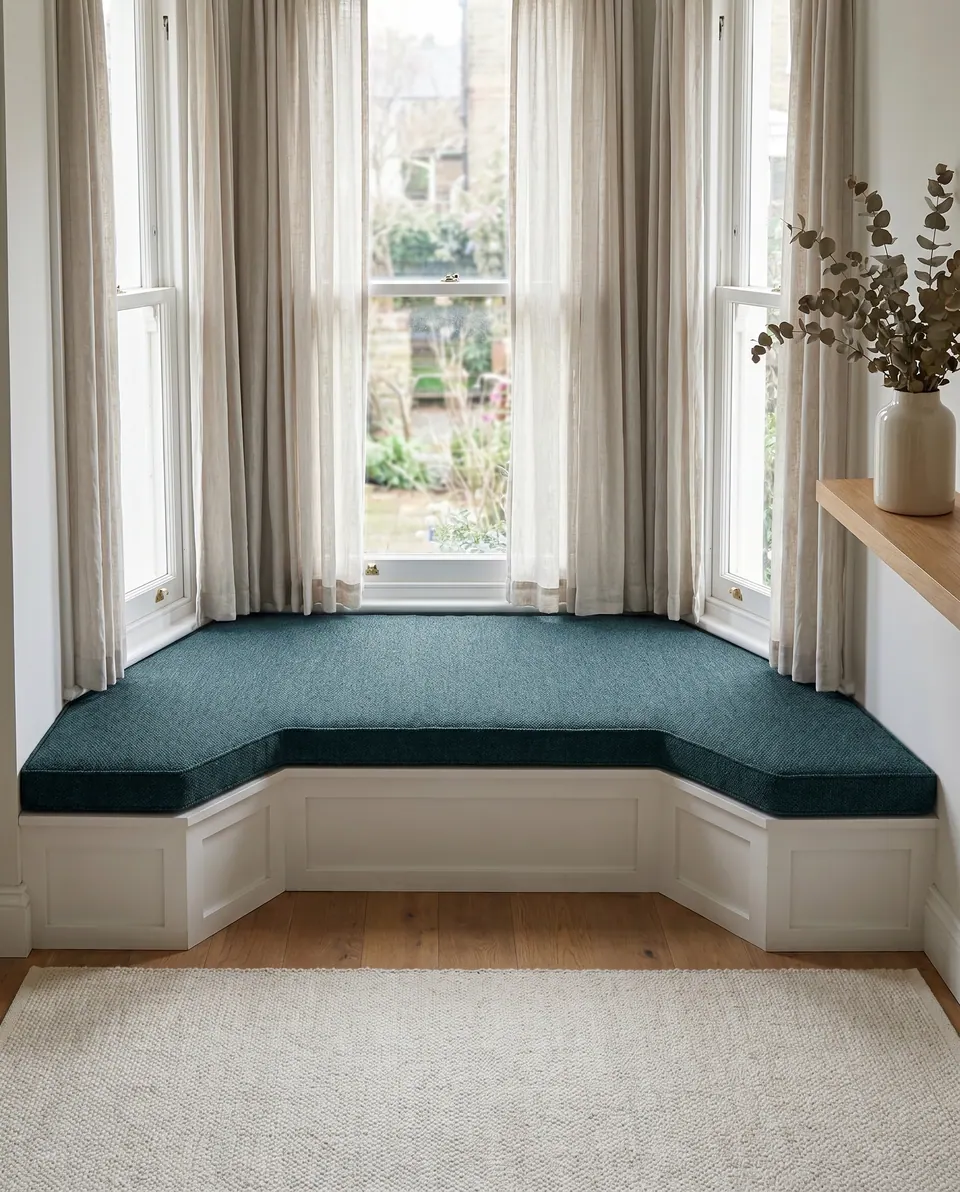
A buyer needed one continuous, slim cushion for an irregular trapezoid bay seat: a 98 3/8 in front, a 49 3/8 in edge along the window, a 62 5/8 in back edge and a 22 7/8 in depth. The notebook table carries the centimeters. They wanted 2 to 2 3/8 in (5 to 6 cm) of firm upholstery foam and a removable zipped cover.
The workshop confirmed it makes these constantly. The buyer chose the size range by depth and front edge and uploaded the fully measured drawing, which is what the cut follows.
- Sizes
- 98 3/8 in front, 62 5/8 in back, 49 3/8 in window edge, 22 7/8 in deep
The lesson: For a multi-angle bay, measure every edge and let the drawing drive the cut.
Velcro, backrests and a slant that didn't add up
- A common question
Can you add velcro so the cushion stays put on the bench?
The workshop's answerIt has been done as a two-part fix: one side is sewn under the cushion, and the other is sent to you to fix to the bench. The strips cost extra, so some buyers fit their own.
- A common question
When I measure for a backrest, do I take the seat cushion's thickness off the wall height?
The workshop's answerYes. The backrest sits on top of the seat, so subtract the seat thickness: with a 4 in seat, a 21 in back area takes a 17 in backrest.
- A common question
The slanted sides on my trapezoid sketch don't seem to add up. What happens then?
The workshop's answerThe long edge, the short edge and the depth fix the slant, so the workshop checks it before cutting. With a 70 7/8 in long edge, a 39 3/8 in short edge and a 21 1/4 in depth, the slants came to 26 3/8 in, not the 25 5/8 in written. A slant shorter than the depth is impossible and goes back for re-measuring.
Piping never changes the size of a bay window cushion; it sits on the seam. It only decides whether the angled ends read quiet or drawn.
Nate
On the cutting table
| Cushion | Trapezoid bay window seat cushion with one angled end, box edge |
|---|---|
| Fabric | Dusty rose velvet, short non-shiny pile |
| Piping | Self, top and bottom seams |
| Piping choices | Self, contrast from any chart, or none; same cost |
| Thinnest with piping | About 1 1/8 in (3 cm) |
| Care | Zipped cover, 86°F (30°C) gentle, air dry |

Have it made
Have this made — ask Nate’s workshop
Precision starts on the phone. Give the workshop your measurements and they will read them back to you, edge by edge. — Nate
Leave your details and the workshop will call you to confirm measurements, fabric, foam and piping. No prices, dates or payment on this page: it is a request, not an order.
Questions buyers ask next
Does piping cost extra?
No. Piping is included, matching or contrast, from any chart, and no piping costs the same. Single piping on the top and bottom edges is standard; double piping is optional.
Self or contrast piping on a bay window seat?
Self piping keeps a long front edge quiet; contrast outlines every angle of the bay and rewards an exact template. Roughly half of orders choose each.
How thin can a cushion be and still take piping?
About 1 1/8 in (3 cm). Cushions of 1 in or ¾ in (2 cm) are made without piping, and the thinnest standard foam cushion is 2 in (5 cm).
± 1/4 in — Nate
Velvet seats, piped and plain
 Save
 Save
 Save
 Save
 Save
 Save