A Reading by NateBay Window Cushions
A forest green velvet bay window cushion, and the five measuring mistakes it didn't make
Notebook open, pencil sharp. Nate reads a self-piped velvet seat cut to an angled bay and lists what usually goes wrong before a shape like this reaches the cutting table.

 Save
The quick answer
The first mistake to avoid on a bay window cushion is a sketch with edge lengths but no front-to-back depth. Label every edge, add the depth, mark each angle or diagonal, and send one drawing per shape. On a bay framed in wood trim, like this forest green velvet seat, self piping is the quieter choice; save contrast piping for plain white joinery.
Notebook, page one: what this bay got right
Page one, top line: angles are just lengths in disguise. Write them down and a bay stops being a mystery.
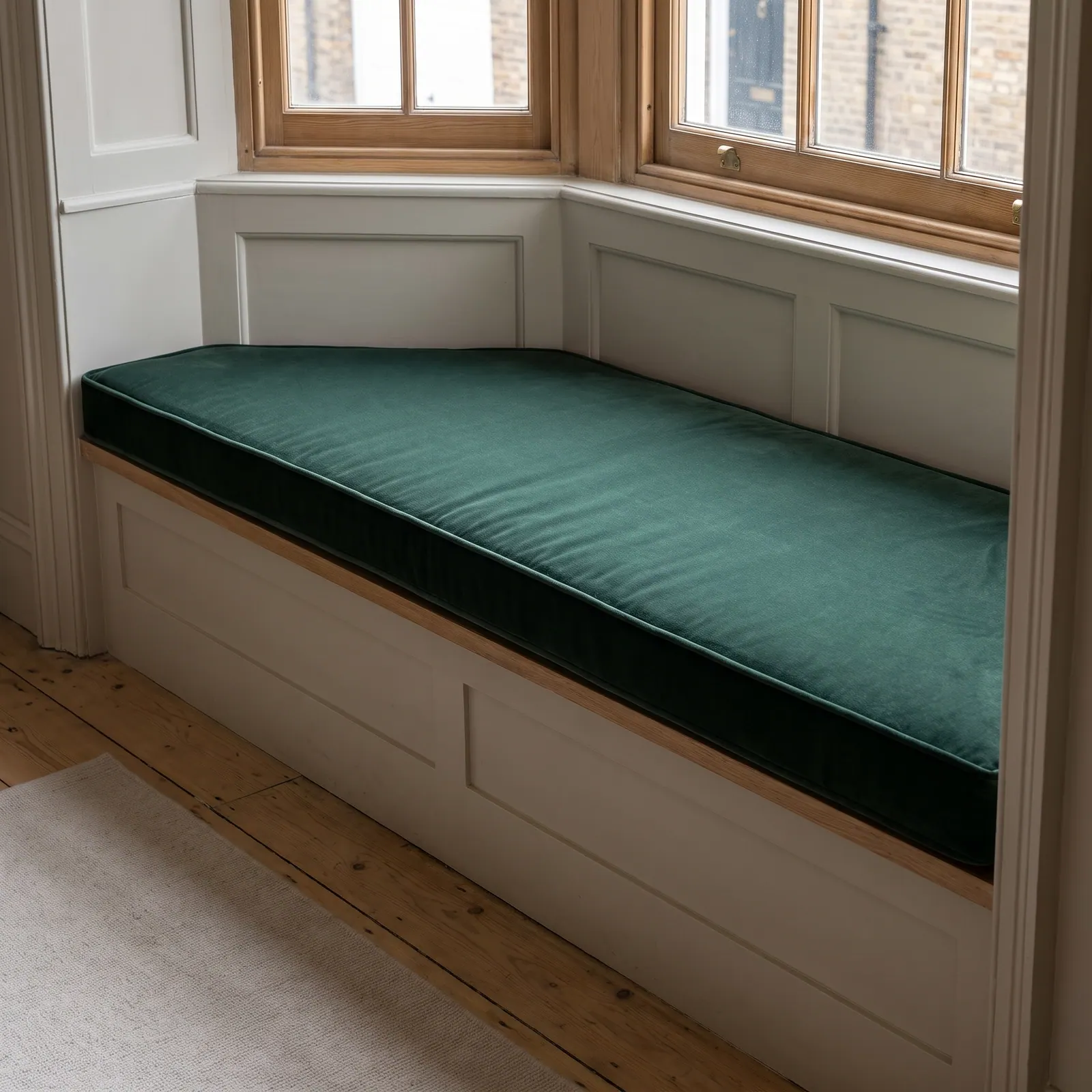
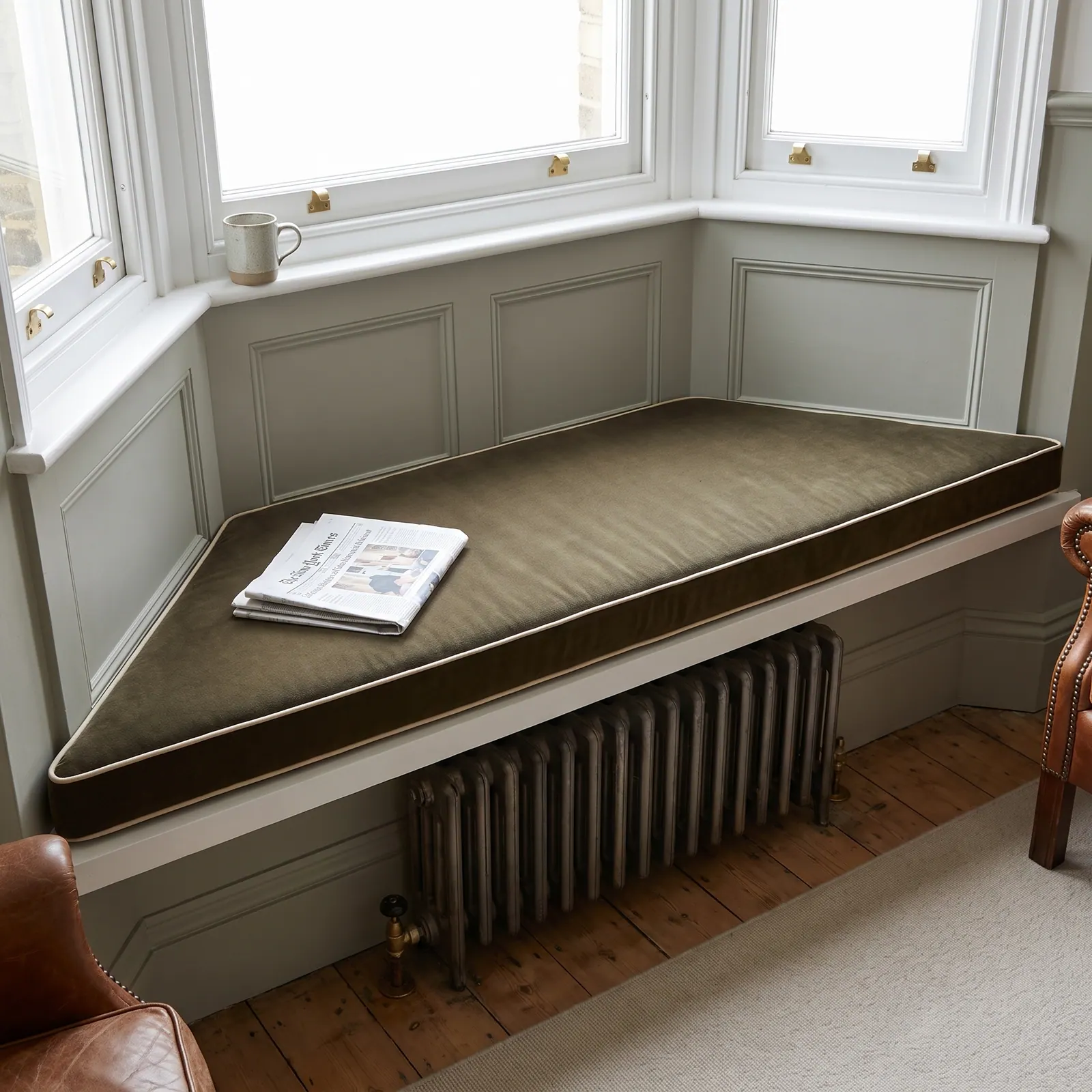
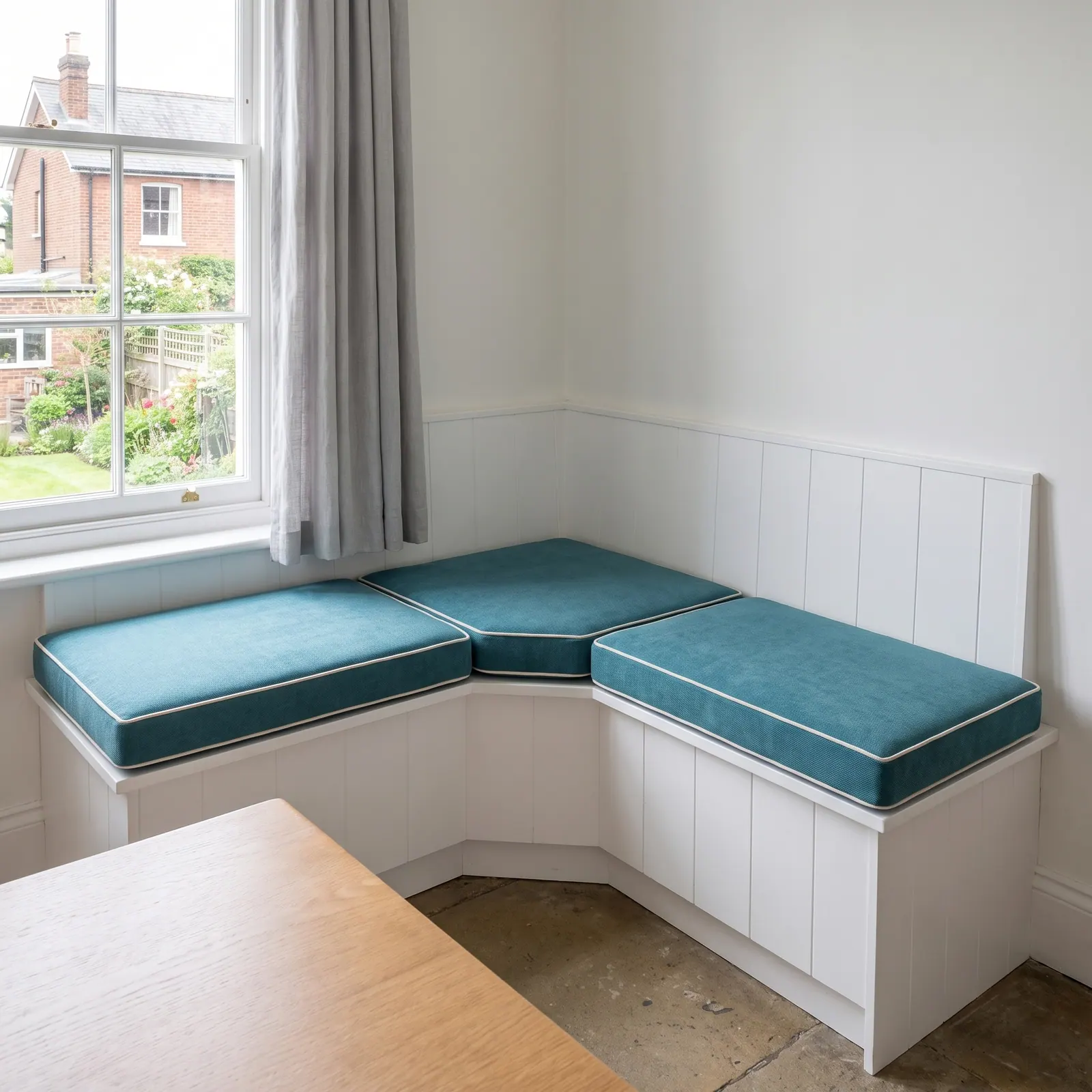
This seat is a trapezoid laid along a painted, paneled bay. The left end is cut to the angle of the side panel, so the cushion meets the wall flush instead of leaving a triangle of bare plinth. The front edge runs straight and parallel to the oak nosing. That tells me somebody measured the front and the back separately and checked the angle instead of assuming it.
The cloth is forest green velvet, code 125, with piping cut from the same green. Self piping lets the top read as one smooth block of color, which suits a calm, traditional living room. The room already has plenty of lines: oak sash frames above, an oak-edged plinth below, painted panels between. A contrast cord would add a fourth outline and pick a fight with the wood.
Velvet has a pile, so the green shifts with the light, darker where the box edge rolls away and lighter across the top. That shading is normal. The stripped pine boards and a cream rug keep the dark mass from sinking into the floor.
More shapes live on the bay window cushions page. For the arithmetic, the bay window calculator turns edge lengths and depth into a cut list.
So, what does your bay measure at its deepest point, front to back?
Pinned by Nate: five coordinates on a green bay
Five pins, each one a measurement or a decision somebody made before the velvet was cut.
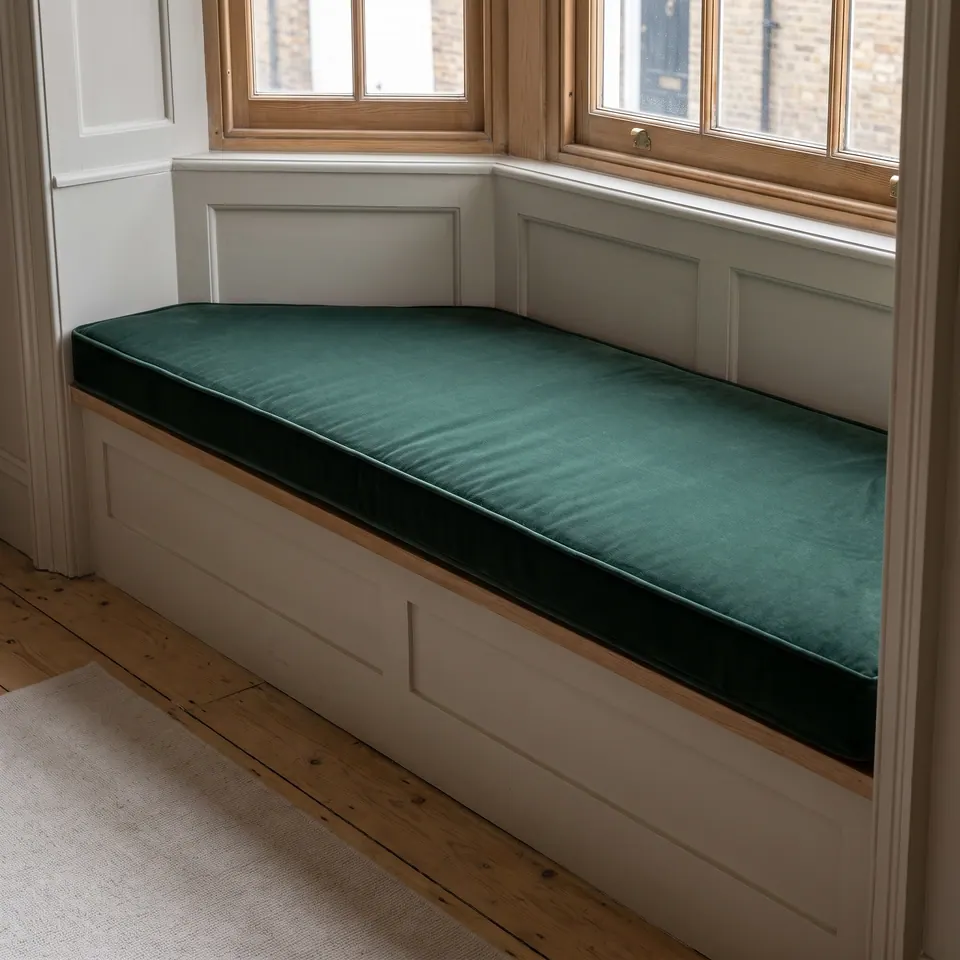
- Monochrome velvet top
Self piping lets the cushion read as one smooth block of color.
- Angled end
The end is cut to the bay's side panel.
- Self-piped front edge
Same-color piping is the quieter choice beside wood trim.
- Oak sash frames
Wood frames the green above and the oak-edged plinth frames it below.
- Stripped boards
Pale boards and a cream rug soften the dark velvet.
- Monochrome velvet topSelf piping lets the cushion read as one smooth block of color.
- Angled endThe end is cut to the bay's side panel.
- Self-piped front edgeSame-color piping is the quieter choice beside wood trim.
- Oak sash framesWood frames the green above and the oak-edged plinth frames it below.
- Stripped boardsPale boards and a cream rug soften the dark velvet.
Five bay window mistakes, with the fix beside each
| Mistake | What goes wrong | The fix |
|---|---|---|
| No front-to-back depth on the sketch | Edge lengths alone fit many shapes; the seat can't be priced or cut | Write the depth at the deepest point and at each end |
| Angles guessed, not measured | The angled end leaves a gap at the side panel | Add a diagonal, or trace the corner on paper |
| Two shapes in one order | Two drawings, one order, easy to mix up | One order and one drawing per shape |
| Contrast piping beside wood trim | An extra outline competes with sash and nosing | Self piping with wood; contrast with plain white joinery |
| Backrests left out of the note | The seat is cut and the backs become an afterthought | Add each back as its own item, noted 'backrest pillow' |
A 91-inch bay, the family dogs, and one missing number
A buyer in the US wrote to the workshop about a bay seat that wasn't a perfect trapezoid, and dogs that use it as a lookout. The shop sent a pet-friendly fabric chart first. Then it read the sketch and found the gap: every edge length was there, but the front-to-back depth was not.
With the depth added, the buyer picked the size range by that depth and by the longest length, 91 in (231 cm). They had fallen for an olive velvet with taupe piping in a review photo, and asked whether velvet would hold up to the dogs. The shop's answer: velvet is as durable as the other chart fabric they were weighing.
This lesson goes in the margin in ink, partner. Depth is a length too, and a bay sketch without it is half a drawing. The three-sided bay guide shows where to hold the tape, and the drawing checklist covers the labels.
Buyer questions: backrests, contrast welts, two shapes
- A common question
How do I add back cushions to my bench cushion order?
The workshop's answerAdd each piece to the cart separately from the same listing. For every piece, write the exact size and fabric code in the personalization box, and add the words 'backrest pillow' to the note for the back pieces.
- A common question
If I want piping that contrasts with the main fabric, how do I ask for it?
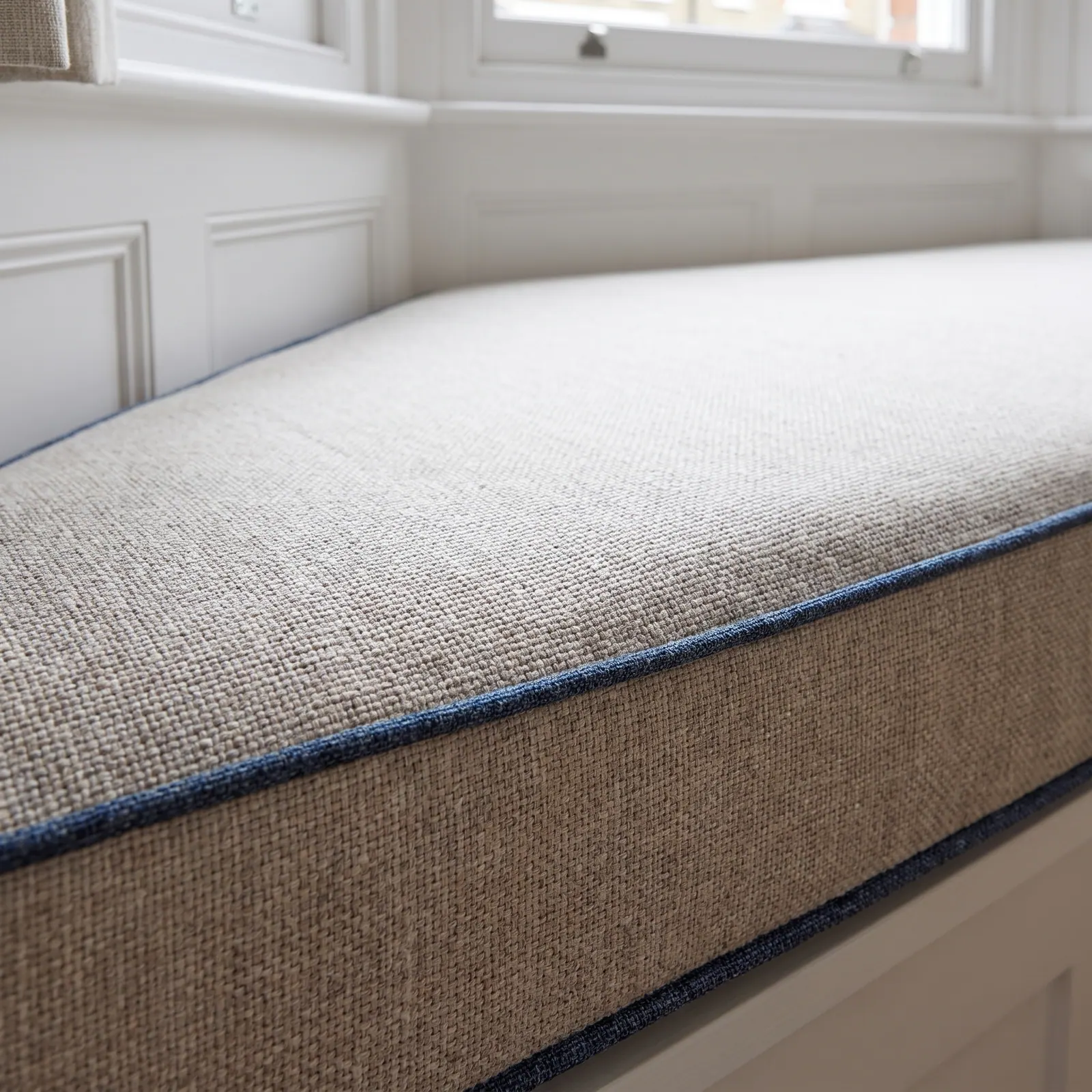
The workshop's answerAny fabric code in the charts can be used for piping. Buyers have paired a cream linen with a blue linen welt and an outdoor stripe with solid blue piping, among many others. Write both codes, body and piping, in the order note.
- A common question
I need two cushions in two different shapes. Can they go in one order, and how do I send the drawings?
The workshop's answerSend a drawing with a measurement written on every edge, ideally labeled. Two different shapes go in as separate orders through the trapezoid listing, each with its own drawing uploaded. If the messaging system won't take a photo in your first message, attach it once the shop has replied.
On the cutting table: the forest green bay seat
| Piece | Bay window seat cushion, trapezoid with one angled end |
|---|---|
| Fabric | Forest green velvet, code 125 |
| Piping | Self, cut from the same green |
| Edge | Box edge |
| Angled end | Cut to the angle of the bay's side panel |
| On the sketch | Every edge labeled, front-to-back depth, one diagonal per angle |
| Measuring | To the nearest 1/4 in (6 mm), at the back and at the front |
| Order note | Body code and piping code for every piece |
| Best for | Traditional living rooms, bays trimmed in wood |

Have it made
Have this made — ask Nate’s workshop
Send the numbers in inches: length × depth × thickness, plus any angle. The workshop checks them with you, because foam has no undo button. — Nate
Leave your details and the workshop will call you to confirm measurements, fabric, foam and piping. No prices, dates or payment on this page: it is a request, not an order.
A bay window cushion sketch with every edge length but no front-to-back depth is half a drawing. Write the depth at the deepest point.
Nate
Questions buyers ask next
Do I need the angles for a bay window cushion, or only the lengths?
Lengths plus depth are not quite enough; add one diagonal per angled end, because a diagonal fixes the angle. Without it, the ends are a guess. On an old, out-of-square bay, a paper template of each corner is the surest record.
Will a velvet bay seat stand up to dogs jumping on it?
The shop told one buyer with dogs that velvet is as durable as the other fabric on its pet-friendly chart. Velvet's short pile brushes and wipes clean, but claws can still pull any weave, so keep nails trimmed.
Why is the piping on this bay cushion the same green as the velvet?
Self piping lets the cushion read as one block of color. This bay already has oak sash frames, an oak-edged plinth and painted panels, so a contrast welt would add a fourth outline. Contrast works better against plain white joinery.
Can one cushion follow the angled end of a bay?
Yes. The cushion in this Reading is a single trapezoid with its left end cut to the side panel's angle. Longer or five-sided bays are often made in sections that meet at the corners, and the bay window calculator helps decide where.
± 1/4 in — Nate
More photographs to read
 Save
 Save
 Save
 Save
 Save
 Save