A Reading by NateBay Window Cushions
A cream velvet bay window cushion, a piano, and props that earn their place
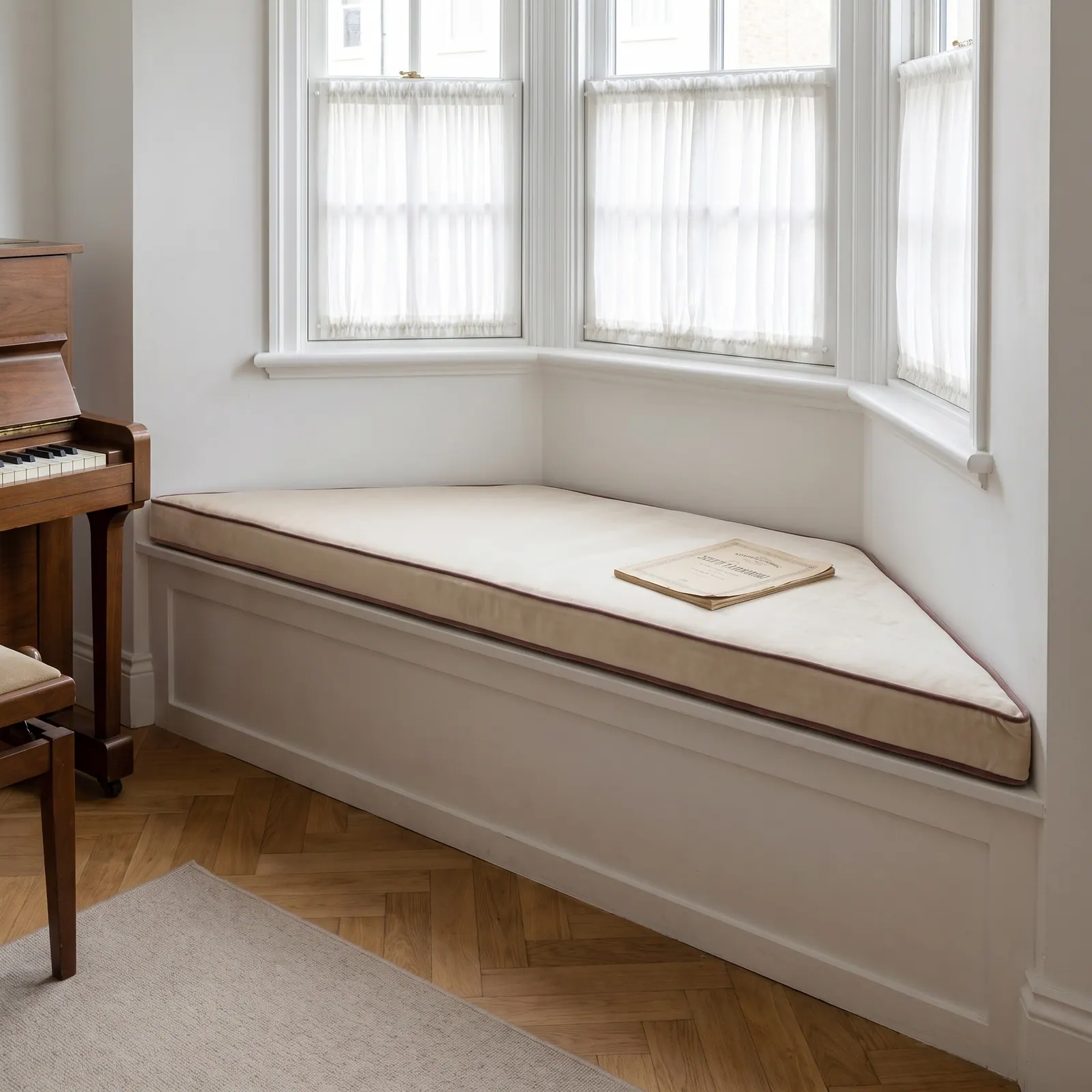
One booklet of sheet music does more styling here than a pile of pillows could. And the geometry underneath had to be caught before anyone cut.

 Save
The quick answer
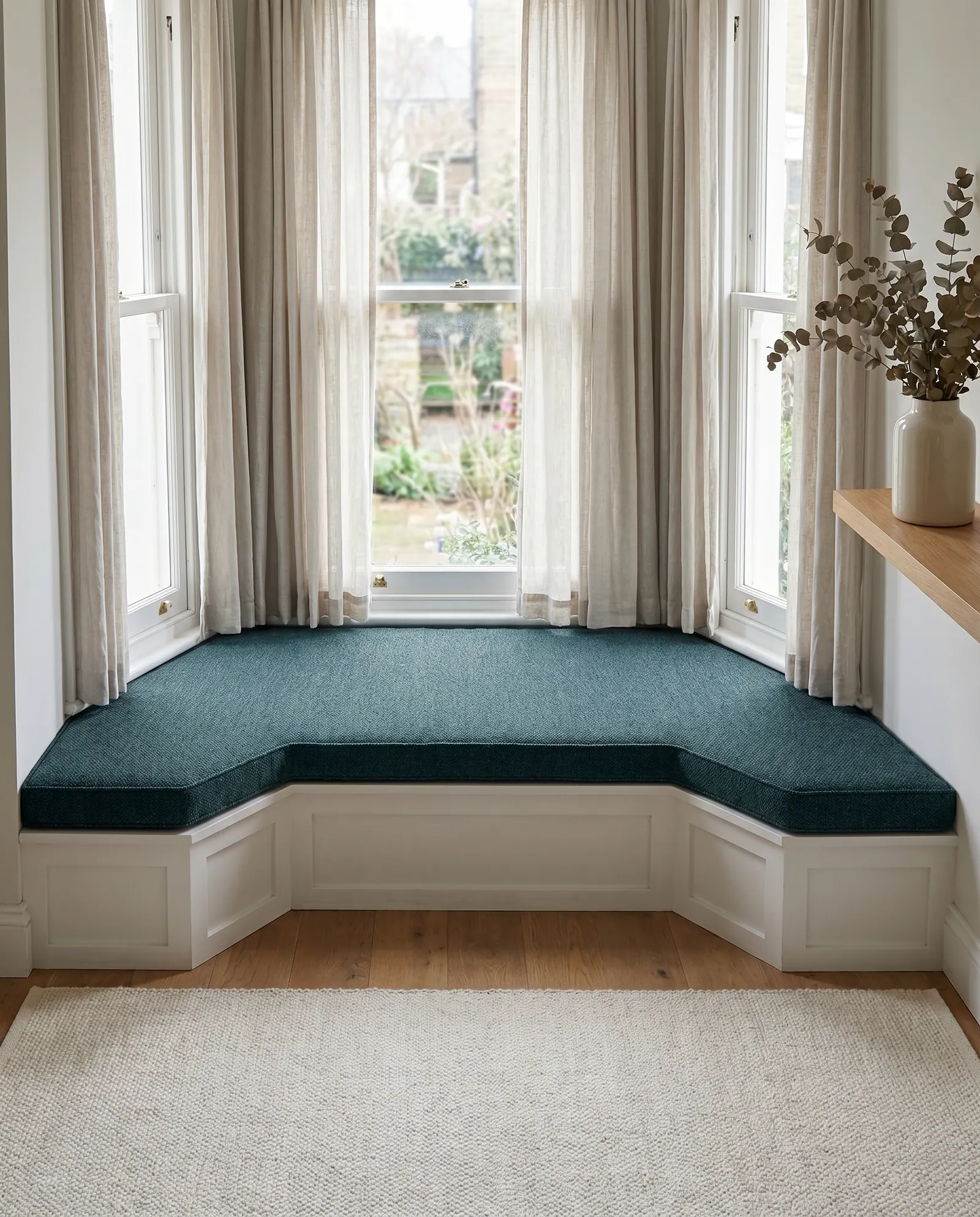
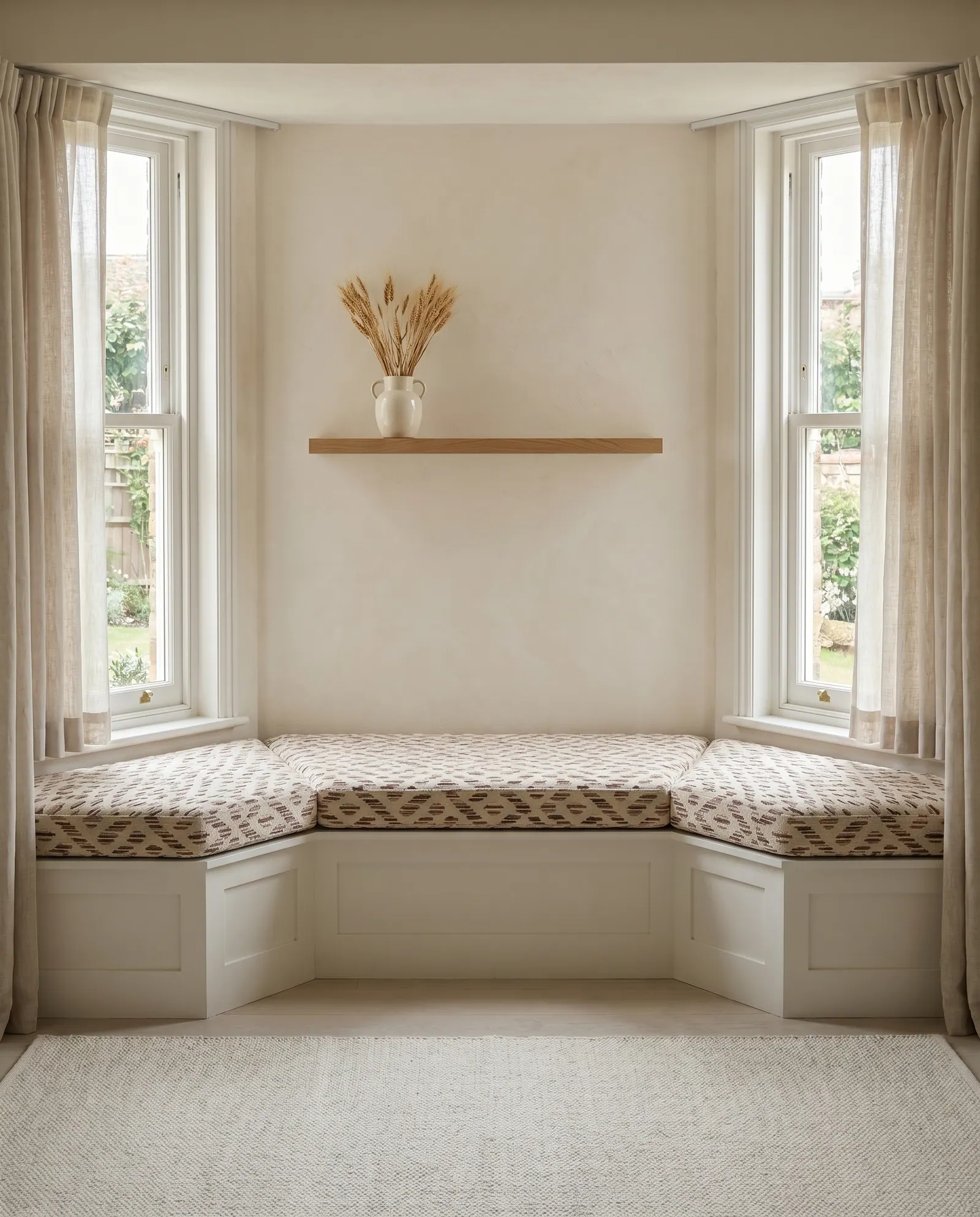
A pale velvet bay window cushion needs few props: sheet music, sheer cafe curtains and a walnut piano do the styling here, and muted dusty mauve piping outlines the cream without a hard line. For the trapezoid itself, give the back, front and both angled sides, and have it drawn to scale before cutting.
Buyer questions: trapezoids, tufts and soft backs
- A common question
How do I give you measurements for a trapezoid window seat cushion?
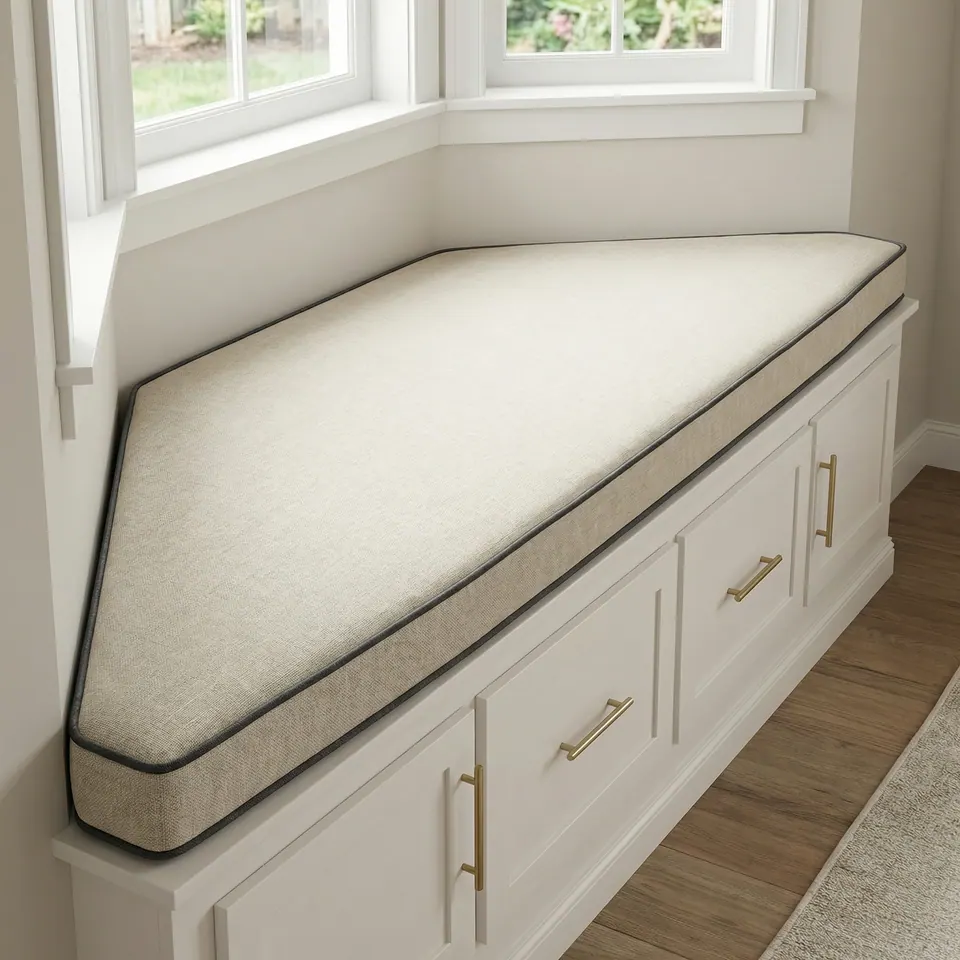
The workshop's answerThe shop sends a drawing with the sides labeled A, B, C and D, and you give each length, for example 43 1/4, 48, 13 3/4 and 13 3/8 in (110, 122, 35 and 34 cm), with a thickness of 3 1/2 in (9 cm). Trapezoids can also be made in tufted corduroy. One bay window trapezoid was quoted with a 28 in (71 cm) back, 27 in (69 cm) sides and a 65 in (165 cm) front.
- A common question
If I choose a tufted cushion, will the cover still zip off?
The workshop's answerNo. Tufted cushions are made without a zipper, while untufted foam-filled cushions have zippered covers. That means a tufted cushion can't get a replacement cover on its own; the whole cushion has to be remade.
- A common question
Should my back cushions be foam or soft like a bed pillow?
The workshop's answerYou choose, and the shop recommends foam. Foam backrests hold their shape better, outdoors too, while pillow-style filling is the cheaper option. One pair of backrests was quoted at 25 in (64 cm) wide and 18 in (46 cm) high.
Now, the reading
The 40 in side that couldn't exist
A buyer ordered an angled window seat cushion in fabric K-7, asked for two buttons in the center in the same fabric, and switched the piping from K-18 to K-7 so everything would match.
Then the shape was drawn to scale. The angled sides had been given as 40 in (102 cm), and on paper the lines would not meet. The only way the other measurements closed into one shape was with angled sides of 34 in (86 cm).
The buyer re-measured with help and found the mix-up: a 30 in (76 cm) and a 40 in measurement had traded places. Numbers fixed, production went ahead.
Angles are just lengths in disguise, partner. If the drawing doesn't close, one number is wrong. The trapezoid cushion calculator will draw yours before anybody cuts, and trapezoid cushion measurements walks through each side.
Pinned by Nate: five things in the music room
Five pins, from the sheet music on the seat to the herringbone oak under the bay.
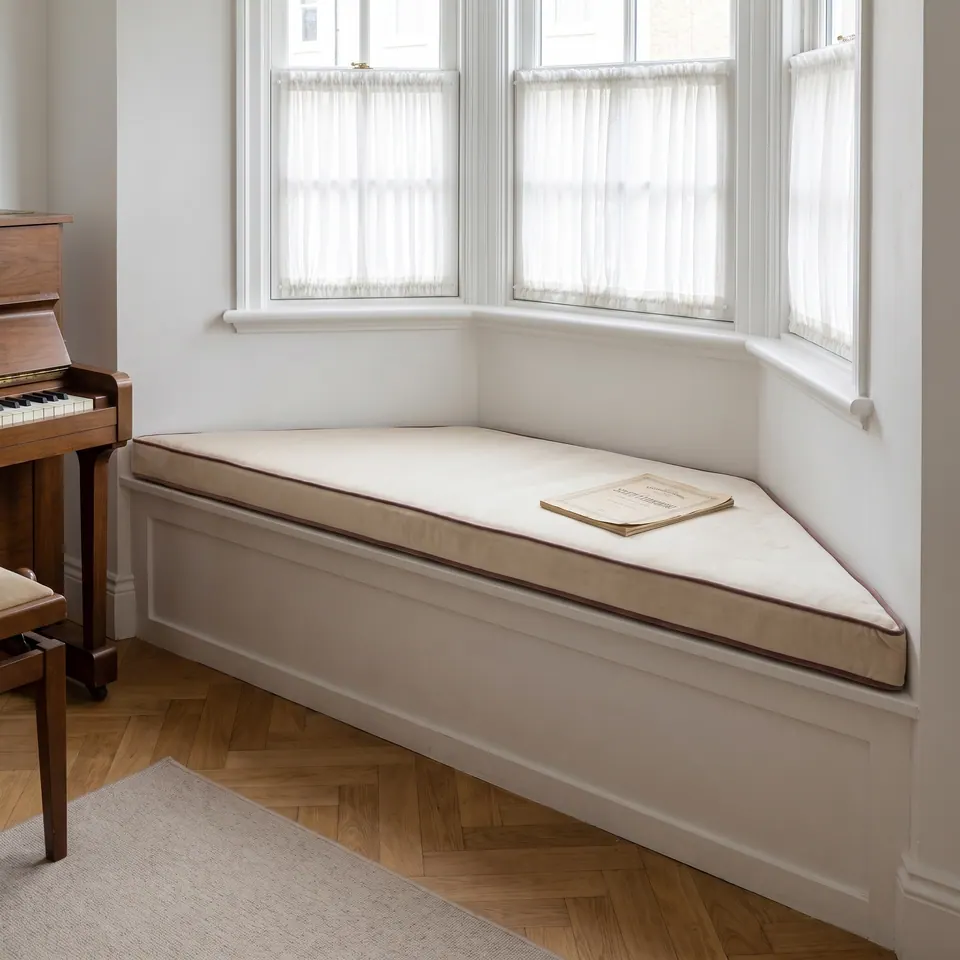
- Sheet music
A single prop tells you this is a listening seat.
- Dusty mauve piping
A muted accent that defines a pale velvet without a hard line.
- Upright piano
Walnut wood is echoed by the warm piping color.
- Cafe curtains
Sheer half-curtains diffuse light across the velvet sheen.
- Herringbone floor
Warm oak grounds the all-pale bay.
- Sheet musicA single prop tells you this is a listening seat.
- Dusty mauve pipingA muted accent that defines a pale velvet without a hard line.
- Upright pianoWalnut wood is echoed by the warm piping color.
- Cafe curtainsSheer half-curtains diffuse light across the velvet sheen.
- Herringbone floorWarm oak grounds the all-pale bay.
Every prop in the bay has a job
I read props the way I read a spec sheet: each one has to do something. In this bay, they all do.
Sheet music on the seat. One booklet tells you what the seat is for: listening. It also gives the eye a flat, familiar object to judge the seat's depth against.
Upright walnut piano and stool. The warm walnut is the reason the piping is dusty mauve. A muted warm accent picks up the wood and the floor without drawing a hard outline.
Sheer cafe curtains. Half-height sheers diffuse the light, so cream velvet takes a soft sheen instead of a glare.
Herringbone oak floor and gray rug. Warm wood grounds an all-pale bay, and the gray rug keeps the corner from melting into one beige note.
The rule for piping on pale velvet: white vanishes, black looks harsh, a muted mid-tone keeps the edge. The trapezoid runs the full width of the bay, deep enough to sit sideways and listen. What's the one object that tells people what your window seat is for? Piping choices are laid out in matching, contrast or no piping; more shapes live under bay window cushions, and the fabric under velvet.
On the cutting table: the music room bay
| Product | Bay window cushion, one long trapezoid |
|---|---|
| Fabric | Cream velvet |
| Piping | Dusty mauve contrast |
| Edge | Box edge |
| Order data | Back, front, both angled sides, thickness |
| Check | Drawn to scale before cutting |
| Light | Diffused through sheer cafe curtains |
| Props | Sheet music, walnut piano, herringbone oak, gray rug |
| Best for | Music rooms and quiet listening bays |

Have it made
Have this made — ask Nate’s workshop
Send the numbers in inches: length × depth × thickness, plus any angle. The workshop checks them with you, because foam has no undo button. — Nate
Leave your details and the workshop will call you to confirm measurements, fabric, foam and piping. No prices, dates or payment on this page: it is a request, not an order.
On a pale velvet bay window cushion, white piping vanishes and black looks harsh. A muted dusty mauve keeps the edge without a hard line.
Nate
Questions buyers ask next
What color piping suits a cream velvet cushion?
A muted mid-tone such as dusty mauve. White piping disappears against cream, and black draws a harsh outline. A soft warm accent can also pick up wood nearby, like a walnut piano or an oak floor.
How many props does a window seat really need?
Fewer than you think. In this bay, a booklet of sheet music, sheer cafe curtains and the piano beside the seat do all the styling, so the cream velvet stays the main object in the room.
Why draw a bay window cushion to scale before ordering?
A scale drawing proves the measurements fit together. In one order, angled sides given as 40 in could not close the shape; the numbers only worked at 34 in, and a swapped measurement turned out to be the cause.
± 1/4 in — Nate
More photographs to read
 Save
 Save
 Save
 Save
 Save
 Save