A Reading by NateBay Window Cushions
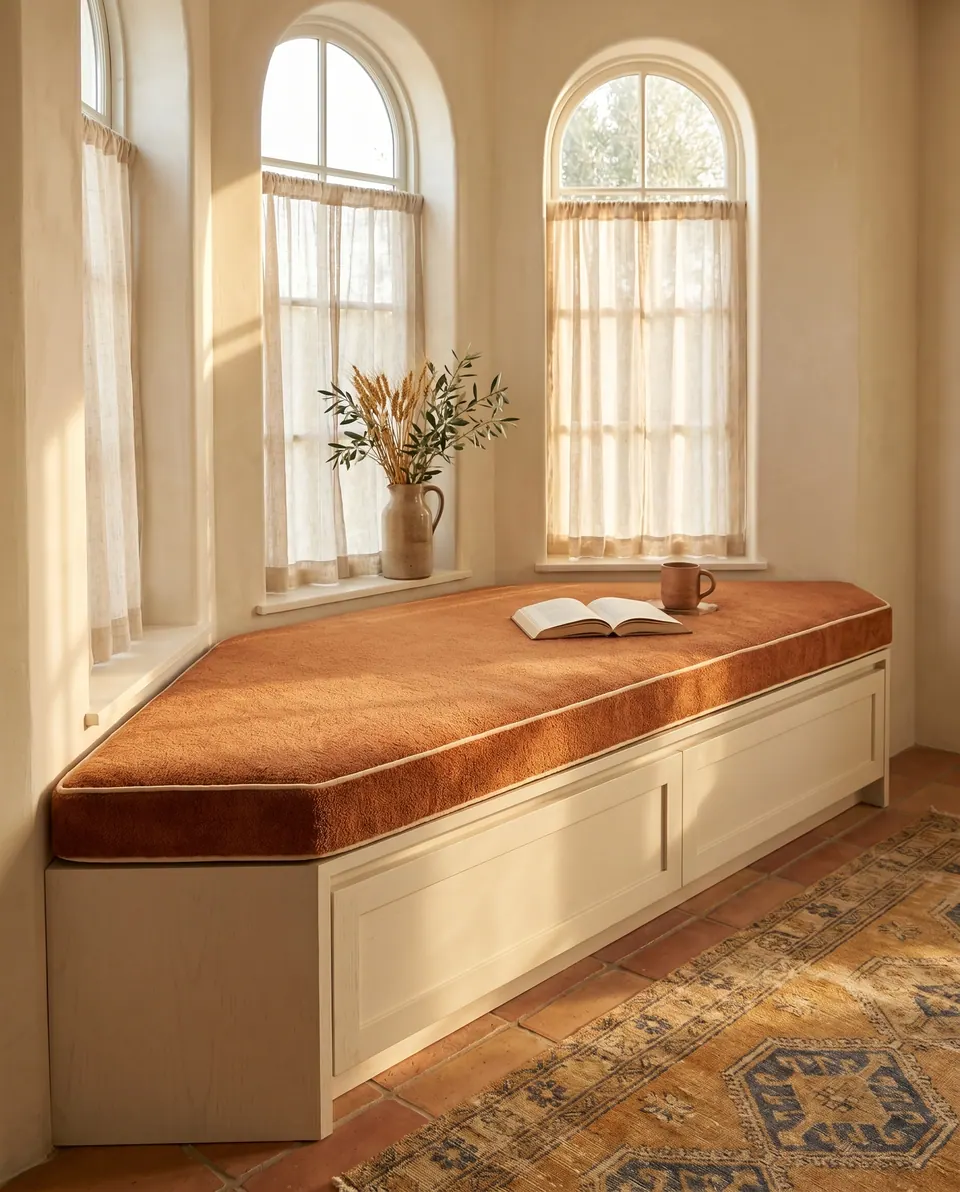
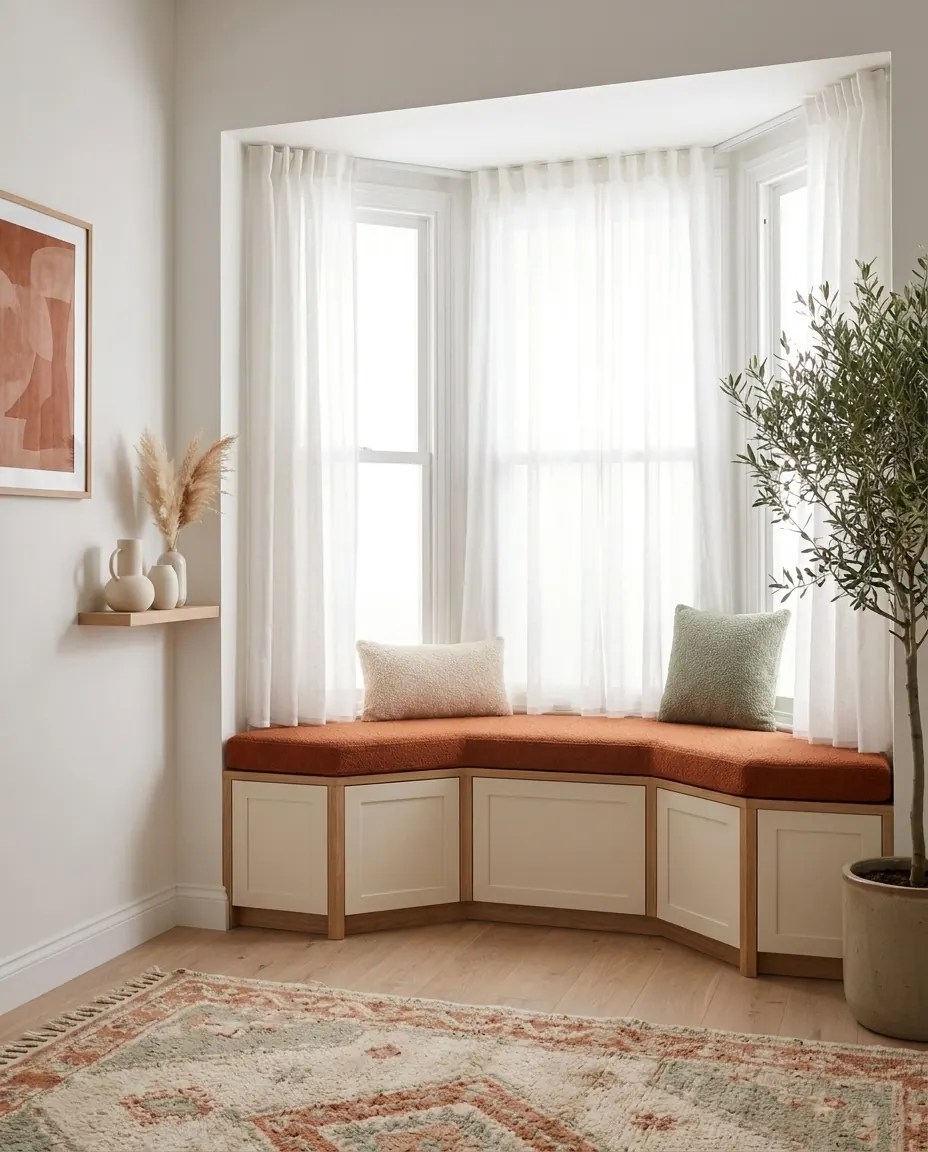
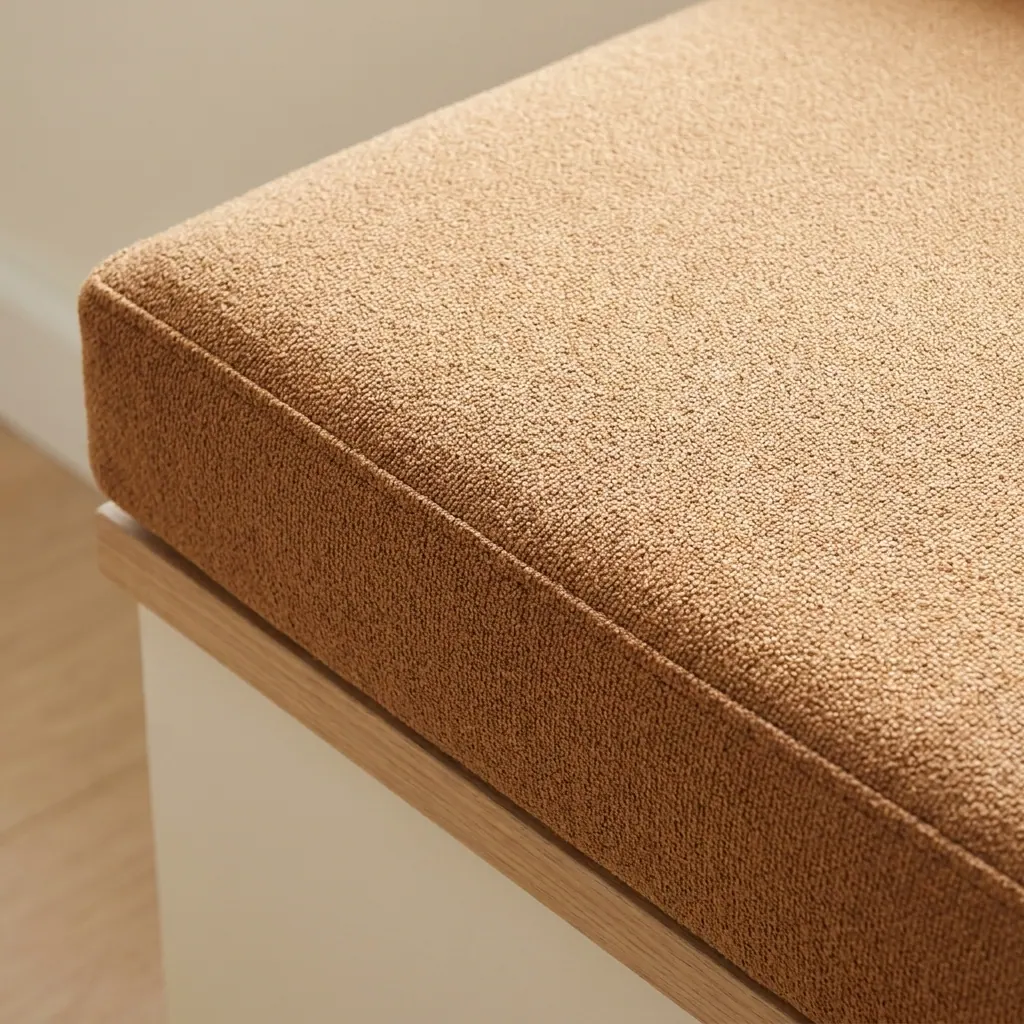
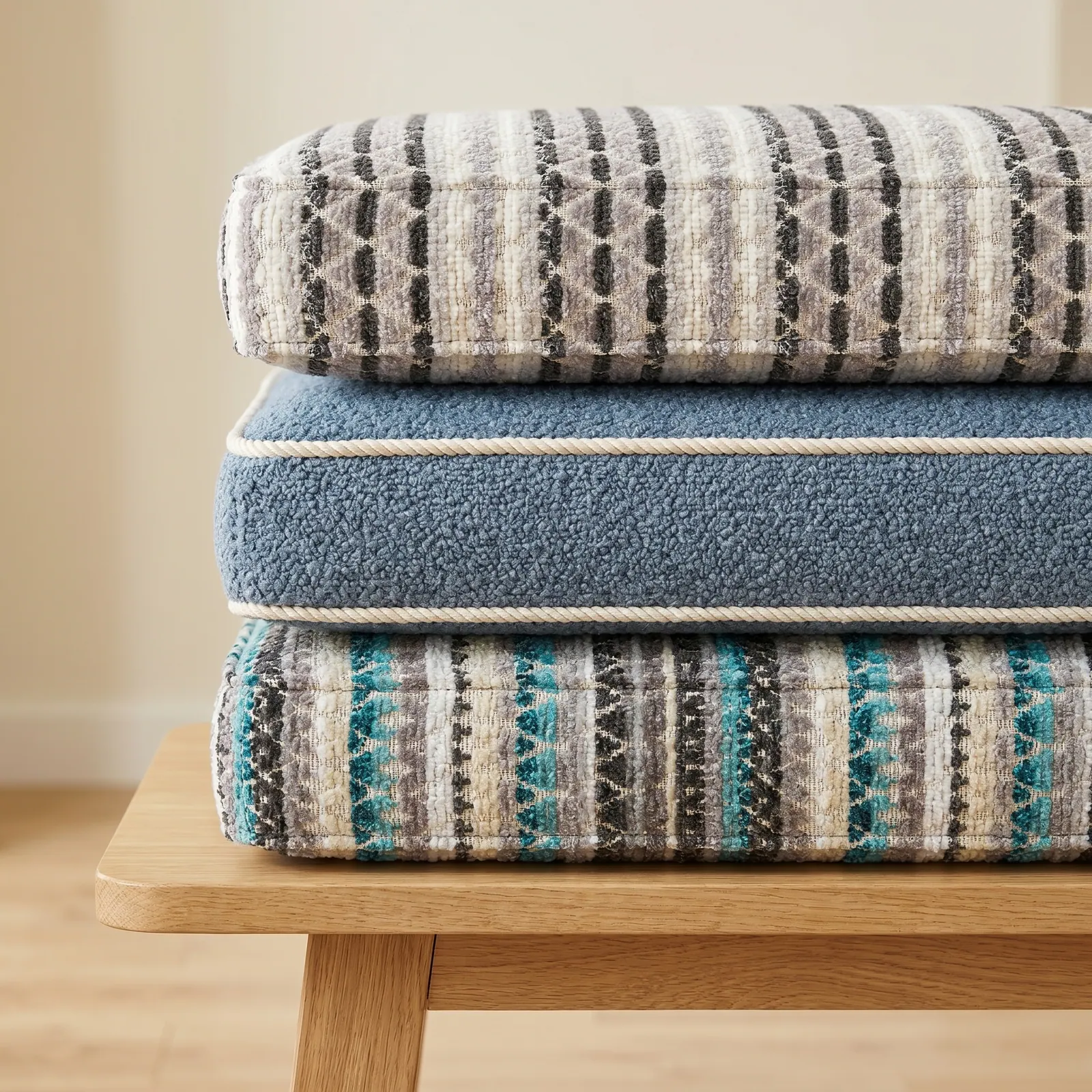
Self, contrast or no piping on a five-sided rust bouclé bay window cushion
Nate opens his notebook on a five-sided bay, numbers each facet, and works out what a welt does to the line when it has to turn four corners.

 Save
The quick answer
On a five-sided bay window cushion, self piping is the safe choice: it defines every facet by shape while keeping one color around all the angles. Contrast piping draws each angle as a line, so every joint must be exact, and no piping gives the softest outline, which suits a looped fabric like bouclé.
Notebook, page one: five facets, four corners, one welt
Four corners, five facets, one continuous welt. That's the whole problem on this page.
The bay is five-sided, with cream cupboard doors below, oak trim, sheer white curtains on every window and an olive tree in a stone pot just beyond. The cushion is rust bouclé, box edge, self piped, and it follows every facet. Each angled section is cut to its own measurement, so the corners meet without gaps. Angles are just lengths in disguise, partner: give me the back length and front length of each wall and the angle takes care of itself.
Rust is a working color here. Through the sheers it glows warm; up close it's deep enough to hide daily wear on a seat people actually use. Only two pillows sit on it: cream on the center facet, where most people will sit, and sage toward the side, echoing the olive tree. A kilim-style rug repeats rust and sage on the floor, and a small shelf of ceramic vases with pampas grass plus an abstract terracotta print close the palette. Two pillows, not six, so the line of the cushion stays readable around the curve.
The 5-sided bay window Pattern and the bay window calculator take the numbers; the bay window cushions atlas shows other bays. How many facets does your bay have?
Pinned by Nate around the bay
Five pins: the rust bouclé run, one angled side section, the cream and sage pillows, and the kilim-style rug.
- Rust bouclé bay cushion
The cushion follows every facet of the bay, keeping one color across all the angles.
- Angled side section
Each angled section is cut to its own measurement, so corners meet without gaps.
- Cream pillow
The cream pillow sits on the center facet, where most people will sit.
- Sage pillow
Sage echoes the olive tree just beyond the bay.
- Kilim-style rug
The rug repeats rust and sage on the floor so the bay feels anchored to the room.
- Rust bouclé bay cushionThe cushion follows every facet of the bay, keeping one color across all the angles.
- Angled side sectionEach angled section is cut to its own measurement, so corners meet without gaps.
- Cream pillowThe cream pillow sits on the center facet, where most people will sit.
- Sage pillowSage echoes the olive tree just beyond the bay.
- Kilim-style rugThe rug repeats rust and sage on the floor so the bay feels anchored to the room.
Three welts, one bay: what each does to the line
| Piping | What it does on five facets | Watch for |
|---|---|---|
| Self (as shown) | Defines each facet by shape; the color stays continuous around all four corners. | Corners still need clean turns, but small errors hide in the same color. |
| Contrast | Draws every angle as a visible line; the bay's geometry becomes the pattern. | Every joint must meet exactly; a wandering welt shows from across the room. |
| None | Softest outline; a plain seam on bouclé reads clean and rounded. | The edge looks rounder, so the facets read less crisp. |
A 160 in bay, in black, in two pieces
A buyer in the US wrote to the workshop about a very large trapezoid bay window: about 160 in (406 cm) long and 2 ft (61 cm) deep. They wanted black, sun-resistant fabric, and specifically not corduroy or velvet.
The workshop confirmed it stocks sun-resistant fabrics and suggested making the cushion in two pieces because of the length. That's good engineering. Very long pieces are easier to make and to handle in two sections, and the split can land on a facet line, where a seam has a reason to be. Run contrast piping on a split like that and the welt marks the joint on purpose, which is honest. One piece or two for long cushions and window seat fading in sun cover both halves of the decision.
- Sizes
- About 160 x 24 in (406 x 61 cm), trapezoid, in two sections
The lesson: Sunny bay windows need a sun-resistant fabric, and very long pieces are easier to make and handle in two sections.
Buyer questions: delivery cost, brighter piping, photos before shipping
- A common question
Delivery on my large window seat cushion came to more than I expected at checkout. Can that be adjusted?
The workshop's answerAsk. For one oversized window seat, the workshop lowered the delivery charge to the lowest rate possible for an item of that size.
- A common question
Do you have brighter piping colors than the ones shown on this listing?
The workshop's answerYes. Fabrics from different listings' charts can be combined on one cushion, and the linen bench cushion listing carries the widest range of charts. Pick your piping from any chart, order from whichever listing suits your shape, and write the codes in the personalization box.
- A common question
Can I see pictures of my finished cushion before it ships?
The workshop's answerYes. Ask, and the workshop sends photos of the finished cushion before it goes out.
On the cutting table: the five-sided rust bay
| Cushion | Bay window cushion cut facet by facet from a measured drawing |
|---|---|
| Sections | Five facets, four corners, joints meeting without gaps |
| Fabric | Rust bouclé |
| Piping | Self piping, one color around every angle |
| Edge | Box edge |
| Pillows | Two only: cream on the center facet, sage to the side |
| Light | Diffused through sheers, warming the rust |
| Very long bays | Split into two sections, as for a 160 in (406 cm) run |
| Best for | Multi-angle living room bays that get daily use |

Have it made
Have this made — ask Nate’s workshop
Precision starts on the phone. Give the workshop your measurements and they will read them back to you, edge by edge. — Nate
Leave your details and the workshop will call you to confirm measurements, fabric, foam and piping. No prices, dates or payment on this page: it is a request, not an order.
On a five-sided bay window cushion, self piping keeps one color around every angle; contrast piping turns each corner into a drawn line.
Nate
Questions buyers ask next
Does contrast piping work on a bay window cushion with many angles?
It can, but it turns every corner into a visible line, so each joint has to meet exactly. On a five-sided bay, self piping is the calmer choice; contrast suits a bay where you want the geometry to show.
Should a very long bay window cushion be made in one piece?
Not always. For a trapezoid bay about 160 in (406 cm) long, the workshop suggested two pieces, which are easier to make and handle. Split on a facet line so the seam has a reason to be there.
Can a bouclé cushion be made without piping?
Yes. A plain seam on bouclé gives a soft, rounded outline, which suits relaxed rooms. Choose self piping instead if you want the facets of a bay to look crisp and deliberate.
What fabric suits a sunny bay window?
A sun-resistant fabric, especially for dark colors like black that sit in strong light all day. Ask for sun-resistant options by name when you order, as one buyer did for a very large bay.
± 1/4 in — Nate
More photographs to read
 Save
 Save
 Save
 Save
 Save
 Save