 Save
A Reading by NateBay Window Cushions
A dusty rose bay window seat cushion, from first question to finished angle
Nate walks a real bay-window project from the first question to the choices it forced, then reads a dressing-room bay where those choices were made well.
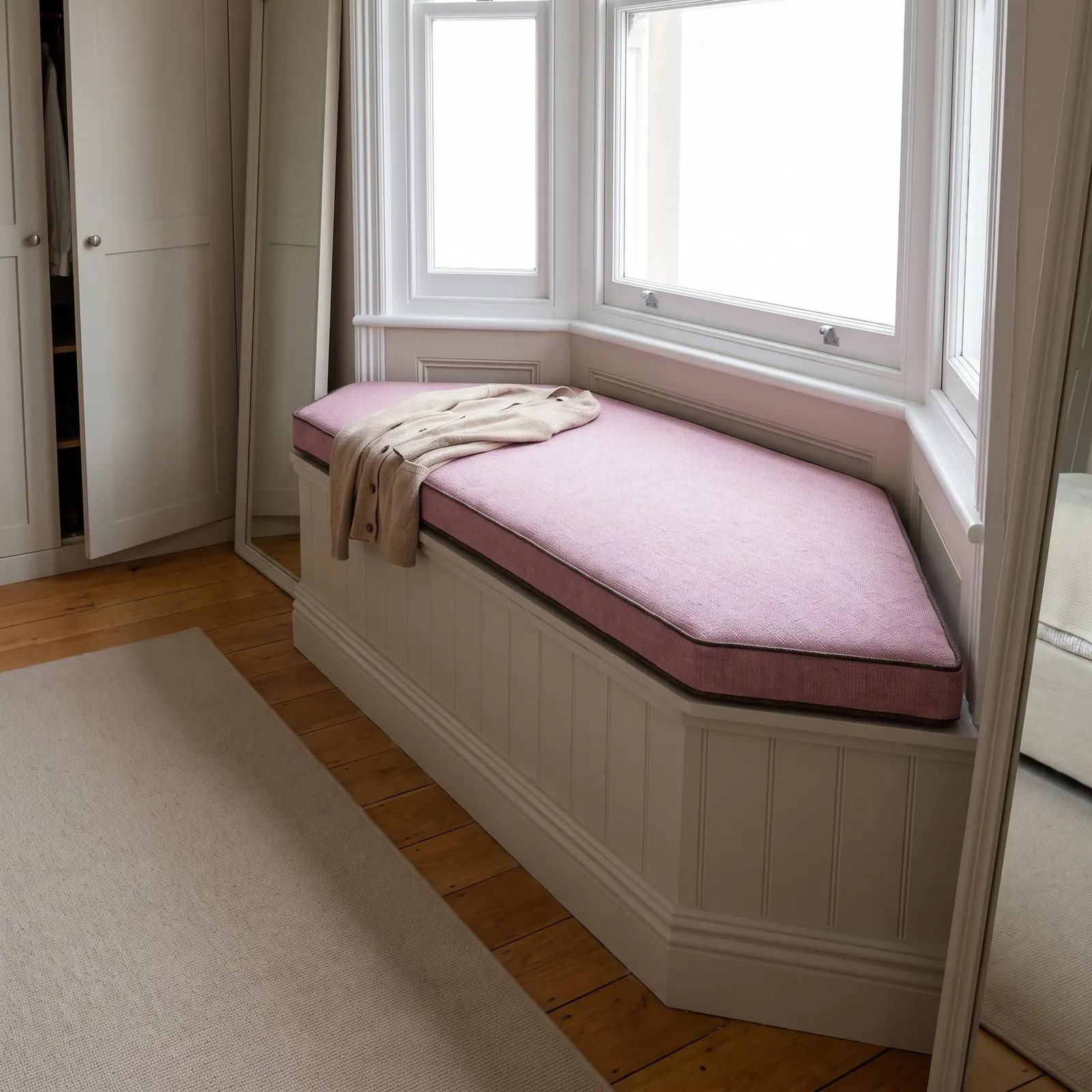
Dusty rose with chocolate piping softens a dressing room bay, cut to follow the angle of the window.

The quick answer
A bay window cushion starts with a drawing, not a fabric: mark every side length and both angled ends, and the quote comes back exact. In this dressing room, the dusty rose linen-look seat is cut with its right end following the bay angle, and chocolate piping gives the pale shape a firm outline.
The question: three 46-inch windows and a curved front
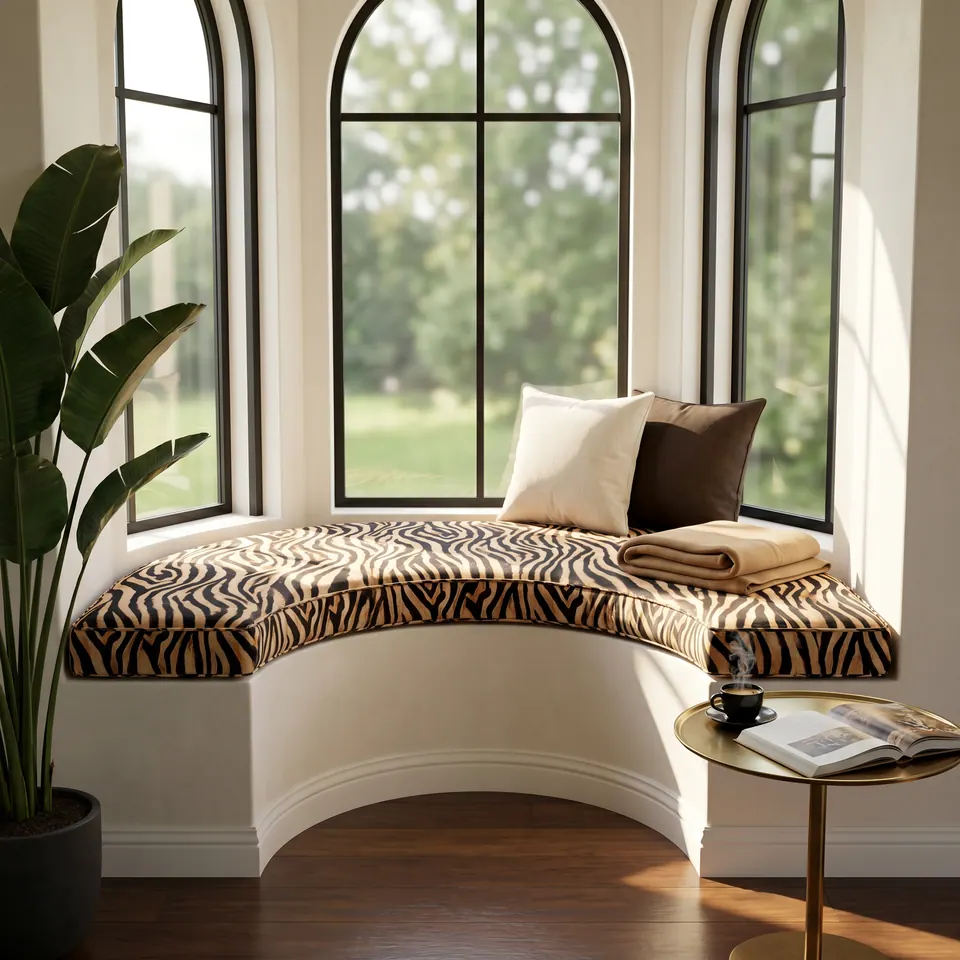
A parent in the US wrote to the workshop about a child's bedroom bay: three windows, each section 46 in (117 cm) wide. The ask was a floor pillow that tucked into the bay and curved on the room side.
The workshop's first reply was a request, not a number: please send a drawing with the measurements. Correct first move, partner. A three-section bay with a rounded front has lengths nobody can guess from a photo: each window run, the depth at the center and at the ends, and how far the curve comes into the room.
With the drawing in hand, the quote followed. It landed above the family's budget, and the workshop held its price because of the size and the custom curved shape. That is not stubbornness. A rounded front on a three-sided footprint is real pattern work, and an honest quote says so.
The choices a bay forces, in the order I make them
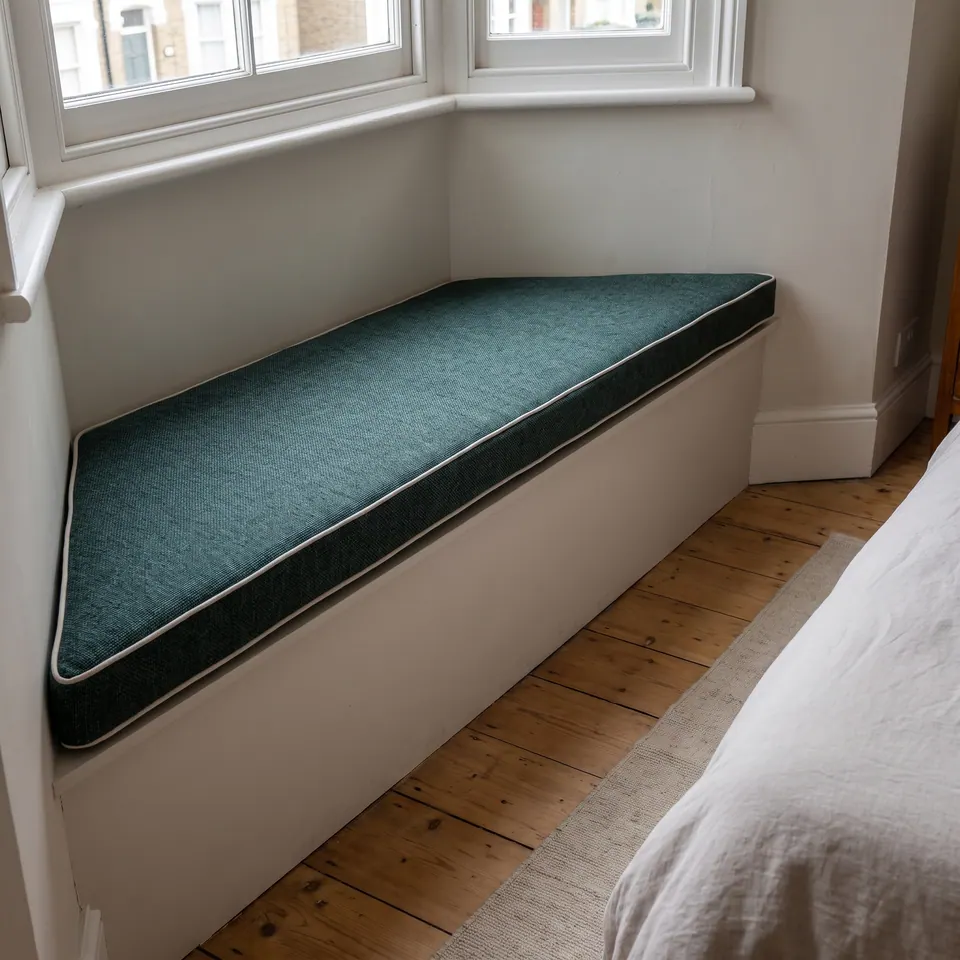
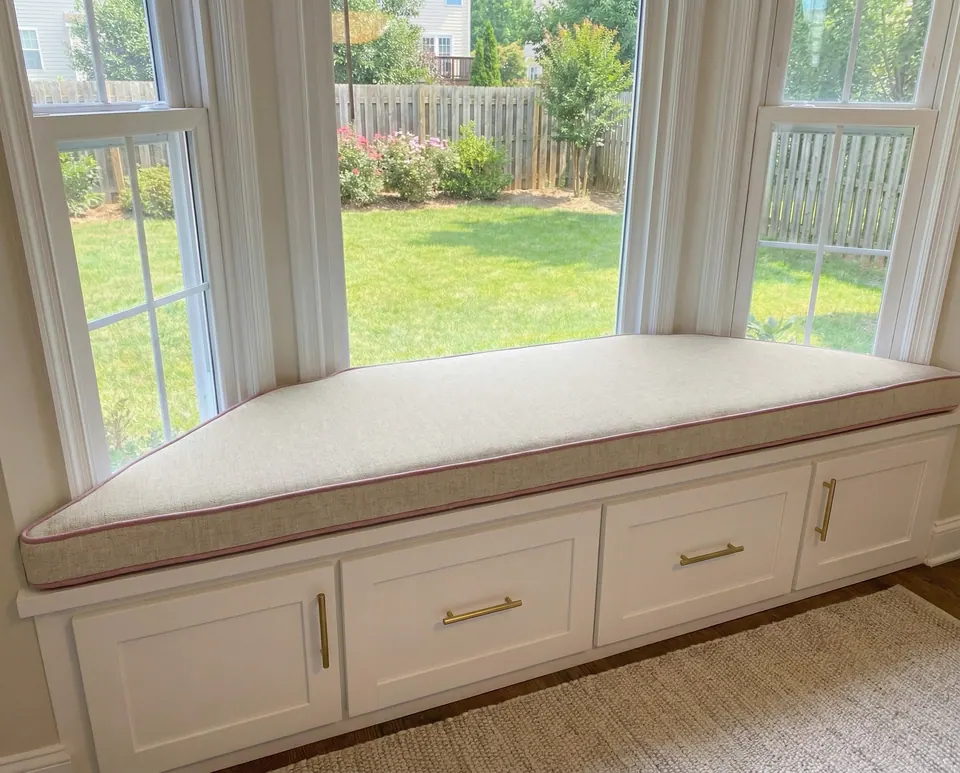
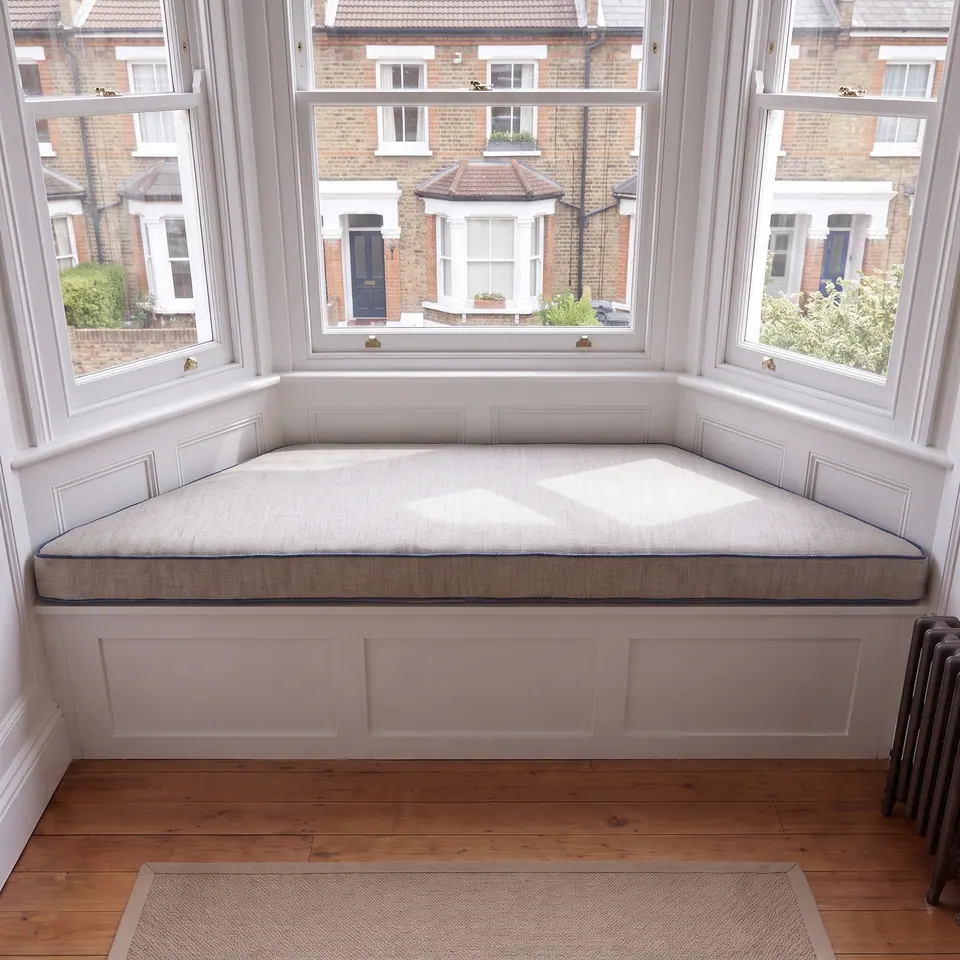
Every bay I have drawn comes down to four decisions: - Footprint. A three-sided bay seat is usually a trapezoid: two parallel sides and two angled ends. A rounded room side adds a curve that must be drawn, not described. - One piece or two. Long runs can be split, and some should be. Decide before you measure; see one piece or two. - Edge. A box edge keeps an angled end crisp where it meets paneling. - Piping. The last decision, and the first thing anyone sees.
Angles are just lengths in disguise. If a protractor makes you nervous, measure the front, the back, the depth and both angled ends to the nearest 1/4 in, and run them through the bay window calculator before you order.
The result: a dressing-room bay that got every choice right
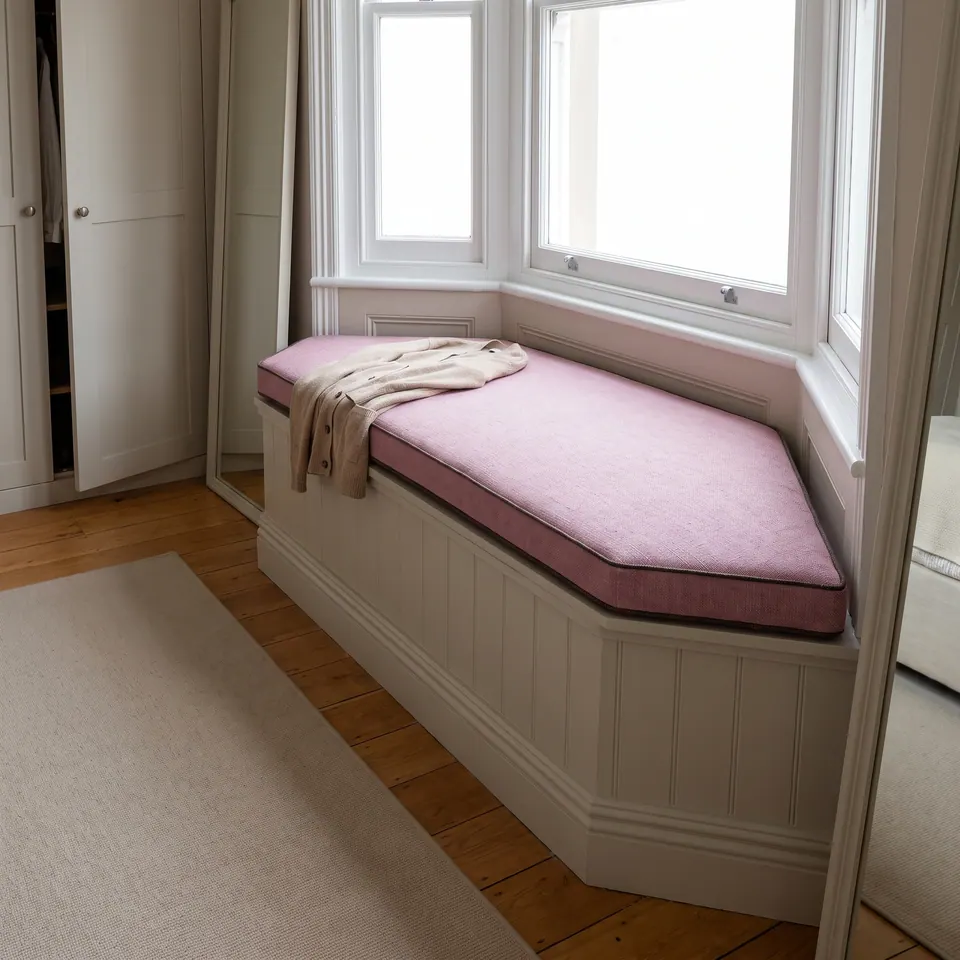
Now the photograph. A tongue-and-groove bay in a dressing room: white paneled wardrobes, a full-length mirror, white sash windows, pine floorboards and a sisal rug. On the seat sits a dusty rose bay window cushion in a linen-look fabric, box-edged, with chocolate brown piping.
Read the right end first. It is cut to the bay angle, so the cushion sits tight to the paneling with no wedge of bare wood. That fit happens only when the angle is measured, not assumed.
The proportion is firm and full width. You sit here to pull on shoes and lay out tomorrow's clothes, so a flat, stable top beats a plump one.
Then the welt. Dusty rose alone against white joinery could turn sugary. Chocolate piping pulls color up from the pine boards and draws a firm outline around a pale shape, so the angled end reads as a deliberate cut. When the main fabric is pale, take the piping from the floor, not the walls.
The only styling is an oatmeal knit cardigan flung over the end, more honest than a row of pillows in a room for getting dressed. The sisal rug keeps the pink from going sweet. More rooms like this in bedroom cushions.
What would your bay drawing need that you haven't measured yet?
Pinned by Nate: five things the photo measures for you
Five pins, from the angled right end tight against the paneling to the sisal rug on the pine floor.
- Draped cardigan
A cardigan flung over the end shows the seat doubling as a place to dress.
- Angled bay end
The right end follows the bay angle so the cushion sits tight to the paneling.
- Chocolate piping
Brown welt grounds a pale pink and ties it to the floorboards.
- Paneled wardrobes
White joinery keeps dusty rose soft rather than sugary.
- Sisal rug
A natural fiber rug stops the pink from feeling too sweet.
- Draped cardiganA cardigan flung over the end shows the seat doubling as a place to dress.
- Angled bay endThe right end follows the bay angle so the cushion sits tight to the paneling.
- Chocolate pipingBrown welt grounds a pale pink and ties it to the floorboards.
- Paneled wardrobesWhite joinery keeps dusty rose soft rather than sugary.
- Sisal rugA natural fiber rug stops the pink from feeling too sweet.
On the cutting table: the dusty rose bay seat
| Product | Angled bay window seat cushion, trapezoid |
|---|---|
| Fabric | Dusty rose linen-look |
| Piping | Contrast welt in chocolate brown |
| Edge | Box edge |
| Cut | Right end follows the bay angle |
| Setting | Tongue-and-groove bay in a white paneled dressing room |
| Floor | Pine boards with a sisal rug |
| Styling | One oatmeal knit cardigan, no pillows |
| Best for | A seat for dressing, shoes and laying out clothes |

Have it made
Have this made — ask Nate’s workshop
Send the numbers in inches: length × depth × thickness, plus any angle. The workshop checks them with you, because foam has no undo button. — Nate
Leave your details and the workshop will call you to confirm measurements, fabric, foam and piping. No prices, dates or payment on this page: it is a request, not an order.
Buyer questions: a deadline, a 102-inch run and a short cushion
- A common question
I need the cushion by a specific date. Can you make it in time?
The workshop's answerIt depends on the date and the size, so ask before ordering and get the date in writing. The workshop confirmed delivery before May 1 for one buyer in the US, and for one urgent order it made the cushion the next day and shipped within 2 days. Items added later, such as extra bolsters, may not make the same deadline.
- A common question
Our bench needs a cushion over 100 inches long. Does it have to come in two pieces?
The workshop's answerNo. A very long cushion such as 102 x 18 in (259 x 46 cm) can be split into two equal pieces of 51 x 18 in (130 x 46 cm), but the workshop can also make it as one continuous piece if you prefer. A single-piece 90 x 18 in (229 x 46 cm) linen cushion has been quoted.
- A common question
My cushion arrived shorter than I ordered. Will you replace it?
The workshop's answerSend a photo with a tape measure along the full length and message the workshop. One that came in at 54 in instead of 57 in was remade at the ordered size. Ask, too, whether the piping color can change on a remake.
On a pale bay window cushion, take the piping color from the floorboards, not the walls; chocolate brown gives dusty rose a firm outline.
Nate
Questions buyers ask next
Why cut the end of a bay seat cushion to the window angle?
A square end on an angled bay leaves a triangle of bare seat or forces the cushion to bow. Cutting the end to the bay angle lets the box edge sit tight to the paneling, which is what makes a cushion look built in rather than bought.
Does a dressing room bay need a thick cushion?
It needs a stable one more than a thick one. You sit there to put on shoes and lay out clothes, so a flat, firm top that holds things beats a plump top that tips them off. Check the thickness against your seat height before ordering.
What does a curved room-side edge add to a bay cushion order?
Pattern work. A rounded front can't be picked from a size menu, so the workshop needs a drawing with every window run and the depth of the curve marked. Expect the quote to reflect the size and custom shape, as it did for a bay of three 46 in sections.
Should a dusty rose cushion have white or brown piping?
Against white paneling, white piping disappears and the pink can look sugary. A chocolate brown welt taken from the floorboards gives the pale shape a firm outline. White piping suits a pale cushion on a dark wood seat instead.
± 1/4 in — Nate