A Reading by NateBay Window Cushions
A hunter green bay window seat cushion, cut for a lopsided bay and a long afternoon
One end square, one end angled, the bed two steps away. This bay is lopsided and the cushion says so honestly. My notes on why a single angle cut is enough, and what makes a bedroom window seat worth a whole afternoon.

 Save
The quick answer
A bay window cushion for a lopsided bay may need only one clipped corner: measure the back edge, the front edge and the depth at each end separately, then draw the shape. For long sitting, a linen-polyester blend holds its shape better than pure linen, zippered covers come off for washing, and 2, 3 or 4 in thicknesses are offered.
Why only the left end is cut
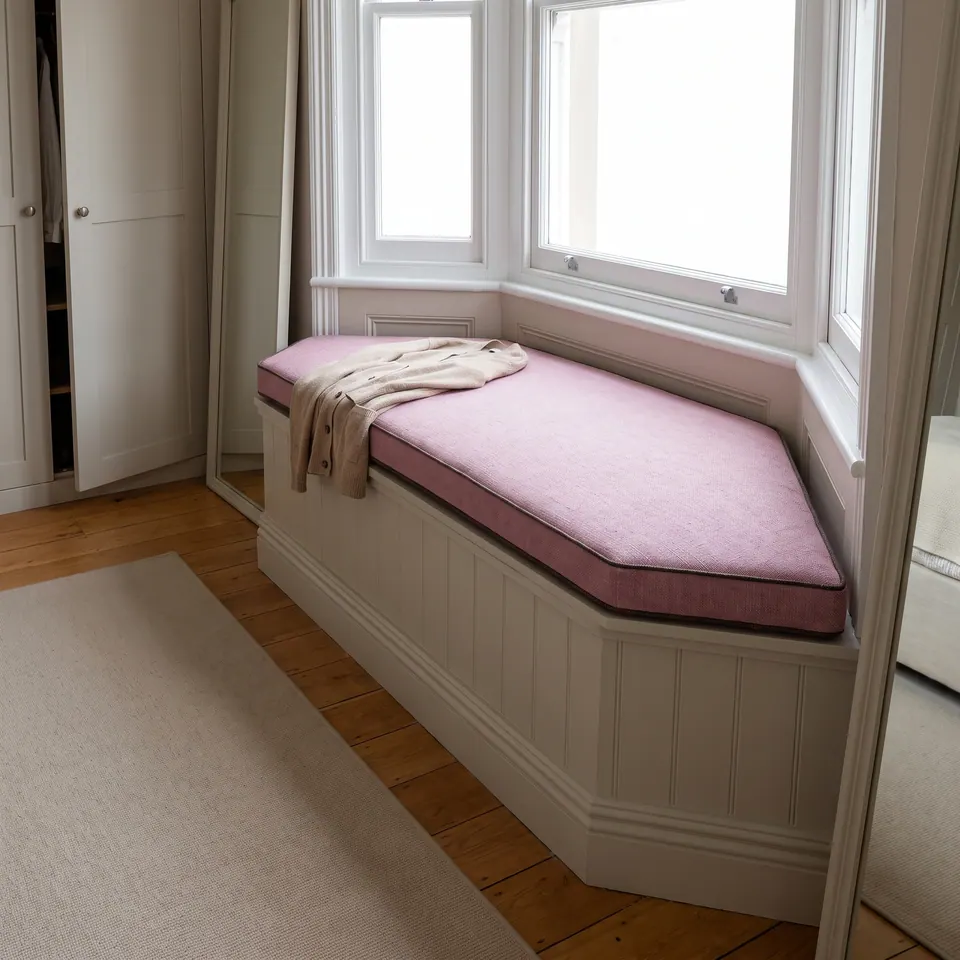
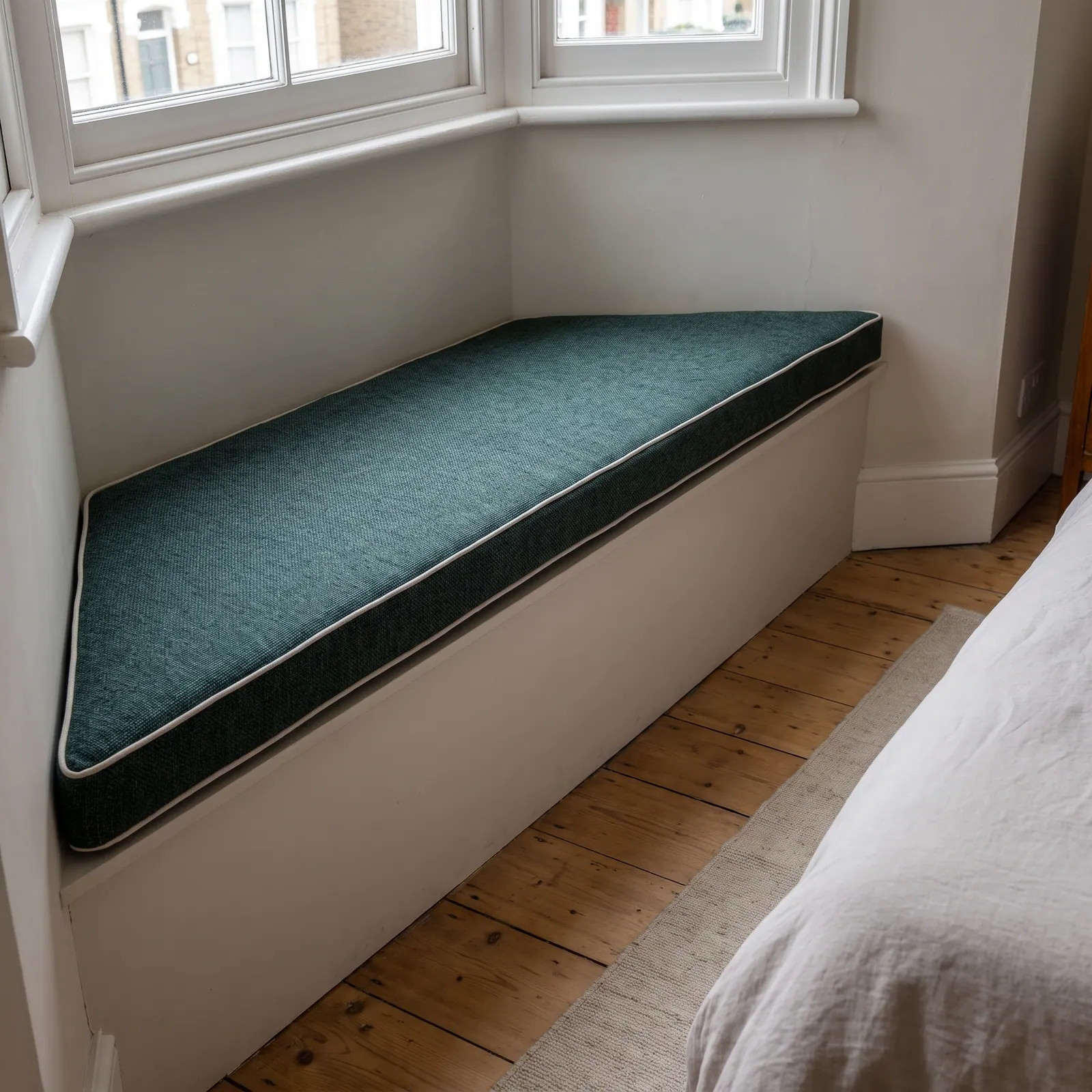
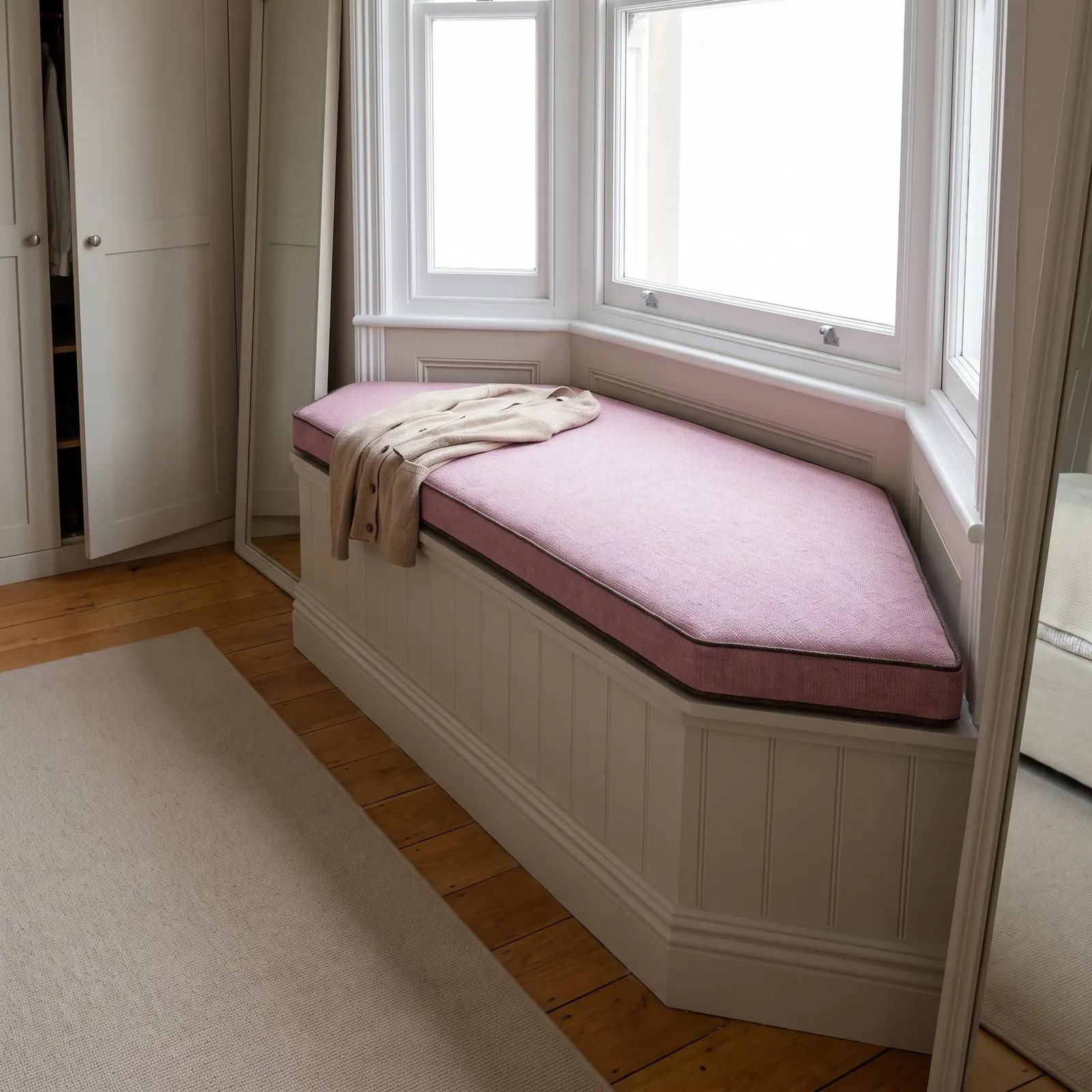
Look at the left end of the cushion. It is cut at an angle to follow the splayed side of the bay, while the right end sits square against a straight wall. Plenty of bays are built like this, one straight side and one angled return, and a bay window cushion made from a symmetric template would gape at one end and jam at the other. Measure each end on its own, partner, or let the bay window calculator handle the angles.
The fabric is a hunter green linen-look in a fine herringbone twill. Up close the weave gives the green depth; from the bed it reads calm, which is the whole point in a bedroom. Ivory piping runs the front edge so the deep green doesn't flatten into a dark slab against the white painted plinth.
Then the room. Wide pine floorboards carry an orange tone, the warm opposite of hunter green, so the pair balances. A jute runner adds a dry, natural texture between them. And the crumpled white linen on the bed in the foreground shows how close the seat sits to where you sleep: close enough that it is the first thing you see each morning, under overcast city light through the sash windows.
A past bay order, converted
| Edge | Inches | Centimeters |
|---|---|---|
| Back edge, window side | 47 1/4 | 120 |
| Front edge, room side | 54 | 137 |
| Depth | 13 3/4 | 35 |
| Separate rectangular bench | 38 1/4 × 15 1/2 | 97 × 39.5 |
| Thickness offered | 2, 3 or 4 | 5, 7.5 or 10 |
Front minus back is 6 3/4 in (17 cm). How that difference splits between the two ends is what the drawing has to show.
Pinned in the notebook
Five pins: two about geometry, three about why the colors hold together.
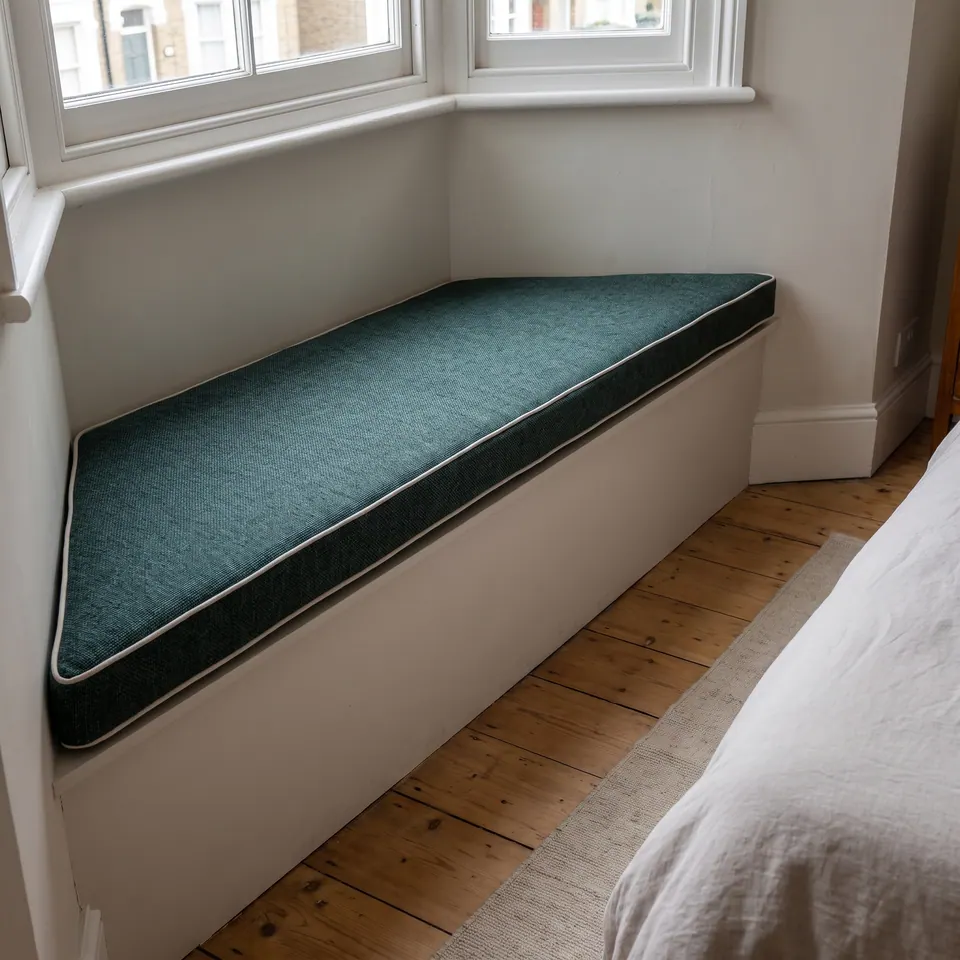
- Clipped corner
The left end is cut at an angle so the cushion follows the splayed side of the bay.
- Ivory piping
A cream welt lifts a deep green that would otherwise read as a dark slab.
- Herringbone texture
The fine twill weave gives the green depth up close.
- Linen bedding
Crumpled white linen in the foreground shows how close the seat sits to the bed.
- Pine floorboards
Orange-toned pine is the warm opposite of hunter green, which is why the pair works.
- Clipped cornerThe left end is cut at an angle so the cushion follows the splayed side of the bay.
- Ivory pipingA cream welt lifts a deep green that would otherwise read as a dark slab.
- Herringbone textureThe fine twill weave gives the green depth up close.
- Linen beddingCrumpled white linen in the foreground shows how close the seat sits to the bed.
- Pine floorboardsOrange-toned pine is the warm opposite of hunter green, which is why the pair works.
Built for an afternoon, not a minute
A window seat beside a bed gets the long sits: a novel, a laptop, coffee while the street wakes up. What will yours be for? The answer changes three decisions.
Cloth. The linen option is a linen-polyester blend. The linen brings the look, the texture and the breathability; the polyester adds strength and shape retention and makes it easy to wash. Pure linen wears and wrinkles faster on a seat. The family is laid out in linen-look fabrics.
Thickness. The bay in the story below was offered at 2, 3 or 4 in. On a seat only 13 3/4 in (35 cm) deep you tend to sit sideways with your back to the wall, so choose by feel and by where the sill lands; the window seat thickness guide sets out the trade-offs.
Covers. Zippered and washable. A seat you live on gets washed, so plan for the wash on the day you order.
A bay and a bench, one velvet, two shapes
A buyer wrote in wanting one velvet for two seats: a plain rectangular bench of 38 1/4 × 15 1/2 in (97 × 39.5 cm), and a bay window seat 47 1/4 in (120 cm) at the back, 54 in (137 cm) at the front and 13 3/4 in (35 cm) deep.
The shop offered 2, 3 or 4 in thickness and zippered, washable covers for both. The rectangle went through the standard size order. The bay did not: it was priced through the trapezoid template, because an angled shape is not a rectangle with the corners trimmed off afterward. Same fabric, same thickness, two different drawings.
- Sizes
- Bench 38 1/4 × 15 1/2 in (97 × 39.5 cm); bay 47 1/4 in back, 54 in front, 13 3/4 in deep (120 / 137 × 35 cm)
- Fabric
- Velvet, both pieces
The lesson: Order an angled bay shape through the trapezoid template, never as a rectangle.
Linen, color and odd shapes: three notes
- A common question
Is your linen tough enough for a seat cushion I'll use every day? What is it blended with?
The workshop's answerYes. The linen option is a linen blend with polyester in the weave. The linen gives the natural look, texture and breathability; the polyester adds strength, shape retention and easy-care washing. That is why it is one of the most-used seat fabrics, while pure linens wear and wrinkle much faster on seating.
- A common question
Can you show me my main fabric and my piping color next to each other before I order?
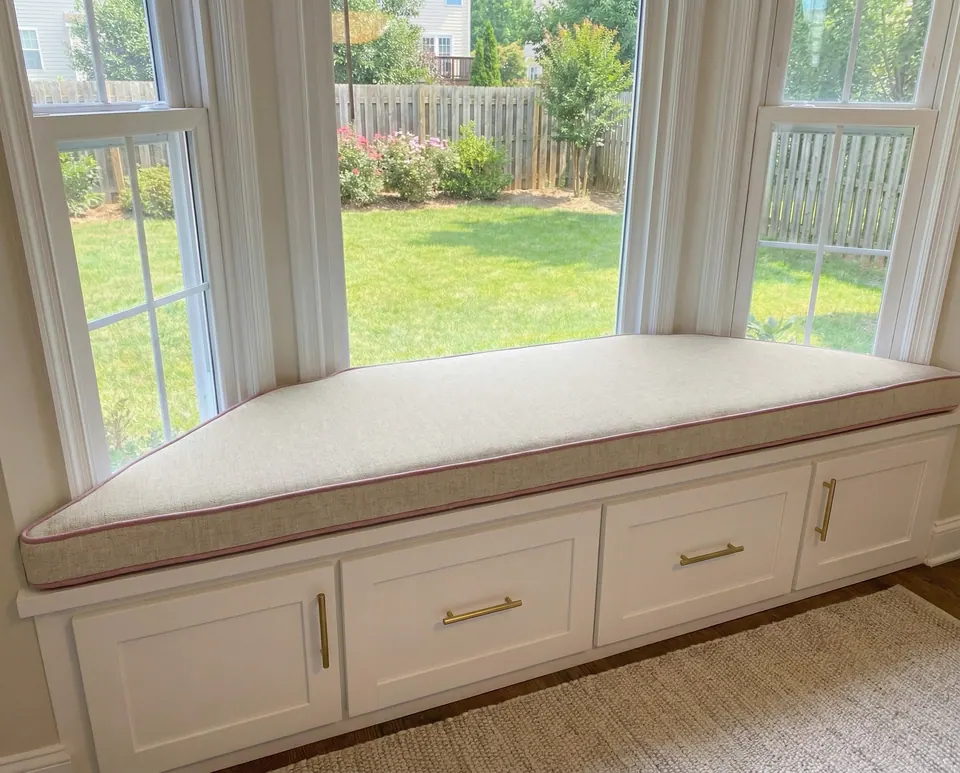
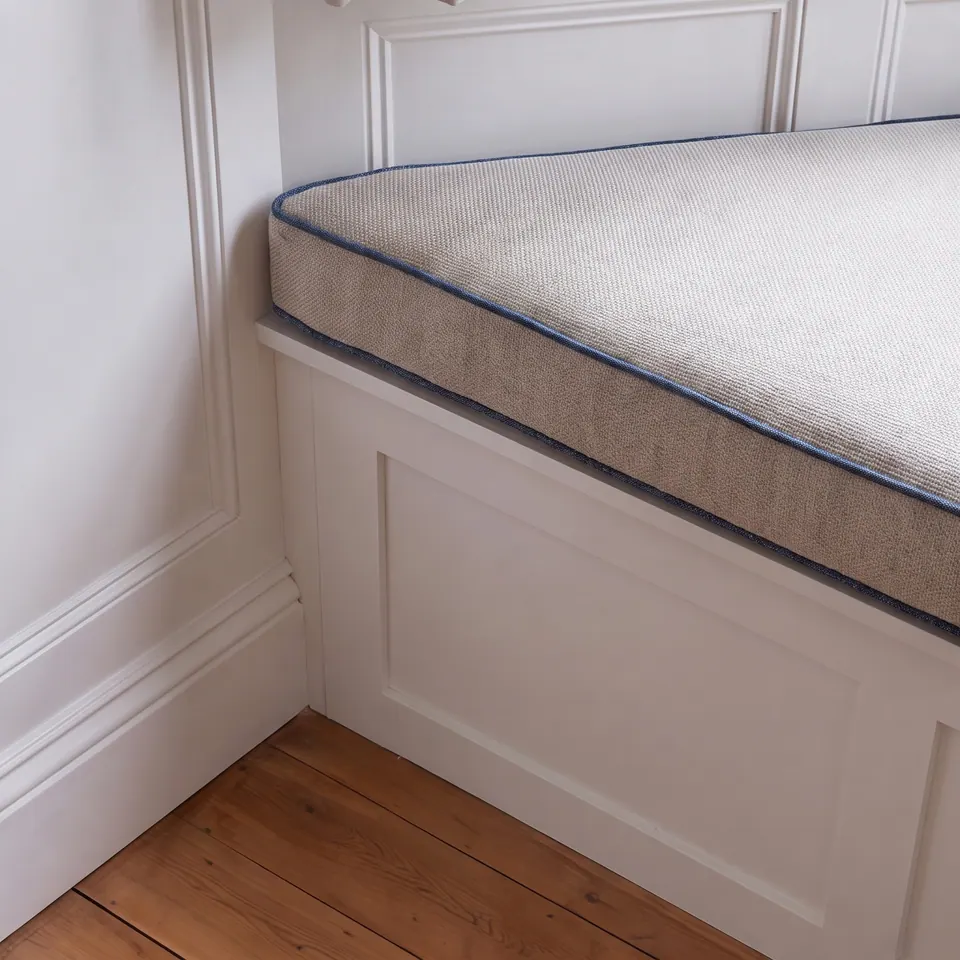
The workshop's answerYes, as swatches: the workshop photographs the two chosen swatches side by side, velvet with a contrasting velvet piping or a light fabric beside a darker blue. It can't photograph every finished combination, since there are hundreds of colors, and photos shift slightly with lighting and camera, so samples are the sure way to confirm.
- A common question
Can you make an L-shaped cushion with a small corner cutout as one single piece?
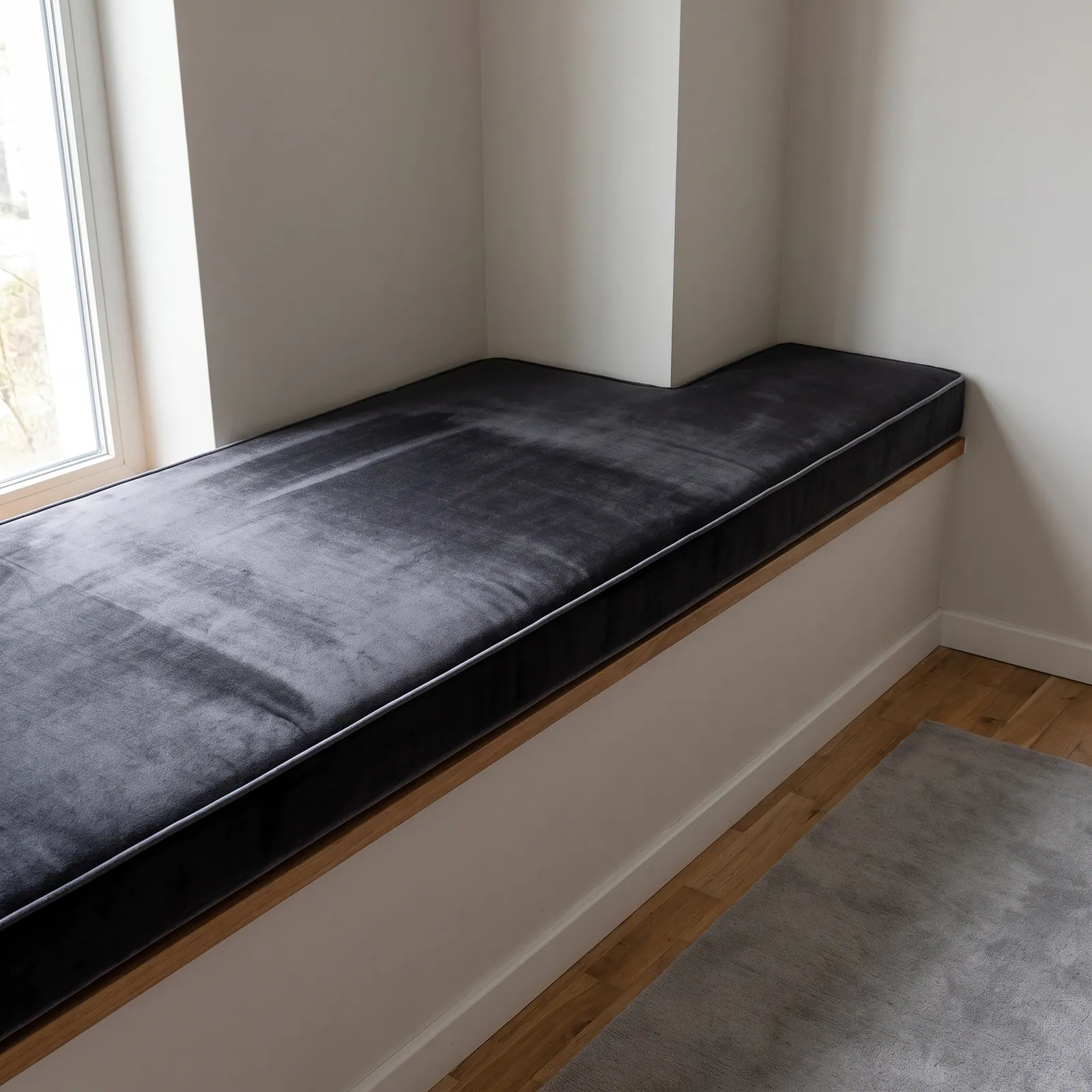
The workshop's answerYes. A one-piece L with a small cutout counts as a custom shape and is ordered through the trapezoid or custom-shape option. Upload your drawing with the measurements at checkout, and the cushion is made exactly to it.
Pure linen wears and wrinkles fast on a window seat; a linen-polyester blend keeps the linen look and adds shape retention and easy washing.
Nate
On the cutting table
| Cushion | bay window seat cushion, box edge, one clipped corner |
|---|---|
| Fabric | hunter green linen-look, fine herringbone twill |
| Piping | Ivory contrast piping |
| Thickness | 2, 3 or 4 in, chosen by feel and sill height |
| Shape | Trapezoid, drawn end by end |
| Cover | Zippered, removable, washable |
| Ordered through | The trapezoid or custom-shape template, with a drawing |
| Best for | Bedroom bays and long reading sits |

Have it made
Have this made — ask Nate’s workshop
Send the numbers in inches: length × depth × thickness, plus any angle. The workshop checks them with you, because foam has no undo button. — Nate
Leave your details and the workshop will call you to confirm measurements, fabric, foam and piping. No prices, dates or payment on this page: it is a request, not an order.
Questions buyers ask next
Does a bay window cushion have to be symmetrical?
No. When one side of the bay is a straight wall and the other an angled return, the cushion is square at one end and clipped at the other. Draw each end as it really is, label every edge, and the cushion is made to that drawing.
Why choose a dark green for a bedroom window seat?
Seen from the bed every morning, a deep hunter green reads restful rather than loud. Ivory piping keeps it from turning into a flat dark slab, and warm, orange-toned pine floors balance its coolness.
Can a bay seat cushion and a matching bench cushion go in one order?
Yes. One buyer ordered a velvet bay seat and a rectangular bench in the same fabric: the rectangle as a standard size, the bay through the trapezoid template, each with its own measurements and the same thickness.
± 1/4 in — Nate
Angled seats in other rooms
 Save
 Save
 Save
 Save
 Save
 Save