Bedroom bench cushions for the foot of the bed, the window and the daybed
A bedroom is seen in two lights, my friends: first morning and late lamp. These are the bench, window seat and daybed cushions buyers ask the workshop about, chosen for how their color behaves at both ends of the day.
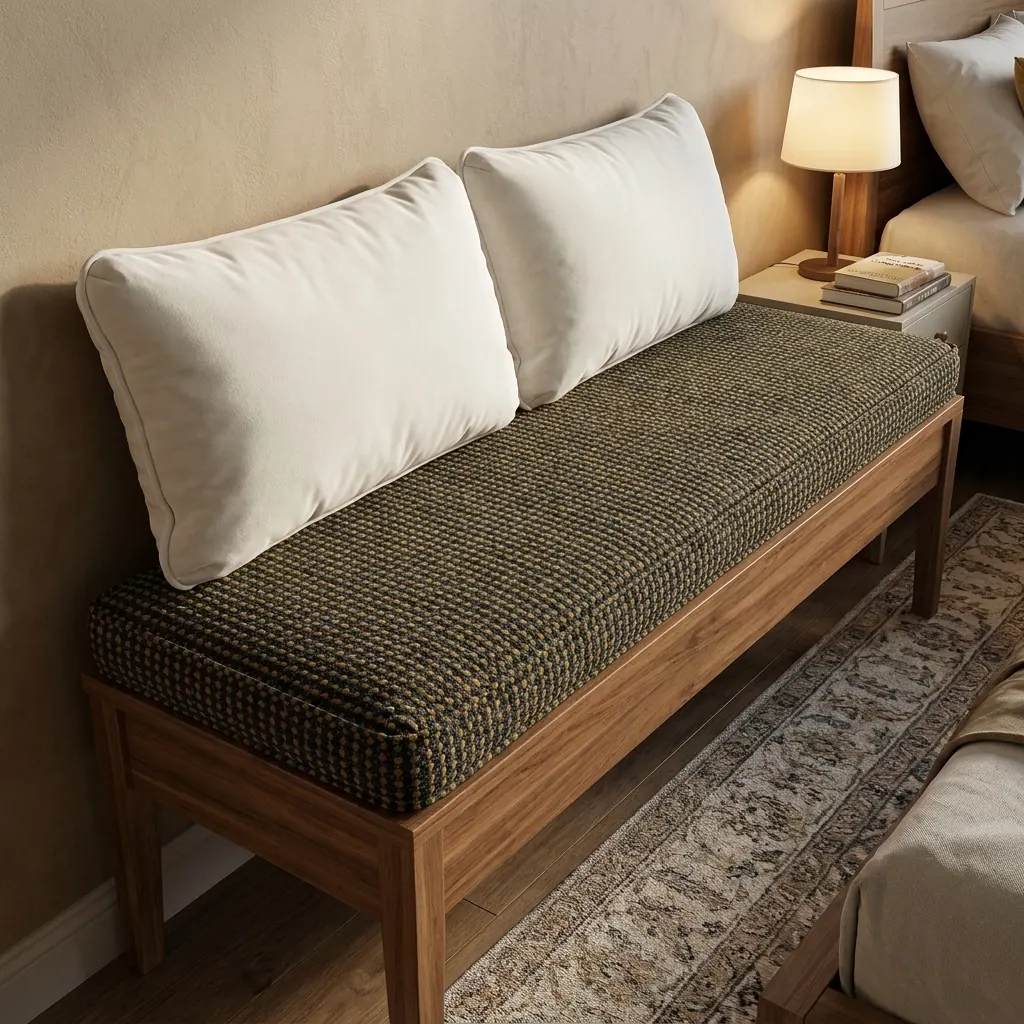
SaveA textured charcoal-and-mustard weave gives a walnut bedroom bench some weight, lightened by two off-white velvet pillows and a glowing bedside lamp.
The quick answer
A bedroom bench cushion is usually a zippered foam cushion 4 in (10 cm) thick, cut to an end-of-bed bench or a window seat and covered in velvet, corduroy or a woven stripe. Choose the fabric by lamplight as well as daylight, add a non-slip base on polished wood, and send a paper template for any curve.
Every one is cut to your measurements. The number is how many readings the atelier has published for that shape.
Sizes & measuring
On the cutting table: bedroom sizes and finishes
Measure the bench top or the window seat itself, length before depth, and name the thickness.
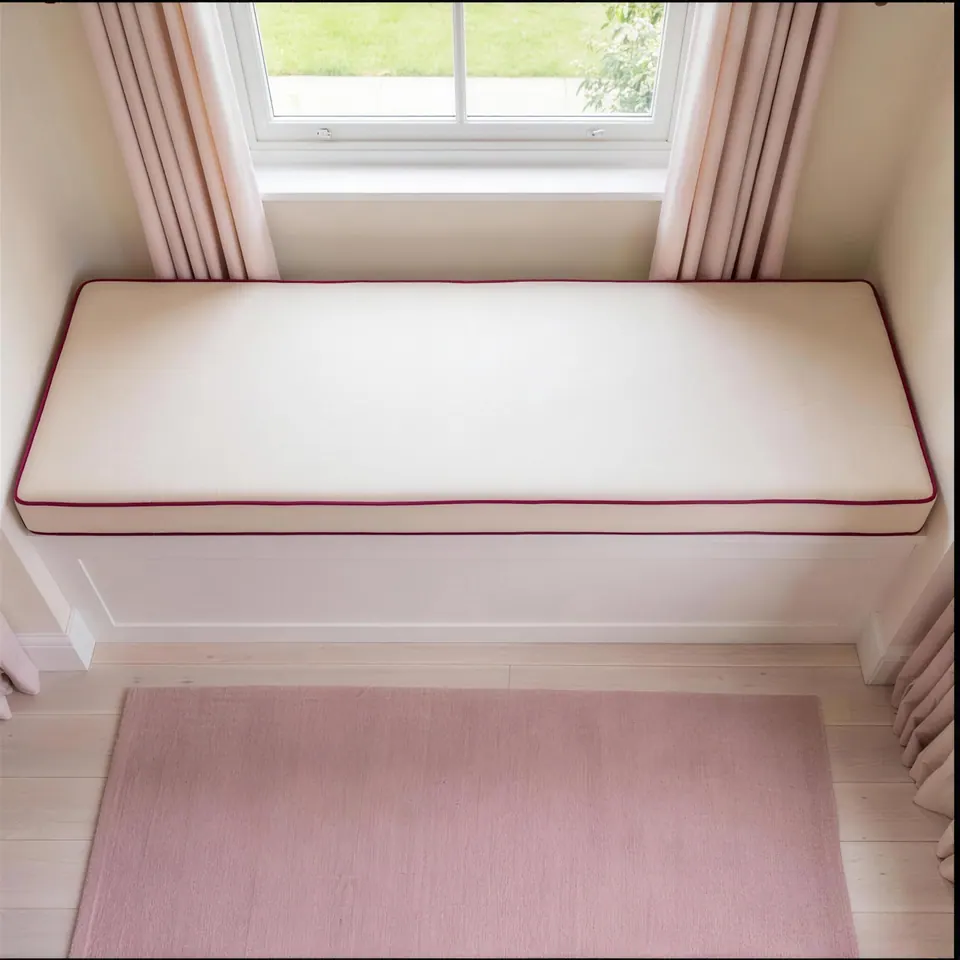
How to measure Seen from above, the cushion fills the frame: measure length and depth inside it, wood to wood. Seen from the front: the thickness you want.
Standard thickness
4 in (10 cm) for bench and window seat cushions; most buyers keep it
Thinnest foam
2 in (5 cm); about 1 in only without piping, and never tufted
Front overhang
Up to about 2 in (5 cm) with an inner support wrap
Daybed or guest mattress
Twin about 38 x 75 in (97 x 191 cm); lengths of 70 to 75 in (178 to 191 cm) are made routinely
Curved or arched seat
A measured sketch, or a paper template photographed flat beside a tape measure
Firmness
Roughly 6 to 7 on a 1 to 10 scale; backrests softer unless you ask
Cover
Zippered and removable; zipper on the back edge or underside, often wrapping two corners on bench and mattress covers
Staying put
Non-slip base across the whole bottom panel, safe on wood; ties on request
The count is how many published readings use each family. Open a family for its swatch book, care notes and neighbors.
Three seats a bedroom asks for
The first cushion you touch in the morning is rarely on the bed. It is on the bench at its foot, where the robe lands and the shoes go on, or on the window seat where you check the sky before the day begins.
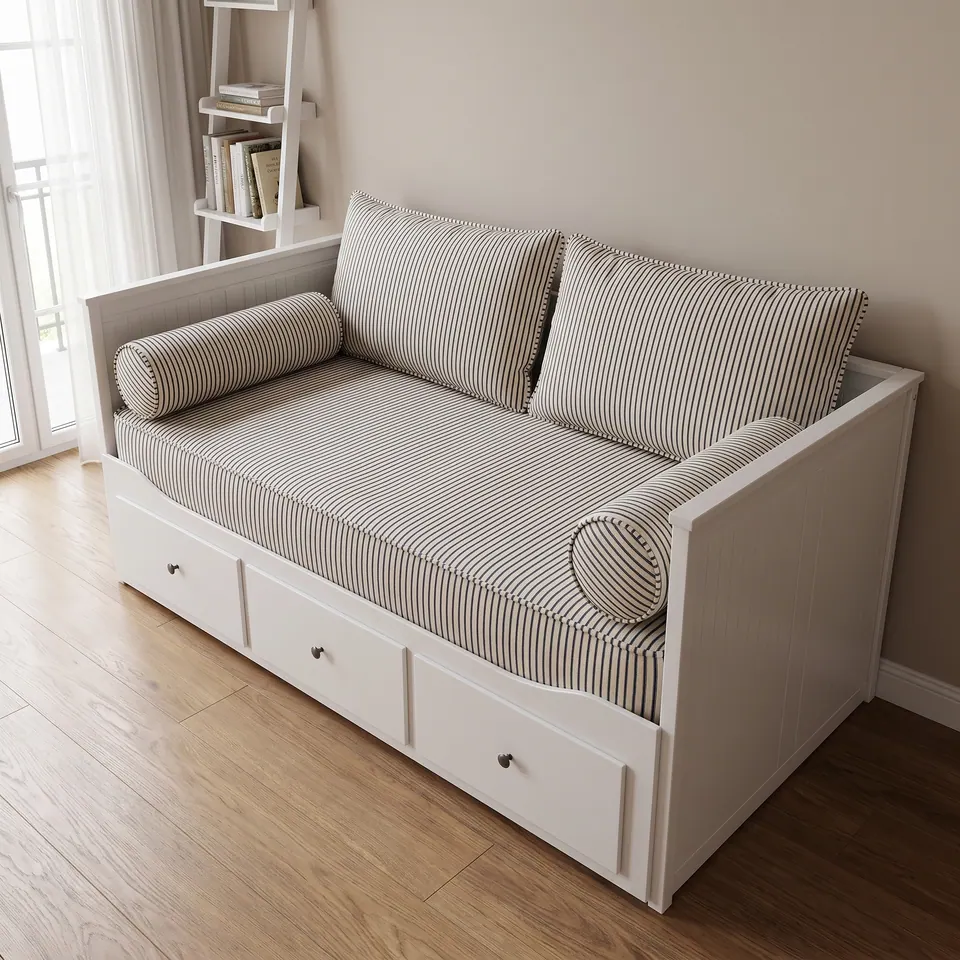
A bedroom bench cushion serves three kinds of seat. The end-of-bed bench, in oak, walnut or reclaimed pine, long and narrow. The window seat, set into an alcove or a paneled reveal. And the daybed that turns into a guest bed. Each has its own Atlas page: bench cushions, window seat cushions and daybed cushions, with IKEA Hemnes daybed covers for that very common white frame.
This page is about the room itself: low light, bare feet, and a cushion that is seen from the pillow.
The edge: piping, buttons, or a clean line
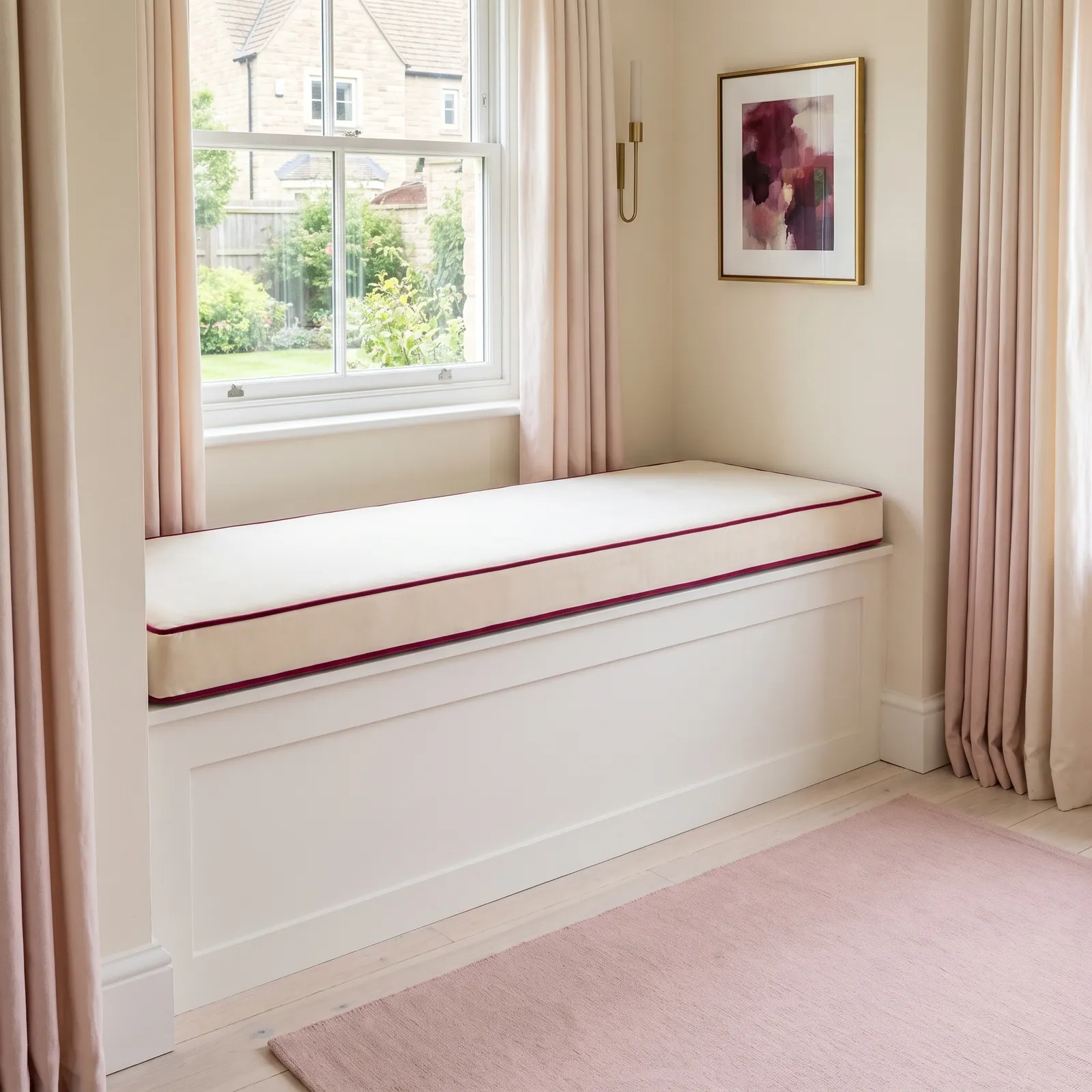
Most bedroom benches take a box cushion: square-edged, zippered, quiet. The character goes into the edge. Fuchsia piping around a cream velvet window seat draws the outline in one confident stroke. Navy piping on a mustard corduroy bench sends the eye down to the walnut beneath.
Some fabrics decline the line. Corduroy daybed covers have no piping by design, and a cushion about 1 in thin cannot take it either. Buttons have their own rules: tufted French-style cushions are fiber-filled and hand-stitched closed, with no zipper, and a zippered version is made without tufting. Before you decide, read box edge vs knife edge and piping: matching, contrast or none.
Velvet, corduroy and a quiet stripe
Bedrooms are kind to fabrics that would suffer in a mudroom, which is why the photographs here lean toward pile.
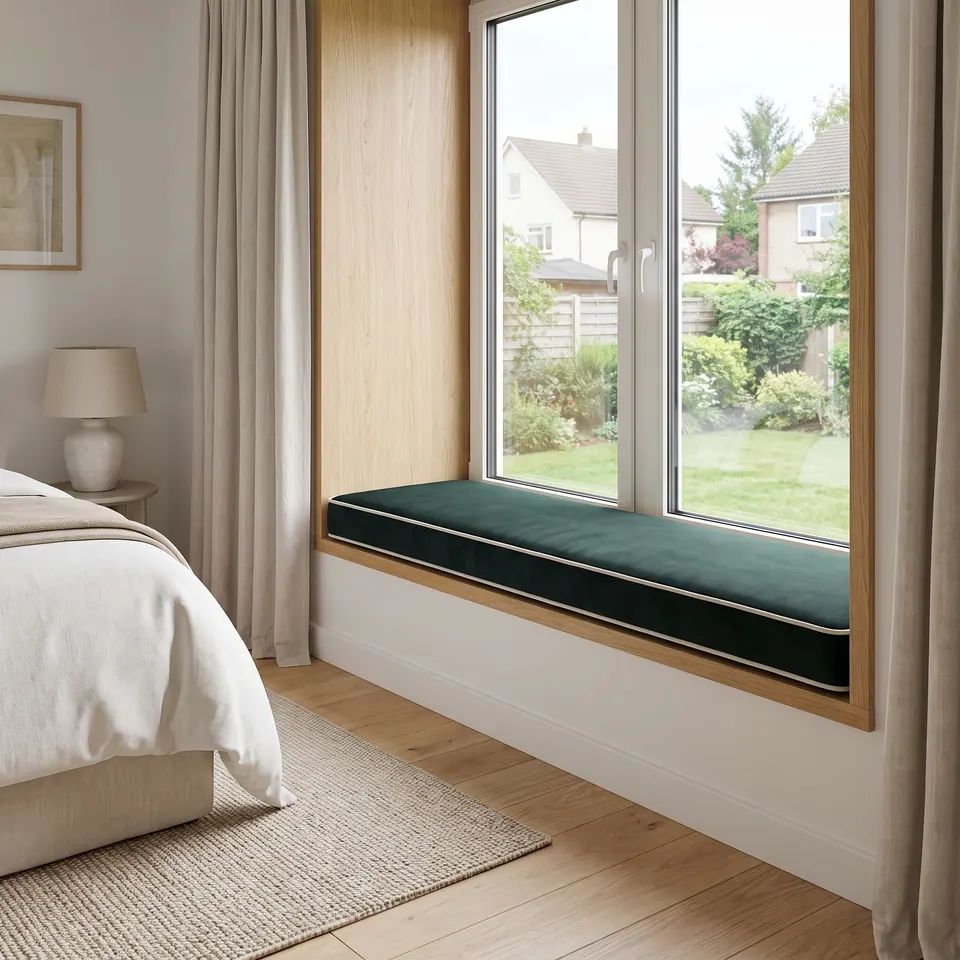
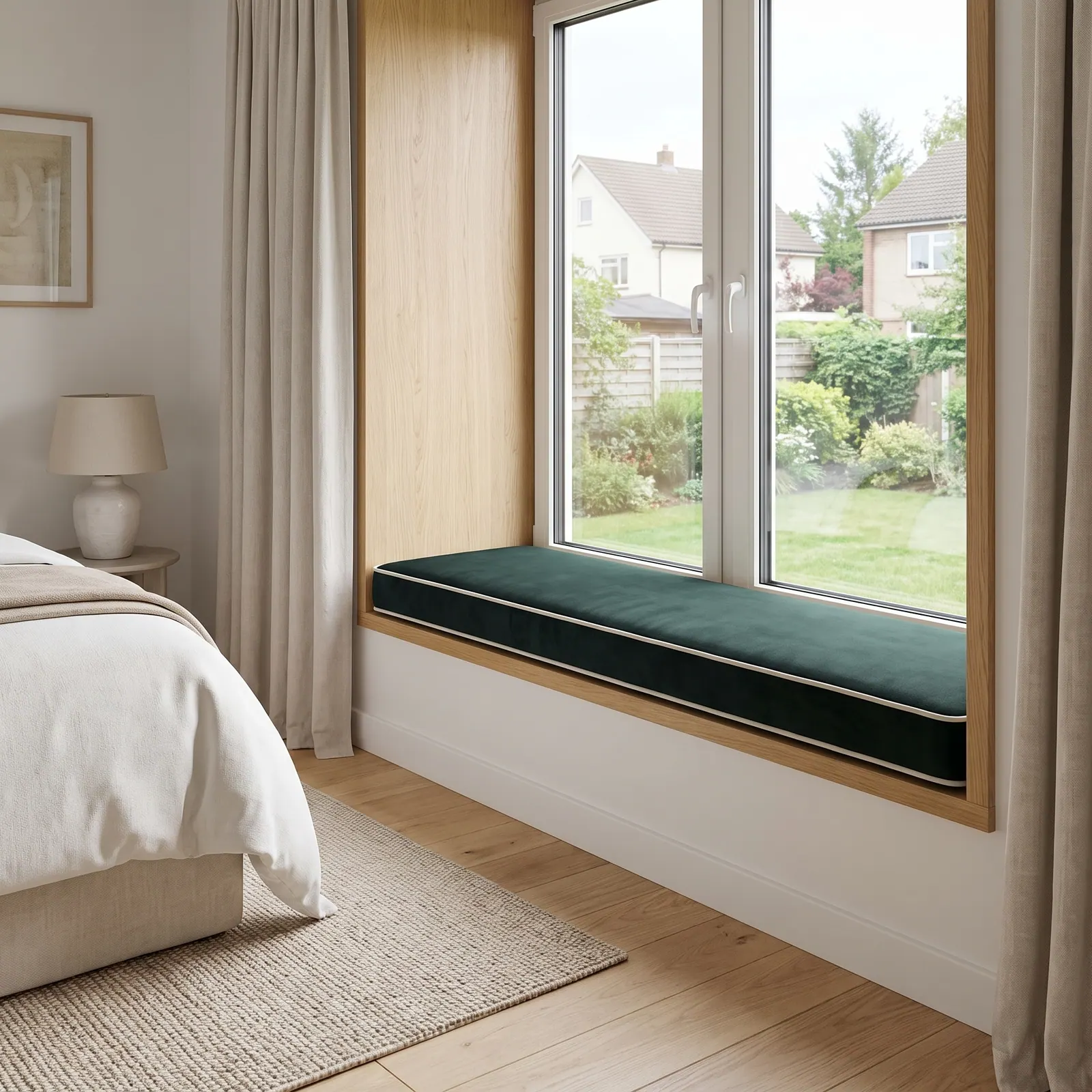
Velvet: plum on honey oak, cranberry on reclaimed pine, forest green in an oak-lined reveal. It deepens under a lamp and turns faintly silver in morning light.
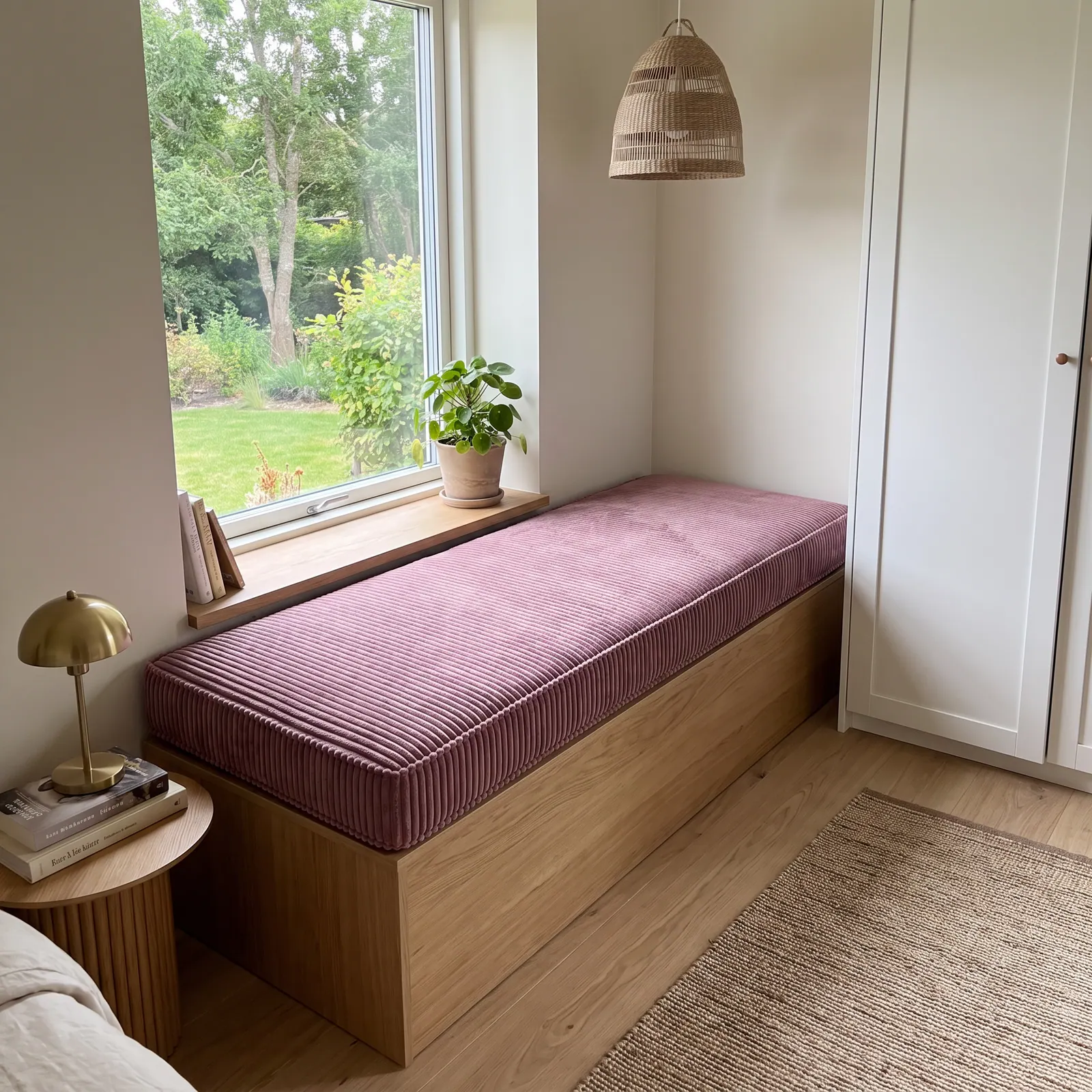
Corduroy: mustard with navy piping, dusty mauve in an oak alcove. The wale catches light from the side.
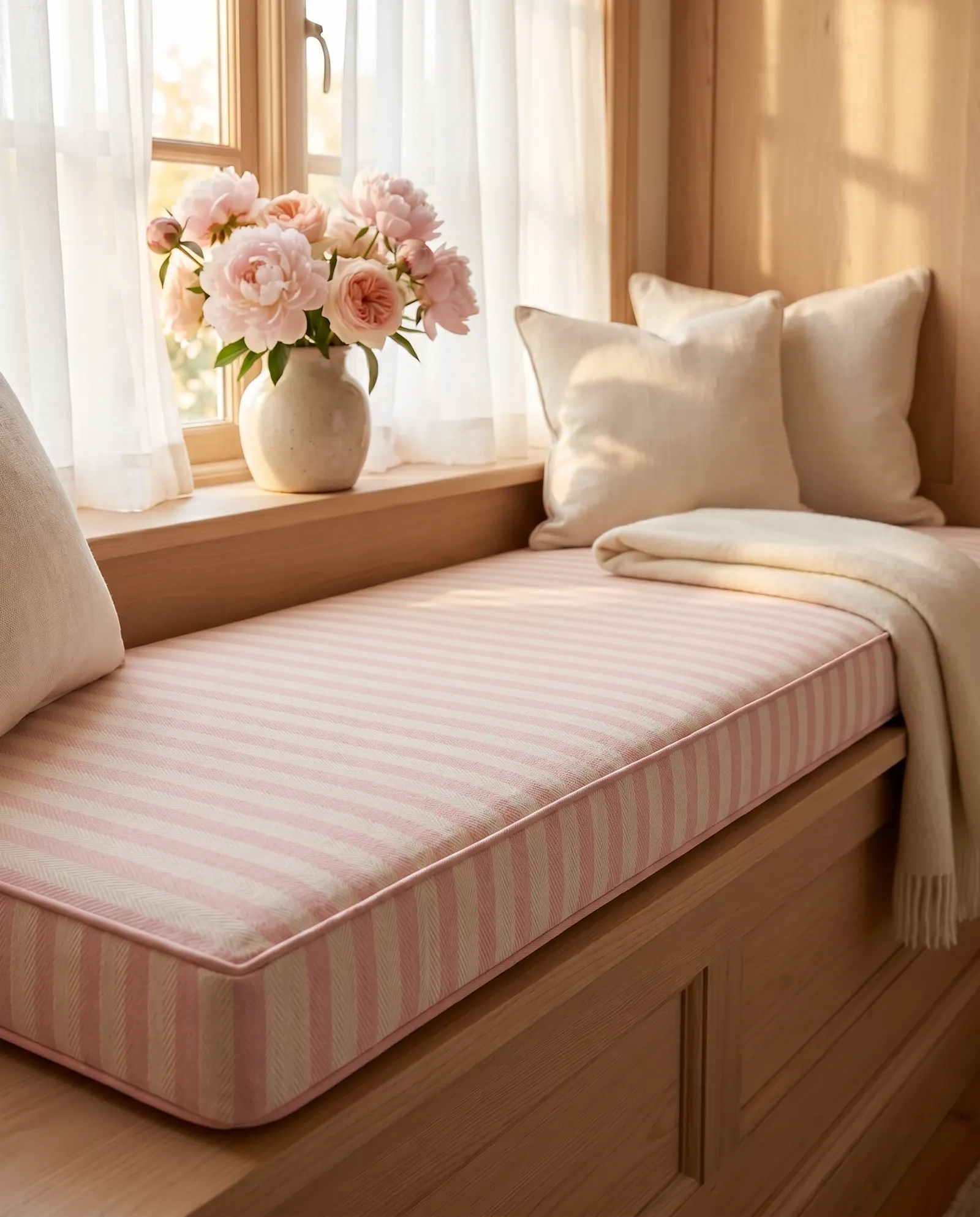
Striped cotton and ticking: a charcoal pinstripe on a white storage seat, a blush stripe in golden oak. The roll is about 55 in (140 cm) wide, so on a long bench the stripes run front to back and a very long piece needs a seam.
Daylight never lies; your screen sometimes does. Chart swatches and close-up photos can look darker or coarser than the cloth, so hold a swatch at the window at noon, then under the bedside lamp.
Foam at the foot of the bed, and a daybed that sleeps
An end-of-bed bench takes the standard 4 in (10 cm) of foam: firm enough to sit on while you tie a shoe, roughly a 6 or 7 on a 10-point scale. High-density foam keeps the top flat and tailored, which matters under velvet, where every dip shows.
A daybed is a heavier question, because someone will sleep on it. Sleeping pieces are sized generously: lengths of 70 to 75 in (178 to 191 cm) are routine, a twin runs about 38 x 75 in (97 x 191 cm), and 6 or 8 in (15 or 20 cm) of thickness lifts a floor-level bed higher. Try the foam firmness finder, then read daybed mattress cover measurements.
A real project
A guest of 5 ft 9 in and a 73-inch set
One buyer wrote in wanting floor seating that could also be a bed for someone about 5 ft 9 in tall. Not a sofa that sleeps badly; a bed that sits well.
The workshop pointed to the 30 x 73 in (76 x 185 cm) French tufted set: one base, one back and two end cushions, all filled. Seventy-three inches leaves about 4 in (10 cm) beyond a 69-inch sleeper.
The same answer covered the other sleeping sizes the workshop recommends: 24 or 27 x 70 in for a child's sleepover bed, about 38 x 75 in for a twin, and around 60 in wide for one adult of about 5 ft 2 in. For a true toddler bed, the workshop points people to a separate kids' foam bed instead.
Measured
30 x 73 in set for a 5 ft 9 in sleeper; twin about 38 x 75 in
What it taught
Size a sleeping cushion to the sleeper's height plus a few inches; lengths of 70 to 75 in are routine.
Why bedroom cushions wander, and other avoidable letdowns
Laying a light foam cushion on a polished bench and expecting it to stay. Order the non-slip base; it grips by friction and is safe on wood.
Cutting a window seat cushion exactly to a shallow seat. With nothing to grip, it slides; ask for a non-slip base or ties.
One long cushion across a lift-up storage bench. Split it at each lid break and add ties.
Writing 'with ties' in the size box. Ties are added only on request and a note among the numbers gets missed; confirm position, length and color by message.
Forgetting to ask whether the non-slip backing is washable. The newer washable version adds about a week.
Photographs from the workbench
Open any photograph large; each one has its own link and a Save button.
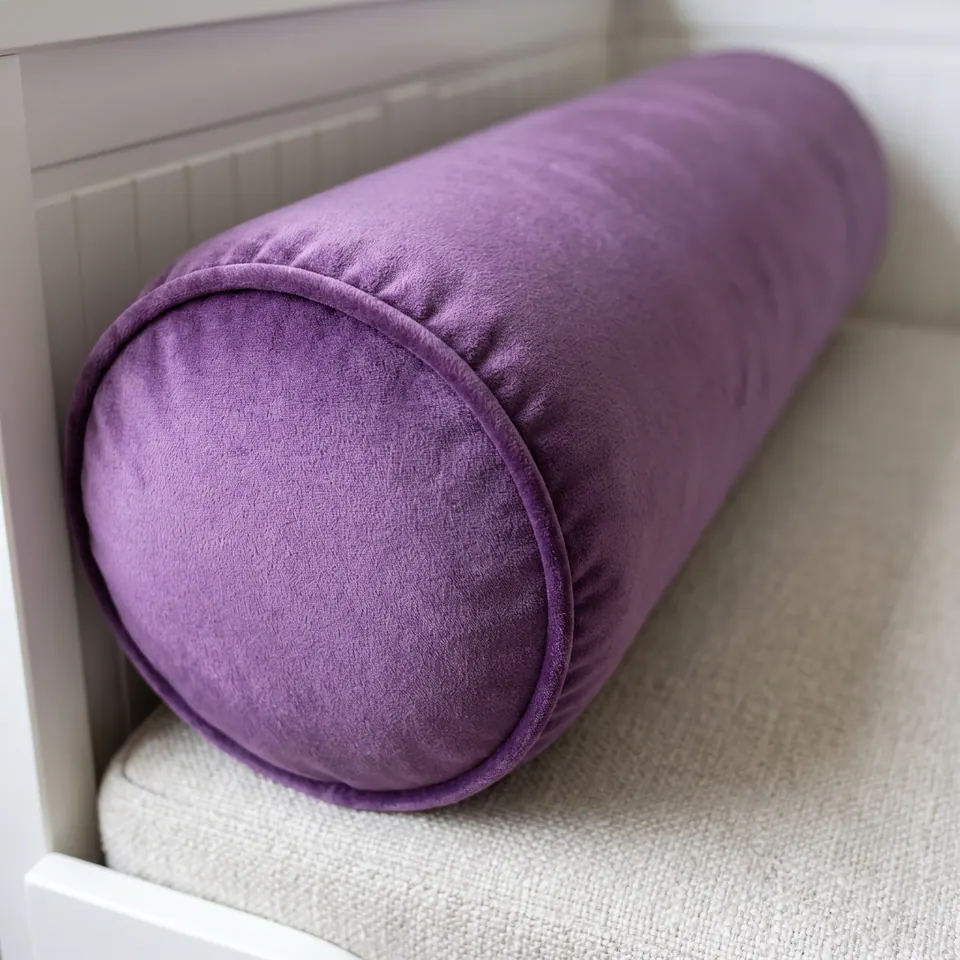
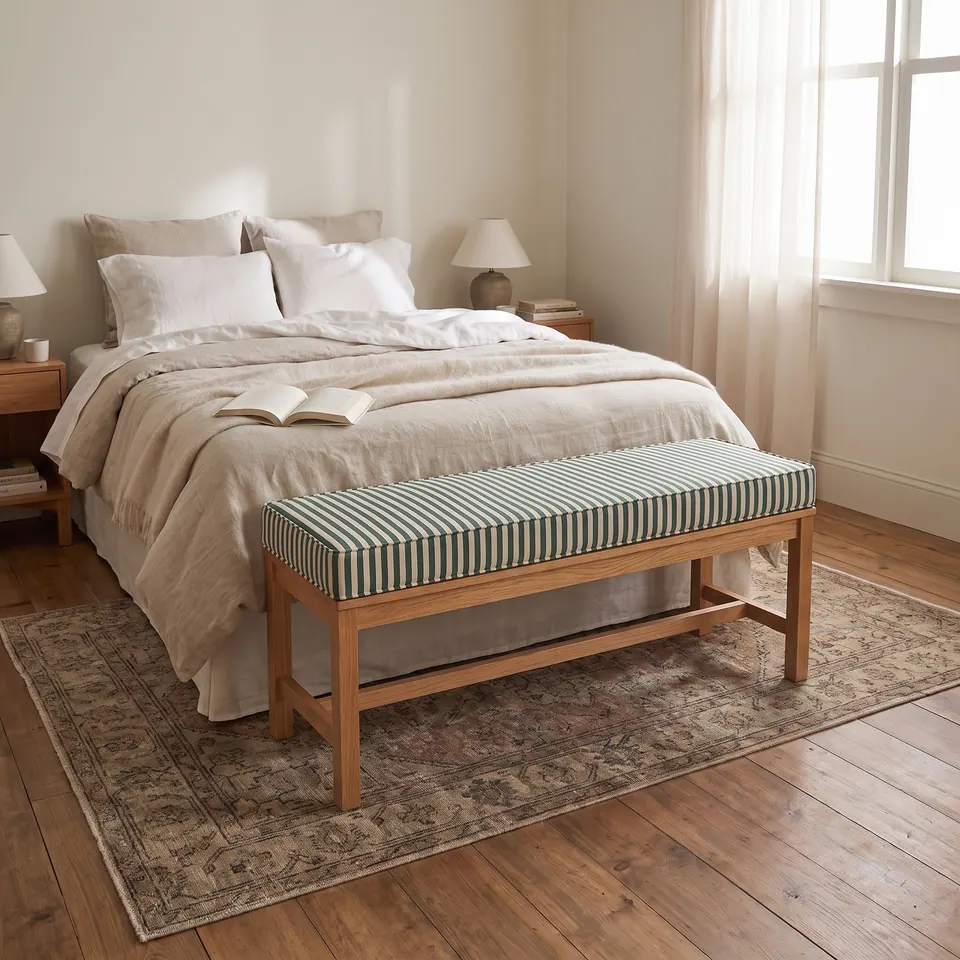
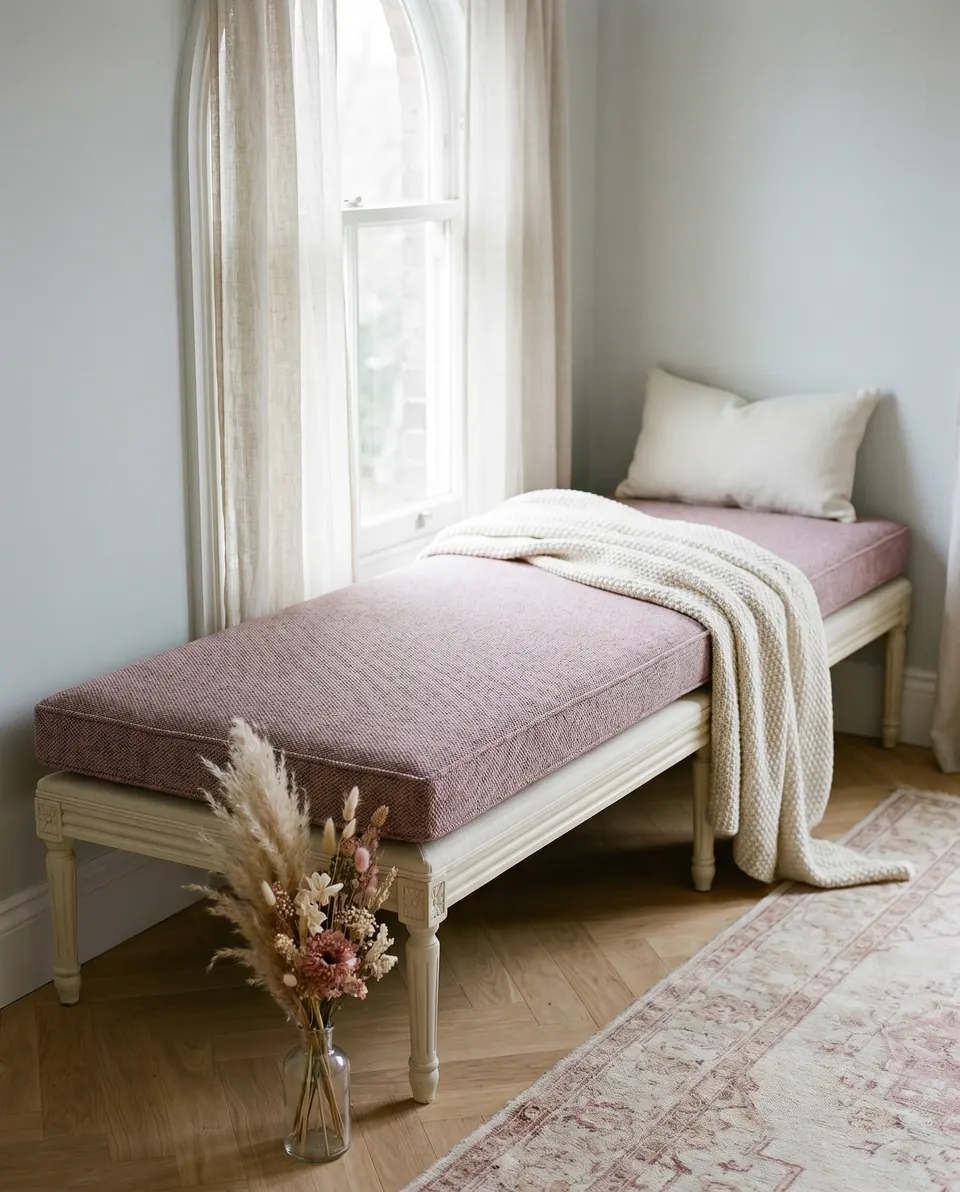
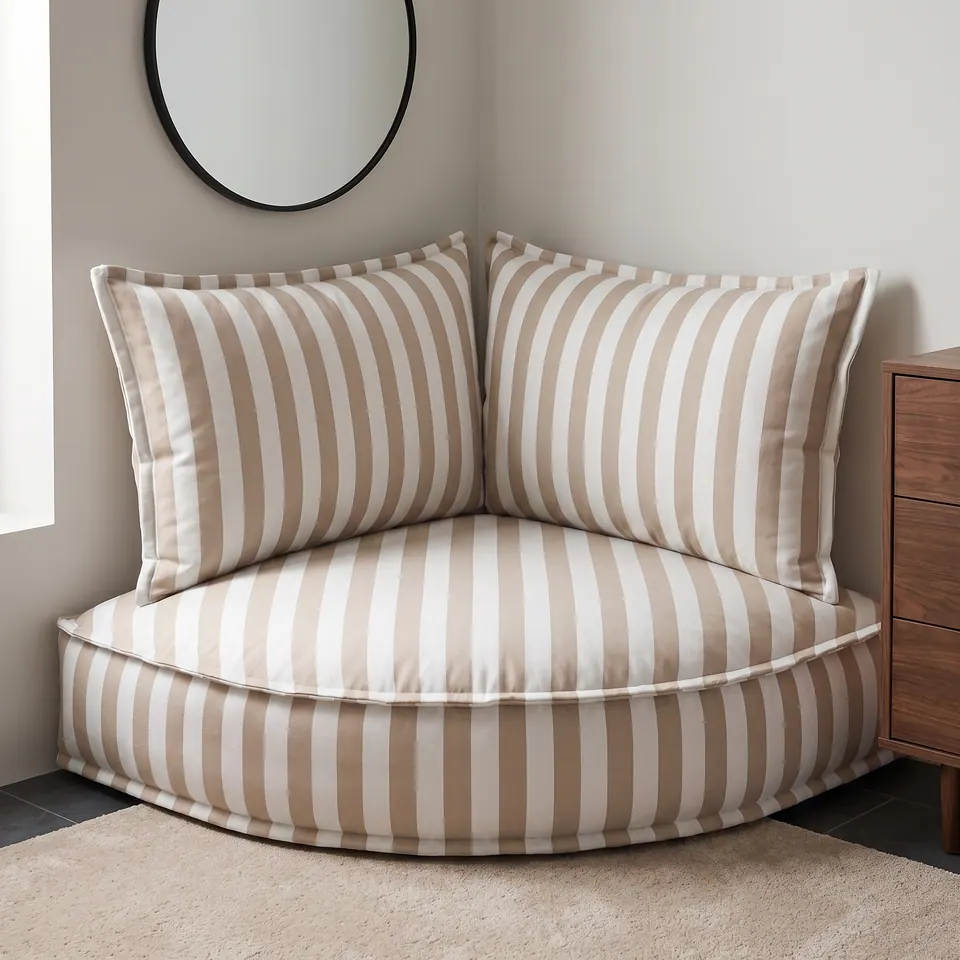
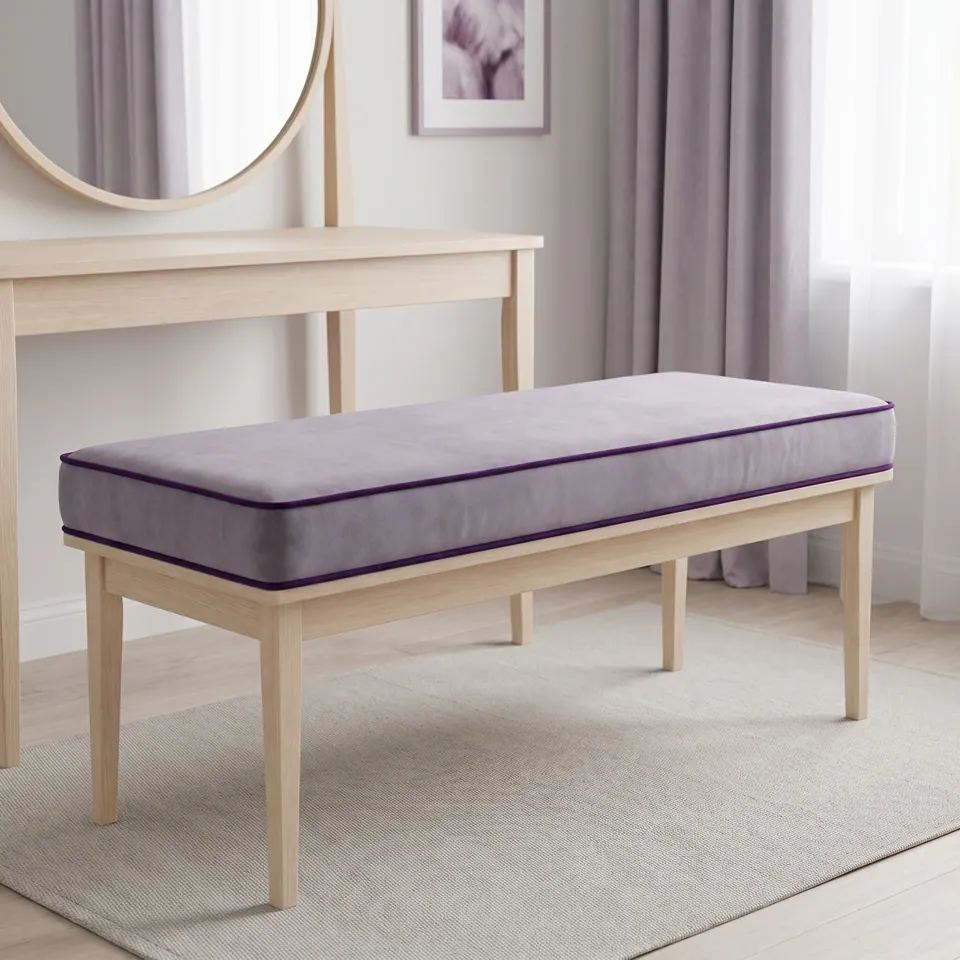
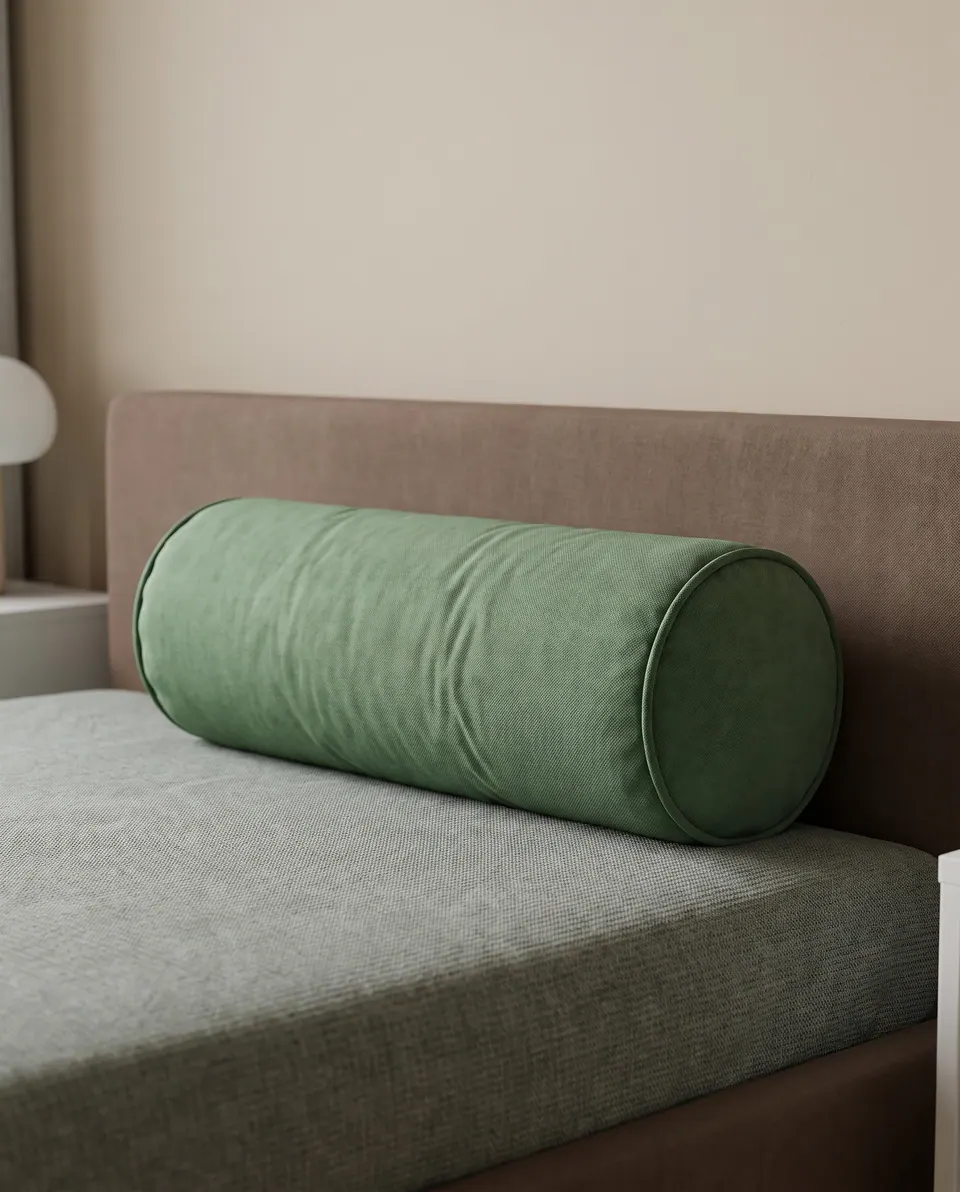
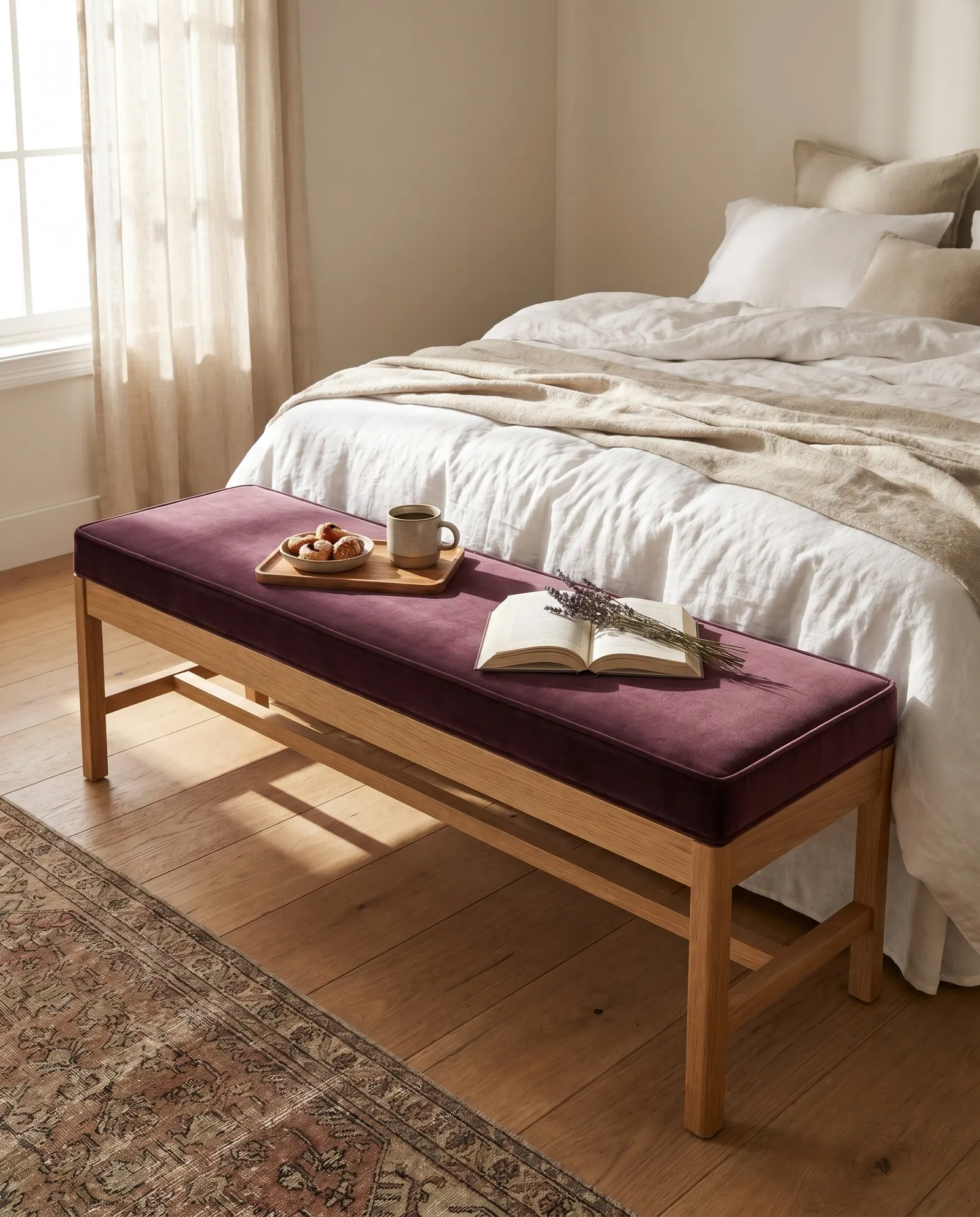
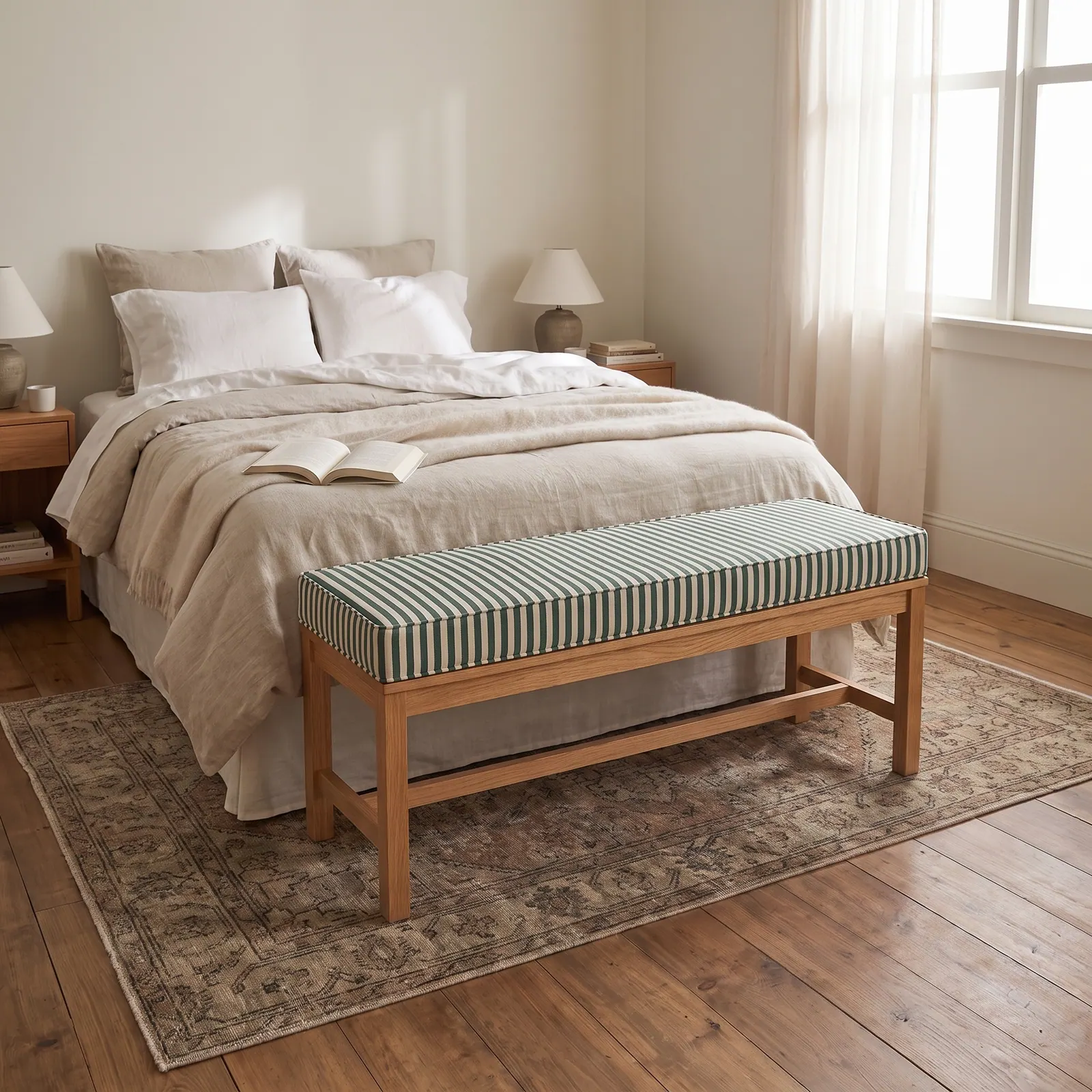
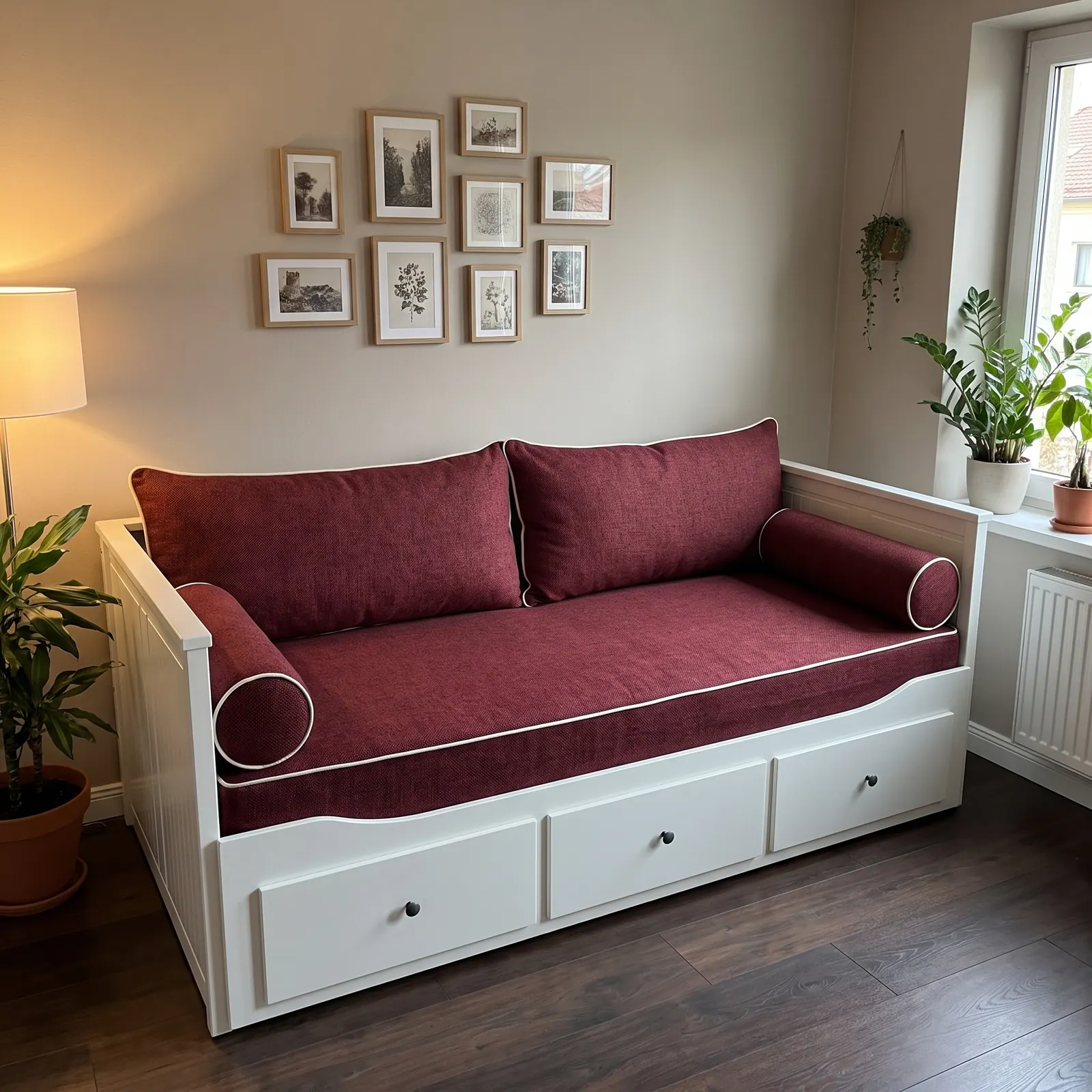
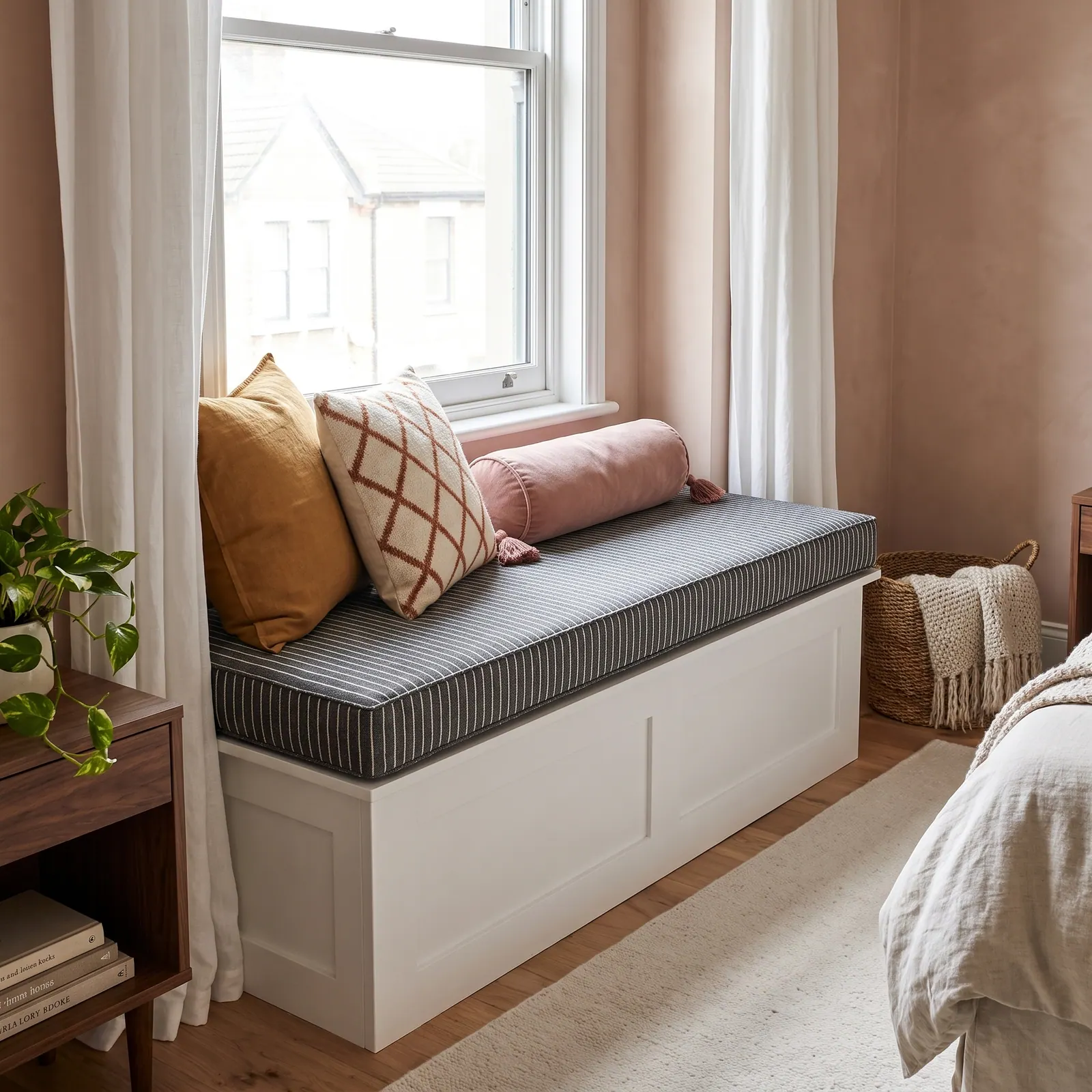
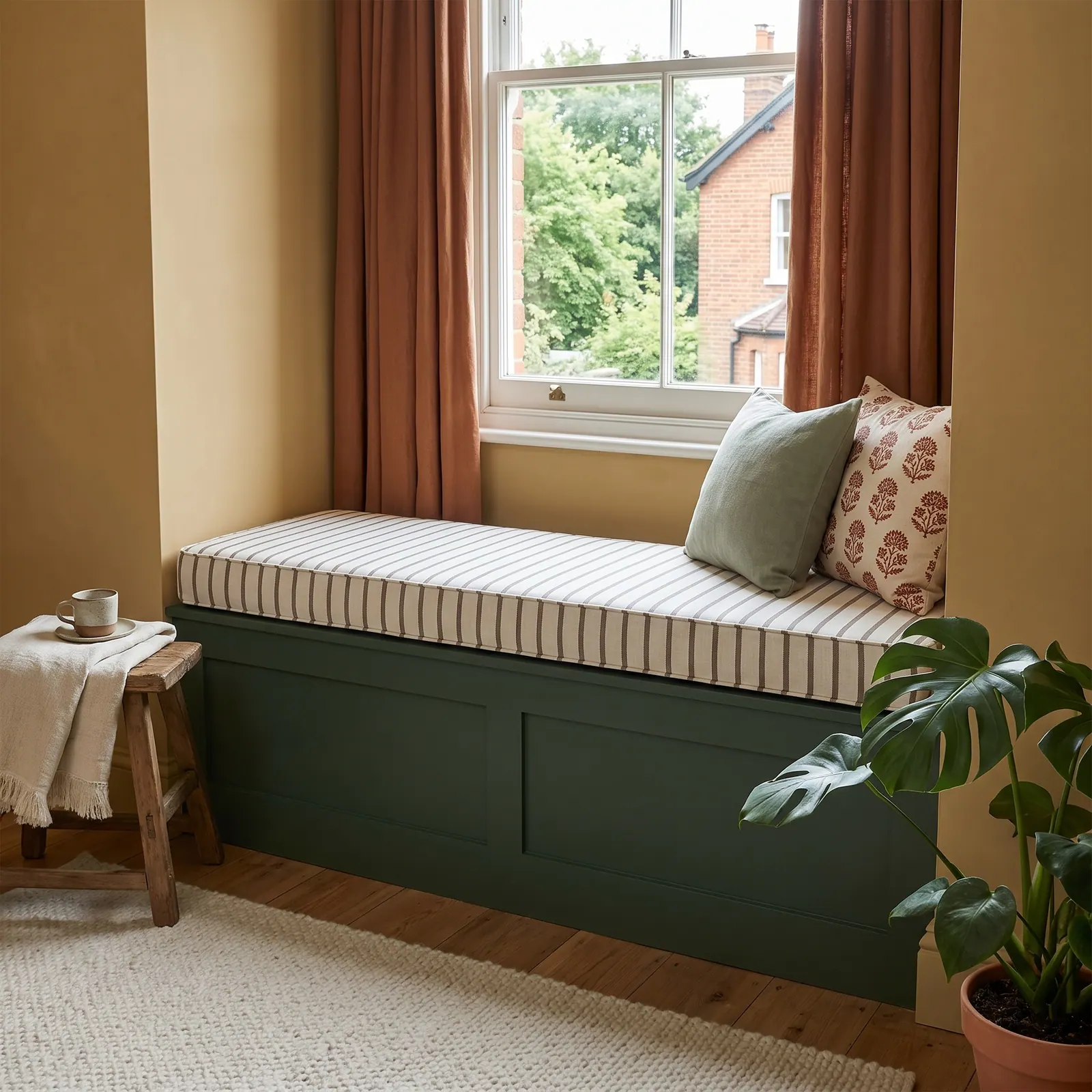
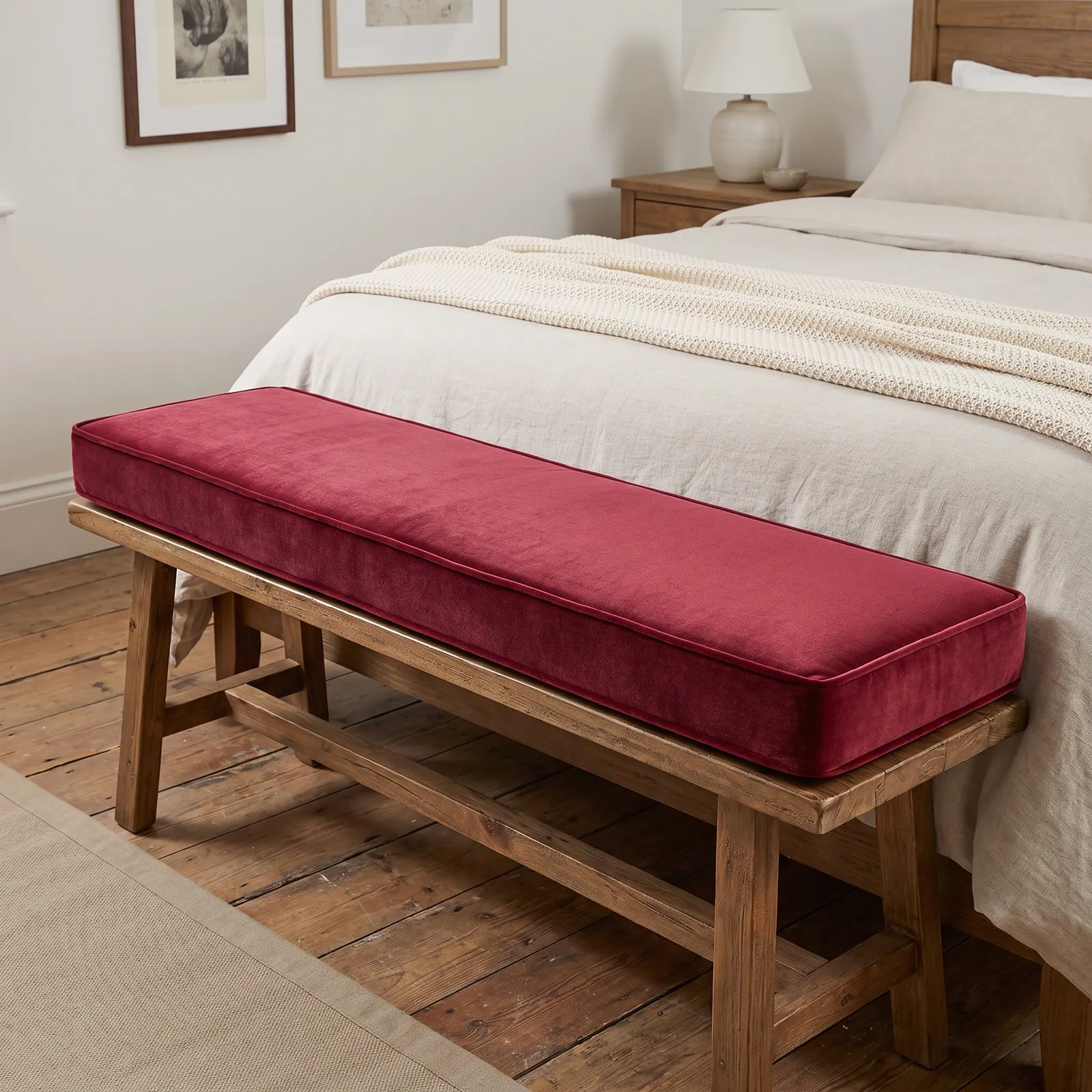
SaveA cream velvet seat edged in fuchsia piping picks up the pink curtains, rug and magenta print, so the whole alcove reads as one planned scheme.SaveDeep green velvet fills the full width of an oak-lined bedroom window, with ivory piping that ties it to the bedding.SaveA slim plum velvet pad turns a bare oak bench into somewhere to sit and pull on socks, or set down the morning coffee.SaveGreen-and-cream stripes on a foot-of-bed bench, picking up the sage in a faded vintage rug.SaveSoft blush stripes pick up the peonies on the sill, while honey oak paneling keeps the pink from turning sugary.SaveMauve corduroy softens a bedroom alcove built from pale oak and white cabinetry. The wide wale catches light from the garden window and looks almost velvety.SaveBurgundy linen-look covers with ivory piping make this Hemnes daybed the heart of a cozy room, centered under a gallery wall of small framed prints.SaveA bolster along the window turns the seat into a lounging spot right beside the bed.SaveA mustard pad with navy piping on a walnut bench brings the end of the bed to life.SaveDeep green, ochre and rust make a rich autumn corner; an ivory stripe keeps the seat itself light.SaveA cranberry red velvet cushion with self piping sits on a rustic pine bench, adding one rich color to a bed dressed in natural linen.
A daybed cushion for a guest about 5 ft 9 in tall should be about 73 in long; made-to-measure lengths of 70 to 75 in are routine.
Look at the hero photograph: a charcoal and mustard tweed cushion on a walnut bench against a warm beige wall, velvet pillows beside it, a lamp glowing on the nightstand. The mustard is the note that answers the lamp. Everything else stays low and quiet so that one warm color can do its work.
The gallery plays the idea in other keys: plum velvet on honey oak against white linen, burgundy on a white Hemnes daybed edged in ivory piping.
I'm moving into a college dorm. Can my cushion arrive just before move-in?
The workshop's answer
Often, yes. Write 'please deliver on or after' and your date in the order note or personalization box, or send a message, and the finished order has been held or production timed so it lands close to that date. Orders have shipped straight to dorms, timed before move-in. Transit time varies, so no single day can be guaranteed; get the estimate with your order, and with UPS you can also hold the delivery for pickup.
A common question
I gave the wrong size for my daybed mattress. Can the order still be corrected?
The workshop's answer
If you message quickly, yes: one mattress order was updated to 75 x 38 x 8 in after checkout. The color can also be changed if production hasn't started, when you give the exact color name or number from the chart. A finished custom piece usually can't be altered, so send final sizes and a drawing as early as you can.
A common question
The bench cushion arrived in the wrong size. Do I have to ship it back?
The workshop's answer
Not in past cases where the size mistake was the workshop's. Send a photo with a tape measure along the full dimension; past cases include 36 in arriving instead of 44 in, and 24 x 40 in instead of 16 x 40 in. Keep the piece until the workshop replies. In those cases only the parts that didn't fit were remade, the piping color could change on the new one, or a partial refund was taken instead.
A common question
My window seat is curved at the front. What do you need to make the cushion?
The workshop's answer
A drawing or a template, never numbers alone. Sketch the total width and depth, the straight length of each edge before the curve, where each curve starts and ends and how deep it goes; an arched seat can be drawn as a rectangle plus an arc of a circle. For a tricky curve, trace the seat onto wrapping paper, cut it out and photograph it flat beside a tape measure.
A common question
I ordered before I'd finished measuring the bench. Can I cancel?
The workshop's answer
Yes, before production starts. Accidental orders have been canceled and refunded, and how soon the refund appears depends on your bank. If size or space was the problem, you may be offered a custom size and a check of your measurements instead, or a later ship date. If you still want to cancel, it is done on request.
Have it made
Have your bedroom bench cushion made — ask Élodie’s workshop
Color is easier to settle in a conversation than on a screen. Tell the workshop about the room and the light it gets, and the fabric choice follows. — Élodie
Leave your details and the workshop will call you to confirm measurements, fabric, foam and piping. No prices, dates or payment on this page: it is a request, not an order.
Fabric · Foam · Pipingwhat the workshop will confirm with you
Will a non-slip base mark an oak bench at the foot of the bed?
No. It is a grippy fabric covering the whole bottom panel, and it holds by friction rather than adhesive or rubber, so it leaves no residue and is safe on wood. There is no border-only version, and it is an extra you choose in the personalization box.
Can a corduroy daybed cover have piping?
No. Corduroy daybed covers and corduroy sofa pieces are made without piping by design. If you want an outlined edge on a daybed, choose another fabric family, such as velvet or a woven stripe, where matching or contrast piping can be added.
Can I unzip a tufted bench cushion to wash the cover?
No. Tufted French-style cushions are filled with siliconized polyester fiber, button-tufted and hand-stitched closed, so the cover cannot come off. If washing matters in a bedroom, choose a plain foam cushion: every one has a zippered, fully removable cover at no extra cost.
How firm does an end-of-bed bench cushion feel?
Roughly 6 to 7 on a 1 to 10 scale: firm enough to sit on while dressing without sinking. High-density foam keeps the top flat and structured. Backrests are softer by default, but one can be made as firm as the seat if you ask.
Can a bedroom window seat cushion be thinner than 4 in?
Yes. The standard is 4 in (10 cm), and the thinnest standard foam cushion is 2 in (5 cm). A cushion of about 1 in can be made only without piping, one of about 1 1/4 in (3 cm) can still take piping, and tufted cushions can't go that thin.
With color and care — Élodie
Share this atlas entry
Readings
Photographs read by the masters: bedroom bench & daybed cushions
Real cushions made for real rooms, each read for proportion, fabric and fit.

 Save
 Save
 Save
 Save
 Save
 Save
 Save
 Save
 Save
 Save
 Save
 Save