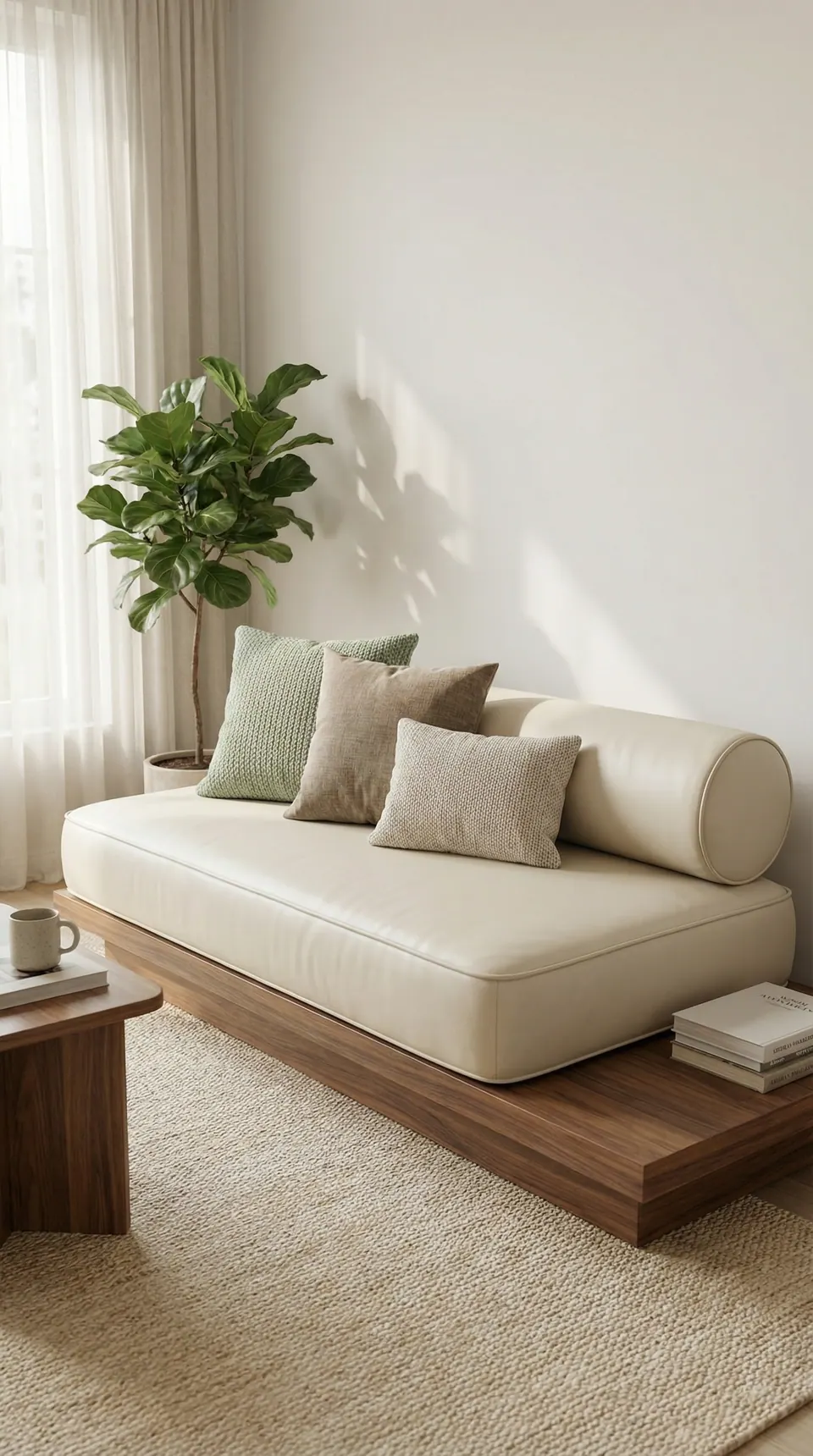
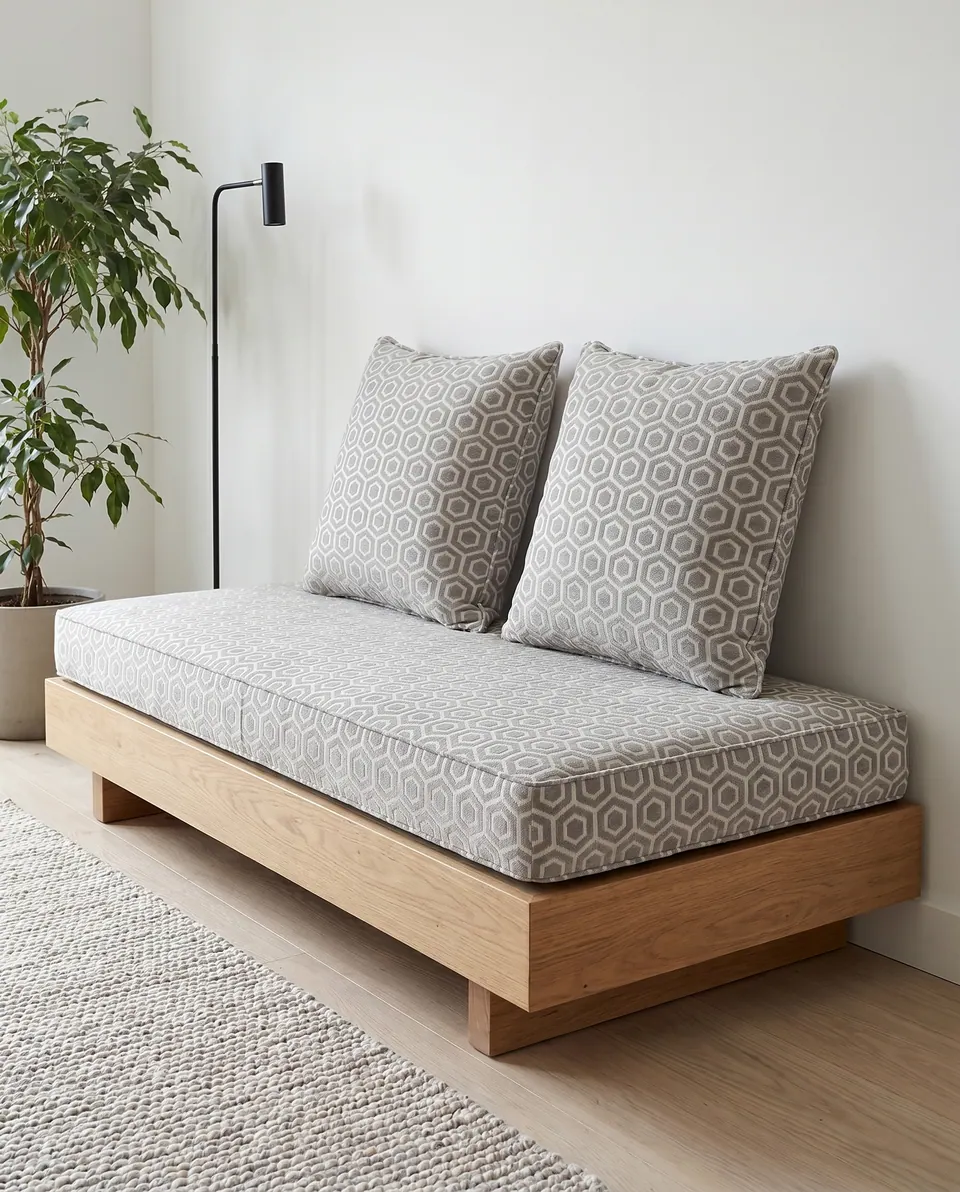
Concept Sketches · 8 scenes
One daybed, three jobs: a cushion set for sofa days and guest nights
A daybed is only as much of a sofa as its back cushions and its color allow. Eight past daybed projects, and what each taught us about height, bolsters and a fabric a guest can sleep on.

 Save
The quick answer
A daybed cushion set that works as a sofa is a fitted mattress cover, two back cushions about 20 in (50 cm) tall and a bolster at each arm. For guests, choose a smooth, breathable fabric. For two stacked mattresses, order one cover at the combined height. On a frame with a raised rim, make the cushion thicker than the rim.
The daybed works three shifts
A daybed stays a bed right up until you set two back cushions about 20 in (50 cm) tall behind it. Then the whole room starts calling it a sofa.
In a small home the daybed works three shifts: sofa by day, reading spot when the late light turns the walls amber, guest bed when family stays over. A good daybed cushion set has to be honest about all three.
Questions about daybed cushions keep returning to three things: how tall the back should stand, which fabric a guest can sleep on, and how one cover holds two mattresses. The eight daybeds below are past projects, most for homes in the US, and their sizes are kept exactly. Which of the three jobs does yours do most, my friends?
Eight daybeds, sofa side up
01A past project
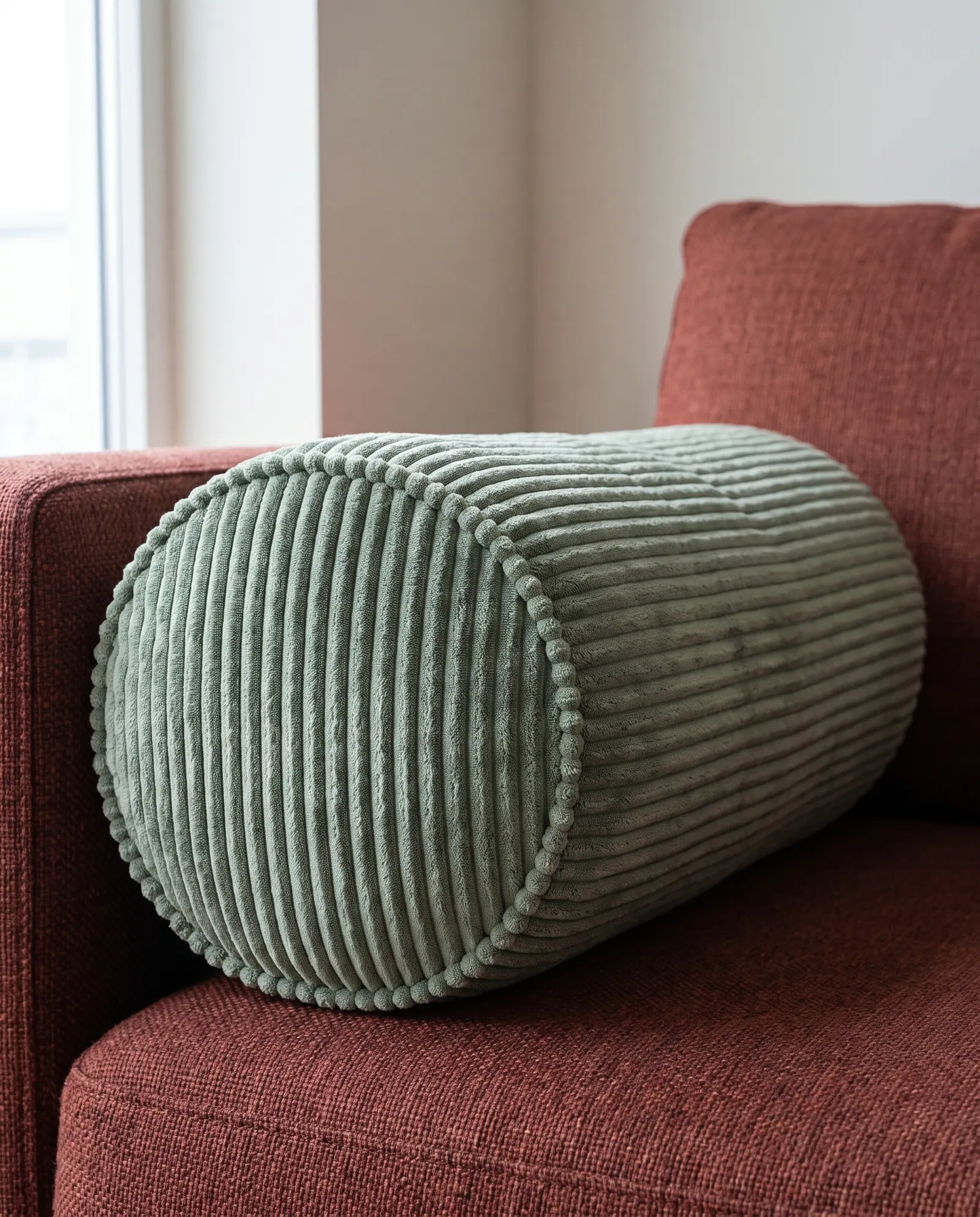
Green corduroy that sits upright
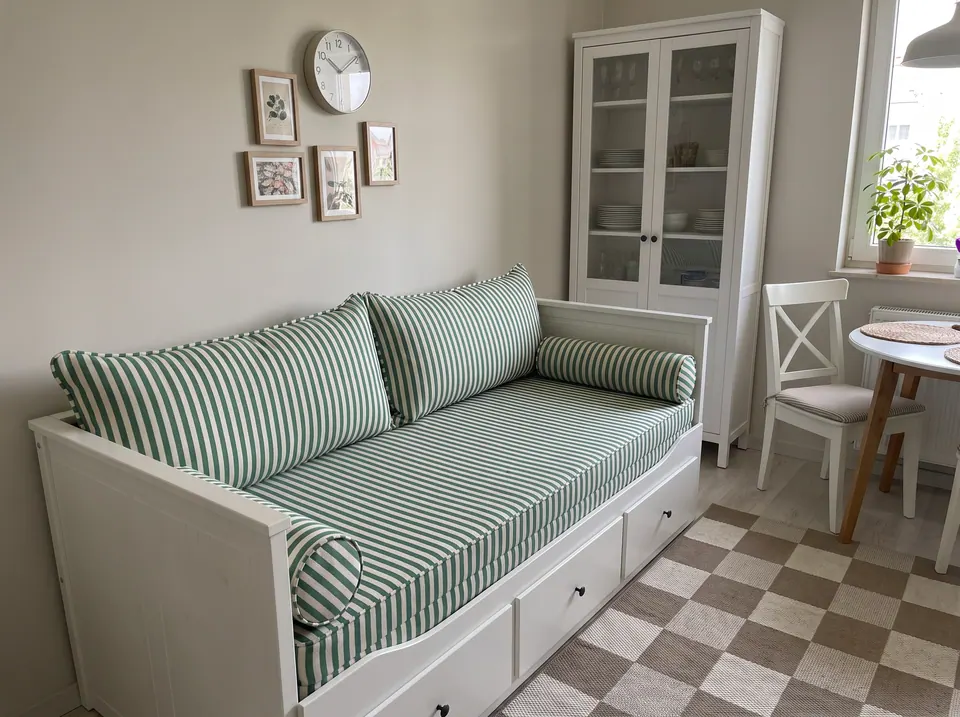
A buyer in the US didn't want the full set. The twin daybed stood against a wall as a sofa, so they asked for one long back cushion firm enough to sit upright against, one armrest bolster, and a fitted cover for a 39 x 75 x 11.5 in (99 x 191 x 29 cm) mattress in green corduroy. The workshop suggested foam-filled back and arm pieces for structure and sent backrest photos to choose from.
The takeaway: If the daybed is mostly a sofa, ask for a foam-filled back cushion rather than loose fiber fill.
02A past project
Twenty inches of back on a twin
A buyer in the US wanted a new cover for a twin daybed mattress and a back pillow as good as the one on her corner sofa. We settled the mattress at 38 x 79 in (97 x 201 cm) and the backrests at about 20 in (50 cm) tall: two stuffed L-shaped back pillows running end to end.
The takeaway: Height is what turns a bed into a sofa, so ask for daybed-height backs, not bench-height ones.
03A past project
A yellow a guest can sleep on
A buyer in the US wanted a yellow daybed cushion that guests could sleep on through hot summers: nothing scratchy, nothing plush. The workshop matched the color in a smooth, breathable soft fabric with self-colored piping, cut it at 23 5/8 x 79.5 in (60 x 202 cm), and moved it up the line for a July deadline.
The takeaway: For a surface people sleep on, choose smooth and breathable over deep pile.
04A past project
Two Hemnes mattresses, one cover
A buyer in the US stacked the two mattresses on an IKEA Hemnes, 9.5 in (24 cm) together, and received two separate covers. Each was too tight to lie flat. The fix was a single cover, 31.5 x 79 x 9.5 in (80 x 201 x 24 cm), zipped around both mattresses at once.
The takeaway: When you give a stacked height, say plainly that you want one cover around both mattresses.
05A past project
A sleepover window seat in mustard velvet
A buyer got in touch about a window seat, 31.5 x 95.7 in (80 x 243 cm), that doubles as a bed for sleepovers. She wanted a black or gray French stripe; we had no match, so she moved to plain velvet. Between a golden yellow and a mustard, she chose the quieter mustard.
The takeaway: When the pattern you want isn't there, a strong plain velvet can carry the room. Compare the two nearest shades side by side.
06A past project
The sofa that opens to a king
A buyer in the US who hosts guests for weeks at a time asked whether our floor sofa is good to sleep on, and what the foam is. It measures 39 x 79 in (99 x 201 cm) as a sofa and lays out to about 79 x 79 in (201 x 201 cm), a king-size sleeping surface, on about 1.75 lb/ft³ (28 kg/m³) cold foam under machine-washable corduroy covers.
The takeaway: When a sofa will work as a regular bed, ask for the foam density as a number.
07A past project
Burgundy velvet above a 4 in rim
A buyer in the US bought a black metal daybed whose sides rise about 4 in (10 cm), and needed a seat plus two bolsters. The first quote was for a 4 in cushion, which would have sat flush with the rim, so she moved to 8 in (20 cm). After re-measuring, the seat became 46 x 21 x 8 in (117 x 53 x 20 cm) in burgundy velvet, with two bolsters 21 in (53 cm) long to match the seat depth.
The takeaway: Make the cushion thicker than the frame's rim so it sits proud of the edge, and cut the bolsters to the seat depth.
08A past project
Cream velvet over a slouchy insert
A buyer in the US with a baby and dogs wanted a new slipcover for a store-bought daybed and first asked about 100% linen. The workshop recommended velvet for its tight weave and its 86°F (30°C) wash, and she chose cream with mushroom-taupe piping. The workshop also told her plainly that a new cover over the original soft filling would stay slouchy.
The takeaway: A cover can't fix a tired insert. If you want a crisp sofa line, the foam has to change too.
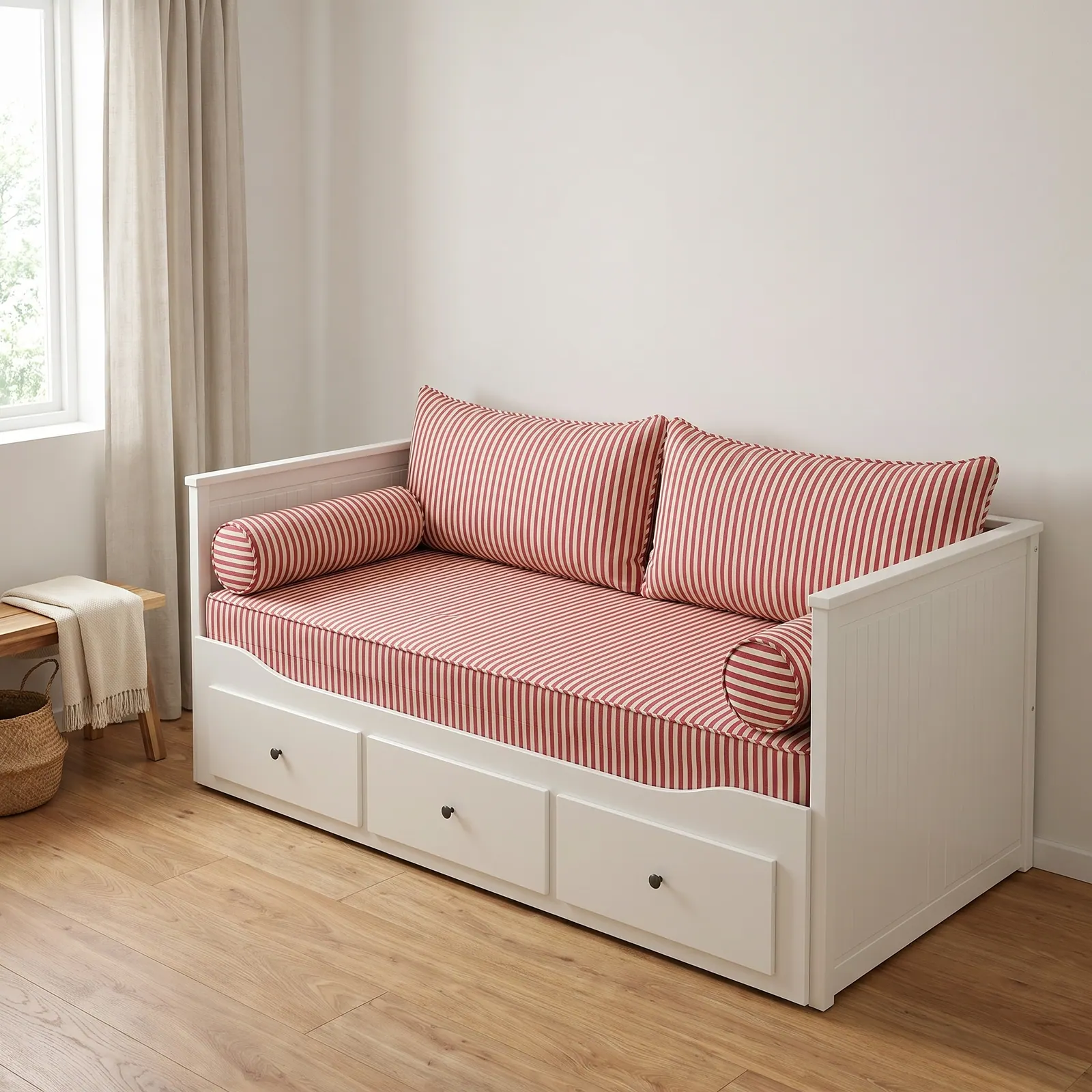
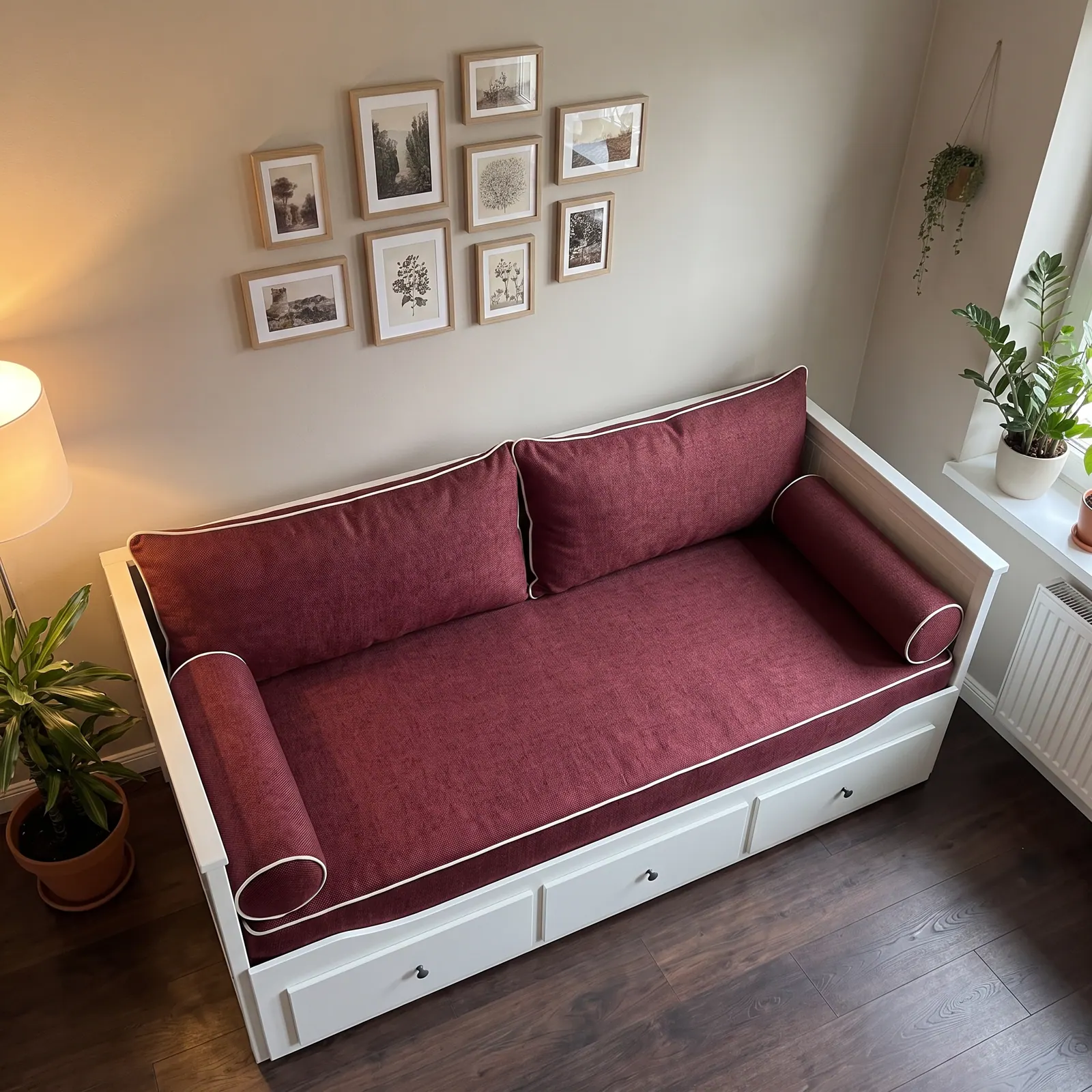
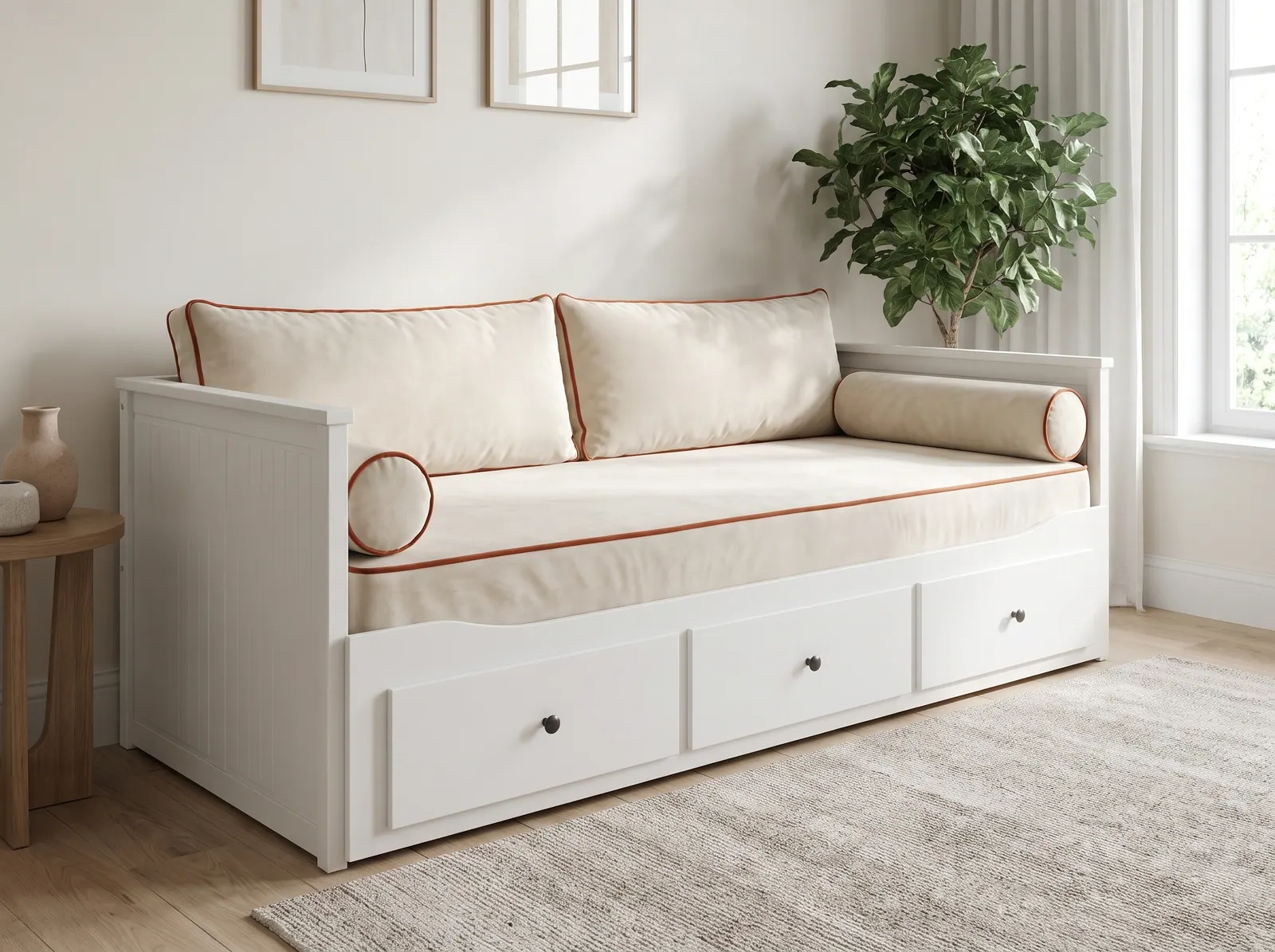
Color that says living room, not bedroom
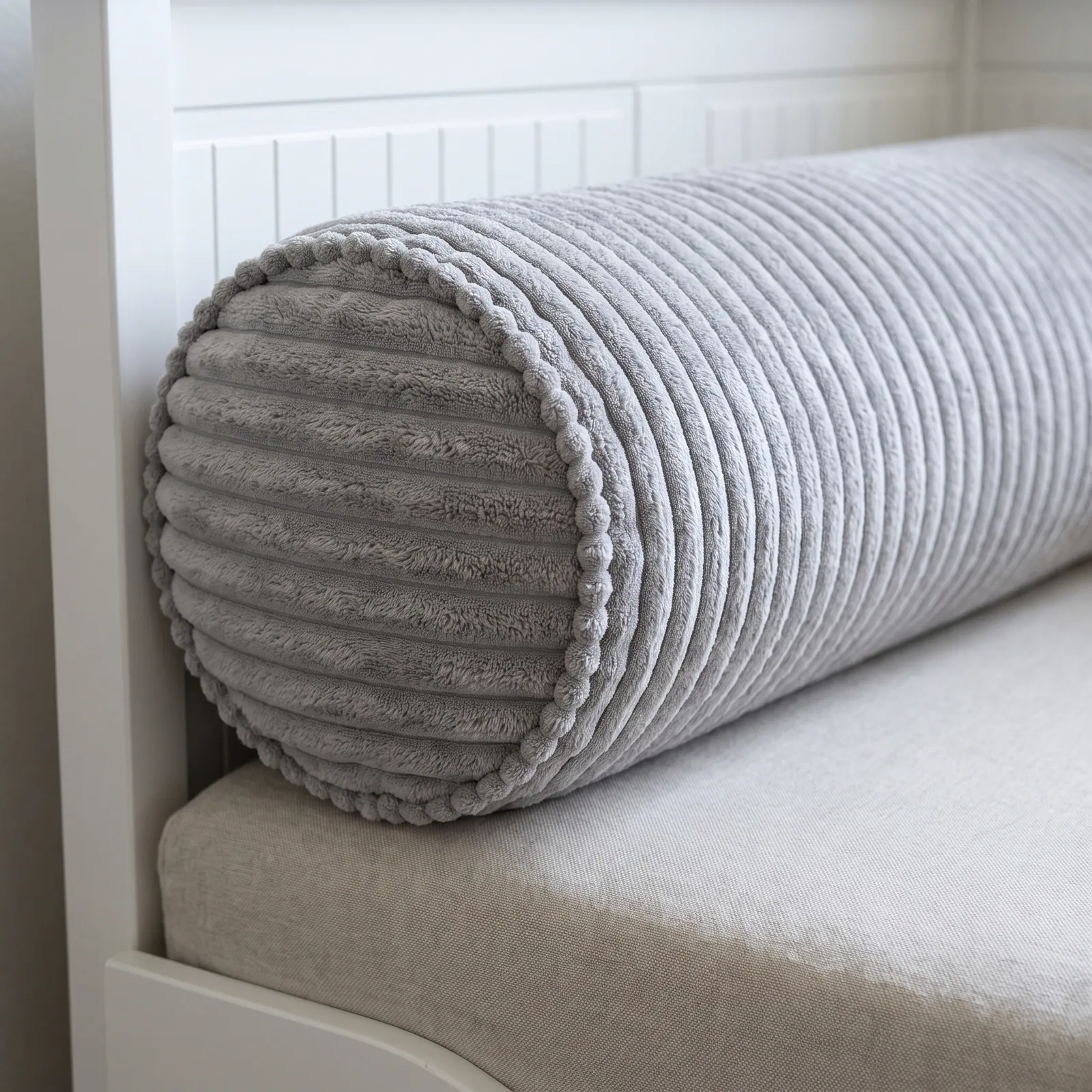
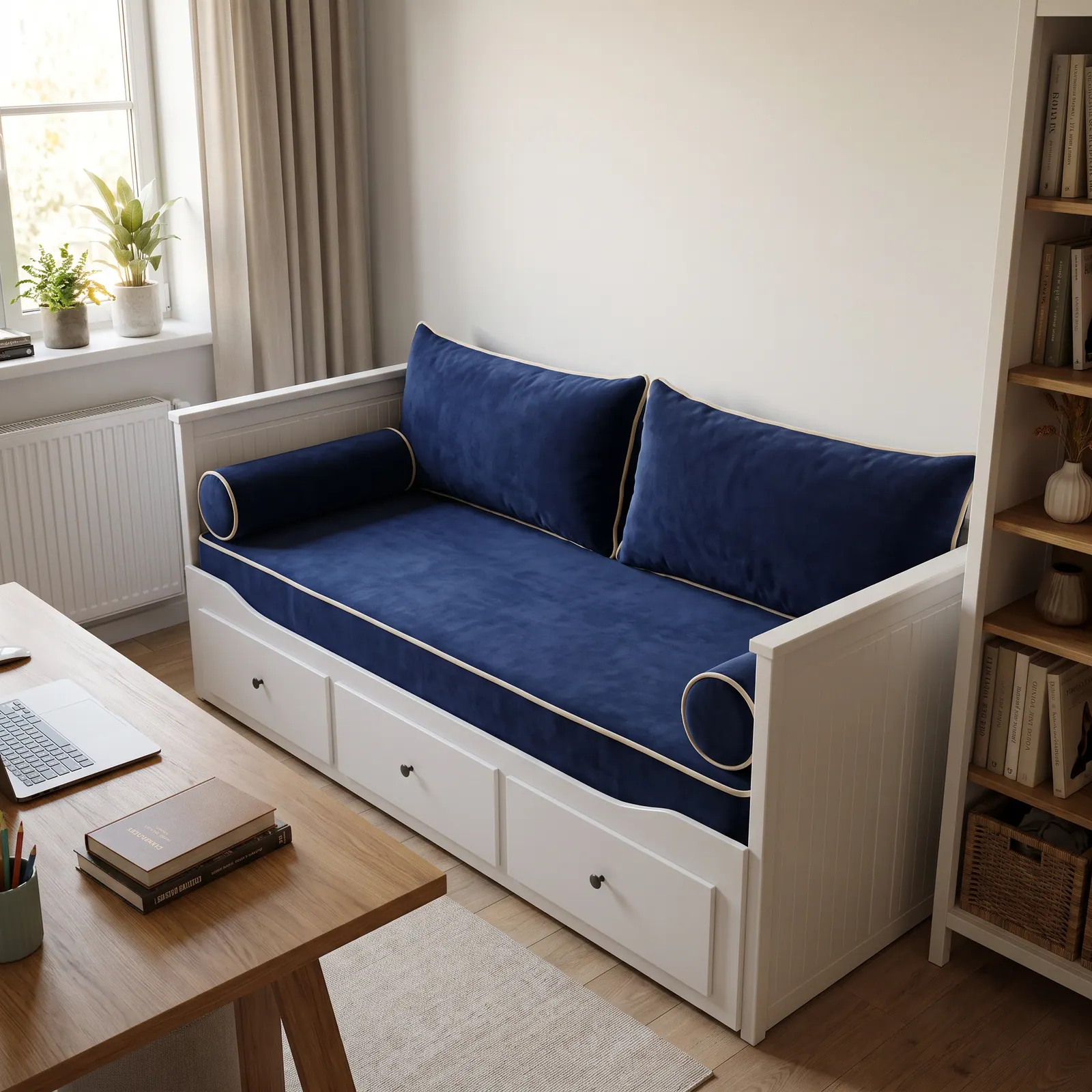
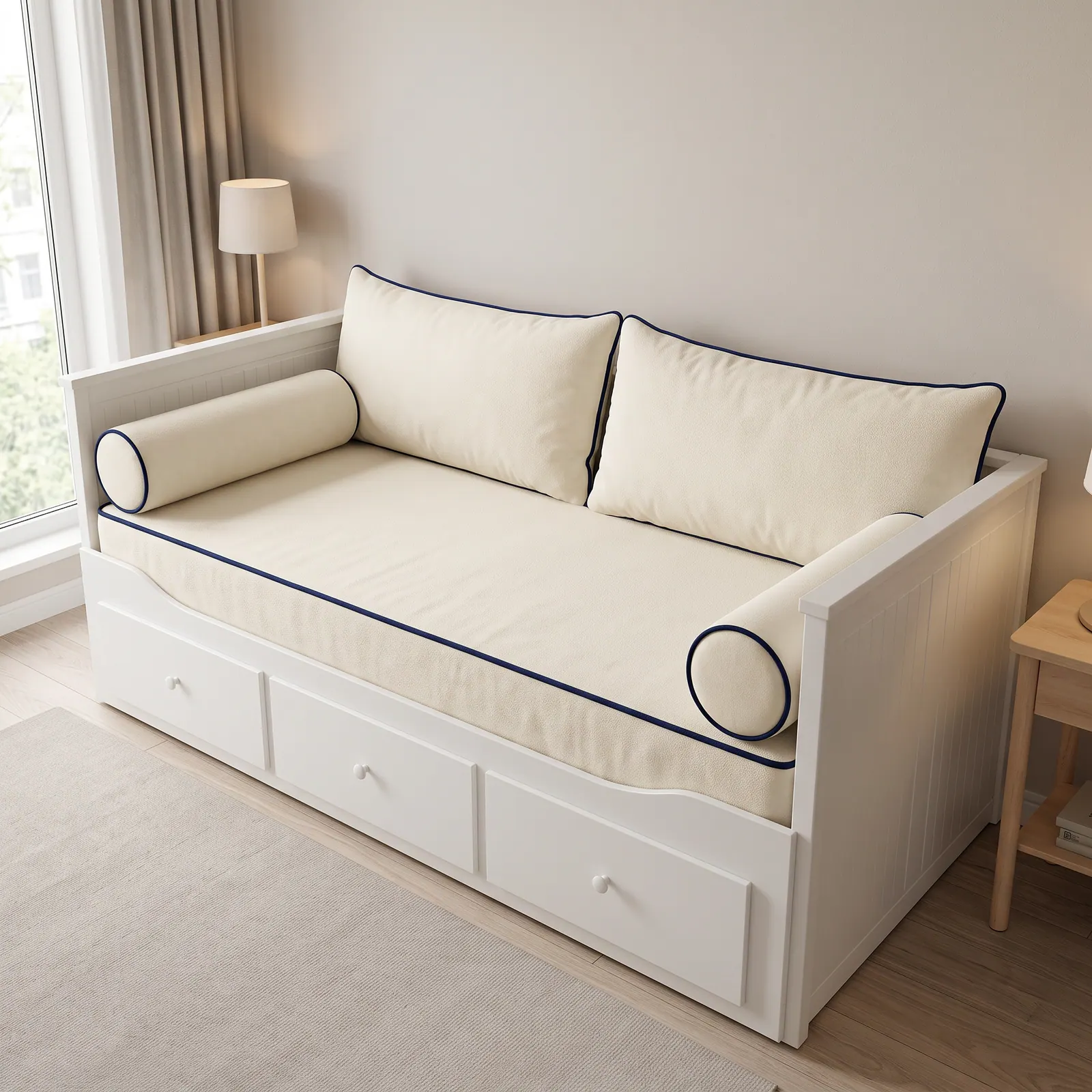
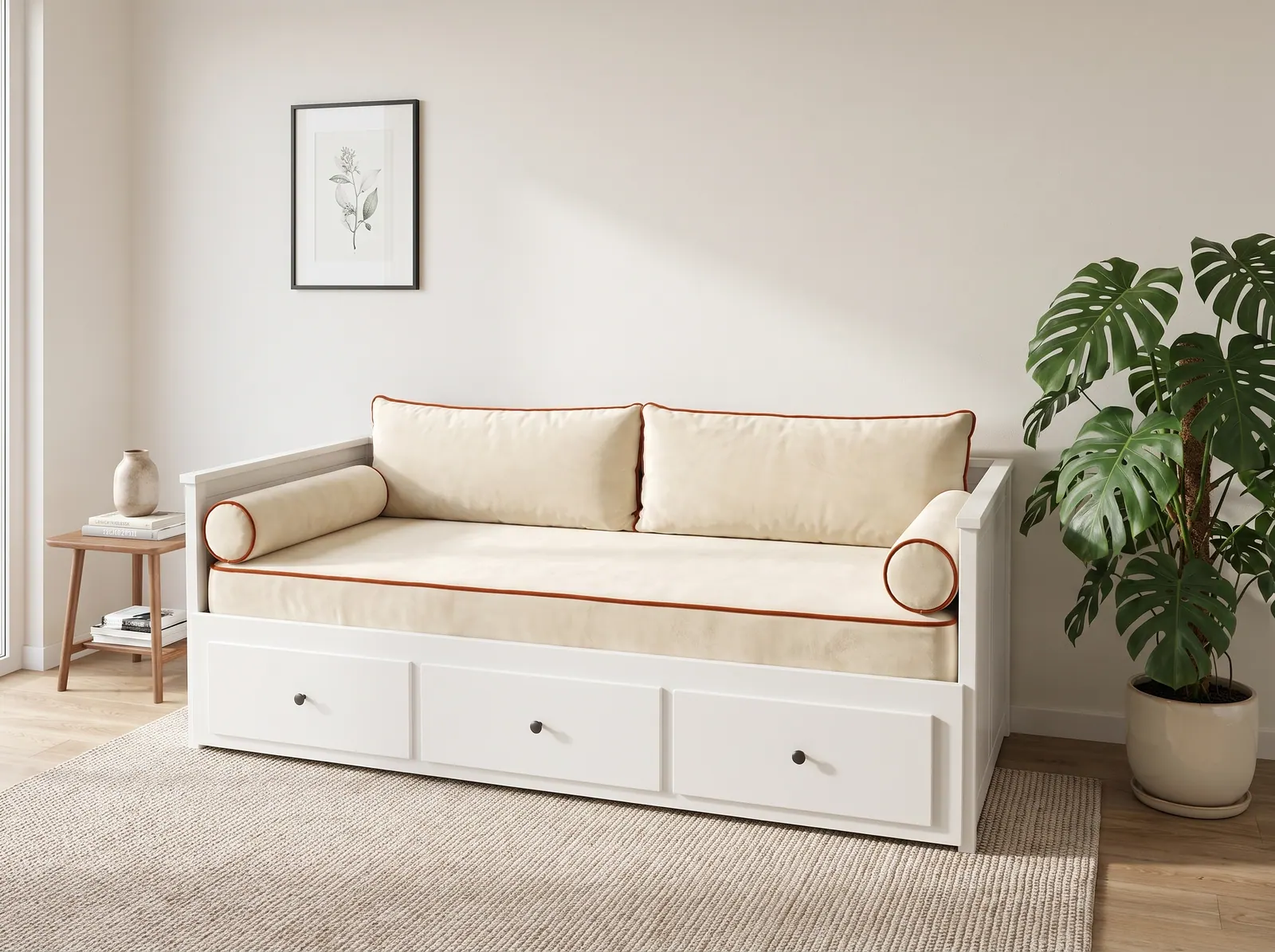
The eye sits down first. A white quilted cover tells the eye bed before anyone sits; a saturated velvet with a contrast welt tells it sofa.
Look again at the sets above: ink navy velvet with cream piping in a study, burgundy with ivory under a gallery wall, cream velvet warmed by a rust or burnt-orange welt. Piping on a daybed set can be a different color from the cover, and that thin line is what turns a mattress edge into an upholstered edge. Velvet and corduroy are the usual choices, and the pillow cover studio lets you try a welt color against the body before you commit.
For guests in hot summers, keep the sleeping surface smooth. If you want linen, know that most linen on the standard charts is a blend; linen and cotton-linen and real linen vs linen-look explain the difference.
What each daybed job asks of the set
Measure with the daybed mattress cover guide or, on an IKEA frame, the Hemnes cover measuring notes and the Hemnes daybed covers hub. For back height, see daybed back cushions for a sofa look.
| The job | Ask for | Real size from past orders |
|---|---|---|
| Sofa you sit upright on | Foam-filled back cushions about 20 in (50 cm) tall, a bolster at each arm | Twin mattress 39 x 75 x 11.5 in (99 x 191 x 29 cm) |
| Guest bed in hot summers | Smooth, breathable soft fabric with self piping | 23 5/8 x 79.5 in (60 x 202 cm) |
| IKEA Hemnes with two mattresses | One cover at the combined height | 31.5 x 79 x 9.5 in (80 x 201 x 24 cm) |
| Metal frame with a raised rim | A cushion thicker than the rim; bolsters as long as the seat is deep | 46 x 21 x 8 in (117 x 53 x 20 cm) inside a 4 in rim |
| Sleepover window seat | One long piece in a strong plain color | 31.5 x 95.7 in (80 x 243 cm), mustard velvet |
| Store-bought daybed with a soft insert | A new cover plus firmer foam | Cream velvet, mushroom-taupe piping |
A daybed cushion set reads as a sofa when the back cushions stand about 20 in tall and a bolster closes each end.
Élodie
Daybed questions
- A common question
What comes in the Hemnes daybed cover set? Is the mattress part of it?
The workshop's answerThe full set is one fitted, zippered mattress cover made to your mattress size, two filled backrest pillows and two filled bolster armrests, ready to use. The mattress and foam are not included, though a mattress can be supplied at extra cost. Piping is included and can be a different color from the cover. Write your mattress size, for example 75 x 39 x 8 in (191 x 99 x 20 cm), and your fabric codes in the personalization note.
- A common question
My daybed isn't a Hemnes. Will the cover set still fit a Brimnes, a regular twin or a thicker mattress?
The workshop's answerYes. The set is designed around the Hemnes, but everything is made to measure, so it fits a Brimnes, a standard twin or any custom size. Send length, width and thickness, such as 39 x 75 x 5 in (99 x 191 x 13 cm); if the thickness is missing, the workshop asks after purchase. Mattresses 8 in (20 cm) or 9.5 in (24 cm) thick are fine.
- A common question
Is the linen on your fabric charts actually 100% linen?
The workshop's answerUsually not. Most standard linen fabrics are blends or linen-look weaves: the linen-look range is polyester, the natural linen chart is 50% linen and 50% polyester, and another range is 50% cotton and 50% linen. They are chosen because they are durable and easy to clean. A separate 100% linen chart and 100% cotton fabrics are available if you ask.
- A common question
Could you make bolsters in the same fabric and piping as my seat cushion?
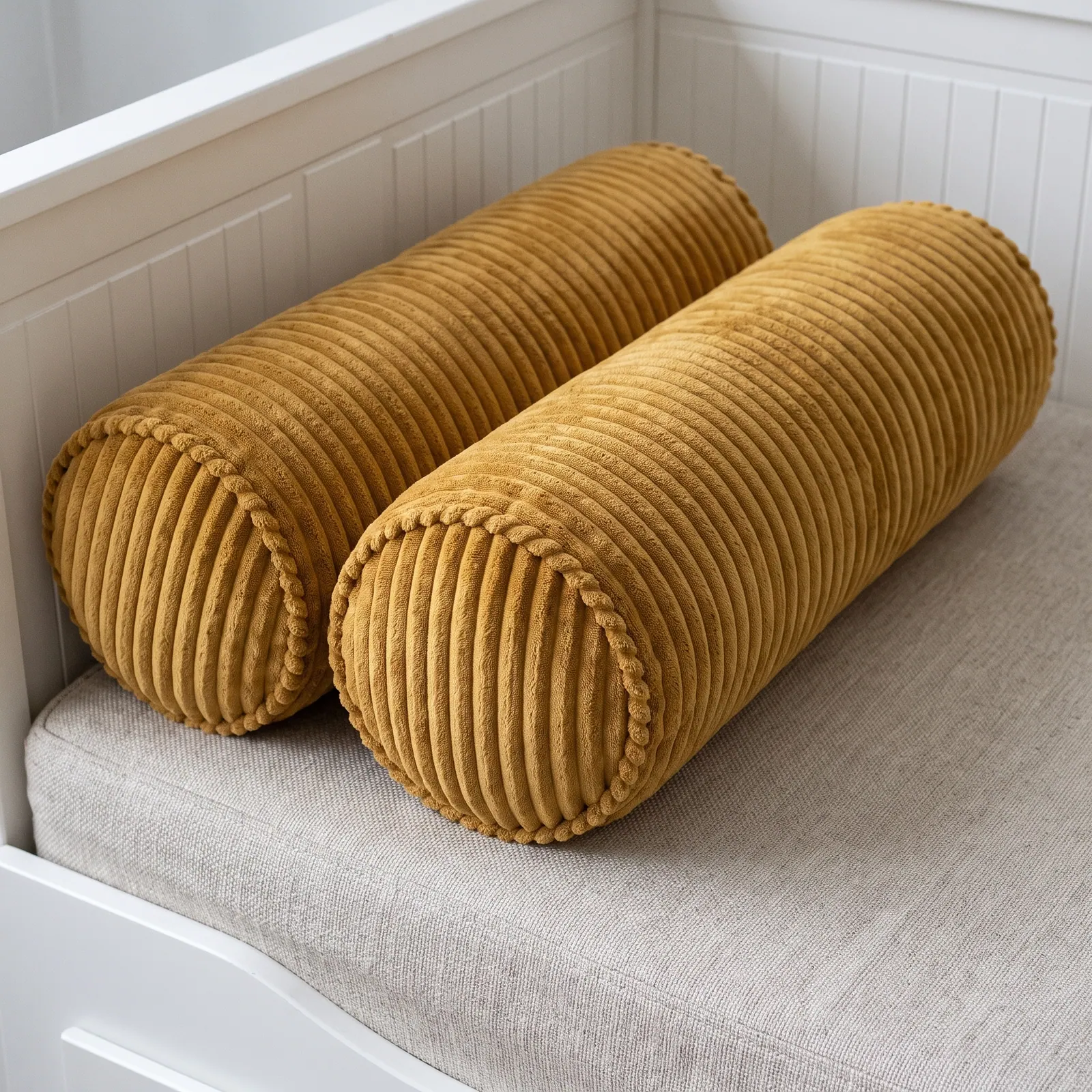
The workshop's answerYes, and a seat with two bolsters is one of the most common custom sets. Bolsters are specified by diameter x length and made in any size; past examples include 6 in (15 cm) diameter x 17.7 in (45 cm) long, and 8 in (20 cm) diameter x 26 in (66 cm) long in corduroy. Send the cushion size, each bolster's diameter x length, the quantity and your fabric for a quote.

Have it made
Have an idea like this made — ask Élodie’s workshop
A fabric reads one way at noon and another at dusk. Mention your light, and the workshop will weigh it with you. — Élodie
Leave your details and the workshop will call you to confirm measurements, fabric, foam and piping. No prices, dates or payment on this page: it is a request, not an order.
Questions buyers ask next
How tall should back cushions be to make a daybed look like a sofa?
Daybed sets use back cushions about 20 in (50 cm) tall, measured from the top of the seat cushion. Standard bench backs are about 16 in (40 cm) tall and 4 in (10 cm) thick, and the workshop doesn't go lower than that, because a shorter back stops supporting you.
Should a twin daybed cushion be one piece or two squares?
One piece, if a seam down the middle would bother you. A buyer in the US with a 75 x 38 in (191 x 97 cm) twin daybed used as a couch was first offered two 38 in squares, then chose one piece 12 in (30 cm) thick. Silicone fiber-ball fill keeps its loft longer than cotton.
How do I stop a daybed cushion sliding on a smooth wooden deck?
Order a non-slip bottom. On a 91.5 x 31 in (232 x 79 cm) daybed cushion over a smooth top, the workshop added one and confirmed the cover stayed machine washable. Confirm add-ons in writing after you order; stopping the slide covers ties and rugs too.
Can a daybed cushion set go outside on a patio daybed?
Yes, in outdoor fabric. A buyer in the US priced a 52 x 28 x 4 in (132 x 71 x 10 cm) patio daybed set with a back cushion and two cylinder side pillows. The water-repellent version costs slightly more, and its color range differs from velvet, which is indoor-only.