 Save
A Reading by ÉlodieBench Cushions
A Forest-Green Striped Bench Cushion and the Props Around It
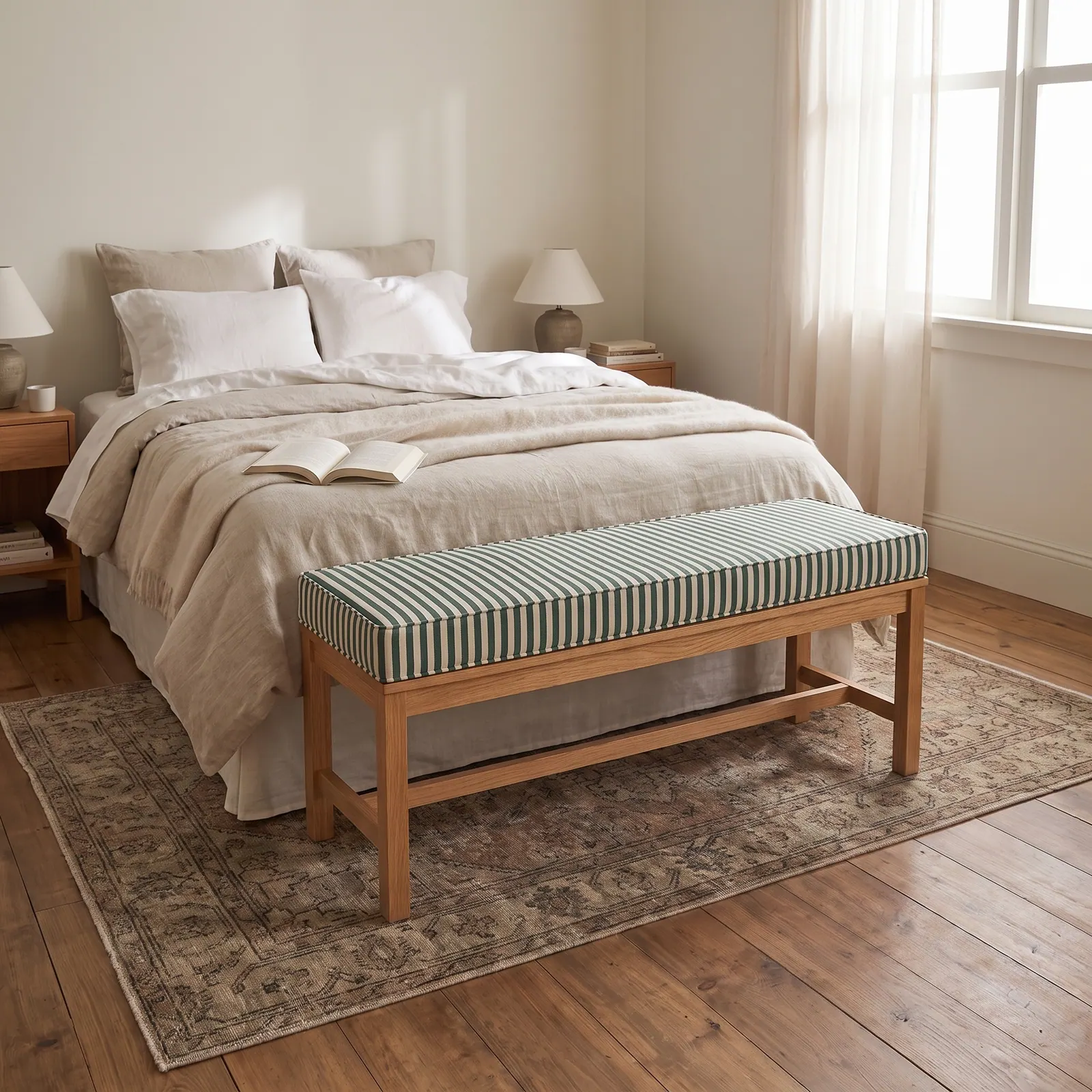
Flax linen, honey oak, two stoneware lamps and a faded rug: every object around this end-of-bed bench is there so one green stripe can speak.

Swatch strip measured from the photograph
- chestnut#60463325%
- taupe#8c715c22%
- sand#b1a29322%
- oatmeal#c6bdb320%
- linen#e8e4e010%
The quick answer
A striped bench cushion at the foot of the bed should run its stripes across the width, so they show on both the top and the front, and be cut to the bench top with no overhang so the oak frame outlines it. Take the stripe color from something already in the room; here the forest green comes from a faded vintage rug.
Swatch strip: a bedroom built around one green
- Forest green#2F4A36The stripe, borrowed from the sage in the rug and taken deeper.
- Cream ground#EFE7D4The stripe's ground, in the same family as the white pillows.
- Flax#CDBB9CThe rumpled duvet, a quiet backdrop behind the bench.
- Honey oak#B98A55Bench, bedside tables and floorboards: one warm wood throughout.
- Faded rose#C99A93From the vintage rug, the only pink, kept low on the floor.
- Stoneware#D9D2C5Lamp bases under linen shades, soft in the late glow.
Why each prop is there, and how to copy it
In this bedroom the eye lands on the bench before the bed. A forest-green and cream stripe from our striped cotton and ticking family, laid on a plain oak bench at the foot of a linen-dressed bed, in a warm late-afternoon glow.
At the foot of a bed, a bench cushion is seen from above as often as from the side. So the stripe runs across the width, and you read it twice: on the top as you walk in, on the front as you sit on the edge of the bed. The cushion is cut to the bench top with no overhang, and the honey oak frame with its stretchers outlines it like a picture mount. Self piping keeps the edge inside the stripe.
Now the props, one by one, my friends. The rumpled flax duvet and white pillows are the backdrop, deliberately quiet, so the stripe is the only pattern above the floor. The open book on the bed says this bench is for sitting and reading, not only for laying out clothes. Two stoneware lamps with linen shades stand on matching oak bedside tables, one on each side, and that symmetry frames the stripe in the middle. Sheer white curtains soften the light to honey.
Then the rug, the source of it all. Its faded green-and-rose pattern is where the forest green came from, taken a few shades deeper. The stripe is broader than anything in the rug, so the two sit at different scales and never compete. Let one color speak and the others listen.
To copy it: choose the stripe color from your rug or quilt, keep everything else in flax, white and one wood, and order the cushion to the exact bench top. Which color in your rug is quietly asking to become a stripe? The bedroom cushion pages have more benches to compare.
Five pins at the foot of the bed
Five pins, from the stripe's direction to the faded rug, tracing where every color in the room came from.
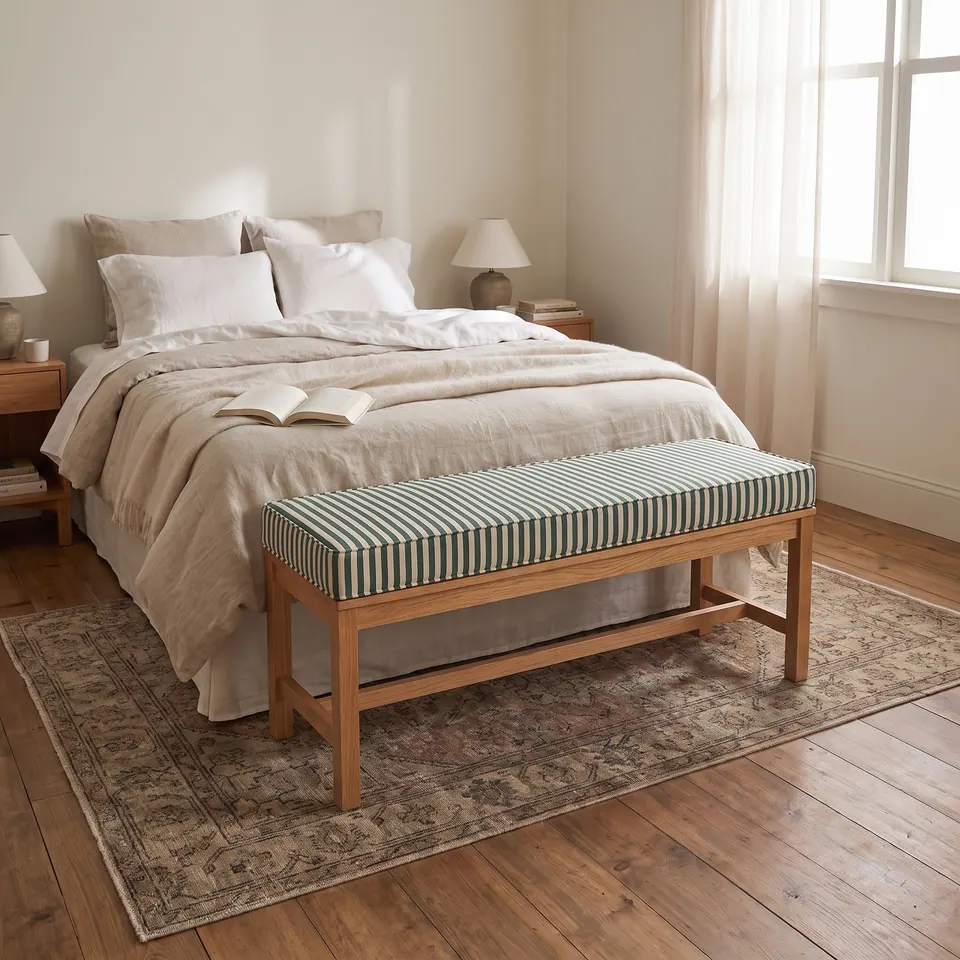
- Forest-green stripe
Stripes run across the bench so they show on both the top and the front.
- Oak bench frame
No overhang lets the oak frame outline the cushion like a picture mount.
- Open book on linen
The rumpled linen and open book make this a bench for sitting and reading, not just dressing.
- Linen-shade lamp
Matching lamps either side keep the bedroom symmetrical around the striped accent.
- Vintage rug
Faded sage tones in the rug are the source of the green stripe.
- Forest-green stripeStripes run across the bench so they show on both the top and the front.
- Oak bench frameNo overhang lets the oak frame outline the cushion like a picture mount.
- Open book on linenThe rumpled linen and open book make this a bench for sitting and reading, not just dressing.
- Linen-shade lampMatching lamps either side keep the bedroom symmetrical around the striped accent.
- Vintage rugFaded sage tones in the rug are the source of the green stripe.
On an end-of-bed bench, run the stripe across the width; it then shows on the top as you walk in and on the front as you sit on the bed.
Élodie
A trapezoid sketch where the numbers argued
A buyer sent the workshop a sketch of a trapezoid seat measured in centimeters: a 65 3/8 in (166 cm) top, a 70 1/4 in (178.5 cm) bottom, slanted sides of 16 1/8 in (41 cm) and a straight height of 17 3/4 in (45 cm). The workshop saw at once that the numbers could not all be right, because a slanted side is always longer than the straight height between the parallel edges.
So it asked which figure was certain. If the slants were 16¼ in (41 cm), the height would be about 16 in (40.5 cm). If the height was 17¾ in (45 cm), the slants would be about 17 7/8 in (45.5 cm). The buyer measured again, confirmed 17¾ in (45 cm) deep with 18 in (45.5 cm) slants, and the order went into production.
I keep this story close because it is the same discipline as color. Measure a slant along the edge itself, the way you judge a green in daylight and not on a screen. The trapezoid measurements Pattern shows where to put the tape.
Buyer questions: what the stripes are made of, and sizes off the menu
- A common question
What are your striped fabrics made of, and do you have other stripes?
The workshop's answerThe striped fabrics are 100% cotton, a fully natural cloth. The stripes in the listing are the only striped options, so there is no linen-feel red stripe, but an extra linen chart with creams and beige-whites is available on request.
- A common question
My bench has a small corner section that doesn't lift. Do I need a third cushion?
The workshop's answerThe workshop can make all three sections, the small one included. Confirm whether you measured in centimeters or inches, and send the length, depth and thickness of each section, ideally with a photo or a simple drawing.
- A common question
I need a bench cushion 11 3/4 x 47 1/4 in (30 x 120 cm), and that size isn't in the listing. Can you make it?
The workshop's answerYes. The workshop added that size as an option to the listing, so the buyer could pick it and order directly.
On the cutting table: the end-of-bed bench
| Piece | End-of-bed bench cushion |
|---|---|
| Fabric | Forest green and cream stripe, 100% cotton (N20) |
| Stripe direction | Across the width, showing on top and front |
| Piping | Self piping |
| Edge | Box edge, no overhang |
| Bench | Oak with stretchers, frame left visible |
| Palette around it | Flax, white, honey oak and one faded rug |
| Best for | Bedroom benches seen from above and from the bed |

Have it made
Have this made — ask Élodie’s workshop
Describe the room at four in the afternoon: the floor, the wall, the one color you love. That is where a good fabric choice begins. — Élodie
Leave your details and the workshop will call you to confirm measurements, fabric, foam and piping. No prices, dates or payment on this page: it is a request, not an order.
Questions buyers ask next
What color stripe goes with a vintage rug?
Pull one quiet color out of the rug and deepen it, the way this forest green deepens the rug's faded sage. Then choose a stripe broader than the rug's pattern, so the two sit at different scales and don't compete.
Should an end-of-bed bench cushion overhang the frame?
Not on a handsome wood bench. Cut the cushion to the exact bench top so the frame outlines it like a mount. An overhang hides the wood and makes the bench look heavier from the doorway.
How do I style a bench at the foot of the bed without clutter?
Keep the palette narrow: one patterned cushion, then linen, white and one wood. A book or a folded throw is enough, and matching lamps on either side of the bed frame the bench without adding anything to it.
With color and care — Élodie