The Pattern Room · a measuring pattern
Soft headboard cushions that hang from a rail, not a board
Some of the loveliest headboards I have seen were never furniture. They were a cushion, a rail and two good knots, chosen for the color of the wall behind them.

 Save
The quick answer
A headboard cushion without a board is a soft backrest hung at the bed head: a removable piped cover over about 4 in (10 cm) of shredded foam, or a firmer solid foam core wrapped in fiber. It hangs by ties at the top corners from hooks or a rail, by fabric loops on a rod, or by hook-and-loop fixed to the wall.
A pillow with good posture
Most headboards are furniture, built on a board and screwed to a wall. Mine are softer: a headboard cushion that hangs at the bed head like a well-made back pillow and comes down for the wash.
The honest part first. The workshop's backrests have no rigid board inside, so there is nothing for a screw or a French cleat to bite, and fixed plywood panels are not what it makes. The board version in DIY tutorials is carpentry, a panel wrapped in batting and hung from straps screwed into the studs; for that, call a local upholsterer. The wall-mounted backrest answer says so in a few lines.
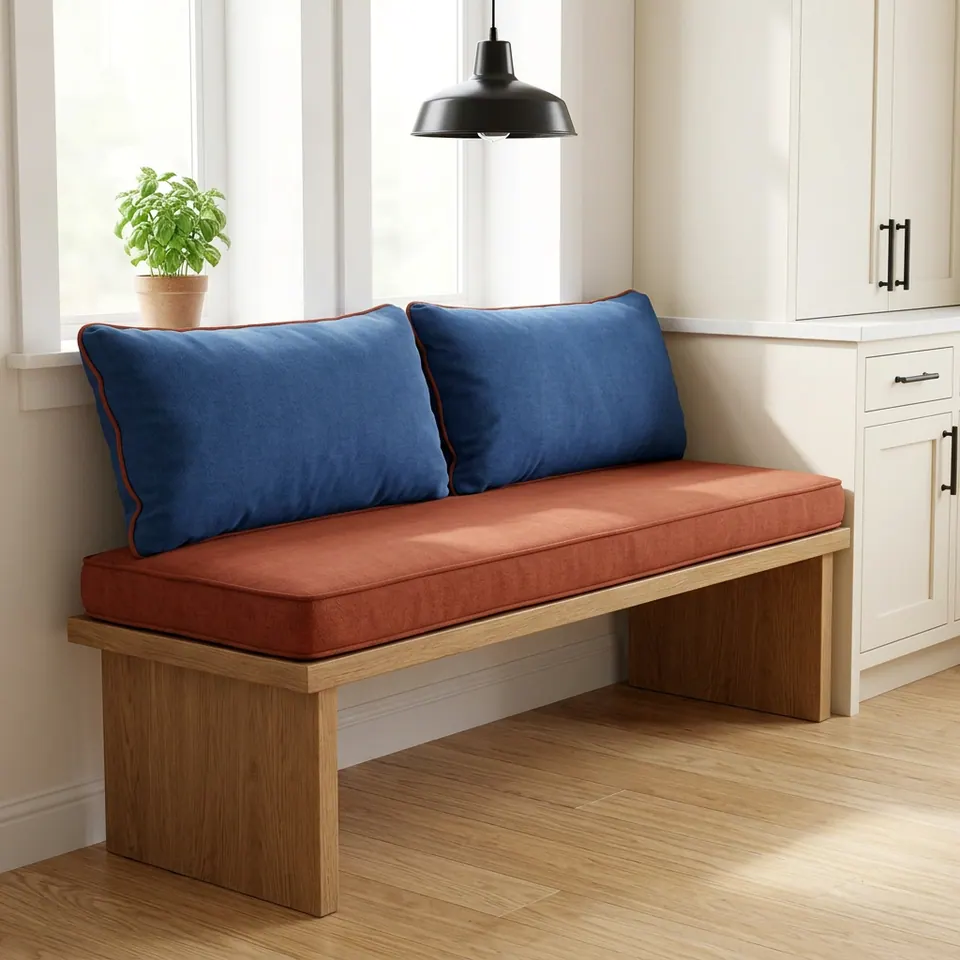
What you get instead is built like the backrest cushions on a banquette, sized to your bed and hung from a rail, hooks or a rod. A foam-filled back without wood always reads softer than an upholstered board. In a bedroom, that softness is the point.
The photo above is a cousin, not a twin: a charcoal reading wedge standing in front of the pillows on a bed with no headboard.
Four ways to hang it, and the one that isn't made
| Method | Sewn on at the workshop | Fixed by you | Best for |
|---|---|---|---|
| Ties to hooks | Ties on the two top corners | Two wall hooks, spaced to the cushion's width | Yes One cushion over a twin or full bed |
| Ties to a rail | Ties on the top corners | A rail or rod across the bed head | Yes Wide beds, or two cushions side by side |
| Loops on a rod | Two fabric loops per cushion, in the cushion fabric or a matching neutral | A rod through the loops | Yes A tailored, curtain-like line; quoted as a custom set |
| Hook-and-loop | One strip sewn to the back of the cushion | The matching strip, on the wall with strong adhesive or screws | Yes A flat look that presses on and peels off for washing |
| Board and French cleat | Not made | Nothing to fix: there is no board inside | No A rigid panel is upholstery and carpentry work |
Whichever you choose, the cushion leans on the wall; a standard backrest isn't freestanding.
What goes inside, and how it feels against your back
| Filling | Thickness | Feel | Cover |
|---|---|---|---|
| Shredded foam, the standard back fill | About 4 to 6 in (10 to 15 cm), set by the fill; you give width and height only | Soft and pillowy, yet holds its shape against a rail | Yes Zips off; the fill has its own inner cover |
| Solid foam core wrapped in fiber | Chosen with the order | Firmer and flatter, a panel look | Yes Zips off |
| Silicone fiber insert | Chosen with the order | Very soft; on a 60 in (152 cm) wide, 2 in (5 cm) deep insert, fiber is very soft and foam is firm | Yes Zips off |
| Tufted, packed with silicone-ball fiber | 4 to 5 in (10 to 13 cm) for a dorm headboard | Soft to the touch, dense to lean on | No Sewn closed around the buttons; clean by hand with a cloth |
The workshop confirms the backrest filling with you before production.
Sizing and ordering a hung headboard cushion
Measure the mattress, not the old headboard
Measure the mattress width at the head. A cushion as wide as the mattress, or a little wider, reads as a headboard; much narrower and it looks like a pillow that wandered off. A queen insert at 60 in (152 cm) is the classic case. For a wide bed, consider two cushions on one rail: several back cushions sit better than one long one, and one long one costs no less.
Set the height against your pillows
Stack your sleeping pillows the way you use them and measure from the top of the mattress to where you want the cushion's top edge. Let it clear the pillows, so its color shows above them. For reference, one dorm headboard was 24 in (61 cm) high, and one pair of buyers asked for 20 in (51 cm).
Choose the fill for how you sit
Reading upright every night wants the firmer foam core wrapped in fiber. Leaning back with a book on a slow Sunday is what shredded foam was made for. Filled back pillows have no fixed thickness, so give width and height and let the fill decide the depth.
Plan the bottom edge
Hang the cushion so its lower edge rests on the mattress top. Then the wall takes the lean and the ties or loops only hold the line; a soft cushion left dangling from two corners will sag in the middle.
Write the hanging method in the order
Name it in the personalization box: ties on the top corners and their length, loops and how many, or hook-and-loop on the back. Extras are never added unless you ask, and a request typed into the size box gets missed. Then look for them in the pre-shipment photo.
Order swatches before you choose the color
Hold the swatches against the wall paint and the bedding, by a window at noon and again under the bedside lamp. Fabric swatches before ordering shows how to read them.
Have it made
Measured it? Have Élodie’s workshop make it
Describe the room at four in the afternoon: the floor, the wall, the one color you love. That is where a good fabric choice begins. — Élodie
Leave your details and the workshop will call you to confirm measurements, fabric, foam and piping. No prices, dates or payment on this page: it is a request, not an order.
Color at the bed head: one step deeper, or a quiet match
The eye sits down first, and at the bed head it sits down on color long before it touches cloth.
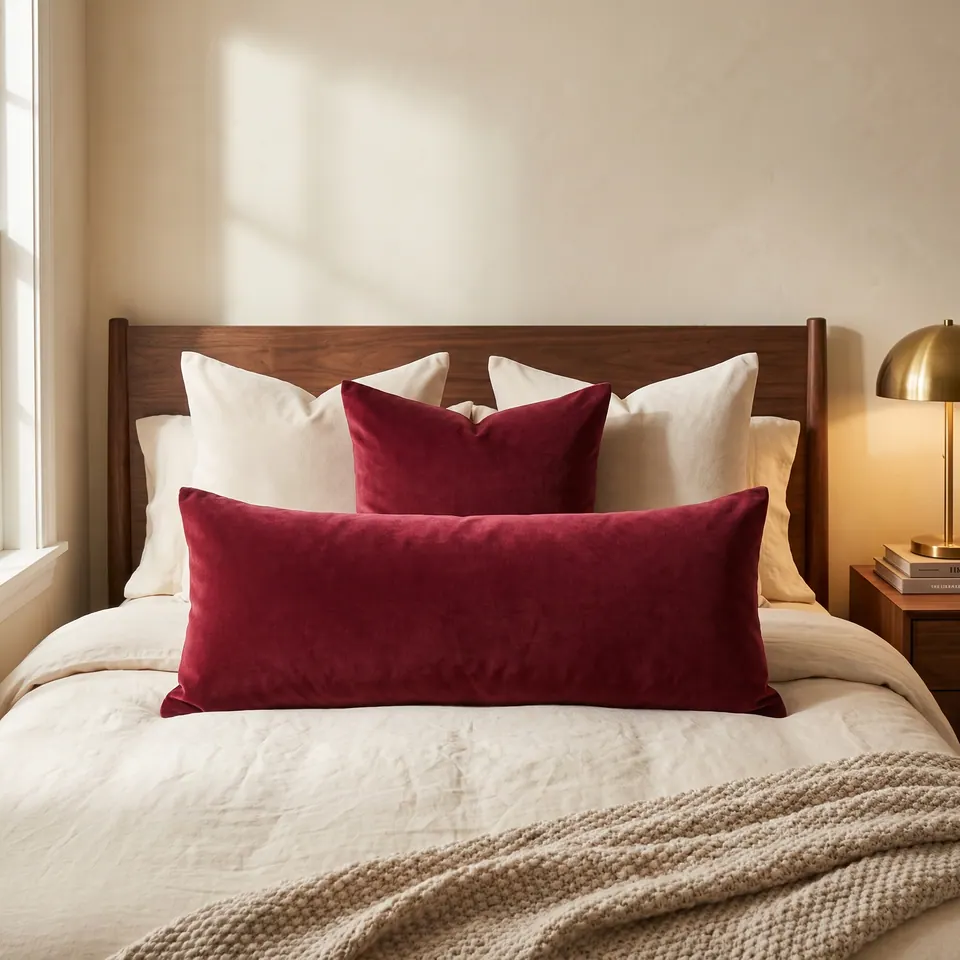
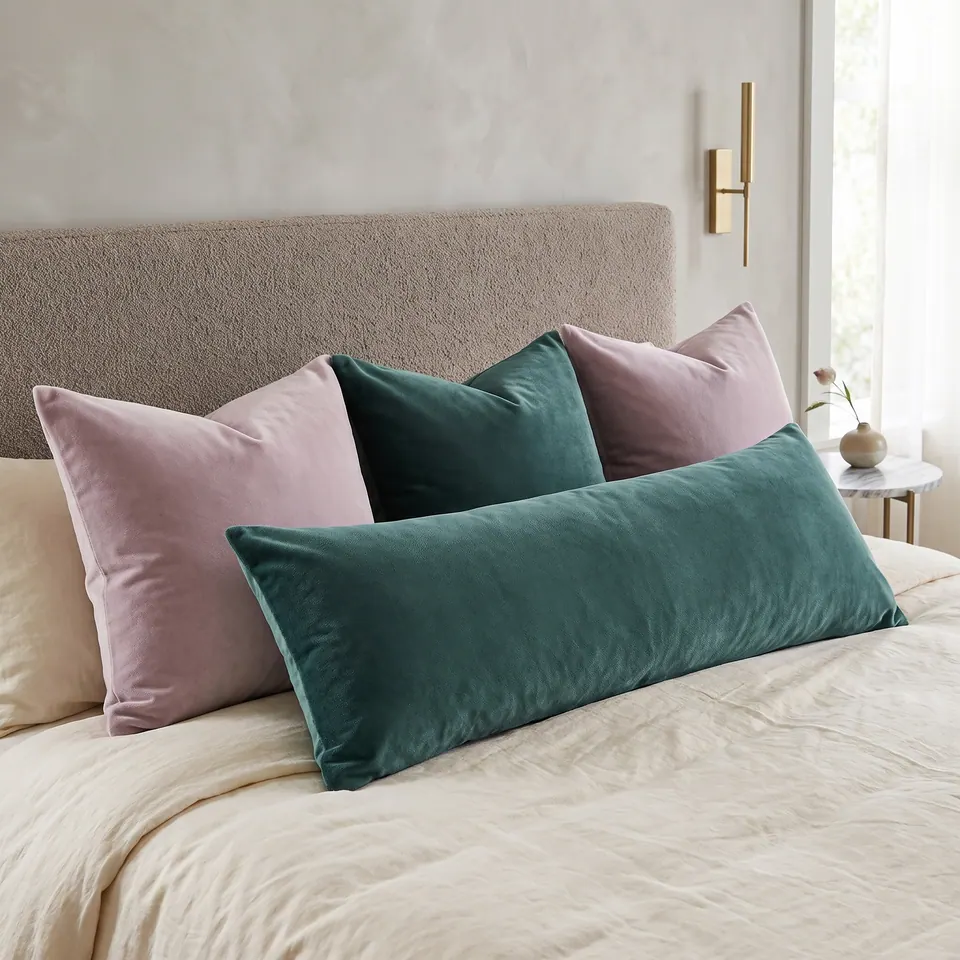
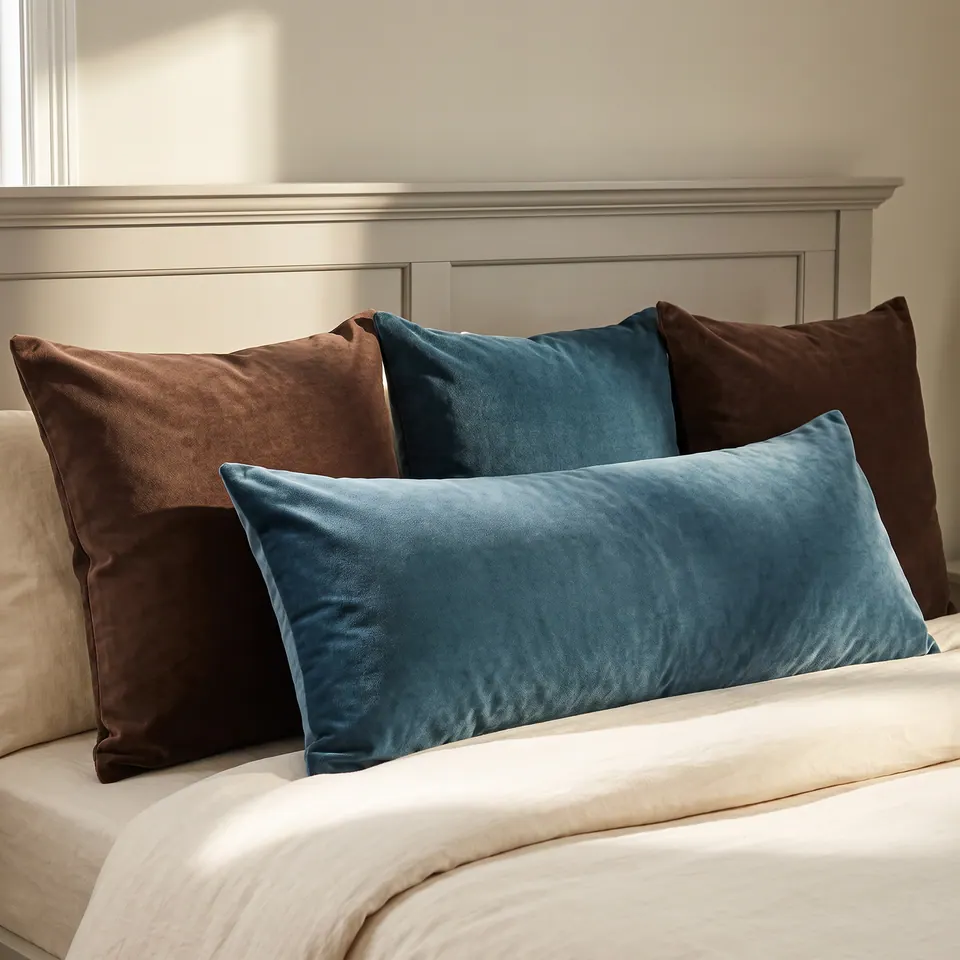
Look at the bolster photos on this page, my friends. None is a hung headboard cushion; they are bolsters in front of upholstered or oak headboards, and they teach the lesson well. The cocoa velvet sits one step deeper than a mauve headboard, so the bed looks softly layered while a sage wall does the contrasting. The teal velvet gives a pale oak-and-linen bed its one strong line.
A hung cushion follows the same rules, larger. Against a dark wall, like the bottle green behind the charcoal wedge, a tone close to the wall keeps the silhouette quiet and lets rust bedding and brass carry the warmth. Against a pale wall, one color deeper than the duvet frames the bed without shouting.
Velvet or linen? Velvet catches lamplight, but its pile has a direction: a panel can read a shade darker than a matching bolster if the pile runs the other way, so ask for every piece cut the same way and brush them all alike. The standard linen range is a matte linen-look polyester that melts under a hot iron; natural linen is available and costs more. More bedroom pieces live in bedroom cushions.
A soft headboard for a dorm room, shipped before move-in
A parent in the US wrote to the workshop wanting a tufted cushion 30 in (76 cm) long and 24 in (61 cm) high to act as a soft headboard on a college dorm bed, in a smoke or cream linen. No listing option matched, so the shop confirmed a thickness of 4 to 5 in (10 to 13 cm) and sent a custom order link.
The real worry was move-in day. The shop confirmed the dorm address, shipped the next day, and gave 3 to 5 business days for delivery. A tufted cushion stood on end needs no hooks and no rail, just the wall and the mattress holding it upright.
Know one thing before you copy it: a tufted cushion is buttoned through and stitched closed, so its cover doesn't come off. In a dorm, I would choose the smoke.
Another pair of buyers wanted the idea larger, a tufted linen floor cushion about 53 x 20 in (134 x 51 cm) and at least 6 in (15 cm) deep, and asked how firm it would be. Tufted cushions are packed with silicone-ball fiber, soft to the touch but dense, about 6 to 7 on a 1 to 10 scale: a firm pillow, not a board.
- What it taught
- A tufted floor cushion stood on end makes an easy soft headboard; ship it straight to the dorm with the room number on the address.
When the bed is really a daybed
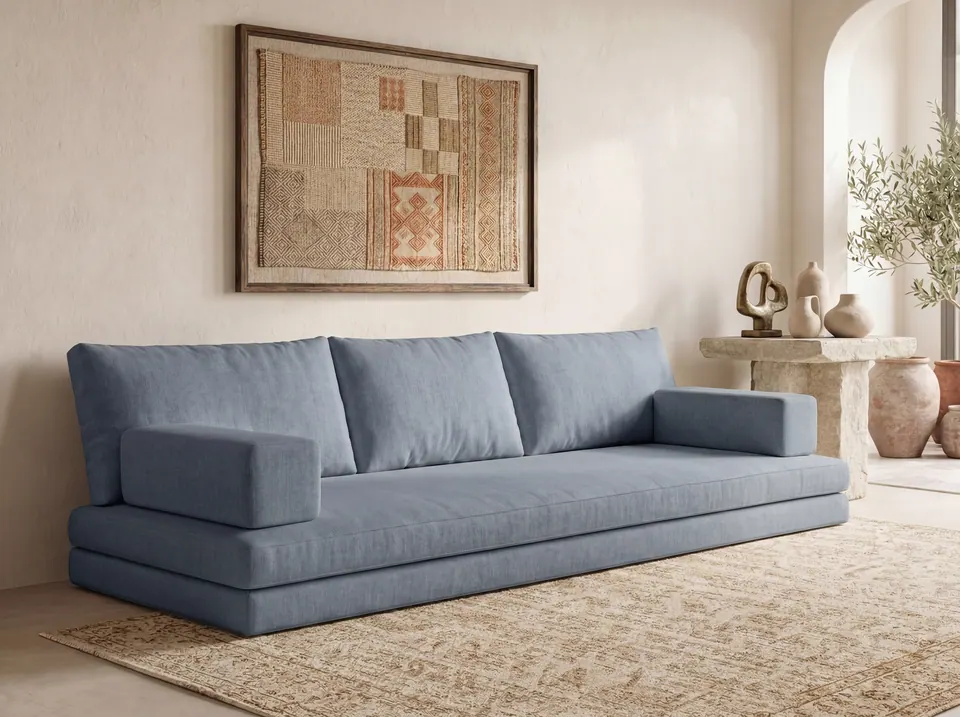
A twin bed against a wall becomes a sofa the moment its back cushion is firm enough to sit up against. A buyer in the US skipped the full daybed set and asked for exactly that: one long back cushion, one armrest bolster, and a fitted cover for a 39 x 75 x 11 1/2 in (99 x 190 x 29 cm) twin mattress in green corduroy. The shop suggested a foam-filled back and armrest for structure, rather than loose fiber.
Another buyer, with a 91 1/2 x 31 in (232 x 79 cm) daybed, wanted a matching upholstered wall board like one in a photo. The shop explained that the pictured style has wood inside and offered a foam-filled backrest instead, which the buyer planned to hang with hook-and-loop. That exchange is this whole page in two lines.
The daybed back cushions Pattern sets out sizes for the sofa look, and attaching a back cushion to the wall covers the fixings. What color is the wall behind your bed?
A headboard cushion without wood will always look softer than an upholstered board, and in a bedroom that softness is the point.
Élodie
Buyer questions: backs, rails and fillings
- A common question
Can you make a headboard-style backrest with a board inside, or one that hangs on a French cleat?
The workshop's answerNot normally. The cushions have no rigid board, so they can't be screwed to a wall or hung on a French cleat, and fixed wall panels aren't the standard make. The backrest is made like the back pillows: a removable piped cover with shredded foam about 4 in (10 cm) thick, or a solid foam core wrapped in fiber for a firmer, flatter panel. It hangs by top-corner ties from hooks or a rail, by rod loops, or fixes with hook-and-loop or adhesive.
- A common question
What's the best way to fix a back cushion to the wall?
The workshop's answerUsually hook-and-loop: the shop sews one side onto the back of the cushion, and you fix the matching side to the wall with strong adhesive, or screws for a firmer hold, so it presses on and peels off for cleaning. Or the cushion hangs from a rod on two sewn-on fabric loops; send the sizes, a rough loop size and how many, since it's quoted as a custom set.
- A common question
Is the back cushion filled with the same foam as the seat?
The workshop's answerNo. Seats are firm solid foam at 32 kg/m³, about 2.0 lb/ft³. Back pillows are usually shredded foam made on the shop's own machine, or fiber: softer to lean on, yet they hold their shape against a rail. With no fixed thickness they come out about 4 to 6 in (10 to 15 cm), so you give width and height only. The zippered cover washes at 86°F (30°C) on a gentle cycle.
- A common question
Will a back cushion stand up by itself, or does it need a wall behind it?
The workshop's answerIt needs support. Standard backrests lean on a wall, the back of a cabinet or something solid, and are sized to your wall. For floor cushion sets with no wall behind them, free metal frames can be included so the backrest stands alone, and a wooden back-frame version can be made on request.
- A common question
Should my back cushion be foam or soft like a pillow?
The workshop's answerEither, and the shop can send photos of both. Foam backs hold their shape better and stay put when made wedge-shaped. Pillow-style backs are softer and the cheaper option, yet can be made firm enough to lean on, zippered and machine washable. A firm seat pairs well with a softer back, and either way the back leans on a wall.
Headboard cushion questions, briefly
Can a tufted headboard cushion have a zip-off cover?
Not while it stays tufted. Tufted cushions are filled, buttoned through the filling and hand-stitched closed, so there is no zipper. The same size can be made as a plain foam-filled cushion with a zippered, removable cover, without the buttons or the French edge.
Is one wide headboard cushion better than two narrower ones?
Usually two. Several back cushions sit better and stay in place than one long one, and a single long backrest costs no less than the pieces. Long spans, such as 79 in (2 m), have been split into two 39 in (100 cm) pieces.
Does the workshop build upholstered headboards on a wooden frame?
No. It makes foam cushions and covers, not rigid plywood-backed panels, support frames or bed frames. A lift-out headboard for a wall bed was offered as separate foam cushions made to measure; the carpentry belongs to a local upholsterer or carpenter.
How thick should a headboard cushion be?
A shredded-foam back settles at about 4 to 6 in (10 to 15 cm) on its own, so you give only width and height. Tufted headboards have been made 4 to 5 in (10 to 13 cm) thick. For a slim wall panel, back cushions have been made just 1 to 2 in (2.5 to 5 cm) thick.