A Reading by ÉlodieLumbar Pillows
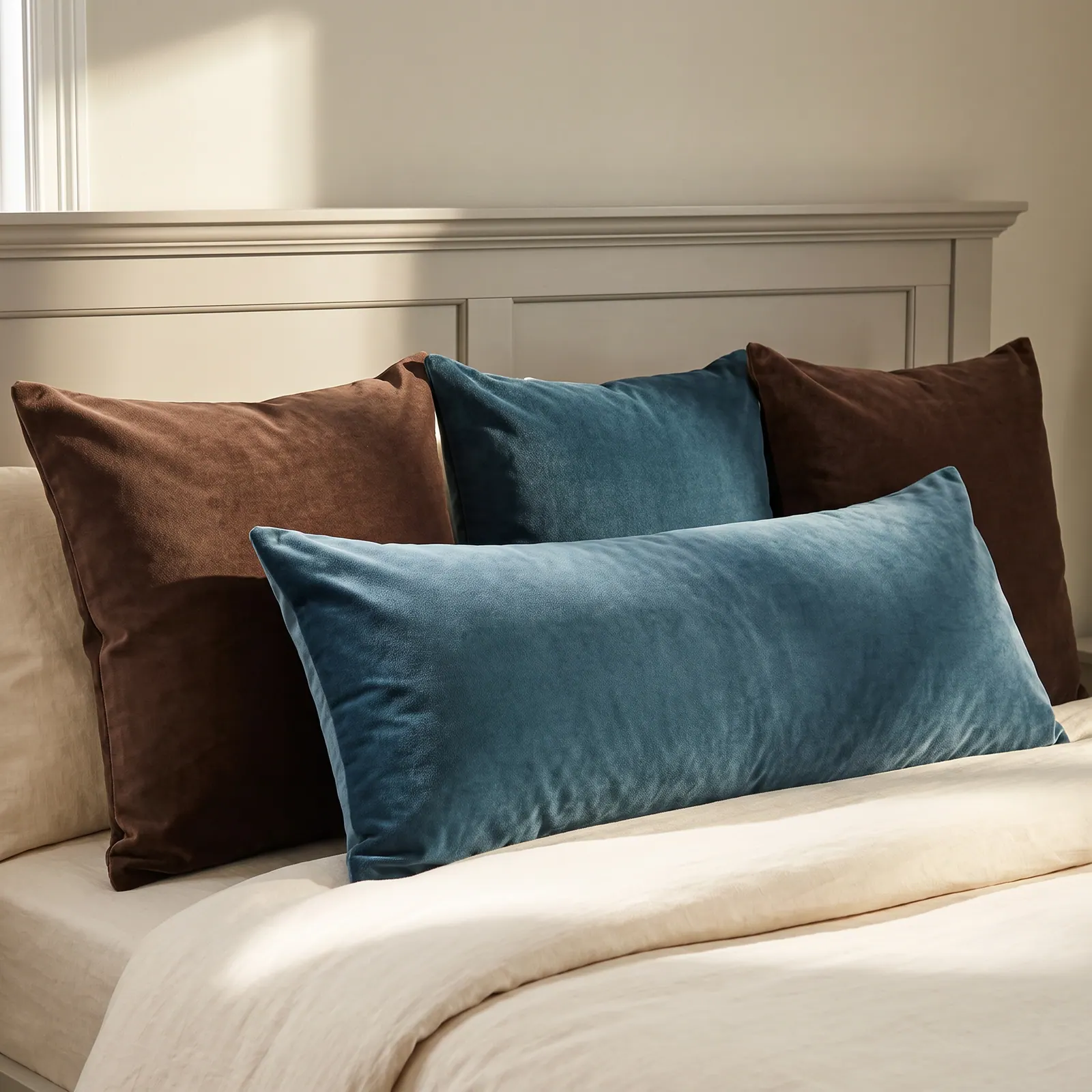
A knife-edge steel teal velvet lumbar pillow between chocolate brown shams
No piping, no side panel, just two faces of velvet meeting at a seam. Here is why a knife edge suits a lumbar on a bed, and when a box edge is the better cut.

 Save
The quick answer
A lumbar pillow on a bed usually looks best with a knife edge: two panels sewn at the rim, full in the middle and thin at the edge, so it leans against larger shams. Choose a box edge when a piece must keep an even depth, like a seat or a mattress cover. Velvet softens an unpiped knife seam into a quiet line.
The cushion, cut open
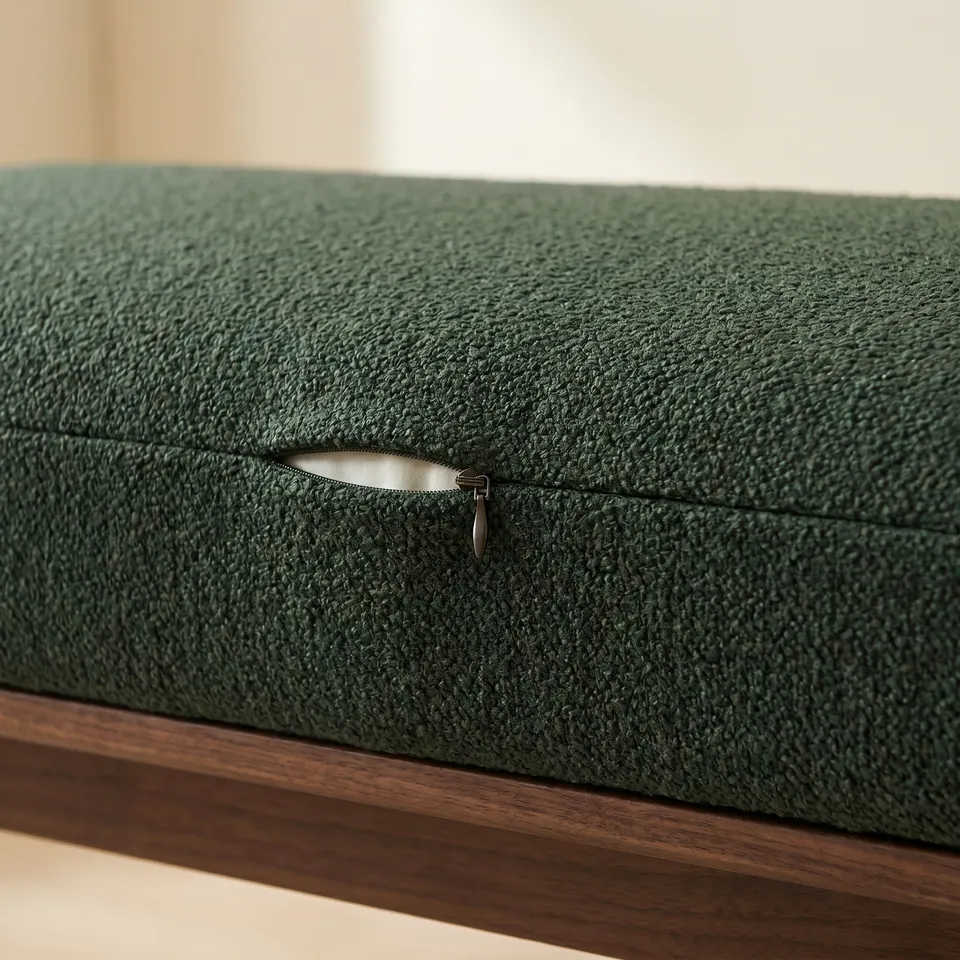
Cover fabric. A removable, zippered cover. Machine wash at 86°F (30°C) on a gentle cycle and air dry.
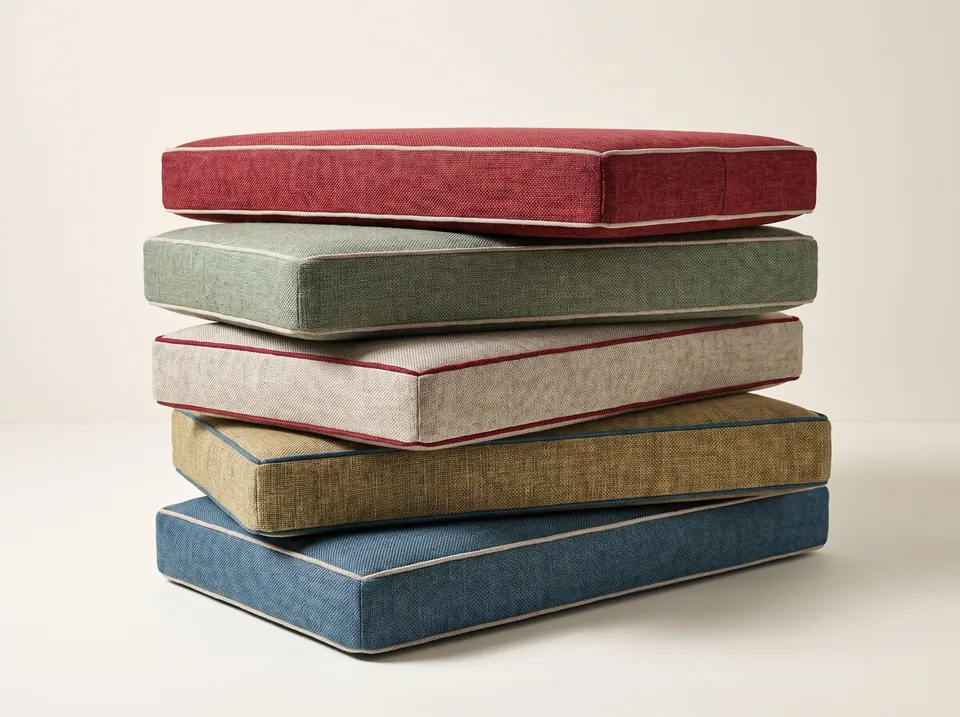
Piping. A fabric-covered cord sewn into the seams. It sits on the seam line, so it does not change the size.
Fiber wrap. Polyester fiber (Dacron) batting around the foam: it fills the cover out and softens the edges.
Foam core. About 2.0 lb/ft³ (32 kg/m³) high-resilience foam, firm to medium-firm, cut to the ordered size.
Zipper. Along the back band, as hidden as possible. The zipper side faces down or toward the wall.
Base panel. The underside of the cover. A non-slip fabric backing can cover the whole of it instead.
Pinned by Élodie: five points across the teal and brown bed
Five pins read the bed from the lumbar at the front back to the painted headboard, the way the afternoon light crosses it.
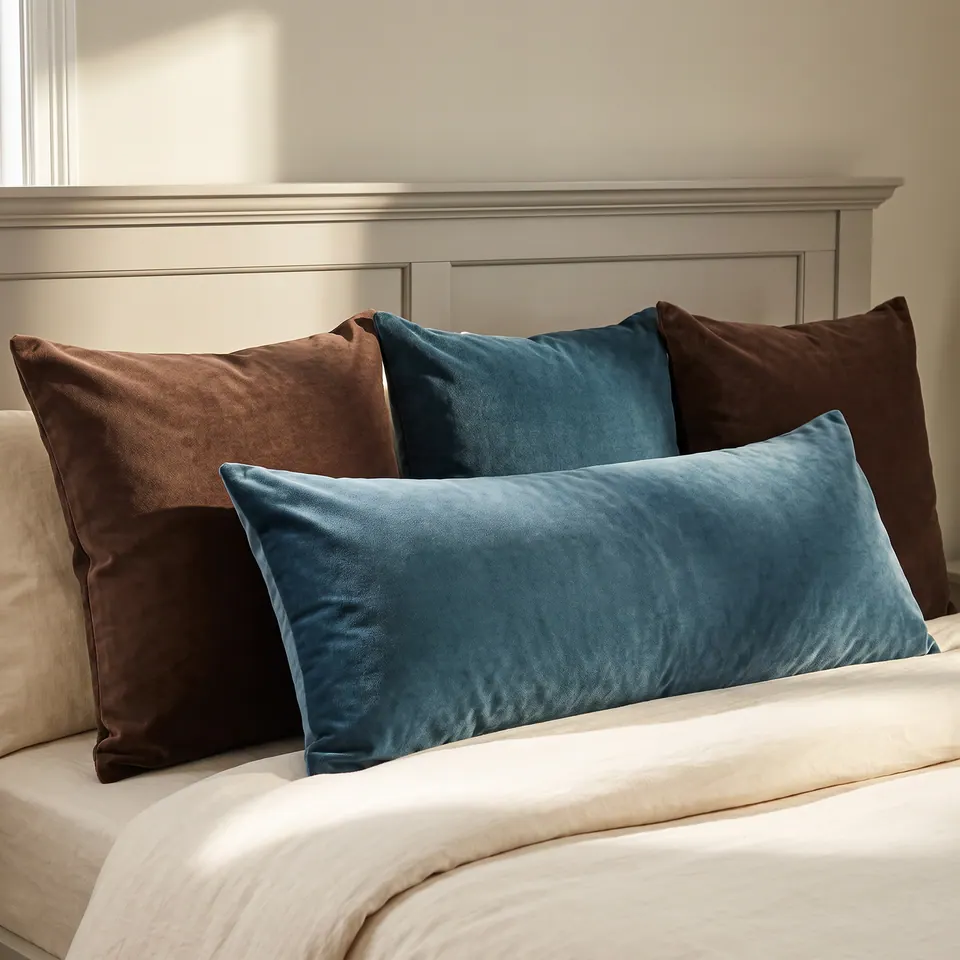
- Steel teal lumbar
The lighter teal pulls forward against the dark brown behind it.
- Teal square
The teal square forms a cool center column between two browns.
- Chocolate brown sham
Brown on the outside works like a dark wooden frame around the teal.
- Brown sham right
Matching brown on both sides keeps the stack balanced.
- Greige panel headboard
A painted neutral lets two strong colors sit together without a wood tone competing.
- Steel teal lumbarThe lighter teal pulls forward against the dark brown behind it.
- Teal squareThe teal square forms a cool center column between two browns.
- Chocolate brown shamBrown on the outside works like a dark wooden frame around the teal.
- Brown sham rightMatching brown on both sides keeps the stack balanced.
- Greige panel headboardA painted neutral lets two strong colors sit together without a wood tone competing.
Anatomy of a knife edge in velvet
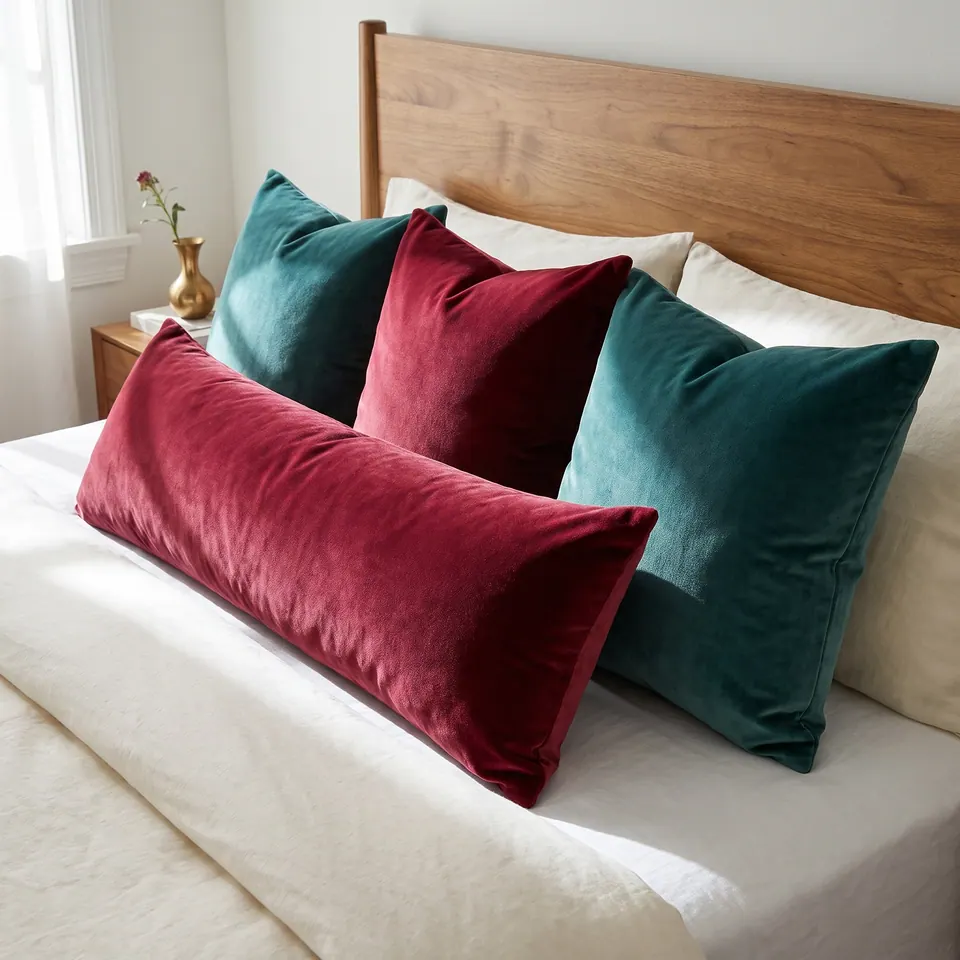
Steel teal is a hard color to name, my friends: a blue-green with gray folded into it, like a pond under a cloudy sky. On this lumbar pillow it steps forward from the chocolate brown shams because it is lighter, not because it is brighter.
Now the cut. This is a knife edge: two panels of velvet sewn face to face around the rim, with no side panel between them. The pillow is full in the middle and thins to a line at the edge. On a bed that shape helps, because the rim tucks against the sham behind it and the lumbar leans instead of standing like a brick. Our Pattern on box edge vs knife edge draws both profiles side by side.
There is no piping, and the velvet is why that works. The pile rolls over the seam and blurs it, so the edge reads as a shadow rather than a stitched line. On a flat linen the same seam looks plainer, and there a self or contrast welt earns its place.
The shams follow the same logic at a larger size. Chocolate brown on both sides does the job a wooden headboard would, framing a cool center column of teal square and teal lumbar. Let one color speak and the others listen: the teal speaks, the brown and the greige painted panel listen.
The cream linen duvet is the rest note, matte under all that sheen. In slanting afternoon light the velvet slides from teal toward slate along the curve of the lumbar, and the flat linen keeps the shimmer from looking restless. The velvet swatches and our notes on matching throw pillows and lumbar pillows take the pairing further.
Knife, box, rounded or angled: which edge for which piece
| Edge | How it is built | Where it looks right |
|---|---|---|
| Knife edge | Two panels seamed at the rim, no side panel; full center, thin edge | Lumbar and throw pillows, shams, anything that leans |
| Box edge | A side panel between top and bottom; the same depth corner to corner | Seats, bench and window seat cushions, mattress covers |
| Rounded corners | Box or knife edge with the corners cut on a curve | Softer looks, and frames with curved ends |
| Angled corners | Corners cut to follow a slanted frame or wall | Bay seats, trapezoids and tapered benches |
Two mattresses, one brown floor sofa
A buyer wrote in with two single mattresses, each 31 1/2 x 78 3/4 in (80 x 200 cm), and a plan: turn them into a floor sofa. They wanted corduroy covers 7 7/8 in (20 cm) deep and two L-shaped foam back pillows. The shop quoted the whole set at one all-included price, and the buyer chose dark brown corduroy, COR 203.
Notice the edge that project needed. A mattress cover is the opposite of this lumbar: a deep side panel, the same depth everywhere, corners that hold their shape. The brown family that frames the teal on this bed became the entire sofa in that room.
They also asked about metal backrest bars, and the workshop was plain about them: the bars have no grips and are not strapped to the sofa. Better to know that before ordering than after. Our notes on floor sofa replacement covers cover the rest of that kind of build.
So which does your room need, a pillow that leans or a cushion that holds its depth?
Buyer questions: extra cloth, a zipper cover and tufting
- A common question
Can I buy some extra fabric to match my order?
The workshop's answerYes. The fabric comes on a roll about 78 3/4 in (2 m) wide, so a piece of roughly 86 1/2 x 78 3/4 in (220 x 200 cm) can be cut for you alongside the cushions.
- A common question
I already have the insert. Can you make just a removable 23 5/8 x 23 5/8 in (60 x 60 cm) cover with a zipper?
The workshop's answerYes. Square zippered covers of about 22 to 23 5/8 in (56 to 60 cm) are made singly, and a pair costs less per cover. A removable cover without a zipper isn't offered, and a pillow cover has no side depth the way a mattress cover does.
- A common question
If I send my own filling, can you tuft the cover?
The workshop's answerNo. Tufting is only done when the workshop makes the filling too, so a cover-only bolster is made round and plain. Piping can be added instead.
On the cutting table: the teal and brown bed
| Product | Velvet lumbar pillow with a matching square and two euro shams |
|---|---|
| Fabric | Velvet, codes 129 and 110 |
| Colors | Steel teal; chocolate brown |
| Edge | Knife edge on every piece |
| Piping | None; the pile softens the seam |
| Headboard | Greige painted panel |
| Bedding | Cream linen duvet |
| Style | Mid-century, traditional |
| Best for | A painted or upholstered bed that needs a wood-toned frame |

Have it made
Have this made — ask Élodie’s workshop
A fabric reads one way at noon and another at dusk. Mention your light, and the workshop will weigh it with you. — Élodie
Leave your details and the workshop will call you to confirm measurements, fabric, foam and piping. No prices, dates or payment on this page: it is a request, not an order.
A knife-edge lumbar pillow in velvet needs no piping: the pile rolls over the seam and turns the edge into a shadow instead of a stitched line.
Élodie
Questions buyers ask next
Should a lumbar pillow be lighter or darker than the shams behind it?
Lighter, on most beds. A paler color steps forward, so a steel teal lumbar reads clearly against chocolate brown shams. When the lumbar is darker than what sits behind it, it tends to sink into the stack and disappear.
Does velvet show the seam on a knife-edge pillow?
Very little. The pile leans over the seam line and blurs it, so an unpiped velvet pillow looks soft at the rim. Flat weaves show the seam more plainly, and that is where self or contrast piping helps define the edge.
Can box-edge covers and knife-edge pillows be cut from the same velvet?
Yes. The edge changes the profile, not the cloth. A deep box cover and a slim knife-edge pillow in the same velvet read as one set because color and sheen match, even though one holds its depth and the other leans.
With color and care — Élodie