 Save
A Reading by NateBay Window Cushions
A caramel bouclé bay window cushion, and how a small bay seat reads bigger
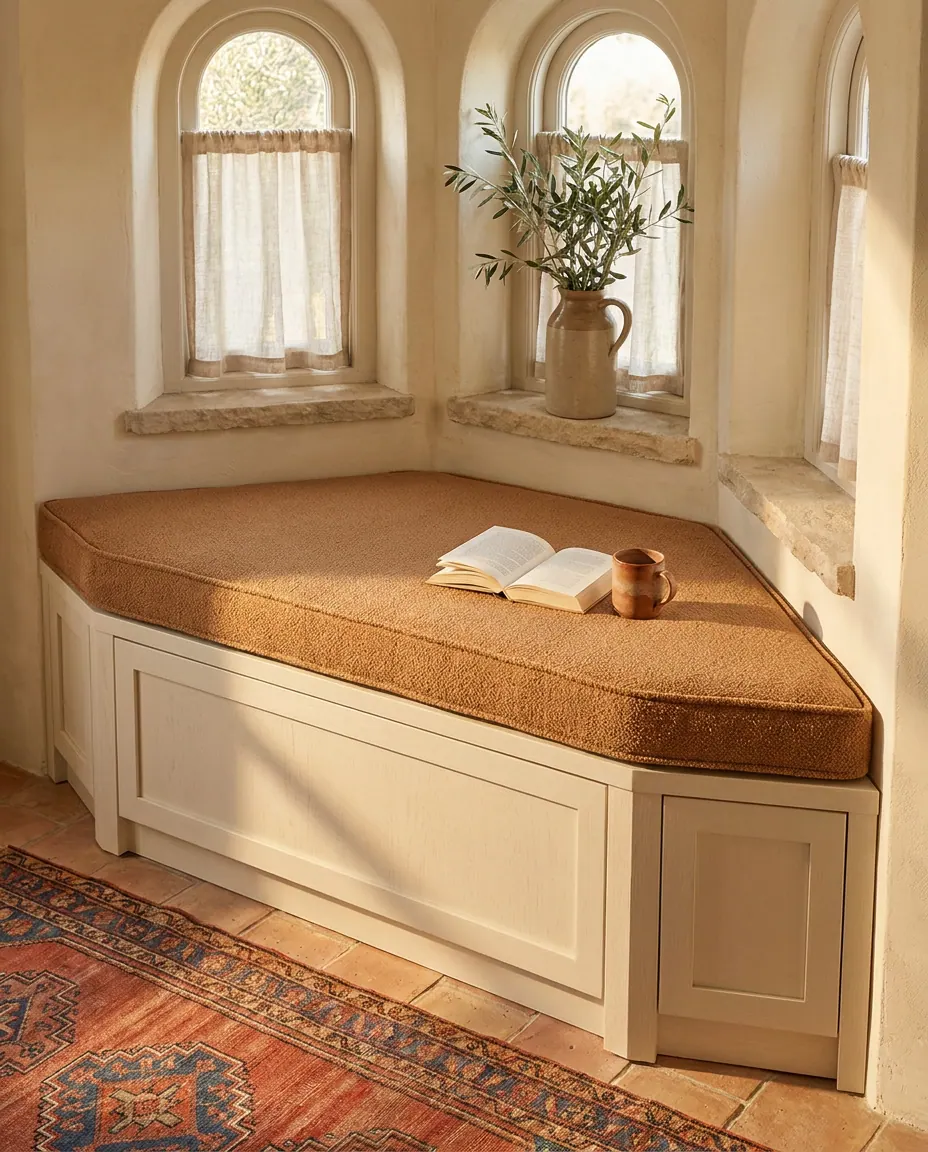
Nate reads a trapezoid of caramel bouclé under three arched windows in late sun, and runs the numbers on making a tight bay feel like a room of its own.
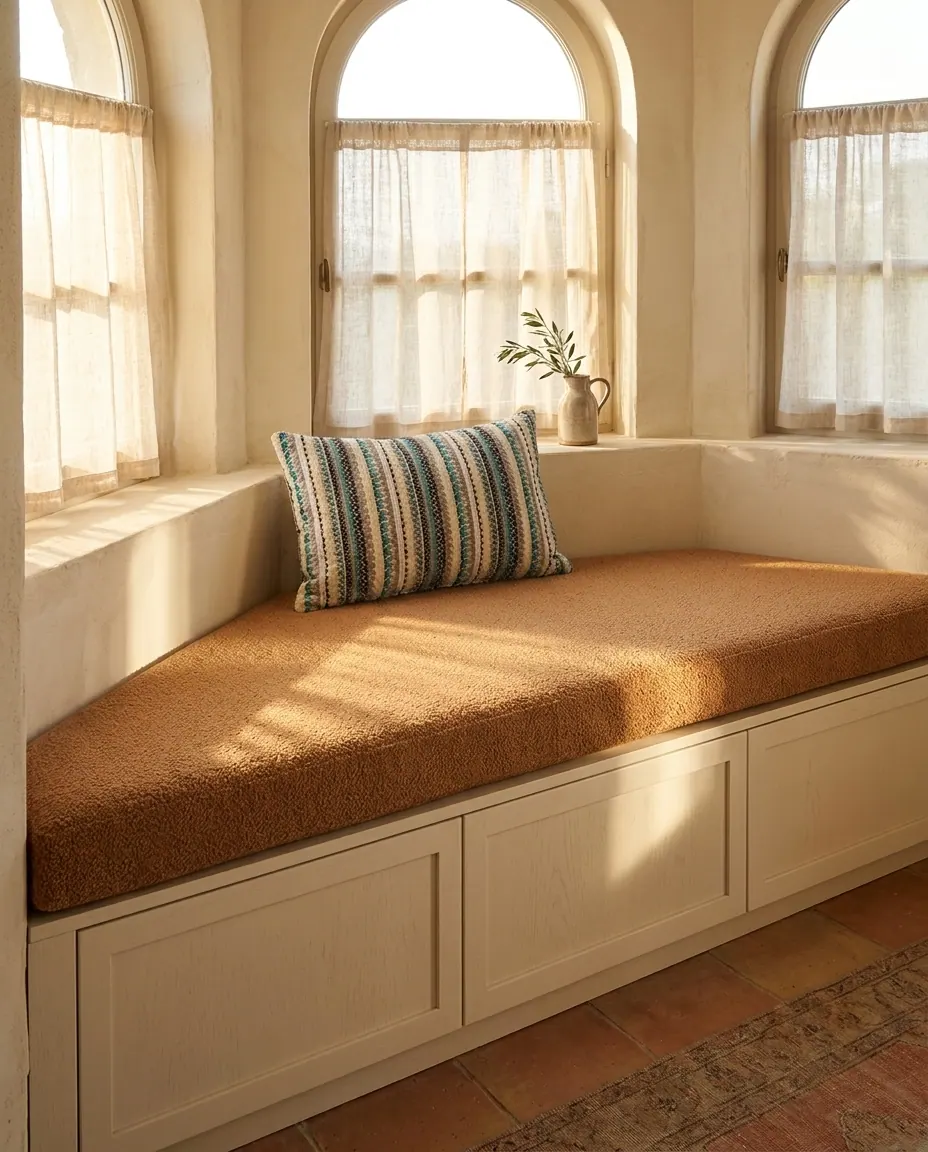
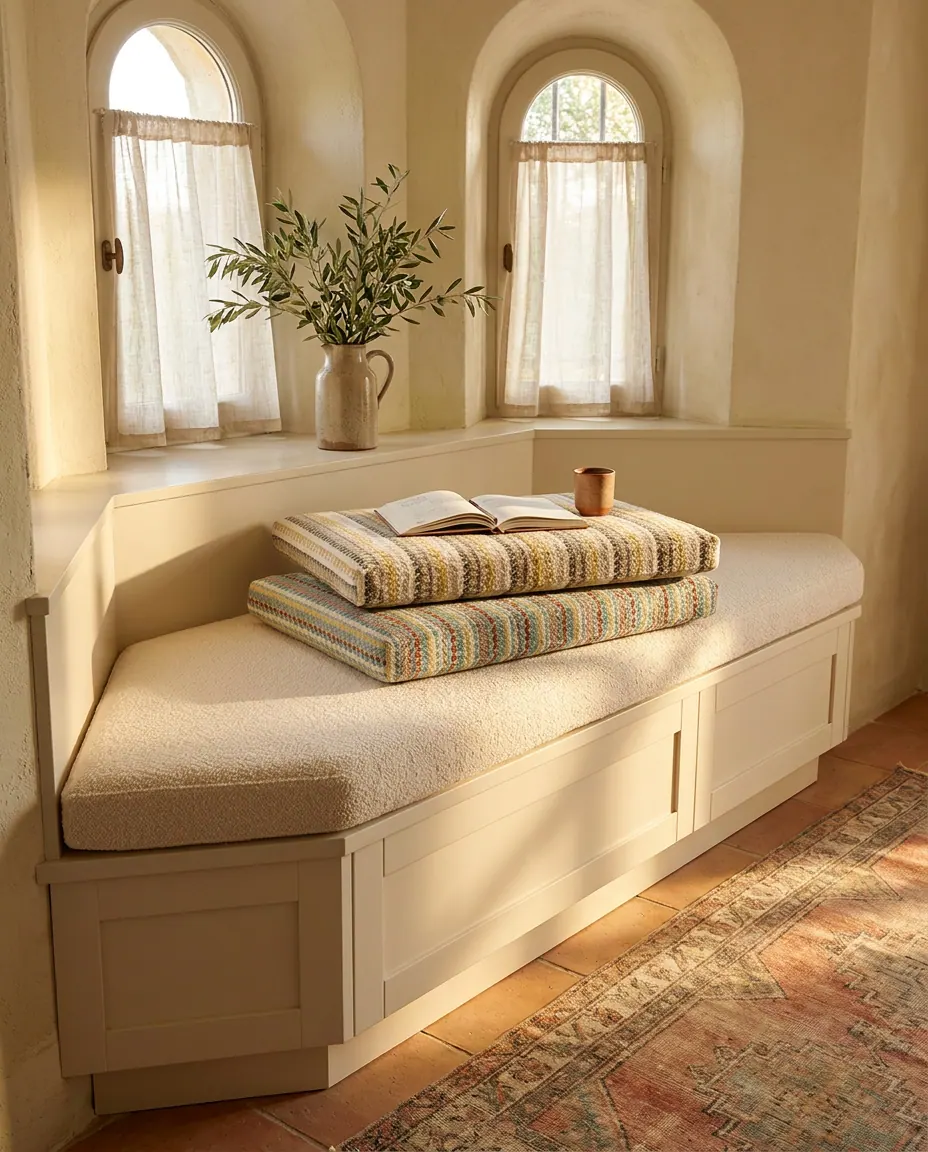
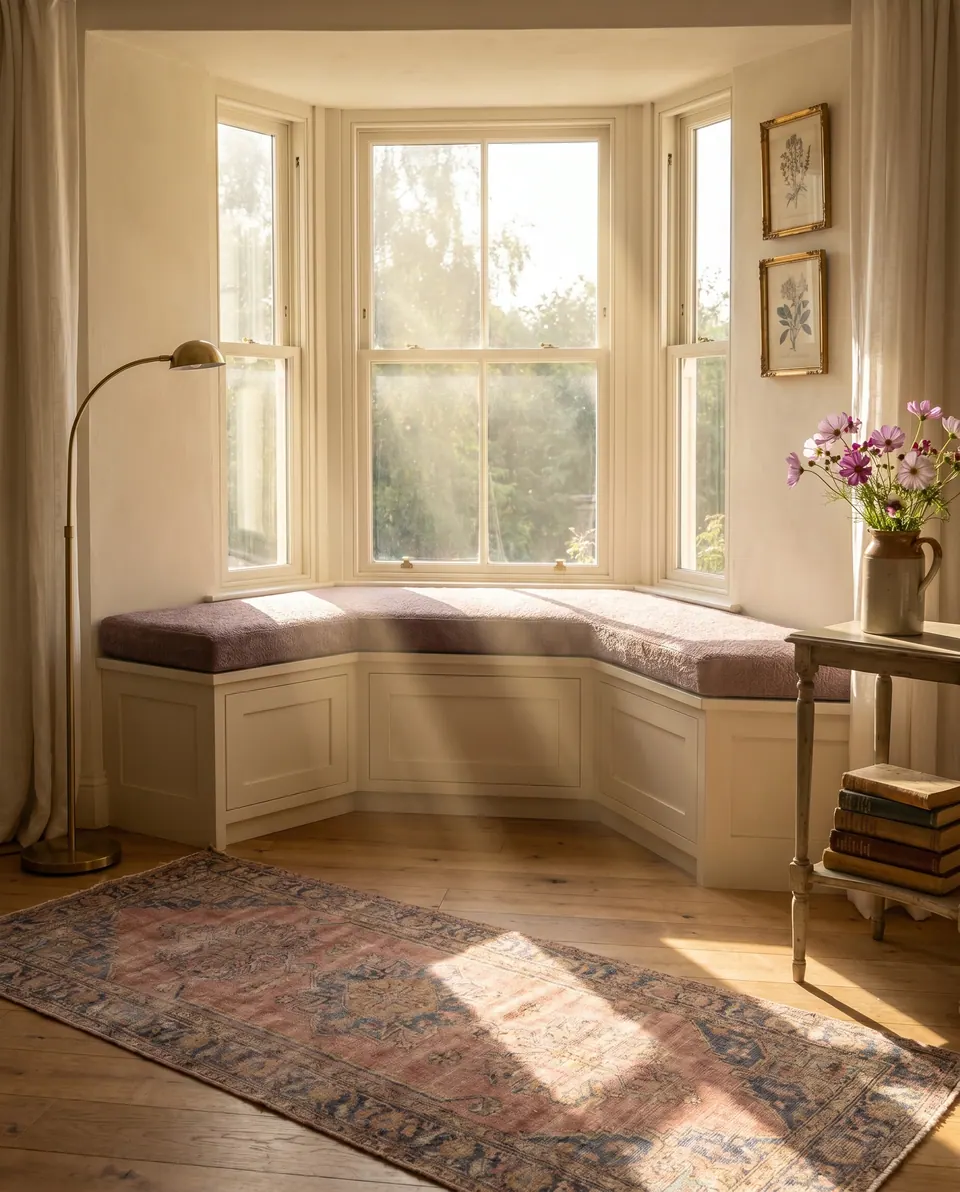
The same angled bay idea with tonal piping: softer edges that let the arches and stone sills do the talking.

The quick answer
A bay window cushion makes a small bay feel generous when it fills the seat wall to wall, wears tonal piping so the edge doesn't chop up the space, and stays at a moderate thickness: 4 in (10 cm) looks plush, while 5 in (13 cm) can look heavy. Measure every edge plus the square front-to-back depth before you order.
Three arches, one trapezoid and no extra lines
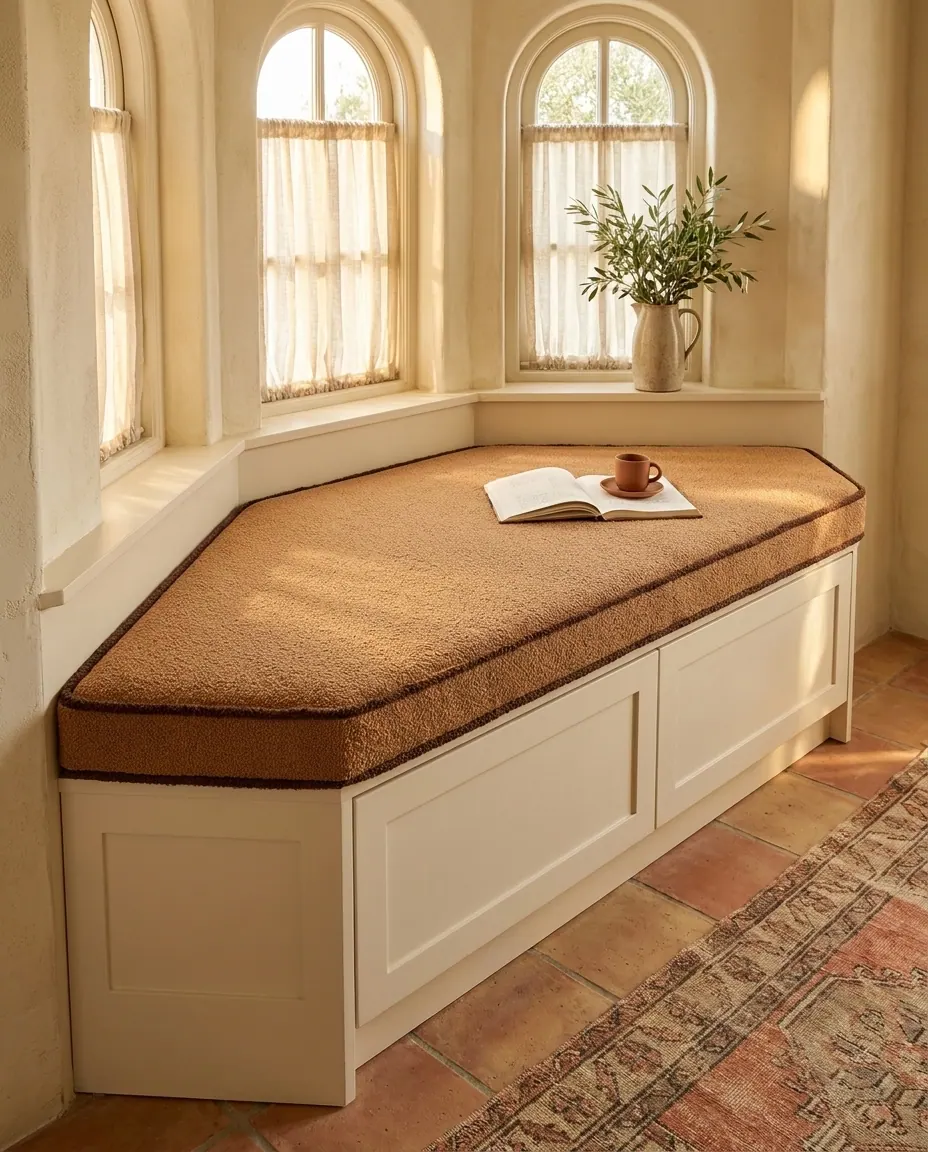
Late sun comes through three arched windows and lands on a caramel bouclé cushion. The seat is a trapezoid: its right end is cut back on the angle of the bay's side wall, so the pad follows the architecture instead of stopping short of it. That full fit is the first reason this small bay looks bigger than it is.
The second reason is the piping. It is tonal, caramel cord on caramel cloth, so the outline is traced softly instead of drawn in ink. A contrast welt would put a hard perimeter around a small seat, and every hard line in a tight space subtracts from its apparent size. Here the arches and the limestone sills lead.
Color follows the same rule. Golden-hour light pushes the caramel toward gold. A terracotta mug on the open book matches the tile floor, tying seat to floor. Olive branches in a cream jug on the sill give the one cool note. The red and blue rug carries all the pattern at floor level, so the cushion can stay plain. Linen café curtains soften the glass without hiding the arches, and a cream paneled cabinet below the seat keeps the base as light as the walls.
Angles are just lengths in disguise, partner. Get them right and a narrow spot stops feeling narrow. More shapes wait in the bay window cushion atlas, and the looped cloth sits on the bouclé and teddy shelf.
Pinned by Nate
Start at the angled right end where the cushion meets the side wall, then follow the pins across the tonal edge to the mug, the olives and the rug.
- Angled right end
The right end is cut back on the angle of the bay's side wall.
- Book and terracotta mug
The mug is the same clay color as the tiles, tying seat to floor.
- Olive jug on sill
Olive greens give the warm bay its one cool note.
- Tonal self piping
Caramel-on-caramel piping outlines the trapezoid softly, letting the arches lead.
- Red and blue rug
A patterned rug adds color at floor level so the cushion can stay plain.
- Angled right endThe right end is cut back on the angle of the bay's side wall.
- Book and terracotta mugThe mug is the same clay color as the tiles, tying seat to floor.
- Olive jug on sillOlive greens give the warm bay its one cool note.
- Tonal self pipingCaramel-on-caramel piping outlines the trapezoid softly, letting the arches lead.
- Red and blue rugA patterned rug adds color at floor level so the cushion can stay plain.
Small-bay numbers: what makes a tight seat read generous
| Choice | Reads smaller | Reads generous |
|---|---|---|
| Fit | Rectangle stopping short of the angled walls | Trapezoid cut to the side-wall angle |
| Piping | Contrast welt drawing a hard outline | Tonal or self piping in the cushion's own color |
| Thickness | 5 in (13 cm) on a modest seat can look heavy | 4 in (10 cm) looks plush without bulk |
| Pattern | Busy print on the cushion | Plain cushion, pattern kept on the rug |
A hand sketch with every number but one
A buyer wrote to the workshop with a hand sketch of a large bay seat: a 95 in (241 cm) front, a 61 in (155 cm) edge against the glass, 22 in (56 cm) angled sides and 10.5 in (27 cm) short edges at each end. Good numbers. One was missing.
The shop redrew the sketch as a clean diagram and spotted the gap: no front-to-back depth. Working from the other edges, it estimated 24.5 in (62 cm). The buyer measured and came back with 27 in (69 cm), a 2.5 in (6 cm) difference that would have left the seat visibly short. They chose 3 in (7.5 cm) thick, the shop revised the drawing, and production began only once the buyer approved it.
Every angled cushion needs the square depth as well as the edges. The bay window calculator asks for it up front, and the 3-sided bay pattern shows where to hold the tape. How deep is your bay, measured square from the glass?
On the cutting table: the caramel bay seat
| Piece | Bay window cushion, trapezoid |
|---|---|
| Fabric | Caramel bouclé |
| Piping | Tonal, in the cushion's own color |
| Edge | Box |
| Angled end | Right end cut to the bay's side-wall angle |
| Bench foam | about 2 lb/ft³ (32 kg/m³), wrapped in polyester fiber |
| Thickness | 4 in (10 cm) for a plush look; 5 in (13 cm) can look heavy |
| Cover | Removable, zipper on the back |
| Best for | Reading nooks in bays with strong architecture |

Have it made
Have this made — ask Nate’s workshop
Send the numbers in inches: length × depth × thickness, plus any angle. The workshop checks them with you, because foam has no undo button. — Nate
Leave your details and the workshop will call you to confirm measurements, fabric, foam and piping. No prices, dates or payment on this page: it is a request, not an order.
Buyer questions: curves, covers and foam depth
- A common question
Can you make a curved cushion, and what's the best way to measure the curve?
The workshop's answerYes: curved, rounded-corner and asymmetrical cushions are all possible. For a drawing, measure total width, total depth, and the depth at the shallowest and deepest points of the curve, sketch it with the numbers and send a photo. For tricky curves the shop recommends a template: trace the seat onto wrapping paper or newspaper, cut it out and photograph it flat beside a tape measure.
- A common question
Will the cover come off so I can wash it?
The workshop's answerYes. The cover comes off completely and can be washed, with the zipper on the back of the cushion.
- A common question
For a softer, sofa-like bench cushion, should I choose 4 or 5 inch foam?
The workshop's answerThey feel the same. Both use 32-density foam (about 2 lb/ft³), firm enough for a timber bench and wrapped in polyester fiber for a plusher surface. Only the look differs: on a 25.5 x 71 in (65 x 180 cm) bench, 4 in gives the plush, sofa-like appearance and 5 in can look heavy. Tufted cushions use a softer filling, but firm foam is more practical on timber.
On a small bay window seat, tonal piping traces the trapezoid in the cushion's own color, so the edge stays soft and the arches get to lead.
Nate
Questions buyers ask next
Tonal or contrast piping on a bay window seat with arches?
Tonal. When a bay already has strong architecture, such as arches, stone sills or paneling, tonal piping outlines the cushion softly and lets the room lead. Contrast piping suits a plain bay that needs a crisp edge to hold the eye.
Does caramel bouclé change color in late afternoon sun?
It warms noticeably. The looped surface catches low sun on every curl, so caramel reads close to gold at golden hour and browner at midday. Check a swatch on the seat at both times before you commit.
Why can't a multi-sided bay cushion be cut from edge lengths alone?
Because on a bay with five or more edges the angles can vary while the edge lengths stay the same. The square front-to-back depth pins the shape down. One bay seat was estimated at 24.5 in deep; the true depth was 27 in (69 cm).
Is a thinner cushion better for a small window seat?
Often, for the look. One large bay was made 3 in (7.5 cm) thick; 4 in (10 cm) looks plush and 5 in (13 cm) can look heavy on a smaller seat. Feel comes from the foam, and the same foam is used at 4 and 5 in.
± 1/4 in — Nate