A Reading by NateBay Window Cushions
A curved tiger-stripe bay window cushion, and the message that gets a bay right the first time
Nate reads a half-moon seat under three arched windows, then shows the drawing, codes and checks that turn a bay order into one cushion instead of two.

 Save
The quick answer
To order a bay window cushion right the first time, send every measurement on one labeled drawing, including straight ends and each slanted side, plus the exact fabric code. Then check that the numbers close into a shape: a bay with 90 in and 52 in parallel sides, 27 in depth and 6 in straight ends needs slants of about 28 in.
The five-line bay order
Draw the shape once
One sketch, every side labeled in inches: the long edge, the short edge, the depth, any straight ends and each slant. Mark which edge sits against the windows.
Check the slants with math
Work each slant out from the other numbers. If your tape and the arithmetic disagree by several inches, one measurement is wrong.
Name the corners in words
Square, pointed or rounded? Say it. A first bay cushion once arrived with pointed ends where square ones were wanted.
Quote the fabric code
Write the code exactly, K-8 and not the caramel one, and compare colors in daylight rather than on a screen.
Approve a drawing
Ask for the workshop's drawing and approve it before cutting starts. That is where extra cuts in a window frame get caught.
Pinned by Nate: the arc and its supports
Five pins around the bay, from the templated front gusset to the tall plant that balances the brass table.
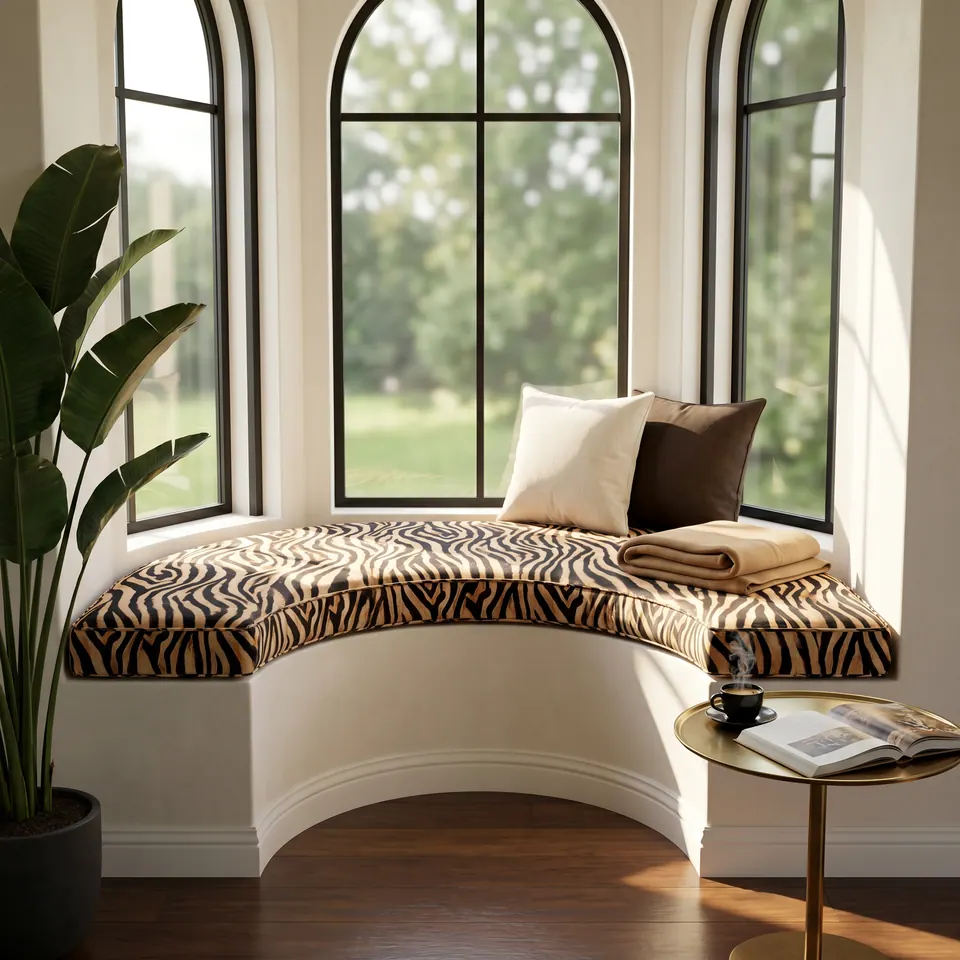
- Curved front gusset
Cut from a template, the boxed edge follows the arc so the stripes wrap without breaking.
- Cream pillow
A solid cream pulls the lightest tone out of the tiger stripe.
- Camel throw
Folded, not draped, so the curve of the cushion stays visible.
- Brass side table
Gives height at the end so the low seat is not lost under tall arches.
- Bird of paradise
A tall plant balances the brass table on the other side of the bay.
- Curved front gussetCut from a template, the boxed edge follows the arc so the stripes wrap without breaking.
- Cream pillowA solid cream pulls the lightest tone out of the tiger stripe.
- Camel throwFolded, not draped, so the curve of the cushion stays visible.
- Brass side tableGives height at the end so the low seat is not lost under tall arches.
- Bird of paradiseA tall plant balances the brass table on the other side of the bay.
Reading the half-moon
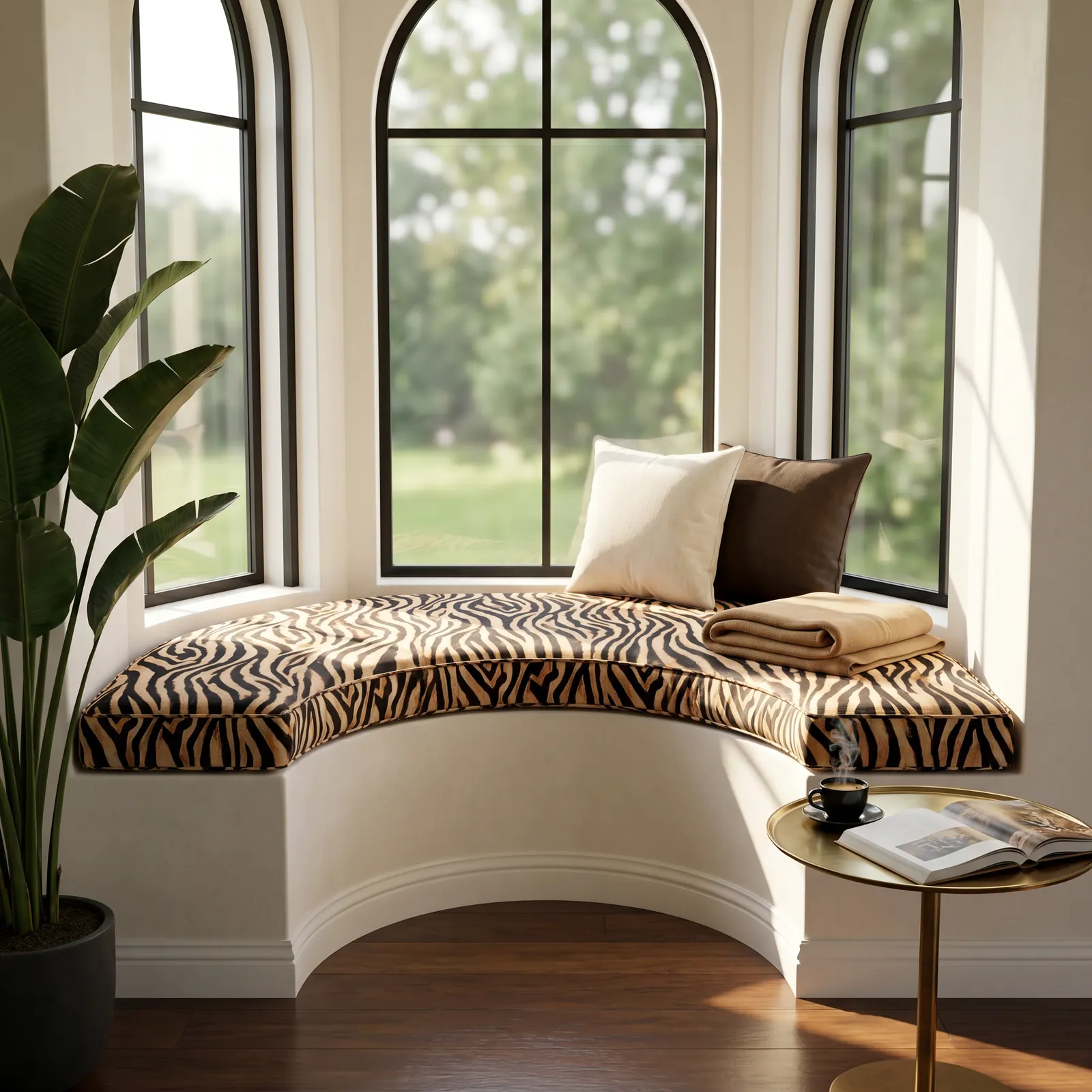
Partner, a curved bay is the one shape nobody should measure with a straight tape alone. This cushion was cut from a template, and you can see it in the front gusset: the boxed edge follows the arc, so the stripes wrap the curve without breaking.
The fabric is a tiger stripe in caramel, black, cream and chocolate brown, self-piped so the outline stays in the print's own colors. A graphic print wants plain support, and it gets it. A cream linen pillow pulls out the lightest tone and a chocolate brown pillow the darkest. The camel throw is folded, not draped, so the curve of the cushion stays visible.
Low sun through three arched, black-framed windows warms the caramel, and the white plaster walls keep all that stripe from getting heavy. Tall arches make a low seat look small, so height goes at each end: a round brass side table on one side, a bird of paradise in a black pot on the other. The espresso cup and open magazine tell you the seat gets used. The dark walnut floor anchors the curve.
For the math of arcs, see the Pattern on chord, rise and radius, how to make a paper template, and the bay window calculator. More seats like this sit among our bay window cushions.
The bay that taught the drawing step
A buyer in the US received a first bay cushion that was too long, too narrow and had pointed ends where square ones belonged. The workshop redrew the sketch: bottom 90 in (229 cm), top 52 in (132 cm), depth 27 in (69 cm), 6 in (15 cm) straight ends, 4 in (10 cm) thick, fabric K-8.
Then the check. The buyer's notes gave the slanted sides as 24 in (61 cm). The other numbers won't allow it:
- Half the difference of the long sides: (90 − 52) ÷ 2 = 19 in
- Depth left after the straight ends: 27 − 6 = 21 in
- Slant: √(19² + 21²) ≈ 28.3 in (72 cm)
So about 28 in, not 24. The buyer then found two extra cuts in the window and sent a new diagram, which the shop turned into a drawing for approval. The workshop remade the cushion free as goodwill; the buyer paid the shipping and kept the first one. The second fit perfectly. If your numbers can't close into a shape, one of them is wrong.
Measurement table: the curved bay seat
| Cushion | Curved half-moon bay window cushion, cut from a template |
|---|---|
| Edge | Box, with a curved front gusset |
| Fabric | Tiger-stripe print in caramel, black, cream and chocolate |
| Piping | Self piping |
| Pillows and throw | Cream linen, chocolate brown, folded camel throw |
| Height at the ends | Round brass side table, bird of paradise |
| Order checklist | One labeled drawing, fabric code, corner style, approved drawing |
| Best for | Round or bow bays under tall windows |

Have it made
Have this made — ask Nate’s workshop
Send the numbers in inches: length × depth × thickness, plus any angle. The workshop checks them with you, because foam has no undo button. — Nate
Leave your details and the workshop will call you to confirm measurements, fabric, foam and piping. No prices, dates or payment on this page: it is a request, not an order.
Buyer questions: carts, headboards and daily sitting
- A common question
I need cushions in several different sizes. How do I pay for them all in one order?
The workshop's answerAdd each size option to your cart separately, for example 18 x 18 in and 20 x 63 in (46 x 46 and 51 x 160 cm), and check out once, or ask for a single custom listing. If the payment only covers one cushion, the shop gets in touch before starting the others.
- A common question
Could a tufted cushion stand in as a soft headboard on a dorm bed?
The workshop's answerYes. A linen cushion 30 in long, 24 in high and 4 to 5 in thick (76 x 61 x 10 to 13 cm) was made as a soft headboard and shipped straight to a college dorm.
- A common question
Will these cushions hold their shape on a kitchen bench that gets sat on all day?
The workshop's answerYes, the tufted cushions keep their shape under heavy daily use. A long bench can also have one single cushion, for example 90 x 24 in (229 x 61 cm), so separate pieces don't shift apart.
Before ordering a bay window cushion, check that the numbers close: a 90 by 52 in bay, 27 in deep with 6 in ends, needs slants near 28 in.
Nate
Questions buyers ask next
How do I measure a curved bay window seat?
Make a paper template of the seat and trace the curve rather than trying to capture an arc with a straight tape. A template lets the front gusset follow the bay exactly, so the cushion fits the curve instead of cutting across it.
What should I write in the order message for a bay window cushion?
One drawing with every side labeled in inches, the corner style in words (square, pointed or rounded), the exact fabric code and which edge sits against the windows. Then approve the workshop's drawing before cutting starts.
Does a bold print suit a bay window cushion?
Yes, if the rest stays plain. Here a tiger stripe carries the bay while cream and chocolate pillows and a folded camel throw pull its colors out as solids, and a table and a tall plant give height at each end.
± 1/4 in — Nate